When Russia launched its illegal war of territorial aggression against Ukraine in 2022, many Russian units were shocked by how badly supplied and equipped they were, with Putin cronies supplying expired food and lots of spare parts and equipment seemingly stolen or sold off. Dictatorships lack checks and balances, and without them, corruption tends to become endemic.
Now news has come to light that the same thing appear to have happened in China.
US intelligence indicates that President Xi Jinping’s sweeping military purge came after it emerged that widespread corruption undermined his efforts to modernize the armed forces and raised questions about China’s ability to fight a war, according to people familiar with the assessments.
The corruption inside China’s Rocket Force and throughout the nation’s defense industrial base is so extensive that US officials now believe Xi is less likely to contemplate major military action in the coming years than would otherwise have been the case, according to the people, who asked not to be named discussing intelligence.
The US assessments cited several examples of the impact of graft, including missiles filled with water instead of fuel and vast fields of missile silos in western China with lids that don’t function in a way that would allow the missiles to launch effectively, one of the people said.
I’ve got to say, trying to get away with graft in your nation’s nuclear forces is a pretty bold move. On the other hand, if China ever tried to use them, there’s such a high chance all military leadership would be incinerated by America’s much better equipped and maintained nuclear forces, so maybe they figured they’d never be held to account.
The US assesses that corruption within the People’s Liberation Army has led to an erosion of confidence in its overall capabilities, particularly when it comes to the Rocket Force, and also set back some of Xi’s top modernization priorities, the people said. The graft probe has ensnared more than a dozen senior defense officials over the past six months, in what may be China’s largest crackdown on the country’s military in modern history.
One wonders what other areas of China’s military capabilities have been degraded thanks to corner-cutting and corruption. Looking at the rest of China: Maybe all of it?
All this leads me to a pretty on-point Habitual Linecrosser:
The front lines in Ukraine have been static for the last few months, with Russia grinding away in Avdiivka to little effect and Ukraine having failed to effect further advances. However, there are a few snippets of interest from the ongoing cyberwar, on both sides. I thought it worth taking a look at.
Over nearly a decade, the hacker group within Russia’s GRU military intelligence agency known as Sandworm has launched some of the most disruptive cyberattacks in history against Ukraine’s power grids, financial system, media, and government agencies. Signs now point to that same usual suspect being responsible for sabotaging a major mobile provider for the country, cutting off communications for millions and even temporarily sabotaging the air raid warning system in the capital of Kyiv.
On Tuesday, a cyberattack hit Kyivstar, one of Ukraine’s largest mobile and internet providers. The details of how that attack was carried out remain far from clear. But it “resulted in essential services of the company’s technology network being blocked,” according to a statement posted by Ukraine’s Computer Emergency Response Team, or CERT-UA.
Kyivstar’s CEO, Oleksandr Komarov, told Ukrainian national television on Tuesday, according to Reuters, that the hacking incident “significantly damaged [Kyivstar’s] infrastructure [and] limited access.”
“We could not counter it at the virtual level, so we shut down Kyivstar physically to limit the enemy’s access,” he continued. “War is also happening in cyberspace. Unfortunately, we have been hit as a result of this war.”
The Ukrainian government hasn’t yet publicly attributed the cyberattack to any known hacker group—nor have any cybersecurity companies or researchers. But on Tuesday, a Ukrainian official within its SSSCIP computer security agency, which oversees CERT-UA, pointed out in a message to reporters that a group known as Solntsepek had claimed credit for the attack in a Telegram post, and noted that the group has been linked to the notorious Sandworm unit of Russia’s GRU.
The pro-Ukrainian hacker group Blackjack is claiming that it breached a Moscow internet provider to seek revenge for a Russian cyberattack on Ukraine’s largest telecom company, Kyivstar.
The attack on M9com was carried out in cooperation with Ukraine’s security forces (SBU), said a source in Ukraine’s law enforcement agency who requested anonymity because he is not authorized to speak publicly about the incident.
There isn’t much information available about the attack, and the SBU’s role in the operation. Hackers said Monday on their Telegram channel that they will reveal more details soon. So far, the only confirmation of the incident they have provided includes screenshots of the allegedly hacked systems of the internet provider.
The group also published some of the data obtained during the hack on a darknet site accessible via the Tor browser.
The time frame of the attack on M9com is unclear, but as of the time of writing, the allegedly hacked website is up and running. There has been no mention of the operator’s shutdown in the Russian media or on its official website. The company has not replied to requests for comment.
This is not the first time Ukrainian civilian hackers have allegedly cooperated with security services to attack Russian organizations. In an incident publicized in October, two groups of pro-Ukrainian hackers and the SBU claimed to have breached Russia’s largest private bank, Alfa-Bank.
The Ukrainian government’s military intelligence service says it hacked the Russian Federal Taxation Service (FNS), wiping the agency’s database and backup copies.
Following this operation, carried out by cyber units within Ukraine’s Defence Intelligence, military intelligence officers breached Russia’s federal taxation service central servers and 2,300 regional servers across Russia and occupied Ukrainian territories.
The breach led to all compromised FTS servers being infected with malware, as well as the hacking of a Russian IT company that provides FNS with data center services.
The attack also reportedly resulted in the complete deletion of configuration files crucial for the functionality of Russia’s extensive taxation system, wiping out both the main database and its backup copies
As Ukraine’s Main Directorate of Intelligence (GUR) says, the repercussions of the cyberattack have been severe, causing a breakdown in communication between Moscow’s central office and the 2,300 territorial departments that also got hacked in the attack.
It has led to a virtual collapse of one of Russia’s vital governmental agencies with a significant loss of tax-related data, according to GUR, as well as tax data-related internet traffic across Russia falling into the hands of Ukraine’s military hackers, as The Record first reported.
If this is true, it will take quite some time to get tax collections up and running again. And the inability to collect taxes will severely hamper Russia’s ability to finance the war.
The Ukrainian hacker group Kiborg has made the entire client base of the Russian Alfa Bank publicly available.
Kiborg hackers, acting in collaboration with NLB hackers, gained access to the customer database in October 2023 and exposed information about 44,000 customers.
The database contains information on the names, dates of birth, phone numbers, cards and accounts of 38 million unique individuals and legal entities.
The Vazhnyye Istorii (Important Stories) website clarified that this includes over 24 million customer accounts and over 13 million more data on legal entities.
Both sides have struck cyberblows against the other, but Ukraine seems to have done more damage to Russia than vice-versa this week.
Three months in, reporting on the Israel-Hamas War has been notably poor, focused on playing up Israel-inflicted casualties and hyping the possibility of a wider two-front war with Hezbollah rather than concrete information on whether Israel is achieving military objectives or not.
So it would be easy to miss this announcement that “IDF says it has completed the ‘dismantling of Hamas’ military framework.'”
The Israel Defense Forces claimed on Sunday that it has “completed the dismantling of Hamas’ military framework” in the northern Gaza Strip, hitting hundreds of targets and taking out key leaders of the terrorist group.
In an assessment of the first three months of the war between Israel and Hamas, Rear Adm. Daniel Hagari, an IDF spokesperson, said Israeli forces have met their goals through airstrikes, ground operations and intelligence gathering in the primary objective of eliminating Hamas.
The Israel Defense Forces claimed on Sunday that it has “completed the dismantling of Hamas’ military framework” in the northern Gaza Strip, hitting hundreds of targets and taking out key leaders of the terrorist group.
In an assessment of the first three months of the war between Israel and Hamas, Rear Adm. Daniel Hagari, an IDF spokesperson, said Israeli forces have met their goals through airstrikes, ground operations and intelligence gathering in the primary objective of eliminating Hamas.
Among the Hamas commanders eliminated was Ahmad Randor, Hagari said, showing what he said was a photograph of Randor sitting with his command echelon in a bunker 40 meters, or about 131 feet, underground.
“We have completed the dismantling of Hamas’ military framework in the northern Gaza Strip and will continue to deepen the achievement, strengthening the barrier and the defense components along the security fence,” Hagari said.
The Israeli Defense Forces (IDF) announced on January 6 that it “dismantled” the 12 Hamas battalions in the northern Gaza Strip. IDF officials added that they have dismantled Hamas’ “military framework” in the northern Gaza Strip. An Israeli Army Radio defense correspondent reported on January 6 that Israeli forces no longer permanently operate in the entire area of the northern strip and have moved to the border with Israel. IDF spokesperson Rear Admiral Daniel Hagari said on January 6 that the IDF would focus on the central and southern parts of the Gaza Strip and strengthen defenses along the Israel-Gaza Strip border fence. These announcements are consistent with the IDF stating that it would establish a security buffer zone in the northern Gaza Strip in the third phase of its operations. This third phase also involved Israeli forces conducting raids against Hamas compounds, destroying tunnels, killing remaining fighters, seizing intelligence and military equipment. CTP-ISW assessed on December 22 that, in Hamas’ Northern Strip Brigade and Gaza City Brigade, three battalions are combat ineffective, eight are degraded, and one is combat effective.
ISW goes on to warn that Hamas has not been completely destroyed and will likely reconstitute itself. But that’s pretty much standard operating procedures for transnational jihadist terror organizations.
No one questioned the IDF’s ability to ability to dismantle Hamas. Israel has one of the most modern, disciplined, technically savvy and motivated armed forces in the world. (Having enemies who literally call for the complete extermination of the Jewish race is a powerful motivator.) Hamas, on the other hand, is a terrorist organization whose main skills seem to be raping and murdering civilians and building tunnels. The only question was whether the the feckless, Iran-dealing Biden Administration and it’s Obama foreign policy retreads would be able to pressure Israel into halting before the job was done. That appears not to be the case.
Another sign that IDF has succeeded is the distinct lack of apparent Hamas activity in Gaza.
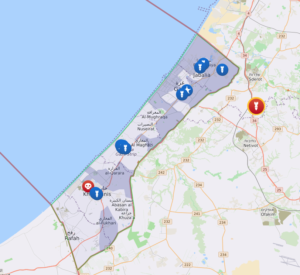
Today’s Livemap snapshot shows one rocket strike into Israel and one dead Al Jazerra journalist in Gaza. There’s precious little sign of any organized, robust Hamas military resistance left in Gaza.
Nor are there any signs of Hezbollah “opening up a second front.”
Though Hezbollah evidently launched rockets at an Israeli base this weekend, right now they’re only firing off the occasional mortar. Rockets and mortar attacks like this are just common terrorist pinpricks, and do not constitute anything like a “second front.” Meanwhile, Israeli planes are hitting Hezbollah positions with impunity.
What constitutes victory for the Israeli government? It took fourteen years after the end of Operation Cast Lead for Hamas to reconstitute itself. Assuming the Shia fundamentalist government remains in power in Iran (which in turn depends on how badly American Democratic Administrations want to prop it up), then maybe we can look forward to a similar period of relative peace on Israel’s southern front.
And presumably Israel won’t be caught asleep at the switch again the next time Hamas stages a big attack.
Happy New Year, everyone! The Biden Recession bites deeper, Israel dirtnaps a top terrorist, Harvard’s chief plagiarist finally steps down, and the crypto CEO who wasn’t there. It’s the Friday LinkSwarm!
The monthly nonfarm payrolls (from the Establishment Survey) may have been weak at 216K but the far more accurate Household Survey showed that the number of Employed workers actually collapsed by an unprecedented 683K, the biggest drop since the US economy was shutdown by covid!
Even scarier, while the monthly grind higher in the payrolls number (pulled from the far less accurate Establishment Survey) means that US jobs hit a record high every month with bizarre consistency and in December this was certainly the case, the total nonfarm employment number rose to an all time high 157.232 million, the abovementioned collapse in US Employment (per Household survey) meant that there were only 161.183 million employed people in the US, the lowest since June, with the now traditional divergence between these two surveys glaringly obvious.
A senior Hamas leader was killed Tuesday in a drone strike in Beirut, Lebanon, during a meeting between Palestinian factions at a Hamas office.
Saleh al-Arouri, deputy chairman of Hamas’s political bureau and commander of the terror group’s military wing in the West Bank, and at least five others died from the explosion, which occurred near Hezbollah’s headquarters in Beirut, Lebanese state media reported. Several more were injured. Following the blast, Hamas blamed Israel for the “Zionist raid” amid its ongoing war with the Jewish state. Israel has not claimed responsibility for the strike.
Many Israeli officials declined to comment. However, Israeli finance minister Bezalel Smotrich posted a statement on X shortly after the attack: “Surely your enemies will perish, O Israel.”
In November, Israeli prime minister Benjamin Netanyahu indicated he ordered the nation’s Mossad spy agency to eliminate Hamas leaders around the world after the militant group’s coordinated October 7 attack. Netanyahu’s office also declined to comment about the explosion.
Al-Arouri, whom Hamas described as “one of the architects” of the terror attack on Israel, had close ties with Yahwa Sinwar, the group’s leader in Gaza. Al-Arouri is the most senior Hamas leader to have been killed since the war began in early October.
A good chunk of the Epstein files have finally been released. Some revelations: Bill Clinton “likes them young” and Donald Trump didn’t have sex with at least one girl who was asked under oath about it.
Harvard President Claudine Gay finally does the right thing and resigns in wake of burgeoning plagiarism scandal.
A three act farce: Act 1: “Ohio governor Mike DeWine (R.) on Friday vetoed a bill that would have banned both transgender procedures for minors and trans student-athlete participation in school sports in the state.” Act 2: Turns out DeWine has taken taken over $40,000 in donations from pro-child-genital-mutilation hospitals. Act 3: “Republican Ohio governor Mike DeWine issued an “emergency” executive order Friday banning child gender-transition surgeries after receiving intense backlash last week for vetoing a bill with a broader but similar mandate.” Ohio’s Republican legislature can and should override DeWine’s foolish veto.
Robert F. Kennedy, jr. qualifies for the presidential ballot in Utah.
Last month, American Values 2024, a super PAC supporting the third-party candidate, announced a plan to spend nearly $15 million to get Kennedy on the ballot in ten states: Arizona, California, Colorado, Georgia, Illinois, Indiana, Michigan, Nevada, New York and Texas. All are important to winning the 2024 race.
I don’t see RFK Jr. doing even as well in Utah as Egg McMuffin did in 2016, and of the other states, only Arizona, Colorado, Michigan and Nevada might have any effect on the election, all four of which went (however fraudulently) for Biden in 2020.
Ricky Gervais has a great idea: He and Dave Chappelle should co-host the Oscars. That would indeed be a smash ratings success, and I would watch the Oscars for the first time this century.
This is the only way for us to live in peace,” said Texas Governor Greg Abbot. “The citizens of Austin have been at war with the people of Texas for many years now, and to end the bloodshed for future generations, we are willing to recognize Austin as its own separate and sovereign land.”
The resolution brought much-needed relief to the war-torn area, where battle lines had been drawn along the border of Austin. “The weirdo hipsters of Austin can stand down now,” said Texas Senator Ted Cruz in a statement acknowledging the resolution. “The people of Austin can now stop patrolling the perimeter of the city in armored tanks and go back to driving electric vehicles, painting strange murals nobody understands, and hating everything the United States stands for.”
It looks like there was a running gunbattle between the Mexican National Guard and the Sinaloa drug cartel in Sonoyta, Sonora, just south of Lukeville, Arizona on the U.S. border, on December 29. There’s a dearth of news stories on the event, so here are two video compilations (with a little overlap) of the fighting.
This was likely the battle that occurred in Sonoyta, Sonora between the Mexican Army/National Guard against gunmen (unknown exactly what group) as was reported yesterday. https://t.co/hAd0XQnhWgpic.twitter.com/zOwwUMUfws
I haven’t seen any news reports of this in American media, possibly because they think their primary goal is to avoid reporting anything on the border that the Biden Administration’s “pro illegal alien invasion” policies make them look bad with voters.
Indeed, there was a gun battle at a different crossing point earlier this month.
A federal law-enforcement source shared with FOX Business Network an internal officer safety alert dated December 13th that warns CBP agents to be vigilant after the Mexican military seized 10 improvised explosive devices (IEDs) at the border.
The IEDs were found by Mexican authorities after Tucson border patrol observed gunshots at the U.S.-Mexico border and a Tucson supervisory border patrol agent arrested an armed person on the U.S. side who had a loaded AK-47 rifle, two loaded AK magazines, loose rounds and a handgun.
Add “border danger” to “budget deficits” in the category of Things That Could Blow Up At Any Moment Our Chattering Classes Refuse To Talk About.
Congratulations, you’ve made it to the end of 2023! Iranian proxies get pounded, NGO’s help destroy the border, Democrats keep trying to remove Trump from the ballot, and thieves get a taste of their own medicine. It’s the Friday LinkSwarm!
Not only is the Obama/Biden administration undermining American sovereignty and the rule of law by allowing a massive influx of illegal aliens, but a wide variety of NGOs, some “none political,” are also involved.
A network of NGOs, or non-governmental organizations, seems to be playing a powerful role in coordinating the large-scale invasion of illegals at the US southern border.
The new website Muckraker revealed a treasure trove of “mass migration blueprints,” handed out by NGOs across South and Central America to illegals with details about their route to the US.
“The collapse of the US southern border is the result of a carefully planned and deliberately executed industrial mass migration program,” Muckraker said.
MAP #1 – Distributed by Doctors Without Borders (Médicos Sin Fronteras in Spanish).
They seem to be taking that “Without Borders” part way too literally.
What’s becoming increasingly evident is that a network of NGOs funded partly by the US taxpayer but by other countries and corporations are covertly facilitating the invasion of illegals at the US southern border, as well as distributing them across the US into progressive metro areas.
According to an August report by progressive left-leaning media watchdog organization Fairness & Accuracy In Reporting, President Biden’s Department of Homeland Security allocated $363 million to NGOs to assist illegal aliens once in the US.
Texas Governor Greg Abbott released a press release one year ago detailing how “NGOs may be engaged in unlawfully orchestrating other border crossings through activities on both sides of the border, including in sectors other than El Paso.”
Once across the border, NGOs are also helping migrants with transportation across the US, such as providing seats on commercial airlines.
Also “Catholic Community Services of Southern Arizona Inc.”
And speaking of Flu Manchu, here’s another fraud case. “A Georgia attorney and former City of Atlanta police officer has been convicted of fraudulently obtaining over $7 million in loans under the Paycheck Protection Program (PPP). According to court documents and evidence presented at trial, 62-year-old Shelitha Robertson from Atlanta conspired to submit PPP loan applications on behalf of four businesses she owned.”
The Real Story: “Philadelphia trans activist charged with rape of not one, but two minors.” The Newsweek Story: “Trans Activist Kendall Stephens’ Arrest Sparks MAGA Uproar.” Evidently the left feels that only MAGA Republicans should be upset at the rape of minors…
According to the Department of Emergency Management, San Francisco’s 911 call dispatchers answered just 72 percent of calls within 15 seconds in October, the latest month available. That’s the lowest share of any month in the last six years, and well short of the department’s goal to answer 95 percent of calls in 15 seconds or fewer.
Staffing is not up to the levels required, which is causing people to burn out, due to mandatory overtime. The bureaucratic hiring practice moves at a glacial pace, and so they can’t hire people to cover retirement and people just quitting due to burn out. They did raise pay some, but there is no indication if that is enough. I guess only time will tell.
The second problem that San Francisco has, in relation to 911 calls, is getting officers to the scene of a “Priority A” incident.
The slowdown in responses has contributed to broader delays San Franciscans face when trying to get help during emergency situations. The city’s typical response time to “Priority A” incidents — defined as the most urgent and serious events, like assaults-in-progress — is slower than it’s been at any point in the last eight years, increasing from about 6.5 minutes in January 2016 to nearly nine minutes this November.
Now this is the media, so there is no mention of any “defund the police” initiatives in San Francisco over the past few years.
“Since President Trump’s win in 2016, black support for him has more than tripled, now exceeding 20 percent in some surveys.” Including Mark Fisher, co-founder of a Black Lives Matter group in Rhode Island
“Two large Pizza Hut operators in California are laying off all their delivery drivers ahead of a new state law that raises the minimum wage for fast-food workers to $20 an hour, Business Insider reports.” Good work, Democrats!
Grocery store manager Gatzke told Bild that the thieves who steal huge bags full of items are usually migrants, with around a third of them being Tunisian.
During one incident at the Edeka supermarket in Regensburg, a man stole €140 euros worth of goods, while the manager has also tried to stop thieves stealing groceries worth €300 euros.
“In the bag were spirits: vodka and liqueurs again. They are Muslims — did they want to resell the alcohol?” asked Gatzke.
“What do you need 10 sea bream and so many shrimp for? Nobody steals that because they’re hungry,” he added.
Gatzke noted that the culprits even steal shopping bags worth up to €2.50 euros.
However, he was denounced as a “racist” for complaining about the mass looting and subsequently criticized by Ferat Koçak, a member of the Berlin House of Representatives for The Left party.
Siding with the criminals, Koçak suggested that the migrants were “entitled” to steal because the government wasn’t giving them enough free money in welfare payments.
Some interesting artillery usage data, via reader Kirk”
Russian tremendous artillery advantage at beginning of war (65k shells/day) down to about 1/10 of that, while Ukraine advantage in platforms & counter battery has grown significantly. Then,… pic.twitter.com/Ak6o0hJmpv
Nothing says “Republican” quite like having Democrats do fundraising for you. “Dade Phelan Fundraiser Hosted by Liberals. Former House Speaker Joe Straus and former Democrat nominee for lieutenant governor Leticia Van de Putte are among those raising cash for Phelan.”
Texas Attorney General Ken Paxton announced a $700 million settlement with Google over anticompetitive practices.
According to the settlement, Google must pay $630 million in restitution—minus costs and fees—to consumers who made purchases on the Google Play Store between August 2016 and September 2023 and were harmed by Google’s anticompetitive practices.
Paxton secured the settlement alongside attorneys general from all 49 other states as well as the District of Columbia, and the territories of Puerto Rico and the U.S. Virgin Islands.
would like to share the happiest Christmas memory of my childhood with you, an experience that shaped the young adult and the man I would become as much as any book or teacher ever would. I was accidentally given an inestimable gift – one which unwittingly dared me to grow intellectually and culturally so that I could be properly worthy of it, and which has since comforted me through endless long subsequent years of disappointment, heartache, personal growth, and triumph. And there’s no better time to write about it than during a season of joy. So if you will graciously permit me, on this Christmas Eve 2023 I’d like to take you back to the “not-too-distant future.”
On Christmas Eve 1991, my father suggested we should watch a cassette of an obscure TV show his friend at work had taped off a then-obscure cable channel called Comedy Central a few days before. “A guy and some robots make fun of bad movies” was how he described the premise. Since my dad and I had been talking back to films from the safety of our family-room couch for years already while watching B-movie schlock like USA Up All Night, it was at least something to do. (11-year-olds do not otherwise have a long list of entertainment options.)
Although my dad couldn’t possibly have intended it, what happened next altered the course of my life, and profoundly for the better: I was exposed to Mystery Science Theater 3000 (MST3K for short) for the first time. And “exposed” is the right word; the experience was as instantly catalyzing a moment for me as a rapid chemical reaction. It was the Christmas episode from a few days earlier, and the show was mocking something called Santa Claus Conquers the Martians.
“I’ll never forget how comforted MST3K made me feel from that exact moment onward, comforted that there were people out there who had my sense of humor – only they were vastly more funny than me.”
God bless us, each and every one…
“North Carolina has a law that allows people to do practically whatever they want to the official state marsupial.” Which would be the possum. And it only applies five days a year. (Hat tip: Dwight.)
It appears the model Denmark, Norway and Netherlands all have is F-16AM/BM Block 15 MLU, which means they’re pretty old F-16s (bad), but were all upgraded (good), but the upgrades arrived in 1996 (not exactly bad, but not great either).
I would expect them to beat the snot out of anything manufactured in the Soviet Union, hold their own against the Su-30 (and possibly the Su-34, of which the Russians have lost a considerable number), maybe get edged by the Su-35 (though maybe not; that platform has had a lot of teething problems), and should theoretically be outclassed by the Su-57, which on paper is a thoroughly modern fighter aircraft with stealth capability (assuming the Russians will even let it go up against a near peer aircraft; they’ve seemed to use it very sparingly after the early stages of the war). And given the NATO country origins, expect all to be better maintained than their Russian counterparts.
This quick and dirty comparison analysis, of course, assumes that said planes will be engaged in dogfighting, which we’ve seen precious little of since the opening days of the war. Indeed, the aerial environment has become so deadly in Ukraine that neither side ventures much in airspace controlled by the other, and the favored Russian ground support tactic seems to be to fly up just short of the front live, release dumb munitions in an arc calculated to have it come down someone in the general vicinity of the enemy forces, then hightail it home and call it a day.
Ukraine getting F-16s would make Russian air activity near the front line even less likely, with AIM-120 AMRAAM missiles and their 60 mile range offering a real threat to splash anything that gets near the contested territory.
While the lethality of the airspace over Russian-held territory will also discourage too much direct sorties against Russian forces (at least at first), the AGM-88 HARM missile would considerably speed up the destruction of Russian anti-aircraft systems.
Russia’s S-400 system (their answer to Patriot) is probably good enough to shoot down the pre-stealth F-16, but Ukraine has had some success in destroying those systems. A squadron of F-16s launched from Odessa is easily within strike range of Sevastopol, and either JDAMs or Harpoons would be enough to sink whatever is left of the Black Sea Fleet that Russia has foolishly left there. And Harpoon-armed F1-6s on regular patrol would probably be enough to deny use of the northwest Black Sea to all of Russia’s surface fleet.
With enough degradation of Russia’s air defense systems, Ukraine might be able to achieve local air superiority in regions like Kherson, which could prove very valuable in future offensives.
A final advantage: With over 4,000 F-16s built, spare parts should be readily available to keep them flying.
Some 50-100 F-16s in Ukraine’s arsenal probably wouldn’t be the game changer that, say, HIMARS and ATACMS have proven, but they might be enough to shift the balance of power top further erode Russia’s hold over illegally seized Ukrainian territory.
While Israel pounds the snot out of it, Hamas continues its long-running video deception operations. “Pallywood” usually uses its video editing to gin up more Palestinian civilian casualties from Israeli, but this time they’re trying to convince the world they make their own “al-Ghoul” sniper rifles. Ian McCollum looks at the resulting video, and concludes that, once again, they’re full of it.
Pretty much nothing they’re doing in the video involves actual manufacturing of sniper rifles.
“Yesterday Hamas posted a video on Twitter/X that is purporting to show them manufacturing what they call the al-Ghoul sniper rifles in some secret bunker, presumably in Gaza. This is nonsense. I thought we should take a minute and let’s go through this video and see what’s actually being shown in it.”
“Because I’ve manufactured rifles, I’ve been in a lot of rifle factories, I’ve done hand loading, I’ve seen a lot of hand loading, I’ve seen ammunition factories, and this video includes none of that.”
“They’ve got the two guys working on lathes. And they clearly want you to think that these are barrels on the lathes. However, what they are doing here is turning the outside profile of the barrel. The difficult element in manufacturing a barrel, if you want to convince me that you are actually manufacturing barrels, what I want to see is the rifling process, because otherwise you got nothing.”
“If you are making a barrel, the first thing you’re going to do is center bore it (what they actually call ‘gun drill’ it), then you are going to ream it, then you are going to rifle it and then lastly you are going to turn the outside diameter.”
“Immediately on the next shot we see them turning the outside profile of this piece of steel and there is smoke coming off of it. You don’t want smoke coming off. They are not running lubricant on this. That’s a problem, that’s not how you manufacture precision anything, much less precision sniper rifles.”
“What they are doing looks like machining, but it’s wrong in all sorts of ways.” I’m going to omit some of the technical details, but What He Said.
“The al-Ghoul is not a domestic Gazan or Palestinian designed firearm, the al-Ghoul is actually an Iranian AM-50, which is like the Steyr HS .50 that we have at home. Iran purchased like 800 HS .50s a bunch of years ago. They then reverse engineered it and made a really crude copy of it that they call the AM-50, that they have provided to all sorts of basically terror and terror-associated groups.”
“What we’re looking at here is an Iranian manufactured AM-50.”
“I think they are making dummy parts for the sake of video here.”
He thinks they may actually be manufacturing the optics mount.
“He guy’s pulled one [part] off of the mill and he’s measuring it, like let’s measure a random part to look good on camera.”
He said it looks a whole lot like how reality TV depicts gun manufacturing.
“There is absolutely nothing in that shot that couldn’t be take a complete Iranian rifle, detail strip it, take all the pieces apart, and then turn on the camera and put the pieces back together.”
“One of the most interesting shots in the video, which is the marking on the side of this gun. Because this says something like Al Qassam Brigade Sniper Rifle, 12.7x99mm. 12.7×99 by the way is .50 Browning.” AKA .50 BMG.
“The guy pulls out a round of 12.7 ammo and now they want to show you their manufacturing process of precision ammo. And there’s some stuff in here that is definitely wrong.” Like the steel case, which may be fine for Soviet designed crap, but isn’t right for .50 BMG, and is much harder to reload properly than brass.
There are a lot more details why the ammo loading process is wrong. I’m just going to note that Hamas has a lower-rate, cruder ammo-reloading setup than random Texas gun owners I’ve known. You can get a fully progressive reloading press for under a grand these days, none of this hand-loading assembly line crap that takes Hamas members away from their main job of killing Israeli women and children.
“I don’t think we saw any actual loading of ammunition here.”
“I’m pretty sure that the al-Ghoul is, in fact, essentially is a re-badged Steyr AM-50.”
“The AM-50 is not a particularly great rifle.”
“The only thing we can see 100% in this video is that they have complete AM-50s that they have disassembled and put back together. And they want you to think that they are manufacturing stuff.”
The Colorado Supreme Court goes full TDS, IDF blows more Hamas tunnels, more unconstitutional gun laws are struck down, and news about two different Francises. It’s the Friday LinkSwarm!
The big news this week is that the Colorado Supreme Court got way, way, way out over their skis by kicking Donald Trump off the 2024 ballot despite him not being convicted of any crimes.
The Colorado supreme court on Tuesday ruled that former president Donald Trump is ineligible to appear on the state’s ballot in the 2024 presidential election.
In a 4–3 ruling, the court held that Trump’s presence on the ballot “would be a wrongful act under the Election Code,” arguing that the former president is disqualified from holding the presidency under Section 3 of the 14th Amendment.
“The Israel Defense Forces (IDF) destroyed a vast network on underground tunnels inside Gaza City this week that belonged to top Hamas terrorist officials. Yahalom Unit Combat Engineering Forces discovered Hamas’ “Elite Quarter” on Wednesday, including “a large network of strategic underground tunnels which connect hideouts, and bureaus belonging to Hamas’ senior military and political leadership,” the IDF said in a statement.”
It blew up real good:
IDF destroyed a Hamas central tunnel system in Gaza city, and the explosion is spectacular. pic.twitter.com/yC3QIggskY
“Oklahoma bans DEI requirements at public colleges and universities, requires cuts to ‘non-critical personnel.’ Oklahoma Governor Kevin Stitt announced the mandate Wednesday, citing a need to spend more money on preparing young Oklahomans for the workforce, and less on ‘six-figure salaries to DEI staff.'” Faster, please. (Hat tip: Instapundit.)
On Wednesday, a federal judge blocked a California law that would have banned the carrying of firearms in many public places, calling the legislation “sweeping, repugnant to the Second Amendment, and openly defiant of the Supreme Court.”
According to Fox News, US District Judge Cormac Carney granted a preliminary injunction blocking the law, adding that it removes people’s ability to defend themselves and their families.
The law was signed into law in September by Democratic Governor Gavin Newsom and was scheduled to go into effect on Jan. 1. The legislation banned people from carrying concealed firearms in places such as public parks, playgrounds, and religious institutions, regardless if they have a concealed weapon carry permit or not.
Chuck Michel, president of the California Rifle and Pistol Association, which sued to block the law, said in a statement, “California progressive politicians refuse to accept the Supreme Court’s mandate from the Bruen case and are trying every creative ploy they can imagine to get around it. The Court saw through the State’s gambit.”
He added that if that law had gone into effect, permit holders “wouldn’t be able to drive across town without passing through a prohibited area and breaking the law.”
Gay has been credibly accused of more than 40 acts of plagiarism during her tenure at Harvard – which the university secretly investigated, threatened journalists over, and ultimately concluded was no big deal – clearing her of breaching Harvard’s “standards for research misconduct.”
The Times, looking at just five examples of Gay’s plagiarism, wrote: “her papers sometimes lift passages verbatim from other scholars and at other times make minor adjustments, like changing the word “adage” to “popular saying” or “Black male children” to “young black athletes.””
One rule for the elite, another for you…
“Investigators Beginning To Suspect Claudine Gay’s Novel ‘Larry Potter And The Sorcerer’s Rock’ May Have Been Plagiarized.”
Returning convicted defense contractor Leonard “Fat Leonard” Francis to U.S. custody as part of the Venezuelan prisoner swap on Wednesday is the latest twist in a decade-long salacious saga and bribery scheme that swept up dozens of American Navy officers.
One of the biggest bribery investigations in U.S. military history led to the conviction and sentencing of nearly two dozen Navy officials, defense contractors and others on various fraud and corruption charges. And it was punctuated by Francis’ daring escape last year, when he fled from house arrest at his San Diego home to South America.
An enigmatic figure who was 6-foot-3 and weighed 350 pounds at one time, Francis owned and operated his family’s ship servicing business, Singapore-based Glenn Defense Marine Asia Ltd. or GDMA, which supplied food, water and fuel to vessels. The Malaysian defense contractor was a key contact for U.S. Navy ships at ports across Asia for more than two decades. During that time he wooed naval officers with Kobe beef, expensive cigars, concert tickets and wild sex parties at luxury hotels from Thailand to the Philippines.
In exchange, the officers, including the first active-duty admiral to be convicted of a federal crime, concealed the scheme in which Francis would overcharge for supplying ships or charge for fake services at ports he controlled in Southeast Asia. The officers passed him classified information and even went so far as redirecting military vessels to ports that were lucrative for his Singapore-based ship servicing company.
In a federal sting, Francis was lured to San Diego on false pretenses and arrested at a hotel in September 2013. He pleaded guilty in 2015, admitting that he had offered more than $500,000 in cash bribes to Navy officials, defense contractors and others. Prosecutors say he bilked the Navy out of at least $35 million. As part of his plea deal, he cooperated with the investigation leading to the Navy convictions. He faced up to 25 years in prison.
While awaiting sentencing, Francis was hospitalized and treated for renal cancer and other medical issues. After leaving the hospital, he was allowed to stay out of jail at a rental home, on house arrest with a GPS ankle monitor and security guards.
An Austin, Texas Democrat politician is demanding police step up their patrols in his neighborhood despite previously voting to defund them.
Yes, in the latest example of ‘Do as I say not as I do,’ Representative Greg Casar now says that he wants more police for at least the next week. It’s unclear why the Congressman wanted the extra police.
The Austin Police Retired Officers Association however did not hold back and called out the Congressman’s sudden change of tone.
“We want everyone in Austin to feel safe, but this seems to us as the height of hypocrisy from the congressman. Maybe he should hire private security like his fellow squad members do. Sure seems like he wants the police in his neighborhood just not yours,” the ROA tweeted out.
Snip. “In 2020, Casar couldn’t hold back how happy he was when he helped the Austin City Council reduce the Austin Police Department’s budget by over $100 million.” (Previously.)
Good: A fat Christmas duck roasting in your oven. Bad: A fat duck roasting in your engine right after takeoff. “Do you need an emergency vehicle?” “We need everything you have.” This was two days ago.
It’s hard to report on Houthi rebels telling U.S. armed forces to “bring it on” and keep a straight face. It’s like Steve Urkel declaring he’s going to kick Mike Tyson’s ass, or Bambi vs. Godzilla.
I mean, their video features a Northrup F-5, a plane introduced to service in 1964 and last manufactured in 1987. It would be very, very unlikely to defeat an F-15, much less an F-35, which would probably splash it from 50 miles away with an AIM-120 and be back in time for breakfast.
I’m a bottomless well of Skiffy pop culture references.
And the rest of their air force (or what little of it survives after Saudi air strikes) is old (and probably ill-maintained) Soviet crap of the type that got smoked by F-15s during Desert Storm more than 30 years ago.
Beyond that, the Houthis probably only have the shitty drones Iran sells to Russia, and the even shittier rockets they give to Hamas, and neither of those will get the job done, either.
So: Yeah.
So instead of the laughable idea of direct Houthi-U.S. military confrontation, let’s turn to Peter Zeihan (yeah, him again) to talk about who the biggest losers are in the Houthi attacks on Red Sea shipping. (Hint: It’s not the U.S., or Israel.)
“Militants in Yemen are launching a combination of low-grade ballistic missiles and drones at commercial shipping in the Red Sea. And that’s led the 10 major shipping companies of the world to basically suspend operations in that area, and either tell their ships to wait [until] the threat passes, or simply sail around the Red Sea completely, which means going all the way around Africa for the Asia-Europe run.”
“Here we have basically a bunch of drug-adled militants, some of the world’s least competent ones, operating from some of the world’s least valuable land in Yemen, probably at the instigation of the Iranians who are their primary supporter, because this is a little conflict that is a needle in the side of Saudi Arabia cost them very little.”
“This is is not a formal shutting down of trade, this is more of a heavy annoyance.”
It’s not the danger of being sunk deterring traffic, it’s the dangerous of losing insurance for going into a zone of conflict.
Who’s hurt worst by all this? First, China. “Roughly 30% of all global containerized traffic [goes through Suez], and the biggest single chunk of that is Chinese exports to the European Union…it increases the sailing distance by 1/3rd to 2/3rds, and that means you need 1/3rd to 2/3rd more container ships to maintain the same flows. So we’re going to see a lot of pinches in the supply chains for finished goods.”
“In an environment where consumption is basically seized up in China and all they have left are exports, it’s also going to make it a little bit easier for the Europeans to put trade sanctions on the Chinese for product dumping.”
The Saudis might find it a bit more difficult to ship crude to Europe, but there are some ways around that.
Then there’s Russia: “Because of a lack of infrastructure, Russian crude had to be exported through the same port points on the Black and Baltic Sea, but it had to be then shipped through the Mediterranean through Suez through the Red Sea across the Arabian Sea to India, southeast Asia and China.”
“Well, that is barely an economically viable route now, which is one of the reasons why the Russians are typically selling their crude at a $20 to a $30 a barrel discount. But if Suez is closed, then they can no longer send these small tankers through it, and these small tankers don’t have the reach to go all the way around Africa.” I find the last assertion dubious, as they are surely ports in Africa they can resupply and refuel at, especially since I don’t think any countries in Africa have signed up for sanctions against Russia.
“So you’re looking at something like 1.5 to 2 million barrels a day of Russian crude that might finally actually be stranded if this isn’t solved pretty quickly now.”
Russian insurance update: “You have some Russian players, some Indian players, and some Chinese players who have started started to offer indemnification insurance. So we might get this really colorful situation where the real shipping companies stop using Suez and the Red Sea, but these shadow companies that have never had to pay out start using it and then we get to find out what happens if an Iranian-backed militant Force hits a Chinese Indian or Russian ship.” Good times, good time…
I also have to wonder if there are mercenaries Ukraine could hire to carry out letters of marquis and reprisal on Russian ships…