Here’s a longer-than-usual LinkSwarm, since last week’s edition was wiped out by the ice storm power outage.
The leftwing corruption of all government institutions continues apace. “US lost 287,000 jobs while government was reporting +1 million in gains.” (Hat tip: Instapundit.)
“That’s because economic growth is slowing down,” explains research fellow EJ Antoni. “Even the areas which contributed positively to gross domestic product (GDP) are not necessarily signs of prosperity. For example, business investment grew at only 1.4 percent in the fourth quarter, but that was almost entirely inventory growth. Nonresidential investment, a key driver of future economic growth, was up just 0.7 percent.”
“Meanwhile, residential investment fell off a cliff,” Antoni continued, “dropping 26.7 percent as consumers were unable to afford the combination of high home prices, high interest rates and falling real incomes. No wonder homeownership affordability has fallen to the lowest level in that metric’s history.”
There was a gain in net exports, but that was largely a mirage created by a major slowdown in international trade. “Imports are simply falling faster than exports, which shows up as an increase in GDP.”
But probably most concerning to Antoni is the sharp decline in real disposable income in 2022, which exceeded $1 trillion.
“This is the second-largest percentage drop in real disposable income ever, behind only 1932, the worst year of the Great Depression,” he observed. “To keep up with inflation, consumers are depleting their savings and burning through the ‘stimulus’ checks they received during 2020 and 2021. Credit card debt continues growing, while savings plummeted $1.6 trillion last year, falling below 2009 levels.”
Boom. “Texas has punted Citigroup from the syndicate that’s set to manage the Lone Star state’s largest-ever municipal bond offering, saying the bank’s policies for gun retailers discriminate against the firearms industry.”
Grand Theft Pollo. The food service director of an impoverished Illinois school district was charged with stealing $1.5 million of food — most of which was chicken wings. Vera Liddell, 66, allegedly began stealing from the Harvey School District during the height of COVID-19.” (Hat tip: Dwight.)
Bill Maher continues to take regular red pills. “The problem with communism and some very recent ideologies here at home, is that they think you can change reality by screaming at it.”
We could be heroes, just for one day. Or once a month, as the case may be…
This week in rapper murders: “Tampa rapper arrested for young mother’s murder days after being acquitted of recording studio double-murder.”
A Tampa jury acquitted Billy Adams of killing two men in a makeshift recording studio in Lutz. He walked free from a Tampa courtroom on January 27.
Three days later, a young mother who was pregnant with her second child was found shot to death in a residential area of New Tampa. Her toddler was still in her vehicle nearby.
A week after her death, Tampa police said Billy Adams “did admit to being the one to pull the trigger.”
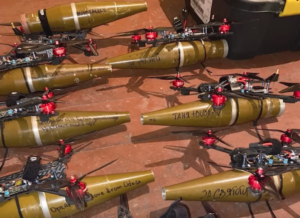
Given that the original video generated doubts as to its veracity, I thought I would post this followup that goes into more detail about Ukraine’s low-cost suicide drone/loitering munition.
These look considerably less jury-rigged than the previous drones.
“These are publicly funded…Ukraine’s Ministry of Defense made a public appeal for donations to buy 1,000 of these.”
There seem to be different types with different warhead sizes. “The technical details are a bit vague. I’ve seen mentioned ranges of just two kilometers to over 10 kilometers.”
We see the successful attacks, but not the failures.
“These cost around 200 to manufacture, so they’re also extremely cost effective.” Indeed, even more cost-effective than my original estimates.
I’ve previously covered suicide drones and drones dropping RPGs. Now Ukraine is evidently cutting out the middleman and passing the savings on to Ivan by just strapping RPGs to light drones and guiding them in.
Here’s a screen-grab of this masterpiece of redneck engineering:
The is a great application of one of Murphy’s Military Laws: “If it’s stupid but it works, it ain’t stupid.” For the Russians, it must be quite embarrassing to get yeeted into the afterlife by Doogie Howser’s science fair project.
I’m somewhat surprised that drones that small can carry the RPG rounds effectively, but presumably they’re replacing camera gear or something close to the same weight.
An RPG-7 costs about $2,500 each, while a BMP-3 costs about $800,000 each. Even if you double the price for the quadcopter ($2,500 is a bit pricey, but not out-of-line for some pro rigs), you still get a hugely useful loitering munition for less than 1/100th the cost of the target you’re taking out…
Once again, Russia has announced its latest Wunderwaffe is coming to Ukraine, which ZeroHedge treats seriously, because ZeroHedge.
Western media outlets flooded the airways with hope for Ukraine this week as the US prepares to send 31 main battle tanks to the wartorn country in Eastern Europe to counter Russian aggression ahead of spring. What wasn’t highly publicized is that these M1 Abrams are a modified version and will be stripped of “secret” uranium armor.
Following the news of NATO-made tanks set to flood Ukraine, the former head of Russia’s space agency Dmitry Rogozin told the Russian newspaper Pravda that “Marker,” a new robo-tank, will be able to ‘destroy Western tanks, including American Abrams and German Leopards.’
Rogozin explained the robot tank automatically recognizes and attacks Ukrainian equipment, including NATO tanks, all because of its artificial intelligence system and machine learning technology.
“The combat version of the Marker robot has an electronic catalog in the control system that contains images of targets both in the visible and in the infrared range,” he said.
The director of the Air Defense Museum, retired colonel Yuri Knutov, told Lenta.Ru, a Russian newspaper, “the robot can thus identify NATO-made tanks” and will be “armed with a machine gun and an anti-tank missile with a range of up to about six kilometers.”
Honestly, all of this is pretty hilarious stuff.
Machine learning and artificial intelligence are real disciplines, and Russia doesn’t entirely lack technological and programming talent. It’s entirely possible that you could develop and effective autonomous battle-tank driven by AI that can adequately detect between friend and foe given lots of money, lots of time, honest, hands-off project management, and sophisticated, iterative, trial-and-error proving over a decade or more of time.
All things Russia isn’t going to have or do. If they could adequately identify friend from foe on the battlefield (especially given how much kit Ukraine shares with Russia), then they’d already be using such technology to prevent the numerous, documented friendly fire instances Russia has suffered from. And training AI to do that is something like six orders of magnitude harder than training troops to do it.
And we all know Russia sucks at training its own troops as well.
Russia’s military is so demonstrably backwards that they can’t even have their army and air force communicate with each other in real time for combined arms operations. And yet we’re supposed to believe that they’ve developed cutting edge autonomous battlefield AI?
Pull the other one.
Russia has a long history of vaporware, and Russia’s previous attempt at field trials for a semi-autonomous AFV in Syria was a hilarious disaster. And it was plagued by bog-standard mechanical failures. Autonomous driving is a whole lot harder.
There’s a small possibility that they’ll get this thing into the field and immediately start blowing away its own troops, but a far more likely outcome is that it never sees the field at all, just the latest case of Russian Wunderwaffe vaporware.
Democrats enabling sexual predators (yet again), more tanks for Ukraine information, and the unexpected return of Storm Drain Woman. It’s the Friday LinkSwarm!
Published in November of 2022, the story indicated “thousands of child molesters are being let out after just a few months, despite sentencing guidelines.”
The story reported that more than 7,000 inmates convicted of “lewd or lascivious acts with a child under 14 years of age” were released from prison the same year they were incarcerated.
The Daily Mail’s analysis was conducted using a database—created in 1994 after the federal Megan’s Law was passed—requiring law enforcement to make public information regarding registered sex offenders. The news organization examined data in California through July of 2019.
“Everyone should be really upset and frightened by this,” Dordulian said.
According to Dordulian, child molesters are the least likely of criminals to be rehabilitated and are four times more likely to commit the same crime again.
“Once they’re out,” he said, “they are going to re-offend and there’s going to be another child that is victimized by these people.”
Senate Bill 357. Signed by Governor Gavin Newsom in July, the measure decriminalized loitering with the intent to engage in prostitution. The bill did not officially take effect until January 1 of this year; but, from the moment it became law back in July, these women say, the on-the-ground reality changed. “The minute the governor signed it, you started seeing an uptick on the streets,” Powell said. “And on social media, the pimps were saying: ‘You better get out there and work because the streets are ours.’”
The pimps were right: police stopped making arrests for crimes that would no longer be charged. The anti-loitering statute had provided the grounds for officers to question women and children whom they suspected might be trapped in a prostitution ring. “As a police officer, you need probable cause to stop and investigate,” Powell explained. “So if I have a law that says you can’t loiter in this area, with pasties and a G-string, flagging down cars, I could stop you for that because you’re loitering. But if I just say I’m stopping you because you look kind of young, that’s a little weak. So, it takes away a tool.” Without the statute, police hands were suddenly tied. Henceforth, questioning the girls—and potentially provoking a violent confrontation with pimps—came to seem a Pyrrhic gamble, one that California’s police officers would now avoid.
The films, which include “Miss Representation,” “The Mask You Live In,” “The Great American Lie” and “Fair Play,” are licensed to taxpayer-funded schools across every state and sometimes contain sexually explicit imagery and push students to feel “shame and sorrow” about American society split by privilege and oppression. They are paired with curricula that include discussion on Gov. Newsom’s comments within the films, urging them to gather their friends and vote for aligned politicians that support a “care economy” that “embraces universal human values.”
“Former Arlington teachers union president charged with embezzlement. A former president of the Arlington teachers union, who was ousted last spring, has been charged with embezzling more than $400,000 from the organization. Ingrid Gant, 54, of Woodbridge, was arrested yesterday (Monday) in Prince William County on four counts of embezzlement.” (Hat tip: Ed Driscoll at Instapundit.)
“Thirty years ago, Guan County, Shandong Province launched the ‘Hundred Childless Days‘ campaign under the aegis of national family planning, known in the West as the ‘one-child policy.’ The birthplace of the “Boxers” was deemed to have too high a birth rate by the provincial government. County officials sought to correct this by ensuring that not a single baby was born between May 1 and August 10, 1991.” (Hat tip: Ace of Spades HQ.)
North says they do not feel safe anymore, and she believes it all ties back to the large homeless encampment located only feet away from the salon.
“Our safety started to become a big issue. We suffered from multiple break-ins. We’ve had our cars broken into. We clean up feces and needles on a weekly basis. It increased from that to, you know, people approaching us and threatening us with weapons, threatening rape, murder, all of those things,” said North.
The salon has been up and running just off Ben White Blvd. for four years now. North says she has seen an uptick in crime for a while now, but the dangerous behavior from people living in this encampment picked up recently.
“In the past year, it’s gotten increasingly worse and, in the past couple of weeks, it’s gotten to the point where I actually finally felt like this might shut my business down,” said North.
Erin Mutschler, another co-owner of the salon, says they have called the police every time they have dealt with a situation like the one caught on video, but she says police often take 45 minutes to an hour for anyone to show up.
The mayorship of Steve Adler is the gift that just keeps giving, even with him out of office… (Hat tip: Dwight.)
Follow-up: Democratic State Rep. Harold Dutton: “Don’t Blame Abbott, Houston ISD Takeover Plan Was My Idea.” (Previously.)
A Florida woman was pulled from a storm drain for the third time in two years. Maybe she was looking for David Icke’s lizard people. Also, she sounds like a real winner: “Police said her license had been suspended 17 times from 2007 to 2020.” (Previously.) (Hat tip: Dwight.)
Jay Leno broke his collarbone, several ribs and both kneecaps in a motorcycle accident. But it sounds like a freak accident: “So I turned down a side street and cut through a parking lot, and unbeknownst to me, some guy had a wire strung across the parking lot but with no flag hanging from it…I didn’t see it until it was too late. It just clothesline me and, boom, knocked me off the bike.” (There’s no evidence the line was strung there by Conan O’Brien.) “But I’m OK!…I’m working this weekend.” (Hat tip: Instapundit.)
It could take months to deliver the tanks because the U.S. has to purchase them through a procurement process.
The move marks a reversal for the Biden administration, which had resisted sending the tanks, and comes as German Chancellor Olaf Scholz announced his country would provide 14 Leopard 2 A6 tanks for Ukraine’s military. Britain said earlier this month it will provide 14 of its Challenger 2 tanks. France plans to contribute 10 armed fighting vehicles.
The Pentagon has long shown a reluctance to send their best miltech abroad for fear of it falling into enemy hands. However, for both the Leopard 2 and the Abrams, the question is which version of the tank are they sending to Ukraine? Any version of either is going to have more sophisticated and modern fire control systems than the majority of Russian tanks currently in theater. And any version of the Leopard 2 is going to feature a Rheinmetall 120mm smooth-bore gun, either the L/44 or the more powerful L/55. The L/44 should punch through the front armor of most Soviet/Russian tanks, and the L/55 should theoretically punch through all of them.
For the Abrams, the M1A1 and M1A2 are both armed with the L/44, and National Review is reporting that the Biden administration is sending M1A1s. (The original M1 uses the older 105mm rifled M68 gun. That’s thought to be able to penetrate any Soviet armor up to and including the early T-72 models, and possibly some later export models, but not later T-72s and more modern domestic Soviet/Russian tanks. In Desert Storm, even M60 Patton tanks with the 105mm gun were regularly reporting kills on T72s.) Thus Abrams and Leopard 2 120mm rounds of various sorts are fully interchangeable.
The Challenger 2 uses the Royal Ordnance L30 rifled 120mm gun, which uses different ammo.
Back to the BBC: “Germany also permitted other countries to send their Leopard 2 tanks to Ukraine – which was restricted until now under export regulations.”
Poland has been itching to send Leopard 2s to Ukraine since very early on in the conflict, but Germany had been dragging its feet until now. Previous German Defense Minister Christine Lambrecht was reportedly the clog in the process, and given this came down a week after her departure suggests that was in fact the case.
They’re getting enough Abrams for two plus tank companies (three tank platoons of four tanks each, plus two command tanks), but not enough for a full armor brigade. But add the 14 German Leopard 2s, and presumably you have a force that can rip a hole in any Russian line. Add the already announced Bradleys and other IFVs, and you have a mobile infantry force behind them that can then exploit those holes.
Ukrainian military blogger Denys Davydov seems pretty ecstatic at the news:
He says that Ukraine will be receiving Leopard 2A6 tanks, which are very modern indeed. There are a number of country-specific variants, but they all use the L/55 main gun and modern fire control systems, electronics and composite armor.
He repeats the rumor that Germany refused to send Leopard tanks unless America sends Abrams, which has a fair amount of plausibility. If Russia does go apeshit over the move (doubtful), Germany could always go “Hey, we just followed America’s lead!”
Correction: Davydov states that the Abrams requires jet fuel for the turbine engines. This is false. The Honeywell AGT1500 gas turbine engine powering the M1 does not require jet fuel to operate, it can run on jet fuel, diesel, gasoline, or marine diesel (which used to have a higher sulfur content than regular diesel, though I’m not sure that’s true anymore, and is probably not relevant to usage in Ukraine).
He says the Leopard 2s being sent are in active service with the German army, not in long-term storage.
“We have the common decision from many of the Western allies (Norway, Poland, Germany, and many others, UK obviously, and probably United States, will provide the tanks to Ukrainian.” Indeed, Norway just announced that it is also sending leopard 2 tanks to Ukraine.
As for his predictions that Ukraine will liberate Crimea come spring, and that this will, in turn, cause the collapse of the Russian federation and drive Putin from power, well, let’s just call them highly speculative.
So too Peter Zeihan (him again) is on the tank news as well:
Some takeaways:
As to why the Germans have been so hesitant, I don’t know if you know your history…
…but the last couple hundred years of history [doesn’t] necessarily put the Germans in the best light. And so the idea that the Germans would ever, in a peaceful environment, decide that they should take a leadership position on military affairs is something that is antithetical, not just to the German population in general, but the government of Scholz specifically. His party is the Social Democrats, and they have basically made their bones in geopolitics about making sure that Germany is never an offensive power at all.
The Leopard 2 is good, but “the Abrams should be more accurately thought of as the pinnacle of armored equipment development. This is a system that is not merely a tank, it’s a weapons system that has several integrated programs within it, some of which the Americans still consider top secret so anything that the United States sends from its arsenal is going to honestly have to be dumbed down a significant amount, and that is going to at a minimum take time.” I think he overstates the case here slightly, because the M1A1 isn’t on the cutting edge the way the M1A2 Sepv3 is, but it wouldn’t surprise me at all if their are some systems in there the Pentagon doesn’t want anyone outside to take a look at. On the other hand, there several other nation operators, so this is a solved problem. Also, Abrams have been deployed to Europe as recently as 2020 as part of Operation Atlantic Resolve.
“There are over a dozen countries in Europe that use [Leopard 2s], and everyone except for the Germans has been arguing for sending these things for weeks now. So these the Leopards can actually be on the front lines in Ukraine probably within two or three or four months, which means it can actually make a difference in the coming spring offensive, which will happen in May and June.” My caveat would be that it takes about as long to properly train a Leopard 2 crew as an Abrams crew, and if I were the government of the USA, Poland, etc., I would have already been secretly training Ukrainian crews on Abrams and Leopard 2 simulators.
“You’re talking a minimum of the year, probably closer to three, three to build out the physical support infrastructure to get an appreciable number of Abrams in play.” This is either false or only narrowly true in that it might take 1-3 years to train a single Ukrainian technician to master the complete suite of Abrams repair and maintenance skills. It uses the same main gun ammo, the same 7.62x51mm NATO machine gun ammo (though the Leopard 2 lacks the M2 .50 BMG machine gun, but .50 BMG is hardly difficult to get a hold of), and the same fuel as the Leopard 2, and we’re sending spare parts along. The logistical tail is real, but it overlaps heavily with the Leopard 2. A C-5 Super Galaxy can lift two Abrams tanks, so if it was absolutely a top priority, all 31 Abrams could be delivered tomorrow to Rzeszów–Jasionka Airport less than 100 miles from the Ukrainian border. (More likely is something like shipping from Charleston to Gdansk, which would be about 15 days after all the bureaucratic niceties are observed.)
As always, tank crew effectiveness comes down to training. A good tank crew takes a minimum of six months to become proficient enough to be effective in combat (and most would argue it takes longer). Even if you assume you can shave some time off for Ukrainian tanks crews experienced on Soviet equipment, it still takes a good deal of time to become proficient on either an Abrams or a Leopard 2; two to three months would seem to be the absolute minimum. So unless Ukrainians were already training on Leopard 2s and/or Abrams in secret, I wouldn’t expect to see in the field any until (at the earliest) late April.
Nothing to cheer you up quite like a discussion of potential genocide.
Takeaways:
He starts out talking about how Russia plans to add some 500,000 new troops and use them in a late spring offensive when the mud dries up. As I mentioned previously, that plan is only scheduled to produce new troops over several years, and I express grave doubts that Russia can train and equip new troops when it has singularly failed to do so thus far.
He reiterates from previous videos that Russia’s military is heavily dependent on rail, but they’ve had to make do with trucks, and those trucks have been heavily targeted by Ukraine.
“Russians began the war with 3,000 military support trucks they’re probably down to only about 500 now.”
“[Russians] are doing what they can to destroy morale, and destroy the Ukrainian economy, and kill as many Ukrainian civilians as possible. They’re using drones, they’re using fighter launch missiles, they’re using cruise missiles and they’ve started to use ballistic missiles, to target specifically Ukrainian physical infrastructure, most notably electricity generating plant.”
Ukraine is having trouble exporting grain. “Exports have fallen to almost nothing.”
The countries that would normally import from Ukraine, come October, November, December are going to realize it’s just not there. Most of those countries are in Africa, some are in South Asia. And the one I am, by far, the most worried about is Egypt. Egypt is poor and they import over half the grains they need to survive, mostly wheat. The wheat is already off-line, and so we should expect to see significant upheaval—economic, humanitarian, political—across the Arab world and into South Asia and in sub-Saharan Africa.
The mention of a second Holodomor is a reminder that not enough people know about the first Holodomor, when the Soviet Union starved some 5-7 million Ukrainians to death (and some 14.5 million total for the whole collectivization famine/”dekulakization”/suppression of the Kazakhs and Tartars/etc.
The state-owned Israel Aerospace Industries arms firm on Thursday unveiled a new small hand-launched loitering missile, or attack drone, that can land back in a soldier’s hand without exploding, the company said.
The announcement came as IAI had been awarded a multi-year, multi-million-dollar contract with the United States Department of Defense to develop a version of the missile for the American market.
The device, dubbed Point Blank, is a small electro-optically guided missile that can be carried in a soldier’s backpack. It can be launched and operated by a single soldier.
Loitering munitions are also known as “suicide drones” or “kamikaze drones.”
Snip.
According to IAI, the device weighs about 6.8 kilograms (15 pounds) and is about 90 centimeters (3 feet) long. It can fly at altitudes above 460 meters (1,500 feet), at a maximum speed of 286 kilometers per hour (178 mph), and can hover in the air while the operator confirms a target’s nature and exact position.
The device includes electro-optical systems to validate and collect surveillance information in real-time, as well as a warhead in order to destroy a target, it said.
If the operator decides not to attack, the device can be flown back and land in their hand safely, according to IAI.
“The system answers the battlefield requirement to provide tactical units ranging in size from small tactical teams to battalion level, with an independent and organic capability to increase their lethality,” IAI said in a statement.
The Point Blank variant being developed for the US Department of Defense is dubbed ROC-X, and first prototypes and training would be provided in the coming fiscal year, the company said.
This video shows a vaguely X-Wing shaped drone that looks like it might have been assembled from an Estes rocket kit:
Switchblade-300 drones cost about $6,000 each, so presumably these are cheaper, and the ability to just toss them into the air before guiding them to the target will probably make them useful in a variety of dense environments where Switchblade might be difficult to launch.
Assuming that the Russo-Ukrainian War extends to the end of the year (a distinct possibility), don’t be surprised if Point Blank/ROC-X sees real world trials there.
Russia detailed plans Tuesday to expand its military to 1.5 million personnel over the next few years, a move that comes as Ukraine warns that Moscow may be planning an offensive and increased tensions between Moscow and the United States and its allies.
Defense Minister Sergei Shoigu announced the troop increase, which is expected to be complete by 2026, according to Russian state news agency, TASS.
Russia will also create military districts in Moscow and St. Petersburg, and an army corps will be created in the Republic of Karelia along Russia’s border with Finland, The Wall Street Journal reported. In addition, Moscow will set up “self-sufficient” units in Russian-held territories of Ukraine, Shoigu said.
“Only by strengthening the key structural components of the Armed Forces is it possible to guarantee the military security of the state and protect new entities and critical facilities of the Russian Federation,” Shoigu said, according to Reuters.
The announcement comes as Moscow faces setbacks on the battlefield in neighboring Ukraine. Since its 2022 invasion, Russia has been bogged down in Ukraine’s east despite some territorial gains.
Russia’s military has around 1 million troops.
The question I have is: How is Russia going to equip and train these 500,000 new conscripts when they’ve hardly been successful providing equipment for their previous conscripts?
Have they gotten better in the last few months? Well, it would be hard to top their previous “stick a tampon in your wound” level of incompetence. The hard-won success in taking Soledar suggests some improvement in tactics, but since most of the success was accomplished by the Wagner group, it says nothing about Russian conscripts being better equipped or trained.
On paper, there’s nothing to prevent the Russians from churning out more field kits, uniforms, small arms, ammunition and bandages with which to equip their new conscripts. None of those things require high tech components. But thus far they’ve proven singularly incapable of supplying them to their troops.
Throwing bodies at the problem is a classic Russian war strategy, but absent a miraculous increase in basic competence, the latest move shows little promise to win the war in Ukraine for Russia, even if they are capable of rounding upo another 500,000 Russians to throw into the meat-grinder. .
Lindybeige (a military YouTuber whose tank videos I’ve used before) interviews a British volunteer fighting in Ukraine as to what is and isn’t useful field kit.