“Joe Rogan interviews Peter Zeihan” is obviously irresistible catnip for me, as any regular readers recognize. It’s like Rogan is reading my blog! (Joe, you should totally interview me! I’m a great speaker, I’m local, I can bring my dogs over to play with Marshall, and I can tell you what doing standup comedy was like in Houston in the 80s…)
I don’t have the entire interview, because Spotify, but there are some big, interesting chunks I found on YouTube. Many cover ground familiar to BattleSwarm readers.
First up: Zeihan explains his theory on why the Russo-Ukrainian War was inevitable because they had to get across Ukraine to plug defensive gaps, and that Russia had to do it in advance of a demographic death spiral.
Caveat: I’m not sure the “plugging the gaps” theory explains the invasion any better than old fashioned Russian chauvinism; how dare those lowly Ukrainians resist being incorporated into glorious Russia?
Next up: Will Russia use nukes? Zeihan thinks it unlikely.
“We’re not just providing the Ukrainians with the weaponry and the ammo, we’re providing them with the intelligence and most of the steps of the kill chain. Without that, the weapons are of limited usefulness, especially at long range, and the Ukrainians have no desire to rupture that relationship.”
“The Russians are relatively casualty immune. They fight in an area where they fight with numbers. They’ve never been technologically advanced versus their peers, they’ve always just thrown bodies at it. So there has never been a conflict in Russian history where they have backed out without first losing a half a million men. We’re at about a hundred thousand now. We have a long way to go before the Russian military breaks.” (I think he’s forgetting the Russo-Japanese War, where they got their asses kicked but lost a whole lot less than half a million men. Maybe he implied European war, and ignored a lot of minor ones following the Russian revolution, and ignored anything before the Russian Empire…)
We don’t how many Ukrainian civilians the Russians have slaughtered; maybe 250,000. “If you think of things like Bucha and Izyum, German radio intercepts told us as far back as May that there were at least 70 places behind Russian lines that had suffered massacres [like] Bucha, and when we’ve had additional liberations since then, it corroborates that general assessment.”
“The Russians are fighting so badly, they’re doing much worse than the Iraqis did in 1992.”
“Russia has always been poorly managed and authoritarian, but under Putin it’s taken a much darker turn because of the nature of the end of the Cold War.” Yeah, no. Putin is not a “darker” authoritarian than Stalin.
On Putin’s paranoia, isolation, and possible illness. Plus a bit about gay demons.
“We’re now in an environment that between the terminal demographic structureof the Soviet/Russian system, and Putin’s personal paranoia. So he’s gone through and purged what was left of the KGB, FSB, of anyone who has personal ambitions to succeed him. We’re left with an entire political elite of only about 130 people, and Putin has removed anyone who has leadership ambitions.”
“Any sort of leadership talent has left, or been killed.”
“When it came to the Kherson offensive, and it became clear that there was more going on than just NATO weapons, the Ukrainians actually knew what they were doing, they changed the the line from that these are all Nazis to these are actually gay demons.” (Rogan: “What???”)
“This is the official line right now that ‘We have homosexual demons fighting us in Ukraine.'” (I’m going to guess that it’s not the line, but just the latest in a firehose stream of ever-more-risible excuses for failure that no one pays any serious attention to, just like whatever Baghdad Bob spit out in 2003.
“The guy who’s in charge of the Orthodox Church is a Putin crony.”
“We’ve got a Jewish Nazi gay demon.”
On Putin having cancer and/or Parkinson’s: “He’s clearly on steroids, but that could mean a whole lot of things…He looks very, not just flushed, but puffy, and that’s that’s kind of a classic too many steroids in your system issue.”
“There was this great piece that came out that I saw last week, where it was all the propaganda shots that he’s taken with, like, the soldiers mothers, and on the front, and with the tech people, and in the, intelligence and it was like the same twelve people were in every single shot, just in different outfits and even with those people he’s wearing his ballistic vest.”
“He’s clearly unhealthy.”
“He’s got the shakes, that’s one of the reasons [for the] Parkinson’s analysis.”
“The Ukrainian propaganda guy has been saying that there’s a coup underway since March…I wouldn’t put too much into that.”
Rogan: “What a fucked-up situation.” Zeihan: “For the Europeans who have been dealing with the Russians for three centuries, this is kind of par for the course.”
I’ve got at least four more videos to go, so let’s break this post into two parts.
Serbia puts its army on high alert over Kosovo (again) because having just one war in Europe obviously isn’t enough. But that was three days ago, so maybe it’s just more sabre-rattling.
As usual, it’s good to be in tech. “Laid Off Tech Workers Are Having No Trouble Finding New Jobs.” This is why all that “get back to the office or get fired” rhetoric is an empty threat.
Sure, there was a very bad storm. But any frequent flyer knows that airlines love to trot out the liability-shielding word “weather” when a more honest reason for a delay is a chronic staff shortage, as was clearly the case in Denver for Southwest; no backup plans; or, in this instance, problems with an archaic, off-the-shelf phone and crew-scheduling system that buckled under pressure even as every other airline quickly got back to normal.
Evidence mounted that Southwest, apparently still stuck in the 1990s, had ignored numerous calls to upgrade its technological support system even after it knew the danger of a meltdown. Rather, it focused on restoring its stock dividend and, reportedly, installing a pickleball court at its headquarters.
As with many businesses in crises, Southwest and its top executives were slow to heed the scale of the problem coming over the net this week: Airline delays on this scale aren’t just about missing family gatherings, although that is bad enough, or sitting on the floor for hours. They can be matters of life and death.
I also read somewhere that the top people at Southwest have finance backgrounds, not airline operations backgrounds.
Studios are shocked, shocked that properties they’ve ignored the advice of fans to infect with social justice are hugely unpopular.
Henry Cavill is like many leading men. He’s handsome and talented, and anything he appears in automatically attracts viewers. However, unlike most leading men, his fanbase consists of both typical and atypical elements for someone like him. While he does have the love of moviegoers, women, and the respect of many a man, he also has a massive following in the nerd and geek communities.
This is because Cavill is, himself, a rabid geek and an unabashed one at that.
It’s this geeky quality that led Cavill to pursue various roles that should have made studios a lot of money. All they had to do was listen to Cavill. However, that’s not what they did. They ignored him, and now things are crumbling around them.
Netflix’s “The Witcher,” in particular, is one lesson that studios could learn a hard lesson from because it represents studios ignoring the geeks on a singular level. Cavill is a man who pushed for Netflix to take on “The Witcher” and he even succeeded in landing the role as the series protagonist “Geralt of Rivia.”
The Witcher is a well-known property. It started as a successful book series that was adapted to successful games. Cavill was a no-brainer for the role of Geralt, not just because he looked and acted the part flawlessly, but because he was a massive fan of both the games and the source material.
Cavill was more excited than anyone that this series was being made and said he’d stick it out with the show for seasons on end and would only depart if they didn’t respect the source material and change the show for their own purposes.
And true to form, Netflix hired showrunners that did exactly what Cavill warned again. Believable rumors began circulating that Cavill was unhappy with the show. It later came out that Cavill was oftentimes fighting to maintain various elements of the story. It was also revealed that the showrunners would laugh at, or show disdain for, the source material that Cavill loved so much. Soon enough, he announced he was exiting the role as Geralt and handing it to Liam Hemsworth. I can only imagine the heartbreak Cavill suffered over this, but it was the right move…according to both his fans and fans of “The Witcher.”
Cavill is one of the few actors who he and his fans can say truly understand each other. He’s one of them and it shows.
Since August, Russian forces (including a large contingent of Wagner Group mercenaries) has been assaulting the Ukrainian city of Bakhmut in the Dunba with almost monomaniacal focus, despite very little to show for their efforts. Despite small successes for Russia (a few streets here, an industrial area there, even capturing a garbage dump on the edge of town was listed as a major Russian achievement a few weeks ago) almost all of Bakhmut has remained stubbornly in Ukrainian hands.
However, over the last day or two, tentative reports having come in that not only have Russian attacks slacked off, but that Ukrainian forces have recaptured not only just about all the hard-won territory Russia had gained in the city itself, but that some outlying areas were liberated after months of control. At the same time, there are numerous, persistent reports that Russia is running low on artillery shells in the region. (To be fair, repeated predictions that Russia must be running low on dumb ammunition of various types have failed to pan out heretofore.)
Here Suchomimus reports that Russia has been pushed out of the industrial areas of Bakhmut in the east, and that Ukraine has recaptured most of the town of Opytne to the immediate southeast.
Russian forces’ rate of advance in the Bakhmut area has likely slowed in recent days, although it is too early to assess whether the Russian offensive to capture Bakhmut has culminated. Russian milbloggers acknowledged that Ukrainian forces in the Bakhmut area have managed to slightly slow down the pace of the Russian advance around Bakhmut and its surrounding settlements, with one claiming that Ukrainian forces pushed back elements of the Wagner Group to positions they held days ago. Ukrainian social media sources previously claimed that Ukrainian forces completely pushed Russian forces out of the eastern outskirts of Bakhmut around December 21. ISW has also assessed that Russian forces made slightly fewer overall advances in the Bakhmut area in November and December combined as compared to the month of October.
Russian forces will likely struggle to maintain the pace of their offensive operations in the Bakhmut area and may seek to initiate a tactical or operational pause. The United Kingdom Ministry of Defense (UK MoD) reported on December 24 that Russian forces currently lack the necessary stockpile of artillery munitions to support large-scale offensive operations and that sustaining defensive operations along the lengthy frontline in Ukraine requires the Russian military to expend a significant number of shells and rockets daily. The Ukrainian Joint Forces Task Force released an interview on December 24 with a Ukrainian servicemember in the Bakhmut area detailing that Russian forces have been conducting an extremely high pace of assaults on Ukrainian positions in the area with little corresponding progress. The Wagner Group’s reported heavy losses in the Bakhmut area in recent weeks have also likely strained Russian forces’ current operational capabilities in the area.
The Russian military’s personnel and munitions constraints will likely prevent it from maintaining the current high pace of offensive operations in the Bakhmut area in the near-term. Russian forces previously allocated significant resources in a meat-grinder effort to seize Severodonesk and Lysychansk in spring–summer 2022. Russian forces culminated after capturing Lysychansk in early July and failed to capture neighboring Siversk to the east or Slovyansk to the northeast. The Russian military’s fixation with conducting a highly attritional campaign to achieve the tactical objectives of capturing Severdonetsk and Lysychansk ultimately undermined the Russian military’s ability to achieve its larger operational objective to envelop Ukrainian forces in a cauldron along the E40 highway and eventually drive to Donetsk Oblast’s western administrative borders. Russia’s relentless and costly push on Bakhmut may also degrade Russia’s ability to pursue long-term objectives in the Donbas theater.
Another sign Russia may be running out of shells in Bakhmut: A tweet from Wagner Group saying just that, while also calling the Chief of Russian General Staff a “faggot.”
Russian mercenaries from Wagner insult the Chief of Russian General Staff with obscene words and complain that they have no ammunition pic.twitter.com/7LYvN2MzHr
As usual with Ukraine news, all this is very tentative, and could be reversed to tomorrow. But right now it looks like Ukraine has the upper hand in Bakhmut.
Since Russia has opted to commit war crimes by repeatedly bombing civilian infrastructure with the goal of inflicting mass civilian causalities, the western world has responded by opting to give Ukraine even more advanced military kit.
The U.S., as usual, is leading the way, supplying a Patriot Missile Defense battery and JDAMs.
SENIOR MILITARY OFFICIAL: All right, well, thanks very much for joining us. Today’s background briefers will include (inaudible) and me, (inaudible). For attribution, please refer to (inaudible) as “a senior defense official” and to me as “a senior military official.”
And with that, I will turn it over to our senior defense official for some opening remarks, and then we’ll be happy to take your questions.
SENIOR DEFENSE OFFICIAL: Good afternoon, everyone. I’d like to start by just recognizing where we are in this war. We’re in over 300 days after Russia launched this war to try to stamp out Ukraine’s existence as a free nation. And at this moment, we are welcoming President Zelenskyy to Washington, D.C., a sign of Ukraine’s determination, its spirit, its resolve, and an opportunity for us to be able to reinforce our support for Ukraine during President Zelenskyy’s visit.
So you will hear more from the White House later this afternoon about President Zelenskyy’s visit. In the meantime, what I wanted to do is give you some important details about our new security assistance commitments that President Biden announced today, totaling $1.85 billion.
Now, these — these commitments come in two parts, and we’re announcing both of these together. First, we have a presidential drawdown package that’s valued at $1 billion. This is the 28th such drawdown of equipment from DOD inventories for Ukraine since August of 2021. And then the second is an additional $850 million in commitments under the Ukraine Security Assistance Initiative.
So first, let me talk about the presidential drawdown package, and this package includes for the first time a Patriot air defense battery and munitions. This is another signal of our long-term commitment to Ukraine’s security. As you know, Patriot is one of the world’s most advanced air defense systems, and it will give Ukraine a critical long-range capability to defend its airspace. It is capable of intercepting cruise missiles, ballistic missiles and aircraft.
It’s important to put the Patriot battery in context. For air defense, there is no “silver bullet.” Our goal is to help Ukraine strengthen a layered, integrated approach to air defense. That will include Ukraine’s own legacy capabilities, as well as NATO-standard systems. Patriot will complement a range of medium- and short-range air defense capabilities that we’ve provided and that allies have provided in prior donation packages, and for us, that includes NASAMS and Avenger systems. Patriot does require training, and we expect it will take several months to ensure Ukrainian forces have the training they need to employ it successfully.
Now, in addition to Patriot, this drawdown package includes several other highlights. First, it includes an additional 500 precision-guided 155-millimeter artillery rounds, and it includes several different mortar systems and rounds for those systems. Second, it includes precision aerial munitions, and then third, it includes additional MRAP vehicles and Humvees, and I think important to note, this is 38 MRAP vehicles, but we’ve provided 440 to date, and it’s 120 Humvees, but this comes on top of 1,200 Humvees that we’ve provided to date.
Now for the second part of today’s announcement, the $850 million under USAI, I just want to remind that this is an authority under which we procure capabilities from industry, rather than drawing them down from U.S. stocks. So USAI capabilities typically take longer to deliver. Now under USA — AI, we are committing to provide a range of different non — what we call nonstandard ammunitions. This is what we formerly called Soviet-type ammunition. It includes 152-millimeter artillery rounds, 122-millimeter artillery rounds, and these will be able to help the Ukrainians bring more of its legacy systems, its legacy howitzers back into the fight in greater numbers. We also plan to — to provide 122-millimeter Grad rockets, and this is to support Ukraine’s Grad rocket artillery capability, as well as tank ammunition to help Ukraine sustain operations with its existing tanks. Another capability we’re providing via USAI are satellite communication terminals and services. This will add resilience to Ukraine’s communications infrastructure. And then as always, we have funding from (sic) training, for maintenance and for sustainment in support of the equipment we and our partners have provided.
Here’s a more detailed breakdown in convenient Tweet form:
Big capabilities in this PDA: -One Patriot battery and munitions; -HIMARS ammo -500 precision-guided 155mm artillery rounds; -10 120mm mortar systems and 10,000 120mm mortar rounds; -10 82mm mortar systems; -10 60mm mortar systems; -37 Cougar MRAPs -120 HMMWVs (1/2)
In USAI package: -45,000 152mm artillery rounds; -20,000 122mm artillery rounds; -50,000 122mm GRAD rockets; -100,000 rounds of 125mm tank ammunition; -SATCOM terminals and services; -Funding for training, maintenance, and sustainment.
Ukraine’s military fortunes also depend on European countries, such as Germany, that let their defense industry atrophy in peacetime and are struggling to catch up as they focus on securing energy supplies.
Ukraine’s battle against the Russian invasion is consuming ammunition at rates unseen since World War II. Kyiv’s forces have been firing around 6,000 artillery shells a day and are now running out of antiaircraft missiles amid a relentless aerial onslaught by Russia, according to experts and intelligence officials. At the height of the fighting in eastern Ukraine’s Donbas area, Russia was using more ammunition in two days than the entire stock of the British military, according to the Royal United Services Institute, a British think tank.
No country in NATO other than the U.S. has either a sufficient stock of weapons to fight a major artillery war or the industrial capacity to create such reserves, said Nico Lange, a former top official at the German Defense Ministry. This means that NATO wouldn’t be able to defend its territory against major adversaries if it were to be attacked now, he said.
“Governments have been slashing contracts for decades, so companies shed production lines and employees,” said Mr. Lange, a senior fellow with the Munich Security Conference, a global security forum.
The current shortage of shells and missiles is largely due to a shift in the military doctrines of NATO allies in recent decades: Instead of planning for World War II-style ground battles, they focused on targeted, asymmetric warfare against unsophisticated opponents, said Morten Brandtzæg, chief executive of Nammo AS, one of the world’s largest arms manufacturers.
“We need orders of magnitude more industrial capacity,” said Mr. Brandtzæg, whose company is co-owned by the governments of Norway and Finland.
Ukraine uses up to 40,000 artillery shells of the NATO caliber 155mm each month, while the entire annual production of such projectiles in Europe is around 300,000, according to Michal Strnad, owner of Czechoslovak Group AS, a Czech company that produces around 30% of Europe’s output of such munitions.
“European production capacity is grossly inadequate,” Mr. Strnad said. Even if the war were to stop overnight, Europe would need up to 15 years to resupply its stocks at current production rates, he said.
As always, there are rumors that Russia has had to buy artillery shells from north Korea and, as always, these rumors should be treated with several grains of salt. Russia used up huge amounts of its smart munitions early, but early predictions that Russia would quickly run out its own dumb artillery shells have thus far proven to be premature.
The Patriot system may prove to be more symbolic than really useful, if only because Russias has already used up sop much of its medium range missile stocks. JDAMs, on the other hand, could prove to be very effective at targeting Russian military assets.
In any case, it’s now clear that a war Russia thought would be “three days to take Kiev” will now drag on as a war of attrition for a year or more, and a goodly portion of the western world has signed up to supply Ukraine with munitions for as long as it takes.
In a non-embedable video, the YouTuber formerly know as The Russian Dude announced that he had been called up for military service as part of Putin’s “partial mobilization” to throw more cannon fodder into the Ukrainian meatgrinder. (I’m pretty sure that’s an important decision point in why he’s now known as The Canadian Dude.)
Oddly enough, all his male friends received conscription notices as well.
Commenters have long stated that Putin doesn’t want to declare a General Mobilization, because under Soviet Russian law, that requires an actual declaration of war, something still lacking in Vlad’s Special Military Operation.
Now this is not even a theory, only conjecture based on a single data point, but what if Putin is actually carrying out a General Mobilization of all eligible males of military age while calling it limited mobilization? It’s not like Putin’s war machine hasn’t already committed more heinous crimes, or that Russia has an independent press capable of calling him on it any more.
Maybe Putin wants to roll the dice on one final spring push for Kiev, putting a million men under arms to launch a massive attack, relying on the Russian doctrine of quantity having a quality of its own to final snatch victory from the jaws of defeat.
Like I said, conjecture only, but it certainly doesn’t make any less sense than the multiple bungling stupidities Russia has committed in the war…
The U.S. Army has announced that it’s next helicopter isn’t a helicopter.
The US Army awarded Textron Inc’s Bell unit with the contract to build the next-generation helicopter, ending years of fierce competition between Lockheed Martin Corp.-Boeing Co. to replace the aging fleet of Sikorsky UH-60 Black Hawks by 2030.
The Army’s “Future Vertical Lift” award went to Bell’s V-280 Valor tiltrotor aircraft, similar to the V-22 Osprey. The new aircraft can take off and land vertically like a helicopter but rotate massive props to fly like a fixed-wing aircraft at impressive speeds.
Combat range: 580–920 mi (930–1,480 km, 500–800 nmi)
Ferry range: 2,400 mi (3,900 km, 2,100 nmi)
Service ceiling: 6,000 ft (1,800 m) ; in hover out of ground effect at 95 °F (35 °C)
Disk loading: 16[55] lb/sq ft (78 kg/m2)
The cruise speed is almost twice the 175 mph of the Black Hawk it’s replacing, and significantly faster than the competing Defiant X design (265 MPH). It also has higher troop carrying capacity than the Black Hawk (14 vs. 12). “Firstest with the mostest” is still hugely important in combat. And though the V-280 carries considerably less than the V-22, it has a much longer combat range.
Here’s a video showing the V-280 in flight, and covering some of the reasons it was selected over Defiant X:
One of the biggest reasons is simply logging more flight time, hundreds of hours since 2017. Defiant X first flew in 2019.
Any drawbacks? Well, tilt rotors share features of both helicopters and fixed-wing aircraft, so they can suffer the problems of both. The Osprey had fourteen crash or hull loss incidents (nine of them fatal), plus an additional eight non-loss incidents (with one additional fatality) for some 400 aircraft built.
By contrast, the UH-60 Black Hawk it’s replacing has been involved in its own share of deadly accidents, but with a much larger number being built (4,000, though how many of those were in U.S. as opposed to foreign service during the period covered is unclear). All V-22 Ospreys (save 2-5 used by Japan) are used by the U.S. military.
It can be hard to determine the truth in any war zone, especially one like Ukraine where honest, English-speaking reporters seem to be thin on the ground. Sometimes people are trying to be accurate and get things wrong, and others fall for propaganda, like Snake Island and the “Ghost of Kiev.” (I use pro-Ukrainian examples here because most Russian propaganda has been unbelievable, clumsy, and poorly executed (and the last two apply to so many aspects of Russia’s illegal war of aggression)).
Example the first: A commenter mentioned that Stingers sent to Ukraine had shown up on “black markets all over the world.” Possible, but I hadn’t heard anything about it. I went searching, where I found this piece:
On September 17, 2022, a worrying claim circulated on social media: FIM-92 Stinger man-portable air-defense systems (MANPADS) were reportedly available for sale online in Germany.
According to the post, which was picked up by prominent figures in Russia, authorities were alerted by a student in Bremen and “local journalists” found that the systems originated in Ukraine and were “meant for the Kharkov counteroffensive”.
A short video was posted alongside the tweet, showing what appears to be a partially disassembled Stinger system with its Identification friend or foe (IFF) antenna missing. The feet of several people in paramilitary clothes can be seen in the footage, and a German voice can be heard in the background.
he posts received thousands of likes and shares, including from the Deputy Representative of Russia to the United Nations Dmitry Polyanskiy, who suggested that delivering weapons to Ukraine was backfiring.
English language coverage has not been widespread, but Russian media published numerous articles with differing variations of the claim. Some add that this is not the first time that Stingers have appeared on the European black market.
However, many others state that weapons provided to Ukraine by NATO countries have been discovered on black markets across the world. All the articles claim that the case resulted in “a scandal” in Germany, attracting the interest of authorities, the media, and spurring discontent among its citizens.
But further down, we find this:
The articles and social media posts refer to German authorities having supposedly intercepted a deal and apprehending the culprits. However, no statement about such an operation has been posted by any of Germany’s law enforcement agencies.
The posts also mention that local German journalists investigated and determined that the weapons were meant for the Ukrainian offensive. However, there is no proof that this took place, and the story was not covered by any prominent German media outlet.
Responding to a Twitter post sharing the video, Lars Winkelsdorf, one of the leading German arms trafficking experts, dismissed the claim.
“At the moment, nothing like that has been found by the authorities, nor have I found anything like this through my own research,” Winkelsdorf said.
The original source of the report seems to be the Journalisten friekorps Telegram channel, which is billed as a “channel for honest journalism”.
“Our task is to help the German state and the German people. The people must be united, Germany must be free,” the channel’s description reads.
One of the Telegram posts state that the channel is created by the team behind Socialharmony.de, an initiative which lists discontinuing arms shipments to Ukraine and stopping support to Ukrainian refugees among its main goals.
Conclusion:
It can be stated, with a high degree of certainty, that the claim regarding FIM-92 Stinger MANPADS being shipped to Ukraine and found on the German black market, is false.
The claim states that the weapon dealers were apprehended by German authorities, yet the German police denies being involved.
The video, provided as evidence, contains a sound recording that was filmed in January 2022. The letters from Ukrainian authorities, provided as a confirmation of connection with Ukraine, also appear to be counterfeit.
Finally, claims that the case was highly prominent and even resulted in a scandal in Germany, do not appear to hold water. This was only covered by social media channels of dubious origin and several sensationalist websites.
So that one we can chalk up to propaganda followed by the social media game of telephone.
The next example is from two sources on the Russo-Ukrainian War that are usually pretty solid.
First up, Suchomimus (whose videos I’ve feature a lot here) has a report on an attack on a Russian headquarters barracks in Melitopol that may have killed some 200 officers:
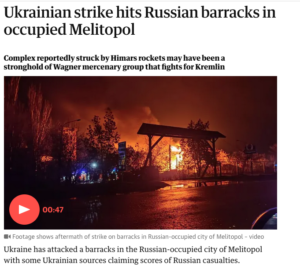
I thought I’ll take a look at last night’s strike on a Russian barracks in Melitopol. I guess most of you have seen the news by now, as this was a pretty major incident reports are saying around 200 soldiers were killed in this strike.
Snip.
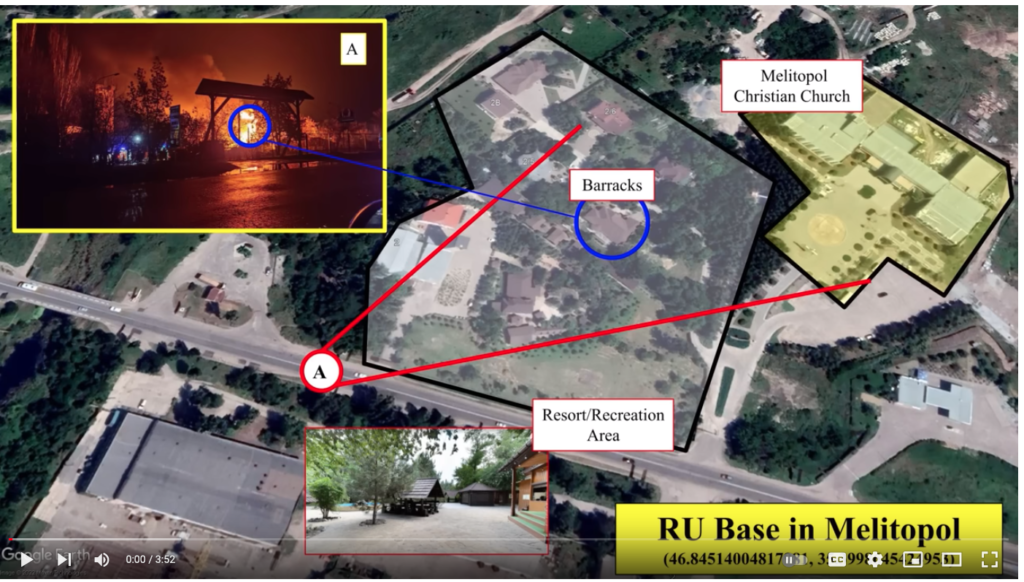
Let’s take a look at the site itself this graphic was put together by a Twitter user TheIntelCrab. Now, a few sources online have said that the strike was of a Melitopol Christian Church. That is not exactly accurate. It was near there, but instead, it hit the area circle to the left, which was being used by the barracks.
Here’s a screen cap:
So it didn’t hit the church itself. Now, this is quite interesting. These photos here of some of the rooms at this place. This was a luxury resort. A few people say it was a spa.
Suchomimus goes on to explain why such luxurious accommodations were probably used by officers. “If this was indeed officer’s accommodation, then this is a even more important strike than realized, especially for numbers of 200 gone are accurate.”
But here’s Ukraine News TV (“Josey here”) with his daily update, including reporting various strikes in Russian occupied territory:
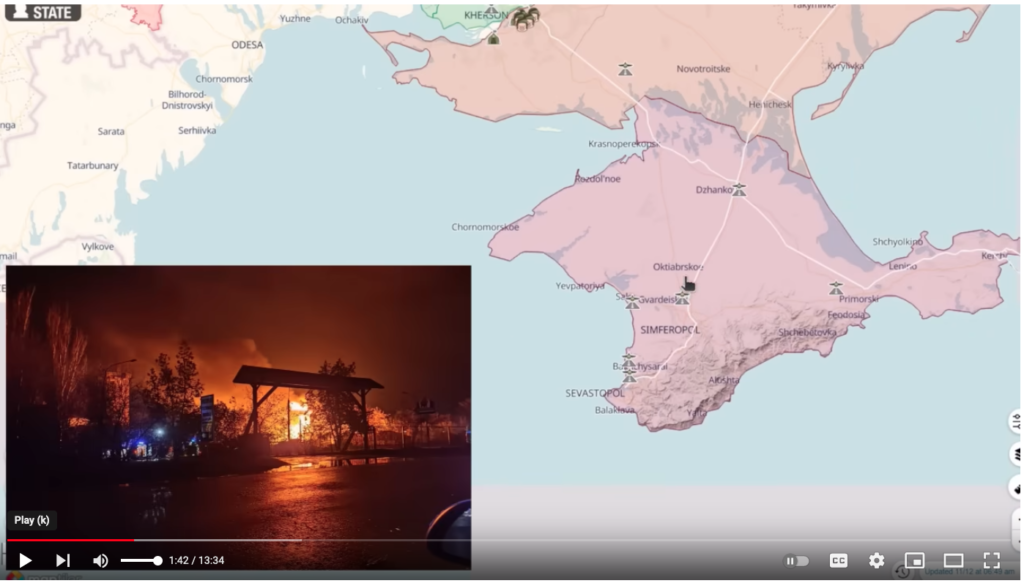
At 1:38 in, he notes “explosions as well at the airport at Simferopol, so a little bit into the the middle of the peninsula.” Part of this screen cap should look familiar:
That fire behind that distinctive gate looks awfully familiar, doesn’t it?
CNN is also reporting the blast in Simferopol, so presumably that actually happened as well. Later in the video (starting about 7 minutes in), Josey reports on the Melitopol strikes, noting a wide range of estimates for casualties, stating “possibly 200-300.” So that’s mostly in accord.
The most likely explanation is that Josey simply grabbed the wrong image for the Simferopol image. These things happen.
But it’s a reminder that war news reporting (including my blogging) is an aggregation of already aggregated sources one or more steps removed from the actual front lines. Everything you see or hear about it deserves at least a basic level of judicious skepticism.
Ever since the Toyota War, when Chad’s cheap, fast-moving force of Toyota-based technicals left $1.5 billion worth of Libyan Soviet equipment burning in the desert, it’s been obvious that such forces could be very cost-effective units in future conflicts. The furious rate of smart-munition depletion in the Russo-Ukrainian War also demonstrated the need for cheaper alternatives to Stinger and Javelin.
L3Harris’ Vehicle-Agnostic Modular Palletized ISR Rocket Equipment (VAMPIRE) is a portable kit that can be installed on most vehicles with a cargo bed for launching of the advanced precision kill weapons system (APKWS) or other laser-guided munitions.
This L3Harris suitcase-type APKWS launcher and designator kit provides a rapid solution for arming non-tactical vehicles (NTV) and a variety of tactical vehicles, while integrating components to customer-specific specifications. Our capability provides ground forces the ability to engage targets beyond the range of weapons normally carried by SOF and light forces.
Modular and palletized, the VAMPIRE system offers a low-cost and effective weapon deployment solution.
VAMPIRE FEATURES
Designed to complement the low-cost, low-signature and availability of common NTVs and fit in any pickup or vehicle with a cargo bed
Installation can be completed in approximately two hours by two people using common tools
Can be configured to meet customer-specific requirements
Everything is on the pallet. Power supply eliminates the need for a 24-volt alternator on the vehicle
The WESCAM MX-10™- RSTA independent stabilized sighting system provides ISR overmatch
Can be equipped with APKWS or other laser-guided munitions
The Fat Electrician (who you may remember from his Sky Warden video) has an amusing rundown:
Takeaways:
“What is it it is literally a DIY kit that shows up on a pallet, and according
to the brochure, two men in two hours can install it on any pickup truck, giving them what amounts to a miniature version of HIMARS.” More like a miniature MLRS.
“As of August 22nd 2022 America is going to start exporting these to countries that are allies or entities that have America’s interest in mind.”
“America’s been sending out a lot of Javelin and Stinger missiles lately, and
those are really expensive, so we made this as a cheaper alternative, and I’m not gonna lie, it’s way fucking cooler.”
“It looks like they gave Xzibit a DOD contract for the deadliest episode of Pimp My Ride. He found out the DOD liked guns and he put the entire Second Amendment in the bed of the pickup.”
“I keep saying any pickup truck. We all know I’m talking about Toyota…that is the official truck of guerrilla warfare.”
“This thing can shoot four Hydra 70 rockets. Now the reason they chose Hydra 70 rockets is because they’re probably the cheapest munition that America uses” at $2,799 a pop. Hydra 70 tops out at around 17 pounds, though most commonly around 10 pounds, so they’re not going to have the kinetic penetrating power of a 120mm APFSDS round to take out a tank, but are probably sufficient to take out a lot of other targets.
“The downside of that being they’re considered a dumb munition because you can’t actually guide them…However, the Hydra rockets being used with the VAMPIRE system are going to be equipped with a retrofit guidance module which is going to allow the Rockets to be laser guided.”
Unit cost with the guidance system is about $22,000, which makes it an order of magnitude less expensive than Javelin or Stinger.
So a soldier can “pull up to the side of the battlefield, throw up his Periscope launch four missiles, and take back off all without even getting out of the air conditioning of the cab because he can do it from the computer in the dash.”
Can also take out drones.
“In conclusion, I’m sure we’re gonna start seeing these in the news a lot more and, it’s probably only a matter of time until some crazy fucker from Texas or Florida acquires one of these mounted on the back of their El Camino, and then uses it to go hunt hogs or iguanas. And that’s the news article I’m looking forward to.”
When Russia bogged down trying to take Kiev, I thought that a raiding force of 100 or so technicals would be perfect to destroy those long lines of trucks (assuming they could be equipped with wheels wide enough to make it across the infamous rasputitsa mud). A system like VAMPIRE, with an ability to take out both light armored vehicles and helicopters, moves us significantly closer to making such a force a lot more practical.
Ukraine has been so successful at hitting Russian infrastructure with HIMARS that it’s no longer news when they hit something 100 kilometers behind Russia’s lines.
But when they hit something 600 kilometers away, that’s news.
Several people have been killed in explosions at two Russian military airfields, according to reports.
A fuel tanker exploded killing three and injuring six in an airfield near the city Ryazan, south-east of Moscow, Russian state media is reporting.
Another two people are reported to have been hurt in an explosion at an airfield in the Saratov region.
It is not known what caused the blasts. Both areas are hundreds of kilometres from the Ukrainian border.
Long-range Russian strategic bombers are believed to be based at the Engels airbase in the Saratov region.
Here’s a Suchomimus video on the Engels Airbase attack:
Ukraine’s ever-increasing range puts a whole lot of Russian infrastructure (military and otherwise) under potential threat. Perhaps Putin should take that into consideration before ordering the next round of attacks on Ukrainian power plants…
Early on, a lot of observers predicted that Russia, with it’s vast store of Soviet-era aircraft, would quickly achieve air-superiority over Ukraine. That hasn’t been the case.
This video from the British Imperial War Museum lists some reasons why.
Takeaways:
They failed to hit Ukrainian aircraft on the ground in the opening phases of the war.
A “great deal of mismanagement, kleptocracy, you know, favored projects over some kind of strategic effect.” Note how Putin is always announcing some sort of awesome wonderwaffen while neglecting basic needs like logistics.
“The level of corruption in Russia itself has had an impact on its ability to have a tactical or even strategic effect without support from the air. Russia’s ground forces have been largely unable to mount effective combined arms operations.”
“The key reason for Russia’s inability to effectively use its air force has been its failure to take out Ukraine’s mobile surface to air missile systems. They have been unable to suppress enemy air defenses.”
Ukraine made an early effort to obtain SAM systems from the west.
Both mobile tracked systems like S-300 and MANPADS have been used.
Failure to achieve air superiority has both sides investing in drones.
“What you do is you flood the airspace, almost like a denial of service attack, as we see on the Internet. As you attack a server, for instance, by having so many pings against it, it essentially shuts down the server. And what we see in the case of Russia is that it’s doing the same thing. It’s trying to flood the air defense systems.”
“The relatively low cost of these drones is one of the main reasons for Russia to deploy them, and in such numbers. Each drone reportedly costs around $20,000. And so losing an expensive advance guided missile to these drones is not an ideal strategy for Ukraine.”
One reason not covered: Russia seems to have used up a good portion of it’s high tech weapons in the opening phases of the war, and western sanctions mean that it can’t easily replace them. Sophisticated fighter bombers are a whole lot less effective when they’re reduced to dropping gravity bombs rather than guided munitions.