Amid fears of worldwide food shortages due to the Russo-Ukrainian war, Russia and Ukraine signed an agreement to reopen sea corridors to allow food exports from the Ukrainian port of Odessa to recommence.
World leaders swiftly condemned the Russian missile strike on a Ukrainian port, a dramatic revelation amid a U.N.-brokered deal that secured a sea corridor for grains and other foodstuff exports.
A day prior, representatives from the U.N., Turkey, Russia and Ukraine signed an agreement to reopen three Ukrainian ports, an apparent breakthrough as the Kremlin’s war on its ex-Soviet neighbor marches into its fifth month.
The deal, signed in Istanbul and set to be implemented in the next few weeks, follows a months-long blockade of dozens of Ukrainian ports sprinkled along the Sea of Azov and the Black Sea.
The strike on Odesa, Ukraine’s largest port, illustrates yet another anxious turn in fruitless efforts to mitigate a mounting global food crisis.
Given how many agreements and treaties Putin violated by occupying parts of Ukraine and then launching the current war, there’s no reason to believe that Putin will adhere to the terms of any agreement.
The path to lasting peace in Ukraine is complete destruction and ejection of invading Russian forces.
The title overstates the case, but this story of the red-tape cutting, round-the clock efforts to field a bunker busting bomb during the Gulf War is fascinating stuff.
(Today has been a bear for a variety of uninteresting reasons, so no LinkSwarm today. Hopefully tomorrow…)
Following the Russian capture of Severodonetsk, the Russo-Ukranian War seems to have gone into an operational pause. Ukraine has now received and fielded its first HIMARS multiple rocket launch systems from the U.S. This video makes the case that that’s very bad news for Russian logistics.
Some takeaways:
HIMARS can hit targets at 80kms with high accuracy, far superior to Russia’s Uragan system (40km and less accurate) and Smersh systems.
The high accuracy makes 6 HIMARS missiles equal to 70 rounds of Russian artillery.
Systems move at 90kph.
Five minute reload time.
Crew of three.
“Just a few highmars can cut off a 100 kilometer long front line from supply and control.”
“Ukraine has already been able to destroy more than 20 large ammunition depots and several command posts.”
All well and good, but I have some caveats with the contention that HIMARS can drive the enemy before it and hear the lamentations of their women.
So far, Ukraine has fielded precisely four HIMARS. Four may be able to change the course of a battle, but certainly not a war.
There’s no reason to believe that Russia can’t adapt by dispersing ordinance to smaller and less dense ammo depots, or by restarting air sorties (which they seem to have largely abandoned) to hit HIMARS. Knowing the Russian military, the rate of adaptation will be very slow, but it’s not beyond their abilities.
While HIMARS help? Yes. Will they completely destroy Russian command and logistics? Color me very skeptical.
Thus far I have seen no signs of any real Ukrainian counter-offensive in the last month. Until that changes, we still look to be in for a long, bloody stalemate.
The U.S. Army on Tuesday selected General Dynamics Land Systems to build a light tank meant to improve mobility, protection and direct-fire capabilities for Infantry Brigade Combat Teams.
The production deal is a key step forward for Army Futures Command, which has promised faster and more successful modernization programs through a competitive prototyping approach.
GDLS will deliver 26 vehicles initially, but the contract allows the Army to buy 70 more over the course of low-rate initial production for a total of $1.14 billion, according to the Army.
At least eight of the 12 prototypes used during competitive evaluation will be retrofitted to be fielded to the force, service officials in charge of the competition said.
The first production vehicles are expected to be delivered in just under 19 months. The first unit will receive a battalion’s worth of MPF systems — 42 vehicles — by the fourth quarter of fiscal 2025. The Army plans to enter full-rate production in calendar year 2025, according to GDLS.
It uses 105mm main gun (the same caliber used in the first iteration of the M1 Abrams) and weighs 35 tons.
The German company said the Panther KF51 (KF is short for Kettenfahrzeug, or tracked vehicle; the number indicates it falls into the 50-ton plus class) “is destined to be a game changer on the battlefields of the future.” It sets “new standards” in “lethality, protection, reconnaissance, networking and mobility,” the company boasted in a statement.
Jan-Phillipp Weisswange, Rheinmetall’s assistant head of public relations, told Breaking Defense that the vehicle was designed on the company’s own funds and not in response to a client’s request. Weisswange said the tank was not designed as a candidate for the Franco-German Main Ground Combat System (MGCS) project, launched in 2012 to replace the Leopard 2 and Leclerc main battle tanks, but rather for an export market.
Still, those two systems could provide a sense of where Rheinmetall could target potential sales. Users of the Leopard 2 are Austria, Canada, Chile, Denmark, Finland, Greece, Hungary, Indonesia, Netherlands, Norway, Poland, Portugal, Qatar, Singapore, Spain, Sweden, Switzerland, Turkey, while the Leclerc is used by Jordan and the UAE.
The Panther’s chassis uses components of the Leopard 2 hull, but the turret is entirely new. According to the company, the 59-ton vehicle has a maximum operating range of about 500 kms (310 miles).
The main armament is the Rheinmetall 130mm cannon, designed for the MGCS project’s Future Gun System (FGS). The FGS is automatically loaded from two revolver-type magazines which each hold 10 rounds of insensitive munition-compliant ammunition. According to the company, the FGS “enables a 50% longer kill range to be achieved [than 120mm] with an unrivalled rate of fire due to the autoloader performance.” It can fire kinetic energy rounds as well as programable airburst ammunition and practice rounds.
There’s also a integrated drone launcher option. Here’s a short video on the tank, showing the location of the autoloader in the rear turret bustle:
Speaking of Germany, they’re evidently blocked Spain’s sale of used Leopard 2 tanks to Ukraine. (I have a skeleton post full of videos (some from this guy) about Germany announcing that it was thinking of sending heavy weapons to Ukraine, then dragging its feet with bureaucratic paperwork to actually do anything. It’s a strange, frustrating topic someone with more experience than myself in the arcane practice of Germany bureaucracy should research…)
The Economist published a thumbsucker on the future of the tank. It covers some familiar ground, including covering Russian failures during the opening phases of the Russo-Ukrainian War. Also includes a scrolling web-graphic thingee covering parts of modern tanks.
Sad news: Hershel “Woody” Williams, the last living Medal of Honor winner from World War II, has died at age 98.
Williams was a member of the U.S. Marine Corps and served in the Battle of Iwo Jima. He was awarded the Medal of Honor on Oct. 5, 1945, from President Harry S. Truman for his “valiant devotion to duty,” the Woody Williams Foundation said.
“Today at 3:15am, Hershel Woodrow Williams, affectionately known by many as Woody went home to be with the Lord. Woody peacefully joined his beloved wife Ruby while surrounded by his family at the VA Medical Center which bears his name,” the Woody Williams Foundation wrote.
Williams, who was born in Quiet Dell, West Virginia, served for 20 years in the Marine Corps and Marine Corps Reserves and then worked for the Department of Veterans Affairs for over 30 years as a veterans service representative.
The U.S. Navy commissioned a warship called the USS Hershel “Woody” Williams in his honor in Norfolk, Virginia, in 2020.
For conspicuous gallantry and intrepidity at the risk of his life above and beyond the call of duty as demolition sergeant serving with the 21st Marines, 3d Marine Division, in action against enemy Japanese forces on Iwo Jima, Volcano Islands, 23 February 1945. Quick to volunteer his services when our tanks were maneuvering vainly to open a lane for the infantry through the network of reinforced concrete pillboxes, buried mines, and black volcanic sands, Cpl. Williams daringly went forward alone to attempt the reduction of devastating machinegun fire from the unyielding positions. Covered only by 4 riflemen, he fought desperately for 4 hours under terrific enemy small-arms fire and repeatedly returned to his own lines to prepare demolition charges and obtain serviced flamethrowers, struggling back, frequently to the rear of hostile emplacements, to wipe out 1 position after another. On 1 occasion, he daringly mounted a pillbox to insert the nozzle of his flamethrower through the air vent, killing the occupants and silencing the gun; on another he grimly charged enemy riflemen who attempted to stop him with bayonets and destroyed them with a burst of flame from his weapon. His unyielding determination and extraordinary heroism in the face of ruthless enemy resistence were directly instrumental in neutralizing one of the most fanatically defended Japanese strong points encountered by his regiment and aided vitally in enabling his company to reach its objective. Cpl. Williams’ aggressive fighting spirit and valiant devotion to duty throughout this fiercely contested action sustain and enhance the highest traditions of the U.S. Naval Service.
Sometime in the next decade or two, the last living World War II veteran will die, and that epoch-changing conflagration will pass out of living memory.
Two landmark Supreme Court cases drop, another woke social justice child-rapist exposed, Keith Olbermann channels John C. Calhoun, and the secret plans to nuke Yorkshire. It’s the Friday LinkSwarm!
Just like the old gypsy woman said leakers indicated, the Supreme Court has overturned Roe vs. Wade.
The Supreme Court on Friday overturned Roe v. Wade, the 1973 ruling that legalized abortion, allowing a Mississippi law that bans abortions after 15 weeks to take effect.
“The Constitution does not confer a right to abortion; Roe and Casey are overruled; and the authority to regulate abortion is returned to the people and their elected representatives,” Justice Samuel Alito wrote for the 6-3 majority.
Justice Alito was joined by Justices Amy Coney Barrett, Neil Gorsuch, Brett Kavanaugh, Clarence Thomas, and Chief Justice John Roberts in the majority. Justice Roberts wrote in a concurring opinion with the majority that he would have taken a “more measured course” stopping short of overturning Roe altogether, but agreed that the Mississippi abortion ban should stand.
The Court’s liberal Justices Stephen Breyer, Elena Kagan, and Sonia Sotomayor dissented….
The ruling in Dobbs v. Jackson Women’s Health Organization means each state will now be able to determine its own regulations on abortion, including whether and when to prohibit abortion.
In New York State Rifle and Pistol Association v. Bruen, the Court affirmed that gun rights are due the same protection as all other constitutional rights.
To which I can only reply “Duh. What took them so long?”
Today’s Supreme Court decision in New York State Rifle and Pistol Association v. Bruen is not only the most important Second Amendment ruling since D.C. v. Heller, it is potentially the most important Second Amendment ruling in American history.
Not sure about that, as Heller firmly established the gun ownership was an individual right unconnected to militia service. That laid the conceptual groundwork for today’s ruling.
For all the brouhaha, the question at hand in Bruen was rather straightforward: Can the state of New York require that applicants for gun-carry permits “demonstrate a special need for self-protection distinguishable from that of the general community,” or is New York obliged by the Constitution to offer a “shall issue” regime of the sort that 43 of the other 49 states have adopted? By a 6–3 vote, the justices decided that the latter approach is required. In the United States, Clarence Thomas’s majority opinion concluded, “authorities must issue concealed-carry licenses whenever applicants satisfy certain threshold requirements, without granting licensing officials discretion to deny licenses based on a perceived lack of need or suitability.” Moreover, while there is nothing illegal about America’s existing state-level permitting systems, those systems may not be mere smokescreens for outright prohibition, unequal protection, or unacceptable delay. “We do not rule out,” Thomas added in a footnote, any “constitutional challenges to shall-issue regimes where, for example, lengthy wait times in processing license applications or exorbitant fees deny ordinary citizens their right to public carry.”
As Justice Alito was keen to note, this “holding decides nothing about who may lawfully possess a firearm or the requirements that must be met to buy a gun. Nor does it decide anything about the kinds of weapons that people may possess.” It concludes solely that:
The exercise of other constitutional rights does not require individuals to demonstrate to government officers some special need. The Second Amendment right to carry arms in public for self-defense is no different. New York’s proper-cause requirement violates the Fourteenth Amendment by preventing law-abiding citizens with ordinary self-defense needs from exercising their right to keep and bear arms in public.
Bottom line: New York is allowed to exclude carry-permit applications on a categorical basis (e.g., the applicant has a felony conviction), but not on a subjective one (e.g., the applicant doesn’t “need” a gun in the view of the determining officer).
To get there, the majority first determined that “nothing in the Second Amendment’s text draws a home/public distinction with respect to the right to keep and bear arms.” Indeed, “to confine the right to ‘bear’ arms to the home,” the majority observed, “would nullify half of the Second Amendment’s operative protections.” This, Thomas explained, would not do, because “the constitutional right to bear arms in public for self-defense is not ‘a second-class right, subject to an entirely different body of rules than the other Bill of Rights guarantees.’”
Liberals are taking the gun and abortion rulings well. Ha, just kidding! Keith Olbermann came out for nullification. Because nothing says “progressive liberalism” like adopting the policies of South Carolina from 1832.
Ukraine has banned the main opposition party. Not a great look. Though you know FDR would have tried that with Republicans if he thought they posed more of a threat to his agenda and the Supreme Court would let him get away with it…
Israel is headed for yet another election. “After almost one year of taking power, Israel’s ruling coalition has agreed to dissolve the parliament and hold new elections. ‘Israeli Prime Minister Naftali Bennett’s office announced Monday that his weakened coalition will be disbanded and the country will head to new elections.'” (“How many elections is that now, five?” “Shut up! Don’t tell Mere!”)
International Swimming Federation bans men from competing. It’s astonishing that headline even needs to be written…
Powers that be in Tennessee are threatening YouTuber Whistlin Diesel with a year in prison for…splashing with a jet ski. Sounds like a clear abuse of power to me…
A review of one of the last production Trebants, the crappy, under-powered, plastic communist car East Germans had to wait years to buy. Let this be another reminder that commies aren’t cool and the consumer goods produced by commie companies that don’t have to deal with market competition are crap.
“In my day, we had to work twenty-five hours a day, eight days a week, and they set off a nuclear explosion underneath us! You tell that to kids these days and they don’t believe you!”
“After ‘Lightyear’ Bombs, Disney Quietly Cancels Their Upcoming Movie ‘Brokeback Woody.”
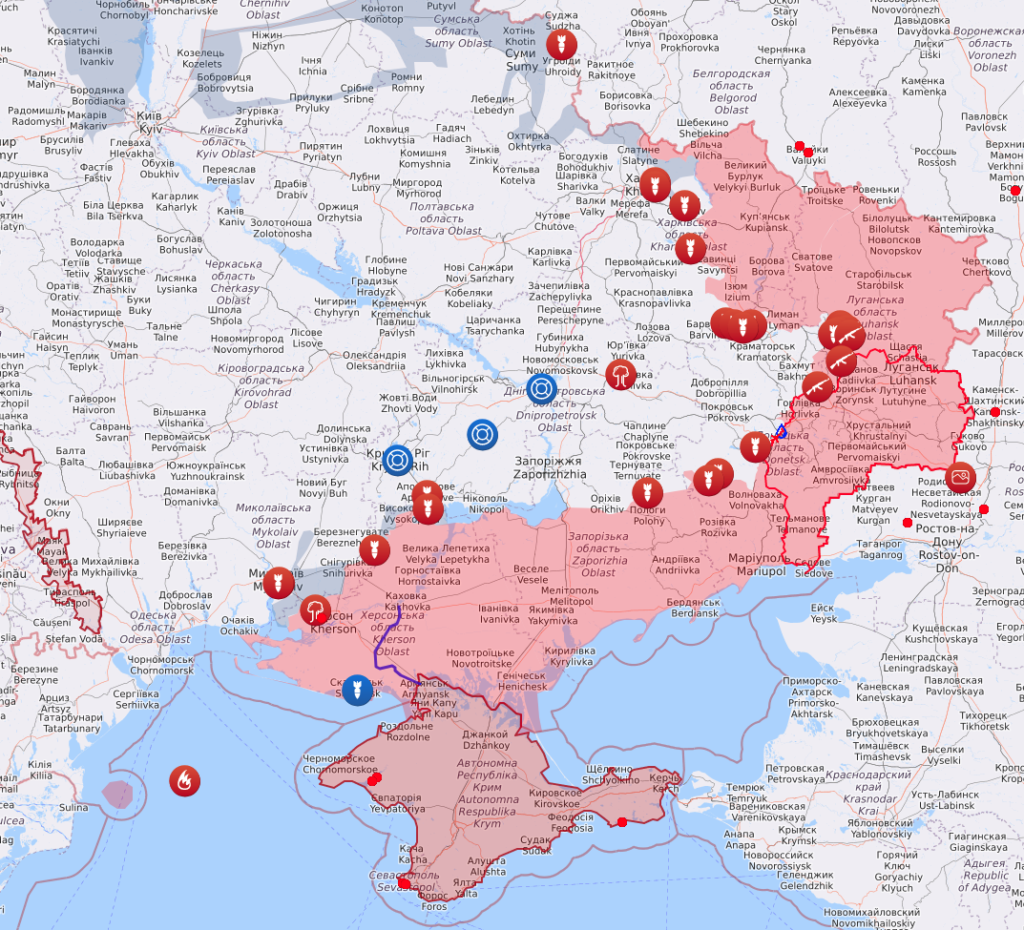
The general course of the Russio-Ukrainian War seems the same (Russia grinding out slow gains in the Severodonetsk front, while Ukraine gains back territory on the wings near Kharkiv and Kherson), but there are a lot of interesting stories out on the periphery of the conflict.
First, the requisite map snap:
(These snapshots are not the end-all and be-all of the situation, but back when I was covering the war against the Islamic State, I found that they were helpful in jogging my memory reviewing the course of the war at later dates.)
Members of the Russian military community continue to comment on the shortcomings of Russian force generation capabilities, which are having tangible impacts on the morale and discipline of Russians fighting in Ukraine. Russian milblogger Yuri Kotyenok claimed that Russian troops lack the numbers and strength for success in combat in Ukraine. Kotyenok accused Russian leadership of deploying new and under-trained recruits and called for replenishment of forces with well-trained recruits with ground infantry experience—though the Russian military is unlikely to be able to quickly generate such a force, as ISW has previously assessed. Despite growing calls for increased recruitment from nationalist figures, Russian leadership continues to carry out coercive partial mobilization efforts that are only producing limited numbers of replacements while negatively impacting the morale and discipline of forcibly mobilized personnel. Ukraine’s Security Service (SBU) claimed that Russian authorities in Luhansk are arranging gas leaks in apartment buildings to force men who are hiding from mobilization into the streets. The Ukrainian Main Intelligence Directorate (GUR) additionally reported that Russian soldiers in occupied Tokmak, Zaporizhia Oblast, are appealing to local Ukrainian doctors to issue them certificates alleging medical inability to continue military service.
Ukrainian forces conducted a drone strike (likely with a loitering munition, though this cannot be confirmed) on a Russian oil refinery in Novoshakhtinsk, Rostov Oblast, on June 22. Russian Telegram channel Voenyi Osvedomitel claimed that the strike, which targeted Russian infrastructure within 15 km of the Ukrainian border, originated from Donetsk Oblast. Ukrainian forces have not targeted Russian infrastructure for several weeks, and this strike is likely an attempt to disrupt Russian logistics and fuel supply to Russian operations in eastern Ukraine.
Though they also note that Russia has been using its anti-air capabilities to better deal with Ukrainian drones.
Well, a June 14 press release from Freeport LNG notes that “the incident occurred in pipe racks that support the transfer of LNG from the facility’s LNG storage tank area to the terminal’s dock facilities. … Preliminary observations suggest that the incident resulted from the overpressure and rupture of a segment of an LNG transfer line, leading to the rapid flashing of LNG and the release and ignition of the natural gas vapor cloud. Additional investigation is underway to determine the underlying precipitating events that enabled the overpressure conditions in the LNG piping.” The statement added that federal authorities were assisting with its investigation.
However, what was not explained is how a critical overpressure event could have occurred without safety systems kicking into action. Two LNG pipeline experts I talked to, who both asked to remain anonymous due to potential retaliatory damage to their business interests, say that pipeline corrosion and other material failures can cause critical incidents. Still, the FBI’s investigative involvement, the specific nature of this explosion, and the scale of damage incurred do raise major questions. The experts suggested that piping from a storage tank to a terminal, as in this explosion, should have extensive safeguards to prevent overpressure events. One expert was highly confident that control of pipeline flows would be undertaken from a networked control facility.
That brings us to the Russian cyber unit involved in the targeting reconnaissance against Freeport LNG.
Named XENOTIME by researchers, the unit has utilized boutique TRITON/TRISIS malware developed by the Russian Ministry of Defense’s Central Scientific Research Institute of Chemistry and Mechanics. That malware is designed for the seizure of industrial control systems and the defeat of associated safety systems. In 2017, GCHQ (Britain’s NSA-equivalent signals intelligence service) outlined the need for network compartmentalization to protect safety systems against this malware better. In March 2022, the FBI warned that TRISIS malware remained a threat.
XENOTIME is assessed by the U.S. and British governments as a critical infrastructure-focused, advanced persistent threat actor. The unit’s modus operandi involves targeting industrial control systems and supervisory control systems in order to effect unilateral control of a network. XENOTIME has caused specific concern in Western security circles for its targeting of safety systems that would otherwise mitigate threats to life during a cyberattack. XENOTIME’s activity has escalated in 2022. Evincing as much, an April 13 U.S. government cybersecurity warning noted, “By compromising and maintaining full system access to [industrial control system]/[safety] devices, [threat] actors could elevate privileges … and disrupt critical devices or functions.”
Snip.
While the Freeport LNG explosion remains under investigation, multiple sources told me they were struck by the overpressure event along a key pipeline transit route and the evident failure of safety systems to engage. This fits with XENOTIME’s modus operandi.
That’s an “interesting but unproven” in my book… (Hat tip: Jim Geraghty at NRO.)
More than 3 tons of gold was shipped to Switzerland from Russia in May, according to data from the Swiss Federal Customs Administration. That’s the first shipment between the countries since February.
The shipments represent about 2% of gold imports into the key refining hub last month. It may also mark a change in perception of Russian bullion, which became taboo following the invasion. Most refiners swore off accepting new gold from Russia after the London Bullion Market Association removed the country’s own fabricators from its accredited list.
While that was viewed as a de facto ban on fresh Russian gold from the London market, one of the world’s biggest, the rules don’t prohibit Russian metal from being processed by other refiners. Switzerland is home to four major gold refineries, which together handle two-thirds of the world’s gold.
Almost all of the gold was registered by customs as being for refining or other processing, indicating one of the country’s refineries took it. The four largest — MKS PAMP SA, Metalor Technologies SA, Argor-Heraeus SA and Valcambi SA — said they did not take the metal.
In March, at least two major gold refineries refused to remelt Russian bars even though market rules permit them to do so. Others, such Argor-Heraeus, said they would accept products refined in Russia prior to 2022, so long as there were documents proving that the gold had not been exported from Russia after beginning of the war, and that accepting them would not benefit Russia, a Russian person or entity anywhere in the world.
he fight for Severodonetsk is a Russian information operation in the form of a battle. One of its main purposes for Moscow is to create the impression that Russia has regained its strength and will now overwhelm Ukraine. That impression is false. The Russian military in Ukraine is increasingly a spent force that cannot achieve a decisive victory if Ukrainians hold on.
Russian President Vladimir Putin is therefore trying to turn his invasion of Ukraine into a brutal contest of wills. He’s betting his army on breaking Ukrainians’ collective will to fight on in their country. His own won’t likely break. Fortunately, Ukraine doesn’t need it to. If Ukrainians can weather the current Russian storm and then counterattack the exhausted Russian forces they still have every chance to free their people and all their land.
Putin amassed the wreckage of Russian combat forces into a lethal amalgam around the cities of Severodonetsk and Lysychansk in Ukraine’s eastern Luhansk Oblast. That amalgam is crawling forward using massive artillery barrages to obliterate everything in its path allowing Russia’s demoralized and frightened soldiers to walk into the rubble.
The Ukrainian defenders are wisely withdrawing in the face of this reckless barbarism, but at a high price to their own morale and their will to continue the fight. Ukrainian soldiers and citizens are criticizing their government for not supporting the troops on the front lines. Ukrainians are starting to doubt that they can prevail for the first time since they won the Battle of Kyiv. Delays in the provision of Western aid and refusals by the U.S. and other countries to provide certain needed weapons systems are helping to fuel those doubts. And now voices are rising in the West calling on Ukraine to offer concessions.
All of which is exactly what Putin needs. He cannot defeat Ukraine militarily as long as Ukrainians retain the will to fight and the West the will to back them. So he attacks the will of both by forcing his own troops into the most vicious and brutal offensive of this war, hoping to persuade everyone that he’s finally harnessed the mass and power of Russia that Stalin wielded to defeat Hitler—and thus that resistance to his demands is futile. Putin also holds hostage critical export supplies of Ukrainian food and fuel, hoping to impose high enough costs on the West to persuade it to abandon Ukraine.
Neither Ukrainians nor their friends around the world must give in to Putin or be deluded by the current mirage of Russian success and power he is presenting in the Battle of Severodonetsk. For mirage it is. Russia’s drive in Luhansk is the desperate gamble of a dictator staking the last of the offensive combat power he can scrape together in hopes of breaking his enemies’ will to continue the fight. and let him claim that he’s taken all of Luhansk Oblast. It is a historical rhyme with Hitler’s determination to seize Stalingrad in 1942 or to hold Kharkov in defiance of his commander’s advice. There are no Russian large reserves coming behind this force to carry its successes forward. On the contrary, Putin has created it only by denuding other key axes of the forces they need to defend against Ukrainian counterattacks. This offensive will likely culminate soon because even this slow, grinding advance will exhaust the forces conducting it. Putin will then be unable to launch another for quite some time.
I thought this would be a longer update, but I’m running out of day…
Lithuania has begun a ban on the rail transit of goods subject to European Union sanctions to the Russian far-western exclave of Kaliningrad, transport authorities in the Baltic nation said on June 18.
The EU sanctions list includes coal, metals, construction materials, and advanced technology.
Anton Alikhanov, the governor of the Russian oblast, said the ban would cover around 50 percent of the items that Kaliningrad imports.
Alikhanov said the region, which has an ice-free port on the Baltic Sea, will call on Russian federal authorities to take tit-for-tat measures against the EU country for imposing the ban. He said he would also seek to have more goods sent by ship to the oblast.
The cargo unit of Lithuania’s state railways service set out details of the ban in a letter to clients following “clarification” from the European Commission on the mechanism for applying the sanctions.
Previously, Lithuanian Deputy Foreign Minister Mantas Adomenas said the ministry was waiting for “clarification from the European Commission on applying European sanctions to Kaliningrad cargo transit.”
The commission stated that sanctioned goods and cargo should still be prohibited even if they travel from one part of Russia to another but through EU territory.
The European Union, United States, and others have set strict sanctions on Moscow for its unprovoked invasion of Ukraine.
As to why Russia ended up with a formerly German enclave between Poland and Lithuania, History Matters provides a handy guide:
The importance to Kaliningrad is that it’s Russia’s only ice-free port on the Baltic Sea and home to the Russian Baltic fleet at Baltiysk.
Anyone who remembers the history of the Cold War knows that there’s no love lost between Lithuanians and Russia.
Peter Zeihan (him again) explains why this is such a big problem for Russia. “Russia is already shitting solid gold kittens over this…in any sort of meaningful conflict between Russia and NATO, Kaliningrad would probably fall in a matter of days if not hours.” So Russia is likely to put in more nuclear missiles.
Plus a bit on Europe abandoning their green delusions to embrace coal, and how German accounting chicanery artificially inflates the amount of renewable energy they’re actually generating and ignore a lot of coal generation for official figures.
The Fed goes Volcker, more Welcome Back Carter cosplay, Big Yellow moves to Texas, and Florida Man makes a run for the ocean.
FYI, Blue Host has been acting weird today, giving errors when you tried to save, even though everything appears to be there upon reloading. (Shrugs.)
Fed hike rates 75 basis points. The attempt to Volckerize inflation during the Biden Recession has begun.
Speaking of St. Volcker, there were a lot of other factors that helped kill inflation in the early 1980s:
Oil was one of the primary causes of the 1970s inflation and everyone remembers the oil crisis. During the decade, oil ran all the way from $2 to $39. However, the flipside to this story is that with a lag, high oil prices will eventually incentivize production. The issue was that the US specifically disincentivized US producers and importers. Ronald Reagan signed an Executive Order in January of 1981 to eliminate oil price controls and then removed Jimmy Carter’s idiotic Windfall Profits Tax a few years later. As expected, global production expanded rapidly and with the removal of price controls, that production flooded into the US. By the middle of the decade, despite repeated production cuts by OPEC, there was a global glut of oil and by 1985, oil had collapsed all the way to $7. It wasn’t interest rates that made oil decline, it was government policy on the deregulation side, along with rapid production increases from non-OPEC countries.
President Reagan’s Economic Recovery Tax Act was signed into law in August of 1981, designed to reduce tax rates and incentivize investment by rewarding risk-taking by businesses. In particular, the Accelerated Cost Recovery System served to accelerate depreciation, reducing taxes for those that invested in productive capacity. Once again, government policy, not interest rates led to an increase in investment and ultimately supply, helping to tame inflation.
It wasn’t just Reagan working on de-regulation; The Staggers Act of October 1980, deregulated the railroads, The Motor Carrier Act of July 1980, deregulated the trucking industry, and the Airline Deregulation Act of October 1978 effectively deregulated transport industries. The net effect was dramatic price competition, better ability to invest and innovate, and the ability to eliminate unprofitable business that was funded by profitable business. Almost immediately after passage, pricing for transport services collapsed and the ease of transporting goods expanded.
Organized labor was also dealt a near-fatal blow when Reagan fired the air traffic controllers in August of 1981. This may have reduced the wages for a generation of middle-class workers, but it sure wasn’t inflationary. It also accelerated the decline of unions which had already peaked out as a percentage of workers. More importantly, it reduced the militancy of unions and took the teeth out of their ability to disrupt businesses, leading to better efficiency and lower costs for consumers.
At the same time, when it comes to macroeconomics, demographics equals destiny. In this case, Volcker simply got lucky. Think of the Baby Boom generation, the last of whom was born in 1964. By 1982, these last Boomers hit 18 and started joining the workforce. The eldest Baby Boomers, born in 1946, were already 36 by then. Look at the massive increase in workers starting in the late 1970s and into the 1980s, which tamped down wages and tamed inflation—especially as female participation in the workforce expanded dramatically. This added labor slowed a key component of the inflation.
The Biden Administration looks capable of pursuing none of those policies, and the Baby Boomers are starting to retire…
How did we get here? Well, in addition to those SUPERgeniuses in the Biden Administration, decades of deficit spending, and loose Fed money printing, there’s the Flu Manchu lockdowns.
For weird reasons, some people, many people, imagined that governments could just shut down an economy and turn it back on without consequence. And yet here we are.
Historians of the future, if there are any intelligent ones among them, will surely be aghast at our astounding ignorance. Congress enacted decades of spending in just two years and figured it would be fine. The printing presses at the Fed ran at full tilt. No one cared to do anything about the trade snarls or supply-chain breakages. And here we are.
Our elites had two years to fix this unfolding disaster. They did nothing. Now we face terrible, grim, grueling, exploitative inflation, at the same time we are plunging into recession again, and people sit around wondering what the heck happened.
I will tell you what happened: the ruling class destroyed the world we knew. It happened right before our eyes. And here we are.
Last week, the stock market reeled on the news that the European Central Bank will attempt to do something about the inflation wrecking markets. So of course the financial markets panicked like an addict who can’t find his next hit of heroin. This week already began with more of the same, for fear that the Fed will be forced to rein in its easy-money policy event further. Maybe, maybe not; but recession appears impending regardless.
The polling error for the 2020 election was roughly 4% nationwide, the largest in the last 40 years.
Fast-forward to today. Inflation is 8+ percent, the price of food and gasoline is way up, crime is up, there is a nationwide shortage of baby formula, and don’t get me started on the border crisis. Yet Joe Biden’s job approval is close to 40% positive. That means almost four out of every ten Americans think Joe is doing a good job if you believe the RealClearPolitics average. And I don’t.
Snip.
If the polls are overestimating approval numbers for Biden and other Democrats, how bad is it? The political climate today is different since the 2020 election, but the Democrat poll bias seems intact, which was 4% nationwide. Since nonresponse bias, 4%, and registered voter bias, 2.6%, should be mutually exclusive, we can add them together. This gives us a total Democrat bias of roughly 6.5%
What does this mean? Until pollsters switch to sampling likely voters right before the election, you can subtract a solid 6 percent from Joe Biden’s approval numbers. And if nothing changes before the election, any Democrat who leads by 3 percent or less is likely to lose.
Texas Attorney General Ken Paxton is enjoying a victory against a Biden administration policy that has allowed illegal aliens to cross the southern border without consequence.
In 2021, President Joe Biden’s Department of Homeland Security issued a rule giving immigration law enforcement officials the power to decide whether or not to detain illegal aliens who attempt to cross the border (in contradiction to federal law, which says they must all be detained).
This policy caught the attention of Texas Attorney General Paxton and Louisiana Attorney General Jeff Landry, who sued to stop the rule change, arguing that Biden was violating federal law when refusing to take custody of criminal migrants.
Paxton bashed President Biden, arguing that the policy was contrary to federal law and was instituted without following the proper procedure. Over a year since the original lawsuit was filed, a federal judge issued a ruling against the Biden administration on Friday.
Federal District Judge Drew Tipton said in his decision that the rule was “an implausible construction of federal law that flies in the face of the limitations imposed by Congress.” Tipton added, “Whatever the outer limits of the authority, the executive branch does not have the authority to change the law.”
After a legal fight lasting almost a year, Texas judges ruled a final judgment banning Biden’s detention-discretion rule.
Speaking of Musk: Several snowflakes working at SpaceX circulated a letter calling Musk “an embarrassment” and demanding the company be more “inclusive.” Result: He fired their ass. Good.
San Antonio symphony orchestra shuts down and files for Chapter 7 bankruptcy. “The last bargaining session between the Symphony Society and the Musicians’ Union took place on March 8, 2022 after which the Union declined to return to the bargaining table, despite efforts of federal mediators and the Symphony. The Musicians’ Union has made it clear there is no prospect of the resumption of negotiations, absent the Board agreeing to a budget that is millions of dollars in excess of what the Symphony can afford.” (Hat tip: Dwight.)