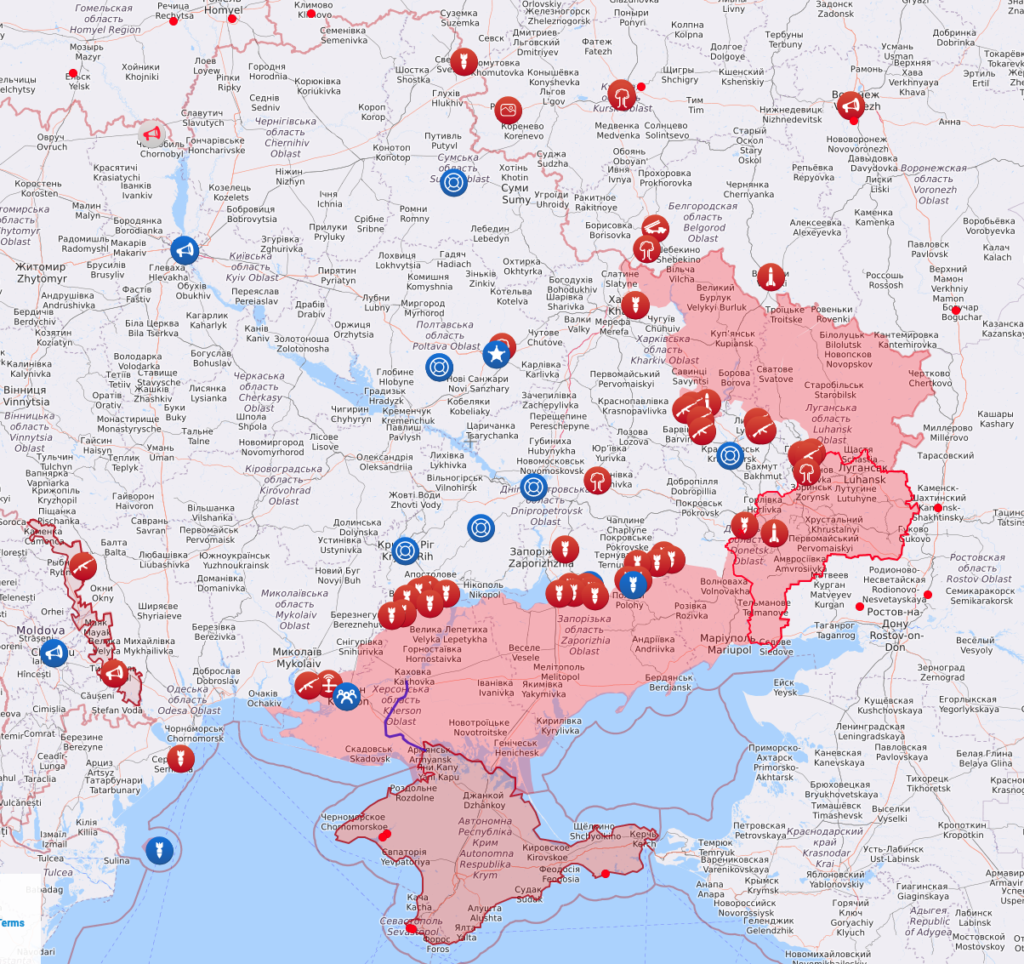
Some significant changes since the last update, mainly that Russian forces have finally taken Mariupol, allowing Russian forces in the east to linkup through Donetsk. But elsewhere a slow, grinding stalemate seems to prevail.
Ukrainian forces have defeated the initial Russian campaign of this war. That campaign aimed to conduct airborne and mechanized operations to seize Kyiv, Kharkiv, Odesa, and other major Ukrainian cities to force a change of government in Ukraine. That campaign has culminated. Russian forces continue to make limited advances in some parts of the theater but are very unlikely to be able to seize their objectives in this way. The doctrinally sound Russian response to this situation would be to end this campaign, accept a possibly lengthy operational pause, develop the plan for a new campaign, build up resources for that new campaign, and launch it when the resources and other conditions are ready. The Russian military has not yet adopted this approach. It is instead continuing to feed small collections of reinforcements into an ongoing effort to keep the current campaign alive. We assess that that effort will fail.
The ultimate fall of Mariupol is increasingly unlikely to free up enough Russian combat power to change the outcome of the initial campaign dramatically. Russian forces concentrated considerable combat power around Mariupol drawn from the 8th Combined Arms Army to the east and from the group of Russian forces in Crimea to the west. Had the Russians taken Mariupol quickly or with relatively few losses they would likely have been able to move enough combat power west toward Zaporizhiya and Dnipro to threaten those cities. The protracted siege of Mariupol is seriously weakening Russian forces on that axis, however. The confirmed death of the commander of the Russian 150th Motorized Rifle Division likely indicates the scale of the damage Ukrainian defenders are inflicting on those formations. The block-by-block fighting in Mariupol itself is costing the Russian military time, initiative, and combat power. If and when Mariupol ultimately falls the Russian forces now besieging it may not be strong enough to change the course of the campaign dramatically by attacking to the west.
Russian forces in the south appear to be focusing on a drive toward Kryvyi Rih, presumably to isolate and then take Zaporizhiya and Dnipro from the west but are unlikely to secure any of those cities in the coming weeks if at all. Kryvyi Rih is a city of more than 600,000 and heavily fortified according to the head of its military administration. Zaporizhiya and Dnipro are also large. The Russian military has been struggling to take Mariupol, smaller than any of them, since the start of the war with more combat power than it is currently pushing toward Kryvyi Rih. The Russian advance on that axis is thus likely to bog down as all other Russian advances on major cities have done.
The Russian military continues to commit small groups of reinforcements to localized fighting rather than concentrating them to launch new large-scale operations. Russia continues to commit units drawn from its naval infantry from all fleets, likely because those units are relatively more combat-ready than rank-and-file Russian regiments and brigades. The naval infantry belonging to the Black Sea Fleet is likely the largest single pool of ready reserve forces the Russian military has not yet committed. Much of that naval infantry has likely been embarked on amphibious landing ships off the Odesa coast since early in the war, presumably ready to land near Odesa as soon as Russian forces from Crimea secured a reliable ground line of communication (GLOC) from Crimea to Odesa. The likelihood that Russian forces from Crimea will establish such a GLOC in the near future is becoming remote, however, and the Russian military has apparently begun using elements of the Black Sea Fleet naval infantry to reinforce efforts to take Mariupol.
The culmination of the initial Russian campaign is creating conditions of stalemate throughout most of Ukraine. Russian forces are digging in around the periphery of Kyiv and elsewhere, attempting to consolidate political control over areas they currently occupy, resupplying and attempting to reinforce units in static positions, and generally beginning to set conditions to hold in approximately their current forward positions for an indefinite time. Maxar imagery of Russian forces digging trenches and revetments in Kyiv Oblast over the past several days supports this assessment.[1] Comments by Duma members about forcing Ukraine to surrender by exhaustion in May could reflect a revised Russian approach to ending this conflict on terms favorable to Moscow.
Stalemate will likely be very violent and bloody, especially if it protracts.
What the invasion revealed about the Russian military:
Lots of problems, including a reiteration of the inability of the Russian air force to conduct combined arms operations, especially given their limited flight training (8 hours a month).
Speaking of limitations:
#Russia's active tank fleet is actually not 12,000 strong. In reality it is just over 2,500. By active tanks I mean tanks that are actually in service in an organised unit (i.e. a tank battalion, regiment, brigade etc.) and are not undergoing field tests (T-14 Armata). pic.twitter.com/fJYrGjc5L4
Lots of tweets wonder aloud why there have been no confirmed T-14 Armata sightings in theater in Ukraine. We’ll know Russia is really desperate if they start hauling T-64s out of mothballs and into service. (Ukraine actually has a lot of modernized T-64 Bulats, as the original T-64 factory is there.)
“We Have Questions About Russia’s Claimed Kinzhal Hypersonic Missile Use In Ukraine.” “In the end, not everything adds up here. That’s just the reality. It is just as possible we are seeing a standard Iskander-M attack in the video as one by Kinzhal.” Russia had produced an awful lot of vaporware when it comes to wonderwaffen, and it wouldn’t surprise me to see their hypersonic missile fall into this category.
And since we’re talking hypersonic and eastern Europe:
Ukrainian civilian drone enthusiasts are carrying out realtime coordinated reconnaissance on Russian troops:
News from St. Petersburg:
St Petersburg, Russia tonight chanting "No to war", "Shame", and "Ukraine is not our enemy!" Russia has been arresting protesters all day and yet the crowd has grown. pic.twitter.com/V6ZtOIam2t
Will the international community’s sanctions succeed in bringing Russia to heel? Completely cutting them off from the world banking system has the potential to do a lot more damage to Russian oligarchs than previously, but it’s important to remember that the Russian economy was already sucking.
Some takeaways:
Russia’s transition to a market economy was badly bungled, with state enterprises being sold off to those well-connected oligarchs rather than people that could actually grow and modernize industry.
Foreign firms were largely excluded from the privatization process.
Lots of oligarchs took a look at the sad state of the Russian economy in the 1990s, and decided it was safer to park their money outside the country (hence all those Russians buying houses in London).
Russia still managed a lot of economic growth in the early 21st century, and was helped by rising oil prices.
By contrast, Russian banks were still so primitive that they weren’t hurt by the subprime meltdown of 2008, since they weren’t exposed to subprime mortgage bundles or derivatives. But they were hurt quite a bit by the subsequent decline in oil.
Limited economic sanctions following the invasion of Crimea did very little, because Russia was prepared for it with considerable foreign currency reserves, and most sanctions were quickly rolled back.
“Russia has never been a real democracy.”
Per capita GDP has dropped from $16,000 in 2013 to just over $10,000 today.
“Corruption, mismanagement and warmongering are rarely a recipe for success.” The Russian shrunk over the past decade.
There are a lot of small countries, especially in the southern and eastern areas of Europe for whom [a Russian invasion] may not have been a plausible scenario two weeks ago, but it’s kind of looking like one now. And if you are a small country close to the borders of Russia, you’re in this difficult defensive position. None of these countries have a military that can, with a straight face, suggests that it could simply put up a toe-to-toe, stand their ground fight and defeat a military the size of the Russian army.
I’m going to point out that this is not necessarily true. Finland did it in The Winter War in 1939-1940. But he gets to that.
Yet you want you have to provide some sort of plausible threat to an invading occupier like Russia to avoid being invaded in the first place. The whole point is that the best possible success in repulsing an invasion is to not get invaded in the first place. So how can you convince a country like Russia that your very small little republic is not worth invading, that it is too difficult to invade? A lot of these countries are looking around, and going “Would NATO actually step up and help us directly, help defend us in case of an invasion? Any maybe NATO would, maybe NATO wouldn’t.”
One big solution is civilian military firearms ownership and preparedness. And here modern Finland comes up:
There is a specific division called SRA which is essentially reservists shooting society, and it is it’s actually technically in some cases for gun, rifle, pistol, shotgun and precision rifle. In competition it requires competitors to essentially carry a military loadout; they have to wear armor, they have to carry water, they have to carry a minimum amount of ammunition during the stages…It’s specifically to encourage military readiness .
“Having a large community of competent civilian marksmen is something that can contribute a very real deterrent to invasion.”
True. Every nation in Europe should make civilian firearms ownership more widely and legally available, for this and other reasons.
Busy day, so enjoy another Ukraine video. This is a good summary of the fight up until now:
Some takeaways:
We know what Russian plans were, based on captured documents and a pre-written “analysis” of Russia’s glorious victory someone found on file on a web server.
They expected to be at the gates of Kiev in three days and have everything conquered in two weeks.
Well, we’re almost two weeks in, and they haven’t achieved any of their major objectives. All major cities remain in Ukrainian hands.
One reason they didn’t: NATO alerted them to impending Russian action slightly before it began, so many commanders and units were already dispersed from bases.
They didn’t have enough trucks to begin with and have already lost 200 more.
Also, not only is the Ukrainian mud all but impassable, but their truck tires really suck. (More on this in a day or so.)
We need to pay more attention to the south, where Russian troops attacking from Crimea have done better (but still not great).
Time is not on Russia’s side, as sanctions are crashing their economy hard.
I’ve touched on some of the logistical difficulties Russia has experienced in its Ukrainian invasion. But this video goes into more detail about how Russia built up logistical support for the invasion, the importance of its rail systems, and how it hasn’t been able to keep up post-invasion.
Some takeaways:
Ukrainian forces destroyed all rail links between the two countries.
Russian forces are relying on analog, unsecured radio communications rather than scrambled digital channels, and Ukrainian forces are listening in and jamming.
Poor logistics also helped Soviet forces lose in Afghanistan.
Russia has 30,000 strong military rail organization.
“Russia doesn’t have enough trucks.” They can’t operate effectively more than 90 miles from supply dumps.
A large percentage of truck transport was dedicated to rocket resupply, not fuel and food.
Russia only had 3-5 days of supplies when they invaded. When those ran out, they were screwed.
Russia’s military works on a “push” logistic system rather than a “pull” system used by the U.S. military, meaning it’s not very flexible.
Russia has the capability to set up the infrastructure for a longer war, but it’s going to take time.
Russia’s failure to quickly achieve it’s objectives has seen it resort to more desperate and indiscriminate tactics.
And here’s a related Twitter thread that touches on rail network logistic issues.
The most logistically dangerous axis is east-west, because the rail runs that way direct from Russia without worrying about a seaport and sealift. That doesn't mean a southern thrust isn't dangerous but the UA must prioritize.
Mary Katharine Ham has some choice words for members of the Democratic Media Complex who still don’t seem to understand why parents are so mad at them.
The doors of the school weren’t always closed! No, no, no! No, they opened public school buildings to paid child care programs so that the parents who weren’t getting the school that they paid for in taxes could pay more money to send their kids to a school building where they would be taught on zoom by teachers who weren’t there, while being supervised by people who were willing to be there. I can’t express how angry that made people. Meanwhile, school boards are renaming school buildings to right our historic wrongs and buying electric school buses.
They sent email after stupid email about how they might let your kids come back to school on such and such date, and you’d tell your kids, and they’d be excited, and then they backed out at the last minute, sending you a 7 PM email leaving you with no way to plan for the next day, over and over again.
“And the icing on this just terrible cake was that when parents had the temerity to get upset about any of this, they were treated like crap.”
“Hand me my mimosa, bitches, because this ride has just begun.”
Russia’s invasion of Ukraine grinds on, Hunter Biden’s bestie’s going to the big house, a massive voting problem (and possible fraud) winds up in court in Harris County, and a tiny bits on both Amazon and anime.
It’s the Friday LinkSwarm!
Not in this LinkSwarm: links on the Zaporizhzhia Ukrainian nuclear reactor, since I’m not sure I can trust any of the information sent out by either side.
It is not foreordained that Russia wins and Ukraine loses. Winning a war is not merely an exercise in numbers or technology. As General George S. Patton observed, “Wars may be fought with weapons, but they are won by men. It is the spirit of men who follow and of the man who leads that gains the victory.”
Since Russian President Vladimir Putin failed to quickly topple the Ukrainian government and kill President Volodymyr Zelenskyy, the war has widened into a contest involving almost the entire border region shared by the combatants along with the stretch of border between Belarus and Kyiv some 80 miles to the north of Ukraine’s capital city.
Much media attention has been given to Russia’s advances along the Sea of Azov in the south and on the approach to Ukraine’s third-largest city, Odessa, on the shores of the Black Sea as well as the remarkable attack that captured Europe’s largest nuclear power plant in Zaporizhzhia. These Russian successes are discouraging for Ukrainian defenders but, in the grand contest, they matter far less than the battle for Kyiv.
Snip.
There are fascinating signs coming out of what may be a decisive battle to the northwest of Kyiv on the long, winding, secondary road from Chernobyl. This is the road where a 40-mile-long column of Russian vehicles was spotted by satellite. Most of the vehicles are supply trucks. They would be carrying fuel, ammunition, and food for the Russian forces that have advanced to the very outskirts of Kyiv itself but have seemingly been stalled for several days.
Snip.
Out of this come three reports that, if true, suggest the beginnings of a devastating reversal for Russian forces operating northwest of Kyiv.
First, reports today in multiple outlets that Russian Major General Andrei Sukhovetsky was killed in combat by a sniper. Sukhovetsky, 47, was an elite Russian Spetsnaz commando and veteran of Russia’s war in Syria. The commander of the Russian 7th Airborne Division, he was assigned the mission of leading the Russian thrust from Belarus to Kyiv. Men like Sukhovetsky have an outsized presence on the battlefield. They’re inspirational. Their personal leadership at the point of the spear often means the difference between victory and defeat during the fast-paced controlled violence of war. His loss would be devastating to his men and to the organizational momentum of the forces he commanded.
That Sukhovetsky was killed by a sniper suggests that he was personally trying to regain the initiative against Ukrainian forces who had fought him to a standstill.
The second report of merit is the heavy damage sustained in the town of Irpin on the northwest border of Kyiv’s city limits. The damage to this city suggests a major battle — an effort by the Russians to breakthrough. They didn’t.
The final piece of the puzzle is the Battle of Bucha. Ukrainian forces claimed the recapture of Bucha hours after the devastation visited on Irpin. The timing is important here. The Russians tried and failed to take Irpin and then the Ukrainians retook Bucha two miles to the northwest of Irpin.
The roughly 80-mile route from the Belarus-Ukraine border from the Chernobyl salient to Kyiv on the western side of the Dnieper River runs over a secondary asphalt road. This road frequently crosses rivers, runs through small villages, or is bordered on both sides by the eastern extent of the mighty Pripyat Marsh — the geographical feature which defines the border between Ukraine and Belarus.
The road is not able to support a large military force, even if unopposed in an exercise, especially during the spring and fall months during a time the locals call “Rasputitsa” — the mud season. Unfortunately for Russian President Vladimir Putin and his military commanders, Ukrainian soil never froze solid this winter, so the fall Rasputitsa is still a factor.
This is why there have been so many photos coming out from the conflict that show all manner of Russian military vehicles bogged down in the mud. As soon as a vehicle on a narrow road becomes disabled or is destroyed in combat, or as the vehicles maneuver off-road in response to combat, they risk becoming mired. Even if they don’t get stuck in the mud, they end up consuming far more fuel that must be delivered to them than they would were the ground frozen solid.
Thus, that 40-mile-long column of “tanks” is more likely mostly trucks carrying fuel, ammunition, and food to the advanced forces of the Russian 20th Combined Arms Army on the outskirts of Kyiv. That this column hasn’t apparently moved much may mean that the Russian forces just north of Kyiv are running low on basic supplies.
This greatly increases the importance for the Russian army to achieve success to the east of Kyiv where the road network is far more developed and, if the terrain is captured and secured, capable of bringing in the volume of supplies needed to properly surround Kyiv and place it under siege.
In the meantime, the forces near Kyiv may be vulnerable to a Ukrainian counterattack. While some of the Russian conscript soldiers and even the veteran contract troops may be more likely to surrender due to low morale exacerbated by a lack of food and fuel.
In about three weeks, we’ve seen a Vladimir who was “off” go from chess to raising on a busted flush in something that is well beyond “off.” The nuclear escalation is not exactly unexpected, at least if you know a bit about the Soviet playbook for such things. What matters is if he still has full control, and/or the extent to which Dead Hand has been brought online. All I will say is that if his ability to give certain orders has been unofficially curtailed, it would not be the first time. If it hasn’t, it is not a good idea to poke the crazy man with the button via official actions.
And there are a lot of official actions out there that are not going to help in regards the deteriorating man. Among others is Switzerland deciding that they are neutral, but not that neutral. Add to it firm allies who have told him no, even after he just helped them out literally a few weeks ago… Even Xi has said no on some fronts. None of this is likely to slow down the deterioration. Or provide enough of a reality check to get through to him as he rages in his bunker with his captive oligarchs.
And while we are at it, let’s look at the attack itself and the absolute fuck up that it, and subsequent actions by STAVKA (call it what it is), truly are. It was billed as a demonstration of the new Russian way of war, their version of “Shock and Awe.” Problem is, S&A or any other form of blitz is heavily dependent upon superior logistics, something the Soviets nor the Russians have ever had. You need massive amounts of ammo, fuel, parts, and replacement troops to pull it off. Replacement troops not only because of losses, but the need to detail out troops to hold key points as you go. It also requires highly trained troops who know land nav inside and out.
From what I am learning, the order went out to make this happen. The actual order, however, may not have even approached what would be given for a small-unit special ops strike. Contingency plans? Decap. No? Then try for decap again. Decap. Decap. Try it again damnit! There are differing reports on the number of Wagner troops killed or captured, but a good number were sent in on assassination missions. They were not alone. Problem was, they were all alone as the original push down got bogged down; the efforts to do airmobile and airborne ops were shot down (literally in some cases); and, the public is now on high alert to the saboteurs and assassins roaming major cities trying to mark targets, etc. Don’t expect rules of war for those caught marking civilian buildings for strikes. For now, expect a return to grinding Soviet bombardment, civilian casualties be damned.
The fact is, Vladimir has already lost simply because he didn’t win. He is committed, and is committing Russia and all its people, to a long, grinding, bloody slog that is going to have severe economic impacts. Just replacing ammunition, gear, people, is going to have a severe impact. Add to it the growing official and unofficial sanctions? The Russian people are going to feel this one, in ways they never have before. Current Vladimir does not care. He’s lost to that. He has no way to go in and control the country, or even the parts he’s tried so desperately to annex. Even those are likely to slip from him given the current state of “uppitiness” on the part of the Ukrainians.
The Ukrainians have not won. At best they have pushed things into a long grind with some chance of a stalemate. Yet, by doing this they have won. They have prevented the cheap and easy victory on which Vladimir counted. They have forced him into committing military and economic resources he does not have over the long term. Heck, even the short term. Russia’s economy was already teetering, current operations and responses are going to crater it unless something major happens. I’ve lived through a couple of power struggles in the Kremlin; under these circumstances, I hope we all do live through what is to come. A quick clean change of leadership seems unlikely given the Keystone gang we’ve seen so far, but it may be our best hope.
All we can do is wait and see what happens. While current circumstances are not new or unique on many levels, I will note that in my lifetime I’ve never seen a situation like this where key leadership was this insecure. Xi is in some ways hanging by a thread, and knows his enemies in the CCP are looking for any excuse to bring him down. Vladimir we’ve discussed. The Europeans, particularly the Germans? They are not secure either, especially since the Green policies have caused them to firmly place their mouth around Putin’s, er, finger, in regards energy. To see them decide to fund their own military, back off on the idiocy of green (maybe), and truly support the Ukraine strikes more as a desperation move than a rational push. Johnson is a non-entity right now, and not to be taken seriously. Our own dementia patient? Hell, he’s just waiting for his ice cream and to be allowed to go back upstairs to watch Matlock. Those behind him, however, are desperate beyond belief. Not one major stable leader anywhere in the world. That’s a new one and I thought I had about seen it all after watching the Soviets/Russians for more than 40 years now.
No NATO no-fly zone. Good. I very much want to see Putin defeated, but clearly NATO can’t be expected to respond to an attack on a non-member country, and that would be a dangerous escalation.
“More than a year” for $60 million in fraud? Seems a little lite.
The defendant, Devon Archer, was sentenced to one year and one day in federal prison by Manhattan Judge Ronnie Abrams, who said the crime was “too serious” to let him just walk.
“There’s no dispute about the harm caused to real people,” Abrams said, noting that the defrauded tribe, the Oglala Sioux, is one of the poorest in the nation.
Archer will also have to pay more than $15 million in forfeiture by himself and more than $43 million in restitution with his co-defendants in the case.
The convicted fraudster has maintained his innocence and intends to appeal the conviction and sentence, his attorney, Matthew Schwartz, said in court Monday.
In brief statements to Abrams just before Archer was sentenced, he and Schwartz claimed he was taken advantage of by corrupt businessmen who wanted to use him in the scheme.
“He came under the influence of a person he trusted too much and didn’t ask enough questions,” Schwartz said.
“Trusted too much.” Yeah, he trusted he wouldn’t get caught because of his powerful friends.
What are the odds this was the only crooked deal Archer had his fingers into? I’d say pretty close to zero.
The Democrats will suffer historic losses in the November midterms.
This disaster for their party will come about not just because of the Afghanistan debacle, an appeased Vladimir Putin’s invasion of Ukraine, the destruction of the southern border, the supply chain mess, or their support for critical race theory demagoguery.
The culprit for the political wipeout will be out-of-control inflation—and for several reasons.
First, the Biden Administration is in such denial of inflation that it sounds to Americans simply callous and indifferent to the misery it has unleashed.
Biden officials have scoffed at price spikes as “transitory.” Or they have preposterously claimed spiraling costs are a concern only to the elite. They blame the Ukraine crisis. Or they fault the out-of-office bogeyman, Donald Trump.
The administration assures us that consumer prices are only rising at an annualized rate of 7.5 percent—as if the steepest increase in 40 years actually is not all that bad.
Yet the middle class knows that inflation is far worse when it comes to the stuff of life: buying a house, car, gas, meat, or lumber.
Second, inflation is an equal opportunity destroyer of dreams. It undermines rich and poor, Democrats and Republicans, conservatives and liberals. It unites all tribes, all ideologies, all politics against those who are perceived to have birthed the monstrous octopus that squeezes everything and everyone it touches.
The conservative passbook holder sees his meager life savings eaten away. The liberal teacher’s car payments stretch from six to 10 years.
The prospective Republican home buyer sees his hard-earned potential down payment eaten away each month. The Democratic carpenter feels his new higher wages buy even less.
Third, inflation is ubiquitous, inescapable, omnipotent—and humiliating. It destroys personal dignity. And its toxicity is insidious, sort of like seeping, odorless, colorless, but nevertheless lethal carbon monoxide.
Unlike now-unpopular critical race theory, it cannot be avoided for a day. You cannot tune it out like one does the mess in Afghanistan or the now nonexistent southern border. Inflation attacks everyone in 24/7, 360-degree fashion.
It belittles you at the gas station. It downsizes you at the food market. It humiliates you in the obscene real estate market. It makes you look stupid when you are paying for a new car. It ridicules you when you buy lumber. Suddenly you apologize that you really cannot afford your child’s braces.
Fourth, inflation undermines a civil and ordered society. It unleashes a selfish “every man for himself” mentality, the Hobbesian cruelty of a “war of all against all.”
Inflation is the economic and emotional equivalent of smash-and-grab or carjacking. It is a brazen robber in broad daylight that so infuriates Americans by its boldness. It convinces them their very civilization is dying.
“Federal Court Declares Diversity Initiative At Thomas Jefferson High School To Be Unconstitutional.” “Judge Claude Hilton ruled that the county unconstitutionally engineered the reduction of Asian-American students to achieve greater racial diversity.”
Did you know that one of the biggest freight management companies in America was temporarily locked down by a cyberattack? “Expeditors International, a top-five freight management company by revenue, disclosed Wednesday that last month’s cyberattack will have a “material adverse impact” on finances and that it will be late filing its 2021 annual report because of difficulty accessing information on its accounting systems.”
Once again Harris County has drawn scrutiny over a slew of election day problems and may need a court order to continue counting votes beyond a state proscribed deadline.
Issues with elections procedures began days before March 1 as election judges found that supplies were not available for pickup at the appointed time on Friday, February 25. Even after the delayed distribution of supplies on Saturday, election workers complained that many kits were lacking essential equipment.
The situation worsened by Tuesday, and during a conference call with the Texas Secretary of State’s Office (SOS) and representatives from the local Democratic and Republican parties, Elections Administrator Isabel Longoria notified the state that her department may not be able to count all early and election day ballots by the statutory deadline of 7 p.m. Wednesday, March 2.
According to a statement from Secretary of State John Scott, the counting delay was “due only to damaged ballot sheets that must be duplicated before they can be scanned by ballot tabulators at the central count location.”
“Our office stands ready to assist Harris County election officials, and all county election officials throughout the state, in complying with Texas Election Code requirements for accurately tabulating and reporting Primary Election results. We want to ensure that all Texans who have cast a ballot in this year’s Primary Elections can have confidence in the accuracy of results.”
According to the state election code, however, any votes counted after the statutory deadline may not count unless the county obtains a court order. Furthermore, under laws in effect since 1986, failure to deliver precinct election returns by the deadline is a Class B misdemeanor.
Calling the county’s elections problems the “worst in 40 years,” Harris County Republican Party (HCRP) Chair Cindy Siegel told KPRC news, “This has been a complete mess. We’ve had equipment delays, we’ve had equipment problems, equipment wasn’t delivered, we had polls that were unable to be set up.”
In a statement to The Texan, HCRP said that after consulting with the SOS, “if the count does not appear to be near completion in all races by [Wednesday] afternoon, the parties have tentatively agreed to seek a court order to require the Harris County Election Administrator to continue counting beyond the 24-hour deadline required by law, and to enjoin the law to allow the count to continue.”
Responsibility for conducting primary elections falls to the two main political parties, but they have contracted with the Harris County elections division to administer the elections.
Sen. Paul Bettencourt (R-Houston) who formerly served as the Harris County voter registrar, called for immediate changes to the elections division.
“[Harris County Judge] Lina Hidalgo must fire her hand-picked election administrator,” Bettencourt told The Texan. “Because if she doesn’t, I don’t think we’re going to have an election in November.”
In 2020, the three Democrats on the Harris County Commissioners Court overruled objections from two Republican commissioners and the Democrat elected voter registrar Ann Harris Bennet to create the new office of elections administrator. Prior to the revamp, the elected county clerk and elected voter registrar managed elections in the state’s largest county.
The commissioners court then appointed Longoria, a former staffer for state Sen. Sylvia Garcia (D-Houston) who had previously run unsuccessfully for Houston City Council, with an annual salary of $190,000.
Under Longoria’s guidance, the county approved $54 million for the elections division last summer which included $14 million to purchase new voting equipment.
Earlier this year, Longoria told commissioners the March primary would cost more than $8.8 million.
In 2020, Harris County received nearly $10 million in grants from Mark Zuckerberg’s Center for Tech and Civic Life and another $1 million in 2021 just before the Texas Legislature restricted such private grants.
According to sources familiar with the equipment, the second page of the paper ballot has been jamming machines and now requires entry by hand. Allegedly, although the early voting period ended Friday,
The question, of course, is whether this is a sign of manifest incompetence, or a sign of widespread attempted vote fraud?
If it was a fraud attempt, we should be grateful that it was bungled so badly in the primary that a lot more attention will be paid.
And the judge didn’t sound pleased:
Update: the "court finds it is required…to impound the precinct election materials in the possession of Ms. Longoria and her staff and for the court to supervise the activities necessary to complete the count…" https://t.co/h1FL7F5XTn
Iowa Republican Governor Kim Reynolds signs bill banning men from women’s sports. I’ll take “Headlines no one would understand 20 years ago” for $400, Alex.
Democratic Party Gaslighting: The Continuing Journeys:
The party that painted this now wants you to believe they support Law Enforcement. Americans won’t forget this — especially not on Election Day. pic.twitter.com/nCBkDmI6yf
— Kari Lake for AZ Governor (@KariLake) March 3, 2022
The Russian offensive in Ukraine continues to bog down against stiff resistance, Putin puts his nukes on alert, a rumor of peace talks, momentum to suspend some Russian banks from SWIFT builds, and a whole lot of aid from the rest of the world is pouring into Ukraine.
Russia invaded Ukraine from three sides on Wednesday night Eastern time, and as of now, early afternoon Saturday, the Russian army has yet to seize any Ukrainian cities.
This morning, a senior defense official at the Pentagon briefed reporters and declared, “We continue to believe, based on what we have observed that this resistance is greater than what the Russians expected and we have indications that the Russians are increasingly frustrated by their lack of momentum over the last 24 hours particularly in the north parts of Ukraine… As of this morning we have no indication still that the Russian military has taken control over any cities. As of this morning we still believe that Russia has yet to achieve air superiority. Ukrainian air defenses including aircraft do continue to be operable and continue to engage and deny access to Russian aircraft in places over the country.”
There is an intriguing but unverified claim from Ukrainian intelligence that Putin is furious, that he expected a quick surrender from Kiev, and that the invading Russian forces weren’t equipped for a long war – and that after ten days, the Russian forces will face serious problems with supply lines, fuel, equipment, ammunition, etc. Maybe this is just Ukrainian propaganda, meant to keep up morale for the next week or so. But there are some intriguing anecdotes of Ukrainians hitting Russian supply columns and videos of Russian tanks running out of fuel. (It turns out supply chain problems are just everywhere these days!)
Sending in armored columns without dedicated infantry, artillery and air support is a big risk, big reward move. Patton did it successfully in the race across France in 1944, but he had air superiority, a friendly population, and the greatest war machine ever assembled in the history of mankind up to that time backing him, and even he had to halt when he outran his supply lines.
Putin’s initial goal, the Russian reabsorption of Ukraine or the transformation of it into a lackey state of a renewed Russian empire, is now probably impossible. Any Russian-backed Ukrainian puppet government is likely to be vehemently rejected by the Ukrainian people. Russian forces will find it difficult to go out on patrol when every citizen’s got a rifle and every grandma on every street corner is handing them sunflower seeds, telling them they are going to be fertilizer soon.
Russia may take large chunks of Ukraine, but they will have an exceptionally difficult time keeping it.
The last three days of combat should put a serious dent in the reputation of this new Russian army. We should, however, try to understand why the Russians are struggling. First, the Russian army’s recent structural reforms do not appear to have been sufficient to the task at hand. Second, at the tactical and operational level, the Russians are failing to get the most out of their manpower and materiel advantage.
There has been much talk over the last ten years about the Russian army’s modernization and professionalization. After suffering severe neglect in the ’90s, during Russia’s post-Soviet financial crisis, the army began to reorganize and modernize with the strengthening of the Russian economy under Putin. First the army got smaller, at least compared to the Soviet Red Army, which allowed a higher per-soldier funding ratio than in previous eras. The Russians spent vast sums of money to modernize and improve their equipment and kit — everything from new models of main battle tanks to, in 2013, ordering Russian troopers to finally retire the traditional portyanki foot wraps and switch to socks.
But the Russians have also gone the wrong direction in some areas. In 2008, the Russian government cut the conscription term from 24 to twelve months. As Gil Barndollar, a former U.S. Marine infantry officer, wrote in 2020:
Russia currently fields an active-duty military of just under 1 million men. Of this force, approximately 260,000 are conscripts and 410,000 are contract soldiers (kontraktniki). The shortened 12-month conscript term provides at most five months of utilization time for these servicemen. Conscripts remain about a quarter of the force even in elite commando (spetsnaz) units.
As anyone who has served in the military will tell you, twelve months is barely enough time to become proficient at simply being a rifleman. It’s nowhere near enough time for the average soldier to learn the skills required to be an effective small-unit leader.
Yes, the Russians have indeed made efforts to professionalize the officer and the NCO corps. Of course, non-commissioned officers (NCOs) have historically been a weakness of the Russian system. In the West, NCOs are the professional, experienced backbone of an army. They are expected to be experts in their military speciality (armor, mortars, infantry, logistics, etc.) and can thus be effective small-unit commanders at the squad and section level, as well as advisers to the commanders at the platoon and company level. In short, a Western army pairs a young infantry lieutenant with a grizzled staff sergeant; a U.S. Marine Corps company commander, usually a captain, will be paired with a gunnery sergeant and a first sergeant. The officer still holds the moral and legal authority and responsibility for his command — but he would be foolish to not listen to the advice and opinion of the unit’s senior NCOs.
The Russian army, in practice, does not operate like this. A high proportion of the soldiers wearing NCO stripes in the modern Russian army are little more than senior conscripts near the end of their term of service. In recent years, the Russians have established a dedicated NCO academy and cut the number of officers in the army in an effort to put more resources into improving the NCO corps, but the changes have not been enough to solve the army’s leadership deficit.
Now, let’s talk about the Russian failures at the operational and tactical level.
It should be emphasized again that the Russian army, through sheer weight of men and materiel, is still likely to win this war. But it’s becoming more and more apparent that the Russians’ operational and tactical choices have not made that task easy on themselves.
First, to many observers, it’s simply shocking that the Russians have not been able to establish complete air superiority over Ukrainian air space. After three days of hostilities, Ukrainian pilots are still taking to the skies and Ukrainian anti-air batteries are still exacting a toll on Russian aircraft. The fact that the Russians have not been able to mount a dominant Suppression of Enemy Air Defenses (SEAD) campaign and yet are insistent on attempting contested air-assault operations is, simply put, astounding. It’s also been extremely costly for the Russians.
To compound that problem, the Russians have undertaken operations on multiple avenues of advance, which, at least in the early stages of this campaign, are not able to mutually support each other. Until they get much closer to the capital, the Russian units moving north out of Crimea are not able to help the Russian armored columns advancing on Kyiv. The troops pushing towards Kyiv from Belarus aren’t able to affect the Ukrainians defending the Donbas in the east. As the Russians move deeper into Ukraine, this can and will change, but it unquestionably made the opening stages of their operations more difficult.
Third, the Russians — possibly out of hubris — do not appear to have prepared the logistical train necessary to keep some of their units in action for an extended period of time. Multiple videos have emerged of Russian columns out of gas and stuck on Ukrainian roads.
The classic saying is “Amateurs talk about tactics, but professionals study logistics” (attributed to Marines Corps commander Gen. Robert H. Barrow, but I suspect the general sentiment is much older). An army runs on its stomach, and a modern mechanized army runs on its gas tank, and something has clearly gone wrong in with Russian logistical support for this war.
Russia seemed to have expected Ukrainian President Volodymyr Zelenskyy to fold. He hasn’t.
America offered to evacuate Ukrainian President Volodymyr Zelenskyy. Zelenskyy replied, “The fight is here; I need ammunition, not a ride.”
Zelenskyy’s reply was reminiscent of past heroes in times of war: Gen. Anthony McAuliffe who replied in “NUTS” in response to the German demand for surrender at Bastogne during the Battle of the Bulge in 1944; and the Texans striving for independence from dictator Santa Anna’s Mexico with their “Come and Take it Flag,” which was itself appropriated from Spartan King Leonidas and his response the Persian surrender demand at the Battle of Thermopylae.
This bravery, in a day when modern communications allow all Ukrainians and the world to see it, has rallied Ukrainians to defend their nation. And now that the fighting has gone on for three days, what might that mean?
Russian President Putin is said to have assembled 200,000 troops for the invasion. It is estimated that half of them have been committed so far. Further, Putin has called on 10,000 battle-hardened Chechen mercenaries. More than half of Russian forces are likely committed to the battle of Kyiv.
Ukraine has 245,000 active-duty members, but most are in the east, facing the Russian-led and equipped militia in the separatist regions of Donetsk and Luhansk. Ukraine also has another 220,000 reservists. Many of these are spread across the nation slightly larger than the state of Texas.
The strategic target is Kyiv and its independent government. To move the reservists to the fight, they must contend with Russian air superiority, slowing their march. More importantly, given this struggle for national survival, 7,000,000 men of military age and fit for military service are taking up arms. Every day, many more older men — and many Ukrainian women — are also being issued weapons, making Molotov cocktails, and joining the fight.
The ongoing Ukrainian mobilization means that the Russian military will soon be outnumbered most everywhere on the battlefield. The Ukrainians may not have the same level of modern equipment — missiles, jets, helicopter — but they have numbers and will power. And, the Russians need to eat, they need fuel, and ammunition — their resupply trucks must get through. They won’t, not in large enough numbers; everyday Ukrainians will see to that.
Zelensky: ‘We successfully fought off enemy attacks. We are defending our country, our land, future of our children. Kyiv & key places near the capital are under our control. The occupiers wanted to capture our capital and install their puppets like Donetsk. We broke their idea.’ pic.twitter.com/3PtnzXmPoy
Russian forces’ main axes of advance in the last 24 hours focused on Kyiv, northeastern Ukraine, and southern Ukraine. Russian airborne and special forces troops are engaged in urban warfare in northwestern Kyiv, but Russian mechanized forces are not yet in the capital. Russian forces from Crimea have changed their primary axes of advance from a presumed drive toward Odesa to focus on pushing north toward Zaporizhie and the southeastern bend of the Dnipro River and east along the Azov Sea coast toward Mariupol. These advances risk cutting off the large concentrations of Ukrainian forces still defending the former line of contact between unoccupied Ukraine and occupied Donbas. Ukrainian leaders may soon face the painful decision of ordering the withdrawal of those forces and the ceding of more of eastern Ukraine or allowing much of Ukraine’s uncommitted conventional combat power to be encircled and destroyed. There are no indications as yet of whether the Ukrainian government is considering this decision point.
Ukrainian resistance remains remarkably effective and Russian operations especially on the Kyiv axis have been poorly coordinated and executed, leading to significant Russian failures on that axis and at Kharkiv. Russian forces remain much larger and more capable than Ukraine’s conventional military, however, and Russian advances in southern Ukraine may threaten to unhinge the defense of Kyiv and northeastern Ukraine if they continue unchecked.
Key Takeaways
Russia has failed to encircle and isolate Kyiv with the combination of mechanized and airborne attacks as it had clearly planned to do. Russian forces are now engaging in more straightforward mechanized drives into the capital along a narrow front along the west bank of the Dnipro River and toward Kyiv from a broad front to the northeast.
Russian forces have temporarily abandoned failed efforts to seize Chernihiv and Kharkiv to the northeast and east of Kyiv and are bypassing those cities to continue their drive on Kyiv. Russian attacks against both cities appear to have been poorly designed and executed and to have encountered more determined and effective Ukrainian resistance than they expected.
Russian movements in eastern Ukraine remain primarily focused on pinning the large concentration of Ukrainian conventional forces arrayed along the former line of contact in the east, likely to prevent them from interfering with Russian drives on Kyiv and to facilitate their encirclement and destruction.
Russian forces coming north from Crimea halted their drive westward toward Odesa, and Ukrainian forces have retaken the critical city of Kherson. Some Russian troops remain west of the Dnipro River and are advancing on Mikolayiv, but the main axes of advance have shifted to the north and east toward Zaporizhie and Mariupol respectively.
Russian forces have taken the critical city of Berdyansk from the west, threatening to encircle Mariupol even as Russian forces based in occupied Donbas attack Mariupol from the east, likely to pin defenders in the city as they are encircled.
Russian successes in southern Ukraine are the most dangerous and threaten to unhinge Ukraine’s successful defenses and rearguard actions to the north and northeast.
Russian troops are facing growing morale and logistics issues, predictable consequences of the poor planning, coordination, and execution of attacks along Ukraine’s northern border.
It appears that the various armored column incursions were secondary to or distractions from the attempted paratroop-powered decapitation strike to be launched from Antonov International Airport. When that went awry (as airborne assaults often do; see the SNAFU that was Operation Market Garden in World War II), there appeared to be no coherent backup plan.
Indeed, the entire operation seems to have been hastily planned and executed, which is odd, since Ukraine has obviously been much on Putin’s mind since 2014.
This is not the way competent troops act in hostile urban environments. It’s like the Russian army forgot all they learned from getting their asses kicked in the First Battle of Grozny, where driving ill-supported mechanized columns filled with untrained conscripts into the city resulted in horrible losses for the Russians.
The Kiev assault seems even less thought out, and their opponents appear much better equipped and trained than the Chechens were.
On the other hand, here’s a report that Kiev is surrounded. I’d take that with several grains of salt.
Putin puts Russian nuclear forces on alert. The idea that Putin would actually contemplate nuclear war with the west because his own ill-conceived and badly-executed invasion of Ukraine has gone off the rails is hardly credible. Russia would be annihilated.
“As you can see, not only do Western countries take unfriendly measures against our country in the economic dimension – I mean the illegal sanctions that everyone knows about very well – but also the top officials of leading NATO countries allow themselves to make aggressive statements with regards to our country,” Putin said on state television.
“Mommy, they’re saying bad things about me!” Those unfriendly measures would, of course, stop instantly if Putin were to withdraw his forces from the territory of other sovereign nations.
Here’s a video of Putin explaining himself:
Does that look or sound like an all-powerful conqueror at the top of his game? No, that’s the tone and the body language of a guy trying to explain why he just fucked up. “We had no other choice!” Yeah, except, you know, not invading another country.
There are evidently plans for talks between Ukrainian and Russian delegations on the Ukraine border with Belarus. Don’t expect much. Zelenskyy: “I do not really believe in the result of this meeting, but let them try, so that no citizen of Ukraine would have any doubt that I, as president, did not try to stop the war when there was even a small chance.”
The U.S. is sending $350 million in military aid. “The defense aid will include anti-armor, small arms and various munitions, and body armor and related equipment.” Let’s hope none of it disappears into the pockets of people connected to members of the Senate Foreign Relations Committee…
Speaking of reversing course, Germany has also done an about-face and is now in favor of removing some Russian banks from SWIFT. “The sanctions, agreed with the United States, France, Canada, Italy, Great Britain and the European Commission also include limiting the ability of Russia’s central bank to support the ruble.” I get the impression that the Eurocrats were hesitant to cut Russia off from SWIFT because they thought it would be a useless gesture. Now that Russia’s invasion has gone off the rails, they’re rethinking. The quick reverse also indicates how pissed they are at Russia right now.
Europe has effectively closed its airspace to Russia:
Based on published NOTAMs, adding Austria, Germany, Iceland, and Italy to the list of airspace unavailable to Russian flights — all in effect by 14:00 UTC. Based statements by government officials, we expect further prohibitions on Russian flights. https://t.co/3GtCYRmZUQpic.twitter.com/O0WTcsdRlz
A final word: There are a few Twitter pundits suggesting that some sort of “wag the dog” scenario of a fake war might be unfolding in Ukraine. I don’t buy it. There’s too much real reporting from too many points in Ukraine for such an elaborate, two-part deception to be unfolding. Lots of weird things happen in warfare.
I will say one thing: The manifest incompetence with which Russia has tried to carry out this assault suggests that Putin felt he had to launch it then due to some sort of time pressure or deadline, but I don’t know what it is. Maybe Putin has late stage cancer, or he felt Ukraine was about to join NATO, or a major Russian oilfield is about to run dry. Whatever it is, this war appears to be a panic move that’s gone very badly for Putin.
Evidently blowing up another Serbu .50 was not enough to quench Scott DeShields of Kentucky Ballistics’ thirst for science! He wanted to see what his super “spicy” 190,000 PSI .50 BMG round would do to semi-automatic, gas operated Barrett (I believe that’s a Model 82A1).
Having lifted a Barrett 50 at a gun show, I can tell you that it is a substantial, heavy piece of steel, and I thought it would withstand the over-pressure better.
My god: “An invasion has begun” by Russia into #Ukraine. Our @mchancecnn is reporting right now that an advisor to Ukraine Interior Minister says the sounds of explosions are missle strikes and Russia is invading. The explosions can be heard in the Capitol Kyiv. War has begun. pic.twitter.com/ho0KzoEbn6
Biden’s weakness and cognitive decline clearly emboldened Putin, and Ukrainians will be paying the price. It remains to be seen whether he just wants control over Russian-speaking portions of Ukraine, or actually wants to wipe it off the globe and incorporate the territory into Russia.