George Soros has set his sights on Texas yet again.
Newly released campaign finance reports show George Soros in the top ten political donors in Texas.
Texas’ latest campaign finance reports show liberal billionaire George Soros has been pouring money into political action committees rather than funding candidates directly.
Soros contributed a total of $2,562,000 across several PACs between August and December 2023, making him one of the top 10 contributors in Texas.
Receiving over a million dollars from Soros, the Texas Majority PAC boasts the motto “let’s turn Texas blue.” The organization seeks to elect statewide Democrat officials by researching the most effective strategies to accomplish this goal.
Texas Organizing Project PAC received a quarter of a million dollars from Soros. Placing their mission’s emphasis on black and Latino voters, TOP focuses on reaching the minority communities in Texas to shift the state’s political leaning. However, TOP has also been linked in recent years to bailing out hundreds of inmates with severe criminal records.
After TOP was linked to Soros in the past, former candidate for Harris County Judge Alexandra Mealer posted on social media, saying “TOP works year around to elect candidates in favor of dismantling the criminal justice system so no surprise on [Soros donation].”
Soros also contributed to the Hidalgo County Democrat Party, which aims to emphasize elections at all levels rather than only those on a larger scale.
CTX Votes, Dallas County Democratic PAC, Cameron County Democratic Party Executive Committee, and Planned Parenthood Texas Votes PAC all listed Soros as a top contributor, with CTX Votes and Cameron County receiving over 94 percent of their total contributions from Soros.
In addition, Soros was in the top 10 contributors for both First Tuesday and the Texas Justice & Public Safety PAC.
One particularly interesting race is that for Harris County DA, where’s backing a primary challenger to incumbent Kim Ogg, whom he had previously supported.
Vying for her third term as Harris County district attorney, Kim Ogg faces a challenge in the Democratic primary from a former prosecutor who is backed by Harris County Judge Lina Hidalgo and groups funded by billionaire criminal justice reform donor George Soros.
Ogg’s challenger, Sean Teare, worked for the Harris County District Attorney’s Office (HCDAO) until February of last year, most recently as head of the Vehicular Crimes Division. After announcing his candidacy, his campaign raised $785,000 in the first six months of 2023, while Ogg trailed behind at $56,000. According to the most recent campaign finance reports, Ogg took in $282,000 compared to Teare’s $279,000 in the second half of the year.
Official campaign finance reports also show that Teare is receiving assistance from the Texas Justice and Public Safety PAC, a political action committee that has received most of its funding directly from Soros. The PAC, which previously supported the campaigns of Travis County District Attorney Jose Garza and Dallas County District Attorney John Creuzot, provided polling services to Teare.
Teare’s reports also show coordination with the Texas Organizing Project, a criminal justice reform group that often posts bail for suspects and supports candidates who will work to end the cash bail system.
On the campaign trail, Teare has criticized Ogg for “weaponizing the DA’s office” against political opponents.
After an investigation into an alleged bid-rigging scheme for a COVID-19 vaccine outreach contract in 2021, a Harris County grand jury issued felony indictments for three of Hidalgo’s staffers, which Teare and Hidalgo have blamed on Ogg.
A day after news broke in November 2023 that the Texas Rangers had issued new search warrants related to the case, at a press conference Hidalgo accused Ogg of leaking the warrants to the media. She also used the press conference, which took place on county property and was live-streamed on the Office of the County Judge’s official social media accounts, to announce her support for Teare, which drew a new criminal complaint and an ethics complaint against Hidalgo.
For more on ethics complaints against Hidalgo, see here. And here. And here. And here. And here.
In an interview with FOX 26 Houston this week, Ogg lambasted Teare for not revealing that after leaving his post at the HCDAO he went to work for the Cogdell Law Firm, which represents Hidalgo’s indicted former staffer Alex Triantaphyllis. According to Ogg, Teare was still a senior staffer at the HCDAO at the time prosecutors were building the cases against Hidalgo’s staff.
“The notion that I should turn a blind eye simply because it was committed by a Democrat is not just offensive. It’s dangerous,” said Ogg.
That is, in fact, exactly what Soros-backed social justice tools expect
Teare’s campaign website features Hidalgo’s endorsement along with those of state Rep. Gene Wu (D-Houston) and a group of Harris County Democratic Party (HCDP) precinct chairs.
On the Republican side, Dan Simons seems to be running for DA, but his campaign doesn’t have a website up yet. An odd decision, since he filed fr the race over a month ago and primary day is less than two months out.
Having seen the devastating toll letting a Soros-backed DA run your county has taken on Harris County thanks to high levels of violence from criminals put back on the street, you would think the Harris County GOP would be doing more to make sure it doesn’t happen again…
A criminal complaint filed against Harris County Judge Lina Hidalgo was referred to the Texas Rangers for investigation on Monday according to information obtained by The Texan from Constable Mark Herman’s (Pct. 4) office.
The complaint stems from a press conference Hidalgo held on November 10, the day after news broke that the Texas Rangers would be executing new search warrants in relation to an $11 million COVID-19 vaccine outreach contract the county awarded to a highly connected Democratic strategist in 2021. Hidalgo’s comments were made on county property and livestreamed on the Office of the County Judge’s official social media accounts.
During the event, Hidalgo accused District Attorney Kim Ogg of leaking the new warrants to the media, although they had been posted to the district clerk’s website and were available to the public.
“This is just the same dirty politics she’s been playing out for years,” said Hidalgo, adding that Ogg stood in the way of changes to the criminal justice system.
Knowing Hidalgo’s soft-on-crime approach, maybe it’s best someone did stand in the way of any changes she wants to make.
Ogg is a more interesting figure. She was initially backed by George Soros, but she has edging away from him, and got primaried from the left in 2020 for not being radical enough, and Soros backed primary opponent Audia Jones.
“She’s up for re-election March 5, and I happen to know her opponent Sean Teare,” said Hidalgo. “He is a well-respected, very experienced, strong opponent.”
“I literally spent the day yesterday before this stuff was leaked working on the endorsement of him Monday.”
Under Texas Election Code using an elected office to engage in political advertising is a Class A misdemeanor, and under the Penal Code misuse of government property, services, or personnel constitutes an Abuse of Official Capacity, which could be classified as a misdemeanor or state jail felony depending on the value of the thing misused.
Following the press conference, attorney Mark McCaig filed a civil complaint with the Texas Ethics Commission (TEC) and a criminal complaint with Harris County Constable Precinct 4.
After McCaig made his complaint with the TEC public, video of the press conference was removed from the county’s official social media sites, but the conference is available here.
“Due to nature of the complaints and the allegations being made against an elected official here in Harris County, our office contacted the Texas Department of Public Safety where it was agreed that the Texas Rangers would investigate the allegations made by this complainant,” Herman told The Texan.
I have to think this is pretty small potatoes stuff for the Texas Rangers to investigate, but the law is the law.
More interesting to me is the sheer number of allegations against Hidalgo for various high crimes and misdemeanors, as well as the split between her and Ogg.
Blue-on-Blue tiffs always have a certain fascination…
Independent journalist Wayne Dolcefino alleges that Lina Hidalgo’s hand-picked election coordinator Clifford Tatum deliberately shorted paper ballots to Republican precincts.
“If you’re a Democrat, you didn’t like the KHOU investigation that cites more than 120 locations that were under supplied with ballot paper, while millions of ballot sheets were available in a warehouse.”
Lots of precinct judges, of both parties, testified that locations ran out.
“It’s not just ballot paper problems. Election judges reported 119 polls, nearly 15%, that didn’t open up on time on election morning. Late in the day, a district judge ordered that polls stay open until 8 PM, but a lot of election judges either didn’t get the message, or didn’t care when they did. 64 polls closed at 7 PM even after the judge’s order.”
“It should force judge Hidalgo to release all remaining public records.”
Of course, she’s waging a lawsuit to prevent just that…
Remember Democratic County Judge and de-facto Queen of Harris County Lina Hidalgo, she of the numerous staff corruption charges? There have been a lot of Freedom of Information Act requests coming her way over all the alleged crooked dealings, so she went to her legal counsel to thwart transparency.
With the state’s largest county already facing at least one lawsuit over refusal to comply with public records requests, a leaked memo from Harris County officials appears to outline a strategy for avoiding the release of documents related to County Judge Lina Hidalgo’s travel and taxpayer-funded expenses.
Investigative reporter Wayne Dolcefino reported this week on a leaked chain of emails that began with a January 25, 2023 open records request from Houston Chronicle reporter Jen Rice seeking travel records for Hidalgo and “her entourage” between January 2019 and January 2023.
After requesting clarification, Hidalgo’s legal counsel Kathryn Kase forwarded the request and instructions for handling it to several Hidalgo staffers and Glenn Smith of Affinity Dynamics. The county auditor’s office lists payments totaling $35,000 to Smith’s company in 2020, but none this year.
“The law does not require us to create documents in response to this PIA request and I ask that you not create such documents,” wrote Kase. “For example, if we do not have a list of the Judge’s trips outside Harris County that the County paid for in whole or part between 1/1/ 2019 and 1/25/2023, then the law does not require us to create such a list, nor do I want you to create one.”
Kase also stated that staffers do not have to ask other departments for documents responsive to the request.
“If, for example, the Auditor or the Treasurer have copies of reimbursements to Judge Hidalgo, do not ask the Auditor or the Treasurer to provide them to you.”
Rice’s request likely stems from reports of Hidalgo taking private security, paid for by Harris County taxpayers, on her personal vacations to Mexico, Columbia, and according to sources familiar with the matter, Thailand, earlier this year.
Until last April, the Precinct 1 constable’s office provided security for Hidalgo, but in a 3 to 2 vote the commissioners court approved a no-bid contract to private security company XMi Protection at a price of $121,524 for three months. The commissioners later approved a budget of up to $500,000 for XMi, although reportedly Hidalgo’s security is now provided by the Harris County Fire Marshal’s Office while XMi continues to cover other employees.
Remember that Queen Lina’s previous legal troubles stemmed from handing out contracts to connected Democrat firms and not wanting public scrutiny for that either.
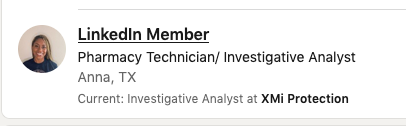
As far as I can tell, XMi Protection seems to employee exactly one person: Cortez Emilio Richardson. (Maybe he hires temps to round out his team?) Also strange: The listed address for XMi protection is 9900 Spectrum Drive, Austin, TX, 78717, which is the address of Integreon, a “global outsourcing partner” that doesn’t list “executive protection” among its services, as well as LegalZoom, which seems to be a “one stop set-up-your-business” shop. (Maybe he set up his LLC through them?) However, Richardson’s LinkedIn profile says that he’s in Houston, and XMi Protection is based in nearby Spring. Two other LinkedIn accounts that show XMi Protection entries are a Paquita Bailey who lives in Detroit and is evidently working four different jobs at the same time (lot of sidehustle they’ve got going on there), and the following private listing:
Which is for a pharmacy technician from Anna, Texas (which is north of Dallas), both of whom would seem to be deeply unlikely to be working a protection detail in Houston.
$40,000 a month is an awful lot of cheddar for one guy.
Jim “Mattress Mack” McIngvale and Dolcefino have also filed a lawsuit against the county, seeking access to public election records that the county has refused to release on the grounds that they are related to litigation and a criminal investigation of Tatum and the elections department.
In response to multiple complaints over delay and evasion tactics employed by government agencies across the state, Sen. Paul Bettencourt (R-Houston) has pushed legislation that would punish those using the appeals process to delay compliance. His Senate Bill 1579 has been approved in committee, but it has not yet been scheduled for a vote on the Senate floor.
According to attorney Bill Aleshire, public information requests must be carefully tailored so as not to offer any loopholes. Aleshire opined that instead of asking for a “list,” Rice should have requested specific documents and included multiple departments in her original demand.
“Having said that, a public office devoted to transparency would not quibble with a requestor seeking travel records; it would just provide the records they’ve got, in good faith,” Aleshire told The Texan.
Snip.
In another leaked internal Harris County memo, legal fees approved by the Harris County Commissioners Court last March totaling $671,383 are described as covering legal costs for Kase, [County Commissioner Rodney] Ellis, and other county employees related to the investigation of a since-canceled $11 million COVID-19 vaccine outreach contract and allegations that Ellis had stored an African art collection at taxpayer expense.
The memo also includes “talking points” from “GS” that former Justice Administration Director Jim Bethke and other county officials, including Tatum, have been harassed by District Attorney Kim Ogg.
Payments for legal expenses appear to have been approved for McClees Law Firm, PLLC; Rusty Hardin and Associates, LLP; and Khalil Law PLLC. In addition to Ellis, Hidalgo, and other employees, the memo notes expenses were also covered for Commissioner Adrian Garcia (D-Pct. 2).
Something stinks in Harris County government, and there are a whole lot of questions about how Lina Hidalgo is spreading around taxpayer money that she really doesn’t want to answer…
Incumbent governor Greg Abbott walloped Robert Francis “Beto” O’Rourke by about a point less than he walloped Lupe Valdez in 2018, the year O’Rourke got within three points of Ted Cruz in the Texas senate race. 2018’s Betomania seems to have slightly raised the floor for Democrats in various down-ballot races, but not enough for them to be competitive statewide. This is O’Rourke’s third high-profile flameout in five years, and one wonders whether out-of-state contributors are getting wise to the game.
Vote totals seem down a bit from 2018, with the governor’s race drawing about 266,000 fewer voters.
Incumbent Lieutenant Governor Dan Patrick increased the margin by which he beat Mike Collier (also his opponent in 2018) from about five points to about ten points.
For all the talk of Ken Paxton being the most vulnerable statewide incumbent, he also won his race over Rochelle Garza by about 10 points, as opposed to a three and half point victory over Justin Nelson (a man so obscure he has no Wikipedia entry) in 2018. (Thought experiment: Could Beto have beaten Paxton this year? My gut says his money would have made it a lot closer than his race with Abbott, but I think he still would have lost by about the same margin he lost to Ted Cruz in 2018. But his lack of a law degree would have worked against him, and I doubt his ego would ever consider running in a down-ballot race like AG…)
In the Comptroller, Land Commissioner and Agriculture Commissioner races, Republicans were up a bit around 56%, and Democrats were down a bit more. (And Dawn Buckingham replacing George P. Bush should be a big improvement.)
Railroad Commissioner Wayne Christian had the biggest spread between him and Democratic opponent Luke Warford, 15 points (55% to 40%).
Three Republican statewide judicial race winners (Rebeca Huddle in Supreme Court Place 5, Scott Walker in Court of Criminal Appeals Place 5, and Jesse F. McClure in Court of Criminal Appeals Place 6) were the only statewide candidates to garner 4.5 million or more votes (possibly due to the absence of Libertarian candidates).
In the House, the GOP grew its ranks by one — giving them an 86-to-64 advantage in the 150-member chamber for the 2023 legislative session. The Senate has 31 members, and Republicans previously outnumbered Democrats 18 to 13. The GOP will hold at least 19 seats next session. Democrats will hold at least 11, though they are leading in one Senate race that is still too close to call.
The Republicans’ victories were felt prominently in South Texas, where the GOP won key races after targeting the historically Democratic region of Texas after Democratic President Joe Biden underperformed there in 2020.
In House District 37, now anchored in Harlingen, Republican Janie Lopez beat Democrat Luis Villareal Jr. The seat is currently held by Democratic state Rep. Alex Dominguez, who unsuccessfully ran for state Senate rather than seek reelection. The district was redrawn to cut out many of the Democratic voters in Brownsville from the district to the benefit Republicans. Biden carried District 37 by 17.1 points in 2020 under the old boundaries, but would have won by only 2.2 points under the new map.
Lopez would be the first Latina Republican to represent the Rio Grande Valley in the House.
In another major South Texas victory, Rep. Ryan Guillen of Rio Grande City, who defected from the Democratic Party and ran this cycle as a Republican, won reelection handily.
In another crucial battle in southern Bexar County, which has traditionally been dominated by Democrats, Republican incumbent John Lujan prevailed over Democrat Frank Ramirez, a former San Antonio City Council member.
Who did well? Incumbent Republican congressman Dan Crenshaw. Remember this ad from 2020? In addition to Crenshaw winning reelection by some 73,000 votes, August Pfluger and Beth Van Duyne won reelection to their districts, and Wesley Hunt, who ran a close-but-no-cigar race for TX7 in 2020, managed to win the race for newly created TX38 this year. (My guess is that, just like Rep. Byron Donalds (FL19) and Rep. Burgess Owens (UT4), Hunt will be blocked from joining the Congressional Black Caucus.)
Is there any sign of black support for Democrats eroding? A bit. In 2018, Democratic Congresswoman Sheila Jackson Lee (one of the very dimmest bulbs in congress) received 75.3% of the vote from her black and Hispanic majority district. In 2020, she received 73.3%. In 2022 (post redistricting), she received 70.7%. Slow progress, but progress none the less.
Leftwing fossil Lloyd Doggett was elected to his fifteenth term in congress, crushing his Republican opponent for the newly created 37th congressional district, while communist twerp Greg Casar (formerly of the Austin City Council) was elected to the 35th, formerly Doggett’s prior to redistricting.
Tarrant County had been trending more purple recently, going for O’Rourke over Cruz there by about 4,000 votes in 2018, and going for Biden over Trump by a mere 2,000 votes (less than .3%). But Abbott beat O’Rourke there by some 25,000 votes.
Jefferson County (Beaumont) is another county that’s flipped back. It went for O’Rourke over Cruz by about 500 votes,and flipped back to Trump over by around 500, but Abbott walloped O’Rouke by over 8,000 votes this year.
The runoff in the Austin Mayoral race will be on December 13 between hard lefty Celia Israel, and soft lefty retread Kirk Watson. If Watson picks up a clear majority of third place finisher Jennifer Virden’s voters (which seems likely), he should win.
This is a side effect of Williamson County, formerly a reliable Republican bulwark, becoming decidedly more liberal as Austin has become a hotbed of radical leftism. Abbott still edged O’Rourke by some 2,000 votes here, but Biden beat Trump by about 4,000 votes in 2020.
If 1978 is the year this election reminds me of nationally, then 1984 is the template year for Texas politics. In 1982, Phil Gramm resigned after Democrats threw him off the House Budget Committee (because why would you want a professional economist on a budget committee?), switched parties, and ran for his own vacancy in a special election as a Republican, winning handily.
Gramm’s switch showed that the time for conservatives to remain welcome in the Democratic Party was drawing to a close, and the way he resigned to run again rather than just switching made him a folk hero among Texas republicans. In 1984, Gramm ran for the senate, walloping Ron Paul, Robert Mosbacher, Jr. (a sharp guy who eventually did better in business than politics) and former Texas gubernatorial candidate Hank Grover in the Republican primary before decisively beating Lloyd Doggett (yep, the same one that’s still in congress) in the general by some 900,000 votes.
Gramm’s victory showed that the political careers of conservative Democrats who switched to the Republican Party could not only survive, but thrive. Between 1986 and the late 1990s, a series of high profile conservative Texas Democrats (including Kent Hance and Rick Perry) would switch from an increasingly radical Democratic Party to the GOP.
So too, this year showed that Hispanic Democrats could leave a party increasingly out of tune with people they represented (largely hard-working, law-abiding, entrepreneurial, conservative, and Catholic) for the Republican Party and win. Republicans may not have flipped terribly many seats in south Texas, but except for recent special election-winner Myra Flores, they held their gains.
The combination of Trump’s distinct appeal to working class Hispanics, deep opposition to disasterous Democratic open borders policies, and Gov. Abbott’s long term dedication to building out Republican infrastructure there have all primed Hispanics to shift to the GOP. Just as it took years for all Texas conservatives and most moderates to abandon the Democratic Party (Republicans wouldn’t sweep statewide offices until 1998), it will take years for the majority of Hispanics to switch.
But if Democrats continue to push open borders, social justice, radical transgenderism, soft on crime policies, high taxes and socialism, expect Hispanics to make that switch sooner rather than later.
That’s my Texas race roundup. If you have any notable highlights you think I should have covered, feel free to share them in the comments below.
According to auditor’s records, Harris County has not yet recovered more than $1 million paid for a since-canceled COVID-19 vaccine outreach contract tied to the felony indictments of County Judge Lina Hidalgo’s staff.
In addition, invoices indicate that the contractor paid more than half a million of the taxpayer funds to data firms assisting progressive candidates with campaigns and voter turnout.
In 2021, the county awarded an $11 million contract to Elevate Strategies, owned by highly-connected Democratic strategist Felicity Pereyra. Pereyra had previously worked for Hillary Clinton’s presidential campaign, the Democratic National Committee, and Commissioner Adrian Garcia’s (D- Pct. 2) campaign when he ran for mayor of Houston.
After revelations that Hidalgo’s staff had sought to alter experience requirements for potential vendors, and had instructed the purchasing department to disqualify the University of Texas Health Science Center, Hidalgo announced she would cancel the contract. But the public later learned that the county paid out $1.4 million to Pereyra’s firm after the date of cancellation.
During a March 2022 meeting of the Harris County commissioners court, First Assistant County Attorney Jay Aiyer told commissioners that Elevate Strategies had repaid about $200,000 and he expected another $1 million in repayment soon.
In response to queries from FOX26 political reporter Greg Groogan, the county attorney’s office responded that they had recovered $600,000, but refused to comply with an open records request and appealed to Attorney General Ken Paxton’s office in an effort to keep the repayment amounts out of the public eye.
Attorney and former Houston mayoral candidate Bill King sought records from the county auditor, which showed that while the county had paid $1.425 million, Elevate Strategies has only returned $208,000.
Among invoices Elevate Strategies submitted to the county are expenditures of $538,057 for software and canvassers from known Democratic voter turnout groups Civis Analytics and NGP VAN EveryAction.
Founded by Dan Wagner, former chief analytics officer of Obama for America, Civis Analytics has worked to increase voter turnout for a variety of progressive candidates and organizations including Battleground Texas. The group touts data collection that can be compiled into individual voter records for use in political campaigns.
Likewise, NGP VAN’s website advertises the company as “the leading technology provider to Democratic and progressive campaigns and organizations.”
Last year, Hidalgo defended the use of political campaigning groups, saying they had the tools to conduct the outreach. But Rice University professor and political analyst Mark Jones told The Texan there is not a great deal of overlap between the kinds of residents targeted.
“Those are companies focused exclusively on likely voters, which is not the same thing as a vulnerable population that would be the target of a COVID vaccine outreach campaign,” said Jones. “The Civis Analytics and NGP data sets are not designed to reach those targets. They are designed to reach people who are likely to turnout in the 2022 county judge election.”
Jones also noted that Elevate Strategies contract lists as a sub-contractor the Texas Organizing Project, which is another group that conducts canvassing and campaigning on behalf of Democratic candidates, including Hidalgo.
Go that? Lina Hidalgo approved over $1 million in funding for a company who’s primary job is getting Democrats (including herself) elected, paid them money after the contract was cancelled, and when told to give the money back, the Democrat company kept more than $1 million, and then Hidalgo’s office tried to cover it up.
Hidalgo doesn’t just need to be voted out of office, she and her cronies need to be sent to prison for abusing taxpayer money by spending it for partisan political advantage.
Democrats flee, lettuce wins, a flood of extra executives, and Musk gets out the hatchet. It’s the Friday LinkSwarm!
People leaving the Democratic Party describe it as cancer:
While Democrat voters have been leaving the party for years, their reasons have become more urgent.
“When people were feeling pushed away years ago, to the point where they were starting to walk away, there was more of a casual tone about it,” former liberal Democrat Brandon Straka, founder of #WalkAway told The Epoch Times.
“People were beginning to feel the effects of leftist, communism, Marxism infiltration into our society, our culture, and our politics.”
Straka founded #WalkAway in 2018 after making his personal decision to leave the party public while inviting others to join him. Since then, thousands of exiting Democrats made social media videos explaining why they were choosing to #WalkAway, giving Straka a window into the minds of these voters.
At that time, people were just noticing changes in the party, he said. They weren’t always identifying what it meant, but they knew they didn’t like how it felt, and quietly left.
“But now, it’s akin to cancer. Cancer doesn’t stop growing and spreading just because people don’t like it. And what’s happening with the left is no different,” Straka said. “Particularly with them getting rid of Trump, installing Biden, and the Democrats taking full control of the government. This is a cancer that’s rapidly growing and spreading now. And it’s becoming not just uncomfortable, but I think intolerable, for a lot of people.”
Drugs dealers openly selling on Broadway. Thinks to mayors Bill de Blasio and Eric Adams, and the feckless actions of Soros-backed DA Alvin Bragg, Democrats have undone not only all the hard-won law-and-order gains of Rudy Giuliani’s broken windows police, but they’ve actually brought NYC back to the nadir of the crime-ridden New York of the 1970s. (Hat tip: Sarah Hoyt at Instapundit.)
Robert Francis “Beto” O’Rourke is heading to his third high-profile defeat in five years. But he and Planned Parenthood have an ace of their sleeve: registering dead voters.
A Texas firearms dealer is suing the Biden administration for weaponizing the Bureau of Alcohol, Tobacco, Firearms, and Explosives to shut down law-abiding gun retailers over paperwork errors discovered during audits.
President Joe Biden ordered the Department of Justice in June of 2021 to enforce “zero tolerance for willful violations of the law by federally licensed firearms dealers that put public safety at risk,” but after a 500 percent increase in federal firearm license revocations for retailers over the last year, it’s clear the Biden administration isn’t just going after gun sellers who intentionally violate the law.
Punishing minor slip-ups, the lawsuit argues, draws on a drastically different interpretation of the law than the definition federal courts have held based on the Gun Control Act of 1968.
The lawsuit, to which the federal government has 60 days to respond, also argues that the Biden administration’s new policy sets an unreasonably high standard that is not applied to any other industry.
That’s why Michael Cargill, owner of Central Texas Gun Works in Austin, chose to bring this case.
Those energy-hostile Democratic Party policies just keep paying dividends: “New England facing natural gas shortages, rolling blackouts this winter.”
The reality is that the normal flow of natural gas into the region is limited and has been unable to keep up with increasing demand levels over the past decade. That means that utility operators have to rely on liquid natural gas (LNG) imports to make up the difference during peak demand periods. During such times, LNG accounts for as much as one-third of the total natural gas used for heating and electricity.
But why is that? You won’t need an ace detective to figure that out. Utility companies in New York, Connecticut, and other New England states projected supply shortfalls more than a decade ago. Fortunately, New York and Pennsylvania sit on some of the richest natural gas resources in the country, found in the Marcellus shale deposits. The companies requested new, higher-volume pipelines to carry natural gas to meet the spiraling demands of New York City, particularly at the furthest end of the gas lines in Long Island. They also urged the development of local gas production to feed those lines. Similar situations were noted all across New England.
Instead of doing that, New York refused to approve new gas lines and passed a moratorium on natural gas drilling in the state. This brings us to the current situation where the same amount of natural gas is being used, but increasing amounts of it come in the form of LNG that has to be imported either from other regions of the country or from overseas. The energy crunch in Europe is eating up a lot of the available LNG, so there may not be enough for New England this winter.
A star reporter for ABC News has been missing since an April 27 FBI raid at his Arlington, Virginia apartment.
Emmy award winner James Gordon Meek – a deep-dive journalist who was also a former senior counterterrorism adviser and investigator for the House Homeland Security Committee, abruptly quit his job of 9 years and “fell off the face of the earth,” after the raid, one of his colleagues told Rolling Stone.
A recent proliferation of phony executive profiles on LinkedIn is creating something of an identity crisis for the business networking site, and for companies that rely on it to hire and screen prospective employees. The fabricated LinkedIn identities — which pair AI-generated profile photos with text lifted from legitimate accounts — are creating major headaches for corporate HR departments and for those managing invite-only LinkedIn groups.
Last week, KrebsOnSecurity examined a flood of inauthentic LinkedIn profiles all claiming Chief Information Security Officer (CISO) roles at various Fortune 500 companies, including Biogen, Chevron, ExxonMobil, and Hewlett Packard.
Since then, the response from LinkedIn users and readers has made clear that these phony profiles are showing up en masse for virtually all executive roles — but particularly for jobs and industries that are adjacent to recent global events and news trends.
Does the Federal Reserve swapping some $6 billion worth of dollars for Swiss Francs with the Swiss National Bank mean a global financial crisis is coming? Boiling down his argument: A.) The Swiss National bank has a weekly dollar auction every Wednesday. 99%+ of the time, no one shows up for them. B.) Last Wednesday, 15 parties (meaning banks) showed up for them to the tune of some $6 billion. C.) The only reason they would do that is if they don’t trust their current repo counterparties, and D.) This is what happened when Flu Manchu hit and before the Subprime Meltdown in 2008. If it’s any consolation, they first started showing up for the latter in December of 2007, so you might have nine months to buy gold, ammunition and canned goods…
“According to the latest campaign finance reports, Republican Alexandra del Moral Mealer has raised a record-setting $4.9 million dollars in support of her campaign for Harris County Judge, outraising Democratic incumbent Lina Hidalgo 4 to 1.”
Related: “Hidalgo Booed Exiting Meeting Where GOP Commissioners Continue Boycott of Tax Increase.”
Woke reporter: Are you just super excited to coach against another black coach? Tampa Bay Buccaneers coach Todd Bowles: “We don’t see color…the minute you guys stop making a big deal about it, everyone else will as well.”
It looks like the Democrats running Harris County are finally going to face some consequences for defunding law enforcement.
Texas Comptroller Glen Hegar has ruled that Harris County reduced funding for some law enforcement agencies and will be subject to sanctions under a new state law enacted last year.
According to a letter addressed to Gov. Greg Abbott, Lt. Gov. Dan Patrick, House Speaker Dade Phelan (R-Beaumont), and Harris County Judge Lina Hidalgo, Hegar said that his ruling is in response to complaints filed by Constables Mark Herman (Pct. 4) and Ted Heap (Pct. 5) regarding funding changes last year and in a proposed budget for next year.
One of the key allegations Hegar is investigating is the county’s move to take away more than $3 million in so-called “rollover funds” from constables’ offices. Last year, commissioners voted 3 to 2 along party lines to remove these funds from the eight elected constables as well as the district attorney’s office, based on a recommendation from County Administrator David Berry.
Hegar notes that the proposed budget for Fiscal Year (FY) 2023 will reduce funding to the constables’ offices by over $12 million as compared to Short Fiscal Year 2022, which covers March through September of this year. Although the county appears to be revising the proposal, they are still poised to reduce overall funds for constables by $3 million.
“The budgeting practices of Harris County may not provide the Constables Office with full authority to expend their allocated budget to meet public safety needs,” wrote Hegar.
Signed by Abbott last year, the state’s “Back the Blue” legislation punishes cities or counties with populations of greater than 250,000 people if they reduce allocations for police, by either freezing property taxes or forcing cities to revisit any annexation done in the last 30 years.
Thus, Hegar writes, if Harris County proceeds with the constable’s budget as proposed “without obtaining voter approval, the county may not adopt an ad valorem tax rate that exceeds the county’s no-new-revenue tax rate.”
Snip.
Last week, Hidalgo and County Commissioner Adrian Garcia (D-Pct. 2) held a press conference to tout increases in “public safety spending” that included non-traditional expenditures such as $1.5 million for public Wi-Fi, $8.4 million for new trails, and $50 million to address blight and add sidewalks and street lights.
With the possible exception of streetlights, none of that makes anyone safer, but does provide nice conduits of graft to shovel to left-wing cronies via rigged bidding contracts (a Hidalgo specialty). We know from an in-depth dive into the Austin defund effort’s Reimagining Public Safety document that letting leftwing activists steal money from police funding to line their own pockets is one of the primary goals of the “defund the police” movement.
The interesting thing about this ruling is that, compared to Austin’s defunding push, Harris County’s defunding efforts were relatively modest at-the-margins stuff. No showy reductions in headcount or refusals to let new cadet classes move forward, just a quick raid to hoover up some loose cash from the constables while no one was looking. That this was enough for Hegar to drop the hammer indicates that defunding the police is a dead letter in Texas.
Does this mean the state government can nail Austin for their much more egregious defunding efforts? Probably not. The worst of that happened in 2020, while the law wasn’t passed until 2021. So unless the Austin City Council stupidly tries to stick their hand in the APD cookie jar again, I doubt they can be held to account for that under this law, unless they try the same trick again. On the other hand, time has proven again and again that there are few limits to Austin City Council stupidity…
The possibility of having votes audited sent Harris County’s Democratic executives into a preemptive panic.
Harris County Commissioners Court voted 3 to 2 along party lines this week to mount a legal challenge to a state-planned audit of county-run elections over the past two years.
“There’s no reason for a politicized and politically motivated election audit especially after democracy nearly crumbled over this pandering,” said County Judge Lina Hidalgo, who equated the audit to the January 6 riot in Washington D.C.
“Politicized and politically motivated” means “we can’t let Republicans catch us cheating.” Remember, this is the county where the voting administrator had to resign over a horribly botched March primary this year.
Last week, the Texas Secretary of State’s (SOS) office announced the random selection of four counties for an audit of all elections from the 2020 general election through the 2022 general election, including all primaries. Senate Bill (SB) 1, the state’s new election overhaul law passed last year, mandates audits of two counties with populations fewer than 300,000 and two with populations greater than 300,000, selected at random.
Although the Office of the Secretary of State posted a video of employees drawing the names of counties to be audited from a bucket, County Attorney Christian Menefee told commissioners he found the drawing suspicious. He said the video looked like “a sketch comedy show,” and complained that the SOS had neither posted rules for how the counties would be selected nor notified counties ahead of time.
“Had we known this was going on, we would have had somebody there to ensure there was transparency in the process,” said Menefee.
You have to have a lot of damn gall to complain about “transparency” after being accused of turnings security cameras off.
Prior SB 1, in September 2021, the secretary of state’s office announced it would launch audits of the state’s two largest Democratic and two largest Republican counties — Dallas, Harris, Tarrant, and Collin — for the 2020 election as permitted under law. The commissioners court voted 3 to 2 to legally contest that audit at the time but took no action.
Those 2020 audits are still underway, but earlier this year, the secretary of state’s office published a progress report indicating Harris County’s voter rolls included 3,063 potentially non-citizen voters.
Judging from the shenanigans pulled in the 2020 Presidential election, illegal alien voting fraud is probably only the tip of the iceberg…
The Biden Recession continues to wreck the pocketbooks of Americans, EU economies are sucking even worse than ours, more Bidens Behaving Badly, and unlimited abortion is not nearly as popular among the American public as it is among New York Times staffers.
Support for unlimited abortion is deeply unpopular:
New Harvard/Harris poll: Huge super-majority of Americans favor 15-week abortion bans in states. Women more likely than men to favor such restrictions; men more likely to support no limitations. Just 10% of respondents agree with federal Dems' 9-month-abortion radicalism: pic.twitter.com/wyOzUPg9uE
Democrats are just tired of Joe Biden and of having to explain away his poor performance. Since Biden was elected, the only thing that has gone right is that the Covid-19 pandemic effectively ended and the unemployment rate has remained low. Inflation is out of control, gas prices are at record highs, grocery bills are skyrocketing, the stock market is getting battered and people’s 401(k)s are shrinking, crime remains high, mass shootings keep bedeviling America’s public spaces, Russia’s invading Ukraine, there’s a global food and commodity crisis, and the Taliban is running Afghanistan and oppressing women again. Democrats are apoplectic that the Supreme Court struck down Roe v. Wade, a New York State gun law, and the EPA’s right to regulate carbon emissions without explicit approval from Congress. Parents are up in arms, the teachers’ unions look like callous fools who kept schools closed and harmed a generation of schoolchildren, and “abolish the police” looks like a suicidal public policy. Republicans notice that waves of illegal immigrants headed north shortly after Biden’s inauguration and haven’t stopped coming since.
You didn’t even mention the Social Justice insanity and all the transexual madness.
That New York Times poll found that 64 percent of Democrats want a different presidential nominee in 2024. Nobody’s willing to cover for this guy anymore; no one is inclined to avert their eyes when Biden or his wife blurts out something tone-deaf now.
There are some of us who would argue that Joe Biden has always been an insecure, abrasive, presumptuous, disingenuous, demagogic, insufferable blowhard who was largely protected by a cozy, all-too-friendly relationship with a press inclined to airbrush his glaring character faults, presenting him as a wacky neighbor or a kindly, ice-cream loving grandpa.
What we see now is what happens when much of the national media, the Democratic Party establishment, and liberal interest groups stop playing along with the narrative that Biden is a wiser, sharper, kinder, more energetic and sensitive man than he is. And the truth isn’t pretty.
Speaking of unwanted Bidens: “Hunter Biden could face prostitution charges for transporting hookers across state lines and disguising checks to them as payments for ‘medical services.'” I’ll believe Hunter Biden prosecution when I see it. Also, I’ve been treating the 4Chan “Hunter Biden iPhone leak” with a certain amount of skepticism. Certainly the Hunter laptop revelations were real, and Hunter is a big enough scumbag to do the the things alleged iPhone leak materials depict. But I try to be cautious about anything that fits too neatly into my preconceptions. (Hat tip: The Other McCain.)
“Left-Wing Nonprofit Scores $171.7 Million-$1 Billion Government Contract To Help Illegal Immigrants Avoid Authorities.”
A liberal non-profit group has been given a taxpayer-funded government contract worth at least $171.7 million — which could potentially reach just under $1 billion — for assisting illegal immigrant minors in avoiding capture or incarceration by U.S. Border Patrol and state officials.
The Department of the Interior was the awarding agency and “The Vera Institute of Justice,” based out of New York — which supports the “defund the police” movement and has lax views on immigration enforcement — was the beneficiary.
Thanks in part to a lack of zoning, Houston builds housing at nearly three times the per capita rate of cities like New York City and San Jose. It isn’t all just sprawl either: In 2019, Houston built roughly the same number of apartments as Los Angeles, despite the latter being nearly twice as large. This ongoing supernova of housing construction has helped to keep Houston one of the most affordable big cities in the U.S., offering new arrivals modest rents and accessible home prices even amid seemingly endless demand.
Houston is by no means a model for planning. Like every other Sun Belt city, it struggles with segregation and sprawl. Yet its continued success as one of America’s most affordable and prosperous cities reveals the workability—indeed, the desirability—of non-zoning. Houston is a profoundly weird place, resistant to seductive oversimplifications. But it provides insight into what comes after the arbitrary lines that have misshapen our cities—and how we might get there.
So why didn’t Houston adopt zoning like every other U.S. city? The answer comes down partly to process. Unique among major cities, Houston subjected zoning to a citywide vote. While most city councils had, historically, quietly adopted zoning after a few perfunctory public hearings, the Bayou City invited voters to decide on zoning in 1946, 1962, and 1993. Voters rejected it each time—a reality that calls into question the often-postulated popularity of zoning.
Zoning critics rightly dispensed with the comforting myths surrounding zoning—that its purpose was to merely rationalize land use—and zeroed in on its tendency to restrict new housing construction, limit access to opportunity, institutionalize segregation, and force growth outward. Far from being duped, Houston’s working-class residents exhibited a subtler understanding of the purposes of zoning than many contemporary planners and rejected it accordingly.
But the answer to why Houston remains unzoned also comes down to politics. Zoning proponents didn’t merely lose the referendums—they were also tactfully bought off by being allowed to have something resembling zoning in their immediate vicinity. Indeed, the dark little secret of non-zoning in Houston is that it depends on a system of land-use regulations known as deed restrictions, which empower certain communities—principally middle- and upper-class homeowners—to effectively “opt out” of non-zoning, writing their own land-use rules for their own neighborhoods. In exchange, Houston is able to protect the vast majority of the city from the types of arbitrary-use distinctions, density limits, and raucous public hearings that cause so much harm in every other U.S. city. That is to say, in exchange for respecting pockets of private land-use regulation, Houston is able to grow, adapt, and evolve like no other city.
Deed restrictions are private, voluntary agreements among property owners—typically the homeowners of a particular subdivision or neighborhood—regulating how they can and cannot use their land. These rules are literally tied to the deed, meaning that a property owner must agree to them as a condition of the sale. Since the failed 1962 zoning referendum, the city has enforced these agreements on behalf of the relevant parties, refusing to issue permits that run afoul of their provisions and bringing legal action against violators.
Is this system of publicly enforced deed restrictions “basically zoning,” as some might argue? On the one hand, deed restrictions—like zoning—demarcate specified areas subject to a distinct set of stricter land-use rules. Both zoning and deed restrictions in Houston are enforced by the government, principally with the aim of propping up home values and maintaining a certain quality of life. Many deed restrictions even have rules banning apartments and enforcing a strict two-and-a-half-story height limit.
Yet, the similarities end there, and Houston’s system of deed restrictions is a significant improvement over zoning. For starters, deed restrictions only cover an estimated quarter of the city, largely in areas with low-rise, detached, single-family housing. Industrial areas, commercial corridors, mixed-use and multifamily neighborhoods, urban vacant lots, and yet-to-be-developed greenfields are virtually never subject to their provisions. This means that roughly three-quarters of Houston—including its more dynamic sections—are largely free to grow without anything even resembling zoning holding them back.
Another key difference is that deed restrictions must be voluntarily opted in to. This serves to discipline deed restrictions in a way that is rarely true of zoning: If the rules are stricter than what prospective homebuyers might prefer, or not strict enough, or simply focus on the wrong concerns, this may translate into lower home values. This in turn nudges homeowners to think through the optimal form of land-use regulation to a degree that rarely happens with zoning.
After deciding to let drug-abusing transients use their restrooms, Starbucks is now closing 16 stores because of rising violence, and the fact that transients are shooting up in their restrooms. Golly, who could have possibly seen that coming?
Another Texas school superintendent has stepped down amid criticism from parents concerned about liberal indoctrination in their children’s classrooms.
At a special meeting Monday afternoon, Clear Creek Independent School District’s board of trustees accepted the retirement of Superintendent Eric Williams, effective in January 2023.
Conservative parents in the Houston-area district had complained that Williams, who started in early 2021, was subjecting their students to liberal ideologies he brought from his former job as superintendent of