Posts Tagged ‘Russia’

China’s Last Year?

Saturday, May 21st, 2022

Peter Zeihan is back with another provocative video (filmed at the Eisenhower Naval School) that suggests that China faces such massive problems that collapse may be imminent. “I see China with not just a demographic failure, but a failure of leadership, a failure of policy, an agricultural failure, and an energy failure, all at the same time. It is
entirely possible that this is the last year of the People’s Republic.”

Some of this (especially the demographic collapse) we’ve covered here before. Takeaways:

  • “China was already the fastest aging society in human history with the biggest sex imbalance. We already knew that their economic model would not match up with this demography this decade, we always knew that the economic collapse of China was coming.” And that was before we found China had over-counted their prime working age population by 100 million.
  • “I don’t see how China survives as a single political entity, much less a globally significant one. I don’t see how it survives this decade with these numbers, because this suggests that the Chinese population peaked back in 2003, and that Chinese economic efficiency probably peaked around the same time.”
  • Chinese labor is no longer cost-competitive with other Asian countries like Thailand or The Philippines, or Mexico. “This is the fastest labor [wage] appreciation in human history, including during the black death, including during all wars. So we’re looking at a 15-fold increase since 1999, [while] their labor effectiveness productivity is probably only increased by a factor of two, maybe three.”
  • “There is not an industrial process that is done in China that can’t be done in North America at a lower cost, because our labor is so much more productive, our energy is so much cheaper, our supply lines are so much shorter and you can produce stuff where people actually live.”
  • “The only reason we think of China as a major industrial player is because of the sunk cost of the preexisting industrial plant.”
  • “You don’t rebuild that somewhere else overnight. But it is happening. The United States is already in the process as its fastest industrialization, even faster than what we did during World War II.” That’s some mighty bold talk, but the U.S. population is roughly 2.5X larger than at the start of World War II.
  • “We probably need to double the size of our industrial plant in the next 5-10 years. That’ll be awkward, expensive, inflationary, but on the other side of it, we will have a far more insulated and secure supply chain system. The problem is just getting from here to there, and that is not a straight line.”
  • He reiterates all the reason why Russia’s debacle in Ukraine has China freaking out about their fading chances for taking Taiwan.

    The Chinese plan has always been to let the Russians go first, just as a proof of concept. So their thinking was a fast war that conquers Taiwan in a matter of days, that imposes a done deal upon the world, and everyone just sucks it up and takes it, because China is too economically powerful to be challenged. And once you hold the territory, there’s no point in going to a broad scale war against the Chinese when it’s already happened. That’s always been their plan.

    Oh my.

    With the Russians, they have had every aspect of all of their planning for the last 40 years set on fire and burned to ash in less than a month. So number one it will not be a quick war, because Ukraine was one of the world’s less militarily competent countries in the first place…

    I think this statement may have been true in 2014, but I don’t think it was true by the time Russia invaded. Ukraine professionalized and modernized their military with considerable help and guidance from western militaries, and developed a competent officer and NCO core (partially thanks to experience with the low-intensity conflict in Donbas).

    …and they’re still holding out against the Russians. Taiwan has been preparing for this war since 1955. Taiwan has a moat. Taiwan has a nuclear program that started in 1974, so if we have a two-month accumulation of Chinese forces getting ready to push, the Taiwanese will see it because this is the only national security question that they pay any attention to, and they will make a nuclear device. And so the only way that the Chinese can even make an attempt on Taiwan is to text all of their soldiers at the same time and just say everyone get to the coast take a fishing boat with your buddies and start moving on Taiwan. They know it is going to cost them a million troops just to get there.

    I find this scenario unlikely, and even less likely to succeed.

  • “Now they know from Ukraine that it’s not going to be a pushover. [Taiwan] is mountainous, it’s forested as opposed to Ukraine, which is flat and open.”
  • Then there are the sanctions:

    Russia has many flaws, but they’re a massive producer of food and energy products. If you put the sanctions that we have put against Russia onto China, oh my. China imports 85% of their energy, 85% of that from the Persian Gulf, and they import 85% of inputs that are necessary to grow their food. So you would have an industrial collapse, a civilizational breakdown, and mass famine within six months, and then you would probably lose a half a billion Chinese over the course of the next year to famine.

    Again, I think this is overstated, as there would be enough countries willing to break sanctions, and enough radical actions China could take (conquer Mongolia and parts of Siberia for farming, throw off all Pacific fishing limits, etc.) to avoid the worst case famine scenario. Not that they wouldn’t be in a world of hurt…

  • The one that has scared the Chinese the most are the boycotts. BP and Halliburton didn’t have to leave, they weren’t doing anything that was sanctioned, but the super majors and the oil services firms and countless other firms left on a moral imperative prompted by individual shareholders and consumers. And in China, the idea that the average Joe or Jane can influence policy is so antithetical to their mindset that they had no idea this was even possible, much less it was going to happen. So everything that the Chinese have based their system and their strategic policy on for the last 30 years has been proven in the last two months to be utterly wrong.”

  • My judgement of Zeihan’s analysis is that he’s more right than wrong, but has a tendency to overstate his case. Still, a worldwide inflationary spiral and energy shortage is the sort of thing that’s likely to destabilize a lot of governments worldwide, and China’s economy is built on more smoke and mirrors than most.

    Ukraine Launches Successful Counteroffensive

    Sunday, May 15th, 2022

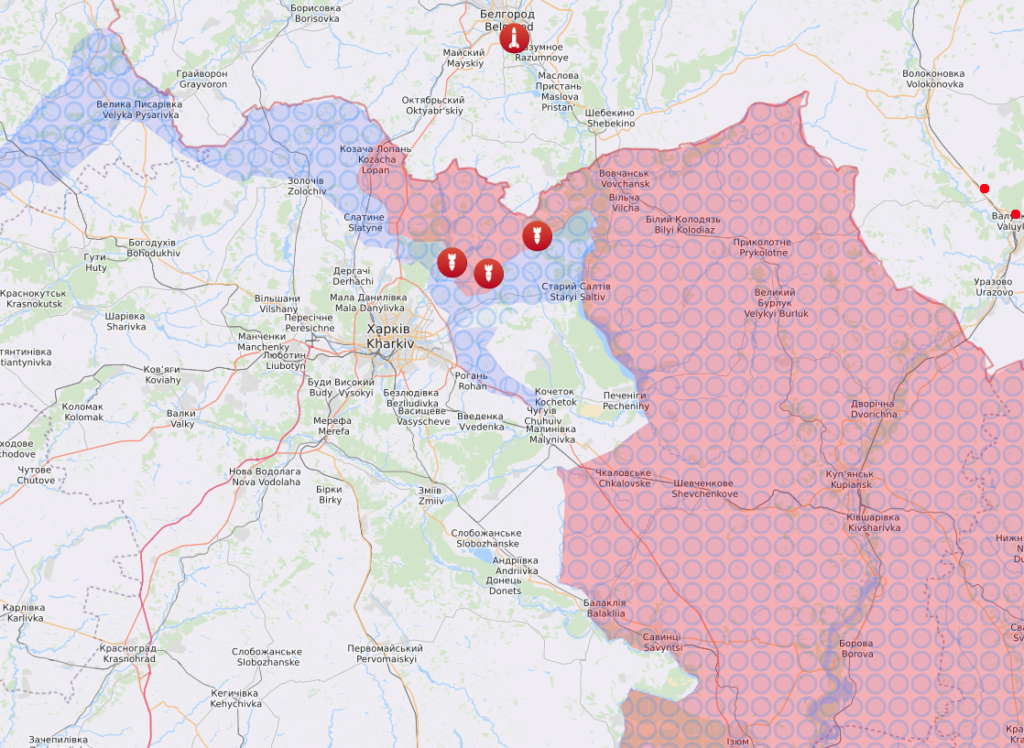
    Ukraine appears to have won a decisive victory by driving Russian forces from the second largest city of Kharkiv and is now pushing them all the way back to the Russian border.

    The Russian military has likely decided to withdraw fully from its positions around Kharkiv City in the face of Ukrainian counteroffensives and the limited availability of reinforcements. Russian units have generally not attempted to hold ground against counterattacking Ukrainian forces over the past several days, with a few exceptions. Reports from Western officials and a video from an officer of the Donetsk People’s Republic (DNR) indicate that Moscow is focused on conducting an orderly withdrawal and prioritizing getting Russians back home before allowing proxy forces to enter Russia rather than trying to hold its positions near the city.

    Ukraine thus appears to have won the Battle of Kharkiv. Ukrainian forces prevented Russian troops from encircling, let alone seizing Kharkiv, and then expelled them from around the city, as they did to Russian forces attempting to seize Kyiv. Ukrainian forces will likely attempt to disrupt at least the westernmost of the ground lines of communication (GLOCs) between Belgorod and Russian forces concentrated around Izyum, although Russia is using several GLOCs, including some further away from current Ukrainian positions than any Ukrainian counteroffensive is likely to reach soon. The terrain east of current Ukrainian positions may also favor the Russians attempting to defend their GLOCs, as large water features canalize movement and create chokepoints that the Ukrainians would have to breakthrough.

    Russian troops continued efforts to advance all along the periphery of the Izyum-Donetsk city salient but made little progress. Russian forces attempted a ground offensive from Izyum that made no progress. We had previously hypothesized that Russia might give up on attempts to advance from Izyum, but the Russians have either not made such a decision or have not fully committed to it yet. Small-scale and unsuccessful attacks on the southern end of the salient near Donetsk City continued but made no real progress.

    The main Russian effort continues to be the attempt to encircle Severodonetsk and Lysychansk from the north and from the south. Russian troops attacking from Popasna to the north made no significant progress in the last 24 hours. Russian forces coming north-to-south have failed to cross the Siverskyi Donets River and taken devastating losses in their attempts. The Russians may not have enough additional fresh combat power to offset those losses and continue the offensive on a large enough scale to complete the encirclement, although they will likely continue to try to do so.

    Yeah, about that river crossing. There’s an awful lot of post-battle evidence that was an absolute disaster.

    Attempting to cross a river near Bilohorivka, east of Lyman, a Russian mechanized battalion got blasted out of existence by Ukrainian artillery:

    The better part of a Russian army battalion — 50 or so vehicles and up to a thousand troops — in recent days tried to cross a pontoon bridge spanning the Siverskyi Donets River, running west to east between the separatist provinces of Donetsk and Luhansk in eastern Ukraine.

    Ukrainian artillery caught them at the river bank — and destroyed them. The rapid destruction of around three dozen tanks and other armored vehicles, along with the bridge itself, underscores Russia’s deepening woes as its troops try, and fail, to make meaningful gains in eastern Ukraine’s Donbas region.

    “We still assess Russian ground force in the Donbas to be slow and uneven,” an unnamed U.S. Defense Department official told reporters on Tuesday. The Russians’ inability to cross rivers might explain their sloth.

    The Siverskyi Donets, which threads from southern Russia into eastern Ukraine then back into Russia, is just one of several water barriers Russian battalions must cross in order to advance west into Ukrainian-held territory. According to the Ukrainian armed forces’ general staff, the battalion that got caught at the pontoon bridge apparently was trying to strike at Lyman, a city of 20,000 that lies 17 miles west of the doomed crossing.

    The Ukrainian army’s 17th Tank Brigade spotted the bridge, perhaps using one of the many small drones that function as the army’s eyes over the battlefield. The 17th is one of the army’s four active tank brigades. Its line battalions operate T-64 tanks and BMP fighting vehicles. But it was the brigade’s artillery battalion with its 2S1 122-millimeter howitzers that apparently got first crack at the Russian bridge.

    The 17th’s shelling destroyed at least seven T-72 and T-80 tanks, 17 BMPs, seven MT-LB armored tractors, five other vehicles and much of the bridging unit itself, including a tugboat and the pontoon span.

    It’s unclear how many Russians died or were wounded, but it’s worth noting that no battalion can lose three-quarters of its vehicles and remain capable of operations. In one strike, the Ukrainians removed from the battlefield one of the roughly 99 Russian battalion tactical groups in Ukraine.

    Proving that some people (or institutions) don’t learn from their mistakes, Russia compounded their disasterous stupidity by trying the exact same thing again, with the same results.

    Russia has made another failed attempt to cross a Donbas river where an entire battalion was wiped out by Ukrainian artillery – losing more men in the process with survivors forced to swim to safety.

    Putin’s troops were trying to rescue men and vehicles that had got stranded on the wrong side of the Donets River, near Biolhorivka, after the first attempt on May 8 ended with their pontoon bridges being sunk by an artillery barrage that destroyed dozens of armoured vehicles and may have killed more than 1,000 troops.

    But their rescue mission was found out and subjected to the same fate. Fresh satellite images taken near Biolhorivka show yet another sunken pontoon bridge along with half a dozen destroyed or abandoned vehicles.

    Russia has lost more than 70 vehicles and seen two infantry battalions mangled in four days of attempts to bridge the river.

    Here’s some decent drone footage of the aftermath:

    Conducting a river crossing under enemy fire has always been a difficult undertaking, which is why Clausewitz devoted two chapters to the topic. Even the most basic combined-arms operations are difficult to carry out under the best of circumstances. Difficult operations become impossible ones if you’re stupid.

    LinkSwarm for May 13, 2022

    Friday, May 13th, 2022

    Greetings, and welcome to Friday the 13th LinkSwarm! Inflation keeps soaring, diesel and baby formula shortages wrack the nation, and too many creepy transexual pedophiles pop up in the news.

  • Wholesale inflation rose to 11% in April.
  • If you think grocery store shelves look spotty now, wait until you see the effects of diesel shortages on the East Coast.

    The East Coast of the U.S. is reporting its lowest seasonal diesel inventory on record. And some trucking companies appear spooked.

    The East Coast typically stores around 62 million barrels of diesel during the month of May, according to Department of Energy data. But as of last Friday, that region of the U.S. is reporting under 52 million barrels.

    The sharp increase of diesel prices has been a major stressor in America’s $800 billion trucking industry since the beginning of 2022. According to DOE figures, the price per gallon of diesel has reached record highs — a whopping $5.62 per gallon. It’s even higher on the East Coast at $5.90, up 63% from the beginning of this year.

    When relief is coming isn’t yet clear, and experts say higher prices are the only way to attract more diesel into the Northeast.

  • How did the Biden Administration react to soaring prices and looming shortages? By cancelling oil and gas leases in Alaska and the Gulf of Mexico.
  • Also in short supply: Baby formula.

    There is a clear dividing line between American households with newborns and those without, and you can see it in which people have been talking about, and worrying about, a nationwide infant formula shortage for months and which people just heard about the problem recently. Target, Walmart, CVS, and Walgreens are all limiting how much infant and toddler formula customers can purchase per visit. So how did the U.S. — the wealthiest, most advanced, and most prosperous nation on the planet — end up in a situation where so many parents are worrying about feeding their youngest children?

    Most reporting on the infant-formula shortage points the finger at Abbott Laboratories, which instituted a February recall of powder formulas, including Similac, Alimentum, and EleCare, manufactured in its Sturgis, Mich., facility. The recall — which the company emphasizes was voluntary — came after four consumer complaints of Cronobacter sakazakii (a.k.a. Salmonella Newport) in infants who had consumed powdered formula manufactured in the Sturgis plant. Cronobacter germs can cause sepsis, a dangerous blood infection, or meningitis, which swells the protective linings surrounding the brain and spinal cord. Those infected with Salmonella bacteria develop diarrhea, fever, and abdominal cramps twelve to 72 hours after infection, and infants are more severely affected than adults.

    Abbott Laboratories emphasized that no product it distributed to consumers has tested positive for the presence of either of these bacteria, but that during testing in the Sturgis facility, the company found evidence of Cronobacter sakazakii in areas of the plant where products would not come in contact with it. As a precaution, it recalled all formula manufactured in this facility with an expiration of April 1, 2022, or later. No Abbott liquid formulas are included in the recall, nor are powder formulas or nutrition products manufactured at other Abbott facilities.

    Here, it’s worth noting that the supply chain for infant formula was strained well before Abbott’s recall. According to the data-research firm Datasembly, the percentage of stores nationwide at which formula was out of stock surpassed double digits way back in July 2021, and by January 2022, it had hit 23 percent.

    According to Datasembly, infant formula is now out-of-stock in 40 percent of stores nationwide. Moreover, in Iowa, South Dakota, North Dakota, Missouri, Texas, and Tennessee, more than half of baby formula was completely sold out during the week starting April 24. In another 26 states, between 40 and 50 percent of infant-formula supplies were sold out.

  • Unspeakable depravity: “Trans porn company owners sentenced for forcing 7-year-old girl into sexual exploitation…One of these members, Marina Volz, a biological male who identifies as a woman, has been sentenced to 25 years in prison for forcing ‘her’ 7-year-old daughter to participate in sexual acts.”
  • Speaking of Democrats supporting child rapists: “Woke L.A. DA George Gascon’s Pet Transgender Child Rapist Is Now Facing a Murder Charge….child rapist, “Hannah” Tubbs, who gamed the system and magically became a ‘woman’ so he could serve his sentence in a female juvenile prison and do easier time with a chance of getting out early.”
  • Still more elite institutions parading their transexual pro-pedophilia positions: “Child sex abuse center hires professor who faced backlash over pedophile comments…[Allyn Walker], an academic who resigned from a Virginia university after saying it wasn’t necessarily immoral for adults to be sexually attracted to kids has been hired by a Johns Hopkins University center aimed at preventing child sexual abuse.”
  • Today on Least Shocking, rapper “Young Thug” is indicted for being a member of a violent criminal gang. What are the odds? (Hat tip: Dwight.)
  • Finland and Sweden sign security pact with the UK. That’s some mighty genius security realignment you’ve engineered there, Vlad…
  • Ministry of Truth dispatch: “Biden Disinformation Czar Demands Power To Edit Other People’s Tweets.”
  • Austin rail project to cost 77% more than estimated. Try to contain your shock.
  • The NBA: Pulls All-Star Game out of Charlotte because it thinks a North Carolina bathroom bill discriminated against transsexuals. Also the NBA: To stage a game in the United Arab Emirates, where homosexuality is punishable by death.
  • “EV Automaker Hailed As The ‘Next Tesla’ Is Hemorrhaging Cash And Investors…Start-up electric vehicle (EV) maker Rivian Automotive’s stock [fell] 18.72% to $23.40 per share on Monday, a whopping 87% decline from its November peak of $179.47 a share.” (Hat tip: Stephen Green at Instapundit.)
  • Old and busted: Shooting down airliners. The new hotness: Sending creepy pictures of plane crashes to airline passengers to abort the flight.
  • Elon Musk says he will reverse Trump’s Twitter ban.
  • Writer who checks all the proper boxes sells a first novel that turns out to be plagiarized. So she publishes an apology. Which turns out to also be plagiarized. The frogurt is also cursed. (Hat tip: Dwight.)
  • School camera footage of the tornado that hit Andover, Kansas.
  • Speaking of extreme weather: haboob hits the great plains.
  • Samsung to hike foundry chip prices by 20%.
  • How store-bought sliced bread differs from traditional bread.
  • They’re making a sequel to This Is Spinal Tap, perhaps the funniest movie ever made, featuring the original principles. My enthusiasm is tempered by the fact that chances are extremely high it will suck.
  • “FBI Sternly Warns Mob At Justice Kavanaugh’s Home To Stay Away From School Board Member’s House Next Door.”
  • Ukraine Artillery Gets A GPS Boost

    Wednesday, May 11th, 2022

    The U.S. and other countries are sending M777 155mm howitzers to Ukraine.

    American M777 howitzers could prove a major factor in turning the tide against Russian forces in the ongoing invasion of Ukraine thanks to their precision and power.

    The howitzers are field artillery pieces that Ukrainian forces are already using to shell the Russians and represent an improvement on the equipment that the country’s military previously had.

    The U.S. has begun sending 90 M777 Howitzers, while Australia is sending six and Canada is providing four. The M777s are the towed howitzers currently used by the U.S. Army and Marine Corps. They have a maximum range of 15 miles and require a crew of eight to 10 people.

    Illia Ponomarenko, a defense reporter with The Kyiv Independent, tweeted on Tuesday: “M777s are already in Donbas, engaging Russian lines – confirmed!”

    Snip.

    The M777 Howitzers generally fire precision-guided Excalibur rounds that use the Global Positioning System (GPS) to home in on targets and it is expected that Ukraine will have been provided with these rounds. Canada was reportedly providing Excalibur shells, according to an AFP report on April 25.

    Here’s more background on the M777:

    A few brief takeaways:

  • Using aluminum and titanium, they weigh half what the M198 they’re replacing weighed. This means they’re fare more air-portable (at least for the U.S., slung from an Osprey).
  • Each costs about $4 million.
  • Contrary to the article above, the video asserts they only need a crew of five.
  • Fires seven rounds a minute.
  • Excalibur shells cost about $70,000 each. Pricey, but way cheaper than a Tomahawk cruise missile.
  • Here’s a “heavy on dramatic music but light on details” video of an Excalibur round hitting a target 65 klicks away.

    Did Ukraine use their new American-gifted, GPS-guided howitzer shell to take out a Russian general? Peter Zeihan (yep, him again) makes this case in this short video:

    Some of Zeihan’s analysis seems a little bit out there, but this one seems right on the cutting edge of plausibility, as we’re now able to do with artillery shells what once took guided missiles or smart bombs. But I don’t think Americans necessarily had to be involved in the targeting. It’s entirely possible that good signals intelligence pinpointed his location, or even just honed in a promising Russian communication cluster and hit General Valery Gerasimov as a stroke of good luck. Also, I should point out that Gerasimov’s death has not yet been confirmed.

    But yes, it’s quite plausible that we and/or Ukraine can pinpoint the locations of Russian generals in theater and drop precision munitions on their heads from 25 miles away…

    Russia’s Decline And Existential Crisis

    Monday, May 9th, 2022

    The Russian May Day parade has come and gone without Putin announcing either and end to the invasion of Ukraine, or a mass mobilization. So expect more of the same for the immediate future.

    Lots of people have speculated on why Russia invaded Ukraine when it did. One reason floated is that they had to act now before the demographic crash makes such action impossible.

    “One hundred and forty-six million [people] for such a vast territory is insufficient,” said Vladimir Putin at the end of last year. Russians haven’t been having enough children to replace themselves since the early Sixties. Birth rates are also stagnant in the West, but in Russia the problem is compounded by excess deaths: Russians die almost a decade earlier than Brits. Their President is clearly worried that he’s running out of subjects.

    It’s a humiliating state of affairs because Russian power has always been built on the foundation of demography. Back in the 1830s, Alexis de Tocqueville foresaw that Russia would become a world power, because “Russia is of all the nations of the Old World the one whose population is increasing most rapidly”. The only other country with its population potential was the United States. De Tocqueville prophesised that, “Each one of them seems called by a secret design of Providence to hold in its hands one day the destinies of half the world.” A century later, they were the world’s two uncontested superpowers.

    At the beginning of the 20th century, Russia’s population was 136 million, and was still booming, just as those of other European powers started to slow. Germany’s population was 56 million, excluding its colonies, and the threat of ever-larger cohorts of Russian recruits into the Tsar’s ranks haunted Germany’s leadership; historian and public intellectual Friedrich Meinecke fretted over the “almost inexhaustible fertility” of the Slavs while Chancellor Theobald von Bethmann Hollweg complained that “Russia grows and grows and lies on us like an ever-heavier nightmare”. This pressure was probably the decisive factor in Germany’s 1914 leap in the dark. German Secretary of State Gottlieb von Jagow wrote to the German ambassador in London as the storm was gathering that “in a few years, Russia will be ready … Then she will crush us on land by weight of numbers.”

    In the First World War, it turned out, numbers were not enough to compensate for Russian industrial and organisational inferiority. But by the Second World War, Russia’s numeric superiority had exploded. Despite the horrors of Civil War and Bolshevism, the nation’s population grew at about three times the speed of Germany’s in the opening decades of the century. The army had an endless supply of soldiers, the military infrastructure an endless supply of workers, giving the country a decisive edge in the Forties. Vast spaces and appalling weather helped, but ultimately it was the endlessness of Russian manpower which ground down the Wehrmacht in what was perhaps the most epic military struggle of all time. Field Marshall Erich von Manstein complained as he faced Russia’s armies: “We confronted a hydra: for every head cut off, two new ones appeared to grow.”

    But if demographic prowess buttressed Russian power then, population decline has undermined it in the years since. Most nations have developed out of the high birth and death rates seen throughout most of human history: as mortality and then fertility falls, first the population expands, then it flattens; eventually, it may contract. But in Russia this process has taken place with a vengeance.

    At the time of its dissolution, the Soviet Union was the home of 290 million people, 50 million more than the USA. Today, the Russian Federation has less than half that number — and less than half of the USA’s current total. In large part, this is the result of the loss of non-Russian republics, including Ukraine (which at the outbreak of the current conflict had a population of 43 million). But in the late Soviet and early post-Soviet period, the country also collapsed into an orgy of suicide and alcoholism, particularly affecting the country’s men.

    One journalist in Russia at the time wrote about how “the deaths kept piling up. People … were falling or perhaps jumping, off trains and out of windows; asphyxiating in country houses with faulty wood stoves or in apartment with jammed front door locks … drowning as a result of driving drunk into a lake … poisoning themselves with too much alcohol … dropping dead at absurdly early ages from heart attacks and strokes”. By the early years of this century, life expectancy for Russian men was on par with countries such as Madagascar and Sudan.

    It’s hard to fight for the future when you’re unwilling to show up for it.

    Peter Zeihan (yeah, that guy again) argues that, despite their numerous setbacks, the Russians aren’t going to give up.

    A few takeaways:

  • Russia has always suffered from inferior technology, which is why they were humiliated in the Crimean War.
  • “But they will never stop until they have to, or they are forced to.”
  • “The Russians see this as an existential crisis. They will fight until they can’t.”
  • “This is going to last months, probably years.”
  • Russia’s current goal: “The complete obliteration of all civilian infrastructure” in Ukraine.
  • Russians consider anyone that doesn’t flee a fighter to be shot on sight.
  • They’ve killed at least 50,000, probably closer to 100,000.
  • Zeihan asserts that Russians are trying to plug traditional invasion corridors into Russia. “There are two of those corridors on the other side of Ukraine, one that goes SW into Romania, and one that goes NW into Poland.”
  • Since we know that the Russians intention is not to stop in Ukraine and is to go into multiple NATO countries, we know that that fight between American and Russian forces is destined to happen, and we now know how it will end: The Russians will be obliterated and they’ll be faced with a simple choice: A strategic retreat across the entire line of contact all the way back to Russia, maybe even further, or escalate to involve nukes, since the Russians see this as an existential crisis, that’s a fight we have to prevent. And so the United States specifically, and NATO in general is sending any weapon system that we possibly can that can be carried or put in a truck.

  • “If we can’t kill Russia in Ukraine, nukes come into play.”
  • “If you’re Poland and you’re Romania, you know ultimately the Russians are coming for you that changes your math and that changes the risks you’re willing to take, and if you border Poland or Romania, same general thing.”
  • “If we can get Predators and Reapers into the Ukrainians hands, they can blow up the Kirch Strait bridge, and then all of a sudden the Crimea is completely cut off. And from a war point of view, that would be fantastic because most of the gains the Russians have made have been out of Crimea.”
  • Russia has to win in Ukraine because “This is their last chance.”
  • I have significant doubts that Zeihan’s “plugging historical invasion gaps” is the driver for this conflict, mainly because such terrain gaps can be overcome in a more modern, dynamic geospatial war envelope by use of air, land, heliborn and remote-piloted combatants. Tactically still very significant, strategically less so. I think Russian chauvinism despises the very idea of a free and independent Ukraine, and lot of Putin decisions seem to be driven by ego. Pro-natalist policies like tax and welfare incentives seem a much better way to deal with their looming population crash than a risky invasion. But Putin makes all sorts of stupid calculations. And seeing his army’s performance in Ukraine would cause a sane man to back away from open conflict with NATO.

    But Zeihan’s theory that the U.S. and NATO see this as a once-in-a-lifetime chance to defang Russia short of a direct conflict with NATO countries strikes me as correct.

    Ukraine Update for April 27, 2022

    Wednesday, April 27th, 2022

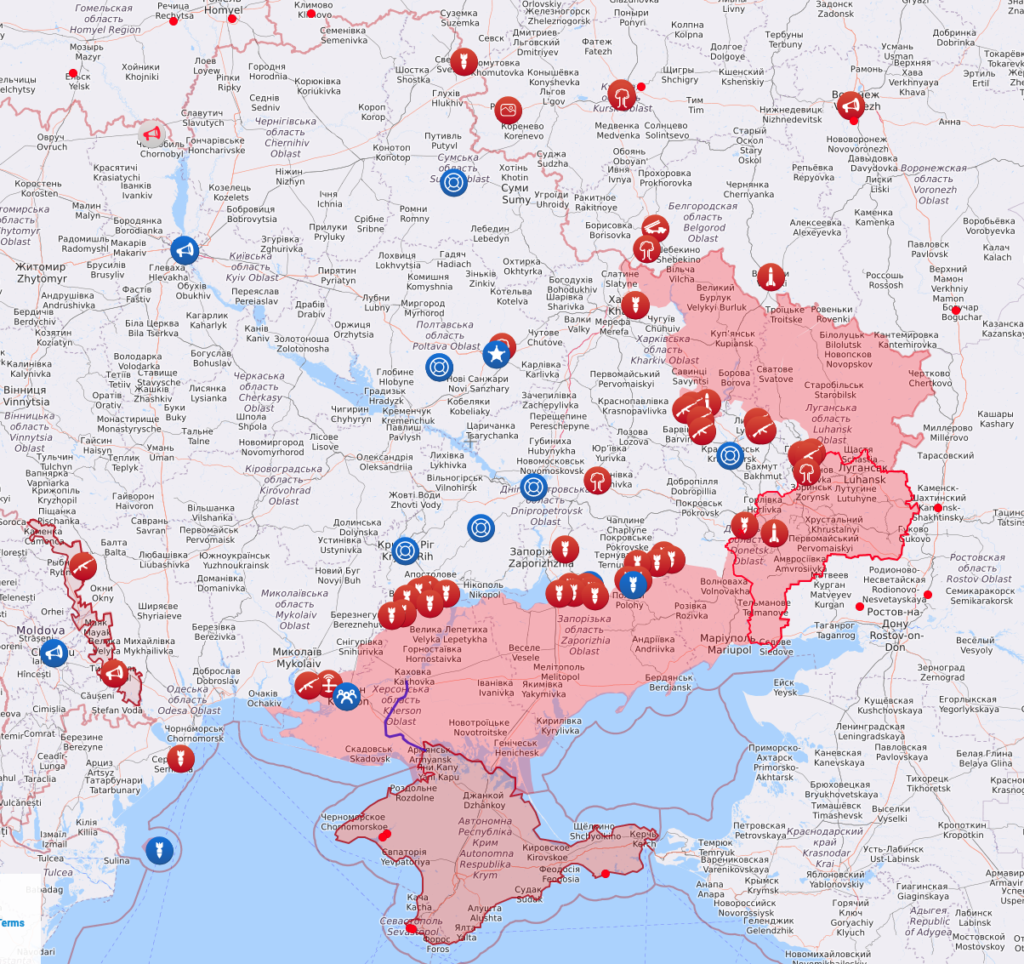
    It’s been almost a month since we did the last general Ukraine-Russo War update, so let’s catch up. The biggest change is that Russia has given up on trying to take Kiev and has withdrawn all their forces in the northwest:

    And here’s a timelapse map of the ebb and flow of the war:

    Keep in mind the usual caveats (the map is not the territory, the difficulty of sifting truth from propaganda, etc.), but it does appear that not much has changed in the overall contours of the war since Russia’s withdrawal from the northwest. But ISW is reporting that Russia has instituted combined arms offenses, something we didn’t see much of during the opening stages of the war, and have reported minor but steady advances by Russian forces.

    Here’s a roundup of war news, some of it several weeks old but potentially still of interest.
    

  • An awful lot of Russian infrastructure seems to be blowing up all of a sudden.

    Storage tanks at a major oil depot in the Russian city of Bryansk exploded early on Monday. Was Ukraine responsible?

    Before you answer, consider first that this is only the latest disaster to afflict Russian critical infrastructure near the Ukrainian border. Another oil depot on Belgorod was targeted by a Ukrainian helicopter strike in early April. Prior to that, Russian railway lines near the border were sabotaged. A Russian missile research center and a chemical plant also recently suffered explosions.

    These incidents all appear to fit well with Ukraine’s military strategy.

    Bryansk, 62 miles from the Ukrainian border, is beyond the range of most drone systems in Ukraine’s possession. Unconfirmed video from the Bryansk incident indicates the sound of a missile in the terminal attack phase. Considering this noise and Bryansk’s relative distance from Ukraine, short-range ballistic missiles may have been responsible. Regardless, the explosion will disrupt energy replenishment efforts for Russian military forces in Ukraine.

    The explosion also dilutes Putin’s credibility in claiming that his war on Ukraine is not a war, but rather a limited “special military operation.” When stuff keeps blowing up in Russian cities, it’s hard to convince the residents of said cities that Russia isn’t at war.

    That takes us to Ukraine’s evolving military strategy. With Russia forced to scale back its goals in the conflict, Ukraine has escalated its offensive operations in what’s known as the “deep battlespace.” This involves targeting of Russian logistics and command and control units deeper behind the front lines. Employing Western-provided drones and highly mobile small units, Ukraine is degrading and demoralizing Russia’s war machine.

    It’s not a wild leap to expect that Ukraine is now applying these same tactics over the border inside Russia. This is likely a result of British training of the Ukrainian military.

    Don’t start none, won’t be none…

  • More structure hits inside Russia:

  • On the same theme:

  • Are Belarussians also sabotaging rail lines used by Russia?

    The slickly produced video opens with an unlikely scenario. The year is 2023. Sviatlana Tsikhanouskaya is the president of Belarus. And Belarus has been invited to join the European Union.

    “Fantasy? Not at all. The war Vladimir Putin started against Ukraine gives us a unique chance to change history,” the narrator says. “Russia is already losing. And without our bases, railways, and borders, Putin’s defeat will be significantly hastened.”

    The video calls on Belarusians not only to demonstrate against the war, but also to deny Russia the assets they need to prosecute it from Belarusian territory. “Blockade the aggressor at bases and supply routes. Deny them food, fuel, and freedom of movement,” it says.

    In fact, this is more than a call for action. It is actually describing something that is already happening. Since Putin’s Ukraine War began on February 24, at least 52 Belarusians including 30 railway workers have been arrested on charges of treason, terrorism and espionage for disrupting the movement of Russian troops and military hardware, according to the Belarusian human rights group Viasna.

    Alyaksandr Lukashenka’s autocratic regime in Minsk is so concerned with what has become known as “The Rail War” that it has also declared the Telegram channel of the “Association of Railway Workers of Belarus” an extremist organization.

    This railway rebellion is the most dramatic example of how Putin’s war against Ukraine is changing the political dynamic in Belarus. Lukashenka’s slavish submission to Putin, allowing the Kremlin leader to use his country as a staging ground for Russia’s assault on Ukraine, has unnerved and angered this nation of 9.4 million people.

    The only thing being Mussolini to Putin’s Hitler is going to get you is being strung up by your heels.

  • This is one of those “too good to believe” headlines: “Ukraine Now Has More Tanks Than Russia and Things Look Worse In the Future.”

    The Ukrainian battlefield of Putin’s War is incredibly lethal. In the sixty days since Putin’s three-to-four day invasion of Ukraine started, Russia has had 1,700 vehicles or major pieces of equipment destroyed and another 1,200 captured. Tanks losses numbered 560 destroyed and 214 captured, while losses of infantry fighting vehicles/armored personnel carriers come to 930 destroyed and 330 captured. These are not estimates; these are floor numbers that have been counted and geocoded. By the same methodology, Ukraine has lost at least 200 tanks destroyed and 70 captured, along with 790 infantry fighting vehicles/armored personnel carriers destroyed and 90 captured. No one really knows how many vehicles have been lost to combat damage or wear-and-tear….

    By way of scale, Russia entered the war with about 120 Battalion Tactical Groups (BTG)) representing approximately 75% of the Russian Army’s combat power as well as the cutting edge of that power. Keep in mind that this is not a Russian Army affair; there is Naval Infantry from as far away as Vladivostok as well as troops of the Rosgvardiya, or the National Guard of Russia….

    The tank losses alone represent all the tanks in 70 BTGs.

    This lethality is why the Ukrainian government has been screaming for more weapons from anyone who has them. Not just munitions, like Javelin or Starstreak, but tanks, infantry fighting vehicles, and artillery.

    Snip.

    As incredible as it may seem, Ukraine now outnumbers Russia in the number of tanks on the battlefield.

    Thanks to European resupplies, Ukraine’s military now has more tanks on the battlefield than Russia does two months into the war, according to the Pentagon.

    The delivery in recent weeks of Soviet-era T-72 tanks to Kyiv from the Czech Republic and other European Nato allies has effectively eroded Russia’s advantage, experts have claimed.

    “Right now, the Ukrainians have more tanks in Ukraine than the Russians do, and they certainly have the purview to use them,” an unnamed senior US defence official told reporters on Thursday.
    Ukraine’s armed forces have previously claimed Russia has lost more than 680 of its tanks, the majority of which were destroyed, while some changed hands after being found abandoned.

    So that’s from the Pentagon. May be true, may not be true. It’s possible Russia has cannibalized other units or (some two months into the conflict) refurbished mothballed tanks.

  • “Young Russian conscripts complain they have been given 1940s guns and are suffering heavy losses against Ukraine.” (Hat Tip: Ed Driscoll at Instapundit)
  • Talk about timing! This piece, published April 10, argues that Ukrainian anti-ship missiles will make the Black Sea unsafe for Russian warships.

    The way I see it (and I am in good company), the Russians will not only be lucky not to be routed from all their gains made since February 24, but are at serious risk of losing the Donbas—Luhansk and Donetsk—and Crimea, as well as having most of their current army destroyed. Talk of some sort of possible Grand New Russian Offensive in the east seem fantastical to me and others who put the big-picture together: with which troops, and of what quality (what elite unites haven’t sustained significant casualties?), and with what equipment? Will it be the remaining equipment that has already proven ineffective and easily destroyed especially by Ukraine’s western-supplied anti-tank and anti-air missiles? The units shattered and barely functional or not functional that managed to escape from Ukraine’s counteroffensives? Non-shattered but non-elite units that have also been deployed for months and are still exhausted? Conscripts almost finishing their terms? New conscripts who have never seen combat??

    Yet as major Russian ground fronts have collapsed, attention is drawn away from an area where, with not much additional assistance from the West or perhaps even with aid already just now promised, Ukraine can easily achieve a resounding victory that would combine massive substantive defeats for the Russians with tremendous symbolism and loss of prestige for Russia in addition to greatly affecting the way ground combat plays out in the south and east.

    I am talking about the near-annihilation of the Russian Navy presence in the Black Sea, including almost the entirety of the Black Sea Fleet.

    Snip.

    Russia has cannibalized its other three fleets (Northern Fleet, Baltic Fleet, and Pacific Fleet) and its one flotilla (the Caspian Flotilla) to reinforce the Black Sea Fleet and support its Ukraine effort, and, with Turkey closing the Bosporus and Dardanelles straits to the Mediterranean in early March to incoming military vessels under the 1936 Montreux Convention, that Caspian Flotilla is the only possible source of reinforcements to what is in the Black Sea, coming in though canal from the Caspian Sea, as other possible reinforcements coming in from the Mediterranean are now blocked.

    As far as sizable surface ships in the Black Sea, by mid-March there were only twenty-one, according to a “senior defense official”: just twelve naval-combat-focused ships along with nine amphibious assault ships, accompanied by numerous far smaller patrol and support boats and, of course, submarines that are harder to track.

    But that total was before the daring Ukrainian strike on the morning of March 24, which mysteriously destroyed a large Russian amphibious ship, the now sunk Alligator class Saratov,docked in the eastern Ukrainian Russian-occupied port of Berdyansk. Two other large amphibious ships, the Caesar Kunikov and Novocherkassk, were damaged and fled the port.

    So scratch one, Russia is down now to just twenty major surface vessels.

    That is not a large number.

    I had finished a version of this section before yesterday’s information that the UK and U.S. would be sending anti-ship missiles to Ukraine. But, for now, keep that low number of major Russian surface ships in mind when considering following:

    For starters, as my old War Is Boring editor David Axe notes in detail, Ukraine has been developing its own anti-ship cruise missile, the Neptune, since 2013. It began testing in 2018, and has since tested successfully repeatedly. The system has a range of 174-180 miles (280-300 km) and operates as a sea-skimmer, flying low and close to the water to make it almost undetectable until just before it hits its target. It was scheduled to be deployed this month with a full division of six launchers, seventy-two cruise missiles (more than three for each remaining major Russian surface vessel), and accompanying radar systems. But Russia’s seems to have derailed this timetable, and it is unclear when it will be able to safely deploy its system and have it and its crews be operational. Details are few and far between as Ukraine obviously would want to keep Russia guessing.

    Secondly, this must have been part of the discussion over the past month between Ukraine and NATO nations, and taking into account the issues with the Neptunes, NATO has been working to arm Ukraine with anti-ship missiles for weeks. Reports from early April indicated United Kingdom Prime Minister Boris Johnson has been keen to arm Ukraine with anti-ship missiles, that these would most likely be truck-mounted versions of its U.S.-supplied Harpoon missiles, its version having a range of 80 miles (128 km) and also capable of hitting land targets (Ukraine has actually been asking for these for some time).

    Snip.

    Russian Naval forces are hardly concentrating along the Turkish coast of the southern Black Sea: they are mostly, perhaps virtually all, off the coast of Ukraine to varying degrees in the northern half of the Black Sea or Sea of Azov, trying to offer support and, presumably, debating whether or not to launch amphibious assaults, particularly on Ukraine’s main port in its West, Odesa (the fact that they have not yet shows how confident they are in such an assault’s chances of success; Putin may not care much about throwing his soldiers’ lives away recklessly, but his larger naval vessels are expensive and take time to construct)…

    Ukraine would have excellent coverage with many of these systems. For most of these systems, many, perhaps even all, of Russia’s twenty remaining large warships in the region—including Russia’s most powerful naval ship, the Slava class cruiser Moskva—are well within striking range from Ukrainian-controlled territory. Even if Ukraine will receive only Harpoons, though they have much smaller range than the Neptunes, they should effectively prevent any Russian naval assaults if the Russians are smart (but they are not). After such Harpoons would arrive, they would still secure Ukrainian coastline and push Russian naval operating areas far from Ukrainian-controlled coastal territory (unless Russia is stupid and keeps its ships within range, inviting their destruction) all while, presumably, the Neptune rollout, training, and deployment finishes, possibly in just a few weeks if the invasion has not derailed Ukraine’s timetable.

    At this crucial moment, when Russia is desperate to turn the tide in the face of its massive failures, the soon-to-arrive unspecified anti-ship missiles have effectively killed any realistic Russian hope of a successful naval assault on Odesa or elsewhere on the Crimea-to-Moldova (where Russia illegally has some military forces in another breakaway region, Transnistria) corridor. These missiles will either prevent any assault from happening or virtually doom any would-be assault. This new round of aid with these anti-ship missiles has, thus, basically closed the gap between the Russians collapsing on three fronts and the Neptunes’ presumed deployment.

    If (and hopefully when) Neptunes can be eventually deployed, a large portion of the entire Black Sea, including both the west and east coasts of Russian-occupied Crimea—where many of Russia’s naval vessels are based and resupplied—as well as the Sea of Azov, would be vulnerable.

  • And then, five days later, this happened.

    A Russian warship that was damaged by an explosion on Wednesday has sunk, Russia’s defence ministry has said.

    Moskva, the flagship of Russia’s Black Sea Fleet, was being towed to port when “stormy seas” caused it to sink, according to a ministry message.

    The 510-crew missile cruiser was a symbol of Russia’s military power, leading its naval assault on Ukraine.

    Kyiv says its missiles hit the warship. The United States says it also believes it was hit by Ukrainian missiles.

    Moscow has not reported any attack – it says the vessel sank after a fire.

    The blaze caused the explosion of the warship’s ammunition, Russia says, adding that the entire crew were later evacuated to nearby Russian vessels in the Black Sea.

    How bad is the truth when the lie is “No, we screwed up and sunk our own ship through gross incompetence!”

  • Ukraine not only shot down a Russian Su-35 fighter, they recovered the long-range targeting system and are turning it over to the U.S. for analysis. And the Chinese use the same system…
  • Thread: “Where is the Russian Army artillery ammunition they are fighting their “Donbas Set Piece Battle” with?”
  • The Javelin is pummeling Russian armor. Can production keep up?

    Congress is asking the Pentagon whether the Defense Production Act, or DPA, should be invoked to ensure supplies of Javelin anti-tank missile systems, as well as Stinger surface-to-air missiles, continue to flow to Ukraine. Ukrainian forces have used both of these weapons to great effect in their ongoing defense against Russia’s onslaught. At the same time, questions are growing about the U.S. defense industry’s ability to meet increased demand for these missiles, not just from Ukraine, but in the event that the U.S. military needs to acquire more of them quickly during a major future conflict.

    “To produce more of the Javelins, Stingers – all the stocks that we are using and diminishing and running low on and our allies, as well – shouldn’t we be applying the Defense Production Act?” Sen. Richard Blumenthal, a Connecticut Democrat, asked Defense Secretary Lloyd Austin at a Senate Armed Services Committee budget hearing today.

    This is a stupid question. Production for high tech weapons is dependent on a wide variety of high tech components, any of which might be from outside the country, and which might or might not have considerable production lead times. If they used custom, MilSpec chips, the wait time right now is about 26 weeks on average, and the fab may or may not be based in the U.S. Optical components may also have long lead times.

  • Another day, another Russian general whacked. “The authorities confirmed the death of the deputy commander of the 8th Army, Major General Vladimir Petrovich Frolov. About it informs press office of the governor’s office.”
  • Russian troops demoralized?

  • They certainly seem to have been lied to.

  • And some are apparently refusing to return to combat.

    Putin’s call for more troops has not had the desired effect so far of inspiring Russians to enlistment offices. It’s certainly not convincing veterans to return for more of the “special military operation” non-war that Putin’s not winning, even if he isn’t quite losing it yet:

    Yelena’s son, Pavel, was serving in the Far Eastern Amur region when Russia invaded Ukraine on February 24. Almost immediately, his unit was sent to the front, and he served almost 40 days in combat. Then his unit was sent back to Russia to regroup, Yelena told RFE/RL’s North.Realities. When his unit was preparing to return to Ukraine, Pavel refused.

    “If he doesn’t want to go back, am I supposed to push him, to tell him, ‘Grab your weapon and go,’” Yelena said. “Those who haven’t been there have no right judge those who have.”

    Yelena’s son is one of a significant but unknown number of Russian contract soldiers who have refused to either fight in Ukraine in the first place or who have fought and do not want to return.

    Lawyer Pavel Chikov, founder of the Agora legal-aid NGO, has written on Telegram that more than 1,000 military personnel and National Guard troops from at least seven regions have refused to go to Ukraine.

  • Did Russian troops massacre over 300 civilians in Bucha?

    Monday’s front pages are dominated by stories of alleged atrocities carried out by the Russian military on civilians in Ukraine.

    Under the headline “Horror in Bucha”, the Guardian reports mass graves have been found in the town north-west of the capital Kyiv, as well as evidence of the killing of civilians in the nearby towns of Irpin and Hostomel.

    The attacks have led Ukraine’s foreign minister to brand Russia being as being worse than infamous terrorist group Isis, the Metro reports.

    The paper says the atrocities were “evidenced in pictures too horrific to print”, including the public execution of handcuffed people and civilians who had been driven over by tanks.

    The Daily Mirror leads with President Volodymyr Zelensky’s accusations that the deaths amount to genocide and that the Russian military was attempting an “elimination of the people” of Ukraine.

    The paper adds the executions apparently carried out by retreating troops led to 300 civilians being killed in Bucha alone.

    The Times reports world leaders have demanded Russian President Vladimir Putin should face more stringent sanctions and be prosecuted for war crimes.

    The paper says its reporters visited the sites of two “execution-style” massacres in Bucha, where Russian troops were also accused of rape and of booby-trapping dead bodies with explosives.

    Historically Russian soldiers have never been known for their tender sensibilities and strong sense of self-control…

  • More atrocity reports here.
  • Thread on Russia changing its tune Bucha massacre.
  • Russian column of tanks near Donetsk destroyed.
  • How various air cargo carriers have reacted to the Russo-Ukrainian war.
  • “Exiled oligarch calls on other Russian tycoons to break with Putin. Mikhail Khodorkovsky says they must denounce the invasion of Ukraine if they want to be above suspicion of collaborating with the Kremlin.” Good luck with that, but I wouldn’t bet the hastily privatized collective farm on it…
  • Especially when they turn up dead.

  • Though he’s not the only one calling for reform:

  • It’s good to have wealthy friends.

  • File this one under “possible but skeptical”:

  • “Russia’s 331st Guards Parachute Regiment is considered ‘the best of the best’, but BBC Newsnight has been tracing the casualties as the unit battles through Ukraine.”

  • You know my summary above about how Russia has abandoned Ukraine’s northeast? Well, they reportedly plastered Sumy with an artillery barrage today, so take all generalities with a grain of salt.
  • I totally want these:

  • The Red Dawn “Wolverines!” tank is real:

  • When France 24 does a profile on how sanctions are hurting average Russians, of course they’re going to include the shop that sells French wine.
  • Heh:

  • Why Are Russia’s Arms Sucking So Badly?

    Saturday, April 23rd, 2022

    So why is Russian miltech performing so badly in Ukraine? In addition to some of the reasons we’ve already covered, this video provides additional answers (skip to 1:35 in to avoid the sponsor blather).

  • Russia has 2.5 to 3 million people in arms manufacturing, “20% of the country’s industrial jobs.”
  • “We all thought Russia had the military muscle to be able to take over Ukraine in a matter of days. However, the real way to test a country’s military power is not in a parade but a war. And with the invasion of Ukraine we are seeing something that has become the norm in the Russian economy. Something like an Expectation vs Reality meme.”
  • 60% failure rate for some Russian missiles?
  • “After a month of the Ukraine invasion, we can say it clearly: Russian armament falls far behind the expectations and hype they had created.”
  • Modernization of the armed forces was supposedly a priority for Putin, with up to 5% of GDP spent on defense.
  • Russia should theoretically have military equipment better than anyone but the U.S.
  • One reason they don’t: Attempted capitalism without privately owned arms companies.
  • “The Soviet military industry was full of unprofitable State enterprises, obsolete factories and, above all, a great deal of corruption.”
  • The U.S. bids out contracts. The Soviets depended on state monopolies.
  • “Russia has never embraced free market capitalism.”
  • According to Vladimir Putin, the problem with communism was not the centralized economy but an economy based on ideological principles. In other words, if you want to improve the efficiency of the system, it is enough to change the managers and put technocrats in charge. Technocrats who have been forged in the bosom of the KGB and who have a pragmatic mentality, totally free of the romanticism of communism or any other ideology. This type of person has a name: “SILOVIKI”. And so, just what was Putin’s formula for bringing his military industry into the 21st century? Very simple: To put Silovikis in all managerial positions. This is how Rostec was conceived in 2007, a conglomerate of companies designed to be the great umbrella of Russian defense. Under this umbrella are more than 700 armaments companies: all of them State-owned. By grouping companies together, a lot of duplication can be eliminated. All following purely technocratic criteria. And who is the CEO of Rostec? None other than Sergey Chemezov, who was a colleague of Vladimir Putin himself when they were both in the KGB offices in East Germany. In other words, a textbook SILOVIKI.

    Yes, in this, as in many other areas, Putin is a complete dumbass.

  • “By acquiring more and more companies, Rostec has ended up consolidating even more monopolies. For example: fighter jets. The United States works with four major manufacturers: Boeing, Lockheed Martin, Raytheon and Airbus (Yes, Airbus is European but it also has contracts with Washington). In the case of Russia, practically all fighter jets are manufactured by the same company: UAC which, of course, is under the umbrella of Rostec.”
  • “Another major Russian defense company is Almaz-Antey. This company does not depend on Rostec but is directly owned by the Russian Ministry of Finance. The CEO of this company is another textbook Siloviki. In this case we are talking about Viktor Ivanov, another former KGB agent. Almaz-Antey is the giant where NPO Novator, the manufacturer of almost all Russian precision missiles, is located. Yes, those very missiles that are proving to be so flawed in the invasion of Ukraine.” Try to contain your shock.
  • “In 2017, NPO Novator could only produce 60 Kalibr missiles in six months. As you can imagine, these figures are ridiculous if we take into account that, in just one month of war, Russia has launched more than 1,200 missiles.”
  • I know you’ll also be shocked to learn that Yevgeny Prigoshin, another friend of Putin’s, was in charged of the company responsible for providing expired food to Russian troops. “As Alexei Navalny reported, Prigozhin dodged all public tender systems to become the army’s caterer. Today, Navalny is in jail and Russian soldiers are receiving expired cans of food.”
  • Russia hasn’t achieved air supremacy because Russia doesn’t have enough precision munitions for its planes to use, which is why they do stupid things like hit hospitals with dumb bombs and fly low enough to be shot down. “Russia’s best planes are dropping like flies because they don’t have adequate ammunition.”
  • “Are you really saying that the Russians are stupid and have gone to war without ammunition? Well, no: the problem is not that the Russians are stupid. The problem is that a political system with bad incentives generates nothing but failure.”
  • In closing, he wonders just how well-maintained those nuclear weapons and ICBMs are.
  • All this accords with what we have observed in Russia’s operation failures, and with what we know about the basic incompetence and economic misallocation of command economies.

    (Sorry about the delay in getting this up. BlueHost was down earlier today.)

    LinkSwarm for April 22, 2022

    Friday, April 22nd, 2022

    Russia eyes Moldova, Ron DeSantis and Florida republicans strip Disney of it’s special privileges in record time, CNN+ dies quicker than Sean Bean, and Florida Man scores a trifecta! It’s the Friday LinkSwarm!

  • A Russian general just announced plans to invade Moldova.

    A Russian General announced plans to occupy the Transnistria region of Moldova on Friday.

    Speaking at a defense industry meeting, Brigadier General Rustam Minnekayev, acting commander of Russia’s Central Military District, stated that the Russian Armed Forces plan to “make passage” into the region – in Moldova’s East, bordering Ukraine and less than 30 miles from the port city of Odessa – to create a “land corridor to Crimea,” Russian media reported. Such a corridor would also purport to connect the Russian mainland to Transnistria.

    Minnekayev stated that the measure was part of Russia’s second phase in its war in Ukraine, which involves establishing full control over the Donbas Region and Ukraine’s coast along the Black Sea. No timeline was provided for the maneuver to begin, however.

    Rather seems like overweening hubris to think about invading another country when they haven’t managed to defeat Ukraine despite pouring huge resources into the attempt.

    Speaking of Russia walking on rakes:

  • Giant fire engulfs Russia’s biggest chemical plant right after a fire broke out at “a sensitive Russian Defense Ministry research facility in the city of Tver.”

    Huge plumes of smoke were seen enveloping the Dmitrievsky Chemical Plant late this afternoon. The cause of the fire remains unknown. Almost 150 plant workers were reportedly evacuated.

    The facility in Kineshma, east of Moscow produces more industrial solvents than any other in Russia. It is less than 1,000km from the border with Ukraine.

    “Less than 600 miles” does not strike me as super close, even for Russia.

    Naturally, observers are starting to ask in connection to Russia’s war in neighboring Ukraine: coincidence? sabotage operation?

    Anti-Putin racecar driver Igor Sushko in tweeting the above video of the Dmitrievsky Chemical Plant going up in flames commented: “We are beginning to see a pattern develop.”

  • Florida Governor DeSantis Signs Bill Stripping Disney of Autonomous Legal Status.”

    Governor Ron DeSantis signed legislation Friday that strips Disney of its 50-year-old “independent special district” status in retaliation for lobbying against Florida’s Parental Rights in Education law.

    The law dissolves the Reedy Creek Improvement District, an autonomous area created in 1967 to accommodate the massive Disney World complex near Orlando. The independent status has shielded Disney from significant tax burden.

    The governor fast-tracked the initiative to a special session Tuesday, after which the state Senate voted 23-16 on Wednesday to advance it.

    The parental rights measure keeps gender identity and sexual orientation instruction out of K-3 elementary school classrooms and enjoys majority support among Floridians.

    To quote The Wire: “You wanted to be in the game, right? Now you’re in the game.” For years, The Mouse was considered an unstoppable juggernaut that always got what it wanted. Then Disney decided to to throw it’s corporate weight behind the pro-grooming faction opposing a bill banning discussion of sex in elementary schools, and DeSantis knee-capped them in a week.

    Though the losses from special tax breaks and privileges is going to hurt the bottom line, Disney has done far, far more damage to its brand for stepping into the cultural wars to embrace forcing radical transexism on a resisting American public. That’s going to be destroying shareholder value for years (if not decades) to come.

  • DeSantis Bonus: Christopher Rufo spoke at the signing ceremony:

  • Dana Loesch isn’t shedding any tears over The Mouse.

    Am I and are others supposed to feel bad because the most opportune time to end Disney’s corporate welfare exploits the momentum that Disney created against themselves?

    Because I don’t.

    Disney vociferously and hatefully opposed parents who didn’t want ideological activist teachers lecturing their K-5th grade kids about how they bang their significant others after hours — Disney accused parents of opposing this as literally killing gay people because teachers with fantasy pronouns can’t talk about genitals when kids should be learning math.

    The left hated corporations influencing issues because of Citizens United v. FEC until they realized they could push Disney to lobby for them and now they LOVE corporations again! Party! I’m confused — are corporations still evil? They can’t influence issues or push for candidates that aren’t Democrat and they have more rights to a child than the parents raising said child? We really need some consistency from the left here.

    When corporations act as agents of the state all bets are off. When a corporation’s actual heir, the CEO, and executives say on camera and on their own social media accounts (as Disney’s did) that parental rights erase gay people (I know, what?) and people who support parental rights in the classroom are murderers, all bets are off.

    Who is “gaslighting” whom, here? Where was the opposition to the heinous manner in which parents were smeared? Was that not Disney’s “revenge” for opposition?

    Disney chose the boss fight against taxpaying parents and they lost.

    Losing their corporate welfare isn’t revenge, it’s a reckoning.

  • Relevant tweets:

  • John Nolte: “Yes, Democrats Really Do Want to Groom Your Children.”

    The debate we’re having right now…

    THE LEFT: We don’t want to sexualize little kids behind the backs of parents. Stop saying that. It’s a lie!

    FLORIDA: We’re going to outlaw sexualizing little kids behind the backs of parents.

    THE LEFT: NOOOOooooooo!

    What kind of country are we living in where we even have to pass a bill that outlaws sexualizing kids aged four to eight in the classroom?

    What kind of country are we living in where Florida teachers are angry that they can’t discuss their personal lives with your little kids, much less discuss sex?

    What kind of country are we living in where the Walt Disney Co., a company built on the idea of preserving the innocence of children and teaching them lessons about honesty, hard work, and true love, is now openly bragging about feeding the little kids sexual propaganda?

    Of course, this is grooming.

    What else would you call it?

    What is the rationale for telling innocent little boys that they might be girls or gay or bisexual? What other rationale could there be for that other than to destroy their innocence, to turn them into sexual creatures, and warp their sexuality into something that can later be exploited?

    Behind the backs of parents!

    For the life of me, except for my second-grade teacher talking about the day John Kennedy was assassinated, I cannot remember a single teacher who ever discussed their personal life. A couple of times, I remember seeing a teacher outside of school, at the store or something, and how odd it was to realize they existed outside the classroom.

    The thing to keep in mind here is that this is not a “gay” thing.

    It’s not gay people looking to groom little kids.

    Plenty of gay people are as disgusted by this as anyone. In fact, this sick movement is a terrible disservice to gays. What you have here is the LEFT working overtime to bring to life the very worst stereotypes about homosexuals looking to recruit among the innocent.

    What you have here is Disney bringing to life these terrible stereotypes.

    But that doesn’t change the fact that the left is desperate to groom your kids, to sexualize them behind your back.

    Why?

    Well, a whole lot of leftists want to have sex with your kids, and want to normalize sex between kids and adults. The evidence of that is everywhere. Democrats know opening the southern border will mean the import of child sex slaves. And yet, Democrats still open the border. Democrats continue to release child predators and suspected predators. We’re about to be saddled with a Supreme Court Justice who shrugs at child porn. More than one left-wing publication has asked us to better understand and sympathize with child molesters. The left embraced Jeffrey Epstein for decades. The left-wing Lincoln Project shielded a suspected predator.

    The other reason for the grooming is political.

    Democrats are losing key parts of their coalition: the working class, Hispanics, and chunks of the black population. One way they see of making up those numbers is to create a lot of damaged and broken young people obsessed with their sexuality. It’s just a fact that neurotic, unhappy lunatics and narcissists who define themselves by what they do with their sex organs vote Democrat. So… Democrats want to damage your kids to create a whole lot more of them.

  • “EIGHT news stories about teachers committing sex crimes upon children. ALL TODAY.”
  • Snapshot of our current problems: “In Biden’s Annual Economic Report, The Word “Gender” Is Used 40 More Times Than The Word ‘Inflation.'”
  • CNN+ shuts down one month after launch. There’s not enough schadenfreude in the world. Let a thousand pink slips bloom…
  • Another story getting short shrift because this LinkSwarm is so overstuffed: “Taylor Lorenz Attacked Libs Of Tik Tok Because Corrupt Media’s Main Function Now Is To Destroy The Right, Not Understand Its Appeal.”
  • From Powerline comes two tales of endemic corruption. The first was Yale University employee Jamie Petrone admitting to stealing over $40 million in computer equipment. “So for years, 90 percent of the equipment (sub-$10,000) that Yale’s emergency medicine department paid for–more than $40 million worth–never showed up. It didn’t exist. And no one noticed.”

    That’s the smaller of the two scandals. The bigger:

    A second instance of corruption is the Feeding Our Future scandal in Minnesota. The scandal actually involves entities in addition to FOF, and altogether $460 million or more has been funneled through these agencies by the federal free food programs Child and Adult Care Food Program (CACFP) and the Summer Food Service Program (SFSP). The whole thing turned out to be a criminal enterprise. Various crooks pretended to be feeding many thousands of non-existent Minnesota children. The fraud should have been obvious since, if you added up the numbers, a ridiculous percentage of all of the children in the state were supposedly getting free food through these newly-founded charities.

    The corruption occurred primarily, although not entirely, within Minnesota’s Somali community. Apparently spread sheets have been circulating among fraudsters showing the names and addresses of many thousands of Somali immigrants who can be listed as phantom beneficiaries of government programs. Here, like the Yale criminal, those who were in on the fraud have lived lavishly, with federal taxpayer money administered by the State of Minnesota paying for luxury cars, expensive homes, exotic vacations, and so on. Scott wrote here about a young Somali bride who was given a tray of gold worth $100,000 as a wedding gift by persons involved in the Feeding Our Future fraud.

    Such criminality is not subtle. Little care is taken to hide it. How can a handful of fly-by-night fraudsters steal hundreds of millions of dollars from the U.S. government and the State of Minnesota, and no one notices? As in Yale’s case, the answer is partly gross incompetence in Minnesota’s Tim Walz administration. But in the larger picture, government at all levels is rolling in so much dough that they don’t know what to do with it. A few hundred million is hardly worth checking up on.

    This goes toward proving my “Working Thesis,” that all new welfare state programs are designed to channel money into the pockets of crooks and left wing activists (to the extent that it’s possible to distinguish the two).

  • Don’t let the FBI ginning up the Gretchen Whitmer kidnapping plot distract you from the fact that they tried to do the same thing in Virginia.

    But the government not only attempted to manufacture “terrorists” in the Whitmer kidnapping hoax—the same FBI operation also tried to coax a man in Virginia to participate in the same sort of plot against Virginia Governor Ralph Northam. That scheme didn’t fully materialize, but the FBI’s attempt to pull off a similar stunt in Virginia reveals just how far agents were willing to go to bolster FBI Director Christopher Wray’s false warning that domestic extremists planned to “kill and assassinate” public officials.

    In summer 2020, Dan Chappel, the main informant in the Whitmer fednapping who was compensated at least $60,000 by the FBI for his services, targeted a man named Frank Butler, a disabled veteran in his late 60s and an alleged militia member. Taking instructions from Jayson Chambers, one of his FBI handling agents, Chappel used the same playbook in Virginia.

    “Dan suggests to Frank that he engage in acts of domestic terror,” defense attorneys wrote in a joint motion filed last year in the Whitmer case. “Like the defendants in this case, Dan suggested to Frank that he attack the governor of Virginia.”

    Screenshots submitted into evidence show a jaw dropping exchange between Chappel and Chambers in August 2020. “Goin [sic] to call frank butler today,” Chappel texted Chambers, asking for direction on what he should say to his target.

    “Mission is to kill the governor specifically,” Chambers replied.

    Just as in the Whitmer plot, Chappel lured Frank Butler into attempting to build an explosive device. Another text exchange in September 2020 shows Chappel and Chambers discussing a “recipe” for a bomb that Chappel can provide to Butler. After passing along the information to Butler, Chappel texted Chambers to tell him Frank planned on purchasing bomb-making supplies. “Awesome. Excellent work,” Chambers told Chappel.

    Chappel also invited Butler to a field training exercise in Wisconsin during the last weekend in October, an excursion attended by some defendants in the Whitmer caper.

    “This event, like all the others,” defense attorneys wrote, “was conceived, planned, and conducted by the federal investigative team of agents and undercover informants working together to provide a stage upon which to manipulate their targets into acting out ostensibly incriminating behavior the government hoped to elicit in its bid to develop and then ‘interrupt’ the operation of a ‘domestic terrorist organization.’”

    Butler, who cannot drive due to disabilities, did not participate. And to date, he has not been charged with any crime.

  • News you might have missed from two weeks ago: “Kenosha County ravaged by BLM riots flips red after decades of Dem leadership.” (Hat tip: Red State.)
  • “Republicans are registering formerly Democratic voters at four times the rate that Democrats are making the reverse conversion in the battleground state of Pennsylvania, a warning sign for Democrats as they try to keep control of the U.S. Congress.” You mean inflation, riots, tranny pandering and talking to elementary children about gay sex aren’t winning issues? Do tell.
  • Speaking of which, Joe Rogan wonders why California schools were trying to preach “antiracism” to his 9-year old daughter.
  • “Seattle’s transit system struggles as riders refuse to pay. So few riders are paying, fares are currently covering just 5% of the system’s operating costs, a fraction of the 40% mark Sound Transit set as a requirement.” (Hat Tip: Dwight.)
  • Incestuous Dealings in Harris County Government Raise Alarms. Connections exposed between Democrat Commissioner Rodney Ellis and organizations receiving taxpayer money.”

    While most reporting on Harris County’s problems revolve around Democrat County Judge Lina Hidalgo, this citizen’s research suggests ties exist between Democrat County Commissioner Rodney Ellis (a former state senator) and certain organizations receiving taxpayer monies.

    Ellis’ influence, and the influence of at least one of these organizations, appears to reach all the way to Hidalgo’s office.

    Snip.

    To counteract shuttering the economy in 2020, Congress broke open a dam and flooded federal taxpayer monies nationwide. These monies flowed to state and then local governments for eventual distribution. Harris County’s cut from the 2020 CARES Act was $426 million.

    One organization the county commissioners gave some of these funds to was the Coalition for the Homeless. Ties were verified between Commissioner Ellis and this organization.

    Licia Green-Ellis, Ellis’ wife, is a partner of the Waterman Steele Real Estate Consulting Group. Another partner is Lance Gilliam, who is chairman of the Coalition for the Homeless. Gilliam donated to Ellis’ campaign in 2015, and he also donated to Hidalgo in 2018, 2019, and March and June of 2021.

    Hidalgo’s chief of staff, Alexander Triantaphyllis, is also on the coalition’s board.

    In April 2021, the coalition recommended commissioners allocate taxpayer monies toward “the rapid expansion of housing” for the homeless. This resulted in agreements between the county and multiple organizations, including a more than $1.2 million agreement with BakerRipley Community Developers. We’ll come back to them in a minute.

    The following month, commissioners ballooned funding for the housing program to more than $7 million, of which more than $3.6 million went to BakerRipley for the county’s “Rapid Rehousing” program.

    A lot more at the link. (Note: This piece came out just before the indictments came down.)

  • More Harris County shenanigans:

    That’s why the judge just recused herself.

  • New York City: Now that the pandemics over, everyone’s going to come back to our high-tax hellhole, right? People who used to work in NYC: LOL. Get Rekt!

    A high-tax, highly regulated city, New York has relied for the past 25 years on a growth formula of low crime, a stable social order, and an emphasis on high-value jobs at profitable companies for whom being in the city brought advantages that outweighed the costs. The result was a prosperous but hollow economy that featured well-paid jobs in finance, law, and technology alongside low-paid service-industry jobs necessary to support those workers, but lacked many of the middle-class jobs in manufacturing or financial back offices that the city once boasted.

    The pandemic has changed that calculus. The work-from-home movement has hit New York City’s office market—the backbone of its economy—right in the pocketbook. More than two years after the initial lockdowns that brought much of the economy to a standstill, only 38 percent of office workers have returned to their city jobs, which is below average for major cities. Employers have tried to get workers back to their Manhattan offices, only to be thwarted by Covid surges and resistance from employees who don’t want to return to working in person five days a week. A rise in violent crime and disorder hasn’t helped. Both the city’s current mayor, Eric Adams, and his predecessor, Bill de Blasio, as well as former governor Andrew Cuomo and successor Kathy Hochul, have at various times urged workers to return, but to little avail.

    The more that workers and companies discover they can accomplish through remote work, the greater the danger—because New York is by far the most expensive place to locate a worker in the country. Its overall cost of occupancy, including labor, utilities, and taxes, is 50 percent higher than the next most expensive American city, San Francisco, and three times as high as Dallas, Chicago, and Seattle. The gap is even larger with many smaller metro areas that seem poised for growth. One big component of these costs is taxes: the city and state together out-tax other competitors, taking as much as 45 percent more taxable income than the average of U.S. big cities and their states. No surprise, then, that even in the pandemic’s early stages, experts rated New York one of the places that might struggle the most to recover its jobs and residents.

    What are the Democrats who run New York (city and state) going to do to bring down high taxes? Jack and Squat.

  • Speaking of New York, a court just struck down their redistricting as Gerrymandering. (Hat tip: Stephen Green at Instapundit.)
  • In case you missed it, Pakistan’s Prime Minister was ousted two weeks ago. “Pakistan’s political opposition toppled Prime Minister Imran Khan in a no-confidence vote in Parliament early Sunday after several political allies and a key party in his ruling coalition deserted him.” He wasn’t the worst person to run Pakistan, but high inflation (even worse than ours) brought him down.
  • The new Pakistani Prime Minister is former opposition leader Shehbaz Sharif.
  • California’s corporate diversity law ruled unconstitutional. California’s law mandated that corporations stock their executive boards with members from various victimhood identity politics groups.
  • The trifecta! “Florida man arrested after cops find him in possession of drugs, guns and alligator.” Click through to see what a hard 31 looks like. (Hat Tip: Dwight.)
  • “Downtown Greek Restaurant Owner Escapes the Country, Leaving Workers and Rent Unpaid. That’s Simi Estiatorio, and the manager partner who fled the country is George Theodosiou. Read the link for the details. (Hat tip: Dwight.)
  • Heh:

  • Nicolas Cage answers the Internet’s questions.
  • “Jen Psaki Walks Back Claims That She Ever Worked For Biden Administration.”
  • “Check Out These 9 Trans-Friendly Kids’ Shows Coming To Disney.” Including Avatar: The Last Genderbender.
  • Worst thing about Austin this time of year? All this pollen in the air. Really triggers the allergies…

  • Is China Screwed?

    Thursday, April 14th, 2022

    Here are two videos where Peter Zeihan argues that China is screwed for many reasons, not least of which is demographics.

    Takeaways:

  • One child per couple means that China is “the fastest aging society in human history, with the largest sex imbalance in human history.”
  • “They’ve run out of people of childbearing age.”
  • They were going shrink in half by 2100. “Then they realized that they had been overcounting people for some time.” Then new data moved the date moved up to 2070. And now they’re saying it will be 2050. “For that to be true, the Chinese would have overcounted the population by 100 million.” And all of those missing people are of childbearing age.
  • Their population actually peaked 15 years ago.
  • “We’ve seen a 12-fold increase in Chinese labor costs since 1991.”
  • “China isn’t getting rich, it’s getting old.” They’re facing demographic collapse within a decade.
  • Xi’s instituted a cult of personality, and silenced anyone capable of independent thought. “He knows that the country’s current economic model has failed. And he knows he can’t guarantee economic growth, and he knows he can’t keep the lights on, and he knows he can’t win a war with the Americans.”
  • Xi’s solution? “Naked, blatant, ultra nationalism. Ethnocentric ultranationalism of the Nazi style.”
  • At the top, they don’t care about keeping the lights on. “A third of the country is facing power rationing.”
  • “These are the sorts of things that you do if you know that the bottom’s falling out and there’s nothing you can do about it, and you have to shift the conversation to remain in power.”
  • “In China, money is a political good. It exists to serve the needs of the CCP.”
  • “All of the economic growth we have seen in China since 2006 is because of debt.”
  • Corporate debt is 350% of GDP, “making China the most indebted country in human history in both absolute and relative terms.” Every country that’s come within half of this has collapsed under the debt load.
  • I’m omitting discussion of how China is screwed on semiconductors (covered enough here), and also the possibility of invading Taiwan (this video was released late last year, before Russia invaded Ukraine).
  • “The Biden administration in bits and pieces is redefining strategic ambiguity, and it’s not clear to me what the endgame is here.” Well, there’s a whole lot that isn’t clear about the Biden Administration…
  • Zeihan thinks Biden might recognize Taiwan for a foreign policy win. Zeihan also thinks that both China and Russia are so weak we can wait them out. (Remember: Pre-Ukraine invasion.)
  • Zeihan dismissive of both Obama and Trump foreign policy.
  • “Joe Biden has been on the wrong side and the right side of every foreign policy decision the U.S. has made in the last 45 years, because he doesn’t have any core beliefs he tacks with the wind.”
  • Now let’s forward to March 24, where Russia’s colossal failure in Ukraine has actually made China even more screwed.

    Takeaways:

  • The biggest damage that we are seeing from the Ukraine war (outside of Ukraine, obviously) is in China. Because in one month the Russians have pulled back the blinders on what has been a 50-year strategic program, the idea that China can come to global power with American sponsorship, with American indifference, that it can take Taiwan, that it can intimidate Japan, that they can dominate all of east Asia and yet not suffer economically at all. It was always ridiculous, but now it’s been shown to just be absolutely stupid.

  • No one can escape the power of global markets because of trade.
  • “The yuan is only traded internally because it’s the most manipulated currency in history. The euro confiscates bank deposits to pay for bailouts.”
  • Russia is the world’s second largest oil exporter, and it can’t export more to China because the pipes that go east don’t interconnect with the ones that go west. “The rail lines are already beyond capacity.”
  • In the west: “One way or another, those pipes aren’t surviving this year.” (Not sure that’s correct, but I’ve long thought that we should be seeing more structure hits inside Russia than we’ve seen thus far.)
  • “The stuff that goes to the Black Sea is in a war zone, so insurance companies will not give the indemnification that is necessary for vessels to operate in that area. So the only way a ship can go and dock it overseas right now is if a country gives its sovereign indemnification and takes all the risk.”
  • Primorsk, on the Baltic, is open. However: “Ship captains for the most part are refusing to go, and European dock workers are refusing to unload the cargo when it arrives. So that is still in use but not nearly as much, maybe a quarter of what it used to be before the war started.”
  • To get more oil to China: “You would have to build a fundamentally new infrastructure from the fields in northwest Siberia to Chinese population centers that is greater than the distance from Miami to Anchorage, most of which is through virgin territory that is very rugged. That’s a 10-year program minimum even with the Chinese building it.”
  • “We’re looking at the single largest removal of crude from the market ever, and in proportional terms it’s going to have a shock somewhat similar to World War II.”
  • We have insurance companies not doing it, shipping companies not doing it, dock workers not doing it and now Halliburton, Baker Hughes and Schlumberger have pulled out, and they do the technical work that makes a lot of this possible. All the super majors are gone, and we even have a couple of major projects out in Sakhalin that are probably just going to die because the Russians can’t make those projects work by themselves. Most of the oil and gas out of that goes to China, so we’re actually looking at an environment where the Chinese see reduced flows rather than increased, as Russia is just melon-scooped out of the market.

  • When the Russians fell under sanctions, everything that the Chinese thought was true about their future was laid bare as, at best, wishful thinking and bad analysis. So they are now looking east to the United States and west to the Russians in a little bit of a panic, because they are being tied indirectly to what’s going on in Ukraine. And they have now found out not only does the west’s and specifically the United States’ financial tools work very well, they now know they would work much better against China than against Russia, because at its core Russia is a commodities exporter, most notably oil, natural gas and food. China imports all those things, so if an equivalent sanctions regime was done against the Chinese, you’d have 500 million dead Chinese in less than a year from starvation.

    Here I think he overstates the case, as there are a lot of emergency avenues a communist government could pursue to stave off starvation. Like invading Mongolia and turning it into emergency farmland. Which is not to so they wouldn’t have some starvation, especially in worse-case scenarios…

  • “The Chinese have always seen themselves as anti-American [well, the commies, anyway -LP], they’ve always seen themselves as anti-Western, anti-democracy and now they’re realizing that the mood of the man in the White House determines whether their country exists.”
  • As tight as the sanctions are, as big as they’re getting, they’re nothing compared to the corporate boycotts. Almost every single company that left Russia was under no legal requirement to do so, they just didn’t want to be associated with the war. And we’re talking about those ESG, social goody two-shoes mammoth companies like Exxon and Halliburton, who are now gone, and everyone else followed. So if that happened to China, you know that’s all of their investment that matters. That’s all of their technology transfers, that’s all of their end markets. This system, if it turned against China, would be far more damning than anything we’ve seen out of Russia so far.

  • I think Zeihan overstates the case a bit, and probably immanizes the timeline of crisis more than warranted, but the demographic and economic challenges China faces are very real.

    Also keep in mind that no one in 1988 expected the Soviet Union to collapse as quickly as it did, either…

    I See Hungary, I See France

    Tuesday, April 12th, 2022

    Let’s clear some tabs on recent European elections of note. First up: Hungary reelects Viktor Orban.

    Viktor Orbán, who has served as prime minister of Hungary since 2010 — and spent a stint in the same office from 1998-2002 — won yet again in Sunday’s much-anticipated elections. His party, Fidesz, won two-thirds of the seats in parliament. Fidesz’s closest competitor was United for Hungary, an amalgamation of parties which included socialists, greens, and Jobbik, which was recognized as an antisemitic, neo-Nazi outfit until recently. Now, it presents itself as a moderate, “modern,” alternative to Fidesz.

    Orbán’s triumph, we are meant to believe, represents a near-fatal blow to Hungarian democracy, and a painful one to the capital L, capital W, capital O, Liberal World Order.

    Snip.

    Now, Orbán is no saint, and yes, that is an understatement. He enjoys close relationships with both Vladimir Putin’s Russia (although he has denounced the invasion of Ukraine) and Xi Jinping’s China. As Jimmy Quinn detailed here, Orbán has helped China carry out its post-pandemic propaganda program, and pursued deeper financial ties between his country and the genocidal one to the east. This is not the behavior of a man keen on being what Rod Dreher calls “the leader of the West now — the West that still remembers what the West is.”

    Moreover, Orbán’s domestic behavior can fairly be called authoritarian. He has championed what he calls “illiberal democracy,” and enacted reforms to the country’s judicial system that undermine its independence. Evidence points to significant financial corruption on his watch as well.

    But the failure of many of Orbán’s critics to accurately report on his regime points to the weakness of many of their arguments. Take this piece from The Atlantic, which, as National Review alum Daniel Foster notes, doesn’t exactly describe Orbán as an autocrat. Its author argues that the formation of a private, pro-Orbán media conglomerate that receives government funding is damning evidence of the corrosion of democracy in the country at the hands of its leader. That’s not exactly convincing to those of us who have watched NPR hold a pillow to the face of the Hunter Biden-laptop story and erroneously smear Supreme Court justices.

    Orbán is not a U.S.-style conservative fusionist or anything especially close to it, and that’s a bad thing, in this writer’s opinion. But he is, quite obviously, the kind of conservative who appeals to Hungarians, and despite his many warts, that might just be okay. People in other countries are allowed to hold different opinions on LGBT issues, European integration, etc. than your average undergrad at Middlebury. Indeed, the implementation of those policies at the public’s will represents democracy in action, not its antithesis.

    Orbán, the prime minister of a nation with a population only slightly larger than New York City’s and something approximating a friend of the Chinese Communist Party, is no more the savior of Western Civilization than Joe Biden is. But he’s also no threat to self-government across the world, and his critics’ flubbing of basic terms they proclaim to love leaves the rest of us wondering if they even know what it is that they value.

    Orban’s victory has generated much consternation among the Euroelite:

    Viktor Orbán and his brand of conservatism faced a crucial popularity test in Sunday’s general elections, a test he passed with flying colors. The Hungarian premier and his Fidesz party thumped the opposition’s unity coalition—composed of liberals, greens, Communists, and the neo-Nazi Jobbik—by a humiliating margin of nearly 20 points; opposition leader Péter Márki-Zay was defeated even in his own district.

    Orbán also struck a painful blow against his critics in Brussels. Ever since he returned to power in Budapest in 2010, and especially in recent years, Orbán has played lightning rod for seemingly the entire EU establishment, even as he has galvanized populist and national-conservative forces on the Continent. Reviled, denounced, sanctioned, and banished from the European Parliament’s center-right bloc, he has gone from internal critic of Brussels to an outright dissident.

    In this, Orbán hasn’t been alone. For the past five years, the European Union has also locked horns with the national-conservative Law and Justice party, or PiS, in neighboring Poland. Both countries allegedly fail to uphold “rule of law,” as defined by Brussels. The European Commission charges Hungary and Poland with threatening media freedom and judicial independence, with not doing enough to tackle (or actively engaging in) systemic corruption, and with violating LGBT and minority rights—charges denied by political leaders in Budapest and Warsaw.

    Some paragraphs on Hungary’s largely neutral stance on the Russo-Ukrainian War snipped.

    Still, once the Russo-Ukrainian dust settles, it is likely that the older dynamic—Budapest and Warsaw together in the anti-EU trenches—will resume. PiS might have won some temporary favor with Western hawks by toeing a hawkish line on Russia, but the underlying tensions haven’t eased. Indeed, the issue that has received the most attention in recent years is the Polish government’s decision to establish, in 2017, a new judicial disciplinary body, composed of jurists appointed by the lower house of Parliament, to hear complaints against judges facing misconduct allegations. European officials claim, not entirely without reason, that this exposes the Polish judges to political control.

    This clash is often framed by both camps in stark culture-war terms. “Pro-European” liberals and EU officials themselves present it as a conflict between the liberal-democratic values of the union and the illiberal and undemocratic practices of the two countries’ nationalist governments. Partisans of Hungary and Poland, meanwhile, frame the contest as one between two traditional and religious nations and an imperialistic Brussels bent on pushing a left-wing, globalist, and anti-Christian agenda.

    Things are a little more complex. For starters, the crimes Hungary and Poland are accused of aren’t unique to those two countries, not by EU standards, at least. The high courts of EU states, where they exist, are all highly politicized, which usually means they hardly ever dare challenge the wisdom of EU legislation.

    As for corruption, it’s notoriously hard to measure. To the extent that some institutions try to gauge it, on the basis of people’s perception of the levels of corruption in their country, Poland’s and Hungary’s governments come out as significantly less corrupt than those of other Eastern nations, such as Romania, Slovakia, Slovenia, and Bulgaria; they also come out better than governments in Spain, Portugal, and Italy.

    Paragraphs on press freedom and “LGBT” issues snipped.

    In light of all of the above, the real question isn’t whether what’s happening in these two countries is indeed worrying, or whether an a-democratic, supranational body like the European Union has any right to lecture the governments of two democratic member states and the people who elected them. The more interesting question is why Brussels has singled out Hungary and Poland for problems common to the bloc as a whole.

    The answer has relatively little to do with the charges brought against the two countries, though of course they play a role. In the eyes of the European gatekeepers, the pair has committed a much more heinous crime: Hungary and Poland have openly challenged the authority and legitimacy of the European Union itself. More specifically, they have dared to reject what is arguably the most important article of faith of EU doctrine: the primacy of EU law over national law.

    Thus, when Brussels claimed that Poland’s judicial disciplinary body, created in 2017, violated EU law and should be revoked “in accordance with the principle of the primacy of EU law,” the Polish government refused to comply, contending that the demand represented an unacceptable infringement on the country’s national sovereignty. In an attempt to resolve the dispute, Polish premier Mateusz Morawiecki asked the Polish Constitutional Tribunal in Warsaw this question: If push came to shove, and EU law were ever to clash with the Polish constitution, which should prevail?

    The tribunal delivered its verdict in 2021: It voted 12 to 2 for the national constitution, holding that “the attempt by the [European Court of Justice] to involve itself with Polish legal mechanisms violates … the rules that give priority to the [Polish] constitution and rules that respect sovereignty amid the process of European integration.”

    The Polish tribunal, in other words, insisted that national law enjoys primacy over EU law—a principle without which “the Republic of Poland cannot function as a democratic and sovereign state.” More than that, the tribunal accused the European Union and the ECJ of violating EU treaties themselves by claiming otherwise. Quite the bombshell.

    Suffice to say, EU officials and pro-EU elites didn’t take it well. Luxembourg’s foreign minister, Jean Asselborn, claimed that the tribunal’s ruling put the very existence of the European Union in jeopardy. “The primacy of European law is essential for the integration of Europe and living together in Europe”, he said. “If this principle is broken, Europe as we know it, as it has been built with the Rome treaties, will cease to exist.”

    To understand why the ruling represents such an existential threat to the EU, one must comprehend the fundamental role of EU law in the bloc’s superstate-building project. Legal scholars have contested the supposed primacy of EU law for half a century. In practice, however, national courts and governments, which tend to have an engrained pro-EU bias, have hardly ever contested the primacy principle. This has allowed the ever-expanding body of EU legislation, the so-called acquis communautaire, to become the main engine for so-called integration by law—the hollowing out from above and within of national constitutional and legal systems.

    EU legal primacy has also bestowed huge powers upon the ECJ: Despite lacking the democratic legitimacy and accountability of national courts, the European court, by constantly creating new “laws” through its rulings, almost always in favor of “more Europe,” has effectively become the bloc’s most important legislative and, indeed, constitution-writing body. Alec Stone Sweet, an international-law expert, has termed this a “juridical coup d’état.”

    By going against this principle—and by asserting the primacy of national sovereignty over EU law—Hungary and Poland have thus dealt a potentially deadly blow to one of the bloc’s main empire-building tools. This is ultimately what the two countries are being punished for. And to do so, the European Union is resorting to the most powerful tool at its disposal: money. Last year, in a move clearly aimed at Hungary and Poland, Brussels adopted for the first time ever a Rule of Law Conditionality Regulation, which allows the European Commission to withhold the payment of EU funds to member states that are found to be in breach of the rule of law—as defined by the EU/ECJ itself, of course.

    The commission has already used the new rule to refuse to approve the Next Generation EU Covid-19 recovery funds for the two countries—€7 billion for Hungary and €36 billion for Poland. And more funds may be withheld in the future. Budapest and Warsaw challenged the new rule at the ECJ, which predictably dismissed the two governments’ complaints.

    Thou Shalt Have No Other Gods Before The EU.

    How this will pan out remains to be seen. The European Union isn’t new to this kind of blackmail. The European Central Bank has repeatedly choked member states, to bring recalcitrant eurozone governments to heel or even to force regime change (the removal of Silvio Berlusconi in 2011, the shutdown of Greece’s banks in 2015). EU leaders seek a similar coup in Hungary and Poland. Only, Hungary and Poland aren’t in the eurozone; they control their own currencies. The money the pair receives from the European Union is significant, but it isn’t a lifeblood: Between 2010 and 2016, annual net transfers from Brussels—the difference between the total expenditure received and contributions to the EU budget—amounted to 2.7 percent of GDP in Poland and 4 percent in Hungary. This puts the two countries in a very different position than, say, Greece.

    Meanwhile, over in France, incumbent Emmanuel Marcon and right-wing challenger Marine Le Pen head to a runoff. (Naturally, French antifa reacted to Le Pen making the runoff by rioting. If you’re a moron and all you have is a hammer…)

    Remember how self-described “Bonapartist” Eric Zemmour was supposed to be the new hotness? Yeah, he finished a distant fourth. Le Monde describes his failure thus:

    Eric Zemmour gathered 7.07% of the votes cast in the first round of the presidential election on April 10, according to official results. This defeat can probably be explained by several factors, which the far-right candidate saw creeping up on him over the past few weeks, leading him to seek supporters in all segments of the electorate.

    Eric Zemmour failed to unite “the patriotic bourgeoisie,” apart from some who voted for François Fillon in 2017 and the Catholics in the “Manif Pour Tous” organization [a group opposing same-sex marriage] and “the working classes,” who have remained for the most part loyal to Marine Le Pen (23.15% of the vote). His Reconquête ! party was already showing these weaknesses: Eric Zemmour has in fact built a new Rassemblement National (RN) party to the right of the RN, where support from Les Républicains (LR) is rare. The only people to join him from the traditional right-wing party Les Républicains are the obscure senator Sébastien Meurant, an unknown former MP, Nicolas Dhuicq, and Guillaume Peltier, the former number two of LR, who is known for switching parties a lot (he is a former member of the Front National, of Bruno Mégret’s Mouvement National Républicain (MNR), of Philippe de Villiers’ Mouvement pour le France (MPF), and also of the UMP).

    Yeah, for the most part I don’t know who those people and parties are either.

    Eric Zemmour had reason to believe in victory: With barely 7% of intended votes in September 2021, he rose to 17% and 18% in polls in mid-October, before plunging down the rankings. He has obviously succeeded in forcing his campaign issues to the forefront, including on the traditional right, building a movement from scratch that now gathers more than 100,000 supporters who are extremely active on social media and drawing crowds to rallies like no other candidate.

    “Extremely active on social media.” That should be a big ole red flag. Twitter is not the territory.

    But the excitement that he generates among his supporters has not translated into votes. “I believe that the momentum is on my side,” he repeated on April 6 on France Inter public radio. “All the objective elements: the full rooms, the excitement, the television ratings, the number of supporters; all of that is me.” His sycophants around him have greatly elevated the hubris of a man who had no shortage of it, and who didn’t mind becoming a kind of a guru whose mere presence electrified the crowds.

    Snip.

    In the end, it is the war in Ukraine that led the candidate to plummet in the polls. Due in part to his admiration for Vladimir Putin (“I dream of a French Putin,” he had said in 2018), his inability to call him a “war criminal,” and finally his reluctance to welcome Ukrainian refugees – unlike Marine Le Pen.

    Yeah, I’m not sure how much that had to do with it, since Le Pen is hardly tough on Putin herself.

    Is Le Pen a nasty piece of work? Well, she’s certainly not my cup of tea, and I doubt she has a translated copy of The Federalist Papers on her bookshelf. (Though thankfully, she seems to have abandoned her father’s antisemitism.) Macron is arguably more “free market,” though that phrase has very little meaning in the matrix of current French politics. Yellow Vest voters seem to favor Le Pen, and she wants to lower VAT taxes. She opposes Flu Manchu passports. She’s still a Euroskeptic, wants to reform the European Commission, wants a referendum on immigration restriction, and opposes jihad. She wants to abolish the International Monetary Fund. She’s a Russo-phile who wants to remove France from NATO. Like Orban, she would be a big thorn in the side of the EU. Unlike Ortban, she would also be a big thorn in the side of the US as well.

    Damned if you do and damned if you don’t.

    Those in the chattering classes proclaiming Orban a grave threat to democracy are wrong. Those proclaiming Le Pen a threat to democracy (and American interests) are slightly less wrong, but Le Pen is less a long-term threat to democracy than the EU’s own transnational globalist elite. NATO survived over 40 years of France’s withdrawal from NATO’s command structure under de Gualle, and (to the extent the alliance is relevant to the 21st century) could survive France’s withdrawal once again.

    As National Review once said of Jean Le Pen, “we have no frog in this fight.”