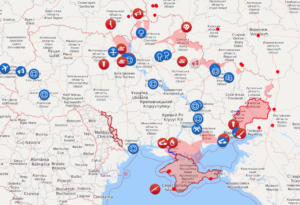
Russia’s invasion of Ukraine grinds on, Hunter Biden’s bestie’s going to the big house, a massive voting problem (and possible fraud) winds up in court in Harris County, and a tiny bits on both Amazon and anime.
It’s the Friday LinkSwarm!
Not in this LinkSwarm: links on the Zaporizhzhia Ukrainian nuclear reactor, since I’m not sure I can trust any of the information sent out by either side.
It is not foreordained that Russia wins and Ukraine loses. Winning a war is not merely an exercise in numbers or technology. As General George S. Patton observed, “Wars may be fought with weapons, but they are won by men. It is the spirit of men who follow and of the man who leads that gains the victory.”
Since Russian President Vladimir Putin failed to quickly topple the Ukrainian government and kill President Volodymyr Zelenskyy, the war has widened into a contest involving almost the entire border region shared by the combatants along with the stretch of border between Belarus and Kyiv some 80 miles to the north of Ukraine’s capital city.
Much media attention has been given to Russia’s advances along the Sea of Azov in the south and on the approach to Ukraine’s third-largest city, Odessa, on the shores of the Black Sea as well as the remarkable attack that captured Europe’s largest nuclear power plant in Zaporizhzhia. These Russian successes are discouraging for Ukrainian defenders but, in the grand contest, they matter far less than the battle for Kyiv.
Snip.
There are fascinating signs coming out of what may be a decisive battle to the northwest of Kyiv on the long, winding, secondary road from Chernobyl. This is the road where a 40-mile-long column of Russian vehicles was spotted by satellite. Most of the vehicles are supply trucks. They would be carrying fuel, ammunition, and food for the Russian forces that have advanced to the very outskirts of Kyiv itself but have seemingly been stalled for several days.
Snip.
Out of this come three reports that, if true, suggest the beginnings of a devastating reversal for Russian forces operating northwest of Kyiv.
First, reports today in multiple outlets that Russian Major General Andrei Sukhovetsky was killed in combat by a sniper. Sukhovetsky, 47, was an elite Russian Spetsnaz commando and veteran of Russia’s war in Syria. The commander of the Russian 7th Airborne Division, he was assigned the mission of leading the Russian thrust from Belarus to Kyiv. Men like Sukhovetsky have an outsized presence on the battlefield. They’re inspirational. Their personal leadership at the point of the spear often means the difference between victory and defeat during the fast-paced controlled violence of war. His loss would be devastating to his men and to the organizational momentum of the forces he commanded.
That Sukhovetsky was killed by a sniper suggests that he was personally trying to regain the initiative against Ukrainian forces who had fought him to a standstill.
The second report of merit is the heavy damage sustained in the town of Irpin on the northwest border of Kyiv’s city limits. The damage to this city suggests a major battle — an effort by the Russians to breakthrough. They didn’t.
The final piece of the puzzle is the Battle of Bucha. Ukrainian forces claimed the recapture of Bucha hours after the devastation visited on Irpin. The timing is important here. The Russians tried and failed to take Irpin and then the Ukrainians retook Bucha two miles to the northwest of Irpin.
The roughly 80-mile route from the Belarus-Ukraine border from the Chernobyl salient to Kyiv on the western side of the Dnieper River runs over a secondary asphalt road. This road frequently crosses rivers, runs through small villages, or is bordered on both sides by the eastern extent of the mighty Pripyat Marsh — the geographical feature which defines the border between Ukraine and Belarus.
The road is not able to support a large military force, even if unopposed in an exercise, especially during the spring and fall months during a time the locals call “Rasputitsa” — the mud season. Unfortunately for Russian President Vladimir Putin and his military commanders, Ukrainian soil never froze solid this winter, so the fall Rasputitsa is still a factor.
This is why there have been so many photos coming out from the conflict that show all manner of Russian military vehicles bogged down in the mud. As soon as a vehicle on a narrow road becomes disabled or is destroyed in combat, or as the vehicles maneuver off-road in response to combat, they risk becoming mired. Even if they don’t get stuck in the mud, they end up consuming far more fuel that must be delivered to them than they would were the ground frozen solid.
Thus, that 40-mile-long column of “tanks” is more likely mostly trucks carrying fuel, ammunition, and food to the advanced forces of the Russian 20th Combined Arms Army on the outskirts of Kyiv. That this column hasn’t apparently moved much may mean that the Russian forces just north of Kyiv are running low on basic supplies.
This greatly increases the importance for the Russian army to achieve success to the east of Kyiv where the road network is far more developed and, if the terrain is captured and secured, capable of bringing in the volume of supplies needed to properly surround Kyiv and place it under siege.
In the meantime, the forces near Kyiv may be vulnerable to a Ukrainian counterattack. While some of the Russian conscript soldiers and even the veteran contract troops may be more likely to surrender due to low morale exacerbated by a lack of food and fuel.
In about three weeks, we’ve seen a Vladimir who was “off” go from chess to raising on a busted flush in something that is well beyond “off.” The nuclear escalation is not exactly unexpected, at least if you know a bit about the Soviet playbook for such things. What matters is if he still has full control, and/or the extent to which Dead Hand has been brought online. All I will say is that if his ability to give certain orders has been unofficially curtailed, it would not be the first time. If it hasn’t, it is not a good idea to poke the crazy man with the button via official actions.
And there are a lot of official actions out there that are not going to help in regards the deteriorating man. Among others is Switzerland deciding that they are neutral, but not that neutral. Add to it firm allies who have told him no, even after he just helped them out literally a few weeks ago… Even Xi has said no on some fronts. None of this is likely to slow down the deterioration. Or provide enough of a reality check to get through to him as he rages in his bunker with his captive oligarchs.
And while we are at it, let’s look at the attack itself and the absolute fuck up that it, and subsequent actions by STAVKA (call it what it is), truly are. It was billed as a demonstration of the new Russian way of war, their version of “Shock and Awe.” Problem is, S&A or any other form of blitz is heavily dependent upon superior logistics, something the Soviets nor the Russians have ever had. You need massive amounts of ammo, fuel, parts, and replacement troops to pull it off. Replacement troops not only because of losses, but the need to detail out troops to hold key points as you go. It also requires highly trained troops who know land nav inside and out.
From what I am learning, the order went out to make this happen. The actual order, however, may not have even approached what would be given for a small-unit special ops strike. Contingency plans? Decap. No? Then try for decap again. Decap. Decap. Try it again damnit! There are differing reports on the number of Wagner troops killed or captured, but a good number were sent in on assassination missions. They were not alone. Problem was, they were all alone as the original push down got bogged down; the efforts to do airmobile and airborne ops were shot down (literally in some cases); and, the public is now on high alert to the saboteurs and assassins roaming major cities trying to mark targets, etc. Don’t expect rules of war for those caught marking civilian buildings for strikes. For now, expect a return to grinding Soviet bombardment, civilian casualties be damned.
The fact is, Vladimir has already lost simply because he didn’t win. He is committed, and is committing Russia and all its people, to a long, grinding, bloody slog that is going to have severe economic impacts. Just replacing ammunition, gear, people, is going to have a severe impact. Add to it the growing official and unofficial sanctions? The Russian people are going to feel this one, in ways they never have before. Current Vladimir does not care. He’s lost to that. He has no way to go in and control the country, or even the parts he’s tried so desperately to annex. Even those are likely to slip from him given the current state of “uppitiness” on the part of the Ukrainians.
The Ukrainians have not won. At best they have pushed things into a long grind with some chance of a stalemate. Yet, by doing this they have won. They have prevented the cheap and easy victory on which Vladimir counted. They have forced him into committing military and economic resources he does not have over the long term. Heck, even the short term. Russia’s economy was already teetering, current operations and responses are going to crater it unless something major happens. I’ve lived through a couple of power struggles in the Kremlin; under these circumstances, I hope we all do live through what is to come. A quick clean change of leadership seems unlikely given the Keystone gang we’ve seen so far, but it may be our best hope.
All we can do is wait and see what happens. While current circumstances are not new or unique on many levels, I will note that in my lifetime I’ve never seen a situation like this where key leadership was this insecure. Xi is in some ways hanging by a thread, and knows his enemies in the CCP are looking for any excuse to bring him down. Vladimir we’ve discussed. The Europeans, particularly the Germans? They are not secure either, especially since the Green policies have caused them to firmly place their mouth around Putin’s, er, finger, in regards energy. To see them decide to fund their own military, back off on the idiocy of green (maybe), and truly support the Ukraine strikes more as a desperation move than a rational push. Johnson is a non-entity right now, and not to be taken seriously. Our own dementia patient? Hell, he’s just waiting for his ice cream and to be allowed to go back upstairs to watch Matlock. Those behind him, however, are desperate beyond belief. Not one major stable leader anywhere in the world. That’s a new one and I thought I had about seen it all after watching the Soviets/Russians for more than 40 years now.
No NATO no-fly zone. Good. I very much want to see Putin defeated, but clearly NATO can’t be expected to respond to an attack on a non-member country, and that would be a dangerous escalation.
“More than a year” for $60 million in fraud? Seems a little lite.
The defendant, Devon Archer, was sentenced to one year and one day in federal prison by Manhattan Judge Ronnie Abrams, who said the crime was “too serious” to let him just walk.
“There’s no dispute about the harm caused to real people,” Abrams said, noting that the defrauded tribe, the Oglala Sioux, is one of the poorest in the nation.
Archer will also have to pay more than $15 million in forfeiture by himself and more than $43 million in restitution with his co-defendants in the case.
The convicted fraudster has maintained his innocence and intends to appeal the conviction and sentence, his attorney, Matthew Schwartz, said in court Monday.
In brief statements to Abrams just before Archer was sentenced, he and Schwartz claimed he was taken advantage of by corrupt businessmen who wanted to use him in the scheme.
“He came under the influence of a person he trusted too much and didn’t ask enough questions,” Schwartz said.
“Trusted too much.” Yeah, he trusted he wouldn’t get caught because of his powerful friends.
What are the odds this was the only crooked deal Archer had his fingers into? I’d say pretty close to zero.
The Democrats will suffer historic losses in the November midterms.
This disaster for their party will come about not just because of the Afghanistan debacle, an appeased Vladimir Putin’s invasion of Ukraine, the destruction of the southern border, the supply chain mess, or their support for critical race theory demagoguery.
The culprit for the political wipeout will be out-of-control inflation—and for several reasons.
First, the Biden Administration is in such denial of inflation that it sounds to Americans simply callous and indifferent to the misery it has unleashed.
Biden officials have scoffed at price spikes as “transitory.” Or they have preposterously claimed spiraling costs are a concern only to the elite. They blame the Ukraine crisis. Or they fault the out-of-office bogeyman, Donald Trump.
The administration assures us that consumer prices are only rising at an annualized rate of 7.5 percent—as if the steepest increase in 40 years actually is not all that bad.
Yet the middle class knows that inflation is far worse when it comes to the stuff of life: buying a house, car, gas, meat, or lumber.
Second, inflation is an equal opportunity destroyer of dreams. It undermines rich and poor, Democrats and Republicans, conservatives and liberals. It unites all tribes, all ideologies, all politics against those who are perceived to have birthed the monstrous octopus that squeezes everything and everyone it touches.
The conservative passbook holder sees his meager life savings eaten away. The liberal teacher’s car payments stretch from six to 10 years.
The prospective Republican home buyer sees his hard-earned potential down payment eaten away each month. The Democratic carpenter feels his new higher wages buy even less.
Third, inflation is ubiquitous, inescapable, omnipotent—and humiliating. It destroys personal dignity. And its toxicity is insidious, sort of like seeping, odorless, colorless, but nevertheless lethal carbon monoxide.
Unlike now-unpopular critical race theory, it cannot be avoided for a day. You cannot tune it out like one does the mess in Afghanistan or the now nonexistent southern border. Inflation attacks everyone in 24/7, 360-degree fashion.
It belittles you at the gas station. It downsizes you at the food market. It humiliates you in the obscene real estate market. It makes you look stupid when you are paying for a new car. It ridicules you when you buy lumber. Suddenly you apologize that you really cannot afford your child’s braces.
Fourth, inflation undermines a civil and ordered society. It unleashes a selfish “every man for himself” mentality, the Hobbesian cruelty of a “war of all against all.”
Inflation is the economic and emotional equivalent of smash-and-grab or carjacking. It is a brazen robber in broad daylight that so infuriates Americans by its boldness. It convinces them their very civilization is dying.
“Federal Court Declares Diversity Initiative At Thomas Jefferson High School To Be Unconstitutional.” “Judge Claude Hilton ruled that the county unconstitutionally engineered the reduction of Asian-American students to achieve greater racial diversity.”
Did you know that one of the biggest freight management companies in America was temporarily locked down by a cyberattack? “Expeditors International, a top-five freight management company by revenue, disclosed Wednesday that last month’s cyberattack will have a “material adverse impact” on finances and that it will be late filing its 2021 annual report because of difficulty accessing information on its accounting systems.”
Once again Harris County has drawn scrutiny over a slew of election day problems and may need a court order to continue counting votes beyond a state proscribed deadline.
Issues with elections procedures began days before March 1 as election judges found that supplies were not available for pickup at the appointed time on Friday, February 25. Even after the delayed distribution of supplies on Saturday, election workers complained that many kits were lacking essential equipment.
The situation worsened by Tuesday, and during a conference call with the Texas Secretary of State’s Office (SOS) and representatives from the local Democratic and Republican parties, Elections Administrator Isabel Longoria notified the state that her department may not be able to count all early and election day ballots by the statutory deadline of 7 p.m. Wednesday, March 2.
According to a statement from Secretary of State John Scott, the counting delay was “due only to damaged ballot sheets that must be duplicated before they can be scanned by ballot tabulators at the central count location.”
“Our office stands ready to assist Harris County election officials, and all county election officials throughout the state, in complying with Texas Election Code requirements for accurately tabulating and reporting Primary Election results. We want to ensure that all Texans who have cast a ballot in this year’s Primary Elections can have confidence in the accuracy of results.”
According to the state election code, however, any votes counted after the statutory deadline may not count unless the county obtains a court order. Furthermore, under laws in effect since 1986, failure to deliver precinct election returns by the deadline is a Class B misdemeanor.
Calling the county’s elections problems the “worst in 40 years,” Harris County Republican Party (HCRP) Chair Cindy Siegel told KPRC news, “This has been a complete mess. We’ve had equipment delays, we’ve had equipment problems, equipment wasn’t delivered, we had polls that were unable to be set up.”
In a statement to The Texan, HCRP said that after consulting with the SOS, “if the count does not appear to be near completion in all races by [Wednesday] afternoon, the parties have tentatively agreed to seek a court order to require the Harris County Election Administrator to continue counting beyond the 24-hour deadline required by law, and to enjoin the law to allow the count to continue.”
Responsibility for conducting primary elections falls to the two main political parties, but they have contracted with the Harris County elections division to administer the elections.
Sen. Paul Bettencourt (R-Houston) who formerly served as the Harris County voter registrar, called for immediate changes to the elections division.
“[Harris County Judge] Lina Hidalgo must fire her hand-picked election administrator,” Bettencourt told The Texan. “Because if she doesn’t, I don’t think we’re going to have an election in November.”
In 2020, the three Democrats on the Harris County Commissioners Court overruled objections from two Republican commissioners and the Democrat elected voter registrar Ann Harris Bennet to create the new office of elections administrator. Prior to the revamp, the elected county clerk and elected voter registrar managed elections in the state’s largest county.
The commissioners court then appointed Longoria, a former staffer for state Sen. Sylvia Garcia (D-Houston) who had previously run unsuccessfully for Houston City Council, with an annual salary of $190,000.
Under Longoria’s guidance, the county approved $54 million for the elections division last summer which included $14 million to purchase new voting equipment.
Earlier this year, Longoria told commissioners the March primary would cost more than $8.8 million.
In 2020, Harris County received nearly $10 million in grants from Mark Zuckerberg’s Center for Tech and Civic Life and another $1 million in 2021 just before the Texas Legislature restricted such private grants.
According to sources familiar with the equipment, the second page of the paper ballot has been jamming machines and now requires entry by hand. Allegedly, although the early voting period ended Friday,
The question, of course, is whether this is a sign of manifest incompetence, or a sign of widespread attempted vote fraud?
If it was a fraud attempt, we should be grateful that it was bungled so badly in the primary that a lot more attention will be paid.
And the judge didn’t sound pleased:
Update: the "court finds it is required…to impound the precinct election materials in the possession of Ms. Longoria and her staff and for the court to supervise the activities necessary to complete the count…" https://t.co/h1FL7F5XTn
Iowa Republican Governor Kim Reynolds signs bill banning men from women’s sports. I’ll take “Headlines no one would understand 20 years ago” for $400, Alex.
Democratic Party Gaslighting: The Continuing Journeys:
The party that painted this now wants you to believe they support Law Enforcement. Americans won’t forget this — especially not on Election Day. pic.twitter.com/nCBkDmI6yf
— Kari Lake for AZ Governor (@KariLake) March 3, 2022
The Russian offensive in Ukraine continues to bog down against stiff resistance, Putin puts his nukes on alert, a rumor of peace talks, momentum to suspend some Russian banks from SWIFT builds, and a whole lot of aid from the rest of the world is pouring into Ukraine.
Russia invaded Ukraine from three sides on Wednesday night Eastern time, and as of now, early afternoon Saturday, the Russian army has yet to seize any Ukrainian cities.
This morning, a senior defense official at the Pentagon briefed reporters and declared, “We continue to believe, based on what we have observed that this resistance is greater than what the Russians expected and we have indications that the Russians are increasingly frustrated by their lack of momentum over the last 24 hours particularly in the north parts of Ukraine… As of this morning we have no indication still that the Russian military has taken control over any cities. As of this morning we still believe that Russia has yet to achieve air superiority. Ukrainian air defenses including aircraft do continue to be operable and continue to engage and deny access to Russian aircraft in places over the country.”
There is an intriguing but unverified claim from Ukrainian intelligence that Putin is furious, that he expected a quick surrender from Kiev, and that the invading Russian forces weren’t equipped for a long war – and that after ten days, the Russian forces will face serious problems with supply lines, fuel, equipment, ammunition, etc. Maybe this is just Ukrainian propaganda, meant to keep up morale for the next week or so. But there are some intriguing anecdotes of Ukrainians hitting Russian supply columns and videos of Russian tanks running out of fuel. (It turns out supply chain problems are just everywhere these days!)
Sending in armored columns without dedicated infantry, artillery and air support is a big risk, big reward move. Patton did it successfully in the race across France in 1944, but he had air superiority, a friendly population, and the greatest war machine ever assembled in the history of mankind up to that time backing him, and even he had to halt when he outran his supply lines.
Putin’s initial goal, the Russian reabsorption of Ukraine or the transformation of it into a lackey state of a renewed Russian empire, is now probably impossible. Any Russian-backed Ukrainian puppet government is likely to be vehemently rejected by the Ukrainian people. Russian forces will find it difficult to go out on patrol when every citizen’s got a rifle and every grandma on every street corner is handing them sunflower seeds, telling them they are going to be fertilizer soon.
Russia may take large chunks of Ukraine, but they will have an exceptionally difficult time keeping it.
The last three days of combat should put a serious dent in the reputation of this new Russian army. We should, however, try to understand why the Russians are struggling. First, the Russian army’s recent structural reforms do not appear to have been sufficient to the task at hand. Second, at the tactical and operational level, the Russians are failing to get the most out of their manpower and materiel advantage.
There has been much talk over the last ten years about the Russian army’s modernization and professionalization. After suffering severe neglect in the ’90s, during Russia’s post-Soviet financial crisis, the army began to reorganize and modernize with the strengthening of the Russian economy under Putin. First the army got smaller, at least compared to the Soviet Red Army, which allowed a higher per-soldier funding ratio than in previous eras. The Russians spent vast sums of money to modernize and improve their equipment and kit — everything from new models of main battle tanks to, in 2013, ordering Russian troopers to finally retire the traditional portyanki foot wraps and switch to socks.
But the Russians have also gone the wrong direction in some areas. In 2008, the Russian government cut the conscription term from 24 to twelve months. As Gil Barndollar, a former U.S. Marine infantry officer, wrote in 2020:
Russia currently fields an active-duty military of just under 1 million men. Of this force, approximately 260,000 are conscripts and 410,000 are contract soldiers (kontraktniki). The shortened 12-month conscript term provides at most five months of utilization time for these servicemen. Conscripts remain about a quarter of the force even in elite commando (spetsnaz) units.
As anyone who has served in the military will tell you, twelve months is barely enough time to become proficient at simply being a rifleman. It’s nowhere near enough time for the average soldier to learn the skills required to be an effective small-unit leader.
Yes, the Russians have indeed made efforts to professionalize the officer and the NCO corps. Of course, non-commissioned officers (NCOs) have historically been a weakness of the Russian system. In the West, NCOs are the professional, experienced backbone of an army. They are expected to be experts in their military speciality (armor, mortars, infantry, logistics, etc.) and can thus be effective small-unit commanders at the squad and section level, as well as advisers to the commanders at the platoon and company level. In short, a Western army pairs a young infantry lieutenant with a grizzled staff sergeant; a U.S. Marine Corps company commander, usually a captain, will be paired with a gunnery sergeant and a first sergeant. The officer still holds the moral and legal authority and responsibility for his command — but he would be foolish to not listen to the advice and opinion of the unit’s senior NCOs.
The Russian army, in practice, does not operate like this. A high proportion of the soldiers wearing NCO stripes in the modern Russian army are little more than senior conscripts near the end of their term of service. In recent years, the Russians have established a dedicated NCO academy and cut the number of officers in the army in an effort to put more resources into improving the NCO corps, but the changes have not been enough to solve the army’s leadership deficit.
Now, let’s talk about the Russian failures at the operational and tactical level.
It should be emphasized again that the Russian army, through sheer weight of men and materiel, is still likely to win this war. But it’s becoming more and more apparent that the Russians’ operational and tactical choices have not made that task easy on themselves.
First, to many observers, it’s simply shocking that the Russians have not been able to establish complete air superiority over Ukrainian air space. After three days of hostilities, Ukrainian pilots are still taking to the skies and Ukrainian anti-air batteries are still exacting a toll on Russian aircraft. The fact that the Russians have not been able to mount a dominant Suppression of Enemy Air Defenses (SEAD) campaign and yet are insistent on attempting contested air-assault operations is, simply put, astounding. It’s also been extremely costly for the Russians.
To compound that problem, the Russians have undertaken operations on multiple avenues of advance, which, at least in the early stages of this campaign, are not able to mutually support each other. Until they get much closer to the capital, the Russian units moving north out of Crimea are not able to help the Russian armored columns advancing on Kyiv. The troops pushing towards Kyiv from Belarus aren’t able to affect the Ukrainians defending the Donbas in the east. As the Russians move deeper into Ukraine, this can and will change, but it unquestionably made the opening stages of their operations more difficult.
Third, the Russians — possibly out of hubris — do not appear to have prepared the logistical train necessary to keep some of their units in action for an extended period of time. Multiple videos have emerged of Russian columns out of gas and stuck on Ukrainian roads.
The classic saying is “Amateurs talk about tactics, but professionals study logistics” (attributed to Marines Corps commander Gen. Robert H. Barrow, but I suspect the general sentiment is much older). An army runs on its stomach, and a modern mechanized army runs on its gas tank, and something has clearly gone wrong in with Russian logistical support for this war.
Russia seemed to have expected Ukrainian President Volodymyr Zelenskyy to fold. He hasn’t.
America offered to evacuate Ukrainian President Volodymyr Zelenskyy. Zelenskyy replied, “The fight is here; I need ammunition, not a ride.”
Zelenskyy’s reply was reminiscent of past heroes in times of war: Gen. Anthony McAuliffe who replied in “NUTS” in response to the German demand for surrender at Bastogne during the Battle of the Bulge in 1944; and the Texans striving for independence from dictator Santa Anna’s Mexico with their “Come and Take it Flag,” which was itself appropriated from Spartan King Leonidas and his response the Persian surrender demand at the Battle of Thermopylae.
This bravery, in a day when modern communications allow all Ukrainians and the world to see it, has rallied Ukrainians to defend their nation. And now that the fighting has gone on for three days, what might that mean?
Russian President Putin is said to have assembled 200,000 troops for the invasion. It is estimated that half of them have been committed so far. Further, Putin has called on 10,000 battle-hardened Chechen mercenaries. More than half of Russian forces are likely committed to the battle of Kyiv.
Ukraine has 245,000 active-duty members, but most are in the east, facing the Russian-led and equipped militia in the separatist regions of Donetsk and Luhansk. Ukraine also has another 220,000 reservists. Many of these are spread across the nation slightly larger than the state of Texas.
The strategic target is Kyiv and its independent government. To move the reservists to the fight, they must contend with Russian air superiority, slowing their march. More importantly, given this struggle for national survival, 7,000,000 men of military age and fit for military service are taking up arms. Every day, many more older men — and many Ukrainian women — are also being issued weapons, making Molotov cocktails, and joining the fight.
The ongoing Ukrainian mobilization means that the Russian military will soon be outnumbered most everywhere on the battlefield. The Ukrainians may not have the same level of modern equipment — missiles, jets, helicopter — but they have numbers and will power. And, the Russians need to eat, they need fuel, and ammunition — their resupply trucks must get through. They won’t, not in large enough numbers; everyday Ukrainians will see to that.
Zelensky: ‘We successfully fought off enemy attacks. We are defending our country, our land, future of our children. Kyiv & key places near the capital are under our control. The occupiers wanted to capture our capital and install their puppets like Donetsk. We broke their idea.’ pic.twitter.com/3PtnzXmPoy
Russian forces’ main axes of advance in the last 24 hours focused on Kyiv, northeastern Ukraine, and southern Ukraine. Russian airborne and special forces troops are engaged in urban warfare in northwestern Kyiv, but Russian mechanized forces are not yet in the capital. Russian forces from Crimea have changed their primary axes of advance from a presumed drive toward Odesa to focus on pushing north toward Zaporizhie and the southeastern bend of the Dnipro River and east along the Azov Sea coast toward Mariupol. These advances risk cutting off the large concentrations of Ukrainian forces still defending the former line of contact between unoccupied Ukraine and occupied Donbas. Ukrainian leaders may soon face the painful decision of ordering the withdrawal of those forces and the ceding of more of eastern Ukraine or allowing much of Ukraine’s uncommitted conventional combat power to be encircled and destroyed. There are no indications as yet of whether the Ukrainian government is considering this decision point.
Ukrainian resistance remains remarkably effective and Russian operations especially on the Kyiv axis have been poorly coordinated and executed, leading to significant Russian failures on that axis and at Kharkiv. Russian forces remain much larger and more capable than Ukraine’s conventional military, however, and Russian advances in southern Ukraine may threaten to unhinge the defense of Kyiv and northeastern Ukraine if they continue unchecked.
Key Takeaways
Russia has failed to encircle and isolate Kyiv with the combination of mechanized and airborne attacks as it had clearly planned to do. Russian forces are now engaging in more straightforward mechanized drives into the capital along a narrow front along the west bank of the Dnipro River and toward Kyiv from a broad front to the northeast.
Russian forces have temporarily abandoned failed efforts to seize Chernihiv and Kharkiv to the northeast and east of Kyiv and are bypassing those cities to continue their drive on Kyiv. Russian attacks against both cities appear to have been poorly designed and executed and to have encountered more determined and effective Ukrainian resistance than they expected.
Russian movements in eastern Ukraine remain primarily focused on pinning the large concentration of Ukrainian conventional forces arrayed along the former line of contact in the east, likely to prevent them from interfering with Russian drives on Kyiv and to facilitate their encirclement and destruction.
Russian forces coming north from Crimea halted their drive westward toward Odesa, and Ukrainian forces have retaken the critical city of Kherson. Some Russian troops remain west of the Dnipro River and are advancing on Mikolayiv, but the main axes of advance have shifted to the north and east toward Zaporizhie and Mariupol respectively.
Russian forces have taken the critical city of Berdyansk from the west, threatening to encircle Mariupol even as Russian forces based in occupied Donbas attack Mariupol from the east, likely to pin defenders in the city as they are encircled.
Russian successes in southern Ukraine are the most dangerous and threaten to unhinge Ukraine’s successful defenses and rearguard actions to the north and northeast.
Russian troops are facing growing morale and logistics issues, predictable consequences of the poor planning, coordination, and execution of attacks along Ukraine’s northern border.
It appears that the various armored column incursions were secondary to or distractions from the attempted paratroop-powered decapitation strike to be launched from Antonov International Airport. When that went awry (as airborne assaults often do; see the SNAFU that was Operation Market Garden in World War II), there appeared to be no coherent backup plan.
Indeed, the entire operation seems to have been hastily planned and executed, which is odd, since Ukraine has obviously been much on Putin’s mind since 2014.
This is not the way competent troops act in hostile urban environments. It’s like the Russian army forgot all they learned from getting their asses kicked in the First Battle of Grozny, where driving ill-supported mechanized columns filled with untrained conscripts into the city resulted in horrible losses for the Russians.
The Kiev assault seems even less thought out, and their opponents appear much better equipped and trained than the Chechens were.
On the other hand, here’s a report that Kiev is surrounded. I’d take that with several grains of salt.
Putin puts Russian nuclear forces on alert. The idea that Putin would actually contemplate nuclear war with the west because his own ill-conceived and badly-executed invasion of Ukraine has gone off the rails is hardly credible. Russia would be annihilated.
“As you can see, not only do Western countries take unfriendly measures against our country in the economic dimension – I mean the illegal sanctions that everyone knows about very well – but also the top officials of leading NATO countries allow themselves to make aggressive statements with regards to our country,” Putin said on state television.
“Mommy, they’re saying bad things about me!” Those unfriendly measures would, of course, stop instantly if Putin were to withdraw his forces from the territory of other sovereign nations.
Here’s a video of Putin explaining himself:
Does that look or sound like an all-powerful conqueror at the top of his game? No, that’s the tone and the body language of a guy trying to explain why he just fucked up. “We had no other choice!” Yeah, except, you know, not invading another country.
There are evidently plans for talks between Ukrainian and Russian delegations on the Ukraine border with Belarus. Don’t expect much. Zelenskyy: “I do not really believe in the result of this meeting, but let them try, so that no citizen of Ukraine would have any doubt that I, as president, did not try to stop the war when there was even a small chance.”
The U.S. is sending $350 million in military aid. “The defense aid will include anti-armor, small arms and various munitions, and body armor and related equipment.” Let’s hope none of it disappears into the pockets of people connected to members of the Senate Foreign Relations Committee…
Speaking of reversing course, Germany has also done an about-face and is now in favor of removing some Russian banks from SWIFT. “The sanctions, agreed with the United States, France, Canada, Italy, Great Britain and the European Commission also include limiting the ability of Russia’s central bank to support the ruble.” I get the impression that the Eurocrats were hesitant to cut Russia off from SWIFT because they thought it would be a useless gesture. Now that Russia’s invasion has gone off the rails, they’re rethinking. The quick reverse also indicates how pissed they are at Russia right now.
Europe has effectively closed its airspace to Russia:
Based on published NOTAMs, adding Austria, Germany, Iceland, and Italy to the list of airspace unavailable to Russian flights — all in effect by 14:00 UTC. Based statements by government officials, we expect further prohibitions on Russian flights. https://t.co/3GtCYRmZUQpic.twitter.com/O0WTcsdRlz
A final word: There are a few Twitter pundits suggesting that some sort of “wag the dog” scenario of a fake war might be unfolding in Ukraine. I don’t buy it. There’s too much real reporting from too many points in Ukraine for such an elaborate, two-part deception to be unfolding. Lots of weird things happen in warfare.
I will say one thing: The manifest incompetence with which Russia has tried to carry out this assault suggests that Putin felt he had to launch it then due to some sort of time pressure or deadline, but I don’t know what it is. Maybe Putin has late stage cancer, or he felt Ukraine was about to join NATO, or a major Russian oilfield is about to run dry. Whatever it is, this war appears to be a panic move that’s gone very badly for Putin.
The gist of the article is that many Democrats are just noticing the problem, which is laughable. The far-left, ultra-woke territory was staked out by all Democrats years ago. They can’t suddenly act like it’s only the fringe that feels this way and the mainstream Dems aren’t on board with the madness. Virtually every Democrat of note has been slobbering all over chances for woke posturing for years. There has been pushback but they’ve been dismissive of it, resorting to their boilerplate “RACIST!” retort each time.
Snip.
While watching the Democrats go mega-woke — especially this year — I’ve wondered aloud whether any of the party’s Beltway elite have recently had a conversation with a Democrat in flyover country. It would seem not.
It’s not unthinkable that Dems running next year would do a temporary 180 on wokeness in an effort to dupe people into voting for them. In recent weeks, we’ve seen them pretend that it was Republicans who wanted to defund the police and also try to convince the public that they’ve always been fans of voter ID. If they’re now worried about the extremely woke look on top of those two issues, the internal polling must really be rattling them.
Honestly, I don’t see how Democrats can uncouple themselves from the woke train they enthusiastically hooked themselves up to so long ago.
The caveat is that we’ve seen this sort of articles before, and the madness still continues…
When Vice President Kamala Harris finally made the decision to visit the Mexico border last week, people inside her own office were blindsided by the news.
For days, aides and outside allies had been calling and texting with each other about the political fallout that a potential trip would entail. But when it became known that she was going to El Paso, it left many scrambling, including officials who were responsible for making travel arrangements and others outside the VP’s office charged with crafting the messaging across the administration.
The handling of the border visit was the latest chaotic moment for a staff that’s quickly become mired in them. Harris’ team is experiencing low morale, porous lines of communication and diminished trust among aides and senior officials. Much of the frustration internally is directed at Tina Flournoy, Harris’ chief of staff, a veteran of Democratic politics who began working for her earlier this year.
In interviews, 22 current and former vice presidential aides, administration officials and associates of Harris and Biden described a tense and at times dour office atmosphere. Aides and allies said Flournoy, in an apparent effort to protect Harris, has instead created an insular environment where ideas are ignored or met with harsh dismissals and decisions are dragged out. Often, they said, she refuses to take responsibility for delicate issues and blames staffers for the negative results that ensue.
While much of the ire is aimed at Harris’ chief, two administration officials said the VP herself also bears responsibility for the way her office is run. “It all starts at the top,” said one of the administration officials, who like others requested anonymity to be able to speak candidly about a sensitive matter.
“People are thrown under the bus from the very top, there are short fuses and it’s an abusive environment,” said another person with direct knowledge of how Harris’ office is run. “It’s not a healthy environment and people often feel mistreated. It’s not a place where people feel supported but a place where people feel treated like s—.”
Of course, we’ve already seen similar reports before, but this one is a lot more nakedly critical. Having such deeply critical pieces launched at a sitting Democratic Vice President in their first year in office is highly unusual, to say the least. Either Harris really is horribly bad at managing her staff, or powerful people in the Biden administration have the knives out for her. Or both.
Last summer, federal officials in Delaware investigating Hunter Biden faced a dilemma. The probe had reached a point where prosecutors could have sought search warrants and issued a flurry of grand jury subpoenas. Some officials involved in the case wanted to do just that. Others urged caution. They advised Delaware’s U.S. Attorney, David Weiss, to avoid taking any actions that could alert the public to the existence of the case in the middle of a presidential election.
“To his credit, he listened,” said a person involved in the discussions, reported here for the first time. Weiss decided to wait, averting the possibility that the investigation would become a months-long campaign issue.
Translation: They withheld the truth from the public because they wanted the Democrat to win.
Thanks to recently released Labor Department data on unemployment claims, we can now, quite predictably, see the welfare rolls expanding in the states where the unemployment bonus remains in place. Yet the number of people on welfare is rapidly shrinking in the states where the supplement is set to expire or already has expired.
“The 26 states that have announced their plan to end participation in the $300 weekly unemployment bonus have seen a 12.7 percent decline on average in initial claims over the past week,” the fiscally-conservative Foundation for Government Accountability reports. “Meanwhile, states that have indicated they will continue participating in the unemployment bonus programs have seen an increase in initial claims by an average of 1.6 percent during this same period. The 12 states that have officially opted out of the $300 weekly bonus thus far have seen consistent declines each week since ending participation in the bonus.”
In other words, people are leaving the welfare rolls and returning to work in the states where the government is getting out of the way. They are not doing so as much in the states where expanded welfare continues to create dysfunctional incentives.
Tucked deep in San Francisco’s sixth district is Dodge Place, a residential street located in the notorious Tenderloin neighborhood. It’s been overtaken by drug users who come to get high, descend into madness, and then destroy themselves and their surroundings. Dodge is a dead end, literally and figuratively—a combat zone, with all sides fighting for their lives.
Citizens’ cries for backup have gone virtually unanswered. Elected officials and government bodies from the district’s supervisor, Matt Haney, to the Department of Public Health have abandoned residents so completely that it’s hard not to wonder if the neglect isn’t deliberate.
Though most of the sixth district, an area that includes City Hall, already rivals the world’s worst slums for its inhumane conditions, Dodge Place is a particularly intense concentration of immiseration. In effect, the dead-end street is at the end of a funnel, into which flow customers from San Francisco’s most rampant illegal drug trade. In fact, mere steps away from the street, residents recently held a rally against the scourge of fentanyl, the potent synthetic opioid responsible for the majority of the city’s fatal overdoses. Organized by journalist Michael Shellenberger, the rally focused on Jacqui, a distraught mother searching for her addicted, homeless son. Jacqui pleaded for help, and community members raged against the city’s inaction. Politicians gave speeches, including Haney, who proclaimed his outrage, conceded government’s failings, and told the crowd to hold him accountable.
Yet the death toll from drug abuse continues to escalate. Data from the Office of the Chief Medical Examiner indicate that fatal overdoses this year in San Francisco are on pace to exceed the 2020 total, a record-breaking year in which more than 700 died.
Hanging around in the Tenderloin is dangerous. Gangs rule the drug-dealing business. Scores of dealers, nearly all young males from Mexico and Central America, openly sell narcotics. Gunfire and homicides are common. On June 14, the San Francisco Police Department’s Tenderloin station reported three shooting incidents, with five victims, and 29 arrests on the corner. Law enforcement doggedly does its part, but the arrestees nearly always return to their spots within hours.
As mayhem in the Tenderloin intensifies, many who have just made drug purchases drift over to Dodge Place so that they can use away from the drama. Once there, they create their own brand of chaos. The result is a place so bizarre and horrific that adequate descriptions sound hyperbolic.
At any given time, dozens of people congregate in the small alley to inject or smoke their substance of choice. Teenagers to seniors, of all races and demographics, jab needles into their bloody, bloated limbs, hands, and feet. One inexplicably common figure is a man neatly dressed for a day at the office who drives syringes deep into other people’s necks. Soon after imbibing, users stand still as statues but bent at the waist, colloquially known as the “fentanyl fold.” Some collapse and crawl, while others sit listlessly on the curb, lining the walls. Or they wander, run, or flail, screaming at each other as well as invisible demons. Many urinate and defecate in their clothes, on the pavement or doorsteps.
Chesa Boudin, San Francisco’s George Soros-backed DA who refuses to prosecute drug dealers, is facing a recall election. This is the future that awaits Austin if Jose Garza stays in the DA’s office…
Los Angeles: Surprise! The mask mandate is back. Sounds like something that calls for widespread civil disobedience.
Vietnam is not the threat that China is, but don’t forget that their communist government still oppresses anyone who objects to their rule. “Vietnamese Dissident Writer Jailed for Five Years, Six Months by Hanoi Court. Pham Chi Thanh was charged under Article 117 of Vietnam’s Penal Code, a law frequently used by authorities to stifle dissident voices.”
Being a black Democratic grifter really pays: “Stacey Abrams now owns two homes totaling $1.4M after starting 2018 campaign in massive debt.”
Paul Ehrlich is spewing the same gloom and doom that’s proven wrong for the last half century.
“Basketball player uses nationally televised CBS interview to show off his ‘Free the Uyghurs’ T-shirt.” Good for him. Though, since this is Royce White, the first round draft pick who never suited up for the Rockets, “player” may be misleading in this case…
Democratic megadonor Ed Buck’s murder trial for giving young men fatal drug overdoses for sexual gratification finally gets under way. (Previously.)
Kaseya VSA ransomware attack succeeded because the company didn’t include a NULL test for login bypass. Jesus. Freaking. Christ. That’s one of the first things you should set up in your QA automated regression testing suite.
“A Florida man stole an alligator from a mini-golf course and tried to heave the reptile onto the roof of a building to ‘teach it a lesson,’ authorities said.
Idiot rioters and their identifying tattoos, more elected Democrats behaving badly, and a higher than usual helping of cute animals. Enjoy your Friday LinkSwarm!
Borepatch points out that U.S. Wuhan coronavirus deaths hit post-March lows. Also, all U.S. deaths are now far below the norms.
This was not just a bad flu. The data are crystal clear on that.
However, the data did not justify shutting down the economy. The data did not justify preventing you from saying goodbye to Grandma on her deathbed. The data did not justify prohibiting public gatherings at funerals. The data did not justify shutting down Sunday church. The data did not justify shutting down the schools. The data don’t justify mandatory mask wearing. The data don’t justify the hype.
George Soros-backed St. Louis prosecutor Kim Gardner, who charged Mark and Patricia McCloskey with felonies for using guns to protect their homes, illegally took several trips took several trips paid for by activist groups that she failed to disclose. Fair and Just Prosecution is the name of the activist group in question.
Tennessee Democratic state senator Katrina Robinson was charged with swindling $600,000 in federal funds to pay for her wedding and a lavish lifestyle.
“Say Her Name” is one of the slogans that activists have connected to this Louisville shooting, but if we want to understand why police shot Breonna Taylor, there is another name that needs to be said — Jamarcus Glover.
Glover is a 30-year-old narcotics trafficker who police say was dealing crack cocaine and marijuana out of a “trap house” on Elliott Avenue in Louisville’s west side. According to a police affidavit, detectives had Glover and his accomplice Adrian Walker under surveillance, and had seen their car — a red Dodge Charger with Mississippi plates — “make frequent trips” from the Elliott Avenue “trap house” to an apartment 10 miles away on Springfield Drive. Detective Joshua Jaynes wrote in the affidavit that Glover was using the Springfield Drive apartment as his mailing address; Jaynes said he had witnessed Glover pick up a postal package at the apartment; and, citing his “training and experience,” Jaynes stated his belief that Glover “may be keeping narcotics and/or proceeds from the sale of narcotics” at the Springfield Drive apartment. All of this was stated in an application for a search warrant of the Springfield Drive apartment where Breonna Taylor lived.
You see, Jamarcus Glover was Breonna Taylor’s ex-boyfriend. They broke up a couple years ago, according to a lawyer for Taylor’s family who said she maintained a “passive friendship” with Glover. This “friendship” apparently included allowing Glover to receive his mail at her apartment, and, although there is no evidence that Taylor was ever involved in Glover’s drug operation, the “training and experience” of Detective Jaynes led him to believe there must be some connection. This was convincing enough for Jefferson County Circuit Court Judge Mary Shaw, who approved the so-called “no-knock” warrant for Taylor’s apartment, and also approved nearly identical warrants for the four other addresses linked to Glover’s drug operation, including the Elliott Avenue “trap house.”
Louisville police served all five warrants almost simultaneously, shortly after midnight on March 13. Glover was arrested at the Elliott Avenue address, but the raid on Taylor’s apartment went horribly wrong. Police Sgt. Jonathan Mattingly, who was part of the five-man squad assigned to serve the warrant on the Springfield Drive address, said the squad was told in a preliminary briefing that this was a “soft target” because Taylor was believed to be alone in the apartment. Therefore, Sgt. Mattingly said, the decision was made for officers to knock on the door and announce themselves as police, despite the authorization for a “no-knock” entry. Sgt. Mattingly knocked for about a minute, he said, before the supervising lieutenant ordered them to “hit it,” using a battering ram to breach the door.
Inside the apartment, however, Breonna Taylor was not alone. She had a new boyfriend visiting her, and they were watching a movie in her bedroom. The boyfriend, Kenneth Walker (no relation to Glover’s accomplice Adrian Walker) had a legally owned pistol, and when he heard somebody pounding on the front door, he grabbed his weapon. Why? Because he was “scared to death,” believing that the person pounding on the door might be Taylor’s drug-dealer ex-boyfriend. Walker and Taylor emerged from the bedroom into the hallway of the apartment and, Walker said, Taylor called out, “Who is it?”
The next thing that happened, in Walker’s description of the incident, is the door “comes off its hinges” — the police are busting in, but he doesn’t know it’s the police. If you’re dating a drug dealer’s ex-girlfriend and somebody busts through your door at 12:30 in the morning, what do you do?
Walker fired a shot, hitting Sgt. Mattingly in the thigh, and Sgt. Mattingly immediately returned fire, getting off six shots. Two other officers also opened fire. In total, police fired at least 22 shots, none of which hit Walker, but Taylor was struck eight times and died on the scene. Although a grand jury indicted Walker on a charge of attempted murder of a police officer, that charge was dismissed in May at the request of Commonwealth’s Attorney Tom Wine.
Lest people think I always follow President Trump’s policy position, here’s another one I differ on: Russia shouldn’t be let back into the G7 as long as they’re occupying parts of Ukraine.
Speaking of super-genius rioters and tattoos, Edward Thomas Schinzing was arrested on federal arson charges in Portland thanks to the fact he was shirtless and had his own name tattooed across his back.
The Washington press corps seems engaged in a collective demonstration of the legal concept of willful blindness, or deliberately ignoring the facts, following the release of yet another declassified document which directly refutes prior statements about the investigation into Russia collusion. The document shows that FBI officials used a national security briefing of then candidate Donald Trump and his top aides to gather possible evidence for Crossfire Hurricane, its code name for the Russia investigation.
It is astonishing that the media refuses to see what is one of the biggest stories in decades. The Obama administration targeted the campaign of the opposing party based on false evidence. The media covered Obama administration officials ridiculing the suggestions of spying on the Trump campaign and of improper conduct with the Russia investigation. When Attorney General William Barr told the Senate last year that he believed spying did occur, he was lambasted in the media, including by James Comey and others involved in that investigation. The mocking “wow” response of the fired FBI director received extensive coverage.
The new document shows that, in summer 2016, FBI agent Joe Pientka briefed Trump campaign advisers Michael Flynn and Chris Christie over national security issues, standard practice ahead of the election. It had a discussion of Russian interference. But this was different. The document detailing the questions asked by Trump and his aides and their reactions was filed several days after that meeting under Crossfire Hurricane and Crossfire Razor, the FBI investigation of Flynn. The two FBI officials listed who approved the report are Kevin Clinesmith and Peter Strzok.
Clinesmith is the former FBI lawyer responsible for the FISA surveillance conducted on members of the Trump campaign. He opposed Trump and sent an email after the election declaring “viva the resistance.” He is now under review for possible criminal charges for altering a FISA court filing. The FBI used Trump adviser Carter Page as the basis for the original FISA application, due to his contacts with Russians. After that surveillance was approved, however, federal officials discredited the collusion allegations and noted that Page was a CIA asset. Clinesmith had allegedly changed the information to state that Page was not working for the CIA.
Meet the source for all the most salacious claims in the debunked Steele dossier: Russian-born habitual drunk Igor Danchenko, who used to work for the Brookings Institution.
From the “facts pulled out of our ass” department:
Other outlets have asked for this evidence too, and have similarly come up with nothing.
"Richmond officials have presented no direct evidence showing white supremacists organized the protest, encouraged violence or participated in any property damage."https://t.co/RJKpblJXi5
Well, every single gun nut in America has spent their entire adult life being continually mocked, insulted, and belittled by the left. You’ve done nothing but paint us as the bad guys.
In Hollywood, we’re always evil, stupid, violent, malicious, redneck, racist, murderers. That’s so ingrained in the liberal religion that when “ally” Harvey Weinstein was trying to get out of being a sleazy rapist, his repentance consisted of promising to make more movies about how the NRA is bad.
In the news, everything is always our fault. If there is a mass murder, we can always count on the vultures to swoop in and blame America’s gun culture. They flog it for weeks on end, 24/7 coverage, hoping for gun control. And if the identity of the shooter doesn’t fit the narrative, it drops off the news in mere hours.
And then at the local, state, and federal level, legally speaking, the left fucks us at every opportunity. You ban everything you can get away with. You ban things that literally make no sense. You ban shit just out of spite.
When we fight back against gun control laws, you declare we are stupid because only the police should have guns (hey, aren’t those the guys you are protesting right now?)
“Stupid racist rednecks! We live in a civilized society! Don’t you realize the police will protect us?” until when your democrat cities are on fire, and you call 911 and the operator tells you sorry, the police can’t come to your house right now, please try not to get murdered… How is that strict gun control working out for you?
Then you did everything in your power to chase gun owners out of your sainted liberal strongholds. You passed laws. You banned everything we like. Forced all the shooting ranges to close. Forced most of the gun stores to close. And just generally let us know that our kind is not welcome there.
But now you’ve started some shit, YOU want US to go into democrat cities, with democrat mayors, and democrat police chiefs enforcing democrat policies which cause strife among democrats, in order to get into gun fights on your behalf?
How fucking gullible do you think we are? 😀 Like holy shit. Damn dude!
Because we all know that literally 30 seconds after a gun nut blows away a government employee on your behalf, then all the national media coverage of the riots will instantly cease (sorta like the Corona Virus coverage did) and it’ll be back to the news breathlessly reporting about right wing extremist gun nuts, and all you useless fucks would go back to whining for more dumb ass gun control.
You’ve already thrown the black community under the bus, cheering as their neighborhoods get burned and yours are safe. Seriously, white liberals are the shittiest “allies” in history, and your moral foundation has the consistency of Play-Doh. Your moral compass is a wind sock.
Hey remember how Joe Biden swore up and down he wasn’t behind the Michael Flynn unmasking scandal? Well, guess what?
Former vice president Joe Biden appears on a declassified list of Obama administration officials who requested the unmasking of former Trump administration national security adviser Michael Flynn.
The list, obtained by CBS News, shows that Biden’s office made its request to see Flynn’s identity on January 12, 2017 — the same day that Washington Post columnist David Ignatius broke news of Flynn’s calls with then-Russian Ambassador Sergey Kislyak. While the NSA says it “cannot confirm” that those listed personally saw the information, the list also names former U.N. ambassador Samantha Power, former director of national intelligence James Clapper, former CIA director John Brennan, and former FBI director James Comey.
Wow, it’s like they got the band back together!
Power in particular sought to obtain Flynn’s redacted identity at least seven times, including twice before Flynn’s phone call with Kislyak, despite swearing under oath she “didn’t recall” doing so, which only makes sense if she’s suffering from Biden-levels of cognitive decline.
Here’s the actual list in convenient Tweet form:
SCOOP @CBSNews obtains @RichardGrenell notification to congress declassified “unmasking list” Flynn between late 2016 and January 2017 – Read 3 pages provided by NSA here pic.twitter.com/NozVpQlRn2
Deputy chief of mission Kelly Degnan (and Trump’s ambassador to Georgia…for now)
Director of Obama White House Office of Intergovernmental Affairs Patrick Conlon
Principal deputy director of National Intelligence Stephanie O’Sullivan
Deputy director of National Intelligence for Intelligence Integration Michael Dempsey
Obama Secretary of the Treasury Jacob Lew
Acting assistant secretary of the Treasury Arthur “Danny” McGlynn
Acting deputy assistant of the Treasury Mike Neufeld
Deputy secretary of the Treasury Sarah Raskin
Undersecretary of the Treasury Nathan Sheets
Acting undersecretary of the Treasury Adam Szubin
NATO advisor Robert Bell
Defense adviser for Russia at NATO Lt. Col. Paul Geehreng
Deputy defense adviser for NATO James Hursh
Deputy chief of U.S. Mission at NATO Lee Litzenberger
Deputy secretary of Energy Elizabeth Sherwood-Randall
Permanent NATO representative Douglas Lute
Political officer at NATO Scott Parish
Political adviser at NATO Tamir Waser
Ambassador to Russia John Tefft
Ambassador to Turkey John Bass
Looks like it was easier to unmask General Flynn than it was to get tickets to Hamilton.
Why so many people at Treasury for an ostensible national security matter? Why so many at NATO? Did they think Flynn was going to sell Putin defense plans (presumably after killing moose and squirrel)?
Democrats and their allies, who like to pretend that President Obama’s only scandalous act was wearing a tan suit, are going spend the next few months gaslighting the public by focusing on the most feverish accusations against Obama. But the fact is that we already have more compelling evidence that the Obama administration engaged in misconduct than we ever did for opening the Russian-collusion investigation.
It is not conspiracy-mongering to note that the investigation into Trump was predicated on an opposition-research document filled with fabulism and, most likely, Russian disinformation. We know the DOJ withheld contradictory evidence when it began spying on those in Trump’s orbit. We have proof that many of the relevant FISA-warrant applications — almost every one of them, actually — were based on “fabricated” evidence or riddled with errors. We know that members of the Obama administration, who had no genuine role in counterintelligence operations, repeatedly unmasked Trump’s allies. And we now know that, despite a dearth of evidence, the FBI railroaded Michael Flynn into a guilty plea so it could keep the investigation going.
What’s more, the larger context only makes all of these facts more damning. By 2016, the Obama administration’s intelligence community had normalized domestic spying. Obama’s director of national intelligence, James Clapper, famously lied about snooping on American citizens to Congress. His CIA director, John Brennan, oversaw an agency that felt comfortable spying on the Senate, with at least five of his underlings breaking into congressional computer files. His attorney general, Eric Holder, invoked the Espionage Act to spy on a Fox News journalist, shopping his case to three judges until he found one who let him name the reporter as a co-conspirator. The Obama administration also spied on Associated Press reporters, which the news organization called a “massive and unprecedented intrusion.” And though it’s been long forgotten, Obama officials were caught monitoring the conversations of members of Congress who opposed the Iran nuclear deal.
Want to guess who TeamBiden is spinning the revelation? Would you believe that it’s all because of…racism?
Following the withdraw of a small number of U.S. troops in the area (I’ve seen estimates range from 25 to 100), Turkey has launched it’s threatened offensive against Kurdish held Syrian territory along the border (which seems to bear the Orwellian name “Peace Spring Operation“). Lots of airstrikes and shelling, but so far actual ground forces seem to be primarily Turkish-backed Syrian National Army (AKA The Army Formerly Know As The Turkish-Backed Free Syrian Army, which is different than the previous Free Syrian Army, which revolted against Assad) supported by small units of Turkish armor, plus artillery and air power. They’ve thus far made five modest incursions from Tell Abyad (AKA Tall Abiad and half a dozen other variations) to Ras al-Ayn. Thus far they haven’t exceeded the 20 mile buffer zone, and the deepest incursion seems to be about 12 miles in toward the Syrian M4 road.
The president at least has a cogent position that is consistent with the Constitution and public opinion. He wants U.S. forces out of a conflict in which America’s interests have never been clear, and for which Congress has never approved military intervention. I find that sensible — no surprise, given that I have opposed intervention in Syria from the start…The stridency of the counterarguments is matched only by their selectiveness in reciting relevant facts.
I thus respectfully dissent from our National Review editorial.
President Trump, it says, is “making a serious mistake” by moving our forces away from what is described as “Kurdish territory”; the resulting invasion by superior Turkish forces will “kill American allies” while “carving out a zone of dominance” that will serve further to “inflame and complicate” the region.
Where to begin? Perhaps with the basic fact that there is no Kurdish territory. There is Syrian territory on Turkey’s border that the Kurds are occupying — a situation that itself serves to “inflame and complicate” the region for reasons I shall come to. Ethnic Kurds do not have a state. They live in contiguous parts of Syria, Turkey, Iraq, and Iran. Most are integrated into these countries, but many are separatists.
The Kurds have been our allies against ISIS, but it is not for us that they have fought. They fight ISIS for themselves, with our help. They are seeking an autonomous zone and, ultimately, statehood. The editorial fails to note that the Kurds we have backed, led by the YPG (People’s Protection Units), are the Syrian branch of the PKK (the Kurdistan Worker’s Party) in Turkey. The PKK is a militant separatist organization with Marxist-Leninist roots. Although such informed observers as Michael Rubin contend that the PKK has “evolved,” it remains a formally designated foreign terrorist organization under U.S. law. While our government materially supports the PKK’s confederates, ordinary Americans have been prosecuted for materially supporting the PKK.
The PKK has a long history of conducting terrorist attacks, but their quarrel is not with us. So why has our government designated them as terrorists? Because they have been fighting an insurgent war against Turkey for over 30 years. Turkey remains our NATO ally, even though the Erdogan government is one of the more duplicitous and anti-Western actors in a region that teems with them — as I’ve detailed over the years (see, e.g., here, here, here, here, and in my 2012 book, Spring Fever). The Erdogan problem complicates but does not change the fact that Turkey is of great strategic significance to our security.
While it is a longer discussion, I would be open to considering the removal of both the PKK from the terrorist list and Turkey from NATO. For now, though, the blunt facts are that the PKK is a terrorist organization and Turkey is our ally. These are not mere technicalities. Contrary to the editorial’s suggestion, our government’s machinations in Syria have not put just one of our allies in a bind. There are two allies in this equation, and our support for one has already vexed the other. The ramifications are serious, not least Turkey’s continued lurch away from NATO and toward Moscow.
Without any public debate, the Obama administration in 2014 insinuated our nation into the Kurdish–Turk conflict by arming the YPG. To be sure, our intentions were good. ISIS had besieged the city of Kobani in northern Syria; but Turkey understandably regards the YPG as a terrorist organization, complicit in the PKK insurgency.
That brings us to another non-technicality that the editors mention only in passing: Our intervention in Syria has never been authorized by Congress. Those of us who opposed intervention maintained that congressional authorization was necessary because there was no imminent threat to our nation. Contrary to the editorial’s suggestion, having U.S. forces “deter further genocidal bloodshed in northern Syria” is not a mission for which Americans support committing our men and women in uniform. Such bloodlettings are the Muslim Middle East’s default condition, so the missions would never end.
A congressional debate should have been mandatory before we jumped into a multi-layered war, featuring anti-American actors and shifting loyalties on both sides. In fact, so complex is the situation that President Obama’s initial goal was to oust Syria’s Assad regime; only later came the pivot to fighting terrorists, which helped Assad. That is Syria: Opposing one set of America’s enemies only empowers another. More clear than what intervention would accomplish was the likelihood of becoming enmeshed, inadvertently or otherwise, in vicious conflicts of which we wanted no part — such as the notorious and longstanding conflict between Turks and Kurds.
Barbaric jihadist groups such as ISIS (an offshoot of al-Qaeda) come into existence because of Islamic fundamentalism. But saying so remains de trop in Washington. Instead, we tell ourselves that terrorism emerges due to “vacuums” created in the absence of U.S. forces. On this logic, there should always and forever be U.S. forces and involvement in places where hostility to America vastly outweighs American interests.
I disagree with McCarthy’s contention that Obama didn’t help create ISIS: Some of our funding of anti-Assad elements helped create it, along with the vacuum of not getting a status of forces agreement with Iraq (you know, the country we actually did invade and conquer).
The easily foreseeable conflict between Turkey and the Kurds is at hand. We are supposed to see the problem as Trump’s abandoning of U.S. commitments. But why did we make commitments to the Kurds that undermined preexisting commitments to Turkey? The debate is strictly framed as “How can we leave the Kurds to the tender mercies of the Turks?” No one is supposed to ask “What did we expect would happen when we backed a militant organization that is tightly linked to U.S.-designated terrorists and that is the bitter enemy of a NATO ally we knew would not abide its presence on the ally’s border?” No one is supposed to ask “What is the end game here? Are we endorsing the partition of Syria? Did we see a Kurdish autonomous zone as the next Kosovo?”…
The easily foreseeable conflict between Turkey and the Kurds is at hand. We are supposed to see the problem as Trump’s abandoning of U.S. commitments. But why did we make commitments to the Kurds that undermined preexisting commitments to Turkey? The debate is strictly framed as “How can we leave the Kurds to the tender mercies of the Turks?” No one is supposed to ask “What did we expect would happen when we backed a militant organization that is tightly linked to U.S.-designated terrorists and that is the bitter enemy of a NATO ally we knew would not abide its presence on the ally’s border?” No one is supposed to ask “What is the end game here? Are we endorsing the partition of Syria? Did we see a Kurdish autonomous zone as the next Kosovo?” (We might remember that recognition of Kosovo’s split from Serbia, over Russian objections, was exploited by the Kremlin as a rationale for promoting separatism and annexations in Georgia and Ukraine.)
It is true, as the editors observe, that “there are no easy answers in Syria.” That is no excuse for offering an answer that makes no sense: “The United States should have an exit strategy, but one that neither squanders our tactical gains against ISIS nor exposes our allies to unacceptable retribution.” Put aside that our arming of the Kurds has already exposed our allies in Turkey to unacceptable risk. What the editorial poses is not an “exit strategy” but its opposite. In effect, it would keep U.S. forces in Syria interminably, permanently interposed between the Kurds and the Turks. The untidy questions of how that would be justifiable legally or politically go unaddressed.
President Trump, by contrast, has an exit strategy, which is to exit. He promises to cripple Turkey economically if the Kurds are harmed. If early reports of Turkey’s military assault are accurate, the president will soon be put to the test. I hope he is up to it. For a change, he should have strong support from Congress, which is threatening heavy sanctions if Turkey routs the Kurds.
Americans, however, are not of a mind to do more than that. We are grateful for what the Kurds did in our mutual interest against ISIS. We should try to help them, but no one wants to risk war with Turkey over them. The American people’s representatives never endorsed combat operations in Syria, and the president is right that the public wants out.
Donald Trump came into office promising to not start any new wars and to get us out of the old ones our feckless elite had dragged us into, and now that he’s doing it in Syria the usual suspects are outraged. How dare he actually deliver on his promise not to have anymore of our precious warriors shipped home in boxes after getting killed on battlefields we can’t even pronounce, while refereeing conflicts that began long before America was a thing, in campaigns without any kind of coherent objective?
Conservatives like me still think of ourselves as hawks, but after hard experience we have learned to be hawkish only where America’s interests are directly at stake. We’re not doves. We’re just not going to spill our troops’ blood when we do not absolutely have to. The elite may not like our attitude, but then it’s generally not the elite that ends up having to bury its sons, daughters, husbands and wives. We do.
I generally like the Kurds. I generally dislike the Turks. But they’ve been killing each other for a long time and no one has yet offered a sufficient reason why America should stick its troops in the crossfire between them. We hear words like “betrayal” tossed around, often by people whose track record re: honor is (charitably) lacking, but that assumes America had a say in this latest round ramping up. If the Turks are intent on invading, a firm “No” from the Oval office is not going to stop a battalion of Leopard tanks. If you want to stop them, you have to be prepared to stop them. That means war, and the president – along with millions of us – say “No thanks.”
Some solid conservatives who I respect disagree with the president’s take. They point out that the Kurds have fought with us and that they’ve had a raw deal. They also point to the Turks’ sordid history of genocide, like with the Armenians. These are good points – I spent 16 months away from my family deployed helping Muslims avoid a genocide in Kosovo – but they are not good enough to justify us doing the only thing that can stop the Turks if they are committed to their threatened aggression, i.e., being willing to have American troops fight them.
Let’s have some real talk, because the Orange Man Bad side of the debate – the side that suddenly is all hopped up on war juice – offers nothing but hack clichés to support its amorphous position. The Kurds helped destroy ISIS, true. It’s also true that the Kurds would have fought ISIS anyway, since the psycho caliphate was right next door. Let’s be honest – the Kurds didn’t show up for us at Normandy or Inchon or Khe Sanh or Kandahar. The Syrian Kurds allied with us in their homeland because we shared a common interest in wiping out the head-lopping freak show that was ISIS. Moreover, all Kurds are not equal. The PKK – the Kurdistan Workers’ Party – are a bunch of commie terrorists who have been fighting the Turks for a long time. Those reds are no friends of ours, and it’s their antics that seem to be inspiring the Turkish campaign. I have little use for the Turks, but they aren’t just picking this fight for Schiffs and giggles. The fact that it’s all so confusing is a really, really good reason for us to stay the hell out of it.
Most of the counterarguments to this position seems to be “Turkey would never dare invade if American troops were there, no matter how few!” Maybe. But American troops abroad are there to serve defined purposes, not to act as a living tripwire to force America into war should a random dictator decide we’re bluffing.
Is there any number of illegal border crossings into the United States that would strike Democrats as an emergency?
As they resisted President Trump’s efforts to stem the flow of illegal migrants across the U.S.-Mexico border, many Democrats made the point that fewer migrants are coming today than years ago, during the Bill Clinton and George W. Bush presidencies. The implication was that today’s situation cannot be an emergency, because it used to be worse.
That doesn’t make sense, of course. One could argue that crossings were an unaddressed emergency back then, and that today’s figures, although lower, also qualify as an emergency.
But now, the border numbers are surging back to the bad old days. It appears that Customs and Border Protection apprehended more than 100,000 people in March (the precise figure has not yet been released), a pace that could mean more than 1,000,000 apprehensions this year.
For some perspective: According to Border Patrol statistics, U.S. authorities caught 1,643,679 people trying to cross the border illegally from Mexico in fiscal 2000. In 2001 the number was 1,235,718. In 2002 it was 929,809. In 2003 it was 905,065. In 2004 it topped the million mark again, with 1,139,282. In 2005 it was 1,171,396. In 2006 it was 1,071,972.
The full text of the Mueller report is a booby-trap for the Democrats. And many of them not named Schiff must know or suspect it….The natural question will then be — what was all this for? Cui bono? A full airing of the report, what Nadler claims he wants, will instead “open the door,” as they say in court, more than ever for an investigation of why this probe was launched in the first place, by whom and for what reason. The results of that investigation will be quite scary, if not humiliating, for Democrats because they will lead close to, if not over, their highest doorstep — the portals of the Oval Office during the previous administration.
Snip.
Besides whatever Barr decides to do, several other vectors are pointing at the Democrats and their DOJ/FBI/media allies. One is obviously hearings from the Senate Judiciary Committee under chairman Lindsey Graham. The second is the investigation into the provenance of the Russia probe and the attendant FISA court decisions (Steele dossier, etc.) to spy on U.S. citizens by inspector general Michael Horowitz. He is supposed to be working in concert with John Huber, a U.S. attorney appointed by Jeff Sessions ages ago with the power to carry out in the courts the results of Horowitz’s discoveries and who has since been silent.
I noticed that the Russia narrative was increasingly being clung to as an explanation for the media’s failures to understand the country they purport to cover. I pushed back against the idea that the American people had been duped by “fake news” (which then meant something else entirely, we might remember) or “Russia” when they voted for Trump, even if such a vote was obviously unfathomable to most media figures.
The Russia strategy Clinton had deployed was being picked up by Obama’s intelligence agencies and spread far and wide by American media, and it annoyed Trump. When he’d dismiss the fevered theories that Russian meddling was the reason Hillary Clinton had failed to visit the upper Midwest, intelligence analysts responded by threatening him with leaks.
“Why Aren’t Democrats Winning the Hispanic Vote 80-20 or 90-10?” The assumption seems to be that Hispanic votes are a birthright for the Democratic Party, and their media partisans are perplexed that they’re not. “While many Democrats expected Trump’s anti-immigrant rhetoric and policies, especially the family separation debacle, to produce a decisive shift to the left among Hispanics, that has not proved to be the case.” Why would Hispanic American citizens be any less worried about illegal alien crime or taking jobs than any other American group? (Hat tip: Stephen Green at Instapundit.)
Hey, remember when all those top Virginia Democrats were called on to resign? “Two of the three officials, Gov. Ralph Northam and Attorney General Mark Herring, wore blackface decades ago. The third, Lt. Gov Justin Fairfax, has been accused of two instances of sexual assault.” Well, they haven’t and they’re not. Evidently the press finally realized that each of them had (D)s after their name…
Chinese woman carrying malware arrested at Mar-a-Lago, President Trump’s frequent vacation home in Florida.
“Pence Issues Turkey Ultimatum: ‘Choose Between Remaining NATO Member Or Buying Russian S-400.’ I don’t think Erdogan’s Turkey should be kicked out of NATO for buying Russian anti-aircraft missiles, they should be kicked out of NATO for running a repressive jihadist scumbag regime. And we shouldn’t be selling them F-35s in any case.
“Trump Is Turning NATO Into a Viable Military Force.” “The Trump administration has made great strides in recent months to transform the cash-strapped and perpetually ailing North Atlantic Treaty Organization into a viable global military force that has the capabilities to confront Russia and other rogue regimes allied with terror forces.”
Some interesting maps showing American land use. (Hat tip: Gregory Benford on Facebook.)
Exhausted by a decade of rising disorder and property crime—now two-and-a-half times higher than Los Angeles’s and four times higher than New York City’s—Seattle voters may have reached the point of “compassion fatigue.” According to the Seattle Times, 53 percent of Seattle voters now support a “zero-tolerance policy” on homeless encampments; 62 percent believe that the problem is getting worse because the city “wastes money by being inefficient” and “is not accountable for how the money is spent,” and that “too many resources are spent on the wrong approaches to the problem.” The city council insists that new tax revenues are necessary, including a head tax on large employers, but only 7 percent of Seattle voters think that the city is “not spending enough to really solve the problem.” For a famously progressive city, this is a remarkable shift in public opinion.
Reporters have in mind a specific quote they’d like to have from you, and have developed great skill in teasing it out of people. Think of it as just one aspect of fake news. I had quite a bit of first-hand experience with this during my years in Washington, and I got good at spotting the technique and having the discipline not to give in to the usual reporter’s tricks. Often I’d get a call from a reporter wanting my comment on something the Bush Administration was doing, and the question, in substance, was usually: “Don’t you think the Bush Administration is doing the wrong thing?” (Though always more artfully put than that.) And when I didn’t give the answer the “reporter” was looking for, they’d keep asking the same question over and over again in different forms, because what they needed for their story was a way to say something like, “But even a conservative at the American Enterprise Institute thinks Bush is making a mistake. ‘Bush is making a mistake,’ said Steven Hayward. . .” Sometimes a reporter would keep me on the phone for 30 minutes or more, hoping I’d give in. I learned the discipline of never giving in to this trick, and what do you know? I was never quoted in any of the stories that “reporters” like this filed. Nor did any of the information or analysis I had about the issue make it into the story, because background information and perspective was not what the reporter was looking for.
Any attempt to discharge the moral crimes of the 18th and 19th centuries with monetary payments in the 21st century is doomed to fail. The logistical and definitional obstacles alone would be a nightmare. The majority of white Americans have no ancestral link to antebellum slavery — they are descendants of the millions of immigrants who came to the United States after slavery had been abolished. Of the remainder, few had any slaveholding forbears: Slavery was abolished in most Northeastern states within 15 years of the American Revolution, while in most of the West it never existed at all. Even in the South at the peak of its “slaveocracy,” at least 75 percent of whites never owned slaves.
That’s just where the complications start. To whom would reparations be owed? Millions of black Americans are recent immigrants or the children of those immigrants, and have no family link to slavery. Are they entitled to compensation for what slaves endured? How about whites whose ancestors were slaves? Or blacks descended from slaveholders? What of the 1.8 million biracial people who identified themselves in the last Census as both black and white? Should they expect to collect reparations, or to pay them?
Almost did a post on all the Unplanned Twitter shenanigans. Basically: Twitter briefly suspends, and then farks with, the Twitter account for a pro-life movie. If you followed it, Twitter would automatically unfollow the account. The shenanigans stopped when enough people noticed, with the result that not only did Unplanned land in the top five for box office that week, but now their Twitter account has far more followers than Planned Parenthood’s official Twitter account. This suggests that a half-century worth of preference falsification by the abortion industry and their media allies is finally falling apart.
If you thought Joe Don Baker’s Mitchell was a bad cop, you haven’t met this one.
MS-13 member on Texas Ten Most Wanted list captured. Seven of the ten are listed as “White (Hispanic) Male” and an eighth is named “Jesus Alberto Villegas.” It doesn’t say (at least on that page) how many are illegal aliens. In other news, Texas has its own Top Ten Most Wanted List.
Gramsci argued that the Bolshevik Russian revolution of 1917 worked because the conditions were ripe for such a sudden upheaval. He described the Russian revolution as an example of a “war of movement” due to its sudden and complete overthrow of the existing governing structure of society. Gramsci reasoned that in Russia in 1917, “the state was everything, civil society was primordial and gelatinous.”
As such, a direct attack on the current rulers could be effective because there existed no other significant structure or institutions of political influence that needed to be overcome.
In Western societies, by contrast, Gramsci observed that the state is “only an outer ditch” behind which lies a robust and sturdy civil society.
Gramsci believed that the conditions in Russia in 1917 that made revolution possible would not materialize in more advanced capitalist countries in the West. The strategy must be different and must include a mass democratic movement, an ideological struggle.
His advocacy of a war of position instead of a war of movement was not a rebuke of revolution itself, just a differing tactic—a tactic that required the infiltration of influential organizations that make up civil society. Gramsci likened these organizations to the “trenches” in which the war of position would need to be fought.
The massive structures of the modern democracies, both as state organizations, and as complexes of associations in civil society, constitute for the art of politics as it were the “trenches” and the permanent fortifications of the front in the war of position: they render merely “partial” the element of maneuver which before used the “the whole” of war, etc.
Gramsci argued that a “frontal attack” on established institutions like governments in Western societies may face significant resistance and thus need greater preparation—with the main groundwork being the development of a collective will among the people and a takeover of leadership among civil society and key political positions.
Snip.
Gramsci, however, viewed civil society in Western societies to be a strong defensive system for the current State, which in turn existed to protect the interest of the capitalist class.
“In the West, there was a proper relation between state and civil society, and when the state trembled a sturdy structure of civil society was at once revealed. The state was only an outer ditch, behind which there stood a powerful system of fortresses and earthworks,” he wrote. In short, in times when the state itself may have shown weakness to overthrow from opposing ideological forces, the institutions of civil society provided political reinforcement for the existing order.
In his view, a new collective will is required to advance this war of position for the revolution. To him, it is vital to evaluate what can stand in the way of this will, i.e. certain influential social groups with the prevailing capitalist ideologies that could impede this progress.
Gramsci spoke of organizations including churches, charities, the media, schools, universities and “economic corporate” power as organizations that needed to be invaded by socialist thinkers.
The new dictatorship of the proletariat in the West, according to Gramsci, could only arise out of an active consensus of the working masses—led by those critical civil society organizations generating an ideological hegemony.
As Gramsci described it, hegemony means “cultural, moral and ideological” leadership over allied and subordinate groups. The intellectuals, once ensconced, should attain leadership roles over these groups’ members by consent. They would achieve direction over the movement by persuasion rather than domination or coercion.
The goal of the war of position is to shape a new collective will of the masses in order to weaken the defenses that civil society provides to the current capitalist state.
Now I have an excuse to embed this:
“CNN Blames Ratings Slump On Lack Of News They Want To Report.” “It’s perfectly natural to see a little bit of a dip in ratings when your entire narrative is being destroyed and you’d rather just not talk about it,” Stelter added. “All part of the business.”
You know that whole “We’ve got to drop rote memorization and teach critical thinking!” thing? It’s not just bunk, it’s really old bunk. “Memorization and practice are still essential elements of learning and prepare students for the kind of higher level thinking we all claim to value.”
Have I ever shared The Worst Web Page In History with you before? If not, behold the abomination in all its glory! (Or rather, a snapshot of the page as it existed in 2005.) Bonus: it’s from a radical leftist! (Warning: Everything!)
Warfare is an endemic part of the human condition, but for at least two millennia, Europeans were the defining practitioners of it. From Alexander the Great and the Roman legions up through the Napoleonic Wars and the Blitzkrieg, Europe was at the forefront of finding new, innovative ways of killing people on a massive scale.
Now the continent that defined warfare can’t figure out how to defend itself. Or, more accurately, they know how to do it but are singularly unwilling to spend the necessary money. For decades, Europe has let the United States do the heavy lifting on defense spending, with most nations falling below the 2% of GDP funding level called called for by NATO. (Only the United States, the UK, Greece, Estonia and Latvia met that threshold last year, with Poland and Lithuania just barely missing it.) It seems that stagnant economies and cradle-to-grave welfare states make adequate defense spending democratically unpopular in most of the EU.
Many U.S. administrations have grumbled abut this. Only President Donald Trump grumbled about it loudly enough to make progress on the issue:
NATO states have agreed to increase their defense spending by $100 billion over two years after President Trump went on a fiery tirade last July – calling on “delinquent” countries to boost their contributions by 2% to 4% of GDP. According to NATO Secretary General Jens Stoltenberg, the alliance heard Trump’s call “loud and clear” and that member nations are “stepping up,” according to the Telegraph.
Right now these are only promises; it remains to be seen if the various European nations will carry-through.
Weirdly, at the same time Trump was pushing for adequate funding for NATO, France and Germany were signing a treaty proclaiming that they were the same country, at least as far as foreign and defense policy were concerned:
Europe’s most powerful personages on Tuesday signed a treaty for the “unification,” of Western Europe’s biggest countries. French President Emmanuel Macron and German Chancellor Angela Merkel inked the deal at Aachen/Aix la Chapelle. It was there in the chapel that Charles de Gaulle and Konrad Adenauer had knelt at Holy Mass to celebrate the signing of the 1963 Franco-German treaty of cooperation that sealed their peoples’ vow of friendship and cooperation. In the ensuing half century, it produced just that. France and Germany became the core of the Common Market and then of the European Union.
Today’s treaty, its pretensions notwithstanding, is between regimes that are overwhelmingly occupied trying, with decreasing success, to fend off domestic challenges to their legitimacy. The treaty is a desperate attempt by France and Germany to change the subject from their internal struggles. Nevertheless, the treaty cannot but have major and deleterious effects on intra-European relations as well as on relations between Europe and the United States.
In 1963, de Gaulle and Adenauer had hoped for even greater coordination in foreign and defense policy as well but, under U.S. diplomatic pressure, the German Bundestag added a clause to the treaty’s ratification that privileged the Federal Republic’s defense relationship with America. By contrast, the 2019 treaty’s main thrust is to sever that clause. The two countries will act “as a single unit with regard to relations with third countries.”
Lest there be any doubt, the final sentence reads: “The admission of the Federal Republic of Germany as a permanent member of of the United Nations Security Council [where it would share France’s seat] is a priority of Franco-German diplomacy.”
For other European countries, and for the United States, Macron and Merkel’s real domestic worries matter far less than the fact that, henceforth, the European core’s main weight will be wielded in unison.
Rules notwithstanding, the EU never was a club of equals. As the years passed, and especially after the advent of the Euro and the European Central Bank, Germany became primus inter pares, and then more to the point, other states learned that Berlin was the place to ask for EU favors, and Germans the folks to blame for not getting them. Henceforth, with Berlin and Paris jointly at the helm, other countries will wonder whether asking or blaming will be of any use. The EU will do whatever the two will dictate to Brussels from their joint councils of ministers.
Snip.
In sum, the new Franco-German core is sure further to erode the EU, NATO, and the United Nations. But even as the French and German alliance is poised to disrupt so many international institutions, it is soft inside because it arises from both regimes’ alienation from their own peoples.
Neither has France’s Macron found, nor is he likely to find, a way of appeasing the anger that the French people, via the “yellow vest” movement, have demonstrated for the way they have been governed for a half century; nor have Merkel and her allies on the traditional Left and Right been able to stanch the hemorrhaging of their electoral support, for reasons that differ little from those that motivate France’s yellow vests. France’s 1958 Fifth Republic constitution and Germany’s 1949 Grundgesetz largely insulate the respective governments from immediate popular pressure. But these governments’ alienation from their citizens is substantive and cultural. It is not such as can be healed by time—or by treaties.
Charles de Gaulle, Konrad Adenauer, and the people then in leadership positions in their countries were in basic sympathy with their peoples’ civilization. They wanted to keep France French and Germany German. As Catholics, the notion of enforcing the religion of “global warming” would have been repugnant to them, as would any of the current, ever-changing dictates of “political correctness.” They did not imagine themselves regulators of energy usage or of the details of life. As nationalists, they rejected the notion of supranational institutions beyond the peoples’ electoral control.
In all these regards, Merkel and Macron, and their recent predecessors, have abandoned their peoples. The abandonment is mutual. Consequently, their regimes are rotting. On January 22 they took another step that transfers this rot to the international institutions of which their countries are part.
France has long pushed for a “European” military structure apart from NATO, and now it may (theoretically) have the political framework to actually carry it out.
(But wait, you ask: What about that “European Defence Union?” Indeed, that does exist, in the form of the Common Security and Defence Policy under the EU’s Common Foreign and Security Policy, bringing with it a host of other organizations and acronyms dwelling between national military command hierarchies and the EU’s luxuriant tangle of bureaucracy. Never doubt, citizen, that many connected Europeans are being paid extremely well to man the bureaucratic barricades of the CSDP…)
The irony, however, is that after more than a century of being on the losing end of Germany military might, France’s new military best buddy now sucks at war:
The biggest problem that Bundeswehr soldiers complained about was the lack of equipment, despite repeated government promises, dating back to a 2014 NATO summit, of a change in direction. That does not count as a surprising development, considering the barrage of poor press the German military has been facing.
Heavy machinery was a particular concern: [Hans-Peter] Bartels found that often less than 50 percent of the Bundeswehr’s tanks, ships and aircraft were available at any one time, either for training or operational purposes.
“Spare parts are still missing; maintenance in industry is dragging; the training programs are suffering,” Social Democrat Bartels said. “An absolute must is the acceleration of procurement.” (…)
Another worry for the Defense Ministry is the stagnation of its post-conscription recruitment drive, which began after Germany scrapped national service in 2011. Though the Bundeswehr is expanding overall (the report found a net gain of 4,000 professional soldiers), most of these were won by extending existing contracts. In other words, the German military is aging.
The further irony is that, while Merkel and Macron signed the treaty, it may very well be National Front leader Marine Le Pen and Alternative for Germany’s leaders like Alice Weidel who inherit it.
Speaking of outliving its usefulness, America’s political establishment seems desperate to avoid debating whether NATO itself has outlived its usefulness. The old adage “Keep the Americans in, the Russians out, and the Germans down” no longer seems to apply. Russia still has ample nuclear weapons and a formidable conventional force, but it’s not nearly as strong as it was before the dissolution of the Soviet Union. While Vladimir Putin shows every sign of being willing to to bite more chunks off Ukraine (and I wouldn’t put trying to reconquer the Baltic countries past him), they can’t afford to deploy their next generation weapons in sufficient numbers, their navy is in a world of hurt, and their adventurism in Syria is looking more and more like costly overreach.
This piece in National Review argues that (among other things):
The irony is that the Trump administration actually has a success story to tell about its policies toward NATO and Russia, particularly in Europe. Under this administration, the U.S. has provided lethal aid to Ukraine to fight off Russian-backed insurgents. It has made no concessions to Moscow regarding that conflict. It has increased sanctions against Russia and boosted America’s military presence in Eastern Europe.
All that is mostly true, except for the tiny, inconvenient facts that the “Russian-backed insurgents” include significant components of the Russian army and that all these efforts have been singularly ineffective at actually expelling Russian forces from Ukraine. This is not exactly a textbook definition of “success.”
I’m willing to be persuaded that NATO is still a vital alliance, but the arguments I’ve seen thus far are not doing it. And letting Turkey remain a member while its Islamist government remains at cross-purposes to NATO’s stated goals is counterproductive.
With a few exceptions, Europe’s transnational elites will continue to skimp on defense in order to continue feeding the maw of their failing welfare states as long as the United States lets them. And despite some moderate successes by the Trump Administration, I don’t see that dysfunctional dynamic changing as long as those same functionaries remain in charge.
Happy Friday the 13th! FBI “Partisan Weasel” Peter Strzok smirked and slithered his way through his capitol hill testimony. “That Strzok could huddle with FBI lawyers while stonewalling a Republican-led committee speaks to the corruption of official Washington and the comparative impotence of Republican administrations. Does anybody think an FBI agent who had vowed to “stop” the candidacy of Barack Obama would have lasted a week at his job, let alone over a year, after the discovery of his bias?”
The U.S. Army has announced that Austin will be home to its new Futures Command. “The Futures Command center will focus on modernizing the U.S. Army and developing new military technologies. It is expected to employ up to 500 people.” Cool. My only question is: How do I get a job there?
“MSNBC Does Not Merely Permit Fabrications Against Democratic Party Critics. It Encourages and Rewards Them.” Also: “Anyone who criticizes the Democratic Party or its leaders is instantly accused of being a Kremlin agent despite the lack of any evidence. And the organization that leads that smear campaign is the one that calls itself a news outlet.” (Hat tip: Ann Althouse.)
Three Democrats: “Here’s a bill to abolish ICE.” House Republican leadership: “OK, let’s put it to a vote.” Three Democrats: “Never mind, we’ll vote against it.” Hypocrite much?
President Trump on NATO: “Europe needs to pay it’s fair share for defense.” Eurocrats: “We have no idea what he’s saying! Stop speaking in code!”
Remember how socialist darling Alexandria Ocasio-Cortez defeated incumbent Joe Crowley in the 14th Congressional District Democratic primary? Surprise! Crowley is still on the ballot on the Working Families Party line. Read on for New York’s goofy third party rules (goofier than most). (Hat tip: Jim Geraghty.)
Problem: Residents of New Jersey are moving to Florida to escape high taxes. New Jersey’s solution: raise them even higher.
“Enough already!” Leonid M. Volkov, chief of staff for the anti-corruption campaigner and opposition leader Aleksei A. Navalny, wrote in a recent anguished post on Facebook. “What is happening with ‘the investigation into Russian interference,’ is not just a disgrace but a collective eclipse of the mind.”
What most disturbs Mr. Putin’s critics about what they see as America’s Russia fever is that it reinforces a narrative put forth tirelessly by the state-controlled Russian news media. On television, in newspapers and on websites, Mr. Putin is portrayed as an ever-victorious master strategist who has led Russia — an economic, military and demographic weakling compared with the United States — from triumph to triumph on the world stage.
“The Kremlin is of course very proud of this whole Russian interference story. It shows they are not just a group of old K.G.B. guys with no understanding of digital but an almighty force from a James Bond saga,” Mr. Volkov said in a telephone interview. “This image is very bad for us. Putin is not a master geopolitical genius.”
The European Union has always been sold, to its citizens, on a practical basis: Cheaper products. Easier travel. Prosperity and security.
But its founding leaders had something larger in mind. They conceived it as a radical experiment to transcend the nation-state, whose core ideas of race-based identity and zero-sum competition had brought disaster twice in the space of a generation.
France’s foreign minister, announcing the bloc’s precursor in 1949, called it “a great experiment” that would put “an end to war” and guarantee “an eternal peace.”
Norway’s foreign minister, Halvard M. Lange, compared Europe at that moment to the early American colonies: separate blocs that, in time, would cast off their autonomy and identities to form a unified nation. Much as Virginians and Pennsylvanians had become Americans, Germans and Frenchmen would become Europeans — if they could be persuaded.
“The keen feeling of national identity must be considered a real barrier to European integration,” Mr. Lange wrote in an essay that became a foundational European Union text.
But instead of overcoming that barrier, European leaders pretended it didn’t exist. More damning, they entirely avoided mentioning what Europeans would need to give up: a degree of their deeply felt national identities and hard-won national sovereignty.
Now, as Europeans struggle with the social and political strains set off by migration from poor and war-torn nations outside the bloc, some are clamoring to preserve what they feel they never consented to surrender. Their fight with European leaders is exploding over an issue that, perhaps more than any other, exposes the contradiction between the dream of the European Union and the reality of European nations: borders.
Establishment European leaders insist on open borders within the bloc. Free movement is meant to transcend cultural barriers, integrate economies and lubricate the single market. But a growing number of European voters want to sharply limit the arrival of refugees in their countries, which would require closing the borders.
This might seem like a straightforward matter of reconciling internal rules with public demand on the relatively narrow issue of refugees, who are no longer even arriving in great numbers.
But there is a reason that it has brought Europe to the brink, with its most important leader, Chancellor Angela Merkel of Germany, warning of disaster and at risk of losing power. The borders question is really a question of whether Europe can move past traditional notions of the nation-state. And that is a question that Europeans have avoided confronting, much less answering, for over half a century.
Snip.
Perhaps the drive to restore European borders is, on some level, about borders themselves. Maybe when populists talk about restoring sovereignty and national identity, it’s not just a euphemism for anti-refugee sentiment (although such sentiment is indeed rife). Maybe they mean it.
Traveling Germany with a colleague to report on the populist wave sweeping Europe, we heard the same concerns over and over. Vanishing borders. Lost identity. A distrusted establishment. Sovereignty surrendered to the European Union. Too many migrants.
Populist supporters would often bring up refugees as a focal point and physical manifestation of larger, more abstract fears. They would often say, as one woman told me outside a rally for the Alternative for Germany, a rising populist party, that they feared their national identity was being erased.
“Germany needs a positive relationship with our identity,” Björn Höcke, a leading far-right figure in the party, told my colleague. “The foundation of our unity is identity.”
Allowing in refugees, even in very large numbers, does not mean Germany will no longer be Germany, of course. But this slight cultural change is one component of a larger European project that has required giving up, even if only by degrees, core conceits of a fully sovereign nation-state.
National policy is suborned, on some issues, to the vetoes and powers of the larger union.
Snip.
European leaders hoped they could rein in those impulses long enough to transform Europe from the top down, but the financial crisis of 2008 came when their project was only half completed. That led to the crisis in the euro, which revealed political fault lines the leadership had long denied or wished away.
The financial crisis and an accompanying outburst in Islamic terrorism also provided a threat. When people feel under threat, research shows, they seek a strong identity that will make them feel part of a powerful group.
For that, many Europeans turned to their national identity: British, French, German. But the more people embraced their national identities, the more they came to oppose the European Union, studies found — and the more they came to distrust anyone within their borders who they saw as an outsider.
European leaders, unable to square their project’s ambition of transcending nationalism with this reality of rising nationalism, have tried to have it both ways. Ms. Merkel has sought to save Europe’s border-free zone by imposing one hard border.
Sebastian Kurz, the Austrian chancellor, has called for ever-harder “external” borders, which refers to those separating the European Union from the outside world, in order to keep internal borders open.
This might work if refugee arrivals were the root issue. But it would not resolve the contradiction between the European Union as an experiment in overcoming nationalism versus the politics of the moment, in which publics are demanding more nationalism.
That resurgence starts with borders. But Hungary’s trajectory suggests it might not end there. The country’s nationalist government, after erecting fences and setting up refugee camps, has seen hardening xenophobia and rising support for tilting toward authoritarianism.
As the euro crisis showed, even pro-union leaders could never bring themselves to fully abandon the old nationalism. They are elected by their fellow nationals, after all, so naturally put them first. Their first loyalty is to their country. When that comes into conflict with the rest of the union, as it has on the issue of refugees, it’s little wonder that national self-interest wins.
Looking back through history, I can only think of two figures that have been mocked more than Trump, and they are Abraham Lincoln and Jesus Christ. So I say, give him a chance. How about a reality president for a reality world? Of course, this doesn’t sit well with people in New York I’m working with on projects, but, y’know, I would just withhold judgment on Trump. And it looks to me like he’s getting things done, and some of ‘em are pretty good things. And the last guy was a f*ckin’ Forrest Gump.
Trump has already done one thing that the previous three Presidents looked in our eyes and told us they were gonna do — and they knew the whole time they were never gonna do – which is move that embassy. He did it. Every expert told him that would result in the apocalypse coming…he did that. And that’s a big thing to do. And he’s done other big things. Pulling out of the Iran deal took Pawn Shop-sized balls when everybody else was telling him what a horrible mistake that was. And…we’ll see. He may be the guy who does get Kim to come along with him, that very well might happen. I follow what Billy Joe Shaver says, which is, Remember that Jesus rode in on a jackass.
No wonder Democrats never embraced him. Too much of a free-thinker… (Hat tip: Ann Althouse.)
LOL. Now this is funny. Remember the Hindenburg sized blimp of Trump over London that was going to rock his world?
This is it.
Blimey… it's not even the size of a Bouncy castle. Trust the socialists to cock up everything. Mock them mercilessly over this. pic.twitter.com/Owo5zX1vep
One reason both Kaiser Wilhelm and Adolf Hitler were able to plunge the globe into successive world wars was that the German military was just that good. The combination of Germany’s industrial might and the Prussian military tradition proved a deadly and potent combination, which (along with innovations in tactics and technology) explain how the Wehrmacht rolled over so much of Europe between 1939 and 1941.
Even after the war, those factors still made West Germany’s reformed Bundeswehr one of the more formidable fighting forces in NATO.
But those days of military prowess appear to be gone, a victim of budget cuts.
If Europe is to take its destiny into its own hands any time soon, Germany has a lot of work to do—the Bundeswehr, Germany’s defense ministry, is suffering from multiple readiness crises in a culmination of years of cost-shaving and poor management decisions. And the latest symptom to emerge of that crisis is the dwindling number of actually functional fighter jets that the Luftwaffe, Germany’s air force, can actually call combat ready. For the Eurofighter Typhoon, Germany’s main fighter aircraft, that number is four—out of a total of 128.
But that’s not all:
The German Navy has had to refuse delivery of the first of its new class of frigates after the ship failed sea trials, and only five of the Navy’s existing 13 frigates were capable of being deployed.
The last available German submarine was pulled out of service for repairs, as all the other submarines in the fleet sit in drydock or sit idle due to lack of replacement parts. (One of those submarines may now be back in service.)
The German Army was found to lack enough tanks and armored personnel carriers, or even enough basic equipment for soldiers, to fulfill its commitment to NATO’s Very High Readiness Task Force at the beginning of 2019. While 105 out of 244 Leopard 2 tanks were called “ready for use,” only nine could be fully armed for the VHRF.
Only 12 of 62 Tiger attack helicopters and 16 of Germany’s 72 CH-53 cargo helicopters were available for exercises and operations last year; the rest were grounded for maintenance.
At any time over the last year, only three of the Bundeswehr Airbus A400M transport aircraft were ready to fly.
Germany’s military is virtually undeployable and security experts say it is too weak to meet its obligations to its allies, as it prepares to assume command of NATO’s crisis response force next year.
Pressure on Berlin is mounting after a series of revelations has exposed the German military as one of the least combat ready in NATO, despite its economic heft.
“The readiness of the German military is abysmal,” said Jorge Benitez, a NATO expert with the Atlantic Council in Washington. “For years, German leaders have known that major elements of their armed forces, such as tanks, submarines and fighter jets, are not fully operational and can’t be used for actual military missions.”
The military dysfunction is likely to re-emerge as a flashpoint between Berlin and Washington when President Donald Trump attends a NATO summit in July.
Berlin’s persistent shortcomings and resistance to meeting NATO spending targets is likely to further strain relations with Washington and risks a standoff that could eventually test the unity of the alliance and the American commitment to it.
Trump, long ambivalent about the value of NATO, remains fixated on Germany as a security free-rider: The alliance “helps them a hell of a lot more than it helps us,” Trump said in December.
If you’re going to have one major industrial power suck at war, Germany is a pretty good candidate, given all the Historical Unpleasantness that resulted when they didn’t. But that development does make it unlikely that NATO can maintain anything like the agreed-upon level of deterrence.