Friday, September 26th, 2025
A whole lot of despicable Democrats voted against remembering Charlie Kirk and denouncing political violence, a whole bunch of lefties are still lying about Kirk, Comey indicted, President Trump officially backs a complete Ukraine victory, a new American stealth fighter enters production, two murderous lefty scumbags die, and an infamous thirty-four year old Austin murder mystery is solved.
It’s the Friday LinkSwarm!
“Democrats cast 58 “noes” on simple vote to honor Charlie Kirk’s life, condemn his assassination.” They couldn’t even do that.
Here’s the list of shame.
Democrats who voted against:
- Gabe Amo of Rhode Island
- Joyce Beatty of Ohio
- Wesley Bell of Missouri
- Sanford Bishop Jr. of Georgia
- Shontel Brown of Ohio
- Andre Carson of Indiana
- Troy Carter of Louisiana
- Sheila Cherfilus-McCormick of Florida
- Yvette Clarke of New York
- Emanuel Cleaver of Missouri
- Jim Clyburn of South Carolina
- Jasmine Crockett of Texas
- Danny Davis of Illinois
- Veronica Escobar of Texas
- Adriano Espaillat of New York
- Cleo Fields of Louisiana
- Shomari Figures of Alabama
- Valerie Foushee of North Carolina
- Maxwell Frost of Florida
- Sylvia Garcia of Texas
- Al Green of Texas
- Jimmy Gomez of California
- Jahana Hayes of Connecticut
- Steven Horsford of Nevada
- Glenn Ivey of Maryland
- Jonathan Jackson of Illinois
- Pramila Jayapal of Washington
- Hank Johnson Jr. of Georgia
- Sydney Kamlager-Dove of California
- Robin Kelly of Illinois
- Raja Krishnamoorthi of Illinois
- Summer Lee of Pennsylvania
- Lucy McBath of Georgia
- LaMonica McIver of New Jersey
- Robert Menendez of New Jersey
- Kweisi Mfume of Maryland
- Gwen Moore of Wisconsin
- Seth Moulton of Massachusetts
- Alexandria Ocasio-Cortez of New York
- Ilhan Omar of Minnesota
- Ayanna Pressley of Massachusetts
- Mike Quigley of Illinois
- Delia Ramirez of Illinois
- Emily Randall of Washington
- Robert Scott of Virginia
- Terri Sewell of Alabama
- Lateefah Simon of California
- Marilyn Strickland of Washington
- Emilia Strong Sykes of Ohio
- Shri Thanedar of Michigan
- Bennie Thompson of Mississippi
- Rashida Tlaib of Michigan
- Lauren Underwood of Illinois
- Nydia Velazquez of New York
- Maxine Waters of California
- Bonnie Watson Coleman of New Jersey
- Nikema Williams of Georgia
- Frederica Wilson of Florida
Democrats who voted “present”
- Alma Adams of North Carolina
- Donald Beyer Jr. of Virginia
- Suzanne Bonamici of Oregon
- Julia Brownley of California
- Janelle Bynum of Oregon
- Salud Carbajal of California
- Greg Casar of Texas
- Diana DeGette of Colorado
- Mark DeSaulnier of California
- Maxine Dexter of Oregon
- Lloyd Doggett of Texas
- Dwight Evans of Pennsylvania
- Lois Frankel of Florida
- Laura Friedman of California
- John Garamendi of California
- Daniel Goldman of New York
- Maggie Goodlander of New Hampshire
- Val Hoyle of Oregon
- Sara Jacobs of California
- Julie Johnson of Texas
- Timothy Kennedy of New York
- Ro Khanna of California
- Doris Matsui of California
- Jennifer McClellan of Virginia
- Grace Meng of New York
- Brittany Pettersen of Colorado
- Chellie Pingree of Maine
- Mark Pocan of Wisconsin
- Andrea Salinas of Oregon
- Linda Sanchez of California
- Mary Gay Scanlon of Pennsylvania
- Brad Sherman of California
- Suhas Subramanyam of Virginia
- Mike Thompson of California
- Jill Tokuda of Hawaii
- Paul Tonko of New York
- Gabe Vasquez of New Mexico
- James Walkinshaw of Virginia
Democrats who did not vote:
- Nanette Diaz Barragan of California
- Sean Casten of Illinois
- Kathy Castor of Florida
- Joaquin Castro of Texas
- Steve Cohen of Tennessee
- Herbert Conaway Jr. of New Jersey
- Robert Garcia of California
- Jesus Garcia of Illinois
- George Latimer of New York
- Teresa Leger Fernandez of New Mexico
- Kevin Mullin of California
- Joe Neguse of Colorado
- Donald Norcross of New Jersey
- Nancy Pelosi of California
- Raul Ruiz of California
- Janice Schakowsky of Illinois
- Melanie Stansbury of New Mexico
- Eric Swalwell of California
- Norma Torres of California
- Ritchie Torres of New York
- Marc Veasey of Texas
- Eugene Vindman of Virginia
Name and shame…
“The ‘Study’ You’re Citing About Right-Wing Violence Is Full Of Fake Data.”
After Charlie Kirk was assassinated last week, conservatives noted that most political violence comes from the left. The left bristles at this fact and has responded by dramatically padding the numbers to pretend the reverse is true.
Consider a Sept. 12 piece from The Economist claiming, “extremists on both left and right commit violence, although more incidents appear to come from right-leaning attackers.”
Right up front, the piece admits it used data “largely compiled by researchers whom sceptical (sic) conservatives would probably dismiss as biased.” The disclaimer is meant to inoculate The Economist’s audience to its sloppy reporting, as if challenges from conservatives will somehow prove The Economist’s accuracy.
Yes, readers should be beyond skeptical of the source in that piece, The Prosecution Project. Its website claims to “track[] and provid[e] analysis of felony criminal cases involving illegal political violence, terrorism, and extremism occurring in the United States since 1990.”
The founder and executive director of the Prosecution Project is Michael Loadenthal, although the links naming the website’s leadership were broken Friday, meaning no names were visible. Google had not yet scrubbed Loadenthal’s name from searches.
Loadenthal is an “openly anarchist Antifa-affiliated … researcher at the University of Cincinnati who, by his own admission, is a far-left violent extremist,” The Federalist reported in 2023.
So we have an Antifa-connected researcher with rabid bias against the right, held out as an expert on deciding who is extreme. It is like using a vegetarian to define which meat eaters are the most humane — none of them, says the vegetarian.
The Prosecution Project lists January 2024 charges against John Reardon of Massachusetts, who made antisemitic threats against synagogues and the Israeli Consulate. It notes, “Influenced by events in Gaza, he also said, ‘you do realize that by supporting genocide that means it’s ok for people to commit genocide against you.’” The Department of Justice never identified Reardon’s political affiliation, but The Prosecution Project’s own account seems to indicate he was a pro-Palestine fanatic, a cause typically associated with Democrats. Yet The Prosecution Project identifies Reardon’s crimes as “rightist” because they’re “identity-focused.”
The group also lists 2022 Freedom of Access to Clinic Entrances Act charges against Edmee Chavannes — even though “Chavannes was found not guilty.”
The Prosecution Project even includes the posting of racist stickers in its tracker, as if that’s comparable to terrorism or violence. One wonders if the group will treat Democrats’ desecration of Charlie Kirk memorials with the same seriousness.
Most crimes involving race or abortion businesses are blamed on the right in the data, with nothing to back up those claims. Yet these issues and others often cross over to the left. The Federalist has reported on the progressive anti-abortion movement, for example, and the left’s Marxist oppressor-versus-oppressed framework is manifestly racist.
Comb through the ridiculous data on The Prosecution Project’s website, and you will soon conclude it is worthless to everyone except leftist propagandists trying to downplay Charlie Kirk’s murder and flip the blame for violence in the U.S. to the right.
Similarly, a biased “study” by Alex Nowrasteh at the Cato Institute was debunked this week by Amber Duke at The Daily Caller.
Nowrasteh claims politically motivated violence is rare in the U.S., but that when it happens, “right-wing terrorists” are more often to blame than the left — that is, when you exclude the terrorists who killed 2,977 victims on Sept. 11, 2001, and exclude injuries, property damage, and people who were not killed. Thus, his criteria exclude the two assassination attempts on President Donald Trump, for example. Additionally, Duke found that some of the crimes Nowrasteh blamed on the right were at best questionable and at worst downright wrong.
Duke pointed to another lopsided study by the Anti-Defamation League, which also claims the right is to blame for increased political violence. Ryan James Girdusky unpacked those magic numbers and noted glaring omissions. For example, the ADL left the murder of United Healthcare CEO Brian Thompson out of its study.
(Hat tip: Director Blue.)
How the fact-free conspiracy theory about Charlie Kirk’s assassin being a right-winger magically spread around the world.
Despite the evidence all pointing to Kirk’s killer being on the left wing of the ideological spectrum, the conspiracy theory about a right-wing shooter was pushed by a host of Democratic members of Congress, high-profile left-wing activists, liberal social media influencers, and more.
The most common evidence-free claim on the left has been that the shooter was a follower of far right influencer Nick Fuentes.
Lot’s more quotes from various lefty idiots asserting this connection without proof at the link.
More from Jeffrey Blehar:
As each new detail trickled out, and the killer’s transgender associations became clearer and clearer, the hysterical spin and assertions of blunt unreality mounted. Cynical pros began inserting outright lies into the mix, as partisan myrmidons took up their work and used it in desperate, craven attempts to either spin facts in ridiculous ways (“his parents are Republicans!”) or simply pretend the facts weren’t “facts” at all. All of it was done with the intent of trying to will into existence — through the spread of fear, uncertainty, and doubt — an alternate narrative whose intended moral calculus amounted to, in so many words, Charlie Kirk was killed by his own team, and this is actually your fault.
So, no, I’m not about to move on just yet.
I could understand a certain amount of denialism at first, because I understand human nature. For those on the left who treat politics like a substitute religion — an increasing number of people in our irreligious age — this moment has been akin to seeing several of the central tenets of your faith publicly refuted. The revelation of the identity of the alleged shooter and the reports about his beliefs were arguably the worst possible scenario for the sorts of loud Democratic types who are deeply invested in the idea of the MAGA right as America’s true fever-swamp of hatred and violence.
I can understand ignorance as well, because I depend on documenting it for a job — the Carnival of Fools would have to fold up its tent without it. In the days before the suspect was caught, it was natural that desperate progressives who get their news from left-wing authorities would use that span of time — when the killer was still at large — to conjure their own arcane interpretive theories in defiance of the known evidence. I feel inevitable disgust at these sad attempts at spin — I know who publicly celebrated the attack on Kirk, after all, and it wasn’t anyone on my side — but again, it was expected.
But I can’t understand any of this after Tyler Robinson was caught on Friday morning. At that point, mere ignorance and wish-casting turned into an active disinformation campaign, and it was particularly appalling to see from people whose civic responsibility it is to know better. To take one example, how about the repellent Eric Swalwell? On Friday afternoon, in an audaciously sleazy bit of “partial storytelling,” the California congressman tweeted: “It doesn’t matter that Kirk’s killer was a straight white male. Or that he was from a Republican family that voted for Donald Trump. Violence has NEVER been the answer.”
If he thought this was a cute joke, he’s a moral reprobate. If he thought it was an effective deceit, he’s also a moral reprobate. I think it is thus fair to conclude that he’s a moral reprobate. The jury’s still out on his fellow California Democratic congressman Dave Min, however, who may simply be stupid. Min said on Saturday: “Now that the Charlie Kirk assassin has been identified as MAGA, I’m sure Donald Trump, Elon Musk and all the insane GOP politicians who called for retribution against the ‘RADICAL LEFT’ will now shift their focus to stopping the toxic violence of the RADICAL RIGHT.” (As it turns out, Dave? No, we won’t!)
How about Harvard Law professor — and Joe Biden legal adviser — Laurence Tribe? Tribe announced on Twitter that the killer “seems to have been ultra-MAGA, exploding the GOP/MAGA attempt to pin the blame for this tragedy on liberals.” (How he got that idea is anybody’s guess.) Later, he deleted the tweet and posted a non-apology accusing the right of “making things up” by associating the killer with transgender or left-wing causes. I can only tell you that once upon a time he had a fine legal mind.
I certainly can’t say the same for Heather Cox Richardson, the world’s most-followed Substacker. Richardson is a Temu Tribe, an oracle of the complacently progressive academic establishment, and demonstrated it once again by going on a podcast on Friday to claim that the killer was a “right-winger” and all those outraged conservatives online were now retreating “in a real hurry.” (Lest you think that was an error born of speaking off the cuff, Richardson put it in writing as well.)
Now that the gaslighting has become impossible to sustain, the left has moved on to its last line of defense: “Let’s not bicker and argue about who killed whom.” It will be a long time before I forget the five days I have just spent being gaslighted both by political operators as well as people who remain transparently in denial. I expected better of them. I held them only to the standards that I hold myself. It was a mistake.
“Trump golf club gunman [Ryan Routh] found guilty after assassination attempt; tries to stab self in court.” The left is sending us an endless parade of violent lunatics and losers.
Biden Autopen scandal deepens.
One of former President Joe Biden’s top aides – Jeff Zients, told the House Oversight Committee on Thursday that an aide with his email credentials was green lighting some of the most controversial ‘autopen’ pardons, that Hunter Biden – who received an insane pardon himself – was involved in the pardon discussions, and that Joe Biden’s brain was pea soup.
According to Axios, Zients – one of the highest ranking officials from the Biden White House – confirmed that Joe Biden had difficulty remembering dates and names, and often required extra briefings to make decisions during the final years of his presidency.
Instead of having three meetings before making a decision, for example, Biden would want four.
Zients said Biden had long had trouble with names and dates, but acknowledged to investigators that the president’s memory of such facts got worse in the final years of his term.
Jill Biden, meanwhile, spoke with Zients about ‘managing Joe’ as Zients was readying himself to take on the role of Chief of Staff in early 2023 – urging him to adjust Biden’s schedule so he could get more rest and return to the White House residence earlier in the evening.
Longtime Biden aide and deputy CoS Annie Tomasini also spoke with Zients about limiting Biden’s schedule and shortening distances and stairs.
According to Fox News, Zients “admitted that President Biden’s speech stumbles increased as he aged,” adding “He also noted that the president’s difficulty remembering dates and names worsened over time, including during the administration.”
Also interesting – Zients told investigators that Hunter Biden was involved in discussions about presidential pardons towards the end of Biden’s term, which included the blanket pardons of several members of the Biden family issued during Joe’s final 24 hours in office. It had been previously reported by NBC News that Hunter was sitting in on White House meetings following the former president’s horrible performance during a June 2024 debate against Donald Trump.
And just like that millions of lefty sorts who piously sand “No one’s above the law!” for the ginned-up Trump indictments all automatically switched to “This is a dangerous precedent!” when it comes to indicting James Comey.
Former FBI Director James Comey has been indicted on criminal charges related to allegations that he lied to Congress during testimony in 2020 about whether he authorized a leak of information.
Comey is facing one count of false statements and one count of obstruction of justice, according to a release from the Department of Justice.
“No one is above the law. Today’s indictment reflects this Department of Justice’s commitment to holding those who abuse positions of power accountable for misleading the American people. We will follow the facts in this case,” Attorney General Pam Bondi said in a statement.
President Trump reacted gleefully to the indictment in a statement shared to Truth Social.
“JUSTICE IN AMERICA! One of the worst human beings this Country has ever been exposed to is James Comey, the former Corrupt Head of the FBI.”
“Today he was indicted by a Grand Jury on two felony counts for various illegal and unlawful acts. He has been so bad for our Country, for so long, and is now at the beginning of being held responsible for his crimes against our Nation. MAKE AMERICA GREAT AGAIN!”
Comey’s indictment in Virginia federal court comes just days before the statute of limitations for the perjury charge was set to run out. The charges come five years after Comey testified on September 30, 2020, before the Senate Judiciary Committee that he never authorized anyone at the FBI to leak information to the press related to the investigations of either possible collusion between Trump and Russia or Hillary Clinton’s use of an unauthorized email system.
During the hearing, Senator Ted Cruz (R., Texas) asked Comey whether he had authorized leaks related to either investigation. Comey reiterated what he said in 2017 congressional testimony, that he had not.
Cruz argued that former FBI Deputy Director Andrew McCabe had said Comey authorized at least one such disclosure, related to the Clinton investigation. But the Justice Department inspector general found in 2018 that McCabe had “lacked candor when he told Comey, or made statements that led Comey to believe, that McCabe had not authorized the disclosure and did not know who did.”
The charges also center in part on an October 2016 New York Times report, “Investigating Donald Trump, F.B.I. Sees No Clear Link to Russia.”
The Times article was in response to reporting in Slate that Trump had established a communications back channel with the Kremlin, involving servers at Trump Tower in Manhattan and Alfa Bank, one of Russia’s largest financial institutions.
Hours after the Slate article was published, the Times report related the FBI’s conclusion that the back-channel claim was unfounded. The report also detailed that the bureau’s counterintelligence investigation of Russia’s malign activities in connection with the 2016 campaign were not linked to Trump and his campaign.
Special counsel John Durham probed the leaks to the Times in connection with the story as an unauthorized public disclosure (UPD) of classified information.
The February 2020 closing memorandum for the probe, obtained by veteran journalist Catherine Herridge, found there were two major government sources for the story: James Baker, FBI general counsel and a close adviser to Comey, and FBI Chief of Staff James Rybicki. Baker told investigators that he was “under the belief” that he was “ultimately instructed and authorized to [provide information to the Times] by then FBI Director James Comey.”
However, Baker did not claim that Comey gave him a direct order. “Baker indicated that FBI Chief of Staff James Rybicki instructed him (Baker) to disclose the information to the NYT, and Baker understood Rybicki was conveying this instruction and authorization from Comey.”
The Antifa left are stepping up their insurrection against American law enforcement. “Shooting at Dallas ICE Facility Leaves Detainees and Suspect Dead.”
A Dallas U.S. Immigration and Customs Enforcement (ICE) facility was the target of a shooting Wednesday morning that left two detainees dead, one person injured, and the suspect committing suicide at the scene.
According to the Dallas Police Department, law enforcement responded to a call at a Dallas ICE facility after reports that someone had opened fire from an adjacent building.
Two detainees were pronounced dead, with another being rushed to the hospital in critical condition with a gunshot injury.
The suspected shooter, a white male armed with a rifle on a roof, died by suicide as agents approached, FOX4 Dallas reported.
ICE Acting Director Todd Lyons spoke to CNN about the shooting as the event unfolded, saying that the scene is secure and the shooter is “down from a self-inflicted gunshot wound.”
Bullets found had anti-ICE slogans written on them.
Stephen Green has some some official Antifa guidelines for engaging in a criminal conspiracy to thwart federal law enforcement through violence and intimidation.
Why people who kept freaking out at Trump negotiating with Putin shouldn’t have. “Trump Says Ukraine Can Win Back All of Its Territory from Russia.”
President Donald Trump declared his belief Tuesday that Ukraine can win its war against Russia outright, an extraordinary shift in tone with significant ramifications for U.S. policy.
Trump shared his views on Truth Social after meeting with Ukrainian President Volodymyr Zelensky at the United Nations General Assembly in New York City.
“I think Ukraine, with the support of the European Union, is in a position to fight and WIN all of Ukraine back in its original form. With time, patience, and the financial support of Europe and, in particular, NATO, the original Borders from where this War started, is very much an option,” Trump said.
Trump’s position is a 180-degree shift from his longstanding view that Ukraine would have to cede territory to Russia as a condition for ending the war. Moscow holds roughly a fifth of Ukraine’s territory after invading its neighbor three-and-a-half years ago. Russian forces have slowly made gains along the eastern part of Ukraine in what has become a grueling war of attrition with hundreds of thousands of estimated casualties.
Trump argued Russia is a “paper tiger” and suggested Russian people were not aware of the damage Russian President Vladimir Putin has done to their nation. He also praised the “Great Spirit” of Ukraine and said Ukraine could “maybe even go further” than reclaiming its original territory. Trump’s comments are a stark contrast from his past statements that argued Russia was winning the war and likened Zelensky to a dictator.
Trump promised the U.S. would keep sending weapons to NATO for the alliance to use in the way it sees fit. His comments will likely prompt a furious response from Putin and Russian forces in Ukraine. It also remains to be seen how Trump’s restraint-oriented cabinet members and political allies react to his unexpected shift.
As previously observed, Trump’s negotiating strategy works on persuasion and tit-for-tat strategies. Zelensky, after some early stumbles, is finally fully onboard with Trump, while Putin hasn’t offered anything in return to Trump’s overtures. That means that Zelensky gets all the carrots, and Putin gets all the sticks. Golly, who could have seen that one coming except everyone who’s actually watched Trump operate for the last ten years who isn’t suffering from Trump Derangement Syndrome?
Ukraine launched another big drone strike, this one on the Saratov oil refinery in Bryanskaya Ulitsa, Saratov Oblast, the third time they’ve hit it since August.
They also hit the Afipsky oil refinery in Krasnodar again. Plus more reports of gas shortages across Russia.
Their marine drones hit an oil loading pier at Tuapse in Krasnodar.
Secretary of War Pete Hesgeth has summoned 800 generals and admirals from around the world to Washington D.C. without telling them what for. They’re going to be pretty surprised when he announces that he’s brought all of them there to talk about Amway…
Russia just flew a wave of drones over Denmark.
“Gunman yelling “Free Palestine!” opens fire at New Hampshire country club.”
23-year-old Hunter Nadeau was arrested on scene for shooting multiple victims at the Sky Meadow Country Club in Nashau, New Hampshire, Saturday night. A 59-year-old named Robert DeCesare was killed in front of his family. At least two others were injured.
Tom Bartelson of Pepperell, Massachusetts, is the witness in the video above. He was at his nephew’s wedding in a private room of the club when the gunman entered the building dressed in all black. The shooter yelled, “The children are safe!” and “Free Palestine!” before killing DeCesare. He then moved into the club restaurant and opened fire again.
Funny no matter what the leftwing cause, the solution seems to be murdering American citizens.
Another month, another #BlackLivesMatter bigwig using donations to fund her lavish lifestyle.
A once-celebrated Boston social activist has pleaded guilty to defrauding donors — including Black Lives Matter — out of thousands of dollars that she used as a personal piggy bank.
Monica Cannon-Grant, 44, pleaded guilty Monday to 18 counts of fraud-related crimes that she committed with her late husband while operating their Violence in Boston (VIB) activists group, according to the US Attorney’s Office in Massachusetts.
The activist scammed money — including $3,000 from a BLM group — while claiming it was to help feed children and run protests like one in 2020 over the murder of George Floyd and police violence.
Cannon-Grant also conned her way into getting $100,000 in federal pandemic-related unemployment benefits — which she used to pay off her personal auto loan and car insurance policy.
But she has now confessed to transferring funds to personal bank accounts to pay for rent, shopping sprees, delivery meals, visits to a nail salon — and even a summer vacation to Maryland.
(Previously.) (Hat tip: Dwight.)
Self-Replicating Worm Hits 180+ Software Packages.
At least 187 code packages made available through the JavaScript repository NPM have been infected with a self-replicating worm that steals credentials from developers and publishes those secrets on GitHub, experts warn. The malware, which briefly infected multiple code packages from the security vendor CrowdStrike, steals and publishes even more credentials every time an infected package is installed.
You may remember Crowdstrike from such hits as “we helped Hillary Clinton illegally erase her secret email server.”
Speaking of technology running amok: “OpenAI admits AI hallucinations are mathematically inevitable, not just engineering flaws.” That sounds like the sort6 of cruel fact that should throw a kink in all of these AI company’s getting trillion dollar valuations but somehow won’t.
In California, 13 year old boy killed by sex-abusing, illegal alien soccer coach. The family of boy is “suing Los Angeles County and the City of Los Angeles for failing to perform a background check on the coach.”
Turns out that when conservatives said they were being unfairly censored due to Biden Administration pressure, they were right all along. “YouTube Lifts Ban on Censored Creators, Admits Biden Admin Pressure Was ‘Unacceptable.'”
Google is making major changes to YouTube’s free speech policies following pressure from House Republicans and shifts among its top competitors.
In a letter to House Judiciary Committee chairman Jim Jordan (R., Ohio), an attorney for Alphabet, Google and YouTube’s parent company, announced a series of changes to YouTube’s approach to free speech, including the return of banned creators to the platform and the implementation of a community notes system to replace third-party fact-checkers.
YouTube is rolling back its restrictive policies surrounding political speech, especially the Covid-19 pandemic and elections. The video platform said its reliance on public health authorities was well intentioned, but expressed regret at its impact on public debate on issues that were far from settled.
More broadly, YouTube admitted senior Biden administration officials conducted extensive outreach to YouTube to influence its approach to “misinformation” and Covid-19 content that did not violate YouTube’s policies.
“Senior Biden Administration officials, including White House officials, conducted repeated and sustained outreach to Alphabet and pressed the Company regarding certain user-generated content related to the COVID-19 pandemic that did not violate its policies,” the letter reads.
While YouTube independently enforced its policies, Biden officials “continued to press the Company” to remove content that did not violate the platform’s policies. The letter calls out Biden and other administration officials for creating a “political atmosphere that sought to influence the actions of platforms” under the guise of “misinformation.”
“Trump to Sign Off on TikTok Deal with Majority American Investors, ‘Retrained’ Algorithm.”
President Donald Trump is expected to sign an executive order later this week declaring that an emerging deal involving the video-sharing app TikTok meets American security needs and constitutes a qualified divestiture under U.S. law, according to people familiar with the matter.
Under the deal, American tech company Oracle will serve as the app’s security provider, which will independently monitor the source code of the app as well as study how a U.S.-controlled copy of the TikTok content recommendation algorithm operates and interacts with phone features and updates.
Oracle will be required to “retrain” a leased duplicate TikTok algorithm…
So it will not necessarily be a Chinese spyware app any more, but will still be malware for your brain…
Good news from the border! “Texas, Southwest Region See ‘Historically Low’ Southern Border Apprehensions in August.”
Less good news from the border: “Shrinking Resources Cast New Doubt on Operation Lone Star Prosecutions.”
Texas’ border jurisdictions are scrambling to manage thousands of pending Operation Lone Star cases after key state partners abruptly pulled out, leaving local officials to coordinate housing and transportation for defendants.
Kinney County Attorney Brent Smith told Texas Scorecard the Texas Department of Criminal Justice (TDCJ) and the Texas Division of Emergency Management (TDEM), both of which helped provide housing for illegal crossers arrested under the border security initiative, are no longer handling those responsibilities.
The Del Rio Processing Center is reportedly shutting down, along with Val Verde County’s detention facility—the original epicenter of Operation Lone Star (OLS) prosecutions.
“We’re left holding the bag,” Smith said. “Counties are having to figure this out on their own without the infrastructure the state had in place.”
Smith said approximately half of all prosecutions tied to OLS in Kinney County have already been resolved, either through pleas or dismissals, but thousands of cases remain active.
According to numbers from the Texas Indigent Defense Commission, more than 2,600 felony cases have already been resolved. Nearly 2,000 cases are still pending, in part due to lengthy appeals.
Meanwhile, the Kinney County Sheriff’s Office has more than 700 outstanding warrants for alleged smugglers and another 1,400 warrants that have not yet been executed because of limited capacity to house and transport defendants.
Kinney County has contracts with about 10 jails across Texas—including some as far away as the Panhandle—but the county jail cannot hold a person beyond 72 hours, as it is considered a temporary holding facility. That has forced sheriffs and prosecutors into a patchwork system for transferring detainees, with major bottlenecks since TDCJ and TDEM stopped coordinating.
The Dolph Briscoe Unit in Dilley and the Segovia Unit in Edinburg, which had filled major housing roles, are no longer available, worsening the shortage.
Plus border counties have been avoid arresting women because they don’t have room for them in separate facilities.
“21-Year Age Minimum for Purchasing THC Products Adopted by Texas Alcoholic Beverage Commission.”
Boeing starts production of the F-47.
Amazon settles a lawsuit for tricking people into signing up for Prime and making it nearly impossibility to cancel to the tune of $2.5 billion.
So where did President Trump get the crazy idea that using Tylenol during pregnancy could result in autism? A Harvard study. “Using acetaminophen during pregnancy may increase children’s autism and ADHD risk.”
Austin Yogurt Shop Murders finally solved? retired Austin detective John Jones fingered serial killer and rapist Robert Eugene Brashers (who died in a standoff with police in 1999) as the culprit. Brashers is a serial killer and rapist who committed at least three murders between 1990 and 1998 in the states of South Carolina and Missouri. He died in January 1999 by suicide during a standoff with police. Evidently a new type of DNA testing finally matched up Brashers as the culprit.
Robber/home intruder gets stabbed by a samurai sword.
“Graceland, Graceland Graceland/Trying to steal Graceland/Four years in prison for a mortgage scam trying to steal Graceland.”
More scenes from The Fall Of England: “Muslim who shouted ‘I’m going to kill you’ while stabbing man is given suspended sentence by British court; victim charged instead.”
UK’s Labour government thought they could get away with some cost-free virtue signaling by recognizing “a Palestinian state.” Surprise! “UK could face claim for $2,700,000,000,000 in reparations for recognizing Palestinian state.”
“Eli Lilly Latest Recipient of Texas JETI Award, Totaling $6.5 Billion Harris County Investment.”
Gov. Greg Abbott today announced a $5.5 million grant from Texas for the construction of a pharmaceutical manufacturing facility in Harris County — one of multiple projects approved under the Texas Jobs, Energy, Technology, and Innovation (JETI) program over the past year.
Abbott joined Eli Lilly and Company executives for a press conference on Tuesday afternoon in Houston to announce its creation of a nearly one million-square foot active pharmaceutical ingredient (API) manufacturing facility. The company estimated that it’ll produce around 600 new jobs and will invest more than $6.5 billion within the state.
The grant of $5.5 million towards Lilly’s new project was made possible through the JETI approval process, a property tax abatement program established through contentious legislation passed during the 88th regular legislative session.
House Bill (HB) 5, which was signed into law by Abbott in June 2023, replaced a 20-year-old initiative with a new economic incentive program. It created a pathway for school districts to grant companies a decade-long break in their property tax payments in exchange for relocation to their area. It limited the kinds of companies eligible to receive abatements and grants for projects in Texas, excluding renewable energy projects after negotiations proved its removal to be necessary for passage in the Legislature.
Let me reiterate my general opposition to government subsidies of business in almost all circumstances. Government shouldn’t be in the business of picking winners and losers. However, an end to subsidizing money-losing “renewable energy” sources that made the Texas Interconnect Grid less reliable is a big plus.
One of the first projects approved under JETI this year, also in Harris County, was to assist Summit Next Gen in opening “a world-class sustainable aviation fuel manufacturing and refining facility along the Texas Gulf Coast,” in January 2025. It’s expected to produce over $1.6 billion in capital investment for Texas.
In February, Abbott made two JETI expansion project announcements: one for a new Braven Environmental facility in Texarkana, estimated to rake in more than $145 million in investment for the state, and the other for Vinton Steel’s “advanced manufacturing facility that recycles ferrous scrap into new steel products.” Vinton is expected to invest over $229 million in the state and create an additional 180 new jobs.
Brazos Midland Processing LLC, also known as Brazos Midstream, was announced as an approved recipient in late August for a “300 million cubic feet per day natural gas processing plant” in Martin County, expected to create $185 million in capital investment.
At Tuesday’s announcement of the new Lilly project, Abbott reiterated that “Texas is the best state in America for doing business.”
And speaking of unreliable renewable energy subsidies: “$2.2 billion solar plant in California scheduled to be turned off after years of wasted money.” That would be Ivanpah Solar Power Facility in California’s Mojave Desert, the one that used mirrors to concentrate light onto a single tower, and which fried lots of birds every year. I’m surprised that it was still running, given how markedly unsuccessful it’s been at generating affordable energy years ago. But I may be confusing it with the similar (and similarly failed) Crescent Dunes project. That’s the one that suffered the molten salt leaks… (Hat tip: Dwight.)
Dwight also brought news of the deaths of two murderous leftwing scumbags: Would-be Gerald R. Ford assassin Sara Jane Moore, and JoAnne Chesimard, aka “Assata Shakur”, of the Black Liberation Army, who murdered New Jersey State Trooper Werner Foerster. The latter died in Havana. Rot in hell, commie.
California attorney hit with $10,000 fine for brief filled with fake ChatGPT quotes. “The Los Angeles-area attorney fined last week, Amir Mostafavi, told the court that he did not read text generated by the AI model before submitting the appeal in July 2023, months after OpenAI marketed ChatGPT as capable of passing the bar exam.” The real fine should be no client ever willing to trust his lazy ass again..
This is pretty damn funny:
(Hat tip: Ed Dricoll at Instapundit.)
“The radical Lower East Side shop that lured drug addicts to its storefront by offering free clothing, food and Narcan suddenly shut down Tuesday — sparking internal warfare and finger pointing.”
Without warning, Bluestockings Cooperative announced that it would permanently shut down after more than 26 years, stating that “daily operations are unfortunately no longer sustainable on multiple fronts.”
“This was our absolute last resort. On top of our crew’s ongoing struggle against the organized abandonment of New York City and the constant crises, the remaining worker-owner and staff are at the limits of what they can manage in terms of health, disability, and finances,” a statement posted to Instagram reads.
The Suffolk Street shop blamed the closure on its failure as a worker-owned cooperative to “come to consensus around the guiding principles and practices Bluestockings should embody” — adding that an inability to align on political and business operations directly led to the setbacks the business faced over the last two years.
“Of course, $12,000 a month in rent, thousands in utilities, and racist, classist violence from ‘neighbors’ certainly didn’t make our work any easier,” the statement continued.
Bluestockings came under intense outrage from its posh Lower East Side neighborhood, which transformed into a “zombie apocalypse” of strung-out junkies shooting up in broad daylight who were drawn to the bookstore’s free and indiscriminate services.
The self-described “radically inclusive” shop was a state-recognized Opiate Overdose Prevention Program and offered “harm reduction services” like Narcan, drug-testing strips and a used needle-drop off bin — which neighbors alleged enabled the junkies.
In recent years, Bluestockings plunged into around $100,000 in debt to its publishers and book distributors, according to reports.
Social justice is incompatible with both profit and basic human decency. (Hat tip: Dwight.)
Has Toronto become the exotic car theft capital of North America? It’s also funny how all these carjackers and thieves seem to have guns despite Canada’s gun control laws…
Critical Drinker and company talk about Britain’s unkillable soldier, Lieutenant General Sir Adrian Carton de Wiart VC KBE CB CMG DSO.
Seven things to do before buying a used car.
Korean court orders man to pay fine for defaming virtual pop star.
That time an American soldier saved his own life by not killing a spider. (Hat tip: Infidel753.)
Inside Tokyo’s smallest apartment.
“Satan: ‘I’ve Made A Huge Mistake.'”
“Nazi Rally Inspires Millions To Forgive And Love Their Enemies.”
“Logo Update: Democrat Donkey Now Holding Sniper Rifle.”
“Hamas Calls On Democrats To Tone Down Violence.”
“Americans Return To Not Watching Jimmy Kimmel By Choice.”
“AOC Loses Debate Against Cardboard Cutout Of Charlie Kirk.”
I’m still between jobs. Feel free to hit the tip jar if you’re so inclined.
Tags:#BlackLivesMatter, acetaminophen, ADL, Adrian Carton de Wiart, Adriano Espaillat, Afipsky, AI, Air Force, aircraft, Al Green, Alex Nowrasteh, Alexandria Ocasio Cortez, Alma Adams, Amazon, Amir Mostafavi, Andre Carson, Andrea Salinas, anti-semitism, antifa, Austin, autism, Autopen Scandal, Ayanna Pressley, Babylon Bee, Bennie Thompson, Bluestockings Cooperative, Bonnie Watson Coleman, Border Controls, Brad Sherman, Brazos Midland Processing LLC (AKA Brazos Midstream), Brent Smith, Brian Thompson, Brittany Pettersen, Bryanskaya Ulitsa, California, Canada, cars, Catherine Herridge, Cato Institute, censorship, Charlie Kirk, ChatGPT, Chellie Pingree, China, Cleo Fields, Clownfish TV, Communism, Crime, Critical Drinker, Crowdstrike, Dallas, Daniel Goldman, Danny Davis, Delia Ramirez, Democrats, Denmark, Department of Defense, Diana DeGette, Donald Beyer Jr., Donald Norcross, Donald Trump, Doris Matsui, Dwight Evans, Edmee Chavannes, Eli Lily, Elvis Presley, Emanuel Cleaver, Emilia Strong Sykes, Emily Randall, Eric Swalwell, Eugene Vindman, F-47, FBI, fraud, Frederica Wilson, Gabe Amo, Gabe Vasquez, George Latimer, Glenn Ivey, Google, Grace Meng, Graceland (Elvis), green subsidies, Greg Abbott, Greg Casar, Gwen Moore, hacking, Hamas, Hank Johnson Jr., Harris County, Harvard, Herbert Conaway Jr., Hunter Biden, Hunter Nadeau, Ilhan Omar, Immigration and Customs Enforcement, Ivanpah Solar Power Facility, Jahana Hayes, James Baker, James Clyburn, James Comey, James Rybicki, James Walkinshaw, Janelle Bynum, Janice Schakowsky, Japan, Jasmine Crockett, JavaScript, Jeff Zients, Jeffrey Blehar, Jennifer McClellan, Jesus Garcia, Jihad, Jihad Watch, Jill Biden, Jill Tokuda, Jimmy Gomez, Jimmy Kimmel, JoAnne Chesimard AKA Assata Shakur, Joaquin Castro, Joe Biden, Joe Neguse, John Garamendi, John Jones, John Reardon, Jonathan Jackson, Joyce Beatty, Julie Johnson, Keir Starmer, Kevin Mullin, Kinney County, Krasnodar, Kristi Noem, Kweisi Mfume, Labour, LaMonica McIver, Lateefah Simon, Laura Friedman, Lauren Underwood, Lawsuit, Linda Sanchez, LinkSwarm, Lloyd Doggett, Lois Frankel, Los Angeles, Los Angeles County, Lucy McBath, Maggie Goodlander, Marc Veasey, marijuana, Marilyn Strickland, Mark DeSaulnier, Mark Pocan, Mary Elise Cosgray, Mary Gay Scanlon, Maxine Waters, Maxwell Frost, Media Watch, Melanie Stansbury, Michael Loadenthal, Mike Quigley, Mike Thompson, Military, Monica Cannon-Grant, murder, Nancy Pelosi, Nanette Diaz Barragan, NATO, New Hampshire, New York City, Nick Fuentes, Nikema Williams, Norma Torres, Nydia Velazquez, OpenAI, Operation Lone Star, Oracle, Palestinians, Paul Tonko, Pete Hegseth, Pramila Jayapal, Raja Krishnamoorthi, Rashida Tlaib, Raul Ruiz, Regulation, Ritchie Torres, Ro Khanna, Robert DeCesare, Robert Eugene Brashers, Robert Garcia, Robert Menendez, Robert Scott, Robin Kelly, Russia, Russo-Ukrainian War, Ryan James Girdusky, Salud Carbajal, samurai sword, Sanford Bishop Jr., Sara Jacobs, Sara Jane Moore, Saratov, Satan, Sean Casten, serial killer, Seth Moulton, Sheila Cherfilus-McCormick, Shomari Figures, Shontel Brown, Shri Thanedar, Social Justice Warriors, solar power, spiders, Stephen Green, Steve Cohen, Steve Lehto, Steven Horsford, subsidies, Suhas Subramanyam, Summer Lee, Suzanne Bonamici, Swords, Sydney Kamlager-Dove, Sylvia Garcia, TABC, technology, Ted Cruz, Teresa Leger Fernandez, Terri Sewell, terrorism, Texas, Texas Department of Criminal Justice (TDCJ), Texas Division of Emergency Management (TDEM), Texas Interconnect Grid, Texas Jobs Energy Technology and Innovation (JETI), Texas Scorecard, The Prosecution Project, The Texan News, Tik-Tok, Timothy Kennedy, Todd Lyons, Tokyo, Toronto, Troy Carter, Trump Assassination Attempt, UK, Ukraine, Val Hoyle, Valerie Foushee, Veronica Escobar, Vinton Steel, VINwiki, Vladimir Putin, Volodymyr Zelensky, Werner Foerster, Wesley Bell, World War I, World War II, Yogurt Shop Murders, YouTube, Yvette Clarke
Posted in Austin, Border Control, Crime, Democrats, Foreign Policy, Global Warming, Jihad, Military, Social Justice Warriors, Texas, Waste and Fraud | 2 Comments »
Thursday, September 4th, 2025
It seems like every year there are news stories about “the biggest meth bust ever in [location x].” But this one is going to be pretty hard to beat.
The “largest” seizure of precursor chemicals used to produce methamphetamine “in U.S. history” happened in Houston this week, the U.S. Department of Justice announced on Wednesday.
Over 300,000 kilograms worth of chemicals “used to produce methamphetamine and intended for clandistine labs” were seized at the Port of Houston, allegedly being shipped from China to the Mexican Sinaloa Drug Cartel.
Along with the arrest of Sinaloa head Ismael “El Mayo” Zambada, it seems like the Trump Administration is particularly targeting Sinaloa above other Mexican cartels.
The seized chemicals are estimated to be capable of producing nearly 190,000 kilograms of methamphetamine, with a dollar value of around $569 million.
“This is the largest seizure of precursor chemicals used to manufacture methamphetamine in U.S. history,” U.S. Attorney Jeanine Pirro said in a U.S. Department of Justice press release.
“China was sending over 700,000 lbs on the high seas to the Sinaloa Cartel before my office seized them. Because of President Trump and Secretary Rubio declared the Sinaloa Cartel a Foreign Terrorist Organization, we can now strike faster and hit harder,” Pirro concluded.
Secretary of State Marco Rubio issued an executive order on February 20 designating the Sinaloa Cartel and several other cartels as Foreign Terrorist Organizations (FTO). He described it as “one of the world’s most powerful drug cartels and is one of the largest producers and traffickers of fentanyl and other illicit drugs to the United States,” adding that it has “used violence to murder, kidnap, and intimidate civilians, government officials, and journalists.”
In a video posted by Pirro on X, hundreds of blue barrels in plastic wrap could be seen lined up in a Port of Houston warehouse.
“Agents seized six shipping containers of benzyl alcohol, a solvent used in the manufacture of pharmaceuticals, weighing 164,880 kilos and six shipping containers of N-methyl formamide, another liquid organic solvent, weighing 151,560 kilos,” the press release recounted. It contrasted this with the U.S. Customs and Border Protection’s (CBP) seizure of 78,925 total kilos of methamphetamine in one year.
I hope the DEA’s data linking these to meth manufacture and Sinaloa is airtight, because there are a lot of legitimate, non-drug uses for those chemicals.
“In order to transport the chemicals from port to a secure [Homeland Security Investigations (HSI)] storage facility, it took twenty-four, 18-wheeler trucks to transport the sheer volume of precursor chemicals.”
Due to the Sinaloa Cartel’s designation as a FTO by Rubio, Pirro and her office had the authority to execute a search warrant under the “terrosim forfeiture provision” of the declaration.
The Houston operation was a collaboration between the HSI, Pirro, and U.S. Immigration and Customs Enforcement Acting Director Todd Lyons.

Not much attention and effort has been spent on The War on Drugs recently, mainly because it looks like Drugs had already decisively won the war. The law of supply and demand is powerful enough to easily jump hurdles like “the rule of law.” To be fair, the ruling elite who lost that war seem increasingly feckless and incompetent in hindsight, and one suspects that a significant percentage of previous regimes never seriously tried to win the War on Drugs. It’s obvious that Trump is able to accomplish many goals they couldn’t. Plus the ongoing slow-motion legalization of marijuana will presumably let the feds concentrate on the hard stuff.
Trump47’s approach, emphasizing the tools of anti-terrorism over mere law enforcement, promises to take the fight nation-state and non-nation-state actors rather than relying on street level busts. But previous administrations have used supply interdiction strategies, to little effect. And it’s not like international drug cartels can’t avoid this problem in the future. If there’s a risk that docking in Houston, New Orleans or Long Beach might get their chemicals captured, they’ll just ship directly to Lazaro Cardenas or Veracruz instead.
And meth is particularly tricky to stop, since there are multiple chemical pathways to producing it. Though this particular bust is huge, it will likely only temporarily raise the price of the end-product and allow other cartels and small-time American sleazeballs to pick up the slack.
There’s talk that blowing up that drug boat will make international drug traffickers “think twice” before smuggling into the U.S. With all due respect: No it won’t. It may temporarily put a crimp in Venezuelan gangs, because they’re relatively low on the pecking order, but for the bigger cartels, a couple of goons and a speedboat isn’t even a rounding error. There are always more boats, and more goons, because the trade is lucrative enough to ensure there will always be more. Cartel gunmen get waxed all the time, and there are always more to take their place, because a high-paying job that lets you have flashy cars and flashy women beats hard-scrabble farming or working in a maliquadora for the vast majority of Mexican street toughs. And the Venezuela per capita GDP is, what, $15 a day? I’m pretty sure $2,000 a speedboat run to the U.S. would be more than sufficient for additional goons to keep lining up for the job indefinitely.
There’s a passage in Cormac McCarthy’s No Country for Old Men where a sheriff talks about staking out an empty drug plane to arrest the gang members when they come back, and another cop notes they’re never coming back. An entire plane is just a line-item write-off for international drug cartels.
I have no objection to dirt-napping narcoterrorists on the high seas, and there’s no foe on earth the U.S. military can’t defeat in a real shooting war, but M1A3 tanks and F-35s are of rather limited use against criminal cartels. It’s easy to imagine DoD throwing billions worth of effort into the fight, killing multitudes of cartel gunmen, and still not making any dent in the drug trade.
I can imagine a War on Drugs that the United States government could actually win, but it would involve simultaneous attacks on all the cartels at the same time, temporary martial law and suspension of habeas corpus where all known drug dealers and gang members where arrested and held for a time while also rounding up and forcing all known addicts into rehab. Oh, you’d probably need to take the top level Mexican politicians, judges and quite a few generals into “protective custody” for a while, take an AI troll through every bank record in Mexico and the U.S. for cartel payoffs, then arrest anyone (in Mexico or the U.S) who were dirty and put them on trial, plus occupy significant portions of Columbia to seize the entirety of the coca crop, do the same to the poppy fields of the golden triangle, and probably bomb a who bunch of fentanyl factories in foreign countries, including China.
Do all that, and you might put a serious dent into the illegal narcotics trade that might last for, oh, maybe five years before the networks regrow. And I think a few people might just have some wee tiny constitutional quibbles with the approach.
It would be every bit as enjoyable as America’s military missions to Afghanistan and Iraq, but without all the rollicking, laughter-filled fun and good times.
And speaking of Afghanistan, drug warriors tried to wipe out the opium trade there during the two decade occupation. How did that work out?
President Trump’s numerous unorthodox approaches to previously intractable problems have already achieved things that many thought were impossible, but I suspect the War on Drugs is one even he can’t win.
Tags:China, Crime, Department of Justice, Foreign Policy, Houston, Jeanine Pirro, Marco Rubio, Mary Elise Cosgray, meth, Mexico, Military, narcoterrorism, Sinaloa Drug Cartel, The Texan News, U.S. Customs and Border Protection (CBP), Venezuela, War on Drugs
Posted in Crime, Foreign Policy, Military, Texas | 4 Comments »
Thursday, August 21st, 2025
After all the unnecessary and futile drama of the Democrat’s quorum break, the Texas House has finally passed the congressional redistricting bill.
After weeks of gridlock, the Texas House has approved a new congressional redistricting plan that Republicans say will strengthen their hold on Washington, adding five GOP-leaning seats across the state.
The issue has been a priority for Gov. Greg Abbott, who placed congressional redistricting on the call during the first special session earlier this summer. But Democrats brought the chamber to a standstill when they broke quorum and fled to Illinois and other states to prevent the map from advancing.
Their walkout effectively killed the first special session, but with Abbott calling lawmakers back for a second 30-day session, Democrats returned on Monday. By Wednesday, Republicans had rushed the proposal out of committee and onto the House calendar, where it passed on a party-line vote.
State Rep. Todd Hunter (R–Corpus Christi), who carried the legislation, defended the process while laying out the plan on the floor.
“This plan originated in the first called special session before the chamber left a quorum,” said Hunter. “In that session, we held three public hearings—we were not required to hold those hearings. At these hearings, we heard testimony from members of Congress and citizens alike. The underlying goal of this plan is straightforward: improve Republican political performance.”
The map, which reshapes districts in Dallas and Houston as well as Central and South Texas, is designed to reflect population growth while giving Republicans an even stronger advantage. Each new district is required to be nearly equal in population, with the ideal congressional size sitting around 766,900 residents.
Democrats blasted the proposal as “illegal and racially discriminatory.”
President Donald Trump, meanwhile, cheered the move on Truth Social, calling it “ONE BIG, BEAUTIFUL CONGRESSIONAL MAP!” He praised Abbott and House Speaker Dustin Burrows for restoring a quorum, writing, “With the Texas House now in Quorum, thanks to GREAT Speaker Dustin Burrows, I call on all of my Republican friends in the Legislature to work as fast as they can to get THIS MAP to Governor Greg Abbott’s desk, ASAP.”
The detailed county-by-county breakdown maps of the new districts can be found here. On a personal note, I am thankfully being moved out of Democrat Lloyd Doggett’s District 37 and into Republican August Pfluger’s District 11.
Here’s a snapshot of the new districts from The Texan.
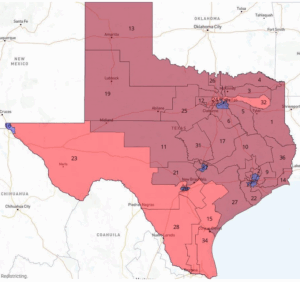
“The final vote was 88 ayes — all Republicans including House Speaker Dustin Burrows (R-Lubbock), who normally doesn’t vote on legislation — to 52 nays.”
Republicans drew this new map at the behest of President Donald Trump and with his 2024 election performance top of mind, ensuring that each of the projected five GOP pickups were areas the president won last year by at least 10 points.
Those five seats are the 9th, 28th, 32nd, 34th, and 35th congressional districts; two are in South Texas, one in Dallas, one in Houston, and one on the outskirts of San Antonio.
The Democrats currently representing those districts are Al Green of Houston (9th), the currently indicted Henry Cuellar of Larado (28th), Julie Johnson of Farmers Branch (32nd), Vicente Gonzalez of McAllen (34th), and infamous commie twerp Greg Casar of Austin (35th).
My guess is that Cuellar and Gonzalez are simply gone, since the Rio Grande Valley was already trending Republican and there are no friendly districts anywhere nearby for them to run in. Green could quite conceivably run in the now-vacant 18th congressional district, previously represented by the deceased Sylvester Turner, and before that by the daughter of the also-deceased Sheila Jackson Lee, and before that by Lee. While Johnson could theoretically run in neighboring Marc Veasey’s 33rd congressional district, that’s a Hispanic and black majority district (and I suspect it’s getting even more so in the current redistricting), which is a tough hill to climb for any white candidate, much less a gay white girl in a suburban district, so I suspect she’s toast as well. The redistricting sets up a Thunderdome showdown between Doggett and Casar for the Austin-based 37th, unless Doggett (who is 79) retires.
Now on to the Texas Senate, where which passed its own redistricting bill handily in the first special session and will likely pass this one in quick order.
I have been (and will continue to be) quite critical of House Speaker Dustin Burrows’ membership in the Straus-Bonnen-Phelan cabal that stays in power thanks to Democrat votes and special interest/gambling money, but in this instance he has delivered on a very important Republican priority.
Remember: All this was set in motion by Petteway v. Galveston County, a lawsuit Democrats filed in order to save one Galveston County commissioner’s seat, whereupon the Supreme Court ruled that “black/brown” coalition minority districts carved out to benefit the Democratic Party were unconstitutional. So instead of saving one county commissioner’s seat, they’re going to lose five U.S. Congressional seats.
Democrats did this to themselves, and have no one else to blame…
Tags:11th Congressional District, 18th Congressional District, 2026 Election, 32nd Congressional District, 33rd Congressional District, 35th Congressional District, 37th Congressional District, 89th Texas Legislature, 9th Congressional District, Al Green, August Pfluger, Austin, Brad Johnson, Brandon Waltens, Dallas, Democrats, Dustin Burrows, Elections, Greg Abbott, Greg Casar, Henry Cuellar, Houston, Julie Johnson, Lloyd Doggett, Marc Veasey, McAllen, Petteway v. Galveston County, Redistricting, Republicans, Rio Grande Valley, Special Session, Supreme Court, Texas, Texas 28th Congressional District, Texas 34th Congressional District, Texas Scorecard, The Texan News, Todd Hunter, Vicente Gonzalez
Posted in Austin, Democrats, Elections, Republicans, Supreme Court, Texas | 13 Comments »