Posts Tagged ‘video’

Are You Prepping For Food Insecurity?

Thursday, October 13th, 2022

Between inflation, the Russo-Ukrainian War, drought, etc., there’s a lot of worry about food insecurity around the world. While I think America will do the best of just about anyone, I’ve long been a cheap prepper, spending around $20 a year on various prep items, but recently I’ve stepped up my food buying, trying to pick up just one extra shelf-stable item a week, just in case. And I’ve been thinking about growing more food beyond the pepper plant I already have.

Here’s a couple of videos on what to grow for food crops given limited areas.

Both mention beans, but dried pinto beans are still pretty darn cheap, and if you like those (I don’t), you’ll want to lay in a lot of dried beans. If the emergency lasts long enough, you can grow them when you start to run low.

I’m not wild about cabbage or kale, but I like potatoes well enough, and I think I could grow those pretty well in a tub or two, as well as sweet potatoes. And I might as well get a pumpkin for Halloween and try spreading the seeds out next spring.

What are you doing to lay in an extra supply of food?

[ays_poll id=4]

If you have any other food tips for the apocalypse (or even just temporary economic disruption, like a possible rail strike), feel free to share them down below.

Huge Ukrainian Offensive in Luhansk?

Wednesday, October 12th, 2022

Weeb Union (not my favorite Ukraine war mapper channel) is reporting a huge Ukrainian offensive just got underway in Luhansk:

Takeaways:

  • “The reported numbers in this offensive is between 35,000 and 40,000 Ukrainian soldiers over a length of about 50 kilometers.”
  • Goal seems to be full control of the P-66 highway running from Troitske to Kreminna.
  • “They are trying to attack and capture Svatova.”
  • “Svatova is the supply hub of the Russian army here in the Luhansk border.”
  • He postulates this is the last Ukrainian offensive before Russian mobilization reinforcements reach the area. I think he greatly overestimates the effect Russia’s hastily mobilized, ill-equipped and ill-trained new recruits might have on the battlefield.
  • Not seeing any confirmation elsewhere yet. Developing…

    Update: Reporting From Ukraine (which I generally trust more than Weeb Union) also reports a lot of activity in Luhansk, but with a different overall thrust and timeline.

    Takeaways:

  • Russia launched a spoiling attack to prevent Ukraine from advancing on their defensive lines before they were fully repaired, and has some success.
  • Ukraine launched a counterattack south and north of the main Russian spoiling attack, also with some success.
  • They also launched a counter-attack in the center of the line, but with more limited success.
  • He also reports that new Russian conscripts are being put to work building the defensive position, which I can well imagine; any able-bodied adult human should be able to dig a trench. (Unless it’s Texas clay, then all bets are off…)
  • How to reconcile these reports? Both could be right, just looking at different slices of time.

    Russia Hits Ukraine With Terror Missiles

    Monday, October 10th, 2022

    Following the successful strike on the strategically important Kerch Straight Bridge, Russia responded by launching a volley of missiles into random neighborhoods in Kiev and elsewhere.

    A series of deadly blasts rocked central Kyiv Monday morning, shattering months of relative calm in the Ukrainian capital a day after Russia’s leader blamed Ukraine for an explosion on a key Crimea bridge.

    At least eight people were killed and 24 were injured in just one of the Kyiv strikes, according to preliminary information, said Rostyslav Smirnov, an adviser to the Ukrainian ministry of internal affairs.

    The Kyiv explosions marked the start of an intensive wave of attacks on targets across Ukraine, with conflicting reports suggesting the blasts were caused by missiles or suicide drones.

    Kyiv mayor, Vitali Klitschko, said in a statement on Telegram that there were “several explosions in the Shevchenkiv district — in the center of the capital.”

    He later said there were “several hits on objects of the city’s critical infrastructure,” adding that there were casualties.

    Lesia Vasylenko, a member of Ukraine’s parliament, posted a photo on Twitter showing that at least one explosion occurred near the main building of the Kyiv National University in central Kyiv.

    Ukraine managed to hit a strategically important bridge. Russia managed to hit a pedestrian bridge.

    Take that, power walkers!

    Indiscriminate attacks on civilians are not only wrong and a potential war crime, but worse for Russia, they’re also counterproductive and ineffective. We’ve know since The Blitz in World War II that wanton destruction of civilian buildings and infrastructure only hardens the resolve of the targeted populace. Using up missile in pointless displays of impotent fury only makes Putin’s Russia look like even bigger losers.

    Kerch Strait Bridge Update: Russia’s Still Using It

    Sunday, October 9th, 2022

    As bad as the damage looked from the Kerch Strait Bridge explosion, Russia is still using the bridge:

  • The rail bridge has two tracks going each way, and they ran a test 15-car train on the other span. I have a civil engineer/bridge inspector friend who thinks it’s probably unwise to use the rail bridge at all, as the fire has almost certainly weakened the structure through spalling. But Russia doesn’t have a lot of options.
  • The destroyed train hasn’t been cleared yet.
  • They’ve opened up the surviving lane for traffic. “It’s been said that the road span can handle 20 cars an hour and has a weight capacity of 3.5 tons.” That’s rural mail route capacity, not “support a major front in a war” capacity.
  • Russia is trying to repair the bridge.
  • They’re using passenger-only ferries to cross, but the run rate is so low they may only have one ferry in service.
  • Peter Zeihan says it’s potentially a turning point in the war:

  • “By far the most significant development of the war to date.” I would say that the failure to take Hostomel Airport in the opening phases of the war was bigger, as that meant Russia’s high risk/high reward decapitation strike had failed.
  • “The Kerch bridge is the only large-scale rail connection between mainland Russia and the Crimean peninsula, which is home to about two and a half million people.”
  • All other rail lines are under threat of Ukrainian artillery.
  • He reiterates that everything in Russia runs on rail, as they never built a modern road network in most of the country.
  • “With Kerch being the only real connection, it is the primary primary way that the Russians Supply Crimea in the southwestern front with not just troops and equipment, but with food and fuel.”
  • He estimates the bridge spans couldn’t be repaired without several months of work.
  • “Now that the Ukrainians know it can be done, you can bet they’re going to try to hit other parts of it to make sure the thing stays offline.”
  • “For the first time we have a path forward for the Ukrainians here to win that is not long and windy.”
  • Russia finally has a problem it can’t just shove bodies at. “You don’t throw a half a million people at logistics. This is something where either you have the connections or you don’t.”
  • Russian troops in Zaporizhzhia, Kherson and Crimea are “suddenly on their own.”
  • They can now only supply those regions in two ways. “One is by truck, and we know that because of all the Javelins that have been put into Ukraine, and all the RPGs, that the Russians are almost out of their entire military tactical truck fleet, and they’ve started using city buses and Scooby-Doo vans, and those just can’t take the volume of stuff that an active frontline needs.”

  • The second way is by ship, and if they can’t supply anti-ship missiles, then Ukrainians can Muscova “every single cargo ship that the Russians try to bring in.”
  • “Losing cargo ships in that volume, losing trucks and buses in that volume, is hollowing out the entirety of the Russian internal transport system. This is the sort of thing that if you bleed this fast, it takes a decade to recover from, and in a war zone that is not going to happen.”
  • And sanctions make everything harder.
  • There still seems to be some confusion over just what blew up the bridge. While truck bomb is still the most widely accepted theory, supposedly Russia scans all trucks before the enter the bridge. And Suchomimus has a video up showing something in the water just before the blast (what isn’t clear).

    Finally, there are persistent reports of arrests of military personnel in Moscow. But the primary source for these reports seems to be Ukrainian, so several grains of salt are probably in order.

    Ukraine Hits Train On Crimean Bridge

    Saturday, October 8th, 2022

    Ukraine manages to nail a Russian train laden with war materials as it was transiting the Kerch Strait Bridge.

    A massive fire is burning on the Kirch Strait Bridge that connects Russia to Crimea Saturday morning, with images showing multiple train cars fully engulfed and two spans of the road bridge in the water.

    Traffic on the bridge, a critical strategic artery for Russian forces in Crimea amid its war in Ukraine, has reportedly been halted as heavy flames and black smoke spew from a train carrying unknown cargo. Photos also show spans of both east and westbound lanes have collapsed into the water near the burning train.

    Yeah, it looks bad:

    Those collapsed spans are potentially a huge blow to Russia’s entire war effort, as they were already having difficulties keeping all of their field units adequately supplied. With the Kerch Strait Bridge out of commission, the job of resupplying the southern front goes from being difficult to being an absolute nightmare, and makes Melitopol even more vital to keeping troops on the southern flank supplied.

    The bridge cost billions to build after Russia seized Crimea in 2014 and has been one of Ukraine’s top targets, although it lacked traditional weaponry capable of striking it from far away. Even the Pentagon has openly stated that it sees the bridge as a viable target for Ukrainian forces. Russia has deployed air defenses and decoy barges in an attempt to protect it from some kind of attack in recent months.

    It’s hard for even a competent military to have effective air defense all along possible logistics routes, and Russia has been far from a competent military in this war.

    Suchomimus is on it:

    He maps it as too far for HIMARS, and thinks it was likely a drone attack.

    Russia has a 30,000 man strong rail organization. If it hasn’t suffered the same rot as the rest of the Russian armed forces (a big if), and if they can scrounge up the proper equipment (such as a crane barge; another big if), it could conceivably have the bridge repaired and usable again, possibly in as little as two to four weeks. It’s not easy, but it’s doable, and I imagine this is going to automatically jump to the top priority on the Russian logistics list. And, unlike the Antonovsky Bridge, it’s not currently in HIMARS range.

    But given the gross incompetence Russia’s military has shown in so many areas, it’s no sure bet that it can be repaired that quickly (or even at all) with assets in or near the theater.

    The clock is ticking…

    Update: Now reading that it was a truck bomb that took it out, timed to hit a passing fuel train, and that certainly seems plausible from fiercely the train was burning.

    Multiple Russian Fronts Collapsing

    Wednesday, October 5th, 2022

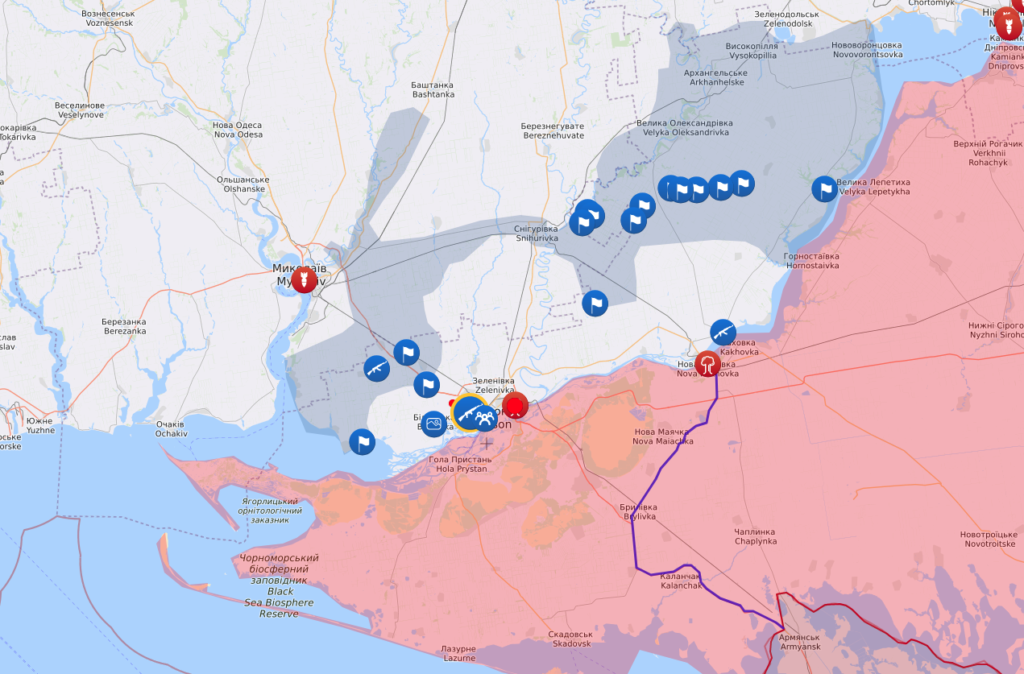
    Ukraine continues to liberate territory from its Russian occupiers, not only in the Kharkiv/northeast front, but also on the Kherson/southwest front, where the last few days have seen a rapid collapse in Russian lines.

    ISW’s daily brief:

    Ukrainian forces continued to make significant gains in Kherson Oblast while simultaneously continuing advances in Kharkiv and Luhansk oblasts on October 4. Ukrainian forces liberated several settlements on the eastern bank of the Inhulets River along the T2207 highway, forcing Russian forces to retreat to the south toward Kherson City. Ukrainian forces also continued to push south along the Dnipro River and the T0403 highway, severing two Russian ground lines of communication (GLOCs) in northern Kherson Oblast and forcing Russians south of the Kherson-Dnipropetrovsk Oblast border toward the Beryslav area. Ukrainian military officials noted that the Ukrainian interdiction campaign is crippling Russian attempts to transfer additional ammunition, reserves, mobilized men, and means of defense to frontline positions. Ukrainian forces also continued to advance east of the Oskil River in Kharkiv Oblast, and Russian sources claimed that battles are ongoing near the R66 Svatove-Kreminna highway.

    Kreminna seems to be the next big target for Ukrainian forces to take in Luhansk, allowing them to cut a major supply line and directly threaten Severodonetsk and Lysychansk.

    Here’s a detailed description of the collapse of the northern portion of the Kherson front.

    For another idea how rapid that advance have been, here are snapshots of the Deep State war map on 10/1 and 10/4.

    Since most of the bridges over both the Inhulets and Dnipro rivers have been blown up, Russian forces are at significant risk of being cutoff and unable to retreat.

    And just as I was working on this, a Peter Zeihan video on the topic dropped:

    Takeaways:

  • Kherson: “The entire Russian line has crumbled.”
  • “Kherson is the only major city Russia has captured in seven months.”
  • “This is the greatest concentration of Russian forces, and it is the best troops Russia has.”
  • They also have the best equipment. If the Ukrainians capture it, it would be even better than Kharkiv.
  • “I still believe this is Russia’s war to lose. The first year of all Russia’s wars look a lot like this. Bad training, bad coordination, poorly maintained equipment.” Modern warfare seldom gives you an entire year to sort your problems out.
  • “Watch Kherson closely. This could be where the war is decided.”
  • Russia seems to be retreating everywhere save the central front in Donetsk, where they seem to be eking out tiny, meaningless gains of a square kilometer or two a day. That’s not a recipe for success.

    Important Lesson: Don’t Trust Alex Jones

    Monday, October 3rd, 2022

    Alex Jones is one of those gadfly media personalities that gets lumped in with regular conservative media, partial to smear said media (“Alex Jones, Sean Hannity, Tucker Carlson, they’re all lunatics!”) and partially because sometimes Jones exposes some of the same holes in The Narrative that sane people do (Flu Manchu vaccines come to mind). He’s more of a loony libertarian fringe figure than a traditional conservative.

    Jones gets lots of things wrong, and many of his ideas are crazy, as indicated by the whole Sandy Hook trial. No one should mistake his views for mainstream conservative thought. That said, I think it is a grave mistake to push Jones off social media like YouTube and Twitter. Let him be wrong, and let people point out he’s wrong.

    Tyler “Hoovie” Hoover is a car YouTuber (“Welcome to Hoovie’s Garage, the dumbest automotive channel in all YouTube!”) who buys, drives, and pays to have repaired various interesting cars, some of which he later resells. I think he popped up in my YouTube feed because I watch a lot of Top Gear/Grand Tour videos.

    Today’s lesson in why you can’t trust Alex Jones comes from the intersection of these two.

    Act I: Hoovie goes in with a friend to buy 50% of an all-electric Ford F-150 Lightning pickup truck. Overall he seems pretty pleased with the truck, which has plenty of acceleration. Video linked rather than embedded, as most of it is peripheral to the discussion.

    Act II: Hoovie tries to use the Lightning to tow an old Ford Model-A truck on a lightweight aluminum trailer, and find outs that the range while towing is absolutely horrible. “I used 90 miles of range in 30 miles!”

    I wouldn’t ding a car manufacturer for towing eating up that much range in, say, a Tesla car or a Prius. But towing a trailer is one of the primary use cases for a big pickup like the Ford F-150. Moreover, it’s a use case that other large gas or diesel powered pickup trucks handle pretty well.

    Act III: Alex Jones finds Hoovie’s video on the Lightning and then proceeds to Alex Jones all over it:

    It’s a pretty bad look when you’re commenting on the video in real time and just making shit up that isn’t there. Hoovie didn’t say it couldn’t get above 25 miles an hour, or that it lacked torque, he said it had range problems when towing.

    There are real concerns about the ability of electric vehicles to replace gasoline-powered transportation, especially under the pressure of irrational green mandates. But if Alex Jones was rational, he wouldn’t have to make up crazy shit that people didn’t say to make his point.

    The Ukrainian Way of War

    Saturday, October 1st, 2022

    This is an interesting video of Ukrainian tanks taking out a Russian strongpoint dubbed “Moscow.”

    Takeaways:

  • They had to break off the attack and return to base for more ammunition. “A tank has 22 shells, which isn’t enough for attack.” By contrast the M1A2 holds 42 rounds. The rapid depletion of ammo in the Yom Kippur War was one reason the Israelis designed the Merkava with a rear access door to allow quick ammo resupply.
  • “They didn’t expect our tanks. They thought it would be just infantry.”
  • “We used all our ammo up in two minutes.”
  • Instead of the squadron commander participating in the attack (as per Soviet doctrine), “he used quadracopter drones and could see the combat scenes and command the tanks in real time.”
  • “Our personnel worked with infantry and special forces. We cleared the way through the forest for them.” That involved clearing lots of mines and booby traps.
  • They said they cleared the way from Husarivka to Bayrak. Which means they were probably involved in the push on Lyman. Husarivka is just east of Barvinkova in the bottom left of this map.

  • As has become the norm, retreating Russian soldiers left behind buttloads of ammo. The Russians may have depleted their smart munitions, but they don’t appear to have any shortage of the dumb variety. “A 15 kilometer forest was full of empty ammo boxes.”
  • Troops breaking and retreating despite plenty of ammo suggests continuing low morale among the invading Russians (or their local conscript cannon fodder).
  • “There was good coordination between our infantry, tanks and artillery.” Classic western combined arms doctrine, something the Russians have seemed mostly incapable of pulling off.
  • Also, the Ukrainian military have reported entering Lyman:

    Will Dollar-Pound Parity Unleash Weirdness?

    Wednesday, September 28th, 2022

    A variety of maladies (global inflation, soaring energy costs due to the Russo-Ukrainian War, and post-Brexit trade wrangles, among others) has the English pound approaching parity with the U.S dollar.

    Can the pound reach parity versus the dollar? It’s now a one-in-four chance when it comes to options pricing.

    The UK currency is heading for its biggest daily loss since early May after Chancellor of the Exchequer Kwasi Kwarteng outlined the government’s plans to stimulate the economy with tax cuts and spending. The simultaneous sharp sell off in Gilts [historical term for UK government bonds – LP] suggests that tackling inflation will be a very hard task for UK authorities and that the currency market sees no easy way out for the Bank of England.

    To attract foreign investors, a weaker pound may be the answer and that is what FX traders are betting on.

    Cable fell as much as 2.1% to touch $1.1021, the lowest since March 1985, and was at $1.1036 as of 12:38pm in London. Risk reversals, a barometer of market positioning and sentiment, show that traders see the greatest downside risks for the pound over the medium term in two years.

    According to Bloomberg’s options pricing model, the pound holds a 26% chance of touching parity versus the greenback in the next six months. That compares to a reading of 14% Thursday.

    I think the real odds are probably higher than that.

    Dollar-pound parity is something that’s never happened, with the nearest it came to some 1.05 dollars to the pound in the mid-1980s. But there’s always a first time for everything, and with the Bank of England doing more quantitative easing and the UK government going on a spending spree during soaring inflation while the Fed ratchets up interest rates, now is as good a time as any.

    Besides making imports from the UK less expensive, what effects will dollar-pound parity have on the financial world? Hard to say for sure, but my prediction is: Weird things.

    There are a variety of reasons for this, starting with the fact that currency trading is itself a weird thing. You may think “American financial houses buy pounds to purchase English goods, while UK financial houses buy dollars to purchase American goods,” but there’s a whole ecology of counter-party trades, hedging strategies, currency reserve requirements, portfolio balancing, and a host of other considerations.

    Here’s a brief video that cover some of the basics for how brokerages handle FX trading:

    That’s a fairly streamlined view, as it doesn’t cover how liquidity pools are set up, different hedging strategies, etc.

    There are even traders who specialize in just trading different duration T-Bills, selling the eight-week-out and buying the four-week-out (or vice versa) for esoteric arbitrage reasons.

    None of that will change if the market hits dollar-pound parity. So where’s the danger? That comes from the possible non-linear effects of the market doing something that a lot of algorithmic instrument designers never considered a possibility.

    For a simple example, let’s talk about the swaps cases. To summarize a whole lot of very complex cases, a whole bunch of local UK governments entered into interest rate swap agreements. Interest rate swap agreements are a legitimate hedging strategy to minimize exposure to interest rate swings, but a few municipalities saw it as a license to print money. To quote Wikipedia, the source of all vaguely accurate knowledge:

    The position of Hammersmith and Fulham London Borough Council was quite different from most of the other local authorities. From about 1985 onwards Hammersmith had entered into interest rate swap transactions on an extremely large scale. At one stage it was calculated that Hammersmith was a counterparty to 0.5% of the global trade in swaps, and 10% of the sterling denominated trade. Moreover, quite exceptionally, all of Hammersmith’s positions in the swap market were betting on a fall in interest rates. Most large participants in the swap market have their exposure balanced by taking positions on both sides and across multiple currencies, but Hammersmith was essentially repeatedly entering into one-way bets that sterling interest rates would fall; a bet that they would end up losing spectacularly when interest rates climbed from around 8 per cent to 15 per cent in the space of ten months.

    This was, to put it in technical terms, “a really fucking stupid thing to do.” The swaps cases were unwound with great expense and difficulty, and various English banks ended up taking a bath (which you know they must have regarded as some sort of diabolical violation of the natural order) after courts determined that the authorities in question didn’t have the authority under English law to enter into such agreements.

    The possibility that interests rates can rise should be an obvious one. But the idea that the pound might be worth less than the dollar is one that people have probably thought about a good deal less, since it hasn’t happened ever. It’s quite possible it hasn’t been contemplated in some percentage of the trillions in derivatives markets and hedging instruments around the world.

    For many financial systems, this is going to be an untested use case. Some systems may work just fine, others may break down, and still others may experience race conditions or cascading failures; think of the flash crash of 2010, or the 1987 Black Monday crash. Somewhere, somehow, something is likely to go off the rails.

    Hopefully, whatever does blow up won’t be big enough to take down the entire market, or at least not for long. Hopefully it won’t uncover massive problems like the 2008 subprime meltdown uncovered, and there won’t be a firm of systemic importance like AIG was there.

    Hopefully.

    A Swimming Ratte?

    Saturday, September 24th, 2022

    This video, covering a scaled down prototype of the Ultra Heavy-Lift Amphibious Connector (UHAC) craft, caught my attention:

    The UHAC drives across the water on treads that double as paddlewheel-style water propulsion.

    That video dropped this week, but most of the UHAC testing seemed to have happened back in 2014. (Another sign that the video is old is the mention of the USS Bonhomme Richard as though it were still in service, when it infamously burned up in 2020. In fact, the arson trial of Ryan Sawyer Mays, the disgruntled SEAL washout accused of setting the fire, is going on this week.)

    If the program is dead, I can understand why. The UHAC seen in the video is only one-fifth of the projected size of the final vehicle, which was supposed to be 84 ft long and 34 ft high. That’s roughly 75% as big as Nazi Germany’s contemplated but never-even-attempted Landkreuzer P. 1000 Ratte tank, a project remembered for being long on imagination and short on practicality. Things that large tend to be a big magnet for air and artillery targeting.

    Another thing probably dooming it: the Marine Corp decision to move away from tanks. An amphibious assault vehicle that (as per the video) can carry three M1A1 Abrams tanks probably won’t be a priority if you don’t have any in inventory.