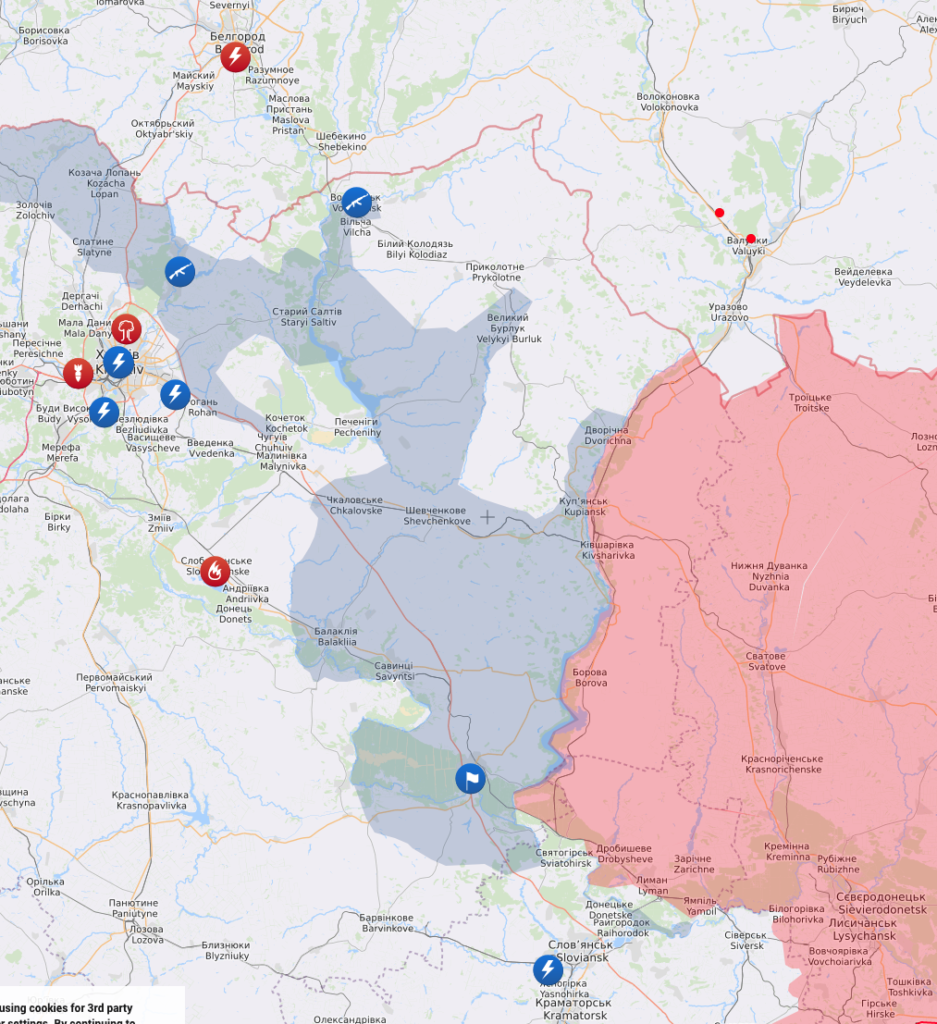
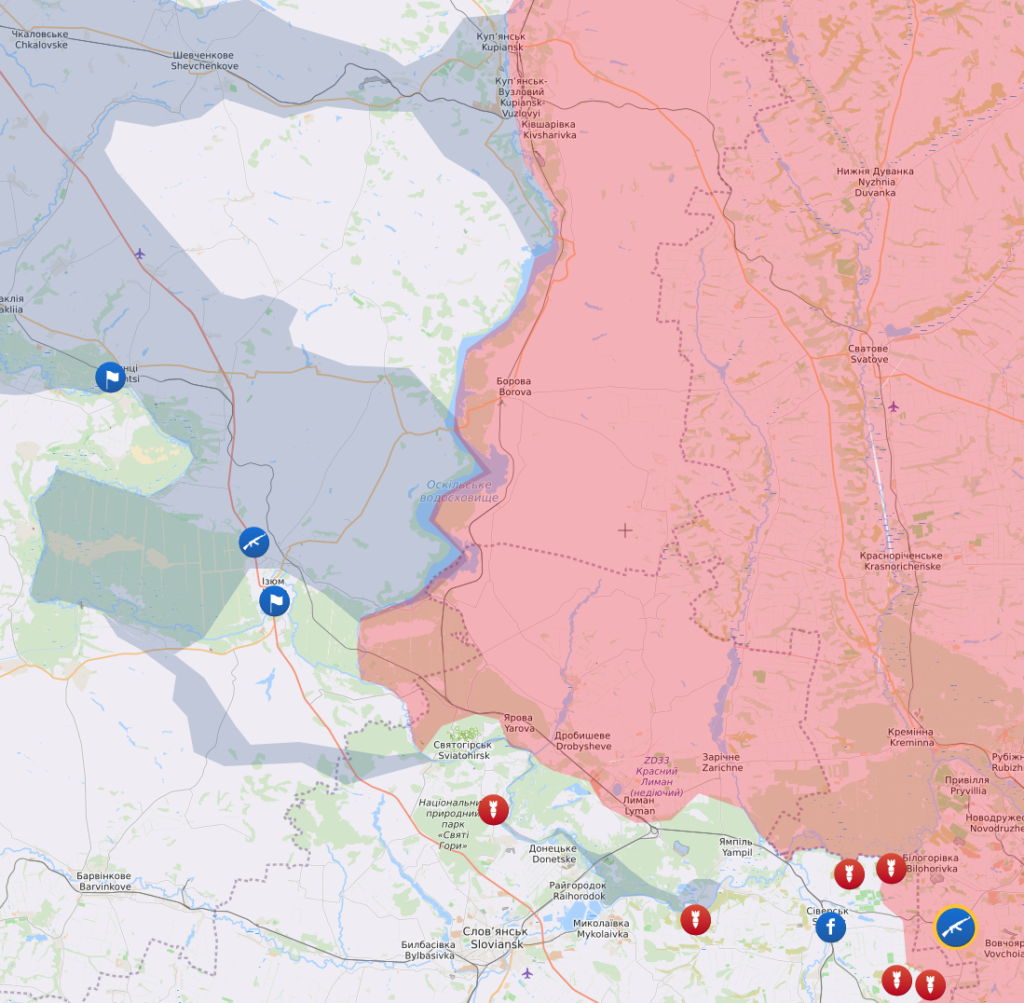
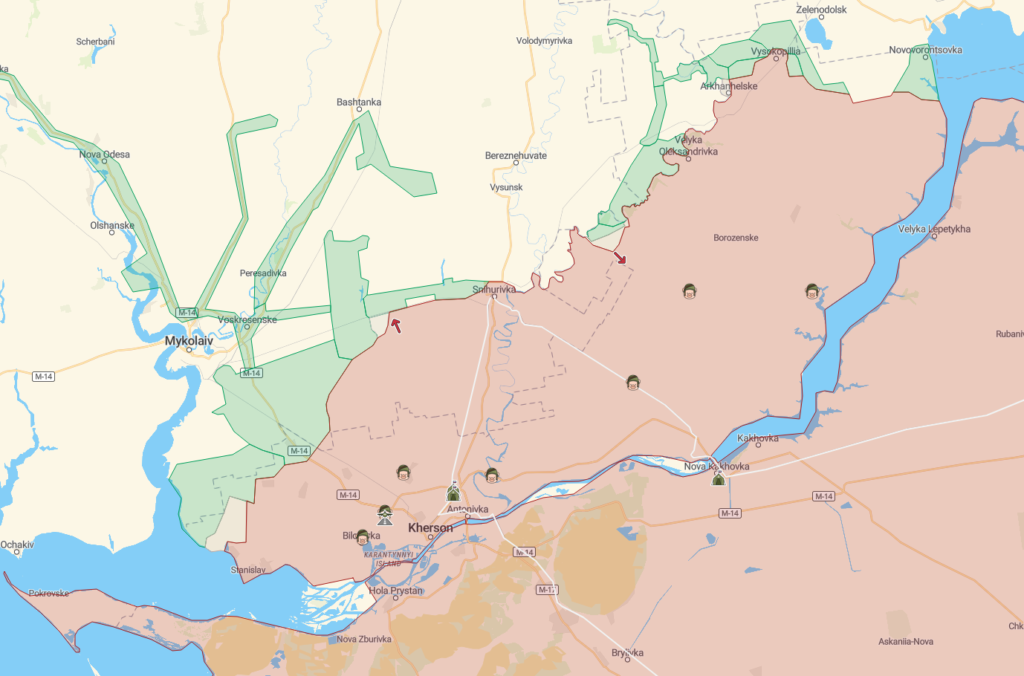
A lot of questions have popped up about the much-talked about Ukrainian counteroffensive for Kherson, among the biggest of which is “Where is it?”
Anders Puck Nielsen, a military analyst at the Royal Danish Defence College, has some answers. What Ukraine is doing right now is not a traditional counteroffensive, but a prolonged attrition strategy to degrade Russian logistics and forces.
Some takeaways:
Usually you want some level of operational secrecy, but Ukrainian officials have been talking up the “Kherson Offensive” since at least June.
“I think it was meant as a kind of trap. It was not enough for Ukraine to liberate Kherson, but they also wanted to take out a lot of Russian soldiers in the process.”
“This area west of Dnipro is probably the one area in the whole operational theater where Ukraine has all the advantages, and Russia has all the disadvantages. So it is better for Ukraine to fight as many Russians as possible in this area than it is to fight them later on somewhere else.”
Putin was faced with withdrawing or reinforcing. “And of course Putin was not going to give up Kherson without a fight, so Russia started pouring reinforcements into the area.”
The phrase that describes Ukraine’s strategy is “accelerated attritional warfare.”
Ukraine’s strategy: “To cause the Russians to have as many casualties as possible rather than defending specific pieces of terrain. And then what we see around Kherson is that Ukraine has figured out a way to accelerate that attrition among the Russians by luring them into a trap where they send reinforcements into an essentially undefendable area.”
So the frontline isn’t moving, but “the Ukrainians expect them to run out of supplies eventually, and then it will be easy.”
“I talked about the bridges, and how Ukraine can target the Russian logistics by destroying the bridges. And I also talked about how this war seems to have entered into what can be called the third phase of the war.”
Phase 1: Russia invades, tries to take Kiev, and fails, because their logistics suck. Advantage Ukraine.
Phase 2: Russia grinds out gains in Dobas, with logistics adequate to the task. Advantage Russia.
Phase 3 (current): Ukraine starts degrading vulnerable Russian forces in the south. “So they are going very hard after the Russian logistics systems. And that is what the attacks in Crimea and other places long behind the frontlines are about.”
“But the point of the attacks is exactly to make the Russian logistics as complicated as possible. To make the supply lines as long as they can possibly be. Because Russia now has to pull the ammunition depots even further away from the frontline, and they have to use trucks instead of railroads and stuff like that.”
“And the supply lines in Kherson and Zaporizhzhia oblasts are actually beginning to look very much like they did in northern Ukraine in phase one of the war.”
“That accelerated attrition [and] the sustained attacks on the Russian supply lines will mean that Ukraine can be in a pretty good position after the battle of Kherson. They will have all the territory west of the Dnipro. And it will be very easy to defend afterwards, because Russia is not going to come back across the river once they have lost that foothold. And then Ukraine will have freed up all those forces from the Kherson area that they can redeploy for a new counteroffensive somewhere else. So that could for example be an attack from the north down toward the Melitopol area. And Russia would be in a really tough position for such a fight. Because they don’t have more forces they can move from the Donbas area, because they already did that for the battle for Kherson. And they don’t have good logistics because Ukraine will have been hitting the infrastructure for months.
Conclusion: There’s no guarantee of Ukrainian success, but it’s hard to see what Russia can do to counter this strategy. “After that Ukraine will redeploy and make a new counteroffensive somewhere else. Perhaps a Christmas offensive or something like that.”
Winter offenses are always a hard sledding in this part of Europe, but the rest of his analysis accords pretty closely with what we’ve been seeing.
Previous stories on Ukraine hitting Russian military bases in Crimea have focused on the possibility of long-range missile strikes. As those strikes have continued, it’s now proven that some have been carried out by drone, and others appear to be the work of Ukrainian special forces or resistance fighters hitting the Russian deep behind the front lines.
None of these is good news for Russia.
Ukraine used a drone to hit the headquarters of the Black Sea fleet in Sevastopol:
Some takeaways:
It was a hit, not a drone shoot-down.
“The new Black Sea commander was there. There are some reports saying it’s his first day in office. So, welcome to the new job, Chuck.”
The author thinks that a number of Ukrainian special forces might be operating drone from a point inside Crimea.
He says another possibility is it’s controlled via repeaters across the Black Sea, but I don’t see why you couldn’t also control it via satlink from orbit.
Ukrainian forces also hit the nearby Belbek Airbase:
More targeted Russian military infrastructure:
The Ukrainians are hitting Russian facilities hard today
• Explosion at munitions depot, Timonovo, Belgorod • Explosion at Stary Oskol Airfield, Belgorod • Explosions in Nova Kakhovka, Kherson • Explosions at Belbek airport, Crimea • Air defence active near Kerch, Crimea pic.twitter.com/kzNleiN2rU
— Louis 🇬🇧 🇪🇺 〓〓 💙 Defend the right to vote (@LouisHenwood) August 18, 2022
Those attacks at Timonovo and Stary Oskol Airfield happened in Russia proper, not occupied Ukraine.
HOLY HIMARS WHAT IS GOING ON? Belgorod local telegram channels report a new explosion at the airfield in Stary Oskol. More than 150 km from front line. Presumably the video below is from there –#Ukraine#Russiapic.twitter.com/35xQAZrpK7
— Special Kherson Cat 🐈🇺🇦 (@bayraktar_1love) August 18, 2022
The Wall Street Journal has a Crimea 101 explainer up:
Russia used Crimea as a huge staging area for the southern part of the invasion.
Right now Ukraine is seeking to degrade Russian forces rather than battle them directly. “A thousand stings from a bee.”
Airfield strikes have forced Russia to move planes out of Crimea.
Despite air superiority, Russia clearly doesn’t have the manpower, organization and equipment to protect their rear echelon from ongoing supply and infrastructure attacks. This exacerbates Russia’s well-documented logistics problems, especially given the Russian doctrinal preference for smaller numbers of support personnel maintaining fewer, larger supply depots.
All that would tend to argue against Russia gaining much further territory in what remains of the summer.
Greetings, and welcome to a Friday LinkSwarm…on Friday! What are the odds?
More dispatches from the Biden Recession: “Homebuyers are GONE.” Home sales are cratering nationally, companies that bought up lots of properties are slashing prices, and the number of homes being built is also cratering.
From the same guy: The 10 locations housing prices will crash the most. #5? Austin. “This is a market in absolute free-fall.” I know prices in my neighborhood have probably lopped off a good $100,000 or so, forcing me to rely on my vast book holdings to remain a millionaire…
The other day, I saw on Twitter someone saying that they are a good liberal and all that, but they are really worried about what they’re seeing regarding the emerging culture of the medical and teaching professions encouraging children to transition to the opposite sex. “But,” said this person, “I don’t want to surrender to a moral panic.”
I submit to you that a moral panic is precisely the correct response to this egregious phenomenon. That is, what is happening is so hideous, and so widespread, and the reaction by most people to this point has been so muted to non-existent, that if you are not panicking, you are not paying attention.
Most people are not on Twitter, and if you’re one of these people, you may not be aware of the extent of the insanity. The media are not covering it, of course. It falls to badasses like Matt Walsh, Chaya Raichik (who runs the Libs Of Tik Tok account), Christina Buttons, and Chris Elston, the guy who runs the Billboard Chris website and Twitter account, to sound the alarm.
The things they document are not nut-picking (the practice of finding extreme weirdos, and falsely using them as an example of the whole). They are completely mainstream. These are things that, if we had a functional media instead of a Narrative-massaging industry, would be widely reported, and discussed intensely.
The Left’s agenda to groom your children has taken another turn. Various states across America have begun implementing laws and policies to allow children to make healthcare decisions without a parent or guardian’s consent — and the medical industry is promoting it. Many of these states are using these new laws to allow for drastic medical decisions to be made without parental consent including hormone therapy, gender reassignment surgery, and medicated mental health treatment.
In Washington, children as young as 13 are now allowed to undergo gender reassignment surgery and other questionable medical treatments without parental consent.
One Washington dad alleged in a viral TikTok video that a school gave his 15-year-old child antidepressants without informing him. Sounds completely insane and illegal, right? Well . . . it sounds that way, but it isn’t. Under Washington law, this is 100% legal and is allegedly being carried out by schools.
New York has hopped on the bandwagon of removing parents from the treatment room as well. New York-Presbyterian recently sent out emails to their patients explaining that accounts for 12-17-year-olds must be updated to reflect the adolescent’s personal email address as the primary contact as New York State law allows children “to keep their sensitive medical information private and to consent to some of their own medical treatment.”
Twelve-year-old children will now have the ability to be the primary decision-maker for many of their medical treatments and procedures. Children will also have the ability to completely revoke medical record access for their parents or guardians. 12-year-old children who can barely do their own laundry now have authority over their healthcare.
Snip.
One concerned parent in Kennebunk, Maine shared photos with us of a medical questionnaire for patients 12 years of age and older which read “To be filled out by patient only.” The questionnaire included questions about sexuality, asking children what gender they’re attracted to, and if the child has ever been in a romantic relationship or had sex. Separate questions ask the children if they’ve ever had questions about their gender identity and what their preferred pronouns are.
The parent spoke to me regarding the questionnaire and stated her child was given the forms right after he turned 13. Naturally, her son was uncomfortable and confused by the questions and asked his mom for help. However, the mom claims the doctor made her leave the room and refused to allow her to be present while her son was answering the questionnaire.
Why would a doctor need to secretly know the sexual preference and gender identity that a 13-year-old child claims without his mom present? Why would any child be required to share answers to all these invasive questions and bar any parental involvement?
It’s not just Maine, Arizona, New York, and Washington — the removal of parents from important decisions in their children’s lives is becoming a nationwide policy trend aggressively pushed by the Left.
Given how much Libs of TikTok has uncovered of the groomer agenda, it’s no wonder that Facebook has banned her:
JUST IN: Facebook permanently banned Libs of TikTok on Wednesday evening and gave absolutely no reason why https://t.co/m6F3wIdzlZ
“Austin Fire Department Chaplain Fired over Blog Post Objecting to Males in Women’s Sports.” No surprise to followers of Austin politics, given the way their union has been taken over by the radical left.
To the great consternation of liberal Democratic mayors in the northeast, the governors of Texas and Arizona continue to send busloads of illegal migrants to New York and Washington to lessen the burdens on their states and draw more attention to the Biden border crisis. This has put the municipal governments of these self-defined sanctuary cities in a bit of a tough position politically. They are supposed to represent bastions of hope for the migrants and freedom from the “oppression” of ICE and the Border Patrol. But now that the migrants are arriving in larger numbers and doing so in a very public way, it’s becoming clear that this is a problem that the mayors were not prepared to handle. As Charles Lipson explains in Newsweek today, these so-called sanctuary city claims were clearly more of a case of virtue signaling than anything else, but when the cost of invoking such policies began to rise, the backlash came quickly.
I still don’t understand Obama’s deep infatuation with Iran’s mullahs, or why he sent them pallets-full of currency, or why he desperately wanted to get nuclear technology to Iran. But I suspect his enthusiasm for providing nuclear technology to Iran was in equal proportion to his enmity toward Israel.
So how was the American left supposed to keep championing Mr. Rushdie when Barack Obama, their Lightbringer, was such a fan of the mullahs who wanted Rushdie dead? Barack Obama had taken American tax dollars and sent it to the mullahs so that they could then turn around and use that money to pay the bounty to whomever successfully pulled off the fatwa against Rushdie. To stay true to Obama, America’s liberal elites had to now ally themselves with the men trying to murder Rushdie.
Conservatives, of course, always supported Rushdie’s right to free speech and always decried the fatwa on him. But for those who matter most in elite society, the fatwa now reflected poorly on Rushdie, not those who imposed the fatwa.
Rushdie was abandoned by the left, because they were now aligned with the mullahs who wanted him dead.
Over in London, unions are working on their Winter of Discontent cosplay by launching a Tube strike.
Families are getting the hell out of north Portland due to the huge increase in drug-addicted transients ts infecting their neighborhood. This is your city on social justice.
Turkey’s wild and crazy president Recep Tayyip Erdogan continues his innovative “lower interest rates during hyperinflation” gambit. Result? The Lira has crashed to an all time low.
Remember San Angelo police chief Tim Vasquez, who accepted bribes via gigs for his Earth, Wind & Fire cover band Funky Munky? Well he just got sentenced to 15 years in the slammer. I guess he’s no longer a shining star…
Also on the crime beat: Charges filed in Whitey Bulger whacking. “Fotios Geas, Paul J. DeCologero and Sean McKinnon have been charged with crimes related to the murder of Whitey Bulger.”
More New York Times editorial judgment on display: “NYT Cuts Ties With Reporter Who Called For ‘Killing,’ ‘Burning’ Jews ‘Like What Hitler Did.’” The surprise is that they actually fired her. How do you think that conversation went? “Sure, lots of us have called for death to the Jews, but the ‘burning’ part just crosses the line…”
Joe Rogan and Seth Dillon have thoughts about the FBI’s raid on Trump’s house.
Dillon: “They just poured rocket fuel in his engine.”
Rogan: “I think the goal was to knock him out of the 2024 elections.”
Rogan has some degree of skepticism that there was actual classified information seized, but not nearly as much as he should.
Dillon: “They want to find something, anything, that they can use to prevent him from running again.”
Rogan: “They’re using the FBI in a way that they would never use it against Hillary Clinton and they’re going after him in a way they would never go after Ghislaine Maxwell’s client list.”
Dillon: “If you’re gonna be selectively enforcing laws like that, and just turn a blind eye to Hillary deleting emails that have been subpoenaed, [or turning] a blind eye to Hunter Biden, trying act like this is not a story until you’re forced to admit that it is. It’s the double standard.”
Rogan on Ron DeSantis: “The left still hates him but they don’t hate him the same way they hated Trump. They try to, but he’s more reasonable. He’s very, like, level in the way he talks about things.”
Rogan: “Tump’s a character, right? Like part of what he’s doing he’s like doing comedy. It’s like he’s doing stand-up when he’s up there. I mean, when he makes fun of Biden and makes fun of other people. He’s doing fucking stand-up, he really is, and he kills.”
Looks like more Russian bases in Crimea are blowing up despite being hundreds of miles from the front lines.
First up: France 24 reports explosions on a base in NE Crimea:
Caveat: The video map calls the location Mayskoye, which isn’t in Crimea, but across the Kerch strait in Russia proper. Later, they show a tweet with the location as Dzhankoi, which matches up with the location shown on the map.
More video, where you can see subsequent munitions explosions, and which says that Mayskoye is 14 miles from Dzhankoi:
I assume that the Crimean Mayskoye is a local town or subdivision too small to show up in Google Maps.
The Russian mass media report of clouds of black smoke over the military airfield in the village of Hvardiiske, Simferopol district of Russian-occupied Crimea.
Source: Kommersant publication with reference to local residents, Christo Grozev, head of Bellingcat on Twitter
Details: Local residents also confirm that clouds of black smoke are seen above the airbase in Hvardiiske.
According to them, several explosions were heard earlier on the territory of the military base.
According to the source, local military departments and law enforcement agencies assume it could be an attack by a small unmanned aerial vehicle that hit an ammunition storage.
Supposedly this is video of the explosion. Usual caveats apply.
3 seconds from flash to bang, she was about a kilometer from the explosion, gives you some idea how big this was ~ pic.twitter.com/Q8RIRIxYbz
The size of the explosions suggest that Ukraine continues to receive good location intelligence about Russian military infrastructure and ammo dumps.
From the beginning of Russia’s invasion to last week, reports of major Ukrainian strike on Crimea were all but non-existent. Since then we’ve had several. Clearly Ukraine sees a new need and/or ability to strike these farther targets.
This may be an attempt to cripple Russian supply lines and air support in support of Ukraine’s slow-developing Kherson counteroffensive.
MEXICO CITY — A gang riot inside a border prison that left two inmates dead quickly spread to the streets of Ciudad Juarez where alleged gang members killed nine more people, including four employees of a radio station, security officials said Friday.
The surge in violence recalled a far more deadly period in Juarez more than a decade earlier. Mexico’s powerful drug cartels commonly use local gangs to defend their territory and carry out their vendettas.
The federal government’s security undersecretary, Ricardo Mejía Berdeja, said the violence started inside the state prison after 1 p.m. Thursday, when member of the Mexicles gang attacked members of the rival Chapos.
Two inmates were killed and 20 injured.
Then suspected gang members outside the prison began burning businesses and shooting up Ciudad Juarez.
“They attacked the civilian, innocent population like a sort of revenge,” President Andrés Manuel López Obrador said. “It wasn’t just the clash between two groups, but it got to the point in which they began to shoot civilians, innocent people. That is the most unfortunate thing in this affair.”
Mejía said four employees of MegaRadio who were broadcasting a live promotional event outside a business were killed in the shooting.
Chihuahua state Attorney General Roberto Fierro Duarte said that a boy wounded in a shooting at a convenience store died later at the hospital, two women were killed in a fire at another gas station convenience store and two other men were shot elsewhere in the city.
U.S. government employees in Tijuana, Mexico have been urged to shelter in place as the U.S. consulate warned of multiple vehicle fires, roadblocks and other incidents early on Saturday.
“The U.S. Consulate General Tijuana is aware of reports of multiple vehicle fires, roadblocks, and heavy police activity in Tijuana, Mexicali, Rosarito, Ensenada, and Tecate. U.S. government employees have been instructed to shelter in place until further notice,” the consulate’s official Twitter account said.
The consulate further advised U.S. citizens to avoid the area, seek shelter if in the area, inform their friends and families of their situation and monitor news reports for information.
Police arrested members of the Jalisco New Generation cartel.
The first suspect of having organized and ordered the narco-blockades yesterday, Friday, in Baja California is Javier Adrián Beltrán Cabrera, according to the first indications received by the intelligence areas integrated in the Coordination Table for Peace and Security, reported the weekly Zeta.
Beltrán Cabrera, also known as “El Javi”, “El Pedrito”, “El Pit” and “Puma”, was imprisoned in 2011 for possession of a weapon and was released.
According to Zeta’s publication, Beltran Cabrera is listed as the leader of a criminal cell called “Los Erres” that had served as hitmen for the Sinaloa Cartel, but in 2022 allied with the Jalisco Cartel – New Generation (CJNG).
“El Puma” was being investigated as the mastermind of multiple murders committed in July and August in eastern Tijuana, but there is no arrest warrant for him.
Zeta reported that in four hours a total of 24 vehicles were set on fire in five of the seven municipalities of Baja California: Mexicali, Tecate, Ensenada, Tijuana and Rosarito.
Here’s video of a truck on fire in Tijuana:
As always, the twists and turns of the ever-present cartel war in Mexico remain seriously under-reported in American media. While calm for a while, Tijuana and Juarez flared up again as turned into hotspots for cartel violence over the last few years, and were ranked the second and third most violent cities in the world last year. (Indeed, seven of the ten most violent cities in the world were in Mexico, along with one each from South Africa, Brazil…and St. Louis. Thanks a lot, Kim Gardner.)
An administration interested in protecting the lives of Americans might clamp down on border security to prevent more cartel members from entering the country. That is not this administration. Their top goal still appears to be keeping the border wide open to get as many illegal aliens to cross over as they possibly can.
As images of large explosions in Russian-occupied Crimea flashed across social media, the Russian Ministry of Defense on Tuesday claimed they were the result of “several aviation munitions destroyed” at the Russian Navy’s Saki Air Base near the village of Novofedorivka.
The incident occured [sic] about 3:20 p.m. local time, according to an official Ministry of Defense (MOD) statement.
Snip.
A senior Ukrainian military official with knowledge of the situation told The New York Times that Ukrainian forces were behind the explosion.
“This was an air base from which planes regularly took off for attacks against our forces in the southern theater,” the official said, speaking on the condition of anonymity to discuss sensitive military matters. The official would not tell the Times what type of weapon used in the attack, saying only that “a device exclusively of Ukrainian manufacture was used.”
A top Crimean official earlier on Tuesday confirmed there were several explosions in Novofedorivka.
“So far, I can only confirm the very fact of several explosions in the Novofedorivka area. I ask everyone to wait for official messages and not to produce versions. Oleg Kryuchkov, adviser to the head of Crimea, said on Tuesday on his Telegram channel.
Viktoria Kazmirova, deputy head of the administration of the Saki district, also reported explosions at the airfield, according to Russian state-run media outlet TASS.
“Our airfield is exploding. Explosions at the airfield. Here all the windows were broken,” Kazmirova said.
The regional health ministry “reported that ambulances and medical aviation were sent to the site of the explosions, information about the victims is being specified.”
Saki Air Base, which Russia occupied when it took over Crimea in 2014, is home to the Russian Navy’s 43rd Independent Naval Attack Aviation Regiment (43 OMShAP). This regiment flies 12 Su-30SMs, six Su-24Ms, and six Su-24MRs, and came to prominence during several encounters with NATO forces in the Black Sea in 2021.
U.S. officials have told The War Zone in the recent past that targets in Crimea are fair game for Ukrainian forces using advanced U.S. weapons. The U.S. sees Crimea as illegally occupied by Russia and no different than the territory it holds in eastern Ukraine. As such, all military targets are fair game, as well as critical infrastructure it relies on to keep its war machine and occupation efforts running.
While some Ukrainian officials claim their military carried out an attack on the base, it is not unheard of for major accidents at Russian ammunition supply depots to occur, although the chances of that being the case are relatively slim in this instance.
However, Novofedorovka is about 124 miles (200 kilometers) from the front lines.
The Saki Air Base seems to be well beyond the range of Ukraine’s long-range fires.
Ukraine has 16 M142 High Mobility Artillery Rocket Systems, or HIMARS, provided by the U.S. as well as three M270 systems provided by the United Kingdom.
Both can fire a variety of 227mm rockets, including Guided Multiple Launch Rocket System (GMLRS) types made by Lockheed Martin, as well as the Army Tactical Missile System (ATACMS) short-range ballistic missiles. So far, the U.S. has only provided Ukraine with an unpublicized amount of M31 rockets with 200-pound class unitary warheads, which are GPS/INS guided and can hit targets at a distance of around 43 miles (70 kilometers.) The Biden administration is reluctant to provide longer-range and harder-hitting ATACMS out of concern that it might rile the Russians. In particular, it could provide a means for Ukraine to execute precision strikes on a large variety of targets well into Russia.
200km is well beyond the range of the missiles we’ve publicly given Ukraine (and of the UK-supplied MLRS system, but within the range of the ATACMS missiles we haven’t announced we’re supplying.
It’s possible this was a long-range drone strike, as 200km is well within the range of the Turkish TB2 Bayraktar drones that Ukraine is known to possess. It’s also possible that Ukraine has developed their own long-range missile system. After all, Germany had V1s and V2s that could attacked at that range all the way back in 1944. And it’s also possible that this was a ship-launched attached fired from closer in.
Whatever the actual weapon used, there seem to be very few locations in Russian-occupied Ukraine safe from further such attacks.
You may remember Peter Zeihan’s analysis of world agricultural output in the wake of of deglobalization and the Russo-Ukrainian War, and his forecast of famine late this year.
That was just before the Ukraine export deal was signed. Now he’s looked at the facts and run the numbers, and says it isn’t going to help much.
Takeaways:
“Right now the Ukrainians have about 18 million metric tons stored up in their silos at or adjacent to their ports. That’s a lot that needs to move. That is in excess of half of a normal harvest for the country.”
“On August 1st we got our first ship, the Razoni, to dock to load up and to leave for Lebanon. It’s carrying 26,000 metric tons. So we need 700 more ships of this size if we’re going to get that grain out.”
“The Ukrainian harvest starts in less than 45 days. So you’re talking about needing to get a dozen or so vessels in there every single day. So far we’ve had one. I don’t have a lot of hope for this.” (Note: Since then we’ve had four more.)
“Right now the Ukrainians have nowhere to put it. Their silos are full from last year’s harvest. They weren’t able to export because the war started back in February.
“Even if the farmers were able to work their fields and not be molested by Russian troops (and remember we’ve already had mass evacuations from eastern and southern Ukraine) the problem remains that they can’t get fuel into the country. So you’re talking about needing to harvest industrial levels of wheat without industrial equipment.”
“The likely end result here is that this is the last year that Ukraine participates in international grain markets. They simply don’t have the capacity to get stuff up at a scale. In fact the only place that they might be able to ship stuff is by rail and at most with significant upgrades that have not yet been done. They can probably only ship about one-fifth of their normal produce out that way the rail lines are just not designed for that kind of bulk cargo.”
Bottlenecks have arisen due to the different rail gauge used in Ukraine, dating back to the Soviet era. That means shipments are being transferred to new wagons at the border.
Ukrainian Infrastructure Minister Oleksandr Kubrakov has targeted the upgrading of rail infrastructure in western Ukraine as a priority the EU should focus on. “Rail transport can partially undertake all the transportation of agricultural products, particularly grain,” he said. “However, transporting goods is difficult due to western Ukraine’s low border-crossing capacity, which is not designed for transshipping such volumes.”
“Some 768,300 metric tons of Ukrainian grain was exported by rail between May 1 and May 16.”
Back to Zeihan: “And a lot of them have to transit little territory called Transnistra [in Moldavia], which is under Russian control.”
The sobering conclusion:
You remove the world’s fourth largest wheat exporter from the market and you’re going to look at cascading problems. Not just with food prices and malnutrition, but civil conflict and breakdown, most notably in the Middle East. The last time we had a doubling of global wheat prices, we saw the Arab spring back in 2011. What we’re dealing with is an order of magnitude more complicated and deeper rooted. And to think that we’re only going to have doubling of prices is ridiculously optimistic.
Well, it’s a good thing the Middle East isn’t know for having populations full of unstable hotheads looking for an excuse to kill each other at the drop of a hat…
Those who get all their news from the MSM may be unaware that Dutch farmers are staging a revolt against attempts to seize their land and force them out of farming.
Americans should start paying closer attention to the ongoing farmer protests in the Netherlands, which this week transformed long swaths of Dutch highways into what looked like a post-apocalyptic warzone: roadside fires raging out of control, manure and farming detritus heaped across highways, traffic stalled for miles, and massive protests across the country in support of the farmers.
Why is the Netherlands, of all places, experiencing such unrest? Americans need to understand what’s happening over there because the ruinous climate policies that triggered these protests are precisely what President Joe Biden and the Democrats have in mind for the United States.
Specifically, Dutch farmers are protesting a government plan to cut fertilizer use and reduce livestock numbers so drastically that it will force many farms out of business. Earlier this month, farmers used tractors and trucks to block highways and entrances to food distribution centers across the country, saying their livelihood and way of life are being targeted by the government.
And they more or less are. The ruling coalition government claims its radical plan, pushed by Prime Minister Mark Rutte, who branded the protests “unacceptable,” is part of an “unavoidable transition” to improve air, land, and water quality.
“Unavoidable” because European elites have decided their virtue signaling transcends the rights of mere peasants to earn a living and feed people.
The goal is to reduce emissions of nitrogen oxide and ammonia, which are produced by livestock but which the government is labeling “pollutants,” by 50 percent nationwide by the year 2030.
The only way to do that, many Dutch farmers say, is to slaughter the vast majority of their livestock and shutter their farms. The government knows this and admitted as much earlier this year, saying in a statement, “The honest message … is that not all farmers can continue their business,” and that farmers have three options: “Becoming more sustainable, relocating or ending their business.”
The genesis of the scheme was a court ruling from 2019 that said the Dutch government’s plan for reducing nitrogen emissions violated EU laws protecting its Natura 2000 network of supposedly vulnerable and endangered plant and animal habitats — basically a bunch of EU-governed wildlife preserves. These sites span the EU, covering 18 percent of the bloc’s land area and 8 percent of its marine territory.
To protect these wildlife preserves, Dutch farmers are being told they must submit to their government’s ruinous emissions plan.
But the Natura 2000 preserves are only part of the story. European leaders such as Rutte are environmental ideologues who want to transform global food production and eliminate private land ownership, and he sees an opportunity in this court order to reshape agriculture and land use in the Netherlands.
Indeed, Rutte — a walking embodiment of the Davos Man if there ever was one — is a big proponent of the United Nations’ “Agenda 2030” and its Sustainable Development Goals, which aim to squeeze farmers and ranchers around the world in order to reduce “emissions.” The policies that flow from these goals, such as drastically reducing the use of fertilizer, contributed to the recent economic collapse of Sri Lanka, which triggered mass protests that toppled Sri Lanka’s government and ousted its president earlier this month.
Last year, Rutte spoke to the World Economic Forum about “transforming food systems and land use” at Davos Agenda Week, announcing that the Netherlands would host something called the “Global Coordinating Secretariat of the World Economic Food Innovation Hubs,” whose job would be to “connect all other food innovation hubs.”
In Davos-speak, that means agricultural production and the supply of food will be centrally controlled by intra-governmental bodies and “stakeholders” consisting mainly of the world’s largest food corporations and international NGOs. Private farms and independent farmers will be a thing of the past, supplanted by global bodies making decisions about how much and what kinds of food are produced. The private sector and the independent farmers will have no place in the future that the UN and the WEF are planning.
Dutch farmers understand this. They know Rutte and his ministers want above all to eradicate their farms and way of life. But they’re not going down without a fight.
And fighting they are:
How bad is it? One farmer says he’ll have to get rid of 95% of his herd.
In the Netherlands, dairy farmer Martin Neppelenbroek is near the end of the line.
New environmental regulations will require him to slash his livestock numbers by 95 percent. He thinks he will have to sell his family farm.
“I can’t run a farm on 5 percent. For me, it’s over and done with,” he said in a July 7 interview with The Epoch Times.
“In view of the regulations, I can’t sell it to anybody. Nobody wants to buy it. [But] the government wants to buy it. And that’s why they [have] those regulations, I think….”
There’s a sword of Damocles hanging over them: the possibility of compulsory seizure of property by the government.
NOS Nieuws reported that Christianne van der Wal, the country’s minister of nature and nitrogen policy, has not ruled out expropriating land from uncooperative farmers.
According to a report from the U.S. Department of Agriculture’s Foreign Agriculture Service, the Dutch government has said its approach means “there is not a future for all [Dutch] farmers.”
You would think that with the world facing the prospect of widespread famine later this year, that the the commissars might pause their radical, agriculture-destroying policies until that problem is dealt with.
You would be wrong.
And the Dutch government seems to be escalating their violence at the same time Dutch farmers are hanging themselves.
At a police station blockade in solidarity with the kid who was shot at by police, this protester says that farmers are hanging themselves because the Prime Minister has taken away their future. pic.twitter.com/NJomDUcoaZ
This week news broke that congressional Democrats had finally reached a deal on the largest piece of climate legislation in American history. The bill is a tax-and-spend cornucopia of some $369 billion for wind, solar, geothermal, battery, and other industries over the next decade, along with generous subsidies for electric vehicles and incentives to keep nuclear plants open and capture emissions from industrial plants.
After pretending to oppose Senate Majority Leader Chuck Schumer’s climate legislation, West Virginia Sen. Joe Manchin relented this week, clearing the way for the bill to proceed. Senate Democrats say the bill will allow the U.S. to cut greenhouse emissions by 40 percent below 2005 levels by 2030 — matching up nicely with the UN’s “Agenda 2030.”
Understand that the Senate bill isn’t the end, it’s the beginning. Climate activists and ideologues are working at the highest levels to transform not just the global food supply, but the nature of private property and property rights, all in the name of saving the planet. What Rutte and his government are doing to Dutch farmers, Schumer and Biden are planning to do to American farmers and American industries.
So pay attention to the roadside fires and blocked highways and mass civic unrest in places like the Netherlands and Sri Lanka. America is next.
Overstatement? Probably. But you know that a lot of Democratic politicians and environmentalists see such radical actions as a model to implement here.
Peter Zeihan (him again) spoke at Iowa’s Swine Day on the topic of Agriculture at the End of the World:
At lot of this is Zeihan’s polished Greatest Hits presentation (Deglobalization, the need to stop Russia in Ukriane to prevent a future conflict with NATO that would go nuclear, China’s demographic crash, the cult of personality/isolation of Xi Jinping, China’s absurd never-ending Flu Manchu lockdowns, etc.), but here are some highlights of specific agriculture topics:
Russia isn’t just destroying population centers in Ukraine, it’s deliberately targeting Ukraine’s agricultural infrastructure, including grain silos.
Odessa is not a normal city. It is at the mouth of the Nipur river, which is kind of their equivalent of the Mississippi, and it is also their manufacturing center. It’s a cultural hub. It’s a financial center. It is New York and Houston and St. Louis and Chicago and New Orleans all in one. And if the Russians succeed in capturing it, that is the end of Ukraine as a modern economic entity. Right now Odessa is under blockade. They can’t export anything. This has been the source of 95 of their exports to this point.
China’s pork industry got hit hard by swine flu three years ago, and they’re probably getting hit by it now.
They’re trying to regrow the swine industry with subsidies, but that’s just resulted in “Two million people who have no idea what they’re doing” buying the wrong kinds of feed.”
“If they don’t have pork, all they’ve got left is rice. Rice is the most phosphate input intensive crop.”
“The Chinese have traditionally been the world’s largest producer and exporter of phosphate, ’cause it’s a food security issue. Well they’ve stopped all exports until further notice. So we’ve lost potash because of the Ukraine War. We’ve lost phosphate because of Chinese mismanagement.”
Skipping over the oil stuff, but Texas is sitting pretty because it’s easier and quicker to bring shale oil production online.
Did I already mention that Zeihan says Russia is probably going to lose Siberian well use because if they can’t ship it off, it freezes in the permafrost?
“We’re not looking at a recession, we’re looking at an energy-induced depression that’s already affecting multiple continents. But not here…The baseline here are pretty good.”
The effect of reduced fertilizer supply to the rest of the world? “This is famine. We will have it again in the fourth quarter of this year…a half a billion to a billion people will suffer malnutrition.”
If you stop growing wheat on marginal land due to fertilizer shortage, you start growing it on your better land, and your export output collapses.
“The volume of internationally traded agricultural commodities is in the early stages of collapse.”
The Brazilian Serato is heavily dependent on external inputs from abroad. We, on the other hand, get the overwhelming majority of our fertilizer inputs nationally and from Canada.
“There is no Brazilian agricultural sector without Russian involvement. And Russian involvement is going away. It’s the world’s largest source of soy exports. And without global soy exports, there is not a global pork industry. Except here. And if we’re being nice, Canada too.”
Argentina will probably do fine as well.
“Your mid case scenario should be inflation of nine to 15% for at least the next five years.”
“You are looking at the fastest expansion in farm incomes, per person, and per acre that we have ever seen in this country’s history, and it will last for at least the remainder of this decade.”
I think Zeihan has a tendency to overstate the case sometimes, but he’s more right than wrong…