The Islamic Republic of Iran is notorious for its pathological hatred of Israel. However, this hatred didn’t prevent the two countries from cooperating against a mutual enemy: Saddam Hussein’s Iraq.
“In the late 1970s and early 1980s, Israel actively collaborated with the Islamic Republic of Iran, and in fact described that country as its most valuable ally, even above the United States, which will undoubtedly shock some people watching this video. But of course, they both feared Iraq, an enemy to both of their nations, and particularly were worried about Saddam Hussein acquiring nuclear weapons.”
“The problem dated back to the 1960s, when Iraq began to establish a nuclear energy program for civilian use [“Civilian use.” Sure it was. -LP] and by the mid 1970s was looking to purchase a reactor.”
“Most countries wouldn’t touch such a deal with a barge pole. Except the French, who made a deal with Iraq in 1974 to75 to sell them an Osiris class research reactor plus 72 kg of 93% enriched uranium and of course provide the training for Iraqi personnel to run such a facility.”
“The deal would net the French $300 million at today’s prices about $1.7 billion.”
“Israel’s Mossad Intelligence Organization began immediate efforts to sabotage the program before all of the equipment and scientists were in place in Iraq. On the 6th of April 1979, Mossad agents damaged the Ozerak reactor while it was awaiting shipment from France.”
“Then the Mossad went further and assassinated Egyptian nuclear scientist Professor Yahya El Mashad, who would head the Iraqi nuclear program, killing him in his room at the Meridian Hotel in Paris.”
“However, Iraq did receive in July 1980 12kg of highly enriched uranium fuel for the reactor, the first of six phase deliveries from France.”
“Israel first tried diplomatic pressure via France and the United States, but the French government was unmoved.”
“The longer Israel waited, so the Israelis thought, the larger the chance that Saddam Hussein would begin building a nuclear bomb.”
“The Mossad also poisoned two Iraqi engineers involved with the project in Switzerland and France, respectively, and sent threatening letters to French personnel involved in the deal, frightening some of them off.”
“In 1979, the US allied Shah of Iran was deposed in the Islamic Revolution and a new government formed under Ayatollah Khomeini. He was no friend of Israel or the Jews, but Israel nonetheless urged Iran to bomb the Iraqi reactor.”
“Iran actually didn’t require much persuasion. The new hardline Islamic regime in Tehran hated Iraq and saw it as a greater threat than Israel.”
“The Iran-Iraq War broke out shortly afterwards when Saddam’s army invaded Iran. And it appeared that getting rid of any possible nuclear weapons that he might develop was in the interests of both Iran and Israel.”
Problem: The U.S. embargoed spare parts to Iran due to that pesky hostage crisis. “Incredibly, the Israelis secretly shipped US-made aircraft spares to Tehran so that the Iranian air force could put together a viable strike force.”
“The Ozerak reactor site was defended by a single battery of Soviet SA6 missiles, plus three batteries of French Roland 2 missiles and some Soviet 23 and 57 mm radar guided anti-aircraft guns.”
“Due to the state of the Iranian Air Force, its F-4 Phantom fighter bombers could only jam the SA6s and not the Rolands. So the pilots would have to fly very low and fast and depart equally quickly, requiring great skill. Israel and Syria also provided the Iranians with some up-to-date intelligence on the reactor site.”
“Operation Scorch Sword, the Iranian attack, commenced on the 30th of September, 1980 with four F4 Phantoms flying to the Iraqi border and being refueled by an Iranian Boeing 707 tanker escorted by two F-14 Tomcats. Each Phantom carried six Mark 82 general purpose bombs, two AI7 Sparrow air-to-air missiles, also had an integral M61A1 Vulcan 20mm cannon.”
“The Phantoms then raced into Iraq at very low level, then climbed to allow the Iraqi radars to briefly paint them in an effort to confuse the Iraqis as to the direction the Iranian aircraft were traveling and then drop low again and turn towards the reactor site. One pair would bomb the reactor. The other pair would attack its associated power station.”
“The pair approached the Tamuz reactor at low level, pulled up about 2 and 1/2 km from their target, and then released 12 bombs.”
“At the same time, the other two Phantoms, bombed the power station at Tammuz, knocking out electricity to Baghdad for 2 days. Two bombs hit the Tammuz One reactor, while others started a huge fire, destroyed all sorts of equipment, laboratories, and other support buildings. No shots were fired at the Iranian planes.”
“Damage to the reactor was listed by the Iraqis as ‘minor.'”
So time for the Israelis to take a whack. “The Israeli operation was code-named Opera, and had to wait until Israel received their brand-spanking-new F-16s from the U.S.
“Reconnaissance missions found a blind spot in Iraq’s radars on the border with Saudi Arabia, and it was decided that the Israelis would enter via this gap.”
“The Israeli attack force comprised eight F-16As, each armed with two unguided Mark 84 2,000lb delay action bombs. Cover was to be provided by a further flight of six F-15As.”
Random fact: “The attacking pilots included Ilan Ramon, who would later die aboard the space shuttle Colombia in 2003, where he was a payload specialist.”
“On the 7th of June 1981, the Israeli attack force departed, passing through Jordanian and Saudi airspace and when challenged, telling air traffic control over Jordan that they were Saudi patrol that had gone off course, and over Saudi Arabia that they were a Jordanian patrol that had likewise become lost.
“The F-16s climbed to 6,900 ft 12 mi from the reactor, then dived at 680 mph, releasing bombs at 3,600 ft. Eight out of 16 bombs hit the reactor containment dome. Iraqi anti-aircraft fire opened up, but the F-16s climbed away unharmed.”
“Though Saddam determined to rebuild the reactor with French assistance, the ongoing war with Iran and payment problems killed this off. And in 1991, during the first Gulf War, the US bombed the facility out of existence permanently.”
(Feeling better today, thanks. I’m cautiously optimistic that I can keep these crackers down.)
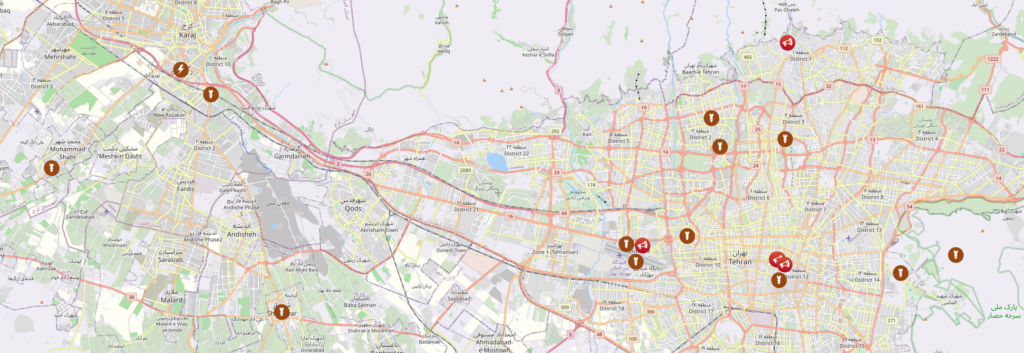
It looks like a big increase in operational strike tempo against Iranian targets has kicked off today, well in advanced of Trump’s 8 PM EST deadline. A whole lot of infrastructure targets are being hit across Iran, along with heavy strikes against Tehran…
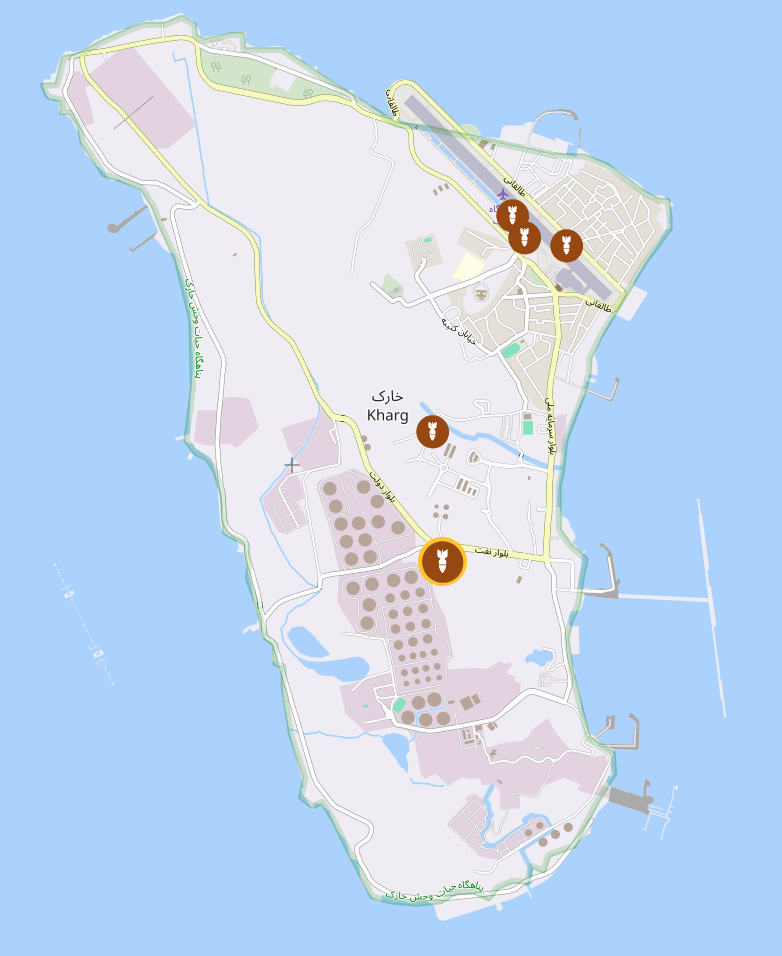
…and Kharg Island. “The targets that the US hit on Kharg Island included bunkers, radar station, ammunition storage. Landing docks were not intentionally targeted. Only would have been struck if Iranians fired something from next to them.”
A list of infrastructure strikes:
“Since early in the morning on Tuesday, Israel and the United States have been extensively targeting railway and vehicle bridges across Iran, with bridges having been targeted in Tehran, Isfahan, Qom, and other regions of Western Iran, with Israeli officials claiming that the strikes were to prevent the movement of military equipment by Iran’s Islamic Revolutionary Guard Corps (IRCG). Roughly ten hours remain of President Trump’s deadline of 8:00PM EST given to Iran.”
The Israeli Air Force (IAF) escalated the stakes against Iran’s leadership yet again, going after the men in charge of Tehran’s oppression and terror organizations.
One of this weekend’s big names is Maj. Gen. Majid Khademi, now confirmed dead, who until the moment of his vaporization served as the head of the Islamic Revolutionary Guard Corps (IRGC) intelligence organization. Khademi’s death was confirmed Monday by an IRGC statement carried by the Iranian state Fars news service.
The same IRGC statement said that funeral and burial arrangements would be announced later, hopefully with just enough of a heads-up for U.S.-Israel forces to conduct a strike on it.
I don’t mean to sound so bloodthirsty on a gorgeous Monday morning, but you have to understand who Khademi was, what he did, and what his death might mean for the regime.
As head of the IRGC Intelligence Protection Organization (IPO), Khademi reported directly to the Supreme Leader of Iran — whoever that might be these days — because he was in charge of both IRGC internal investigations and internal repression.
So think of the IPO as a combination of a big city police department’s internal affairs division and Hitler’s Gestapo. The 45,000 Iranians reportedly murdered following last year’s big uprisings? Yeah, their blood is on Khademi’s hands. Be glad he’s dead.
But there’s more — some speculative, some confirmed.
An interesting tidbit: a pair of unverified rumors that lean into today’s news. The first — and quite persistent — is that Quds Force chief Esmail Qaani is an Israeli asset. Quds Force specializes in unconventional warfare, international terrorism, and military intelligence. Qaani became head following President Donald Trump’s assassination of former chief Qasem Soleimani in 2020.
The second rumor is that Khademi was heading up an internal investigation of Qaani before getting blown up. If there’s any substance to these rumors, you can imagine the chaos right now inside Quds and the IRGC as a whole.
But again, these are merely rumors.
Not a rumor is OSINTechnical’s report on Monday that another recent strike also killed Yazdan Mir, “leader of the Quds Force’s Unit 840, a covert operational group responsible for conducting clandestine activities outside of Iran.”
“Iran’s overnight strikes towards Saudi Arabia’s Jubail petrochemical complex threatened to “derail the talks”, a senior Pakistani official tells Reuters. “A Saudi retaliation to the attack could draw Pakistan into the conflict under its defence pact with KSA.” Pakistan has been very critical of Iran’s actions, but hasn’t taken any direct military action against the regime since Operation Epic Fury kicked off. If Pakistan does join the war against the Islamic Republic of Iran, it will probably be because they’ve decided Iran is the weak horse and they can get in on the spoils of a United States victory. The Baluchestan border has been a constant source of friction between the two nations, and they actually fought a short conflict there in 2024. Also, Pakistan, unlike Iran, still has a functional air force, even though some planes (like Mirage IIIs) are quite old.
As of this writing, there’s word that some sort of tentative ceasefire deal may be in the offing, assuming Iran agrees to open the Strait of Hormuz. Could be real, could be positioning.
“Big Week” was a combined allied air offensive against Germany in 1944. The results were mixed.
In an interview with Fox News, Netanyahu said, “The reason that we had to act now is because after we hit their nuclear sites and their ballistic missile program [in June 2025]… they started building new sites… underground bunkers that would make their ballistic missile program and their atomic bomb program immune within months.”
“If no action was taken now, no action could be taken in the future,” he said.
Moreover, envoy Steve Witkoff said the Iranians “bragged” about enriching Uranium.
US special envoy Witkoff, who together with Trump’s son-in-law Jared Kushner led Washington’s negotiations with Tehran over the disputed nuclear program, said that Iran’s top negotiators boasted in the first round of talks this year of having enough highly enriched uranium to build 11 nuclear bombs.
“In that first meeting, both the Iranian negotiators said to us directly — with no shame — that they controlled 460 kilograms of 60% [enriched uranium] and that they’re aware that could make 11 nuclear bombs,” Witkoff told Fox.
Trump has asserted that the US “obliterated” Iran’s nuclear facilities during the 12-day war last June, which would ostensibly render Iran incapable of immediately turning that enriched uranium into a bomb.
Still, Witkoff said the Iranian negotiators “were proud that they had evaded all sorts of oversight protocols to get to a place where they could deliver 11 nuclear bombs.”
He said that during that first meeting, the Iranian negotiators insisted on “an inalienable right” to enrich their nuclear fuel.
They now have an inalienable right to a pine box.
Ben Shapiro weighs in on the current state of the conflict, and declares Iran toast:
“I hope all the folks watching understand what uncontested airspace and complete control means. It means we will fly all day, all night, day and night, finding, fixing, and finishing the missiles and defense industrial base of the Iranian military. Finding and fixing their leaders and their military leaders, flying over Tehran, flying over Iran, flying over their capital, flying over the IRGC, Iranian leaders looking up and seeing only US and Israeli air power.”
We got the guy in charge of trying to assassinate American leaders, “Rahman Moadam, who’s head of the Islamic Revolutionary Guard Corps special operations division.”
Admiral Brad Cooper explains the status of the operation:
More than 50,000 troops, 200 fighters, two aircraft carriers, and bombers from the United States are participating in this operation, and more capability is on the way. In the opening hours of Operation Epic Fury, US Central Command forces together with Israel delivered overwhelming and unprecedented strikes into Iran. Now, we’re less than 100 hours into this operation, and we’ve already struck nearly 2,000 targets with more than 2,000 munitions. We have severely degraded Iran’s air defenses and destroyed hundreds of Iran’s ballistic missiles, launchers, and drones. And in simple terms, we’re focused on shooting all the things that can shoot at us.
“We are also sinking the Iranian Navy. The entire Navy.”
“We will not stop.”
Back to Shapiro: U.S. consulate in Dubai was hit by drones. No casualties because it was evacuated.
“How do you know that Iran is really losing? Because Qatar has turned. So Qatar, which has always played this sort of middle ground between the United States and Iran. Well, now they’re turning on the IRGC and actually arresting members of the IRGC in Qatar.”
He debunks the myth that we’re using $2 million Patriot missiles to shoot down $35,000 drones, says most are being down down with $25,000 air-to-air missiles. “And you know who’s going to run out of $25,000 iterations more and faster? The US or the piss-poor Iranians?”
“If we get in a spending war with Iran, Iran don’t have no money. It is a problem for them.”
The Iranian regime splits its air power between two forces, the conventional Islamic Republic of Iran Air Force and the Iran Revolutionary Guard Corps Aerospace Force. Available public information about the size of Iran’s air fleet is somewhat contradictory in the details. The independent analysis site WarPowerIran states Iran has 778 aircraft, but “while impressive in terms of available quantity of aircraft, the IRIAF suffers from an aging fleet and limited military-industrial capabilities as they relate to modern combat platforms.”
Similarly, “FlightGlobal’s World Air Forces 2025 listed 65 F-4s, 35 F-5s, 41 F-14s, 18 MiG-29s, 21 Su-24s, and 12 Mirage F1s in the Islamic Republic of Iran Air Force, plus a smaller number of tankers and special-mission aircraft. Iran has also received an unknown number of Yak-130 light attack aircraft in recent years.”
The Yak-130 is the most modern of those aircraft, but it’s really most suitable as a low-cost trainer. If you actually need to go up against F-22s and F-35s in that thing, you’re in deep, deep trouble. And indeed, an Israeli F-35 shot one down.
Beyond that, it’s not an air force, it’s an impressive aviation museum. The MiG-29 is the only plane in active service with any modern military. The F-14 is the next most modern, and the vast majority of U.S. planes were deactivated in the late 20th century. The F-5 has proven really durable for Third World air forces, but no one mistakes it for a modern fighter. The F-4 is a Vietnam War staple retired everywhere except Greece, Turkey and Iran.
The United Arab Emirates, a Defense Ministry spokesperson said air defenses detected 812 drones and intercepted 755, with 57 getting through and causing damage.
Kuwait said it intercepted 283 drones. A Bloomberg-compiled tally put the first two days of the war at 541 drones targeted at the UAE, 283 at Kuwait, 36 at Jordan, 12 at Qatar and nine at Bahrain. Combined with the UAE’s later figure, the publicly reported totals indicate at least about 1,150 drones launched at regional targets since February 28, with the overall number likely higher.
Naval sinkings stats snipped.
During yesterday’s briefing, Caine released some figures indicating the Iranians are losing their ability to fire ballistic missiles and drones: “As of this morning, U.S. Central Command is making steady progress. Iran’s theater ballistic missile shots fired are down 86 percent from the first day of fighting, with a 23 percent decrease just in the last 24 hours, and their one-way attack drone shots are down 73 percent from the opening days.”
“Mojtaba Khamenei, son of Iran’s late Supreme Leader, has survived the U.S. and Israeli airstrikes on Iran in which his father Ayatollah Ali Khamenei was killed, two Iranian sources told Reuters on Wednesday.” Maybe. But there’s a good chance that’s disinformation as well.
Iran’s democratic opposition groups — monarchists and republicans, secular and religious minorities, leftists, liberals, and every ethnicity — are united… on four foundational principles: Iran’s territorial integrity; individual liberties and equality of all citizens; separation of religion and state; and the Iranian people’s right to decide a democratic form of government. Many Iranians, often despite facing bullets, have called on me to lead this transition. I am in awe of their courage, and I have answered their call. Our path forward will be transparent: a new constitution drafted and ratified by referendum, followed by free elections under international oversight. When Iranians vote, the transitional government dissolves…. A free Iran would extend [the Abraham Accords] by immediately recognizing Israel and pursuing a broader regional peace framework linking Iran, Israel and our Arab neighbors in cooperation rather than conflict.
You can never depend on China as an ally:
This isn't just about Iran. Every country watching this is doing the math. Every country that has been quietly drifting toward Beijing's orbit, betting that China is the future, is watching Beijing issue press conferences while its strategic partner gets regime-changed.
More from Suchomimus on that Soleimani-class corvette sunk yesterday, which turns out to be the IRIS Shahid Sayyad Shirazi.
If Iran is currently the A-Plot in As the Middle East Burns, then the war against Hezbollah is the B-Plot. Israel has already started and air and ground campaign against the Iranian-backed group, and Simon Whistler explains the current state of that conflict:
“What’s happening in Lebanon right now might end up being one of the most consequential events of the entire war. Israel and Hezbollah are at war again.”
“What’s really significant here is what the Lebanese government just did in the middle of this. A total ban on Hezbollah’s military and security operations. If you would have told us that we’d be making an episode on that just two years ago, we would have thought you were dreaming. Or possibly really rather drunk.”
For years people assumed an attack on Iran would mean Hezbollah would unleash an unstoppable barrage of rockets on Israel.
Skipping over the glorious execution of Operation Grim Beeper.
“The Lebanese government chose, after decades of weakness, to go after Hezbollah. Prime Minister Nawaf Salam’s cabinet declared an immediate, total ban on all Hezbollah military and security activities and ordered the group to surrender its weapons to the state.”
“President Joseph Aoun, the former army commander who had been elected after Hezbollah could no longer block the vote, called the decision final.”
“In what has been the most notable development of all, Nabih Berri, the speaker of parliament and leader of the Amal movement, Hezbollah’s most reliable political partner for decades, refused to vote against the measure.” This is huge, since Amal is the only other Shia party in Lebanon’s parliament next to Hezbollah.
“There’s a pretty sizable camp in Washington that sees the current moment as the best chance anyone will ever have to finish Hezbollah off, and they’re not being quiet about it.”
Israel is haunted by it’s failure to destroy Hezbollah in its 2006 incursion, and by its inadvertent creation of Hezbollah following it’s 1982 incursion to go after the PLO.
“The situation today is genuinely different. First and foremost because the Lebanese state is the one driving the push to restore its sovereignty, backed by a president who seems absolutely determined to disarm the militants on his territory once and for all.” No, first and foremost, Iran is done. Without their funding, Hezbollah would be nothing.
“All of this is the complete opposite from 1982 and 2006, where it was variously an Israeli occupation force imposing order from the outside and an international community with very little legitimacy, respectively. This willingness was a long time in the making, but now that it’s surfaced, it doesn’t appear likely to be disappearing anytime soon.”
Related: “IDF Orders Mass Evacuation of Hezbollah Stronghold in Beirut Ahead of Strike.”
Add Azerbaijan to the list of countries droned by Iran:
❗️BREAKING: An Iranian Shahed-136 drone struck the city of Nakhchivan in Azerbaijan, Azerbaijani state media reported. The target was likely Nakhchivan Airport. #Iranpic.twitter.com/UeQsADtDSm
And Azerbaijan is getting ready to retaliate. And Azeris make up about 16% of the Iranian population, which is actually higher than the number of Kurds…
Heh: “To Save Time, Iran Appoints Supreme Leader Who Is Already Dead.”
Again, this is what significant news I thought was worth including. If you have additional information you thought I should have included, leave it in the comments below.