Something a little different than the usual Iran roundup: Two videos about Kharg Island, one an after-action report on a U.S. attack run, the other a description of what makes taking the island difficult.
The caveat for the after-action video, a recreation of an actual U.S. attack run, is that it’s done a breathless, overly-dramatic fashion, like something from Most Shocking. But the detailed, blow-by-blow account suggests it was taken from actual after-action reports.
Three B-1B Lancers carrying precision-guided bombs attempted the most surgically demanding strike of Operation Epic Fury — destroying Iranian military targets on Kharg Island without touching the crude oil infrastructure sitting meters away. Then the GPS jamming started, and the mission nearly came apart.
This video reconstructs the full tactical breakdown of the Kharg Island strike: how an Iranian GPS jammer degraded bomb accuracy toward the oil, how the F/A-18 Super Hornets sent to destroy it nearly got hit by friendly JDAMs when a deconfliction failure put them directly in the bomb fall line, and how one Mersad air defense commander’s final radio transmission turned inaccurate anti-aircraft fire into precision-guided shrapnel that bracketed B-1Bs mid-bombing run. We cover the AGM-158 JASSM cruise missile shot that eliminated the SAM battery, the burning missile propellant creeping toward thirty million barrels of crude oil, the IRGC patrol boat sprint toward the supertanker loading channel, and the F/A-18 pilots who descended into accurate anti-aircraft fire from guns they couldn’t suppress to stop a mining operation with laser-guided GBU-54 JDAMs.
The breathless nature of the narration makes me suspect that certain aspects have been embellished for dramatic effect.
Next up: Simon Whistler discusses how difficult it will be for the American military to take and hold Kharg Island. Consider it the pessimist case against the operation.
“The value of Kharg Island is obvious. Control the island, and you could throttle Iran’s oil dependent economy. Capture the island intact, and another nation could make Iran do anything to get it back. Destroy it outright and Iran would transform from a powerful rogue nation into an economic afterthought. And that’s if we’re being generous.”
“The export facilities on Kharg Island are the most important site in one of Iran’s most important regions, meaning that the region is especially important to the Iranian military. This is a region with a well-developed civilian infrastructure, a large presence from the Islamic Revolutionary Guard Corps or IRGC, and most likely the hidden weapons stockp match. Then there’s the island itself, a low-lying coral crop with an elevation of just 70m at its highest point. With a land area of roughly 20 square km, Kharg Island is basically flat, basically triangular in shape and surrounded by deep waters to enable the transit of oil tankers.”
Some pre-situated weapons and supply caches will likely survive any American bombardment.
“There’s no telling what the US will destroy and what it’ll fail to pick up on, but some of those mines and air defenses will survive, raising the possibility that they could claim the lives of US troops or shoot down vulnerable non-stalthy low-flying aircraft. That said, Kharg will not be an easy place to defend once US ground forces have established a foothold. Iranians on the island will either be left exposed or be forced to use refinery infrastructure as cover unless they allow themselves to be pushed into the island town where most residents live.”
“Iran’s objective is not victory in any conventional sense. Iran is able to accept the deaths of its political and military leaders and the destruction of its cities and mass casualties among its soldiers, paramilitaries, and civilian supporters. Iran’s focus is on regime survival, not the survival of the people who make up the regime, but the survival of the regime itself.” No, that’s the regime‘s goal. Most ordinary Iranians hate the regime’s guts.
He notes the difficulty of getting amphibious landing ships through the Strait of Hormuz. But America will likely have a screening force of destroyers and frigates in addition to overwhelming air superiority, and Iran probably has very little in the way of missiles that can reach across the strait, at night, without real air assets to spot and paint the target, in the face of American air and naval superiority. Given America and Israel’s attacks on their sensor and communication infrastructure, I also doubt the Iranian military is capable of efficient coordination and dissemination of any real-time information they may be receiving from Russian or Chinese satellites.
He’s still right that amphibious and aerial invasions are exceptionally difficult and fraught with peril.
But I believe there are multiple places where Whistler is unduly pessimistic about such an operation.
First and foremost, the military assets discussed in the media are not necessarily the assets such an operation would be limited to. Remember how the very public news of B-2s in route to Diego Garcia was a ruse to cover the fact that the real B-2 force was already headed to the target in the June strikes on Iran’s nuclear infrastructure. It’s entirely possible (even probable) that America already has assault assets in theater that media outlets don’t know about.
Some debatable assertions: “Iranian forces are nothing if not creative, and they are highly motivated to accept risk to their own lives in order to deliver damage to an adversary.” And “The first problem that the US would have to account for is the Iranian ground forces. Combination of roughly 350,000 soldiers in the Iranian army, about 150,000 soldiers across the ground forces of the Revolutionary Guard Corps, and another several hundred thousand paramilitary fighters of the Basij Resistance Force.” Whistler suggests virtues not necessarily in evidence for Iran’s forces. The IRCG has certainly shown itself highly motivated when it comes to launching terror rockets, supporting insurgencies, or slaughtering civilians, but not so much when it comes to an actual toe-to-toe fight against a real military, a domain in which they have zero experience or demonstrated competency. Likewise, there’s little evidence that Iranian military regulars are all that keen to die for the regime. They also did not notably distinguish themselves in the long, bloody slog of the Iran-Iraq War, a stalemate against an Iraqi military that the United States-led coalition would quickly and comprehensively dismantle in the Gulf War a few years later. And back then, Iran had some relatively modern air power. Likewise the Basij seem well equipped to beat defenseless women for immodesty, but I rather strongly suspect the overwhelming majority will cut and run when faced with trained soldiers who can fire back.
If America successfully takes Kharg Island, it will be impossible for Iranian forces to get ships across from the mainland to retake it in the teeth of overwhelming American air power, even if they try crossing at night.
Likewise, the difficulty in taking the island without damaging the critical oil infrastructure that makes it worth taking may cause Iran to avoid their usual inaccurate missile barrages. And Iranian forces will likely find it difficult to set up missile, artillery and drone systems on the coastline under withering American and Israeli attack.
“The American public is not willing to accept the loss of American troops, and it is not willing to accept long-term or severe economic pain just to see the Islamic Republic overthrown.” This assertion is not necessarily true. The American public can certainly be fickle, but thus far Astroturf protests against the war have modest and populated with the usual foreign-funded, elderly white lefty idiots. Americans over a certain age remember the Iranian Hostage Crisis, and may feel eliminating one of they key sources of jihad terror worldwide for good worth the cost. Also, unlike Iraq or Afghanistan, U.S. military and civilian leadership seems 100% dedicated to absolute victory.
Whistler seems to think that all of Iran’s military forces will fight with the same fanaticism of Imperial Japanese troops on Iwo Jima. Given how badly the regular armies of Muslim nations have fought against first world armies in standup fights, as opposed to fanatical insurgencies running year-long campaigns of attrition, I rather strongly suspect he’s mistaken.
The Iran war is one months old and the usual Negative Nellies in the Democrat Media Complex are whinging that the war’s not won yet, or suggesting that the Trump Administration is looking for an “off ramp.” Funny how it takes time to defeat a nation of 92 million, even one where the regime is hated by its citizens and whose prewar air force looked like a museum. Everything we hear from CENTCOM is that the air campaign is on schedule.
And the “off ramp” for the war is regime change in Tehran.
“The USS Tripoli and USS New Orleans arrived in the Middle East, carrying with them 2,200 Marines — with more on the way — hours after an Iranian strike left dozens of U.S. service members hurt at a Saudi air base. The Tripoli and New Orleans are two of several additional vessels and personnel the Pentagon has deployed to the region as the U.S.-Israeli war in Iran enters it’s second month. The Tripoli Amphibious Group brings with it F-35B Strike Fighters, as well as transport aircraft, amphibious assault vessels and other tactical assets.”
“Israel struck secret facility for production of Iran’s naval weapons and storage of boats and ships.”
“The facility located in the city of Yazd served as a key production center for advanced missiles and sea mines intended for Iran’s naval forces.”
“The site that was hit was reportedly involved in designing, assembling, and testing advanced missiles that could be launched from ships, submarines, and helicopters, targeting both moving and stationary vessels at sea.”
“The Israeli Defense Forces described the location as the central hub of Iran’s naval strike capabilities, noting that weapons produced there had been used in operations that posed a threat to navigation in the Strait of Hormuz.”
“Following the strike, the facility’s production infrastructure and stores of ready-to-use missiles were said to have been completely destroyed.”
“A reported Israeli airstrike on Tehran has killed Hassan Hassanzadeh, a senior commander of the Islamic Revolutionary Guard Corps’ Mohammad Rasul‑Allah Corps, which oversees security in Greater Tehran and counter‑ unrest operations.” I’ve also seen his name rendered “Hassan Hassan Zadeh,” for those playing IRGC Dirtnap Bingo at home…
“Majid Zakriyai, commander of the Iranian Army’s Natural Resources Organization protection unit, was killed.”
President Trump promised some absolute scorched earth on Iran if they don’t fall in line, promising to blow up their electric grid, their oil wells and Kharg Island…but then deleted the tweet. 🤷
E-3 Sentry and KC-135 destroyed at Prince Sultan Air Base in Saudi Arabia.
The anti-air capabilities of Prince Sultan Air Base still leave much to be desired.
The Houthis had been unusually quiet during the open stages of the war. Well, that’s ended, and they’re now tossing missiles at Israeli. Not sure how many they have, given that Iran has been both broke and busy…
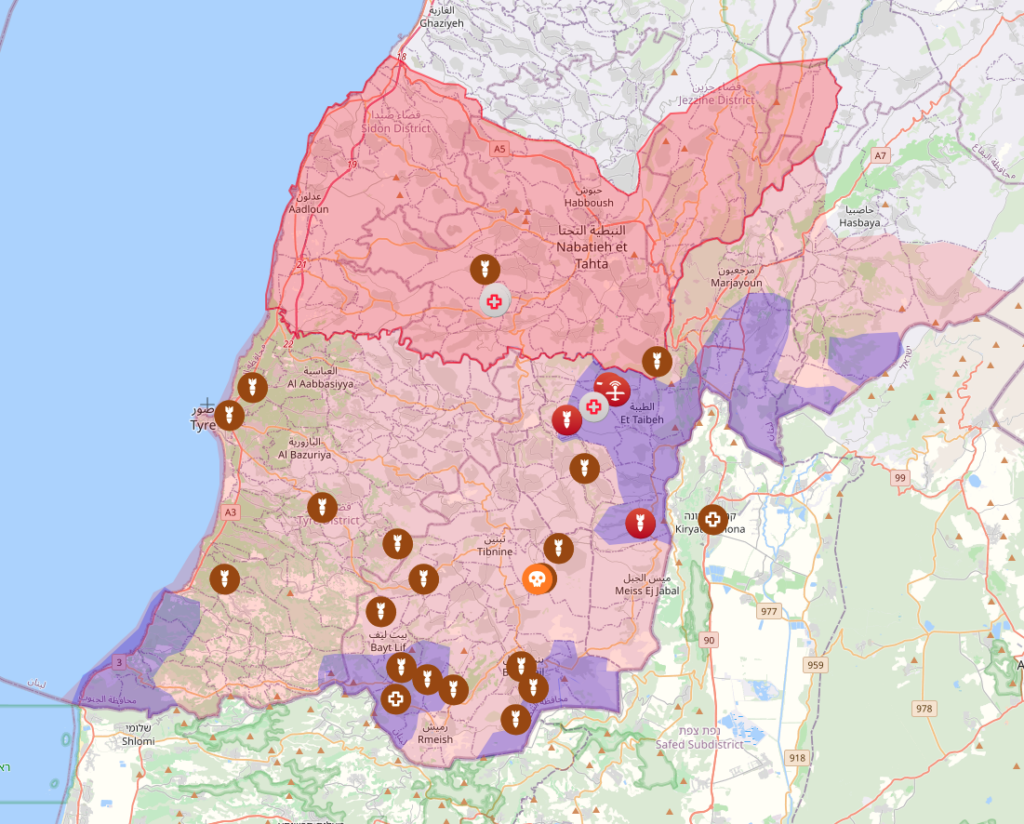
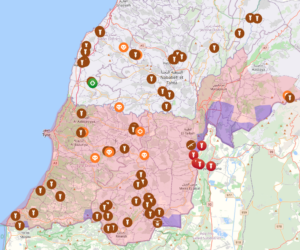
It’s always hard to tell what the state of the war in Lebanon is, but to my casual observation, it looks like the intensity of strike has lessened on both sides, but Hezbollah attacks seem to have fallen sharply. On the other hand, today’s status map show that Israeli forces are already at the Litani River in the eastern part of Lebanon:
“US military has been working on Iran ground raid plans for years.” One would hope.
Retired Gen. Frank McKenzie, the former commander of U.S. Central Command (Centcom), said Sunday that the U.S. military has been working on plans for a ground raid in Iran for years, as President Trump is reportedly considering sending troops into the war.
“Margaret, for many years we’ve considered options along the southern coast of Iran, seizing islands, seizing small bases. Typically raids. And a raid is an operation with a planned withdrawal. You’re not going to stay. But some of those islands you could seize and hold. That would have a couple effects,” McKenzie told CBS News’s Margaret Brennan on “Face the Nation.”
“First of all, it would be profoundly humiliating for Iran and would give us great weight in negotiations. The second, the example of Kharg Island, which everyone talks about, if you seize Kharg Island, you really can shut down the Iranian oil economy completely. And the beauty of seizing it is, you’re not destroying it,” he said.
Is China pushing Iran for a ceasefire?
“The risks to global trade through the Strait of Hormuz have surged and the dynamics of Iran’s relationships with Russia and China are constantly in the spotlight. Recently, both countries have pressured Iran, urging diplomatic solutions to the crisis. On March 24th, China’s foreign ministry reported that Foreign Minister Wang Yi held a phone call with Iran, calling for seizing the opportunity for peace and negotiating as soon as possible.” So did Russian Foreign Minister Sergei Lavrov.
“Analysts believe Russia has explicitly urged Iran to back down, signaling that Moscow views Iran as unable to continue fighting. Shortly afterward, China followed suit, aligning with Russia in terms of diplomatic timing. This indicates coordination between the two countries. Their shared goal is to maintain the stability of the Iranian regime, ensuring it continues to act as a strategic counterbalance to the United States.”
“From Beijing’s perspective, Iran is not only a major energy supplier, but also a key node in the Belt and Road Initiative. Chinese investments in the country amount to at least hundreds of billions of dollars, covering oil and gas field development, port construction, and transportation networks. If the Iranian regime were completely overthrown, it would directly threaten China’s energy and geopolitical interests. Therefore, Beijing must intervene diplomatically and urge Iran to turn to negotiations.” A lot of observers believe that Belt and Road is already moribund.
“A source close to China’s Foreign Minister, Wang Yi, revealed to the Epoch Times that Iran has refused any purely diplomatic arrangements and instead pressured Beijing with selective security, linking substantial aid to the safe passage of Chinese commercial ships through the Strait of Hormuz. This is soft extortion. Without military assistance, China cannot ensure the smooth passage of its trade routes. Beijing’s multiple secret negotiations have ended in failure and its efforts to profit from the geopolitical game are now facing the dual impact of diplomatic imbalance and economic stagnation.”
China also thought it could be a negotiating mediator between Washington and Tehran. Yeah, fat chance.
“This crisis is essentially the inevitable backlash of China’s ‘wolf warrior diplomacy” and camp confrontation mentality.”
“China’s leaders have fallen into a self-entangling dilemma. The forces they’ve supported are now cutting off their own economic lifelines. The disruption in the Straight of Hormuz is not only a rupture in global logistics, but also a microcosm of the complete collapse of China’s geopolitical strategy.”
“You’re starting to see the Iranian regime looking for an exit ramp.”
“USAF A-10s are arriving in the UK tonight as the U.S. surges more Warthogs to the Middle East.”
As usual, this is just the Iran news I felt significant enough to include in the roundup. If you think I’ve missed anything, feel free to share in the comments below.
More proof of widespread Biden Administration abuse and fraud uncovered, more news from the Iran war, the Trump Administration fights welfare fraud, LA displays both welfare and voting fraud, more lefty sorts stealing funds to feather their own nests, Muslim EPIC City development runs into more roadblocks, and some weird video game news.
It’s the Friday LinkSwarm!
Thanks for everyone who contributed to the Pay For Buddy’s Vet Bill Fund. He’s already doing so much better that you can’t tell he was hurt, though some of that is probably the pain pills.
Newly released records in the Senate investigation into the weaponization of government raise questions about whether the FBI went on a fishing expedition targeting Trump advisors who were never charged with crimes and whether Special Counsel Jack Smith’s prior testimony to Congress was truthful.
The documents were made public by Chairman Chuck Grassley, R-Iowa, before a Senate Judiciary Committee subcommittee hearing into alleged abuses by the Biden-era FBI and Justice Department in their investigations into then ex-president Donald Trump before and during the 2024 presidential election during its probe code-named “Arctic Frost.” Just the News previously reported that Biden’s FBI paid anti-Trump ‘Sedition Hunters’ as informants in the Arctic Frost probes.
“If Watergate taught us anything, it is that even a single abuse of power carried out by a handful of individuals can shake the foundations of our Republic,” said Sen. Ted Cruz, R-Tex., Chairman of the Judiciary Committee’s Subcommittee on Federal Courts, Oversight, Agency Action, and Federal Rights.
“What we confront today, the Biden administration’s Arctic Frost scheme, is not a single act,” he continued in his opening remarks. “It is a modern Watergate trading a break-in at one office for a digital sweep into approximately 100,000 private communications, more than a dozen senators and 1000s of individuals lives.”
Cruz said that ultimately, “just like Watergate,” the judges, FBI and Justice Department officials involved should be “investigated, tried, impeached, and brought to justice.”
The scope of Smith’s probe, which centered on Trump’s challenge to the 2020 election results and the events of January 6, 2021, was truly expansive. Grassley previously released records showing that Smith’s office issued nearly 200 subpoenas in his sweeping Arctic Frost-linked case, secretly seeking records on more than 400 Republican personalities and groups. This included more than 160 Republicans–many closely connected to Trump.
The Arctic Frost was one of four separate probes that targeted Trump and his allies stretching from summer 2016 to January 2025. The other probes were code-named Crossfire Hurricane, Round River, and Plasmic Echo, Just the News reported earlier this month.
As FBI Director, Patel has personally led the effort to review those probes, uncovering evidence of a far-reaching dragnet that in some cases may have been predicated on false, misleading or uncorroborated justifications, officials previously told Just the News.
The newly-disclosed records show that the FBI ordered two sweeping subpoenas of FBI Director Kash Patel’s phone records, while he was a private citizen in Trump’s orbit. Each subpoena covered an approximately two-year time frame.
The FBI’s requests for information included demands for highly personal data of Patel’s, including Patel’s addresses (“mailing addresses, residential addresses, business addresses, and e-mail addresses”), a “call detail record” which lists inbound and outbound calls, text messages and voicemail messages, as well as sources of payment for the phone service, including credit card and bank account numbers. The FBI also demanded expansive internet session data including exact IP addresses, the document shows.
The FBI also sought–and was granted–non-disclosure orders (NDOs) from federal judges, shielding the existence of the subpoenas from Patel and his lawyers on the grounds that revealing them could result in his “flight from prosecution, destruction of or tampering with evidence, intimidation of potential witnesses and serious jeopardy to the investigation.”
Susie Wiles, Donald Trump’s then campaign manager and future chief of staff, was also targeted in the probe. The Biden-era FBI reportedly even went so far as to record a private phone call between Wiles and her lawyer in 2023 while she was actively managing the campaign of President Joe Biden’s chief political rival, according to Reuters.
U.S. intelligence intercepted Ukrainian government communications discussing a plot to route hundreds of millions of American tax dollars earmarked for clean energy in the war-torn country and move them to the United States to enrich then-President Joe Biden’s 2024 re-election campaign and the Democratic National Committee, according to a declassified intelligence report summarizing the intercepts that was obtained by Just the News….
‘The Ukrainian Government and unspecified U.S. Government personnel, through USAID in Kyiv, reportedly developed a plan that would provide hundreds of millions of US taxpayer dollars to fund an infrastructure project for Ukraine that would be used as a cover to send approximately 90% of funds allocated to the DNC to fund Joe Biden’s reelection campaign,’ the declassified summary of the intercepts stated.
Every American involved in the scheme should be prosecuted. Still doesn’t justify taking Russia’s side in their illegal war of territorial aggression.
Long overdue: “Trump Administration Launches Whole-of-Government Effort to Fight Welfare Fraud.”
Vice President JD Vance and Federal Trade Chairman Andrew Ferguson convened members of the administration’s newly created anti-fraud task force on Friday to lay out the administration’s hopes for rooting out fraud in public programs across the country.
Established by President Trump via executive order earlier this month, the task force includes newly confirmed fraud-focused Assistant Attorney General Colin McDonald and spans multiple government agencies tasked with implementing new fraud detection and reporting protocols, investigating Biden-era policies regarding fraud prevention, proposing new legislative and regulatory tools to combat fraud, and prosecuting illegal behavior when necessary to recover as much in improperly obtained funds as possible.
According to a task force memo authored by Vance and Ferguson and shared with National Review, the White House will focus primarily on high-spend, low-verification programs that “pay out large sums of money with low confidence or limited information about the ultimate recipients and uses of those funds.” Key programs that fall into this category include benefits administered through Medicare, Medicaid, the Supplemental Nutrition Assistance Program, and Small Business Administration loans.
The task force divides fraud into four main categories, according to the memo. The first category is so-called “ghost” billing where there is no real beneficiary and no real service provided, a prime example being a fake business that applied for Paycheck Protection Program relief during the Covid-19 pandemic. The second category are low-quality services provided to real beneficiaries, such as substandard medical care provided to elderly patients at nursing homes or memory-care facilities.
The third category is “upcoding” or “overbilling,” where fraudsters hand patients manipulated bills. “When hospitals commit fraud, for example, there are often real patients receiving necessary hospitalizations but with exaggerated diagnoses purporting to justify more expensive services than the patient actually needed or received,” the memo reads.
And the final category outlined by the task force is “necessity” fraud, where a real service is provided to an unqualified beneficiary. “Medicare fraud, for example, often involves real doctors giving real people treatments they don’t need, such as a person who can walk getting a wheelchair or a patient getting a lab test they don’t need,” the memo adds.
During a brief news conference on Friday, the vice president spotlighted egregious practices by autism daycare programs in Minnesota, where earlier this month one defendant, a Somali man named Abdinajib Yussuf, pleaded guilty to one count of wire fraud in a $6 million Medicaid reimbursement scheme.
“The first tragedy is that you have people who pay into the federal government, who pay into the IRS, who pay their taxes, expecting that those taxes will go to help their fellow citizens, and it’s not going to. It’s going to help fraudsters,” Vance said in remarks to the press before leading a closed-door strategy meeting with cabinet members and other senior administration officials working on the effort.
And the more important tragedy is that you have families who need these services who are unable to get them because people are getting rich off of fraud schemes, instead of making sure that autistic children and their families get access to these resources,” he added.
The task force has already cracked down on blue states and cities like Los Angeles, where the Centers for Medicare & Medicaid recently suspended 70 home-health providers and hospice centers identified as high-risk fraudulent medical programs.
Another target is also Minnesota, where federally funded nutrition-assistance fraud and state-agency-related mismanagement ran rampant during Democratic Governor Tim Walz’s tenure while somehow failing to disqualify him from Vice President Kamala Harris’s running-mate shortlist. The White House paused $259 million in federal Medicaid payments to Minnesota earlier this month as part of the administration’s response to the state’s baffling degree of fraud.
Over the coming months, task force members are also looking to highlight lax verification protocols at the state level that amplify this problem, particularly in states run by Democrats.
“I think that most citizens probably assume that there’s some verification process that takes place for the receipt of most federal benefits,” said White House Deputy Chief of Staff for Policy Stephen Miller. “The reality is that there is not. This is particularly true in blue states — willfully true in blue states in which all of these programs are operating entirely on the honor system, no verification takes place before individuals are enrolled in or receive these benefits.”
“Vance’s Anti-Fraud Task Force Suspends 70 Hospices in Los Angeles. The Senate also confirmed federal prosecutor Colin McDonald to lead the DOJ’s anti-fraud division.”
Yesterday the Telegraph told us about a “sinister new power” pulling the strings in Iran: “Ahmad Vahidi is the key cog in the regime’s chain of command.”
Unlike [Mohammad Bagher] Ghalibaf, Vahidi has remained in the shadows since the war. This is not without reason: our analysis suggests he is likely to be operating as the key cog in the regime’s chain of command and his survival is essential to its continuity. Long before the war, Ali Khamenei had entrusted Vahidi to draw up plans to further militarise the regime. If he outlasts this conflict and the regime survives, he will finally be able to implement this vision – a design that will produce a far more radical and extremist Islamic Republic.
Vahidi has unmatched experience and influence across the regime’s military, intelligence, and bureaucracy. His career began in the 1980s in the IRGC’s Intelligence Bureau, made up of the regime’s most ideologically loyal operatives. As the IRGC’s deputy for intelligence, he was hand-picked to join a secretive cohort to accompany Khamenei to visit North Korea – a trip designed to acquire missile and nuclear technology.
During the Iran-Iraq War (1980-1988), Vahidi was also one of the original members of the Ramadan Headquarters, a unit within the IRGC created to form Islamist terrorist groups globally and overseen by Khamenei.
Upon assuming the supreme leadership in 1989, Khamenei created the notorious Quds Force – the IRGC’s extraterritorial terror branch – and appointed Vahidi as its first commander. It was a testament to his loyalty. Vahidi demonstrated in that role that his vision to export terrorism was far more global than his notorious successor Qasem Soleimani.
Under Vahidi’s command, the IRGC orchestrated the bombing of a Jewish cultural centre in Argentina in 1994, the 1996 Khobar Towers attack in Saudi Arabia, and secretly dispatched operatives to Europe to train Islamist Mujahideen – including members of al-Qaeda – during the Bosnian war. This résumé would earn him a spot on Interpol’s wanted list in 2007.
Today:
🚨🇮🇷BREAKING: General Ahmad Vahidi who was appointed as commander-in-chief of the Islamic Revolutionary Guard Corps (IRGC) on March 1, 2026, reporadaly has been ELIMINATED in U. S. & Israel strikes. pic.twitter.com/7wuxWVRV6X
US signals to allies no ground invasion coming, with thousands of troops still en route: Iran denies requesting Donald Trump’s 10-day halt; Israel attacks steel & industrial sites. Also, Khondab Heavy Water Research Reactor, part of the Arak Nuclear Complex, targeted. Yellow Cake factory in Yazd province hit.
Escalation on all fronts: IRGC HQ targeted by US-Israsel; Iran signals expansion by naming UAE targets, hitting Kuwait ports and sending drones on Riyadh. Iran newly warning it will hit Gulf industry.
Rubio tells G7 foreign ministers war will continue for another 2-4 weeks.
Israel doubles down amid reports of manpower strain: IDF chief warns of manpower pressure even as Defense Minister Katz vows to “intensify and expand” strikes.
Risk rises that Iran is holding back more advanced missiles for a prolonged war: WSJ writes “The US and Israel are pounding Iran’s missile-launching sites… But Tehran’s missiles keep flying.”
The last seems tinged with ZeroHedge’s usual Iran war pessimism. Ever fewer missiles have been flying as time goes on, and the places they’re manufactured have been hammered.
“Iranian Atomic Energy Organization: US and Israeli airstrikes target uranium processing plant.” Good. Bomb every nuclear-related facility twice-over, then make the rubble bounce.
A special House Ethics Committee found Representative Sheila Cherfilus-McCormick guilty of 25 total ethics violations, after a three-year investigation into allegations that the Florida Democrat stole millions in federal relief funds.
Following a seven-hour televised trial, members deliberated through the night before voting, finding Cherfilus-McCormick guilty of almost all the charges against her — 25 of the 27.
“I’m as pure as the driven snow!” denials snipped.
In November, a federal grand jury indicted Cherfilus-McCormick, alleging she stole $5 million from the Federal Emergency Management Agency. Cherfilus-McCormick’s family operates a health care company, Trinity Healthcare Services, and received FEMA funds for a Covid vaccination contract.
According to the DOJ, the $5 million payment was an overpayment, and the congresswoman and her brother never paid back the funds to the government. Rather, the pair funneled the funds through various accounts and used the money to back Cherfilus-McCormick’s 2022 special election campaign, which she ultimately won.
Snip.
Cherfilus-McCormick and her siblings “funneled more than $500,000 originating from Trinity into various outside organizations that made expenditures on behalf of the campaign,” Sydney Bellwoar, the committee’s lawyer, said.
Further, Bellwoar said “the most egregious example” was when Cherfilus-McCormick received $2 million directly from Trinity Health into her campaign in July 2021, to forge the appearance of a robust campaign infrastructure.
Seize everything she owns to pay back and sentence her to extended prison time.
Sen Rand Paul offers up a simple, elegant solution that Democrats will fight tooth and claw against:
DataRepublican says that John Thune is trying to pull a sneaky maneuver to kill the SAVE Act.
Hello Senator Thune,
Let’s expose what you’re really doing with “reconciliation.”
You announced it yesterday, eleven months after the House passed the SAVE America Act. You’re not trying to pass this bill. You’re trying to kill it in a way you can blame on process.
Here’s how we know:
Reconciliation requires the Senate parliamentarian to rule that provisions are “budgetary.” Citizenship verification is not budgetary. Photo ID mandates are not budgetary. The parliamentarian will gut the bill. Then you’ll shrug and say “we tried.” We see through you.
Meanwhile, you WON’T use the tools that actually work:
Rule XIX limits each senator to two speeches per legislative day. Keep the Senate in continuous session, file cloture daily, and the filibuster exhausts in ~12-20 days. You dismissed it as “complicated.” Because if you tried and succeeded, you’d have to actually pass the bill.
Harry Reid nuked the filibuster in 2013 when he wanted results.
Mitch McConnell changed Senate rules THREE times and canceled the August recess.
Chuck Schumer used reconciliation within months on a 50-50 Senate.
You have 53 seats. You’ve changed nothing, canceled nothing, and waited eleven months.
Now let’s talk donors:
• Goldman Sachs: $150K to you – top H-1B user
• Google: $75K – lobbies against E-Verify
• Meta: $72.5K – Zuckerberg’s FWD[.]us pushes mass immigration
• Wells Fargo: $90K – banks undocumented immigrants
Same corporations sponsor Punchbowl News, where you sit for “Fly Out Days” which nobody watches except Congress staffers and K Street lobbyists who pays premium bucks for legislative intelligence. Their reporter then telegraphs to the audience the SAVE Act “will ultimately fail.”
Corporate money flows to you AND to the outlet that frames your inaction as inevitable.
We see the loop.
You called grassroots anger a “paid influencer ecosystem.” YOU are the paid influencer. You take the wrong side of a 80% issue because you are indistinguishable from a K Street mouthpiece, and an ineffective one to boot who won’t bend the rules to get anything passed.
What we want:
1. Force a real talking filibuster.
2. Stop hiding behind process.
3. Pass the SAVE America Act.
YOU will become the reason that we will have our butts kicked in midterms. Not Candace Owens, not Nick Fuentes, not anyone else. You and you alone, and all because you want to make the 200 or so viewers of Punchbowl Fly Out Days happy. You’re living in a K Street information bubble, addicted to the comforts and praises of lobbyists masquerading as journalists. You mistake the steak and martini dinners you get invited to as your own constituents.
You are not “moderate.” The SAVE America Act has 98% support among Republicans. Name one other thing that has 98% support. You are an extreme minority who prides himself on being a calm leader, when in reality you are well in the running for the most ineffective Majority leader of all time.
Prove me wrong. Do the bare modicum of effort. Not symbolic. Actual effort. Cancel the recess. Get SAVE America Act passed.
Paid activists in Los Angeles, California, have been caught on hidden camera paying homeless people on skid row to forge signatures of registered voters on ballot initiatives.
O’Keefe Media Group (OMG) released part Two of its undercover investigation into the Democrats’ blatant election fraud operation in L.A. on Tuesday.
California’s Republican gubernatorial frontrunner Steve Hilton commented on X: “They paid homeless people cash and drugs on Skid Row to forge your signature. Your name. Your vote. Stolen by a crackhead with a clipboard — while Gavin Newsom looked the other way.”
Hilton added: “This isn’t a conspiracy theory. It’s on tape. And not one Democrat is outraged. That’s because THEY DID IT ON PURPOSE.”
Part One showed petitioners offering cash to homeless people and drug addicts for their signatures. The shocking new video shows the activists, armed with printed lists of voter names and addresses, taking the scheme to another level.
“Fraudulent petitioners on Skid Row are now paying the homeless people to forge names, forge addresses and forge signatures of registered voters,” O’Keefe says at the beginning of Part Two.
Rather than registering the Skid Row denizens to vote, activists gave them $2–$3 in cash to commit forgery and election fraud in what OMG called “a coordinated system.”
O’Keefe stated that the operation was observed on nearly every street corner in downtown Los Angeles.
“The scheme appeared to be present in whatever direction we walked,” he noted.
The goal of the operation, according to OMG, is to “ensure the information matches official records so he signature passes verification.”
The workers handed out post-it notes with the names of a single voter written on them to each of the homeless dupes.
Lots of “activists” need to go to prison.
“‘Not a done deal‘: Democrats start to sweat over Virginia’s redistricting referendum. The unique nature of the April special election and the state’s recent redistricting history have presented challenges for Democrats, even as they hold a financial edge in the race.” “Some supporters of the Virginia referendum acknowledge the challenge of convincing voters to back a gerrymandered map when Democrats, who several years ago backed the formation of the state’s bipartisan redistricting commission, have criticized Republicans for similar moves.” Ya think? (Hat tip: Sarah Hoyt at Instapundit.)
Democrats have been hyping their wins in very specialized races. And the Left has been declaring that it’s going to finish devouring and digesting the Democrats.
On paper, it should be looking good. The public is dissatisfied. The Left’s program of socialism disguised as economic populism and antisemitism disguised as anti-Zionism should be selling. Except the Illinois wipeout suggests it’s not.
Again, on paper Obamaville, where the dead vote and the unions run everything, should have been a good choice. Plenty of leftists have been elected here. And the Democrat primaries in many urban areas are virtually owned by the Left.
But 6 potential Squaddies, including two Muslim candidates, lost Democrat congressional primary races.
The media and the Left (but I repeat myself) are blaming AIPAC and the newly combative pro-Israel lobby, which sees itself being NRA’d out of the Democrats, is happy to take credit, but its results were mostly mixed.
So what does explain the Left taking a beating in primaries it should have been able to dominate?
Despite all the anti-ICE hysteria, radicalism fatigue may be setting in. Enough Democrat primary voters showed no interest in voting for the ‘podcast class’, the Bernie Brats, Hamas fan girls and the rest of the radicals.
The Left was hoping that Mamdani’s victory was a bellwether, but just like Obama’s win what it really showed was that a smooth radical isn’t supposed to sound like one. Democrats didn’t want. The Bernie people, the Justice Dems and that ilk lost badly in Illinois because maybe radicalism isn’t what the Democrat voter wants right now.
They also hit the Ust-Luga oil terminal in the same general area, and it was still burning 24 hours later. They also hit two oil tankers in the same strike.
But that’s not all! They hit the same Ust-Luga oil terminal again less than a day later. “Russia has lost 40% of its oil export capacity.”
One of Russia’s newest warships, a Project 23550 icebreaker, is now damaged and listing heavily after drone strike.
“U. North Texas Cutting up to 70 Programs in Effort to Trim Deficit” including “women’s and gender studies, LGBTQ studies, Mexican American studies, Africana studies, Asian studies as well as dance, geology and special education.” Most of those sound like they should be killed, and the rest are unnecessary luxuries if no one is taking them.
Attorney General Ken Paxton has obtained a court order halting actions by an EPIC City-linked municipal utility district.
The case centers on allegations that the Double R Municipal Utility District No. 2A has been used to advance a controversial development project organized by the East Plano Islamic Center by skirting state oversight and standard MUD-creation procedures. The project, originally known as EPIC City, has been rebranded as the Meadow.
Judge Christine Nowak’s order blocks the district and its board from taking further steps to support the development while the litigation continues.
The state’s lawsuit focuses on a 2025 special meeting where the Double R MUD board allegedly resigned en masse, installed new directors at a remote roadside location identified only by GPS coordinates, and then quickly voted to annex more than 400 acres tied to the EPIC project.
State lawyers say that maneuver effectively transformed the MUD into a vehicle for EPIC City’s backers, allowing them to expand taxing authority and infrastructure support without going through the process of forming a new district.
After the annexation, regulators requested documents to confirm that the new board members met legal requirements to hold public office and levy taxes on residents inside the district.
According to the suit, records submitted by Double R MUD showed the individuals did not meet statutory qualifications—a finding the attorney general’s office said casts doubt on every action the board took, including the EPIC City annexation.
The state is asking the court to remove the disputed board members, unwind the 402.5-acre annexation tied to EPIC City, and restore what Paxton describes as lawful governance of the utility district.
More: “Hunt County Rejects Plans for Controversial EPIC City. Commissioners disapproved the Islamic development based on deficiencies in the plat application.”
“Monica Cannon-Grant, a Black Lives Matter activist who was named ‘Bostonian of the Year’ by the Boston Globe, was ordered to pay back every dime she stole from her nonprofit, unemployment benefits, and other fraudulent practices, amounting to almost $225,000. U.S. District Court Judge Angel Kelley sentenced Cannon-Grant to four years’ probation, six months of home detention, and 100 hours of community service. Federal prosecutors, however, recommended 18 months in prison. Although Cannon-Grant dodged time behind bars, she must return all of the money she managed to bilk from her nonprofit.” Kelley was appointed by Biden, and I bet if Cannon-Grant hadn’t been a leftwing political activist, she would have received prison time.
Important tip: “Ultra-pure copper” bought from China shouldn’t stick to a magnet. Plus, make sure the Chinese companies you’re buying materials from actually exists…
Just hours after Irish rappers Kneecap blasted the amps and turned a Havana concert into a rave for Code Pink activists chanting anti-blockade slogans, reports claim local hospital went dark and ventilator patients died.
Meanwhile, members of the communist flotilla stayed in 5-star hotels with the lights blazing and AC running.
No one cashes in on capitalism faster than the clowns preaching communism.
The U.S. Attorney’s Office for the Southern District of New York has charged associates of an unidentified U.S. server maker with illegally diverting billions of dollars in Nvidia-powered servers to China.
The U.S. government has been trying to figure out how high-powered chips have reached China without authorization, as American artificial intelligence companies such as Anthropic and OpenAI face challenges from DeepSeek and other Chinese rivals.
In an indictment unsealed Thursday, the U.S. government alleged that Yih-Shyan “Wally” Liaw, Ruei-Tsan “Steven” Chang and Ting-Wei “Willy” Sun worked together to violate the Export Control Reform Act.
The server company’s products containing Nvidia chips “are subject to strict U.S. export controls barring their sale to China without a license,” the plaintiff said in the indictment. “Those controls are in place to protect U.S. national security and foreign policy interests, among other things.”
Artificial intelligence may well be the most important technological development of the coming decade-and that is exactly why the current capital surge around it warrants skepticism. History is littered with transformative innovations that were nonetheless disastrously overbuilt and mispriced in their early phases. Austrian Business Cycle Theory was never a children’s story in which every boom ends with clowns, ashes, and worthless machinery; its real claim is subtler and nastier. When the price of time is falsified-when interest rates are pushed below their natural rate-often proxied, however imperfectly, by modern estimates of the neutral rate-entrepreneurs are encouraged to undertake projects that are more roundabout, more capital-intensive, and more time-sensitive than underlying saving and final demand can actually support. The neutral rate is a policy construct; the natural rate is an economic reality. Some of those projects may still embody genuine innovation.
The problem is not that AI must be fake; it is that a very real technological advance can be financed, priced, and physically built in ways that are wildly uneconomic.
That distinction matters because AI is about as roundabout as modern capitalism gets. This is not a boom in apps and slogans alone; it is a boom in data centers, power, cooling, transformers, specialized semiconductors, fiber, land, and the commodities and construction needed to house and feed all of it. Reuters reports that Alphabet, Amazon, Meta, and Microsoft are expected to spend more than $630 billion combined on AI-related infrastructure in 2026, up sharply from 2025, while separate Reuters reporting says Amazon alone projects roughly $200 billion of 2026 capex. Analysts also expect the hyperscalers’ debt issuance to keep climbing, with BofA lifting its 2026 forecast to $175 billion after Amazon’s jumbo deal and Reuters noting that these firms issued $121 billion in bonds in 2025 versus a 2020–2024 annual average of just $28 billion. In Austrian terms, this is not consumption drunkenness; it is higher-order production marching deep into the structure of capital with a flamethrower and an Excel model.
Snip.
The most charitable case is that AI is a genuine general-purpose technology whose economics are merely messy in the early innings. OpenAI says ChatGPT had more than 900 million weekly users as of late February, and Bloomberg reports OpenAI’s annualized revenue topped $20 billion in 2025 while Anthropic is tracking near that level as well. There are also signs of real productivity gains in narrow use cases, especially coding and selected support tasks. But the bill is arriving much faster than the profits: Bain estimated the industry would need roughly $2 trillion in annual revenue by 2030 to support projected compute demand, yet expected a gap of about $800 billion. That is not a business model; that is a promissory note written in GPU ink.
The more worrying Austrian angle is not simply overvaluation in public equities, but miscoordination in the capital structure. If chips depreciate economically faster than accountants admit, if grid interconnections lag by years, if open models compress pricing power, and if customers love AI demos more than they love paying enterprise invoices, then the industry has a classic ABCT problem: complementary capital arrives in the wrong proportions and at the wrong times. And though not easily captured in formal models, technological history is clear: infrastructure-heavy systems rarely stay that way for long, and early capital often pays the price. The New York Fed warns that r-star is an estimate, not an oracle, but the larger point survives that caveat: if market rates were held too low relative to the economy’s true intertemporal balance, then the resulting investment pattern will look profitable only until bottlenecks, replacement cycles, and cost of capital reassert themselves. Bloomberg reports OpenAI has discussed infrastructure commitments above $1.4 trillion, while Anthropic has announced a $50 billion U.S. data-center push; meanwhile, the IEA has warned of grid-connection queues, transformer shortages, and permitting delays for the power build-out data centers require. A boom can survive many indignities, but not all of them at once.
So: does AI constitute malinvestment? The best answer is that AI almost certainly contains both real innovation and a large malinvestment component.
Barksdale Air Force Base (BAFB), a major U.S. strategic bomber installation in northwest Louisiana, has just experienced an unusually serious series of unauthorized drone incursions over its most sensitive areas.
More than a dozen unsanctioned drones repeatedly swarmed a US Air Force base that is home to a nuclear bomber fleet — and were able to resist efforts to bring them down via jamming technology, according to military officials.
The restricted airspace of Barksdale Air Force Base in Bossier City, Louisiana, was infiltrated by “multiple unauthorized drones” between March 9 and March 15, a base spokesperson told The Post.
The 22-acre installation located east of Shreveport, hosts a fleet of B-52 bombers which can carry out nuclear strikes with “worldwide precision,” according to the Air Force.
As an Air Force Global Strike Command base, Barksdale also plays a crucial role in the Air Force’s nuclear defense capabilities…
Military officials report that more than 12 to 15 unauthorized drones swarmed the base, which hosts the U.S. nuclear B-52 bomber fleet.
The drones resisted jamming efforts, with multiple waves detected.
Snip.
The briefing includes a determination that the drones were different than what the typical consumer could purchase off the shelf. They appeared to be custom built and required “advanced knowledge” of signal operations.
The analysts said “with high confidence” they expected unauthorized drones to continue to operate in and around Barksdale Air Force Base in the immediate future.
“The drone incursions at BAFB pose a significant threat to public safety and national security since they require the flight line to be shut down while also putting manned aircrafts already inflight in the area at risk,” the document said.
Maybe his hatred for the police will finally be his undoing. “Resignation Demands Mount for Travis County DA Garza over Prosecutorial Misconduct Allegations.”
Travis County District Attorney Jose Garza is facing calls for his resignation over accusations that he withheld evidence in prosecuting a police officer for actions taken during a 2020 Black Lives Matter protest in Austin.
“Jose Garza’s habitual misconduct and his lack of prosecutorial experience puts our entire community at risk,” said Austin Police Retired Officers Association (APROA) President Dennis Farris in a statement.
“Felony cases, when properly handled, present opportunities for the innocent to be absolved of serious allegations, for the guilty to be held accountable and for the residents of Travis County to have confidence in the judicial system. In order for these principles to be upheld, Travis County needs a new district attorney.”
Farris was responding to recent revelations about Garza’s prosecution of Austin police officer Chance Bretches.
In 2022, Garza charged Bretches with Aggravated Assault, two years after an anti-police demonstration spurred by the death of George Floyd. During the protest, Bretches fired a “less lethal” bean bag round, resulting in severe injury to a woman who said she was a volunteer providing medical assistance to protestors.
In 2024, Garza brought additional charges against Bretches for Aggravated Assault by a Public Servant, Deadly Conduct, and Assault.
Although prosecutors are required to provide the defense with exculpatory evidence in accordance with a U.S. Supreme Court ruling in Brady v. Maryland and Texas’ Michael Morton Act, Garza did not disclose alleged “secret” meetings in 2023 with city officials to discuss the possibility of charging the City of Austin.
Last week, attorney Doug O’Connell asked Travis County District Court Judge Karen Sage to dismiss the case on the grounds that Garza violated Bretches’ constitutional due process rights and violated the law by not disclosing the meetings or related communications. O’Connell also argued that Garza’s actions are part of a pattern of misconduct.
“This goes to the issue of why dismissing the case is the only solution, because how will the judge ever know whether they turned over all the evidence,” O’Connell told The Texan.
Courts previously sanctioned Garza for withholding evidence in the manslaughter prosecution of two Williamson County Sheriff’s deputies, and an investigator also accused the DA of hiding evidence in the trial of Daniel Perry.
Perry was convicted in 2023 of murdering Air Force veteran and Black Lives Matter protester Garrett Foster. Gov. Greg Abbott pardoned Perry in 2024.
In addition to APROA, the Combined Law Enforcement Associations of Texas (CLEAT) has also called for Garza’s resignation, and the incoming president of the nonprofit Central Texas Public Safety Commission, Jennifer Stevens, told CBS Austin that Garza’s prosecution of police officers instead of criminal defendants is contributing to division between the Travis County District Attorney’s Office (TCDAO) and law enforcement.
“There can be no worse violation of the oath taken by a district attorney than to intentionally deny a defendant a fair trial. It is a direct violation of their constitutional rights,” said CLEAT Executive Director Robert Leonard in a statement.
In December, a Texas appeals court overturned the conviction of Austin police officer Christopher Taylor, who had been prosecuted by Garza over the 2019 shooting death of Mauris DeSilva.
Abbott responded to the new allegations against Garza in a social media post.
“All of this will be taken into consideration when I have the final say on the fate of the police officer. This DA’s failure to prosecute murderers & repeatedly letting dangerous criminals go free, while prioritizing prosecuting police, will have consequences,” wrote Abbott.
The sooner Garza is gone, the sooner citizens can stop dying because he let criminal scumbags back on the street.
“Dallas and Williamson County GOPs to Return to Countywide Voting After Primary Election Day Confusion. At least 13,000 Dallas residents reportedly showed up to the wrong polling place on March 3.”
America’s most prolific serial killers now burns in hell. Kermit Gosnell dies in prison at 85.
A Philadelphia grand jury, in its investigation of Gosnell’s Women’s Medical Society abortion center, labeled it a ‘house of horrors’ and initially sought charges for hundreds of murders of babies born alive and then killed.
Charges were ultimately limited to seven murder counts ‘after pressure from senior political and law enforcement officials,’ according to accounts from those covering the case.
The facility functioned as a ‘pill mill by day and an ‘abortion mill’ by night,’ federal authorities noted….
Witnesses described shocking details: Baby A was large enough that employees took photos after the killing, with Gosnell joking the baby was ‘big enough to walk around with me or walk me to the bus stop.’
Other infants showed signs of life, including breathing and movement, before being killed.
Gosnell was also convicted of involuntary manslaughter in the 2009 death of 41-year-old patient Karnamaya Mongar, a Bhutanese refugee who died from an overdose of anesthesia during a botched abortion.
He faced more than 200 additional counts and was found guilty on most, including 21 felony counts of performing illegal abortions beyond Pennsylvania’s 24-week limit and violations of the state’s 24-hour informed-consent law.
Finally. “International Olympic Committee Bans Male Athletes from Women’s Sports.” Pretty soon the only place radical transsexism will still hold sway is among 2028 Democratic Presidential candidates…
The House Select Committee on Governmental Oversight will have over a dozen members, with state Rep. Cody Vasut (R-Angleton) serving as the chair and state Rep. Armando Walle (D-Houston) as co-chair.
The other representatives on it will be state Reps. Richard Hayes (R-Denton), Brooks Landgraf (R-Odessa), Mitch Little (R-Lewisville), AJ Louderback (R-Victoria), Christian Manuel (D-Beaumont), Eddie Morales (D-Eagle Pass), Richard Raymond (D-Laredo), Shelby Slawson (R-Stephenville), Carl Tepper (R-Lubbock), Ellen Troxclair (R-Lakeway, and Erin Zwiener (D-Driftwood).
“Meta to Pay $375 Million Penalty After Jury Finds Company Endangered Children in Landmark Case.”
A jury in New Mexico determined on Tuesday that Meta misled consumers about the safety of its platforms and put children in harm’s way by failing to protect them from sexual predators.
The jury ordered meta to pay a $375 million penalty, significantly lower than the $2.2 billion that New Mexico sought, based on the total number of violations and a $5,000 fine per violation. Meta was found to have violated New Mexico’s unfair-practices act
Adam Savage reorganizes his storage drawers. I’m not saying everyone should watch all 40 minutes of this, but if you have a workshop full of tiny components you have trouble organizing, you might find his method useful.
Tom Scott returns to YouTube after a two year absence. I’m not necessarily super excited for the particular shows he’s returning with (a tour through all of England’s counties, with something interesting in each), but I’ll probably dip into it because I liked his previous work, where he traveled around the world and explained interesting things.
Not one but two Iranian naval commanders get dirtnapped, more than 10,000 Iranian targets have been hit, Iran getting 12 year olds to join the fight, and claims it’s reinforced Kharg Island.
The latest CENTCOM update from Admiral Brad Cooper:
Highlights:
Over 10,000 Iranian targets hit. More counting Israeli strikes.
“We’ve destroyed 92% of the Iranian Navy’s largest vessels.”
“Iran’s drone and missile launch rates are down over 90%.”
“Today, we have damaged or destroyed over two-thirds of Iran’s missile, drone, and naval production facilities and shipyards, and we’re not done yet.”
“Now, in their eighth decade of flight, our B-52 bombers are executing strikes into Iran with up to 70,000 pounds of munitions on each mission.”
Also from Admiral Cooper: “Israel has eliminated the commander of the Iranian Islamic Revolutionary Guard Corps-Navy, Admiral Alireza Tangsiri.” He was supposedly the guy overseeing blocking the Strait of Hormuz.
Israel also hit two “key naval cruise missile production sites in Tehran. IAF fighter jets targeted facilities used by the Iranian regime to develop and manufacture long-range naval cruise missiles capable of destroying targets at sea and on land.”
Israeli fighter jets, on Tuesday, struck Iran’s main weapons production site. The Israel Defense Forces (IDF) described the fortified underground site in the central Iranian city of Isfahan as the regime’s “most central explosives production facility.”
The “Israeli Air Force, acting on IDF intelligence, completed a wide-scale wave of strikes, targeting the Iranian regime’s military-industrial production facilities in Isfahan,” the Israeli military announced Tuesday evening. “The IDF confirms that it struck the most central production site for explosive materials in Iran, where the Iranian regime developed and produced explosive materials for various of weapons.”
Israel had hit the facility extensively last year, but they were trying to rebuild it.
“Israel hit a naval facility in Iran’s Caspian Sea port of Bandar Anzali and has targeted a military supply route used by Moscow and Tehran to transfer weapons….The Israeli military said the strike hit dozens of targets, including warships, a command centre and a shipyard used to maintain vessels. Verified images showed damage to Iran’s naval headquarters and destroyed vessels.”
Iran is winning so hard they have to recruit 12-year olds. “Iran has said that children as young as 12 can join the war, country’s state media quoted Iran’s Revolutionary Guards Corps (IRGC) official as saying that the minimum age for participation in war-related support roles has been lowered.” Much like they used 12 to 17 year olds to clear minefields in the Iran-Iraq war.
“The United States has deployed uncrewed drone speedboats for patrols as part of its operations against Iran, the Pentagon said, the first time Washington has confirmed using such vessels in an active conflict.”
The MSM may be against the war, but the Iranian people are for it. (Hat tip: Instapundit.)
Don Lemon finds out that an American of Persian descent is 100% behind the war:
WATCH: Don Lemon: “How do you feel about the war?”
Young Man: “I'm Persian. I support Donald Trump 100%. The Islamic regime kills woman. They killed 50,000 people in two days. A lot of them believe in death [to] all Americans. I 100% support Trump.”
Another Iran update: More Jihadis dirtnaped, Iran’s neighbors want the Islamic regime finished off, Mossad gives regime members person-to-person call warnings, Uncle Sam fast-tracks a lot of weapon sales to the Middle East, and the BRRRRRRRTTTTTTTT of Freedom rings out over the Strait of Hormuz.
Israel Defense Forces killed top Iranian intelligence official Esmaeil Khatib and Hamas commander Yahya Abu Labda in separate airstrikes in the Middle East overnight.
The IDF confirmed Khatib, Iran’s intelligence minister, was killed in the strike in Tehran on Wednesday morning.
“Khatib played a significant role during the recent protests throughout Iran, including the arrest & killing of protestors and led terrorist activities against Israelis & Americans around the world,” the IDF wrote in a post announcing Khatib’s death. “Similarly, he operated against Iranian citizens during the Mahsa Amini protests.”
The Hamas commander was reportedly killed during an IDF airstrike in the Gaza Strip on Tuesday, according to the Times of Israel.
The strikes come a day after Israel killed Ali Larijani, secretary of Iran’s National Security Council, in an airstrike.
Abu Labda was a prominent figure in the development of Hamas’s precision missile project, according to the Times of Israel.
The Israeli Air Force (IAF) for the first time hit Iranian naval targets in the Caspian Sea on Wednesday, striking infrastructure and ships at the port of Bandar Anzali in northern Iran, at a distance of some 1,300 kilometers (over 800 miles) from Israel.
In addition, the IAF continued striking targets belonging to the Iranian regime’s Islamic Revolutionary Guard Corps (IRGC), the Basij militia, and the Air Force, among others.
The Israeli military confirmed on Thursday that the strikes in Bandar Anzali hit several ships, a repair facility, as well as a headquarters controlling naval operations in the Caspian Sea.
The US has deployed A-10 Warthogs attack jets, Ah-64 Apache helicopters, and 5,000-pound ground penetrator bombs to take out Iranian drones, boats, and mines to help secure the Strait of Hormuz, America’s top general said Thursday.
Gen. Dan Caine, chairman of the Joint Chiefs of Staff, vowed at a Pentagon news conference that the US would “hunt and kill” all of Tehran’s weapons facilities and assets being used against the strait, a critical trade route through which 20% of the world’s oil supply is transported.
“We continue to hunt and kill afloat assets, including more than 120 vessels and 44 minelayers,” Caine told reporters alongside War Secretary Pete Hegseth.
Simon Whistler has a meaty update on the war, including how all the Persian Gulf nations now agree that the Islamic Republic of Iran must go.
“Iran’s response to this war has managed to achieve something truly remarkable. [Ali Larijani]’s own neighbors, who had previously gone to bat for them, are now done dodging missiles and are reportedly pushing Washington to eliminate the Iranian threat for good, destroying the tools of repression.”
Skipping over the deaths of Ali Larijani and Gholam Reza Soleimani, previously reported here.
“Since the war began, American and Israeli forces have been running what amounts to a parallel campaign alongside the more headline grabbing strikes on nuclear sites and missile infrastructure. This campaign has been aimed squarely at the regime’s domestic repression capabilities and infrastructure, and it’s been accelerating massively in recent days. These targets should tell you something about what this part of the campaign is actually designed to do. Destroying missile launchers and stockpiles might degrade Iran’s ability to hit back, but destroying a law enforcement station and the men who run it degrades Iran’s ability to keep the lid on a country that it only barely had a grasp on before all of this kicked off.”
Skipping lightly over news of Iranians celebrating the traditional Chaharshanbe Suri fire festival, and the regime cracking down on same (no Zoroastrian fire festivals allowed in Islamic Iran), because it’s hard to get a sense of scale there.
“Noras, or Persian New Year falls on March 20th this year. This holiday is historically one of the largest public gatherings in Iranian life and has often been a flash point for protests against the regime. Last year, they arrested dozens of people across multiple provinces during Nar and that was before any of this broke out. this year. Suffice it to say, the situation has uh changed a bit. We don’t want to rest too much on Naras as a make or break moment, though. But it nevertheless represents a significant test of the coalition’s core theory for ousting or at least seriously pressuring the regime. Degrade their tools of oppression enough and the population will be able to do the rest.”
“The Guards have never been a domestic military force, but instead an ideologically driven group of hardliners explicitly set up to defend the Islamic Republic’s continued existence, no matter what the cost. Whatever comes next on the streets of Tehran, it does not appear likely that these men will simply lay down their weapons and go quietly into that good night.”
“The IRGC’s hardliner stance did not just reveal the power dynamics going on in Tehran, though. It helped to reshape the entire region’s posture in ways that would have been difficult to imagine just a few weeks ago. Before the war started, the Gulf States were the closest thing that Iran has to a coalition against American military action. Despite hosting US bases, most of them had adamantly pushed the White House not to strike Iran and were actively working to try and find common ground between Washington and Iran so they can avoid conflict.”
“While this was partially out of self-preservation interests, they knew the conflict in the region is never good for their bottom line, at least in the short term. They were still some of the best friends that Tehran had left. The Emirates had spent years rebuilding its relationship with Iran, and Aman’s foreign minister was in Washington discussing the matter with Vice President JD. Vance the day before the strikes took place. None of them doubted that Iran posed a threat. They hosted US bases for a reason, after all. But they calculated that living with the Iranian threat would be preferable instead of being largely defenseless in a war.”
“Iran’s response to Operation Epic Fury settled that debate in about 72 hours. Since February the 28th, Iran has launched over 1,800 projectiles split between ballistic missiles and drones at the UAE alone.”
“Bahrain took it even further, branding Iran treacherous. Bahrain even took the lead in sponsoring a UN Security Council resolution condemning Iran for its targets in this conflict which passed with unusually lopsided support. While not everyone throughout the Gulf was quite as forceful as that, they’ve all been moving in the same direction.”
“Behind the public statements urging peace, the private messaging to Washington has been far more direct: ‘Finish the job.'”
“Gulf officials have been pushing the Trump administration for what amounts to a permanent end to Iran’s ability to threaten their infrastructure.”
“In the space of three weeks, Iran has managed to turn every Gulf state that was lobbying Washington on its behalf into a partner actively backing the campaign to destroy its military capabilities. It is by almost any measure one of the most self-defeating foreign policy decisions a country has made in the modern Middle East.”
“A recent Goldman Sachs stress test published on March 15th showed that if the strait remained effectively closed through April, Qatar and Kuwait could see their full-year GDP contract by 14%, the worst since the 1990 Gulf War. The UAE and Saudi Arabia wouldn’t be quite as hard hit, but they’d both take a 5 and 3-point hit, respectively.”
Whistler also offers up a nice roundup of the current state of Israel’s incursion into Lebanon: “By March 16th, at least three separate IDF divisions were operating simultaneously inside of southern Lebanon, pushing through Kiam, Bins Jabel, and Marion in the most significant ground operations since their 2006 intervention. Evacuation orders are now covering everything south of the Latani, which when combines with the evacuated areas in the Bekaa Valley and southern Beirut totals to roughly 14% of the entirety of Lebanon’s territory.”
“Israeli Defense Minister [Israel] Katz has said at least parts of the operation are modeled explicitly on Gaza, offered no timeline for withdrawal, and some ministers are already floating the idea of a semi-permanent security zone. For now, there are no signs of a push toward Beirut or anything beyond the Litani.”
“In the last 48 hours alone, [Lebanese President Joseph Aoun] publicly called Hezbollah’s decision to enter the war a trap and an almost overt ambush serving Iranian interests, warned that the country is on the path to become a second Gaza, and floated a four-point plan calling for an immediate ceasefire, international backing for the Lebanese armed forces to oversee disarmament, direct negotiations with Israel, and long-term border security agreements.”
“While all of this is unprecedented for a Lebanese president, Beirut is currently falling short of Israeli expectations for two reasons. First, Lebanon has a long history of promising to finally get tough on Hezbollah that, well, hasn’t exactly materialized. Second, and more pertinently, the LAF [Lebanese Armed Forces] are already struggling to implement the ban on Hezbollah’s military operations that we reported on just a week ago. Hezbollah’s attack was earth-shattering for Beirut, which appeared to have finally found a moment of cross sectarian agreement that Hezbollah simply had to go. And while there were initially promising signs that the LAF was taking this seriously, the army has largely stalled. LAF commander [Rodolphe Haykal] has essentially refused to enforce the government’s ban on Hezbollah military activities, and the United States has even suspended some coordination with the LAF over it. The country’s prime minister has considered firing him for the whole debacle.”
“Now look, in fairness to Haykal, this isn’t just some random act of indifference where he’d rather sit around and watch Warfronts than go out and disarm the group. Though we couldn’t blame him if that was the case, could we? Rather, his calculation is that 20 to 30% of the LA Shia and would possibly refuse to mobilize against Hezbollah entirely, risking a total fracture of the military. Keep in mind that in Lebanon, sectarian identity is front and center just about everything that happens, especially in politics, and the LAF is broadly considered to be the last cross-sector institution in the country.”
“All that said, the inaction here is seriously jeopardizing the country’s sovereignty. The lesson that Israel took away from the October 7th attacks, rightly or wrongly, was that they couldn’t afford to allow a hostile force to exist along its borders anymore. In the aftermath of the 2024 ceasefire with Lebanon, Israel made it clear that disarmament of the group was an absolute bare minimum condition. And the tragic thing is that the LAF largely delivered on this. Earlier this year, they completed phase one of the operation. And while it was slowgoing, potentially so slow that Hezbollah was actually rearming faster elsewhere in the country than it was being disarmed, the LAF nevertheless demonstrated that it could deliver.”
“And all of this isn’t helped by the fact that even today, right now, Hezbollah continues to launch on Israel. While their stockpile has been severely reduced and seems likely to be further reduced in their ongoing clashes with the IDF, they don’t appear to be anywhere close to surrender.”
One of the reasons Iran was caught off guard at the opening of this war is that its leadership did not take Yahya Sinwar or Hassan Nasrallah’s approach. The Iranian regime—a state built on terror—was acting like a state and forgot what happens to those who spread terror. What Hezbollah and Hamas understood, and what Iran forgot, is that when you attack Israel, you become prey.
After the regime’s decapitation on the first day, Larijani grasped that reality. As Iran’s most senior surviving security official, he never stayed in the same place twice, and maintained exceptionally high security awareness.
In the end, it took a combination of precise intelligence, special ground capabilities, and rapid decision-making at both the political level and the by chief of staff to complete the operation. The time between the intelligence alert and the order for the strike was less than an hour; that’s an incredibly tight kill chain. This wasn’t a Hamas or Hezbollah target; exploiting this opportunity meant scrambling aircraft all the way to Iran.
Snip.
According to The Wall Street Journal, Israel is chasing internal repression forces from their headquarters to secret muster points at sports stadiums, even to neighborhood police stations. All in an effort to demonstrate to the Iranians that the regime’s fangs have been removed.
Meanwhile, Israel is calling mid- and low-level commanders, threatening them and their families if they don’t stand aside in the event of an uprising.
One conversation is worth recounting.
“Can you hear me?” a Mossad agent can be heard, speaking in Farsi. “We know everything about you. You are on our blacklist, and we have all the information about you.”
“OK,” the commander said in the recording.
“I called to warn you in advance that you should stand with your people’s side,” the Mossad agent said. “And if you will not do that, your destiny will be as your leader. Do you hear me?”
“Brother, I swear on the Quran, I’m not your enemy,” the commander said. “I’m a dead man already. Just please come help us.”
Last night, a very senior Israeli source outlined to me Israel’s five objectives in this war:
To act jointly with the United States to reopen the Strait of Hormuz.
To permanently deny any future Iranian regime the ability to again close the strait — including through the development of alternative pipelines.
To dismantle Iran’s weapons industry, with an emphasis on ballistic missile capabilities — this time targeting not just equipment but the factories that produce it.
To complete the destruction of Iran’s nuclear program.
Israeli Defense Minister Israel Katz has authorized the country’s military to kill Iranian and Hezbollah officials without explicit approval from higher-ups.
Katz announced the blanket order as he alerted Israeli residents that the military had taken out top Iranian intelligence official Esmaeil Khatib. Katz said he and Prime Minister Benjamin Netanyahu authorized the directive overnight.
The purpose of the authorization is to thwart the possibility of delays in Israel’s Operation Roaring Lion against Iran, according to Israeli network Channel 12. Katz vowed that there were more “significant surprises” to come as part of the development.
In the past several days, targeted Israeli strikes have assassinated several top Tehran officials, dealing a devastating blow to the Iranian regime’s power structure as the war moves well into its third week.
Snip.
The assassinations come as Israel has ramped up its attacks targeting Basij checkpoints and infrastructure. The Guard’s Basij unit has notably been targeted in the war, as the paramilitary force has long been seen as the leading military unit behind the deadly crackdown on Iranian protesters over the winter and behind repression in general against regime dissidents.
The Israeli military is targeting Basij personnel and facilities as the country seeks to weaken the Islamic regime enough to encourage Iranian citizens to topple the power structure.
“We’re undermining this regime in the hope of giving the Iranian people a chance to oust it,” Netanyahu said in a statement on Tuesday.
Next regime figure to get droned announced. “Hossein Dehghan, who was sanctioned in 2019 for his alleged role in an attack that killed 241 American troops, has been named to replace the assassinated Ali Larijani. According to a report by Iran International, Iran appointed former Defense Minister Hossein Dehghan on Thursday as the new secretary of the Supreme National Security Council,”
The Trump administration announced plans to sell more than $16.5 billion worth of radar systems, air defense equipment, and fighter aircraft weaponry to the United Arab Emirates, Kuwait and Jordan Thursday, as Iranian missiles and drones continued to hit sensitive infrastructure across the Gulf region.
US Secretary of State Marco Rubio issued an emergency waiver to bypass the mandatory congressional review period for the sales, the Pentagon said in its press release.
For the UAE, the State Department approved $2.1 billion worth of 10 FS-LIDS counter-drone interception systems, along with 240 Coyote backpack-carried drone interceptor systems, along with related sensors and munitions.
Another planned sale to the UAE includes a THAAD long-range discrimination radar, as well as Sentinel A-4 uplinkers and THAAD tactical operations and launch and control systems. A third sale set for Abu Dhabi includes $644 million worth of F-16 munitions and upgrades, including GBU-39/B small diameter bombs and Joint Direct Attack Munitions guidance systems (JDAMs), along with 400 AIM-120C AMRAAM air-to-air missiles and eight guidance sections, the Pentagon said.
Kuwait is set to receive $8 billion in Lower-Tier Air and Missile Defense Sensor (LTAMDS) radars, the administration further announced Thursday, along with a slew of accompanying electronic equipment. Jordan, meanwhile, is slated to receive $70.5 million worth of maintenance, logistics, and munitions support for its F-16s, C-130s and F-5 aircraft.
The planned sales come as Iran has targeted sensitive early warning and missile defense radar sensors in several US-aligned countries in the Gulf. Iran has also repeatedly struck civilian centers and, increasingly over the last 48 hours, oil and gas infrastructure with drones and missiles.
US Defense Secretary Pete Hegseth on Thursday praised Gulf states for their support for Washington’s war effort, saying Iran’s “reckless” pattern of counterattacks has brought some of those countries “squarely into our orbit.” He specifically named the UAE, Qatar, Bahrain, Kuwait and Saudi Arabia.
Speaking alongside Hegseth at the Pentagon, the US’ top-ranking general, Chairman of the Joint Chiefs of Staff Gen. Dan Caine, said the US military will continue to work with Gulf states “to help them to improve any defensive capabilities that they need.”
Missile plant hit: “Karaj Surface-to-Surface Missile Plant” destroyed by U.S. strikes. This was March 1, but CENTCOM only released the images today.
Iran evidently managed to damage an F-35:
“Likely hit by a Qaem-118 short range SAM.” The pilot returned to base safely and made an emergency landing.
Once again, this was just what I was able to gather from various sources. If you think I’ve missed something, feel free to share it in the comments below.
Iranian ships reportedly laying mines go boom, as does another suspected Iranian nuclear site, Iran hits Jordan and Iraq, the Israelis dirtnap more Basij, VDH weighs in, the Saudis are buying Ukrainian MilTech, and a quick guide to drones.
Another day, another 429 error. This one cleared up while I was out riding my bicycle (which broke).
US forces obliterated several Iranian navy vessels — including 16 minelayers — near the Strait of Hormuz on Tuesday as President Trump warned the Islamic Republic against planting explosives along the critical global trade route.
The strikes came amid reports that Iran had already begun laying mines along the vital shipping lane — which carries about 20% of the world’s oil supply — despite Trump’s demands that it remain open and unaffected as tensions with the US and Israel escalate.
Trump himself doesn’t sound sure mines were actually laid: “If Iran has put any mines in the Hormuz Strait, and we have no reports of them doing so, we want them removed, IMMEDIATELY!”
And the video compilation of those same boats going boom:
Among the three cargo vessels that were hit in the strait was a Thai-flagged vessel, which was 11 nautical miles north of Oman. A fire broke out on board and the Royal Thai Navy said the 23 crew members were rescued.
Iran has claimed responsibility, saying the ship’s crew ignored warnings.
The second vessel was a Japanese-flagged container ship that was struck 25 nautical miles off the coast of the United Arab Emirates, sustaining minor damage.
A third cargo vessel was hit about 50 nautical miles north-west of Dubai, according to UK Maritime Trade Operations (UKMTO).
Also: “32 countries voted unanimously to the release of 400 million barrels of oil due to the “unprecedented” situation, the International Energy Agency (IEA) announced.” Including the U.S. (See below.)
Iran also threatened $200 a barrel oil, which will make them super popular with any country that isn’t Russia.
The Israel Defense Forces on Tuesday declared it had dismantled most key assets of Iran’s internal security forces in Ilam province, a western region that became a flashpoint during the anti-regime protests that swept the Islamic Republic earlier this year.
Security forces and members of the Basij—the Islamic Revolutionary Guard Corps’ volunteer militia—”carried out many terror attacks and brutally repressed internal protests during demonstrations that took place across Iran in the December–January period,” the IDF stated.
Since the start of “Operation Roaring Lion” on Feb. 28, Israeli Air Force jets struck the local headquarters of Tehran’s internal security forces, including barracks of a special forces unit; an office of the regime’s Intelligence Ministry; an IRGC command center responsible for battalions that suppress protests; and several Basij and IRGC infrastructures used to reinforce the regime’s control, it said.
The IDF noted that the damage to repression and control mechanisms in the Ilam province, which borders Iraq and has a significant Kurdish population, was just “one example of many” of its recent operations.
The security forces “form part of the Iranian regime’s security apparatus and have for years been responsible for executing terror activities,” said the army, noting that they also lead Tehran’s main “repression efforts against internal protests, particularly in recent periods, using severe violence, mass arrests, and force against civilian demonstrators.”
Israel reportedly hit an Iranian bank. I certainly hope not. We need to seize the records of all Iranian banks to find out what bribes were paid out to Obama and Biden Administration officials…
Until last year, for some 46 years, Iran enjoyed a North Korea-like reputation in the heart of the Middle East: always unpredictable, reckless, dangerous, inevitably to be nuclear, self-destructive, and nihilistic.
All that said, was it really ever all that formidable?
The mullahs came into power after the removal of the Shah and, subsequently, the interim secular socialists. They did so by taking American hostages, murdering opponents, executing former supporters, and transforming the most secular and modern of the Middle East Muslim nations into the most medieval that routinely hung homosexuals, adulterers, and almost anyone who questioned the authority of the ayatollahs. In other words, these were gruesome people, but they didn’t necessarily have a competent military.
The theocracy’s only constant with the prior monarchical Iran was that it inherited near limitless oil and natural gas reserves, sophisticated arms, and the Shah’s modernized cities. It controlled the key strategic chokepoint at the Strait of Hormuz and enjoyed a geostrategically critical location between Asia and the Middle East. It fueled Iran’s historical chauvinism and pique that the millennia-long historical preeminence of Middle Eastern Persia was not fully appreciated by its Arab neighbors. So there were lots of natural advantages—and all for the most part squandered.
Under the camouflage of Shiite puritanism and otherworldliness, the ayatollahs proved even more corrupt (and far more incompetent) than the Shah’s entourage. They fought a destructive eight-year war with Saddam Hussein’s overrated Iraqi dictatorship and showed they were mostly just as militarily incompetent.
Over decades, they killed and wounded thousands of Americans by bombing U.S. embassies, barracks, and bases in the Middle East—without directly confronting the American military. For years, they sent lethal shaped charge IEDs to the Shiite insurgents to slaughter and maim thousands of Americans in Iraq and to the Taliban to do the same in Afghanistan.
At the first sign of popular protests, the regime never hesitated to gun down thousands of unarmed protesters. And, of course, they were abject hypocrites—hating the West, damning the Great Satan—and sending their pampered children to universities in America. The apparat proved quite earthly in its desire for money, estates, foreign travel, and the good life.
Their general strategies were never hard to follow.
One, the theocrats’ prior familiarity with Americans under the Shah and in exile in Europe bred an irrational fixation with and hatred of the West in general that made them useful proxies for the grand designs of communist and then later oligarchic Russia, and later ascendant communist China.
Iranian realpolitik alliances with secular communists were based on the quid pro quo of granting Russia and China access to the Gulf, selling oil to China, and buying arms from both.
Two, they were endlessly chagrined that the Persian Shiites had been overshadowed by more populous Sunni Arab neighbors that supposedly lacked their own historical sophistication and more legitimate claims of embodying and speaking for global Islam.
So they would correct that historical travesty by doing their best to mobilize their clients and proxies to bully, isolate, and weaken Arab autocracies, especially those that are pro-Western.
Three, their planned eventual destruction of Israel would ensure that theocratic and Shiite Iran regained its lost prestige and honor by finally accomplishing what the Sunni world had failed to do. By arming murderous clients in Lebanon, Gaza, Syria, the West Bank, and Yemen, they fashioned a global network of death that compromised European foreign policy toward the Middle East and terrified Western leaders and many of their Arab neighbors.
Fourth and finally, they sought to diminish the role of the United States in the Muslim world, drive it from the Middle East, and wage a virtual 47-year opportunistic war against American citizens and soldiers, with help from their terrorist surrogates.
Iran’s zenith in power and prestige came during Obama’s presidency (2009–17), and the so-called “Iran Deal” that they believed would guarantee them eventual nuclear power status.
But far more importantly, their massive acquisitions of air, land, and sea weapons and the empowering of terrorists, coupled with their passive-aggressive claims to victimhood, both scared and enticed President Obama into dropping sanctions. Soon, he was apologizing for supposed past sins and nocturnally sending them millions of dollars in Danegeld.
But worse by far, Obama thought he had squared the circle of neutralizing the supposed Middle Eastern Iranian juggernaut by envisioning it as an empathetic victim—and eventual friend if not ally.
Iran was to be rebooted as the Persian and Shiite righteously aggrieved underdog—bullied unfairly by Western imperialists and their surrogate corrupt Arab petro-kingdom clients for its asceticism and courage in fighting the West since its own birth in 1979.
Obama would remedy this “injustice” by bolstering Iran as a counterweight to not just the Sunni Arab world but to Israel itself. The reset would include an American détente with the murderous pro-Iranian Assad regime in Syria, the supposedly benign neglect of Hezbollah’s takeover of Lebanon, and the championing of the “Palestinians,” which de facto had insidiously become indistinct from Hamas terrorists.
Such creative tension between the Iranian Shiite crescent and a diminished Arab world would be adjudicated from time to time by Obama himself, whose America would go from oppressor to ally of the oppressed.
Snip.
In sum, no one apparently realized—with the exception of Donald Trump and Benjamin Netanyahu—that beneath its rough, ugly shell, theocratic Iran was rotten and decayed inside. Its corruption and the hatred of its own people ensured that even its huge revenues and sophisticated Chinese and Russian weapons could never translate into a modern, lethal military.
And in summer 2025, the Israelis and Americans first proved that Iran was indeed hollow.
Saudi Arabia is preparing a “major deal” to purchase Ukrainian weapons, according to the Kyiv Independent
One source in the Ukrainian defense industry told the publication that Riyadh and Kyiv are negotiating a separate “huge agreement” for weapons supply, which could be… pic.twitter.com/LxmoipkZOt
Day 10 of the Iran War: Oil spikes then falls, Iran gets a new theoretical Supreme Leader, China’s low cost GPS substitute is just as crappy as their other MilTech, the gulf states are investing in Ukrainian MilTech, and Habitual Linecrosser tries to cut through the fog of war.
He told CBS News “I think the war is very complete, pretty much”, and said the US was “very far ahead of schedule”
Speaking to NBC, he left open the prospect of acquiring Iranian oil, saying “certainly people have talked about it”
In an interview with the New York Post, he said the administration was “nowhere near” making a decision on whether to order US troops into Iran
Speaking to Republican lawmakers, Trump said the US was drawn into a “short-term” military operation in Iran to “get rid of some very evil people”
He went on to say: “We’ve already won in many ways, but we haven’t won enough”
Trump told the New York Post he is “not happy” with Iran’s new supreme leader, Mojtaba Khamenei, but at his press briefing later did not make clear who he wants to take his place – or how that will be achieved
At his press briefing, Trump reiterated that the operation in Iran has been a “tremendous success”, but also added that he wants to ensure Iran cannot develop nuclear weaponry “for a very long time” – a much bigger task
The US still has targets in Iran, Trump tells reporters, but they could be taken out “in one day”
Theoretically, Mojtaba Khamenei survived the leadership airstrike and is now the Iran’s new supreme leader. Maybe, but I wouldn’t put it past the people currently not running the country to announce him as leader even though he’s room temperature so they can continue to keep not running the country without U.S. and Israeli planes sending them to Allah.
“Third Iranian Shahid Soleimani-class Corvette Hit By America: At Bandar Abbas Port.”
The war between the U.S., Israel and Iran has entered a decisive phase that may determine the political future of the Middle East for decades to come.
President Trump declared that there will be no deal with the Iranian regime — nothing short of unconditional surrender. Tehran responded with predictable defiance, announcing that it would never surrender. Yet behind the regime’s rhetoric, reality appears very different.
Much of the leadership now reportedly communicates from undisclosed locations, hiding from sustained strikes while the propaganda machine attempts to project strength and resilience.
The scale of the military campaign has been extraordinary. In the first week alone, the U.S. reportedly struck approximately 3,000 Iranian targets across the country and the region. Israel has launched repeated waves of air strikes — more than twenty separate operations — systematically dismantling the regime’s military infrastructure. Missile launchers, air defense systems, command centers and naval facilities have been destroyed. Advanced weapons systems and new technologies, including next-generation laser defense platforms, are shaping the battlefield.
Israel has reportedly targeted and dismantled hardened command structures associated with the regime’s leadership, including the underground bunker networks linked to Supreme Leader Ali Khamenei. Several key figures may have been killed in these operations, though the regime has yet to publicly acknowledge casualties buried under the rubble of destroyed facilities.
Meanwhile, the Islamic Republic’s military capacity has been devastated. What once appeared to be a formidable regional force increasingly looks like what many analysts suspected all along: a paper tiger built on intimidation, propaganda and bluff.
For decades, the regime invested enormous resources in projecting power across the Middle East, building proxy networks and threatening neighboring states. Now it faces an unprecedented strategic crisis. Today, it is focused primarily on surviving.
The central question confronting policymakers in Washington and Jerusalem is not whether the regime’s military capabilities can be degraded — that process is already underway — but whether the campaign will stop short of dismantling the Islamic Republic itself. Anything short of regime-change risks allowing the system to recover, reorganize and once again threaten regional stability.
The military balance of power favors the U.S. and Israel. Iran’s conventional warfighting capabilities have been severely degraded. Air superiority allows continued targeting of strategic assets, meaning the regime’s ability to project military power beyond its borders will keep declining as long as the campaign persists. In the short run, this places the regime in a defensive posture.
But the weakening of Iran’s military does not automatically translate to the collapse of the regime. The Islamic Republic has historically relied less on conventional military strength and more on asymmetric tools — intelligence networks, ideological mobilization, proxy militias and global terrorism. Even if its missile forces, navy and air defenses are heavily damaged, the regime’s internal security structures — the Islamic Revolutionary Guard Corps, the domestic Basij security force, intelligence services and propaganda apparatus — can still function. Note that these institutions exist primarily to protect the regime rather than to defend the country.
LUCAS drones (“even cheaper than the Shahed, around $15,000”).
Ship-based anti-drone lasers (cost per kill: 50¢).
Tomahawk
Precision Strike Missile
Evidently American forces have found a way to jam China’s BeiDou system, their version of GPS:
Also, BeiDou seems to include its own text message system, which comes with a lot of drawbacks in an active combat environment…
A document circulating lays out the possibility of a limited campaign for U.S. ground forces to taking over Bandar Abbas and surrounding areas.
It is important to note that the United States does not currently maintain the ground force numbers in the region required for a full-scale invasion of Iran, nor has it established the logistical infrastructure that such a campaign would demand. Furthermore, there is no visible mobilization that would indicate preparation for a large occupation force. However, the US does have a large number of forward-deployed naval assets, rapid deployment units available back home, and special operations forces that could deploy within 18 to 48 hours to conduct a limited landing designed to seize specific objectives only.
The current goal of the ongoing air campaign appears to be to undermine the Iranian military and political leadership, to ignite internal dissent and local opposition movements, and whereafter, support these through air support and supply drops. Nevertheless, if current aerial efforts fail to create such a scenario, the US may consider scaling up its efforts.
One viable strategy could entail securing a foothold inside Iran to host a provisional government and facilitate overland supply routes instead. The most likely target for such a landing is Bandar Abbas, Iran’s primary southern port and a central node in its oil export system. In addition to establishing a bridgehead, capturing the city would allow US forces to obtain Iran’s main naval base. The accompanying port infrastructure, including cargo terminals and former fleet facilities, could then be repurposed to rapidly unload supplies and serve as a staging ground to support friendly forces inland.
Most importantly, Bandars Abbass’ is strategically located on the Strait of Hormuz. Following the attack, Iran is attempting to blockade the Strait, causing disruptions that are already affecting global shipping lanes. Securing Bandar Abbas would give the US a position from which to guarantee maritime passage to the major oil flows and deny Iran the ability to leverage the strait as a pressure tool.
In preparation for a landing, the US would shift focus to an air campaign aimed at degrading Iranian coastal defenses, displacing Iranian army units from the shoreline, and disrupting their ability to maneuver along the main logistics corridors leading into Bandar Abbas. With defenses disrupted, a numerically smaller landing force could then move into secure administrative buildings, port facilities, and the surrounding districts, in order to secure a perimeter and consolidate control. Infiltration routes through the mountains would be used to send small special forces groups to link up with local resistance networks as well as provide supplies and weaponry overland. Any landing would also force Iranian army units hiding in the surrounding mountains into the open terrain, if they want to contest the US bridgehead. However, any attempt to mass forces for a real counterattack would expose them to US and Israeli airstrikes almost immediately; with over 150 US combat aircraft, several cruisers, and guided-missile destroyers, ready to provide fire support to any landing party.
The alternative for the Iranian army would be a shift toward a guerrilla‑style resistance inside the city and surrounding area. But the operational impact of such a campaign would remain limited if the United States avoids expanding the offensive inland, and positions itself as a supporting force for a new government, instead of an occupying one. High local pro‑Western sentiment, visible in the large protests in the cities and towns here earlier this year, could additionally constrain the Iranian army’s ability to operate covertly.
Highly speculative, but it does contain a certain logic. Plus, with physical control of the oil export terminal, the U.S. could start selling oil in exchange for direct payment, promising to turn over any proceeds after a non-Jihadist government takes power…
Add the Royal Jordanian Air Force to the list of countries flying defensive missions over the Persian Gulf, specifically protecting Bahrain and UAE.
Azerbaijan has reportedly reopened the border with Iran, but the source is TASS, so several grains of salt are probably in order.
Jordan Peterson and Douglas Murray talk about what a scumbag death cult Hamas is.
UAE is investing in Ukrainian MilTech companies and buying Flamingo missiles to counter Iran.
“The United Arab Emirates-based Edge Group is set to purchase a 30 percent ownership stake in Fire Point, Ukraine’s combat-proven missile and drone manufacturer. The proposed deal of around 760 million US dollars will raise the total valuation of the Ukrainian defense firm to roughly 2.5 billion US dollars. Fire Point, which produces the FP-1 and FP-2 unmanned aerial systems as well as the Flamingo cruise missile, has risen to become Ukraine’s leading defense technology manufacturer within just two years, with production of drones currently reaching 6,000 per month.”
“The most interesting product in Fire Point’s arsenal is the Flamingo cruise missile, of which the company produces 1 to 2 units per day. With 30% share in the company and certain agreements, the UAE can receive around 10 to 20 such missiles and 1800 drones per month, significantly enhancing its ability not only to protect itself against enemies like Iran, but to carry out preventive strikes. Combat-proven with an estimated range of 3,000 kilometers and already successfully used to target critical Russian infrastructure within the 2,000 kilometer range, the missile is capable of reaching and destroying any target across Iran. Air bases, command centers, and missile storage facilities can be targeted with ease by its 1,150 kilogram warhead, forcing the Iranian command to change planning due to another deadly threat in the region.”
And what’s happening in the “southern front” of the war? In Lebanon, Israel seems to settling Hezbollah’s hash in both Beirut…
…and southern Lebanon.
Today’s Habitual Linecrosser:
As usual, if you think I missed any significant stories on the war, feel free to share them in the comments below.
Lots of news from the war in Iran, much of it in video form.
One reason I do these updates is that the vast majority of MSM reporting is of such poor quality. It’s all government talking heads said this or critics of Trump said that. In other words, lazy reporting crap no one cares about.
Back before American journalists became self-licking ice cream cones, war reporting used to include maps, unit movements, logistics, combat reports from journalists embedded with U.S. units, etc. The BBC still seems to do a little of that, but I’m not seeing that from American outlets, maybe because it’s hard work. They don’t even seem to be bothering to tell ChatGPT to do it for them.
Hence these roundups to fill the gap.
As a brief snapshot of the dysfunction at the highest levels of Iranian government, here’s the President of Iran saying “Sorry about all the droning, it won’t happen again,” and the IRGC saying “Shut the hell up, you weak little bitch!”
To many, it seems like an end-of-days scenario: Qatar and Israel on the same team.
Who would have thought? In September, Israel attacked in Qatar, targeting terrorist leaders the Gulf state was housing. But here we are. After five days of war with Iran, the Iranians have succeeded in putting Israel and Qatar on the same team – to say nothing of the United Arab Emirates, Kuwait, Oman, Bahrain, and even Saudi Arabia – all countries targeted over the past five days by Iranian missiles and drones.
By some estimates, Iran has fired more missiles and drones at Gulf states combined than at Israel.
What Iran may have done is something Israel has long struggled to achieve diplomatically: place Israel and several Sunni Arab states on the same side of a regional conflict. By striking the Gulf states directly, Tehran has widened the war in a way that forces governments across the region to reconsider where their interests truly lie.
Within the first 48 hours, Tehran launched missiles and drones not only toward Israel but toward every member of the Gulf Cooperation Council: the UAE, Saudi Arabia, Qatar, Kuwait, Oman, and Bahrain. What might initially have appeared to be a confrontation between Iran and the US and Israel quickly transformed into something wider – a regional conflict touching key Sunni Arab states.
And it was not only countries that have agreements with Israel that were targeted – the UAE and Bahrain – but also countries that have tried to maintain good relations with Iran, such as Qatar and Oman. Even Turkey announced on Wednesday that an Iranian missile was downed as it headed toward its airspace. By going after these countries, Iran is signaling that it wants everyone in the region to formally pick a side.
Tellingly, the strikes in the Gulf states were aimed largely at civilian targets rather than solely at US bases and facilities located in those countries. The strikes went far beyond American installations and hit airports, hotels, and oil infrastructure.
Why? The conventional wisdom is that Tehran hopes to sow chaos in the region and pressure those countries now under attack to lean on Washington to call off the campaign before the situation spirals even further out of control.
Having two aircraft carriers launching strikes at Iran evidently wasn’t enough, as the USS George H. W. Bush is now poised to join the party, joining the USS Abraham Lincoln and the USS Gerald R. Ford. Obviously you need ships named after Republican presidents to win wars. If you had the USS Barack Obama, it could only drop pallets of cash, and the USS Bill Clinton could only hit on underage Iranian girls…
Grand Ayatollah Abdollah Javadi-Amoli had issued a fatwa against President Trump, “says shedding blood of Zionists and Trump is mandatory.” Sounds like someone wants to be moved higher on the drone list.
Since Iran has hit the oil facilities on Persian gulf nations, Israel hits oil storage facilities near Tehran. Those burning symbols on this Liveuamap snapshot are where airstrikes have hit oil facilities in and around Tehran.
For all the talk of Kurdish forces entering Iran, Trump has said he’s told them not to. But we have numerous reports of Israeli jets hitting targets like IRCG posts along the border and police stations in Iranian Kurdistan.
Reports of blinding Iranian satellites:
🇮🇷🇮🇱 As expected, the IDF claims to have targeted the ground control station for Iran's Russian-built Khayyam imaging satellite. I suspect that this is the first time that a satellite ground control station has been targeted in wartime.https://t.co/gL42aeVkc9https://t.co/Gx4kUodxXB
Possibly three new U.S. weapons have been seen in Epic Fury:
A black-coated Tomahawk variant, possibly for stealth.
The Precision Strike Missile (PrSM). This is a new Lockheed Martin missile to replace ATACMS.
Lots of lessons learned from the Russo-Ukrainian War and Ukraine’s use of Patriot there. Missiles are getting intercepted, but Shahed drones are still leaking through.
In addition to the B-2 and B-52, the B-1 is also hitting targets in Iran. I think this is the first war in which all the Bs were hitting targets…
Suchomimus does damage assessment on Iranian naval assets and other targets hit on both sides:
Azerbaijan closes the border crossing with Iran to cargo:
Iranian truck drivers had already started staging strikes against the regime even before the crossing shutdown. “Inside, 400,000 drivers have cut off contact and are known to be against the regime. While outside, thousands of trucks and drivers are stuck at sealed borders. This double squeeze means the collapse of the state’s control over the economy. The truck drivers mutiny is not just blocking roads. It is breaking the entire industrial backbone from steel to prochemicals, from food to logistics.”
Mark Felton asks whether Iranian missiles can hit London? Answer: Probably not.
“We can probably say that yes, Iran has at least one missile that has the legs to reach the UK [the Simorgg SLV, use to launch satellites into orbit], but not the systems to deliver a warhead successfully. At present, it is technically impossible for Iran to bombard the UK.”
In an interview with Fox News, Netanyahu said, “The reason that we had to act now is because after we hit their nuclear sites and their ballistic missile program [in June 2025]… they started building new sites… underground bunkers that would make their ballistic missile program and their atomic bomb program immune within months.”
“If no action was taken now, no action could be taken in the future,” he said.
Moreover, envoy Steve Witkoff said the Iranians “bragged” about enriching Uranium.
US special envoy Witkoff, who together with Trump’s son-in-law Jared Kushner led Washington’s negotiations with Tehran over the disputed nuclear program, said that Iran’s top negotiators boasted in the first round of talks this year of having enough highly enriched uranium to build 11 nuclear bombs.
“In that first meeting, both the Iranian negotiators said to us directly — with no shame — that they controlled 460 kilograms of 60% [enriched uranium] and that they’re aware that could make 11 nuclear bombs,” Witkoff told Fox.
Trump has asserted that the US “obliterated” Iran’s nuclear facilities during the 12-day war last June, which would ostensibly render Iran incapable of immediately turning that enriched uranium into a bomb.
Still, Witkoff said the Iranian negotiators “were proud that they had evaded all sorts of oversight protocols to get to a place where they could deliver 11 nuclear bombs.”
He said that during that first meeting, the Iranian negotiators insisted on “an inalienable right” to enrich their nuclear fuel.
They now have an inalienable right to a pine box.
Ben Shapiro weighs in on the current state of the conflict, and declares Iran toast:
“I hope all the folks watching understand what uncontested airspace and complete control means. It means we will fly all day, all night, day and night, finding, fixing, and finishing the missiles and defense industrial base of the Iranian military. Finding and fixing their leaders and their military leaders, flying over Tehran, flying over Iran, flying over their capital, flying over the IRGC, Iranian leaders looking up and seeing only US and Israeli air power.”
We got the guy in charge of trying to assassinate American leaders, “Rahman Moadam, who’s head of the Islamic Revolutionary Guard Corps special operations division.”
Admiral Brad Cooper explains the status of the operation:
More than 50,000 troops, 200 fighters, two aircraft carriers, and bombers from the United States are participating in this operation, and more capability is on the way. In the opening hours of Operation Epic Fury, US Central Command forces together with Israel delivered overwhelming and unprecedented strikes into Iran. Now, we’re less than 100 hours into this operation, and we’ve already struck nearly 2,000 targets with more than 2,000 munitions. We have severely degraded Iran’s air defenses and destroyed hundreds of Iran’s ballistic missiles, launchers, and drones. And in simple terms, we’re focused on shooting all the things that can shoot at us.
“We are also sinking the Iranian Navy. The entire Navy.”
“We will not stop.”
Back to Shapiro: U.S. consulate in Dubai was hit by drones. No casualties because it was evacuated.
“How do you know that Iran is really losing? Because Qatar has turned. So Qatar, which has always played this sort of middle ground between the United States and Iran. Well, now they’re turning on the IRGC and actually arresting members of the IRGC in Qatar.”
He debunks the myth that we’re using $2 million Patriot missiles to shoot down $35,000 drones, says most are being down down with $25,000 air-to-air missiles. “And you know who’s going to run out of $25,000 iterations more and faster? The US or the piss-poor Iranians?”
“If we get in a spending war with Iran, Iran don’t have no money. It is a problem for them.”
The Iranian regime splits its air power between two forces, the conventional Islamic Republic of Iran Air Force and the Iran Revolutionary Guard Corps Aerospace Force. Available public information about the size of Iran’s air fleet is somewhat contradictory in the details. The independent analysis site WarPowerIran states Iran has 778 aircraft, but “while impressive in terms of available quantity of aircraft, the IRIAF suffers from an aging fleet and limited military-industrial capabilities as they relate to modern combat platforms.”
Similarly, “FlightGlobal’s World Air Forces 2025 listed 65 F-4s, 35 F-5s, 41 F-14s, 18 MiG-29s, 21 Su-24s, and 12 Mirage F1s in the Islamic Republic of Iran Air Force, plus a smaller number of tankers and special-mission aircraft. Iran has also received an unknown number of Yak-130 light attack aircraft in recent years.”
The Yak-130 is the most modern of those aircraft, but it’s really most suitable as a low-cost trainer. If you actually need to go up against F-22s and F-35s in that thing, you’re in deep, deep trouble. And indeed, an Israeli F-35 shot one down.
Beyond that, it’s not an air force, it’s an impressive aviation museum. The MiG-29 is the only plane in active service with any modern military. The F-14 is the next most modern, and the vast majority of U.S. planes were deactivated in the late 20th century. The F-5 has proven really durable for Third World air forces, but no one mistakes it for a modern fighter. The F-4 is a Vietnam War staple retired everywhere except Greece, Turkey and Iran.
The United Arab Emirates, a Defense Ministry spokesperson said air defenses detected 812 drones and intercepted 755, with 57 getting through and causing damage.
Kuwait said it intercepted 283 drones. A Bloomberg-compiled tally put the first two days of the war at 541 drones targeted at the UAE, 283 at Kuwait, 36 at Jordan, 12 at Qatar and nine at Bahrain. Combined with the UAE’s later figure, the publicly reported totals indicate at least about 1,150 drones launched at regional targets since February 28, with the overall number likely higher.
Naval sinkings stats snipped.
During yesterday’s briefing, Caine released some figures indicating the Iranians are losing their ability to fire ballistic missiles and drones: “As of this morning, U.S. Central Command is making steady progress. Iran’s theater ballistic missile shots fired are down 86 percent from the first day of fighting, with a 23 percent decrease just in the last 24 hours, and their one-way attack drone shots are down 73 percent from the opening days.”
“Mojtaba Khamenei, son of Iran’s late Supreme Leader, has survived the U.S. and Israeli airstrikes on Iran in which his father Ayatollah Ali Khamenei was killed, two Iranian sources told Reuters on Wednesday.” Maybe. But there’s a good chance that’s disinformation as well.
Iran’s democratic opposition groups — monarchists and republicans, secular and religious minorities, leftists, liberals, and every ethnicity — are united… on four foundational principles: Iran’s territorial integrity; individual liberties and equality of all citizens; separation of religion and state; and the Iranian people’s right to decide a democratic form of government. Many Iranians, often despite facing bullets, have called on me to lead this transition. I am in awe of their courage, and I have answered their call. Our path forward will be transparent: a new constitution drafted and ratified by referendum, followed by free elections under international oversight. When Iranians vote, the transitional government dissolves…. A free Iran would extend [the Abraham Accords] by immediately recognizing Israel and pursuing a broader regional peace framework linking Iran, Israel and our Arab neighbors in cooperation rather than conflict.
You can never depend on China as an ally:
This isn't just about Iran. Every country watching this is doing the math. Every country that has been quietly drifting toward Beijing's orbit, betting that China is the future, is watching Beijing issue press conferences while its strategic partner gets regime-changed.
More from Suchomimus on that Soleimani-class corvette sunk yesterday, which turns out to be the IRIS Shahid Sayyad Shirazi.
If Iran is currently the A-Plot in As the Middle East Burns, then the war against Hezbollah is the B-Plot. Israel has already started and air and ground campaign against the Iranian-backed group, and Simon Whistler explains the current state of that conflict:
“What’s happening in Lebanon right now might end up being one of the most consequential events of the entire war. Israel and Hezbollah are at war again.”
“What’s really significant here is what the Lebanese government just did in the middle of this. A total ban on Hezbollah’s military and security operations. If you would have told us that we’d be making an episode on that just two years ago, we would have thought you were dreaming. Or possibly really rather drunk.”
For years people assumed an attack on Iran would mean Hezbollah would unleash an unstoppable barrage of rockets on Israel.
Skipping over the glorious execution of Operation Grim Beeper.
“The Lebanese government chose, after decades of weakness, to go after Hezbollah. Prime Minister Nawaf Salam’s cabinet declared an immediate, total ban on all Hezbollah military and security activities and ordered the group to surrender its weapons to the state.”
“President Joseph Aoun, the former army commander who had been elected after Hezbollah could no longer block the vote, called the decision final.”
“In what has been the most notable development of all, Nabih Berri, the speaker of parliament and leader of the Amal movement, Hezbollah’s most reliable political partner for decades, refused to vote against the measure.” This is huge, since Amal is the only other Shia party in Lebanon’s parliament next to Hezbollah.
“There’s a pretty sizable camp in Washington that sees the current moment as the best chance anyone will ever have to finish Hezbollah off, and they’re not being quiet about it.”
Israel is haunted by it’s failure to destroy Hezbollah in its 2006 incursion, and by its inadvertent creation of Hezbollah following it’s 1982 incursion to go after the PLO.
“The situation today is genuinely different. First and foremost because the Lebanese state is the one driving the push to restore its sovereignty, backed by a president who seems absolutely determined to disarm the militants on his territory once and for all.” No, first and foremost, Iran is done. Without their funding, Hezbollah would be nothing.
“All of this is the complete opposite from 1982 and 2006, where it was variously an Israeli occupation force imposing order from the outside and an international community with very little legitimacy, respectively. This willingness was a long time in the making, but now that it’s surfaced, it doesn’t appear likely to be disappearing anytime soon.”
Related: “IDF Orders Mass Evacuation of Hezbollah Stronghold in Beirut Ahead of Strike.”
Add Azerbaijan to the list of countries droned by Iran:
❗️BREAKING: An Iranian Shahed-136 drone struck the city of Nakhchivan in Azerbaijan, Azerbaijani state media reported. The target was likely Nakhchivan Airport. #Iranpic.twitter.com/UeQsADtDSm
And Azerbaijan is getting ready to retaliate. And Azeris make up about 16% of the Iranian population, which is actually higher than the number of Kurds…
Heh: “To Save Time, Iran Appoints Supreme Leader Who Is Already Dead.”
Again, this is what significant news I thought was worth including. If you have additional information you thought I should have included, leave it in the comments below.
The more the Islamic Republic of Iran lashes out at other countries in the region, the more obvious it is that eliminating the regime and its nuclear ambitions was the right call. I once read a quote that if Hitler had possessed nuclear weapons in the in his bunker as the end drew near, he surely would have used him. That’s the sort of nihilistic death-spasm we’re seeing from the Iranian regime.
Some news:
U.S. submarine torpedoes Iranian frigate IRIS Dena off Sri Lanka:
Note that secretary of defense Pete Hegseth stated that we sunk the IRIS Shahid Soleimani, but the video he showed was that Suchomimus posted, which is clearly not a Soleimani-class ship with its distinctive duel prow. There’s obviously some confusion here. But maybe Hegseth just mixed up the videos, as this CENTCOM tweet des seem to show stills from a strike on a Soleimani-class ship.
U.S. forces have struck or sunk to the bottom of the ocean more than 20 ships from the Iranian regime. Last night, CENTCOM added a Soleimani-class warship to the list. pic.twitter.com/KgW8cS726P
With complete American/Israeli air superiority over Iran, the B-52 has joined the fight:
Also, F-22 Raptors have been stationed in Israel, possibly setting the stage for the greatest Habitual Linecrosser video ever.
There are conflicting reports on whether Kurdish rebel forces have launched a ground invasion into Iran or not. Kurdish sources seem to be denying it. But it wouldn’t surprise me if they’re infiltrating units.
“A citizen sent a video to IranWire, reporting several consecutive explosions in the city of Baneh. The United States and Israel extensively targeted some positions of the Islamic Republic in the city of Baneh today.” Location of Baneh? Kurdistan province.
Simon Whistler explains how Russia and China are going to do “jack” and “squat” to Iran. Or, more specifically, all the moral support you can pack into a roadside IED.
Russia is too busy with its quagmire in Ukraine, and China gets more oil from the Persian Gulf states Iran has been drone and missile attacking than from Iran.
“In a way, Russia and China have delivered Iran the ultimate geopolitical insult. They don’t hate Iran. They aren’t condemning Iran, but at the end of the day, they just don’t really care that much. After decades of loyal partnership, and recent years where Iran has clearly believed that its relationships with China and Russia were growing far deeper, Iran has been discarded. It’s too inconvenient to defend. It isn’t valuable enough to save. And for Moscow and for Beijing, it’ll be easy enough to forget.”
OK, that’s the news I’ve scraped today. If there’s something significant you think I’ve missed, feel free to share it in the comments.