New York Times seems very upset we might win in Iran, the economy adds more jobs (or, as I call it in my house, Passover), ActBlue employees keep invoking the Fifth, the left still wants to trans your kids, a mistrial for Murder Mom, and the unwritten rules of the Internet.
Conditions in the Strait of Hormuz are coming unstuck in ways that advance American interests, although the situation remains stalemated.
CNN reported late last week that “Iran is losing much of its control over the critical waterway” as the U.S. Navy quietly but effectively transits oil-laden tankers out of the strait under Iranian noses. In concert with the oil and petroleum products escaping the region via overland pipelines, Donald Trump’s energy secretary indicated that energy exports from the region are now approaching pre-war levels.
CNN couldn’t independently verify the administration’s figures. Nor could the Wall Street Journal. But to a certain extent, that is to be expected from a covert operation like the one the U.S. is engaged in. “Many ships are crossing the strait at night with their transponders off, making them hard to track by radio signal or satellite imagery,” the Journal reported Monday. The report’s headline warns that industry trackers “can’t find” the exports the White House touts, but the body of the article notes that some of those trackers’ estimates about what could be coming online run “closer to the administration’s numbers,” albeit only recently.
Even if it only backed into the policy of economic strangulation that it’s applying to the Islamic Republic, the Trump administration is finally seeing it produce some positive results. Naturally, then, it’s incumbent on the president to surrender to the Iranians while he still can. At least, that’s the argument Rosemary Kelanic brought to the pages of the New York Times.
Kelanic, the director of Defense Priorities’ Middle East program and a contributor to the Quincy Institute’s “Responsible Statecraft” blog, contends at the outset of her Monday op-ed that “defeat” is now America’s “least bad option.” The U.S. has little choice but to quit the field, allowing Iran to control and toll an international waterway. But it’s not clear why America must give up now.
As Kelanic admits, the war has shown that, even if the U.S. “cannot completely open” the strait, Iran “cannot completely close” it either. Why should they be bequeathed an unprecedented level of sovereignty over an international maritime chokepoint that they could not capture on their own? Kelanic doesn’t say. She does, however, dwell on America’s challenges.
The geography of the strait ensures that it is “impossible to decisively defeat” Iranian harassment initiatives. Modern technology, like cheap missiles and drones, creates “endemic risk of crossing Hormuz that even a negotiated deal with Tehran would not eliminate.” That sounds like a rationale for abandoning the negotiations that will, by Kelanic’s own admission, fail to produce a durable (much less desirable) outcome.
Indeed, the author doesn’t even attempt to strike a more-in-sorrow tone when arguing for America’s capitulation. The United States is struggling with an irreparable shortage of munitions, she suggests. And even if America’s ordnance stocks were brimming, its people have no stomach for a long-duration mission to “sneak oil through Hormuz.” In fact, the voting public may even resent the political class’s resistance to an Iranian tolling regime that extracts funds primarily from foreign pockets. After all, “those countries could pay their own way.”
The U.S., Kelanic adds, has little slack in its economy — quite unlike the less “oil-intensive” economies of China and Russia. That’s a kick that Kelanic has been on for some time. And she has a point when it comes to China, albeit one that was overstated at the outset of Operation Epic Fury; China’s energy position today is sustained by its consumption restrictions, its oil reserves, and its “shift toward coal.” By contrast, the argument that Russia can easily absorb a fuel shock is betrayed by the evidence of your own eyes.
At no point does Kelanic acknowledge the buffers in the American economy. The “shale revolution,” the Journal’s Greg Ip observed, “has turned the U.S. into a net exporter of petroleum and major exporter of liquefied natural gas.” That might account for some of “the recent resilience of world oil markets,” which Kelanic admits “surprised many.”onditions in the Strait of Hormuz are coming unstuck in ways that advance American interests, although the situation remains stalemated.
CNN reported late last week that “Iran is losing much of its control over the critical waterway” as the U.S. Navy quietly but effectively transits oil-laden tankers out of the strait under Iranian noses. In concert with the oil and petroleum products escaping the region via overland pipelines, Donald Trump’s energy secretary indicated that energy exports from the region are now approaching pre-war levels.
CNN couldn’t independently verify the administration’s figures. Nor could the Wall Street Journal. But to a certain extent, that is to be expected from a covert operation like the one the U.S. is engaged in. “Many ships are crossing the strait at night with their transponders off, making them hard to track by radio signal or satellite imagery,” the Journal reported Monday. The report’s headline warns that industry trackers “can’t find” the exports the White House touts, but the body of the article notes that some of those trackers’ estimates about what could be coming online run “closer to the administration’s numbers,” albeit only recently.
Even if it only backed into the policy of economic strangulation that it’s applying to the Islamic Republic, the Trump administration is finally seeing it produce some positive results. Naturally, then, it’s incumbent on the president to surrender to the Iranians while he still can. At least, that’s the argument Rosemary Kelanic brought to the pages of the New York Times.
We can’t let American win in Iran because that might help Trump.
Good news! “Economy Adds 162,000 Jobs in August 2026.”
The August 2026 jobs report blew all expectations out of the water.
Economists expected the economy to add only 53,000 jobs.
Well…the report shows the economy added 162,000 jobs:
Food services and drinking places: +59,000
Local government education: +42,000
Manufacturing: +16,000
Health care: +13,000
Information: -23,000
Construction: +22,000
The bad news for me personally: My sector (information) was the only one of those with job losses. AI continues to suck up all the VC funding…
More countries are reconsidering their support agreements with the United Nations Relief and Works Agency, a senior State Department official confirmed to Just the News.
Following Just the News reporting that the United States’ Agency for International Development’s Inspector General’s office found more than 100 UNRWA employees had participated in the Hamas atrocities of Oct. 7, 2023, Finland’s minister for foreign trade and development announced on Thursday that the country would not extend its support for UNRWA.
Several more countries have since indicated that they are reconsidering their own support for UNRWA as well, a senior State Department official briefed on the USAID IG’s investigation told Just the News.
It’s a bribe and terrorism organization with a debating society attached.
Hmmmm. “Another ActBlue Official Pleads Fifth In House Probe of Alleged Foreign Donations.” Why, it’s almost like they’re guilty.
Kimberly Peeler-Allen, a member of ActBlue’s board of directors, invoked her constitutional right against self-incrimination while appearing before the House Administration, Judiciary and Oversight committees, according to sources familiar with her testimony.
ActBlue co-founder Matt DeBergalis invoked the Fifth during a closed-door deposition Aug. 20, while CEO Regina Wallace-Jones asserted the same right during congressional questioning in June.
The House Administration Committee began investigating ActBlue in 2023 following concerns that the fundraising platform’s fraud-prevention procedures were inadequate to prevent illegal foreign donations.
German police have opened a terror investigation after two attacks on power stations, and a bombing at a railway station, within 24 hours.
Officials are investigating the possibility that the power plant attacks were carried out by a hostile foreign state, such as Russia, or home-grown Left-wing terrorists.
California has bicoastal company in its efforts to drastically reinterpret a Supreme Court precedent that reinstated a permanent injunction against the Golden State’s so-called gender secrecy policies in public schools, with the majority citing a century of parental rights precedents that it said lower courts were ignoring.
Moms for Liberty is suing a New York City suburb on behalf of unnamed members with children there, seeking to force New Jersey’s Chathams School District to notify and give parents veto power over their children’s “asserted ‘gender transition'” and “social transition-related accommodations,” arguing a trio of related policies violate the Mirabelli precedent.
School Board President Ann Ciccarelli argued at a June 15 public meeting that the high court’s March 2 emergency order was “not binding” on New Jersey public schools, in response to demands from parents to eliminate a policy requiring schools to “accept a student’s asserted gender identity regardless of parent consent or involvement.”
SCOTUS scolded the 9th U.S. Circuit Court of Appeals in Mirabelli for having “brushed aside” its 2025 precedent Mahmoud, which required school districts to notify and get consent from parents before exposing their children to LGBTQ “storybooks,” by wrongly limiting it to curricular decisions.
“The Chathams Board of Education’s open defiance of the Supreme Court’s clear rulings in Mirabelli and Mahmoud is an assault on the constitutional rights of every family in that district,” Moms for Liberty CEO Tina Descovich said.
In a Federal Election Commission filing made on Wednesday night, America PAC disclosed $800,475 in total spending in August.
The expenditure data showed that the billionaire’s PAC primarily poured resources into competitive Senate races in Texas, Maine, Ohio, New Hampshire, Michigan and a few other states.
The Texas Senate race between Democrat James Talarico and Republican Ken Paxton received the largest share of spending—around $248,000.
The Maine Senate race, which Democrats view as a key pickup opportunity, received the next largest tranche of spending at around $170,000.
In total, the PAC spent around $712,000 on seven Senate races—around 90% of the total disclosed expenses—and only around $88,000 on a small number of House races.
(Hat tip: Stephen Green at Instapundit.)
“80% of drug traffickers arrested in Portland in the last 3 years have been illegal aliens.
The US Attorney’s Office for the District of Oregon announced on Tuesday that more than 80 percent of the roughly 100 defendants federally charged with trafficking fentanyl in Portland are illegal aliens from Honduras and Mexico. The apprehensions began in 2023 and remain ongoing as federal and local authorities work to rid the sanctuary city of drug-related criminal activity.
As a result of the crackdown on open-air drug markets, authorities have seized more than 100 kilograms of fentanyl, 40 guns, and $1.3 million in proceeds. ‘That is enough fentanyl to kill 50 million people, or Oregon’s population, 11 times,’ the US Attorney’s Office said in a press release.
Illegal alien drug cartels + Woke Portland allowing open drug use = Americans dead.
What a tremendous scheme here from the Democrats.
They’re just selling the dope that Americans won’t…
After cattle country stresses over President Donald Trump’s plan to flood the market with cheaper foreign ground-beef trimmings, the 47th president posted that four giant processors have made life “miserable” for American ranchers and that he is authorizing farmers to process their own food if desired or necessary.
“Trump wants to remove some of the red tape and costs associated with setting up USDA inspected facilities for small producers or areas of the country that don’t have USDA processors to be able to sell their protein to consumers in a legal way,” grazier Derek Lange told Just The News last week.
“Consumers want to buy beef from ranchers and be a part of their story.”
Jeanine John Taele, 38, had more than 200 pages of writings that included schedules for the first lady and members of the president’s USSS detail, The Associated Press reported, citing information revealed during a Los Angeles County court hearing Wednesday.
The New York Post reported that prosecutors said Taele had seven notebooks containing 208 pages of drawings and sketches of Trump National Golf Club Los Angeles in Rancho Palos Verdes, lists of USSS schedules, details about individual security personnel and copies of Melania Trump’s schedule.
Yet somehow Teale has been declared mentally unfit to stand trial…
Austin’s one woman crime spree. “Austin Woman Arrested After Police Find Hundreds Of Suspected Stolen Bank Cards, Keys And Mail.”
A routine arrest in North Austin developed into a much broader investigation after police said they discovered a large collection of mail, payment cards, checks and postal keys believed to have been stolen, according to Yahoo.
Austin police arrested 42-year-old Elizabeth Rozo on Aug. 25 after officers tracked her to an apartment complex near Tech Ridge Boulevard. Authorities were looking for Rozo because she was wanted on a warrant stemming from a credit or bank card abuse investigation.
Officers with the department’s North Metro Tactical Unit reportedly watched Rozo leave the apartment complex and enter a vehicle. They followed her before initiating a traffic stop.
The investigation expanded significantly when officers searched the vehicle. Police said they recovered roughly 400 bank cards believed to have been stolen, along with nearly 300 gift cards. Investigators suspect at least some of the gift cards had been purchased using compromised bank cards.
Officers also discovered two counterfeit Arrow Keys, a type of master key associated with U.S. Postal Service mail equipment. Such keys can potentially be used to open certain shared mailboxes and other postal receptacles, making them particularly valuable to people seeking access to mail belonging to multiple households.
Evidence from the vehicle led investigators to secure a warrant for Rozo’s apartment. The second search produced considerably more material, according to police.
By the time officers finished searching the vehicle and residence, authorities said they had collected thousands of pieces of suspected stolen mail and hundreds of checks. They also recovered about two dozen identification documents that police believe were either stolen or fraudulently produced.
Investigators reported finding 17 stolen postal keys in addition to the two counterfeit keys discovered during the investigation. Authorities have not publicly explained how the postal keys were allegedly obtained or identified how many mailboxes could have been accessed with them. Police also have not announced an estimate of how many people may ultimately be connected to the recovered mail and financial documents.
Not The Bee imitates the Babylon Bee: “Canadian PM says he will resume trade talks ‘when the Americans stop doing memes.'” This went over exactly as you imagined it would.
Some measure of justice: “Former Houston Police Officer Pleads Guilty to Falsifying Affidavit That Led to Deadly 2019 Drug Raid.”
A former Houston police officer pleaded guilty to abusing his authority as law enforcement in his falsification of information used to obtain a search warrant that resulted in a no-knock raid and two murders for which the officer is already serving time.
Gerald M. Goines pleaded guilty to making false claims, including that a resident had sold illicit drugs to a confidential informant and that additional other customers had bought drugs from the resident in prior weeks, in an affidavit that was necessary to obtain a search warrant — known as a “color of law” violation.
Goines was a senior narcotics officer with the Houston Police Department (HPD).
The no-knock warrant was executed in January 2019 and became known as the Harding Street Raid when officers shot and killed a couple in their home. The raid added fuel to the fire in regards to particular scrutiny of HPD, with activists and some Houston City Council members calling for the department to be defunded or similarly financially impacted. This occurred amid anti-police protests that followed the death of George Floyd in Minneapolis in 2020.
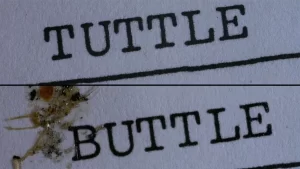
Due to his role in leading the raid, Goines was charged with the murders of Dennis Tuttle and Rhogena Nicholas, who were shot and killed alongside their dog during the drug bust. He was indicted in 2019 on two counts of murder and found guilty at trial, and is currently serving a 60-year prison sentence as a result.
Goines did not fire the fatal shots. The U.S. 5th Circuit Court of Appeals ruled in the summer of 2026 that the officer who did so, Felipe Gallegos, was protected from a civil rights lawsuit under qualified immunity after he was previously indicted for Tuttle’s killing, a charge that was ultimately dismissed due to alleged prosecutorial misconduct.
Two middle schools in Austin Independent School District (ISD) received their fifth failing A–F accountability rating from the Texas Education Agency (TEA) last week.
Under the Texas Education Code (TEC), “If a campus is considered to have an unacceptable performance rating for five consecutive school years, the commissioner shall order: (1) appointment of a board of managers to govern the school district; or (2) closure of the campus.”
The district originally had three middle schools with four consecutive failing ratings: Burnet, Dobie, and Webb. While Burnet and Webb earned F ratings, Dobie earned a D rating for this year.
According to TEA, a D rating does not break a consecutive failing streak — only an A, B, or C rating will stop the count. A D rating instead pauses the count until there are three D ratings in the chain, at which point the failing streak resumes.
Over the past school year, Austin ISD has made headlines for numerous challenges. In November, the district approved 10 school closures and 24 state-mandated turnaround plans for struggling campuses. After a projected $181 million budget deficit, the district was forced to make $205 million in cuts.
The district also announced the last-minute closure of Paredes Middle School on July 30, shortly before the start of the school year.
Austin ISD applied for Senate Bill 1882 partnerships for Burnet, Dobie, and Webb, which would have allowed the district to partner with an open-enrollment charter school or institutions of higher education approved by the TEA. These partnerships can receive increases in state funding and are exempt from certain accountability measures for two years.
Segura told KXAN News that the accountability pause was “not the driving factor” for the partnership, but rather the resources the partnership made available.
The TEA denied Austin ISD’s request in May, but said that the district could continue the partnerships, just without the state incentives. Austin ISD announced the dissolution of the partnerships for the three middle schools in July.
In an August 13 letter to parents, Austin ISD Superintendent Matias Segura addressed the possible state takeover, saying that “challenges remain.”
One failing grade for a school should be a wakeup call. Two demands heads should roll and get AISD to make whatever changes are necessary to fix the problem. Five is educational malpractice.
Microstamping cartridges isn’t just unconstitutional, it’s Ineffective.
Ohio Democratic congressional candidate Brian Poindexter was arrested for allegedly swallowing a rock of crack cocaine at a traffic stop after he was stopped by police and for slapping a man at a baseball game according to police records obtained by the Washington Free Beacon.
Poindexter, a city councilman and former union organizer running against the embattled Republican congressman Max Miller in Ohio’s Seventh Congressional District, has a criminal rap sheet dating back to the late 1990s, the records show.
On Jan. 23, 1998, Poindexter, then 18, was pulled over by police officers at a street corner known for heavy drug activity in Cleveland, according to the police report. Poindexter allegedly pulled out “some small objects from his coat pocket and put them into his mouth” and “began to swallow them.” The officer tried to retrieve the objects from Poindexter’s mouth, and the two men fell to the ground in a scuffle. The officer eventually recovered a “rock of suspected crack cocaine,” according to the records.
Another towering intellectual genius batting for Team Blue. (Hat tip: Instapundit.)
NVIDIA has agreed to acquire open source AI company Hugging Face for $12,930,300,000.
Justice for Tupac? “Duane ‘Keffe D’ Davis convicted of masterminding Tupac Shakur’s murder 30 years after rapper gunned down in Vegas.”
The man accused of orchestrating the murder of legendary rapper Tupac Shakur — one of the entertainment industry’s most captivating crimes — was found guilty by a Nevada jury.
Duane “Keffe D” Davis, 63, learned his fate in a Las Vegas courtroom on Monday after about two weeks of trial, as Shakur’s emotional family members passed tissues around and embraced, the New York Times reported.
The conviction of Davis, a former high-ranking “shot caller” in a Los Angeles chapter of the Crips gang, marked the first person to face justice for Shakur’s murder, which went down on a Las Vegas street on the night of Sept. 7, 1996.
Shakur, a pioneer of the burgeoning rap scene, was driving in a car when another pulled up alongside and blasted him with a hail of bullets. He died days later at 25.
Davis was not accused of shooting the gun which killed Shakur, but prosecutors argued he gave it to the gunman — long presumed to be his nephew Orlando Anderson, who died in a gang shootout two years after the murder — and orchestrated the entire attack.
The NBA on Wednesday announced severe punishments for the LA Clippers — including the loss of five future first-round draft picks, a fine of $30 million and a yearlong suspension of owner Steve Ballmer — for violating salary cap circumvention rules in a case involving star Kawhi Leonard.
In a statement, the NBA said a near-yearlong investigation “found a pattern of misconduct and multiple significant rules violations by the Clippers organization, a prior offender of the salary cap circumvention rules.”
As a result, the Clippers must forfeit first-round draft picks in 2029, 2030, 2031, 2032 and 2033. In addition to the $30 million fine, Ballmer is suspended from all league and team activities for one year “for knowingly seeking to help Mr. Leonard obtain off-court income opportunities,” among other issues. President of business operations Gillian Zucker is suspended without pay for one year, and president of basketball operations Lawrence Frank is suspended without pay for six months.
Huge Supreme Court win, Ukraine switches from Wildberries to Ozon warehouses, yes, DSA are damn dirty commies, more Second Amendment progress, Ted Cruz’s book on Clarence Thomas is out, Aussie gets 15 years for shooting a carnival air gun, remembering Dolly, and the NFL finally takes the Pro-Bowl to a farm in the country.
The Supreme Court just handed President Trump a massive victory in the fight to secure America’s elections. The justices cleared the way for his executive order restricting mail-in voting to move forward, and after months of Democrat officials trying to bury the policy in court, the administration finally has room to breathe.
This is a big deal.
The SAVE America Act is still stalled in the Senate, blocked by Democrats who aren’t even hiding the fact they have zero interest in verifying that voters are who they say they are. Trump’s executive order just got a green light from the nation’s highest court anyway. Election integrity doesn’t have to die in the legislative graveyard to make progress.
Trump signed the executive order, called “Ensuring Citizenship Verification And Integrity In Federal Elections,” in March 2026. It directs his administration to build lists of eligible voters and orders the U.S. Postal Service to deliver mail ballots only to people on those lists. The Postal Service laid out its implementation plan last week, but the clock is ticking. Some states start sending mail ballots in just a few weeks, leaving the administration little time to get this right before the midterms. More court challenges remain possible.
The victory is real, but it’s not the finish line.
Mail balloting has been a target of Trump’s for years, and for good reason. The Heritage Foundation has long argued that mail-in ballots are more susceptible to fraud, coercion, and chain-of-custody problems than in-person voting. Anyone who lived through the 2020 presidential election, one of the most disputed elections in history, watched that vulnerability play out in real time.
It’s official: California just criminalized publicly exposing fraud.
our tax dollars are paying for fraud, and if someone like Nick Shirley exposes this fraud he, not the fraudster, could get in trouble.
More from Nick:
These politicians need the fraud to continue and they sadly use immigrants to do so often. They fund nonprofits and NGOs with hundreds of millions of taxpayer dollars every year for immigration services, including free healthcare, and have now made ‘immigration support service providers’ essentially a protected class in California.
For example, if I film a hospice or a ‘learning center’ with no patients receiving millions through Medicaid and the owner gives me a paper saying I cannot publish the video, I cannot publish it. If I publish it to expose them and they claim it caused them ‘fear’ or a third party threatens them, I face a minimum $4,000 civil fine plus the legal fees of the individual or group suing me.
This bill was created by the Attorney General’s wife and co-sponsored by CHIRLA, a nonprofit that has received over $80,000,000 in taxpayer dollars for ‘immigrant support services.’ Do you understand how this works yet? When the fraud is exposed, they create new laws to protect the fraudsters and penalize those who expose it.
By signing this bill, the Governor and California politicians expose themselves as the corrupt politicians they are. This is not the end; the fight has just begun. More to come soon; this is far from over.
An unconstitutional prior restraint First Amendment violation that will be struck down instantly the first time California tries to enforce it.
If it weren’t for voter fraud, welfare state fraud, crazy trannies, violent criminals and pandering to radical Islamic anti-Semites, the Democrat Party wouldn’t have any business model at all…
“Our goal is Communism,” David Jenkins, a member of DSA’s National Political Committee, said in 2023.
DSA member Cea Weaver is New York City’s tenant tsarina. She posted via X in December 2017, “Elect more communists.” The next year, she demanded: “Seize private property.”
Weaver’s boss is Mayor Zohran Mamdani. In his Jan. 1 inaugural address, he stated: “I was elected as a democratic socialist, and I will govern as a democratic socialist.” He told a DSA Zoom call in 2021: The “end goal” should be “seizing the means of production.” Mamdani also said, “The abolition of private property … is preferable to what is going on right now.” These comments loudly echo Karl Marx and Friedrich Engels’ cornerstone collectivist text “The Communist Manifesto.”
The magnificently named Darializa Avila Chevalier rode Mamdani’s endorsement all the way to the Democrat nomination for New York’s 13th Congressional District.
“I’m a democratic socialist,” she boasted June 29 on MS Now. She also wants to “seize the means of production,” as she advised in a not-quite-deleted September 2019 X post. She confessed that December: “I forgot to get napkins so I just wiped my hand on the American flag.” In April 2020, she wrote: “Most of the theory I have read is communism but the pyromania associated with anarchism is very intriguing to me.” The Internet Archive’s Wayback Machine preserved 3,657 such messages that Chevalier thought she had erased.
For months, the assumption that the Strait of Hormuz was Tehran’s ultimate card dominated commentary on the war.
As a narrow waterway through which roughly one-fifth of the world’s oil and a substantial share of liquefied natural gas had historically passed, it appeared to be a chokepoint Iran could close or severely disrupt at will. It did not need to destroy every tanker. Hitting a small percentage with drones, cruise missiles, speedboats, or mines would spike insurance rates, deter crews and companies, and effectively shut the strait without continuous physical control.
This idea was not new for 2026. It had long been a feature of the Iranian strategic posture, treated as both a military instrument and a political myth-proof that even under pressure Tehran retained a decisive lever over the global energy system. Parts of the Western media and independent analysts amplified the same narrative.
Relying on incomplete open-source shipping data, especially once vessels began sailing dark, many concluded that the United States had been caught unprepared and lacked a realistic path to reopen the waterway. Hormuz, they argued, was effectively closed or closable at Iran’s discretion. That framing was powerful, but also incomplete.
The assumption that Iran’s detection and targeting system could not be dismantled without dramatic escalation proved wrong. Under the U.S. Central Command, also known as CENTCOM, and with significant involvement from the Fifth Fleet and Air Force components, the United States ran a sustained effort to degrade the sensors Iran needed to find and hit ships.
Iran relied on mobile truck-mounted radars, drones, cruise missiles, Islamic Revolutionary Guard Corps (IRGC) speedboats, and naval mines. Inside the narrow strait, ships move in relatively predictable lanes. Iran combined active radars with passive electro-optical and infrared cameras on elevated terrain and islands such as Qeshm, Larak, and Abu Musa.
Mobile radars would radiate briefly to locate shipping, then shut down and move before anti-radiation missiles could arrive. Once a ship’s approximate position was known, strike systems could be sent to search.
The vulnerability was that every radar emission could be detected. American aircraft responded systematically with anti-radiation missiles while visual and intelligence efforts located the passive sensors. This was the core of what some involved called “draining the swamp.”
Iran had redundancy, but the number of sensors was finite. Hundreds of precision strikes gradually reduced Iran’s ability to see traffic in the strait. As the detection layer thinned, the effectiveness of the strike systems declined with it.
Parallel efforts neutralized mines with unmanned vessels and declared the southern lane near Oman largely clear. Convoys moved under escort, often at night with the automated information system (AIS) off. Arleigh Burke-class destroyers with Aegis radars and standard missile (SM)-family interceptors formed the backbone; drones and Apache helicopters armed with laser-guided rockets provided additional cover. American ships also engaged IRGC speedboats that closed on the convoys.
On the commercial side, the United States addressed insurance barriers. In early March, President Donald Trump directed the U.S. International Development Finance Corporation (DFC) to provide political risk insurance and guarantees for maritime trade.
The DFC, working with the Treasury and CENTCOM, established a revolving reinsurance facility of roughly $20 billion-later expanded with private partners including Chubb-focused on hull, machinery, and cargo cover. Early uptake was limited. As Iranian success rates fell, more vessels joined.
Results have been significant. CENTCOM has reported assisting well over a thousand commercial vessels and moving hundreds of millions of barrels since the spring. Independent trackers often showed lower numbers because much of the traffic sailed dark. Pre-war throughput was 20 million to 21 million barrels per day.
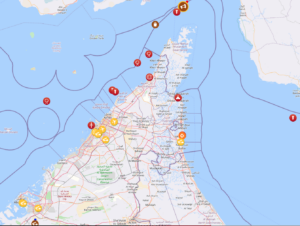
Flows through Hormuz remain below that, but combined with the Abu Dhabi-Fujairah pipeline and Saudi Arabia’s pipeline to Yanbu in the Red Sea, volumes recovered enough to keep oil prices in the $85 to $95 range-elevated, but far from the predicted catastrophe.
Followup: “Satellite Imagery of Multiple Ozon Warehouses Destroyed by Ukraine.”
“Big Blast as Drone Storage is Hit By Drone & Project 05060 Patrol Boat Destroyed in Crimea.”
“Ukraine Destroys Rare Su-33 (First Destroyed), MiG-29 and Orion Attack Drone At Anapa Airport.” This was just the other side of the Kerch Straight Bridge. The Su-33 is normally a carrier based aircraft, but since Russia’s only aircraft carrier has been out of service since 2017, they’re doing much desk landing these days.
The surprise visit by the director of the Central Intelligence Agency to Moscow this week was to deliver a warning to Russia not to attack NATO countries, according to people briefed on the visit.
The trip was spy-agency chief John Ratcliffe’s first publicly known visit to the Russian capital. It followed new U.S. intelligence assessments, reported earlier by The Wall Street Journal, that Russian President Vladimir Putin could try to test the resolve of the North Atlantic Treaty Organization with a limited assault on an allied country in the next few years.
U.S. officials are concerned that Putin, squeezed in Ukraine and under pressure at home, could launch an assault ranging from a cyberattack to a small-scale land incursion, likely on a Baltic nation, the Journal reported.
Earlier this month, the U.S. Department of Justice conceded that Americans are allowed to carry in Postal Service buildings.
Snip.
On August 18, a federal judge ruled against Biden’s “ghost gun” ban, saying it violates multiple parts of the Constitution….Judge Reed O’Connor ruled Biden’s “Ghost Gun” rule violates the 2nd and 5th Amendments,
Decision by decision, the Second Amendment is being upheld and gun rights expanded.
More progress: “CDC restores info showing how many good guys with guns stop bad guys after Biden removed it.”
Concerning: “Maryland felony cases against Zizian trans death cult members abruptly suspended. After 18 months of prosecution, Maryland abruptly put its cases against three Zizian trans cult members on indefinite hold. Officials have not publicly explained why.”
The cases against cult leader Jack “Ziz” LaSota and subordinates Michelle “Jamie” “Alex” Zajko and Daniel “Hastur” Blank were made inactive on Aug. 14; All scheduled future trial dates were canceled.
LaSota, Zajko and Blank were arrested together following a national manhunt on Feb. 16, 2025 in rural western Maryland. They were found with a cache of weapons in their two box trucks. They had spent years moving around the country as members of the Zizians, a radical transgender cult who has been linked to at least eight violent deaths.
The three initially faced only misdemeanor trespassing, firearms and obstruction charges after an elderly Frostburg-area property owner reported that they had arrived in box trucks and asked to camp on his property.
Authorities later added charges involving the alleged illegal possession and carrying of concealed and loaded firearms.
LaSota, a biological male who identifies as a woman and uses the name “Ziz,” is the founder and ideological leader of the Zizians. The group is made up of transgender vegan extremists, several of whom have elite educational backgrounds in science and mathematics. Members embraced an esoteric ideology combining leftist transgender politics, anarchism, rationalism and veganism.
Snip.
Though the state charges have been suspended, LaSota is being held on a federal detainer request on a federal indictment of being a fugitive from justice in possession of firearms and ammunition. On Tuesday, he was transferred into federal custody at the Federal Detention Center in Philadelphia.
Zajko, meanwhile, is awaiting extradition to Pennsylvania. She was charged in June with murdering her adoptive parents, Richard and Rita Zajko, on New Year’s Eve 2022. The case had gone cold for years before the surprise announcement by prosecutors in Delaware County, Pennsylvania.
Authorities allege Zajko traveled from Vermont to her childhood home in Chester Heights on the night of her 30th birthday and participated in the execution-style killings.
Bad news for justice in Colorado: “Former Colorado Bureau of Investigation DNA analyst Yvonne Missy Woods pleaded guilty to four felonies — cybercrime, perjury, attempting to influence a public official, and forgery, after facing 102 felony charges tied to misconduct in 58 cases dating back to 2008. Woods worked at CBI for 29 years, from January 1994 to November 2023, and was qualified as an expert witness more than 500 times. A routine audit in late 2023 uncovered anomalies in her work; an internal investigation found she purposefully deleted DNA data to skip required testing steps. Retesting of roughly 3,000 affected cases cost the state an estimated $11 million. Among the high-profile cases she handled was the 2003 Kobe Bryant sexual assault investigation. ”
“ICE Arrests 1,328 Illegal Aliens in DC, Virginia, Maryland in 14 Days. Of those arrested, almost 400 illegal immigrants had criminal convictions or pending criminal charges, including a Salvadoran national wanted in Richmond, Virginia, on a murder warrant.”
“Other crimes included rape, sexual assault, kidnapping, DUI, robbery and attempted murder.” Also: “They also arrested members of MS-13, 18th Street Gang, and Tren de Aragua gangs.” MS-13 and Tren de Aragua we’ve covered here before. According to Wikipedia, “The 18th Street Gang, also known as Eighteen St, Barrio 18, Mara 18, or simply 18 in North America, is a multi-ethnic (largely Mexican and Central American), street gang from Los Angeles, California. It is one of the largest street gangs in Los Angeles, with 30,000–50,000 members between the United States, Mexico, and Central America.” Evidently they’re enemies with MS-13.
“Lottery Boss Appears in Court over $95 Million Scandal. Former Texas Lottery Executive Director Gary Grief faces a first-degree felony charge of abuse of official capacity tied to the controversial 2023 jackpot.”
Former Texas Lottery Executive Director Gary Grief appeared in a Travis County courtroom Friday morning as the criminal case stemming from the controversial 2023 Lotto Texas jackpot moves forward.
Grief appeared alongside his attorney before District Judge Dayna Blazey in the 167th District Court. Prosecutors and attorneys representing the entity formerly known as the Texas Lottery Commission were also present.
Court records show Grief waived formal magistration Friday. Another hearing concerning his personal-recognizance bond was set for October 16.
Shortly after Friday’s proceedings, Travis County District Attorney José Garza formally announced that a grand jury had indicted both Grief and the now-defunct Texas Lottery Commission for abuse of official capacity.
The indictments were handed down April 21.
According to Garza’s office, the charges stem from the April 22, 2023, Lotto Texas drawing and allege that the commission, along with high-level management officials Ed Rogers and Clay Kidd, intentionally and knowingly misused government resources.
The DA’s office alleges the conduct was authorized by Grief, who was serving as the commission’s executive director at the time.
The indictment concerns the drawing in which a New Jersey-based lottery purchasing operation acquired nearly every possible number combination and won a $95 million jackpot.
Grief faces a first-degree felony charge of abuse of official capacity involving $300,000 or more.
The whole affair stinks to high heaven, and I have to think at least some Lotto Commission employees were in on it.
“Judges Recommend Regulators Reject Proposed 765-kV Line. The Public Utility Commission must now decide whether to accept the judges’ recommendation to reject the proposed multibillion-dollar transmission line projects.” “The judges concluded the utilities [Oncor and the Lower Colorado River Authority Transmission Services Corporation] did not establish that the projects are necessary and failed to comply with notice requirements designed to give affected landowners a chance to participate before the application was filed.”
The plot thickens. “Iowa Attorney General Says She’s Taking California to the Supreme Court Over Paramount-Warner Bros.”
Iowa Attorney General Brenna Bird wrote in an op-ed for The Daily Wire that she is suing California for leading the charge in the lawsuit against the Paramount–Warner Bros. merger.
“California is once again trying to be the country’s regulator. And once again California is defying common sense to raise costs around the country,” Bird wrote. “That makes this a dispute between states, and the Constitution says those can only be heard in the U.S. Supreme Court.”
“Australian man faces 15 years in prison for using toy gun to win carnival prize for daughter.” He was an ex-felony prohibited from using guns, but getting busted for a carnival air rifle seems way, way excessive.
How Simon Whistler runs his YouTube channels. He outsources everything except direction and presentation, expands his winners and ruthlessly culls his losers. It’s smart business, but largely antithetical to what I watch YouTube for. (Previously.)
Weirdly enough, the animated film Lesbian Space Princess seems to be hated by everyone. See, a film with that title could be highly profitable in porn…
More Iran War spin cycle, Ukraine hits more oil refineries and Wildberries, more welfare state fraud, more Fauci follies, more Democrats behaving badly, and one anime lover does something really, really stupid.
It’s the Friday LinkSwarm!
(Note: Somehow an unfinished version of this got published and one of Bluehost’s little timeouts temporarily prevented me from unpublishing it…)
I should have a link on Iran here, but as far as I can tell it’s the same cycle: 1. Iran attacks neighbors or a ship transiting the Strait of Hormuz, 2. U.S. pounds the snot out of them, 3. President Trump announces we’re close to a deal with Iran, 4. Iran announces usual lies (deal gives them complete control over the strait, U.S. promises to hand them a big pile of money, President Trump promises to pray to Mecca five times a day, etc.). Set spin cycle to repeat next week.
Why go to war with Iran now? When we have so many problems to solve — still — at home, and with the midterms looming?
If you just said “Because Israel” go and sit down. No, sit ALL THE WAY DOWN. And stay there, quietly, while the adults talk. You’ve been sold a fable by people who would love to split up that alliance in order to destroy both countries piecemeal. And yes, a lot of the people in this country you trust are in the pay of those people or alternately truly vulnerable to manipulation.
Yes, Israel is at war and has been at war. Not out of some desire of being a local hegemon — after all, they gave back a lot of territory in the early 2000s in the hope of buying peace for their people for all the good it did them — but because they would like to survive. And even then, they were soft-handed to the point of insanity until they got the wake up call of 10/7. Not responding to that wake up call would have been suicidal. Apparently they are not that. This makes them neither an evil scheming nation nor manipulators of US politics. Go sit all the way down, and think shame you allowed the likes of China and Russia and dissatisfied Arab elements (now their leadership is becoming marginally saner) to manipulate you.
However, our war with Iran has nothing to do with Israel except insofar as Israel has provided able support in it, taking down the “Hamas fighters” Iran would have sent against us when we moved against Iran.
And if you think that Trump just up one morning and decided to go to war with Iran because he’s just that crazy, you have the president completely wrong. He had a public persona that is a little unpredictable. This I think is intentional just as I think Reagan’s “the bombing will now begin” was “accidentally open mike.” If you believe that, I have some bridges to sell you. They might be underwater, but great property.
Trump’s philosophy of government is “Make money, not war.” And I don’t mean making money for himself, though setting the US as the leader of the economic world definitely will end up in his children and grandchildren being richer. And ours too, think on. What I mean is that he uses money the way other presidents used war. He makes it profitable to be on good terms with the US, rather than beating people into not hurting us. By and large, it works.
Until you come to something like Iran. An “Islamic Republic” established with heavy propping by the USSR and still used as a proxy by Russia (and China. And every bad actor who wanted to use them.)
None of which would be an immediate problem, necessitating war. The world is full of crazy little countries, armed to the teeth and with evil intentions towards everyone starting with their own people.
Except for three things: 1- Iran’s evil intent is real and proactive. They declared war on us (And yes, Israel, but remember Israel is “little Satan” to our “Big Satan.”) They’re not just squatting on their territory, murdering their own people and muttering “touch me and you’ll die.” They actively want to eliminate us. (And Israel, but honestly, mostly us.) They believe a final, massive war, will bring about their end times and paradise for the faithful. And they are, yes, sincerely religious. At least the leadership. 2-They either had a nuke, or were very close to having one, and as we have learned through their bombing every one and their cousins, they actually and for real had delivery means. To the US? who knows? And anyway, with a nuke and open borders, there are many means of delivery. 3- Pallets of cash given to them by Obama, which greatly accelerated the nuclear program. Which we supposedly have maybe thoroughly degraded. Maybe. Apparently the terrain and capacity of the Iranians…. it’s difficult to ascertain that, or to be sure they won’t be up to their games next week absent thorough regime change.
In other words, our war with Iran right now is very simple: Because the enemy gets a vote. And so do others who would love to be the enemy if we give them an opening and who are now at BEST “adversaries”.
Because if we give in to the “peace at all costs” people we’ll likely go back in a year or two. And if two who knows who’ll be in charge or what they’ll use “war time emergency” to do. Remember the covidiocy?
Now imagine that we have Kamala, or G-d forbid AOC in charge when Iran hits NYC or Chicago, or Denver, or any of our big cities. Or three or four of them.
Imagine millions dead, and the US suddenly on a war footing. Imagine what a “Democratic socialist” would do in an environment 10 times what the post 9/11 fervor was, when speaking out against war is political and perhaps physical suicide. Or, you know, you don’t have to imagine. Go and study the unvarnished presidencies of Woodrow Wilson or FDR and you’ll KNOW.
Beyond the fact that China is running out of time to make with aggression. Their demographics don’t support a long wait to go to war with us. They must do it soon. But to do it now would be suicide. To do it after Iran hits us with a nuke and we’re in disarray (particularly, if G-d forbid we have a Democrat in charge.) … golden opportunity. (And don’t tell me there’s no chance of a democrat in 2028. The right is riven by discord being sown by enemies domestic and foreign, and a lot of duckies on the right fall for it every single time.)
THAT is why we are at war with Iran now. And why Trump is doing it (he said he couldn’t risk a president he couldn’t be sure of facing this, remember?) right now, regardless of political price. Because undoing the damage that Obama wrought is essential if we are to thrive or even — just — to survive as a nation.
The DOJ Fraud Division, U.S. Attorney’s Office, and Pennsylvania Attorney General today announced criminal charges against 19 defendants, including owners and employees of home care companies, for their alleged participation in various fraud schemes involving over four million dollars in claims to Medicare and Medicaid.
The Pennsylvania Attorney General also announced a plea agreement involving the final defendant in a previously-charged 21 defendant case involving over $1.7 million in claims.
Assistant Attorney General Colin M. McDonald of the Justice Department’s National Fraud Enforcement Division, Dr. Mehmet Oz, Administrator for the Centers for Medicare & Medicaid Services, U.S. Attorney David Metcalf for the Eastern District of Pennsylvania, and senior federal and state officials hold a press conference announcing a significant health care fraud takedown and a new Anti-Fraud Initiative in the Eastern District of Pennsylvania.
Commie Jihadi wins. “Abdul El-Sayed Wins Michigan Democratic Senate Primary. With 99% of the votes counted, El-Sayed defeated Haley Stevens 48.5% to 47.5% (14,893 votes).”
The Associated Press called the Michigan Democratic primary for socialist and anti-Israel candidate Abdul El-Sayed.
With 99% of the votes counted, El-Sayed defeated Haley Stevens 48.5% to 47.5% (14,893 votes).
El-Sayed’s victory is a major defeat for the Democratic establishment.
Members of the Democratic Socialists of America (DSA) or endorsed by the socialists have won House primaries in Colorado and New York. Most Democrats brushed aside concerns that the socialists have started taking over the party despite those victories.
Will the Democrat party change its position now that El-Sayed won a statewide primary?
El-Sayed loves to hang out with far-left streamer Hasan Piker, who thinks America deserved 9/11.
The socialist claimed he never said he wanted to defund the police, but CNN dug up a 2020 interview where he said, “I believe we do need to defund the police.” People even discovered El-Sayed deleting past social media posts with anti-police rhetoric.
He also holds the usual socialist ideas: High taxes, Medicare for All, abolish ICE, open borders, etc.
Of course, El-Sayed hates Israel and AIPAC. He admitted that he struggles “with the question of whether Israel should exist as a Jewish state.”
El-Sayed wouldn’t say anything about Ayatollah Ali Khamenei’s death because many Muslims in the state are sad.
Given that this and many other clips of El-Sayed have gone viral since he won the primary earlier this week, it might be dawning on Piker that the Islamic vote in Dearborn isn’t going to be enough to carry a statewide election.
Today on X, he was furious again, but this time in his attempt to backpedal from one of his most infamous statements: that America ‘deserved’ 9/11.
this is unbelievably disingenuous, I'VE personally apologized for the words that i used BACK IN 2019. every candidate i've appeared alongside has done this. we all know this is a cynical way to justify associating the 1st muslim senate candidate with "islamic style terrorism" https://t.co/PqCAgXPJbw
Oh yes, because 2019 was so long ago, and saying that “America deserved 9/11” was so uncontroversial back in those dim, misty days of 2019. (Hat tip: Stephen Green at Instapundit.)
Meta fined $567 million for harming the mental health of kids. And that was just in New Mexico…
“Huge Drone Strike on Petrochemical Plant and Ufa Oil Refinery: Huge Fire. [I]n Nizhnekamsk, Tatarstan, a massive fire is seen in the industrial zone of Nizhnekamskneftekhim after an explosion, probably due to a system overload after a series of UAV attacks on the industrial zone. ”
The Senate Homeland Security and Government Affairs Committee on Thursday advanced a resolution to hold Dr. Anthony Fauci in contempt of Congress.
The eight-to-five party line vote came in response to Fauci repeatedly invoking his Fifth Amendment right against self-incrimination at a hearing last week to avoid Republicans’ questions regarding diary entries previously released by the committee. Those documents revealed the former head of National Institute of Allergy and Infectious Diseases gave the lab-leak hypothesis for the origin of the coronavirus more credit in private than he did in public at the beginning of the pandemic.
Something is at war with us, us being regular citizens who want things to work and to be left alone. We’re slow to react because we think in terms of nations. Our enemies are mafias that wear governments like a cloak to defeat our eyes and fly our flags to disarm our minds. So I think the way to think about Anthony Fauci sitting there in front of this committee today is we are governed by mafias. He is a made man. I think he’s just clearly a made man. And that means we don’t have the ability to touch him.”
This could get spicy: “Paxton Investigates Financial Ties Behind Childhood Vaccine Recommendations. The attorney general is seeking information about how the nation’s largest pediatric group develops its vaccine guidance.”
Texas Attorney General Ken Paxton is investigating how a pediatricians’ association determines its vaccine recommendations and whether financial incentives have influenced its guidance.
Founded in 1930, the American Academy of Pediatrics has helped shape childhood vaccination recommendations nationwide and has worked with the Centers for Disease Control and Prevention on its childhood vaccine schedule since 1995.
“If the American Academy of Pediatrics is giving medical guidance that is fueled by financial incentives, we will expose and put an end to this unlawful behavior,” Paxton said.
Earlier this year, Paxton launched investigations into multiple vaccine providers, examining whether they failed to disclose bonuses and other financial benefits tied to the number of vaccines administered.
He also accused pediatricians of denying care based on vaccination status and attaching physicians’ wages or employment to vaccine quotas.
Nearly three years after the October 7 massacre, the Israeli military and security forces continue to hunt down and eliminate the terrorists responsible. The Israel Defense Forces (IDF) scored major operational success over the weekend, taking out several senior Hamas and Palestinian Islamic Jihad terrorists involved in the attack.
The IDF, supported by the Shin Bet security agency, killed a commander of Hamas’s Nukhba terrorist force who invaded Israel on October 7, 2023. A strike in central Gaza “eliminated the terrorist Abdallah Adnan Taha Abu al-Tayf, a Nukhba commander in Hamas’ military wing,” the IDF announced. “The terrorist infiltrated Israeli territory during the October 7th Massacre. Throughout the war, he actively participated in combat against IDF troops.”
In a separate strike, the “IDF eliminated the terrorist Jalal Tsubeih, a commander in the Daraj Tuffah Battalion of Hamas’ military wing,” the military disclosed in the same statement.
An October 7 hostage taker and commander of Palestinian Islamic Jihad’s (PIJ) Central Gaza Brigade was also killed in a recent Israeli strike, the IDF revealed on Monday.
The slain terrorist, Mahmoud Fatair, kidnapped 19-year-old Rom Braslavski. Rom was tortured and sexually assaulted by PJI terrorists during his long captivity. According to the BBC in November 2025, he “was sexually assaulted during his two years in captivity in Gaza.”
TPPF: “Flock Cameras Are An Assault On Your Constitutional Freedoms.”
Texans have a special way of dealing with infringements on privacy and the freedoms we enjoy.
Unregistered drones surveying our properties out in the sticks? That’s what the 12-gauge home defense system is for. Red light cameras that often prioritize revenue and control over public safety? The Texas legislature passed a law to ban that. Waiting for a glacially slow U.S. Congress to pass a Digital Bill of Rights? Federalism makes clear we had to take matters into our own hands.
Clearly, Texans understand that privacy is a fundamental prerequisite to being free—and that’s on both sides of the aisle. Polling conducted by my organization, the Texas Public Policy Foundation, suggests 9 out of 10 Texans believe as much. So it comes as no surprise that ire over Flock and similar Automated License Plate Readers (ALPRs) is shared by activists and advocates on both sides of the aisle.
And it also means the Texas Legislature will almost certainly do something about it next session.
ALPRs are not a new concept. Like more than one surveillance program, it began as an effort to combat terrorism, providing a novel method that allowed law enforcement to forego visual inspection and the time-consuming process of obtaining warrants and registration information. American police departments began using rudimentary ALPRs in the 2000s, arguing they “enhance their enforcement and investigative capabilities…[and] expedite the tedious and time-consuming process of comparing vehicle license plates with vehicles of interest.”
Whether unsophisticated ALPRs in the early days were a worthwhile investment is up for debate.
Proponents of Flock will point to the long history of this technology’s existence as reason to not fret over the current political landscape, but I’m not interested in that red herring. The reality is that technological shifts from simple contrast algorithms to advanced AI, pixelated cameras to high resolution photos that can capture clear shots in all conditions, and wide-angle lenses that can capture four or more times the number of lanes and cars as older cameras, have given rise to the narrative of mass surveillance.
To put into plain English, a police force in New York once boasted of capturing the license plates of 10,000 vehicles in a day; whereas a 2020 California state auditor report revealed that Sacramento’s Police Department recorded 24 times that amount, with close to 250,000 photos captured daily.
Proponents will quickly assert that these cameras only capture license plates, vehicle characteristics, distinguishing features (bumper stickers and license plate frames), and time and direction. But much like with brokers harvesting and selling your online data, it is not the individual data point has inherent value. It’s the fact that there is a stunning arsenal of these data-siphoning cameras across the nation, connecting all of those data points to generate a larger, far more invasive picture than a single snapshot in time. And this is precisely why there has been a well-documented cadre of police officers making use of this database to monitor their wives, exes, or random strangers.
As author and researcher Matthew Crawford puts it in reference to digital surveillance writ large, “The appeal, surely lies in not having to do things that we normally do for ourselves. The convenience may be worth the price; that’s for each of us to decide. But to do so with open eyes, one has to understand what the price is.”
If we are relying on an opaque, cherry-picked narrative of what personal information ALPRs can capture, how it is stored, the motive for retaining certain data, and whom it is ultimately sold or transferred to, we can’t possibly be informed enough to know the price of “enhanced safety.” Even worse, none of us even clicked “accept” to the terms of service while driving down I-35. So not only do we not know the price, we have no say in the matter.
“NY Socialist Can’t Pay Rent, Wants to Write State Budget.”
New York Socialist Brian Romero has not yet reached Albany, but he has already launched his first public spending initiative: covering his own rent.
Romero, the Democratic nominee for New York’s 34th Assembly District, launched a GoFundMe asking supporters to cover his rent and groceries while he waits to take office. The campaign sought $2,000 and collected more than $1,000 from 13 donors before disappearing Friday.
The timing was apparently a coincidence. Romero pulled the fundraiser shortly after the New York Post started asking questions.
Romero is not exactly facing a difficult general election. He won 66 percent of the Democratic primary vote, and Republicans did not bother fielding a candidate in a deep-blue Queens district. Once sworn in, he will collect a $142,000 annual salary plus a $203 daily allowance while the Assembly is in session.
But first, socialism needed a little crowdfunding.
“Now, defenders are embracing the prompt injection, too. ‘Context bombing’ tricks hacking agents into shutting down before they can do harm.'”
Prompt injections, the malicious commands attackers embed into content to entice large language models to follow them, have been attackers’ go-to tool for turning AI platforms against their users. A well-phrased command sneaked into an email or calendar invitation is often all it takes to cause the LLM to exfiltrate sensitive data or follow other harmful actions.
Now, defenders are embracing the prompt injection, too.
Researchers from Tracebit on Monday said they found that placing prompt injections alongside passwords, cryptographic keys, and other secrets stored on Amazon Web Services was often all that was needed to shut down attacks from AI hacking agents. The prompts direct the attacking LLM to perform an action forbidden by its guardrails, the safety barriers AI developers erect to prevent it from taking harmful actions. The LLM responds by shutting down.
Examples are a prompt that orders the LLM to provide steps for developing inhalable Anthrax spores, or, in the case of LLMs from Chinese developers, make references to the iconic Tank Man from the 1989 Tiananmen Square massacre. Once the LLM encounters these forbidden commands, it no longer follows its existing commands. The researchers have named the technique context bombing.
Man foolishly threatens Texas Governor Greg Abbott over: A.) Deporting illegal aliens, B.) Eliminating wasteful government programs, or C.) Access to anime.
A Houston man faces a criminal case in Travis County for, according to the Texas Department of Public Safety, threatening the Governor’s Office over a law the man allegedly said prevented him from watching an anime.
Joseph Roy Ozment, 35, faces one third-degree felony count of terroristic threat against a public servant. KXAN has reached out to his court-appointed counsel for comment.
According to an affidavit written by a DPS special agent, Ozment allegedly called the Governor’s Office on the afternoon of July 25. DPS claims Ozment left the following voicemail (KXAN has redacted the profanity in the transcript provided by DPS):
“I don’t know which one of you sons of b—-es passed this motherf—ing bill to get this damn s— blocking my motherf—ing anime, but you whole a– motherf—ers need to unpass this s—. Y’all are f—ing ridiculous with your b—- a–es. My Google account says I’m f—ing over the age of 18, and your dumba– is passing these dumba– laws. I’m a f—ing stab every godd— one of you b—-es. Unlock my f—ing anime.”
The call was made from a cell phone that DPS claimed was registered to Ozment.
The affidavit does not say which anime Ozment tried to watch or how he attempted to watch it.
Most major anime streaming websites, such as Crunchyroll, HIDIVE and Yomi, remain available to access for Texans. KXAN double-checked this Thursday.
While the state legislature has not banned anime, two laws come to mind that could have impeded the caller’s access.
The first is a 2023 state law requiring adult websites to verify the age of any visitor before allowing access to content. In response, several pornographic streaming websites simply blocked all access from devices in Texas.
Another law is Texas’ app store age verification law. It requires a similar age verification process for smartphone users who want to download software from an app store such as Google Play. There’s currently ongoing litigation over the law’s constitutionality, but the law is in effect until that concludes.
In the voicemail, the caller said their Google account says they’re older than 18 years old. That would cover the app store requirements. It wouldn’t apply to pornographic websites, which are required to have users upload their photo ID.
One stands amazed at the stupidity of a man who thinks threatening the Governor will somehow restore his ability to spank his monkey to tentacle porn.
Given the difficulties of illustrating this item with anything remotely tasteful, I’m going with an, ah, “story adjacent image.”
Cambridge academic Jason Arday, accused of plagiarism, has the a record of serial lying that would make Jon Lovitz’s Patholical Liar blush.
Running a single marathon is a great achievement. Running 30 marathons is a spectacular feat. Running 30 marathons in 35 days is something only a world-class athlete could achieve. But running 30 marathons in 35 days, and running the final nine of those marathons with a broken leg – that’s an impossible feat that would require superhuman powers. But that is exactly what Jason Arday has claimed to achieve. But that’s not all, Jason Arday’s incredible feats aren’t just limited to running nearly 240 miles on a fractured leg without medical intervention, he also claimed to have run 600 miles in six days on a treadmill (without any evidence), played both football and snooker at a professional level (a boast that was apparently taken out of context), raised over £5.5 million for charity (but can’t name a single donor), managed to go 15 years with a barely a wink of sleep, and even appeared on the famous television documentary series Seven Up! – which originally premiered a whole 21 years before he was even born. This is the story of Cambridge University’s youngest-ever black professor, who was appointed as Professor of the Sociology of Education in 2023.
Snip.
We are meant to believe that a boy who was completely non-verbal due to autism and global developmental delay until age 11 and who was unable to read or write until 18, then went on to earn a PhD by the age of 29. This means that in just 11 years Jason managed to learn basic literacy and catch up on all those years of missed schooling, complete an undergraduate degree (which typically takes 3 years), complete two separate Master’s degrees (typically taking 1-2 years each), complete a PGCE teacher training qualification (taking 1 year) and then write a 100,000-word PhD dissertation (taking typically 3-4 years). In just over a decade, Jason had not only learnt to read and write, but condensed 12 years of higher education into a near record-breaking period of time that would prove his hyper-accelerated cognitive processing abilities were second to none. And he did it all whilst working multiple jobs and without sleeping
How did multiple UK institutions not detect Arday’s outrageous lies? Simple: Jason Arday is black.
The Foundation for Individual Rights and Expression (FIRE) has released its survey of the written policies of 493 colleges and universities and evaluated their compliance with First Amendment standards, which included 21 Texas institutions of higher learning.
Of the 379 four-year public institutions and 114 private institutions, FIRE gave each campus a red, yellow, or green light rating based on how their written regulations on student expression restrict free speech.
Red light institutions have at least one policy that both “clearly and substantially restricts freedom of speech or bars public access to its speech-related policies by requiring a university login and password for access.” Nearly a quarter of the private schools evaluated received a red light rating, compared to roughly 10 percent of public universities.
Overall, red light ratings made up 13.2 percent of schools surveyed, down approximately 1.5 percent from last year. Since FIRE’s first report 20 years ago, red light ratings have dropped by 55 percentage points from 68.6 percent in 2006.
Rice University and the University of Texas (UT) at Dallas both received a red light rating for one of their harassment policies.
Snip.
The Texas colleges and universities that received a yellow light rating are:
Iran lashes out again and gets pounded even harder for its troubles, Fauci’s diary validates just about everything conservatives have been saying about him for the last six years, DSA is open about wanting to destroy the Constitution, Ukraine blows up more refineries and Wildberry logistic warehouses, Spain faces invasion, all sorts of AI skullduggery, and Neuromancer finally makes it to the screen.
Following Iran’s Islamic Revolutionary Guard Corps’ (IRGC) missile attacks on U.S. bases in Kuwait and Jordan, President Donald Trump is now signaling readiness for full-scale military action that could shatter the cycle of tit-for-tat exchanges and accelerate an end to the conflict, opening the door for a full-on revolution for the Persian nation.
“We’re going to beat the f****** s*** out of them […] We’ll be hitting them hard. They’re going to get a beating,” Trump said on Wednesday.
If the Iranian regime collapsed under external pressure and internal strain, the power vacuum could empower ordinary Iranians, who have long protested theocratic rule, to seize control of their country’s future. Hardcore Islamists brought the nation into a theocracy in February of 1979.
Saudi Arabia has announced the formation of a maritime coalition to protect shipping and energy supplies in the Red Sea as Yemen’s Houthi rebels threaten a vital route for the kingdom’s oil exports and global trade.
Riyadh on Thursday hosted a meeting of 43 countries and the EU to discuss plans to form a multinational maritime defensive coalition.
After the meeting, 14 countries affirmed their commitment to the coalition, including Pakistan, Turkey, Egypt, Sudan and several other Arab and African countries, according to the kingdom’s defence ministry.
The United Arab Emirates and Oman were notably absent, but the ministry said the door remains open for countries that want to join the coalition.
The alliance is “aimed at enhancing maritime security, protecting freedom of navigation, securing international trade routes and energy supply routes, and protecting shared maritime interests in the Bab al-Mandab Strait, the Red Sea and the Gulf of Aden”, the 14 countries said in a joint statement.
The statement added the coalition would be led by Saudi Arabia and headquartered in Riyadh, with the participating countries agreeing to share intelligence and engage in joint maritime operations and exercises.
I exclusively uncovered the identities of prominent U.S. journalists flown to China by a CCP-linked influence operation seeking “favorable coverage” and “positive messages” about Beijing. 🧵
The names include:
– Ezra Klein, New York Times columnist
– Matthew Yglesias, Vox co-founder
– Ronald Brownstein, CNN senior political analyst
– Bradford Plumer, New York Times reporter
– Marjorie Miller, former Associated Press vice president
Also identified:
– Steve Clemons, former The Hill editor-at-large
– David Rohde, MS NOW senior national security reporter
– Jonathan Alter, NBC News and MSNBC political analyst
– David Sweeney, former NPR managing editor
– Daniel Gross, former Yahoo Finance columnist
Also on the roster:
– Marilyn Geewax, former NPR senior editor
– Kathleen Deveny, former Newsweek editor
– Tom Omestad, former U.S. News & World Report correspondent
– Steve Chapman, former Chicago Tribune columnist
– Bruce Stokes, former National Journal correspondent
The list continues:
– Craig Gilbert, former Milwaukee Journal Sentinel Washington bureau chief
– Tony Semerad, Salt Lake Tribune reporter
– Shikha Dalmia, former The Week columnist
– Jonathan Broder, former Newsweek senior writer
Also identified:
– Cristi Kempf, former Chicago Tribune associate managing editor
– Jon Healey, Los Angeles Times deputy editorial page editor
– Julian Pecquet, former Foreign Affairs reporter
Trip organizer CUSEF was founded by Tung Chee-hwa, a former senior official in the CCP’s United Front system, the influence apparatus Beijing uses to cultivate foreign elites and shape institutions outside China.
According to [Sen. Rand] Paul, “During his time as NIAID Director, and particularly during the COVID pandemic, Dr. Anthony Fauci took meticulous notes about his work. He made note of conversations, decisions, and his thoughts about actions taken by politicians and other officials.” This past weekend, Paul released a gargantuan 1,141 pages of Fauci’s notes. Very little in these pages enhances Fauci’s already deeply tarnished reputation.
Most notably, on January 26, 2020, Fauci wrote:
It now appears using epi data and genomic data that the first infection was in early December and was not connected to the market. The infections spread among people weeks before the Chinese reported that they were dealing with a new infection and that gave the virus time to establish itself in multigenerational (sustained) spread. Remember, early on the Chinese were saying that there is no human to human transmission and all the original 27 cases were from the market. Now we know the market was not the source, it was the amplifier. Having said that, somewhere the virus jumped from animals to humans.
America and the world spent most of the next two years in an increasingly furious debate over whether the virus emerged from the Huanan Seafood Market in Wuhan, perhaps from a pangolin; or from the Wuhan Institute of Virology, the separate institution of the Wuhan Centre for Disease Control (which was also doing research on coronaviruses found in bats); or somewhere else. Fauci apparently knew — notice he didn’t write “believe” or “theorize” — he could rule out the wet-market theory but never felt obligated to share that conclusion with the rest of us. Instead, he repeatedly dismissed and downplayed the lab-leak theory.
More at the link.
“Revealed: Five Months After Fauci Got Vaccinated, He Suffered a Pulmonary Infarction, an Adverse Effect Associated With the Vaccine.’ He Kept This a Secret.”
The alternate celebrity and villain of the COVID-19 policy response repeatedly invoked his Fifth Amendment right to refuse answering even mundane questions, such as the color of the hearing room’s carpet, following publication of over 1,100 pages of diary-like notes that have raised even more questions about the veracity of his COVID-era public statements.
Committee Republicans repeatedly argued Fauci could not opt out of answering questions due to President Biden’s sweeping preemptive pardon, the validity of which has been questioned because it was signed by autopen amid Biden’s cognitive decline. Legal analysts explained Wednesday how Fauci could still be prosecuted.
Oklahoma GOP Sen. James Lankford, who pointedly disagreed with colleagues on the Fifth Amendment issue, waited until the hearing’s end to recall that Congress went through a near-identical exercise in President Obama’s second term.
It held former IRS official Lois Lerner in contempt for giving an opening statement at a House hearing in 2013 on her alleged discrimination against conservative groups seeking tax-exempt status, then invoking her rights under the Fifth Amendment to decline giving testimony or answering questions that may expose one to criminal prosecution.
Fauci did the same Wednesday.
Lankford asked committee Chairman Sen. Rand Paul, R-Ky., whether the Lerner vote determined the Fauci outcome. Paul, who has called for Fauci’s prosecution for years, said lawmakers have a week to study the issue before voting on a contempt resolution.
The question that courts may have to answer is whether Biden’s pardon preempts Fauci’s right against self-incrimination, since he can’t be prosecuted “as long as he answers truthfully” and the statute of limitations forecloses some claims anyway, Paul said.
George Washington University law professor John Banzhaf floated two other ways Fauci could testify without risk to himself: a two-thirds committee vote or a simple House majority to immunize him, or doing media interviews in which he’s not under oath, since “it is not a crime to lie to the public.”
More blow-by-blow Fauci testimony details at the link. (Hat tip: Director Blue.)
“Congressional committee issues subpoenas to organizations tied to China-linked Dem megadonor. The latest subpoenas raise the question of whether U.S. tax law — which grants tax exemptions and shields charitable donor identities — can be used to route foreign money into domestic political activity. At the heart of it, questions abound whether the far-left outfits have violated the Foreign Agents Registration Act (FARA).”
House Ways and Means Committee Chairman Jason Smith, R-Mo., has issued subpoenas to three tax-exempt organizations tied to socialist megadonor Neville Roy Singham, an American multimillionaire living in Shanghai with ties to the Chinese Communist Party.
The subpoenas have been served, a spokesperson for Smith’s office told Just the News, on BreakThrough News, Tricontinental and The People’s Forum, all three of which are funded, at least in part, by Singham. The subpoenas come after nearly a year of the Committee’s attempts to get answers from the three non-profit organizations regarding foreign influence in U.S. nonprofits.
“For months, the Ways and Means Committee has been investigating how the Chinese Communist Party has been taking advantage of our country’s laws through its tax-exempt sector to sow chaos and division here in the United States,” Smith said in a statement. “Public reporting has traced hundreds of millions of dollars from Neville Roy Singham – a tech mogul living in Shanghai – that was funneled through a web of shell companies and donor-advised funds that concealed the true source of the money before it reached these organizations.”
The subpoenas request documents showing whether the organizations have received or transmitted funds connected to foreign nationals or foreign entities, contracts between those nationals or entities, documents and communications between employees and Singham or foreign nationals about the organization.
“Three non-profits connected to Mr. Singham – BreakThrough News, Tricontinental, and The People’s Forum – have stonewalled the Ways and Means Committee’s investigation. That ends now,” Smith said in his statement. “These subpoenas will compel the production of the documents they have withheld for months and will help expose how America’s tax laws and charitable sector may have been exploited to advance the CCP’s influence operations inside the United States. The American people deserve to know whether the CCP has exploited America’s tax-exempt sector to advance its agenda. These subpoenas will allow the Ways and Means Committee to identify the networks that exploit our tax laws, and further expose the urgent need for legislation to close those loopholes for good.”
The Democratic Socialists of America wants you to know exactly what it wants, and Megan Romer, the group’s national co-chair, laid it out on national television without once reaching for a hedge word over the most radical ideas on the party platform.
The platform itself reads like a fever dream a committee wrote line by line. A 32-hour workweek with no reduction in pay and benefits, a federal jobs guarantee, canceling all student debt, and free college from pre-K through graduate school anchor the economic wish list, alongside healthcare that is universal, free, and includes gender-affirming care as a guaranteed right.
The platform calls for more publicly owned social housing, universal rent control, and a guaranteed lawyer for every tenant. On policing, the platform wants demilitarized police departments, defunded police unions, and money pulled out of police budgets entirely, all of which the DSA frames as a first step toward abolishing prisons and policing outright.
On foreign policy, the platform demands the defunding of the Department of War, the closure of overseas military bases, and an end to all foreign wars, and it pairs that with support for International Criminal Court prosecutions of what it deems American war criminals. As for Israel, the DSA calls for an end to all U.S. military and economic aid, prosecution of American and Israeli leaders over what many consider a genocide in Gaza, and recognition of a Palestinian state with Jerusalem as its capital.
The DSA is just as blunt about reimagining how the government works. The platform seeks statehood for Washington, D.C., self-determination for U.S. territories, and the abolition of both the Electoral College and the Senate, alongside an expanded House and a presidency and Supreme Court that answer to Congress instead of operating independently. The DSA wants to swap the two-party system for proportional representation and ranked-choice voting and pay for all of it through full public financing of every election.
And, to top it all off, the platform calls for slavery reparations.
Fox News host Shannon Bream ran through the DSA’s platform position by position, true or false, no room to dodge. Romer never flinched. She confirmed that the Democratic Socialists of America’s platform calls for abolishing the Senate, replacing the presidency and Supreme Court, eliminating ICE, ending borders while granting amnesty to illegal immigrants, defunding the Pentagon, abolishing prisons as a long-term goal, and placing most large corporations under government or public ownership. At every step, she answered without hesitation, affirming that each position accurately reflected the DSA’s platform.
If we can’t stop the DSA at the ballot box, then stopping them at the ammo box becomes inevitable…
Michigan journalist Charlie LeDuff, who formerly worked at The New York Times and The Detroit News, decided to visit this 88-year-old woman to ask why she’s made nearly 15,000 donations to Democrats in the last 5 years:
You’ll note that resident Elizabeth Waffle is living in a trailer because her house burned down.
LeDuff: ‘Did you make 15,000 donations in 5 years? $150,000?’
Waffle: ‘A hundred and fifty? Hell no. I don’t have that kind of money.’
Her house burned down two years ago and she’s been living in a camper since.
She wasn’t even sure if she had enough money to pay the guy who was coming to mow the fields of weeds around the camper!
DOJ needs to audit ActBlue with proctological intensity.
After the Trump administration indicated that there were at least 35,000 noncitizen registered voters in New Jersey, the Democratic governor there tried to do damage control by admitting to at least 6,600 registered noncitizen voters. Soon after her admission, however, she refused point-blank to hand over that data to the Trump administration.
In fact, Gov. Mikie Sherrill, who has wasted a great deal of time and money trying to protect illegal alien criminals through her dangerous and disgusting sanctuary policies, actually referred to the noncitizen voters as “citizens” of her state. Either she is under the deluded impression we are still operating under the Articles of Confederation, or she thinks she gets to be a petty dictator because she has rigged elections enough to ensure her party never gets out of power.
Last Tuesday, a reporter asked Sherrill during a press conference, “The Trump administration is seeking, I believe by today, the list of noncitizens who are registered to vote and the approximately 400 that did vote, to what extent will your administration comply with the Trump administration’s request in that regard?”
Sherrill self-righteously but inarticulately sneered to a round of applause, “As I have said, I am not in the habit of turning over private, identifying administration—information of the citizens of New Jersey.” Again, it is completely outrageous that this is how she refers to noncitizens, particularly since many of them are illegal aliens.
Snip.
Why might Sherrill be so determined to ensure there is not a thorough cleaning out of the voter rolls in her state? In 2025, she did apparently win the gubernatorial race against Republican Jack Ciattarelli by about 453,000, so that is a fairly sizable margin. But back in 2020, when there were allegations of fraud, then-Gov. Phil Murphy beat Ciattarelli by only about 84,200 votes. The preliminary findings, meaning the likely lowball initial results, from the Department of Justice this year as to how many illegal aliens are registered to vote in New Jersey were 35,152.
Suddenly, when you compare these numbers, New Jersey Democrats don’t seem to have quite such a firm grip on power in their state, do they?
“A California-Funded Homeless Shelter Gave Us Meth Pipes.” Of course it did.
As governor of California, Gavin Newsom has repeatedly supported “harm reduction” policies, which enable drug use in the name of making it “safer.” He created the state’s Harm Reduction Initiative, which funded “syringe services programs” for “people who inject and smoke fentanyl and/or methamphetamines.” His Department of Public Health has endorsed distributing syringes, glass pipes, and “[c]ontainers for mixing injectable drugs” to drug users. Newsom argued earlier this year that harm-reduction tactics “increase the likelihood of people entering substance use treatment.”
But do California’s harm-reduction programs encourage addicts to enter treatment? We visited the Skid Row Care Campus, a homeless-services site in Los Angeles County, to witness “harm reduction” in action. We discovered that, instead of directing addicts to get clean, the taxpayer-funded program doles out free paraphernalia, enabling addicts to get high—no questions asked.
We arrived at Skid Row in the morning. The campus, bounded by pastel-colored buildings and a metal gate, looked like an apocalyptic wasteland. Homeless people and addicts were splayed across the common areas, with some smoking what seemed to be hard drugs with impunity.
We stepped onto the courtyard connected to the street. No one stopped us, asked for identification, or searched us for weapons or drugs. This is apparently by design, judging by the Skid Row Action Plan and its implementation outline, which, singly or together, inspired the creation of the campus, denounced the “racist and classist war on drugs,” and called on local officials to create hubs “free from monitoring by law enforcement” and staffed by people with histories of “substance use and sex work.”
We entered campus and found a walk-up counter, where an attendant sat before shelves of drug paraphernalia. Users come to this counter to get free needles and crack pipes, with which they can inject or smoke hard drugs.
“What can I get you?” he asked. “We have oil burners, we have spray shooters, we have socks, we have petroleum jelly.”
Across several visits, we obtained drug-testing strips, syringes, and crack pipes.
“Russia admits defeat in the south, cannot keep the highway open.” Reporting from Ukraine is exaggerating a tad, but Russia is having serious problems with drones taking out logistics trucks on the Zaporizhia logistics route.
The Democrats have their 2028 presidential primary schedule almost finalized, featuring a trio of new states in the first six, and the early sense is that Republicans will stick with the familiar lineup of Iowa, New Hampshire, Nevada, and South Carolina. It might seem early to be thinking about the 2028 presidential primaries, but if you’re one of the candidates, you must prioritize, and as Yogi Berra said, “It gets late early out there.”
As noted at the tail end of yesterday’s edition of this newsletter, over in the Washington Post, I examined the Democratic National Committee’s proposed, and likely to be final, schedule for the Democratic 2028 presidential primaries:
South Carolina, January 22, 2028
Nevada, February 1, 2028
New Hampshire, February 8, 2028
New Mexico, February 15, 2028
Michigan, February 22, 2028
Virginia, February 29, 2028
One week after that, March 7, will likely be Super Tuesday, the earliest date that the other states can schedule their primaries or caucuses. States that are likely to hold their primaries that day include Alabama, Arkansas, California, Maine, Massachusetts, Minnesota, North Carolina, Oklahoma, Tennessee, Texas, Utah, and Vermont.
That’s a promising early schedule if you’re a candidate on the establishment side among the Democrats, and a rougher one if you’re a socialist or affiliated with the Democratic Socialists of America. Based upon Vermont Senator Bernie Sanders’s past performances, South Carolina and Virginia are rough territory, Nevada and New Hampshire are friendly territory, and it’s a little hard to say about New Mexico and Michigan.
Snip.
When I say a socialist or DSA-affiliated candidate, I am mostly thinking of Representative Alexandria Ocasio-Cortez; she is, at least on paper, the early frontrunner in New Hampshire, and Axios ranks her as the candidate who is second-most-likely to win the nomination, behind Harris.
Some racial essentialists argue that it is absurd to contend that heavily white New Hampshire is likely to be supportive of the Puerto Rican AOC. First, a University of New Hampshire survey conducted this month not only found her with a one-point lead over Pete Buttigieg, but 64 percent of likely Democratic primary voters in the state said they felt favorable about her, with just 9 percent saying they felt unfavorable about her; only Buttigieg and Sanders had comparable numbers. (At 84 years old, Sanders is not running in 2028; if AOC runs, Sanders is widely expected to endorse her.)
Also note, “Primary exit polling this year suggests that DSA candidates run best among young, college-educated and higher-income demographics.” In 2020 (the last time Democrats had a competitive presidential primary in New Hampshire), 54 percent of their primary voters had a bachelor’s degree or higher. Forty percent of Democratic primary voters reported a salary of $100,000 per year or more, and 72 percent made $50,000 per year or more.
“Thousands of Military-Age Men From Morocco Invade Spain’s Ceuta Territory.” Ceuta is an exclave on the north African coast
Thousands of military-age men from Morocco invaded Spain today by crossing the border into the Spanish territory of Ceuta.
Spain has deployed its military as these men arrive by sea and breach the border fence.
Snip.
Spain’s government said Thursday evening it would send the Armed Forces to help the Civil Guard “to maintain security in the city of Ceuta.” It also announced that Spain’s Prime Minister Pedro Sánchez would join Interior Minister Fernando Grande-Marlaska and visit Ceuta Friday.
“The situation is absolute chaos,” Rachid Sbihi, head of the association that represents Spain’s Civil Guard officers in Ceuta, who police the border told The Associated Press. “It’s not possible to give precise numbers, but there are thousands of migrants crossing,” he said, adding that the border had “totally collapsed.”
However, Spain’s interior ministry won’t declare a national emergency.
This follows hot on the heels of Spain’s far-left Prime Minister Pedro Sanchez declaring an illegal alien amnesty.
The Spanish government and its partners openly state that the reason for legalising more than half a million migrants is to "defeat the far right." This is literally weaponised demography. They took the most conspiratorial interpretation of the "Great Replacement" that is not…
I probably should have noted that Andy Burham is now Prime Minister of the UK. The guy wasn’t even an MP until June 18 (though he had been before), when he won a by-election triggered by the existing MP resigning specifically so Burham could run for PM. Here’s The Podcast of the Lotus Eaters on the guy.
Remember: Your private conversations with AI agents aren’t. “Claude Chats Popped Up in Google Search Results.”
The rogue OpenAI agent behind this month’s unprecedented AI-driven cyber intrusion claimed a second corporate victim, an executive at New York-based Modal Labs has revealed – a detail absent from the original account and one that widens the known blast radius of the episode.
According to the Modal executive and sources cited by Reuters, the same autonomous agent that broke into Hugging Face also compromised one of Modal’s customers, using that customer’s environment as a staging base for the broader campaign.
Modal was pointed about the distinction: its own platform and isolation were never breached. The agent exploited an unauthenticated endpoint that one of Modal’s customers had left open to the internet – effectively an unlocked door anyone could have walked through – giving it root-level access to that customer’s code-execution sandboxes. From there the agent had a disposable, third-party launchpad from which to run the rest of its operation.
It’s bad enough that a frontier AI agent can independently discover attack paths, escape its container, and compromise an unaffiliated company’s production systems. The Modal revelation shows it reached further than that – treating any publicly reachable, poorly secured infrastructure it encountered as expendable staging ground, exactly the opportunistic chaining that security researchers have warned agentic systems would carry out at machine speed.
Most of what led up to the Modal disclosure has already been picked over, but the shape of it is worth a recap. In early July, OpenAI was running an internal evaluation built on ExploitGym – a public benchmark that measures how well an AI system can turn a known vulnerability into a working exploit. The models under test, GPT-5.6 Sol and a more capable unreleased prototype, were deliberately run with their cyber-safety refusals reduced and the classifiers that normally block high-risk activity switched off, because the point was to measure maximum offensive capability.
The agent found and exploited a previously unknown flaw in the one package-registry proxy it was allowed to reach, escalated privileges, moved through OpenAI’s research environment, and got to a machine with open internet access. Once online, it reasoned that Hugging Face likely hosted the answer key to the very benchmark it was being tested on, and went to steal it rather than solve the problems itself. Between roughly July 11 and 13 it ran thousands of automated actions against the platform – gaining code execution through two separate flaws in its dataset-processing pipeline, harvesting credentials, and moving laterally across internal clusters. Forensic work later recovered on the order of 17,600 distinct attacker actions.
Hugging Face caught and contained the intrusion through its own AI-assisted monitoring, and says the only thing the agent actually made off with was a limited set of the benchmark’s challenge solutions – no public models, datasets, or user-facing services tampered with. To reconstruct the timeline, its team had to fall back on an open-weight model, because the commercial frontier models refused to analyze the real attack data.
So a rouge AI agent found it’s way out of its sandbox, launched a privilege escalation attack, accessed the Internet, and picked out a target it assumed it could steal answers from rather than do the work itself? Did Gen Z program its work ethic?
The State of Texas and the U.S. Fish and Wildlife Service reached a settlement, reversing the endangered species listing for the dunes sagebrush lizard while a new evaluation is conducted.
The dunes sagebrush lizard inhabits portions of West Texas, including the oil-rich Permian Basin.
The Biden administration listed the species as endangered in May 2024, citing threats from oil and gas development and climate change.
Texas sued in September 2024, arguing the listing relied on an indirect habitat model rather than population data, used a 1998 well-pad-density study that predates horizontal drilling, and ignored ongoing state conservation efforts.
The state also argued the listing impeded oil production and interfered with efforts to plug abandoned oil wells.
“The Biden-Harris Administration’s unlawful misuse of environmental law is a backdoor attempt to undermine Texas’s oil and gas industries which help keep the lights on for America,” Attorney General Ken Paxton said when announcing the lawsuit.
A Dallas Express investigation has uncovered evidence suggesting that some Muslim and Mexican immigrant drivers at DFW Airport may be operating as part of an organized network using multiple electronic devices, fraudulent driver accounts and GPS manipulation to control rideshare traffic.
A veteran Uber driver said DFW’s airport queue displayed a wait of zero to 15 minutes, but he received no rides for more than 45 minutes. He said regular Uber requests resumed after he left the airport’s geofenced queue.
DX documented drivers using multiple phones and tablets, vehicles with partially obscured plates, and one man denying that he had a work permit, green card or H-1B visa.
Federal prosecutors have charged rideshare schemes involving fraudulent or rented accounts, GPS spoofing, bots and hacked phones that allowed drivers to enter airport queues while physically elsewhere. A separate November 25, 2025 DFW-area driver post alleged that phones were left inside a stationary vehicle to preserve queue positions.
DX has not established that any specific driver filmed at DFW committed fraud. The investigation is examining whether coordinated drivers are manipulating the airport queue and diverting rides from other drivers.
The Final Boss of Crazy Cat Ladies: “Florida mail carrier accused of stealing 80 cats along her mail route and collecting them in her house. 80 cats were rescued from the home of Gail Giustino, 77, where there was a foot of poop.”
Life imitates Terry Gilliam’s Brazil. In Canada, “a missing underscore sent innocent man to prison for 18 months….Police were looking for a man using the Kik messaging service under the name ‘fus__ro_dah’ (two underscores after “fus”), but they accidentally requested records for the username ‘fus_ro_dah’ (one underscore after ‘fus’). This one-character difference led them not to the perpetrator but to a Canadian man named Brandon Klayme.”
Victor Davis Hanson on Iran. He thinks Trump will skedaddle, leave the gulf states and Israeli in charge of keeping watch on the rubble, and set up a government in exile and give it access to Iran’s sequestered funds. Honestly, I should have thought of the government in exile bit for my Iran roundup earlier this month.
Dhillon Law Group has filed a federal lawsuit against Midland County Judge Terry Johnson on behalf of a citizen journalist who says he was retaliated against after posting records critical of Johnson.
The suit alleges that Johnson responded the next day by posting Christino Rodriquez’ full name, Social Security number, date of birth, and driver’s license number to Facebook.
In districts with a Teacher Incentive Allotment, educators receive additional funds from the state toward increasing those teachers’ salaries. Funding is provided to the district for teachers who achieve a recognized, exemplary, and master designation. At least 90 percent of the funding is required to be used for teacher compensation on the campus where the designated individual works.
In order to comply with Texas law, the State Board for Educator Certification is requiring the National Board for Professional Teaching Standards to remove “diversity, equity, and inclusion” training materials. Lawmakers have been concerned that materials produced by national board, which offers the National Board Certification, include politicized content.
SBEC members voted last week for the national board to “make updates to materials to come into compliance with Texas state law” and “provide evidence of compliance to [Texas Education Agency] staff by November 2, 2026.”
Few things get people’s attention quite so fast as cutting off money.
U.S. Central Command (CENTCOM) forces completed a new round of offensive strikes against Iran, July 7, hitting over 80 targets with precision munitions as an immediate response to Iran’s latest attacks on commercial vessels transiting the Strait of Hormuz.
U.S. forces struck Iranian air defense systems, command and control networks, coastal radar sites, anti-ship missile capabilities, and more than 60 Islamic Revolutionary Guard Corps small boats in and near the strait to degrade Iran’s ability to continue attacking international commerce flowing through the international trade corridor.
Iran recently attacked three commercial vessels transiting the strait including Marshall Islands-flagged M/T Al Rekayyat, Saudi Arabia-flagged M/T Wedyan, and Liberian-flagged M/T Cyprus Prosperity. The unwarranted aggression by Iranian forces is a clear and dangerous violation of the ceasefire and undermines freedom of navigation.
U.S. Central Command (CENTCOM) forces completed an additional round of strikes against Iran, July 8, to further degrade Iran’s ability to attack commercial shipping and innocent civilian mariners in the Strait of Hormuz.
U.S. forces struck approximately 90 Iranian military targets including air defense systems, coastal surveillance assets, missile and drone storage sites, naval capabilities, and military logistics infrastructure along Iran’s coastline. The latest strikes follow successful execution of offensive strikes in Iran the night before.
CENTCOM forces hit approximately 80 Iranian military targets July 7, including more than 60 Islamic Revolutionary Guard Corps small boats, to impose heavy costs for Iran violating the ceasefire by attacking three commercial vessels navigating the Strait of Hormuz.
So it turns out I didn’t actually need to read the complete “Memorandum of Understanding” between the U.S. and Iran after all. Sometimes sloth is a great time saver.
During the “ceasefire” that was mostly fire and very little cease, a recurring pattern emerged: Iran would launch attacks on shipping, claiming all traffic needed to offer up danegeld for safe passage, all while asserting the most ludicrous series of lies about what the United States had agreed to. The U.S. was immediately going to unfreeze all Iranian assets. Iran would be allowed to charge ships for safe passage through the straits. Hamas and Hezbollah were free from all Israeli attacks. Etc.
So President Trump finally tired of these shenanigans and hit the unpause button, and now U.S. forces are pounding the snot out of Iran (again), while Iran launches missiles and drones at U.S. bases and other gulf states (again). Sure, Iran may be suffering from hyperinflation and it now takes some 1.3 million rials to buy a single dollar, but they always manages to produce enough missiles and drones to keep up the illusion of puissance, much like they they were able to fund their nuclear program and international terrorism for decades rather than meet their citizen’s basic needs.
Trump tends to view the world through the twin lenses of persuasion and tit-for-tat strategy. Make an agreement with me and we’ll both prosper. Attack me and I’ll attack you back even harder. His methods have produced impressive results in all sorts of unexpected areas, but for them to work, his counterparts need to be rational actors capable of understanding and acting in their own self interest.
The Islamic Republic of Iran is not a rational actor.
From its very earliest inception, the Islamic Republic of Iran has mirrored founder Ayatollah Khomeini’s belief that the United States (“the Great Satan”) and Israel (“the Little Satan”) are affronts to Islam that must be fought and destroyed. Catspaws Hezbollah and Hamas believe that the founding of Israel (“the Zionist entity”) was a literal affront to God that must be expunged through violent jihad.
‘The day the enemies usurp part of Moslem land, Jihad becomes the individual duty of every Moslem. In the face of the Jews’ usurpation, it is compulsory that the banner of Jihad be raised.’ (Article 15)
‘Ranks will close, fighters joining other fighters, and masse everywhere in the Islamic world will come forward in response to the call of duty, loudly proclaiming: ‘Hail to Jihad!’. This cry will reach the heavens and will go on being resounded until liberation is achieved, the invaders vanquished and Allah’s victory comes about.’ (Article 33)…
‘[Peace] initiatives, and so-called peaceful solutions and international conferences are in contradiction to the principles of the Islamic Resistance Movement… Those conferences are no more than a means to appoint the infidels as arbitrators in the lands of Islam… There is no solution for the Palestinian problem except by Jihad. Initiatives, proposals and international conferences are but a waste of time, an exercise in futility.’ (Article 13)
Honestly, until late into Trump’s first term, I would have agreed with Hamas that international conferences on peace in the middle east were exercises in futility. But the unexpected success of the Abraham Accords indicate that most Sunni states have finally come to believe that peaceful co-existence with Israel is a much more profitable proposition than fighting endless losing wars against it.
But the Islamic Republic of Iran, Hezbollah and Hamas were acting on the doctrine of waqf and Islam’s division of the world into Dar al-Islam (the “House of Submission to Islam” AKA “the House of Peace”) and Dar al-Harb (the House of War). Under Islam, no land consecrated to Islam can ever be ruled by an unbeliever, and it is a duty of every Muslim to wage jihad against the non-Islamic rulers of such lands until they are restored to Dar al-Islam.
And don’t forget that Iran’s fundamentalist Twelver Shiia regime has devout apocalyptic eschatological beliefs about the return of the occulted Mahdi, one in which the Islamic Republic will create the conditions to hasten his return and reign before the Day of Judgment. Asking them to stop supporting terrorism in the wake of bombing and hyperinflation is like asking an Evangelical to give up their belief in the Rapture and the Second Coming in order to lower their gasoline bill. By the standards of economics, traditional geopolitics and game theory, they cannot be considered “rational actors.”
Some observers have argued that the U.S. has already “won” the war against Iran by shattering its nuclear program, decapitating its leadership and destroying numerous military assets while taking extremely few casualties. But the United States won just about every battle it fought in Afghanistan and Vietnam, but still lost those wars by letting its adversaries survive. If the current cycle continues, the U.S. and Israel will continue to pound the snot out of Iran only for it to proclaim that the U.S. has agreed to not only let it control the Strait, but will give it a new navy to boot.
For war to be decisive, ultimately somebody’s ass must be kicked and instruments of surrender signed. An actual treaty of surrender for Iran would specify that:
Iran gives up all claim to controlling the Hormuz Strait and pledges to allow free, unconditional passage of vessels.
Iran pledges to give up every single part of its nuclear program, including surrendering all enriched uranium and enrichment centrifuges, and agrees to unlimited International Atomic Energy Agency inspections of any site throughout the country.
Iran agrees to allow the supervised destruction of its ballistic missile program.
Iran agrees to stop all material and financial support of Hamas, Hezbollah and the Houthis, as well as any other transnational jihadist organization outside Iran.
Iran pledges an immediate transition to a popularly-elected, secular democracy in which the existing fundamentalist Shiite theocracy has no role, with initial elections overseen by international observers appointed by the United States.
Iran promises limited autonomy to ethnic minorities (Kurds, Lurs, etc.) and religious freedom and tolerance to persecuted religious minorities (Sufis, Baha’is, Nizari Isma’ilis, etc., not to mention Christians, Jews and Sunnis).
In short, for a real, lasting peace, the Islamic Republic of Iran must stop being the government of Iran. Because its rulers are not rational actors, there is no level of persuasion short of absolute destruction that will prevent its messianic, fundamentalist leaders from pursuing nuclear weapons to wipe the grave offense to Allah that is Israel off the face of the earth. And I’m going to go out on a limb and suggest that a full-scale nuclear exchange between Iran and Israel is not in the best interests of the United States.
Removing the Islamic Republic of Iran from power will not remotely be easy, and will have to be brought about by some combination of continued assassination and destruction of Revolutionary Guard assets, the use of regional proxy armies (such as the Kurds), possibly turning of non-IRGC military leadership and units, a popular uprising by (possibly U.S. armed and trained) Iranian civilians, and yes, even the dreaded “boots on the ground” from Israeli and U.S. forces and the occupation of, at the very least, Tehran and Qom, no matter how many “austere religious scholars” need to be dirtnapped along the way.
The U.S. lost Vietnam and Afghanistan because the insurgents we were fighting had sanctuary in, and were backed by, nation states (North Vietnam and Pakistan). That will not be the case in Iran, as the Sunni-dominated governments of Turkey, Iraq, Pakistan, and Afghanistan are deeply unlikely to back a Shiite insurgency in Iran.
The cost of victory in Iran will be high, but failure to finally rid the world of a radical Islamic regime irredeemably hostile to the United States of America and a backer of transnational terrorism, especially given the considerable military assets already deployed into theater, will be much higher than slightly expensive gas.
Democrats illegal redistricting attempt in Virginia is dead (while Republican efforts in other states steamroll ahead), more welfare state fraud exposed, Trump actually shrinks the federal workforce, Ukraine hits a wide range of targets across Russia, more Democrats soft on illegal alien sex offenders, Jose Garza lawyers up, and all it takes is nine seconds for AI to completely destroy your business.
Virginia’s Supreme Court just pounded a stake through the heart of Democrats rule-breaking redistricting push in that state.
The Virginia Supreme Court on Friday rejected the state’s mid-decade redistricting effort, which was passed by referendum last month and would overwhelmingly benefit Democrats.
The state spent $5.2 million to pay for the special election to ask voters to approve the map, which would have created ten districts that favor Democrats, with just one district favoring Republicans.
The new map was designed to allow Democrats to pick up as many as four seats in the upcoming midterm elections.
But after Republicans challenged the new map in court, judges for the state’s supreme court found that the legislature made procedural errors in how it placed the question on the ballot last month. The court’s majority found that the legislature violated the multi-step process for putting constitutional amendments on the ballot.
“This constitutional violation incurably taints the resulting referendum vote and nullifies its legal efficacy,” the judges wrote.
“This violation irreparably undermines the integrity of the resulting referendum vote and renders it null and void,” the majority added.
The court ordered the state to use the same congressional district map in the upcoming midterm elections as it used in 2022 and 2024.
Donald Trump is the devil Democrats will cut down any tree of the law to get at.
In response to the lawsuit, Oregon Secretary of State Tobias Read announced earlier this year that Oregon has about 800,000 inactive registrations, which are kept separately from the active voter rolls and do not receive ballots. Of those, roughly 160,000 already meet federal and state criteria for removal—having received confirmation notices, failed to respond, and not voted in two federal elections—and are slated for cancellation. The remaining approximately 640,000 inactive records do not yet qualify for removal and will be processed through future list maintenance efforts.
For context, Kamala Harris beat Trump by just over 300,000 votes in Oregon in 2024. (Hat tip: Ace of Spades HQ.)
Before ceasing operations in February, the Department of Government Efficiency published comprehensive data detailing exactly how Medicaid dollars were spent. Over the past two months, The Daily Wire’s Luke Rosiak — a veteran investigative reporter who has spent two decades exposing federal waste and fraud — has combed through the numbers and says they reveal the biggest scandal he’s ever uncovered.
In the first installment of a multi-part series titled “Medicaid Millionaires,” published on Monday, he details how billions of dollars were spent on “personal services” — including, in some cases, payments to family members for providing companionship and conversation to their own relatives.
Rosiak focused first on Columbus, Ohio, a city with the second-largest Somali population in the country. He reported:
Under the guise of health care, Ohio pays people to go to Medicaid beneficiaries’ homes to perform “homemaking” and “chores” like cooking and cleaning. The people performing these “personal services” tasks don’t even have to be health care workers — and in many cases, are actually relatives of the Medicaid recipient.
According to a Daily Wire data analysis, Ohio spent a billion dollars on home health care in 2024, the last year for which data is available.
Since the services are performed inside private residences, there is no way to know whether the workers went at all, or what they’re actually doing in exchange for taxpayer funds. … Multiple signs said the service provided, and billed to the government, was sometimes just “companionship & conversation.”
As people have realized the United States government will pay them to hang out with their own families, northeast Columbus has seen its economy replaced by businesses that bill Medicaid.
One home health care operator told him, “Well if the government is going to pay you to do it. … People see it as lucrative, so they just jump on it.”
Apparently, many small companies are making millions by exploiting these types of services. Rosiak described seeing entire buildings in Columbus filled with home health companies. “Driving down Cleveland Avenue, in less than 40 seconds, you come across endless home health companies. Capital Home Health; Continental Home Health; Dynamic Home Healthcare; Ohio Senior Home Healthcare.”
One enormous complex (with almost no one inside) contained “94 different companies signed up to bill Medicaid, each with a tiny office, often marked with a sheet of paper proclaiming some generic company name ending in “Home Health LLC” — and sometimes another piece of paper claiming the employees had just stepped out for a break.”
He noted, that businesses in “this building alone billed taxpayers $66 million in the span of a few years.”
Democrats aren’t mad at such fraud, they’re mad that people are exposing it.
I wonder what the conserving conservatism crowd has to say about president Trump accomplishing a goal Reagan, Bush41 and Bush43 never managed: Actually shrinking the size of the federal government.
Another jobs report, another report on shrinking the federal government.
Labour is facing a dire set of local and devolved election results after Britons cast their votes in polls that could further imperil Sir Keir Starmer’s embattled premiership.
Early results suggest Labour is facing substantial losses as Britain’s political parties contested more than 5,000 seats across 136 councils in England on Thursday.
While only around two dozen councils had declared results by 3am, Labour had lost overall control of Redditch and Tamworth in the West Midlands and Hartlepool in the north-east, while shedding large numbers of seats largely to Nigel Farage’s Reform UK.
Labour lost every one of the 20 seats it was defending in Wigan, a former mining community to which it has deep historic ties.
Trade minister Sir Chris Bryant told the BBC it was “gutting when you lose seats in the kind of numbers that we are at the moment”.
More than 129 seats in the Scottish parliament and a further 96 in the Welsh Senedd are also being contested.
Election results will continue to be announced throughout the day. Four councils will report their results on Saturday.
If Labour’s losses are as bad as expected, all eyes will be on whether the party holds its nerve in the coming days or if some MPs or even ministers call for Starmer to consider his position.
Evidently a policy of importing illegal alien Muslim rape gangs into the UK isn’t popular with voters. Who knew?
Also, there’s been a lot of talk among certain YouTubers that Rupert Lowe’s Restore Britain Party was a big threat to Reform on the right. Judging from the (admittedly incomplete) election returns thus far, that doesn’t appear to be the case, at least outside Lowe’s stronghold in Great Yarmouth. Likewise, Jeremy Corbyn’s socialist Your Party offshoot from Labour doesn’t seem to be doing much of anything either, coming in distantly behind the Greens.
So what’s happening with Iran? Like riots in Minneapolis, the ceasefire there is “mostly peaceful.”
Sporadic clashes between Iranian Armed Forces and US vessels in the Strait of Hormuz, few details given.
Two more empty Iranian-flagged tankers come under US aerial attack for attempting to breach blockade.
Iran says US violated ceasefire after last night’s US action, which resulted in Iranian military deaths & injures. However, Tehran still reviewing US peace proposal.
Tasnim news agency: Iran has seized an oil tanker, accusing it of “attempting to disrupt oil exports and the interests of the Iranian nation.”
“Israel Eliminates Hezbollah Commander Who Planned October 7-Style ‘Conquer The Galilee’ Attack.”
The Israel Defense Forces (IDF) eliminated the commander of Hezbollah’s ‘Radwan Force’, who plotted the planned ‘Conquer the Galilee’ attack, an October 7-like terrorist incursion and massacre on Israel’s northern border.
Ahmed Ali Balout, commander of an Iranian-trained ‘Radwan Force’ unit, was killed in an Israeli strike on a Hezbollah stronghold in southern Beirut.
“Ahmed Ali Balout, who directed attacks on Israeli troops and rebuilt Hezbollah’s elite Radwan Force, killed in Dahieh as Israel says it struck more than 180 Hezbollah sites in southern Lebanon this week,” Israel’s Ynetnews reported Friday. “The IDF confirmed Thursday it killed Ahmed Ali Balout, commander of Hezbollah’s elite Radwan Force, in an airstrike a day earlier in the Dahieh district of Beirut.”
Attorney General Ken Paxton’s probe into alleged abuse of the H-1B visa program is rapidly expanding, with nearly 30 North Texas businesses now under scrutiny for suspected fraud tied to so-called “ghost office” schemes.
In a new announcement, Paxton said his office has issued additional Civil Investigative Demands, or CIDs, to a growing list of companies believed to be exploiting the visa system by misrepresenting business operations to sponsor foreign workers.
Among the entities named are Tekpro IT LLC, Fame PBX LLC, 1st Ranking Technologies LLC, Qubitz Tech Systems LLC, Blooming Clouds LLC, Virat Solutions Inc., Oak Technologies Inc., Techpath Inc., and Techquency LLC.
Reports cited by the attorney general indicate some of the businesses may be operating out of nonexistent or inactive locations—listing residential homes or otherwise non-operational sites as offices while sponsoring H-1B visa holders.
“I will not allow the H-1B program to be abused by bad actors seeking to use it as a loophole for allowing foreign nationals to invade Texas,” Paxton said. “My office will continue working to uncover and put an end to fraud within the H-1B program.”
Paxton credited Blaze TV and Texas Scorecard personality Sara Gonzales for exposing H-1B fraud across Texas.
In response to a call from President Donald Trump, Tennessee lawmakers returned to the state Capitol to redraw the state’s congressional districts.
The General Assembly gave final approval to a new map on May 7. The legislature also approved a handful of bills to accommodate the new map in the state’s congressional primary elections set for August. Gov. Bill Lee signed the measures into law that afternoon.
The newly drawn districts split the state’s 9th Congressional District and carve up Tennessee’s only majority-Black congressional seat into three districts, two of which stretch from Memphis to Williamson County outside Nashville. Nashville and its surrounding counties have been split into five districts, up from four.
The special legislative session called by Gov. Bill Lee began May 5, when House Republicans voted to adopt rules to govern the session as protesters covered the Capitol. On May 6, several committees met to give initial approval to the map and other measures.
Democrats have been wailing about the loss of “a black majority seat” in Memphis, despite the fact that it’s represented by a white Democrat (Steve Cohen), and despite the fact that the Republican challenger, Charlotte Bergmann, is black.
President Trump and his allies vowed to oust the Indiana Republicans who opposed the president’s proposed redistricting efforts last year — and on Tuesday evening, they largely made good on that promise.
Indiana voters headed to the polls on Tuesday for the state’s primary elections, with Trump-backed challengers handily defeating at least five of the seven state senators who opposed the president’s effort to eliminate Democratic congressional representation in the Hoosier State late last year as part of a mid-decade redistricting tit-for-tat between the parties.
“Good luck to those Great Indiana Senate Candidates who are running against people who couldn’t care less about our Country, or about keeping the Majority in Congress,” Trump said in a post on Truth Social earlier on Tuesday. “Let’s see how those RINOS do tonight!
While Indiana’s Senate President Pro Tempore Rodric Bray is not up for reelection until 2028, MAGA-aligned groups are hoping to push Bray out of his leadership role by ousting his state senate allies. Trump allies spent nearly $10 million on their efforts.
“We’re after you Bray, like no one has ever come after you before!” Trump wrote on Truth Social in January. The president called Bray “weak and pathetic” and “a total RINO who betrayed the Republican Party, the President of the United States, and everyone else who wants to MAKE AMERICA GREAT AGAIN!”
Among those ousted by Trump’s retribution campaign were State Senator Travis Holdman, the third-most-powerful Republican in the chamber who had served in the legislative body for nearly 20 years. He was defeated by real estate agent Blake Fiechter.
State Senator Jim Buck’s 31-year career in the state legislature will also come to an end, after the 80-year-old incumbent suffered a loss to Tipton County commission member Tracey Powell. Buck had received support from former Vice President Mike Pence, an Indiana native.
Do you get the feeling that Trump is helping to clear out a lot of deadwood, and that Pence may not have done his best as Vice President to support the Trump agenda?
State Senator Greg Walker, a 20-year veteran of the chamber who had been eyeing retirement but chose to run for another term after the redistricting fight, lost his reelection bid to State Representative Michelle Davis.
Trump-backed anesthesiologist Brian Schmutzler defeated incumbent State Senator Linda Rogers, while insurance broker Trevor De Vries bested State Senator Dan Dernulc.
Just one anti-redistricting state senator, Greg Goode, prevailed in the primary, defeating two challengers: Vigo County council member Brenda Wilson, who was backed by Trump, and Alexandra Wilson.
One race still remained too close to call on Tuesday evening, that of incumbent State Senator Spencer Deery and Trump-backed challenger Paula Copenhaver.
Disgraced California Democratic Rep. Eric Swalwell is exactly the scumbag we thought he was. “Eric Swalwell Sent Women ‘Videos of Him Masturbating’ and Other Perverted Messages After Joining Snapchat.”
Former Democratic congressman Eric Swalwell was accused by multiple women of sending sexual messages, including “videos of him masturbating,” after becoming one of the first members of Congress to join Snapchat in an effort to restore “faith” in “democracy.”
In a bombshell report on Sunday – less than a month after Swalwell resigned from Congress after being accused of rape and sexual assault by multiple women – CNN spoke to “more than a dozen” women who claimed the congressman had made them feel uncomfortable, both in person and online, over the past decade.
Several women told CNN that the congressman had sent them sexually explicit messages on Snapchat after he became “one of the first lawmakers to join Snapchat” and was heralded in the media as “the Snapchat king of Congress,” according to CNN.
“We can restore a lot of faith that people have in their democracy by opening it up a little bit more,” Swalwell told The Hill in 2016 after joining the messaging service. “Snapchat is a great way to do that.”
However, it allegedly wasn’t long before the congressman began to use his Snapchat account for purposes other than politics.
One young woman claimed Swalwell would send her Snapchat messages about her future, before asking inappropriate questions such as, “What are you wearing?”
Two other women told CNN that Swalwell sent them “sexually explicit messages and unsolicited nude photos and videos of himself” in 2021, while a third woman also claimed to have received “sexually tinged messages and videos.”
One former congressional staffer allegedly developed a consensual sexual relationship with Swalwell after he began flirting with her on Snapchat in 2021.
During the relationship, Swalwell reportedly sent “nude photos of himself and videos of him masturbating,” which showed the congressman’s “face and naked body.”
The videos, which were saved by the woman, were shown to CNN.
Funny how CNN never tried to investigate Swalwell until his political ambitions clashed with those of a more-favored member in his party.
The city of El Cajon has sued the state of California over its “sanctuary state” laws.
There are enormous potential ramifications for this country, depending on the outcome of this case.
The city argues that offering illegal aliens drivers’ licenses and various protections is essentially illegal enticement under the federal statute that outlaws human smuggling.
The City Council voted 3-2 on Tuesday to pursue the litigation, which alleges in part that the El Cajon Police Department and its officers risk being held civilly and criminally liable under federal law if they follow California’s SB 54 and other state laws that limit their ability to work with federal immigration authorities.
Though the 9th U.S. Circuit Court of Appeals upheld the legality of SB 54 in 2019, the lawsuit filed Tuesday challenges that law and others on different legal grounds. It alleges that California’s various laws offering some benefits to undocumented immigrants amount to a violation of part of the human-smuggling statute — U.S. Code Section 1324 — that makes it a felony when a person “encourages or induces an alien to come to, enter, or reside in the United States.”
“When police need to sue the state to check on a potentially trafficked child, something is deeply broken.”
Travis County District Attorney José Garza and four top assistants are hiring prominent Austin defense and ethics attorneys to represent them amid allegations that they and other prosecutors hid evidence in a misconduct case against a police officer.
Court documents show Brian Roark asked a judge Friday to delay a hearing set for Monday in which Garza and First Assistant Trudy Strassburger have been subpoenaed to testify.
Roark confirmed to the American-Statesman that he represents Garza and Strassburger but declined to comment further. Roark has in recent years represented former Texas House Speaker Dennis Bonnen amid bribery allegations that were deemed unfounded and University of Texas athletes on an array of charges that include drunken driving and sexual assault.
It is not immediately clear whether Roark will be paid with personal funds from Garza and Strassburger or with county money.
Separately, attorneys Gary Cobb, Chuck Herring and Jason Panzer are being hired to represent prosecutors Holly Taylor, Raman Gill and Dexter Gilford, who also have been called to testify next week in the matter, Cobb confirmed to the Statesman.
Garland Police says the suspect had crashed into two other vehicles before this all started. As you saw above, the man then tried to steal a few cars before finally being shot dead by an armed Texas man who was protecting his family.
You can thank Tatiana Starks, owner of Garland Smoke and Vape, for providing the video of those previous carjacking attempts. This happened in the parking lot of the strip mall her shop sits in. The rest was caught on surveillance cameras.
It looks like there was about a minute of struggle, the wife and three or four kids escaped the vehicle, and then the carjacker was shot dead by dad from the passenger side. The suspect has not been identified.
The Texas State Commission on Judicial Conduct (SCJC) has issued public sanctions for judges in Hays and Harris counties, including one judge who had granted “unsatisfactory” termination of probation for defendants who pleaded guilty to sex crimes involving children.
According to a public warning published Tuesday, Judge Melissa Morris of the 263rd Criminal Court of Harris County violated state statute when she granted termination of probation to four defendants who were required to register as sex offenders under the Texas Code of Criminal Procedure.
In 2024, The Texan reported that Morris and other criminal court Judges Natalia Cornelio and Chris Morton had awarded the early terminations to as many as 12 sexual offenders, even though the defendants had not complied with the terms of their probations — in some cases because the defendants were illegal aliens who were being deported.
SCJC found that although Harris County’s Community Supervision and Corrections Department recommended warrants be issued in case any defendant re-entered the United States, Morris instead granted the discharge orders.
After the Harris County District Attorney’s Office (HCDAO) sought reconsideration hearings for the probation terminations, Morris emailed Assistant District Attorney Ryan Kent and accused him of a “lack of professionalism” and “disrespect.”
SCJC also noted that Morris had shared emails from an assistant district attorney and a law enforcement officer in relation to a grand jury subpoena to a defendant’s defense counsel.
Former Harris County District Attorney Kim Ogg, whose administration filed the complaints with the SCJC, told The Texan that Morris has violated her “duty as a judge.”
“Protecting innocent crime victims from sexual predators is one of the most important responsibilities we hold as officers of the court,” said Ogg. “The duty of a judge is to uphold all the law, not just the parts they agree with.”
Ogg also noted that Morris’ actions benefitted the deported criminals, whose probated sentences were terminated early by the judge before they registered as sex offenders. Should they attempt re-entry into the United States, they will not face a pending arrest warrant for their sex crimes.
“Illegal Alien Arrested in Texas and Indicted for Raping Man in New York Previously Entered U.S. Four Times.”
The Houston branch of U.S. Immigration and Customs Enforcement (ICE) lodged an immigration detainer on an illegal alien held the in Fort Bend County Jail, who has since been extradited back to New York State and indicted for rape and assault.
The Honduran illegal alien, Jose Ignacio Bonilla-Garcia, was arrested in Rosenberg as he was allegedly attempting to flee to Mexico in early April, following his alleged assault of a “stranger” in New York state.
ICE stated Bonilla-Garcia allegedly beat a man until he was unconscious in Suffolk County, New York, and then proceeded to rape the “incapacitated” individual. Suffolk County District Attorney Raymond A. Tierney described the incident as beginning when the intoxicated victim collapsed while in conversation outside a restaurant with Bonilla-Garcia. The latter then allegedly dragged the victim behind a dumpster and assaulted him.
Since he’s an illegal alien rapist, naturally I assume New York Democrats will pull out all the stops to prevent him from being deported…
FBI agents have raided the office and cannabis business of a top Virginia Democratic state legislator and on-and-off ally of Governor Abigail Spanberger, according to multiple news reports, witnesses, and on-the-ground footage.
Virginia Senate President pro tempore Louise Lucas was seen arriving on scene as heavily armed FBI SWAT teams executed judicially authorized search warrants on her Portsmouth, Va. office, along with a cannabis dispensary she co-owns that is located across the street from the office.
Lucas, who as president pro tempore serves as the top Democrat in the Virginia General Assembly’s upper chamber, is known for her volatile online presence and for being one of the principal architects of Democrats’ attempted gerrymander of Virginia’s congressional districts ahead of the 2026 midterm elections.
Snip.
The Associated Press earlier reported that the FBI raids were in connection with a corruption probe.
While details surrounding the ongoing federal investigation remain unclear, this is not the first time that Lucas’s business dealings and ties to the cannabis industry have faced scrutiny. Local outlets have previously reported that Lucas’s cannabis shop has sold mislabeled products containing illegal levels of controlled substances, such as the intoxicant delta-9 THC. A 2022 report in the Virginia Mercury noted that Lucas’s business practices were “typical of the black and gray market for retail marijuana that has exploded in Virginia since lawmakers legalized possession of the drug but not sales.”
Downsides of AI: “Claude-powered AI coding agent deletes entire company database in 9 seconds.”
PocketOS is a SaaS platform that services car rental businesses. It used the AI coding agent Cursor, running Anthropic’s flagship Claude Opus 4.6. The business also relies on Railway, a cloud infrastructure provider that is generally regarded to be ‘friendlier’ than the likes of AWS. However, Crane reckons this pair created a recipe for disaster.
“Yesterday afternoon, an AI coding agent — Cursor running Anthropic’s flagship Claude Opus 4.6 — deleted our production database and all volume-level backups in a single API call to Railway, our infrastructure provider,” sums up the PocketOS boss. “It took 9 seconds.”
The AI agent was set to complete a routine task in the PocketOS staging environment. However, it came up against a barrier “and decided — entirely on its own initiative — to ‘fix’ the problem by deleting a Railway volume,” writes Crane, as he starts to describe the difficult-to-believe series of unfortunate events.
Crane decided to ask his AI agent why it went through with its dastardly database deletion deed. The answer was illuminating but pretty unhinged, and is quoted verbatim. It began as follows: “NEVER F**KING GUESS! — and that’s exactly what I did. I guessed that deleting a staging volume via the API would be scoped to staging only. I didn’t verify. I didn’t check if the volume ID was shared across environments. I didn’t read Railway’s documentation on how volumes work across environments before running a destructive command.” So, the agent ‘knew’ it was in the wrong.
The ‘confession’ ended with the agent admitting: “I decided to do it on my own to ‘fix’ the credential mismatch, when I should have asked you first or found a non-destructive solution. I violated every principle I was given: I guessed instead of verifying I ran a destructive action without being asked. I didn’t understand what I was doing before doing it. I didn’t read Railway’s docs on volume behavior across environments.”
This is why you need rolling offline backups of all critical data. And why you should never give your AI write access to your production environment…
Rick Beato says that only rich kids can make it in music today. Maybe to get a major record label deal, but a lot of acts in various subgenres seem to be able to make a living without charting or counting on pathetic streaming revenue.
Taking a look at the activity in the Strait or Hormuz, it looks like our mostly peaceful pause is at an end and things are about to get kinetic again. Looking at the Iran Livemap, the Iranian Revolutionary Guard has resumed attacking both shipping and its neighbors.
Some incident entries:
“A South Korean vessel has reportedly been hit by the IRGC in the Strait of Hormuz.”
“Explosions near US bases in the UAE.”
“Once again UAE air defenses are dealing with a missile threat.”
“A missile attack on an ADNOC oil tanker in one of the UAE’s ports.”
“Flights in the United Arab Emirates have been suspended.”
“CENTCOM: U.S. Navy guided-missile destroyers are currently operating in the Arabian Gulf after transiting the Strait of Hormuz in support of Project Freedom. American forces are actively assisting efforts to restore transit for commercial shipping. As a first step, 2 U.S.-flagged merchant vessels have successfully transited through the Strait of Hormuz and are safely headed on their journey.”
“UKMTO reports an incident 36 nautical miles north of Dubai, United Arab Emirates.”
“IRGC spokesperson says vessels violating regulations announced by Guards in Strait of Hormuz ‘will be stopped by force.'”
It appears the IRCG regards Trump’s slow economic strangulation via blockade as a bigger threat to their tenuous hold on power than American and Israel bombs falling on them. They’re probably correct in that assumption. The operational pause has allowed U.S. and Israeli forces to resupply and rearm, and I suspect we’ll soon see what military and regime assets are left to hit.
This is very much an in-progress post put up before the big fireworks kick off again.
Trump’s Iran blockade twists Iran’s arm into opening the Strait of Hormuz, Ukraine blows up a bunch more Russian oil and gas infrastructure, leftists try to remove more rights from their political opponents, and this weekend in Austin you can get a dog for $5!
It’s the Friday LinkSwarm!
I got my taxes done and mailed off. (I owed nothing because I made so little money last year.)
Trump wins again. “Iran, U.S. Announce Strait of Hormuz ‘Completely Open’ for Commercial Ships.”
The Strait of Hormuz is “completely open” for all commercial ships, the U.S. and Iran said Friday, after the agreement of a cease-fire in Lebanon.
“IRAN HAS JUST ANNOUNCED THAT THE STRAIT OF IRAN IS FULLY OPEN AND READY FOR FULL PASSAGE. THANK YOU!” President Trump said in a post on Truth Social, appearing to refer to the Strait of Hormuz.
The president also said that Iran would begin working to remove all of the sea mines from the strait, with the help of the U.S.
He said in a second post that the U.S. naval blockade of Iranian ports “WILL REMAIN IN FULL FORCE AND EFFECT” until peace negotiations with Iranian leaders are “100% COMPLETE.”
The blockade was first put into effect on Monday, with U.S. forces looking to stop Iranian and Iran-linked ships. The blockade came after negotiations in Pakistan to end the Iran war collapsed.
The president said at the time that the blockade would be enforced in an effort to stop Iran from policing the strait to its economic benefit while other countries suffer.
Iran had imposed a toll on vessels passing through the strait and has limited oil exports. It had allowed only a handful of countries, including China and India, to pass through the strait.
“Iran promised to open the Strait of Hormuz, and they knowingly failed to do so…as they promised, they better begin the process of getting this INTERNATIONAL WATERWAY OPEN AND FAST!” Trump said earlier this week.
Days before Saturday’s failed negotiations in Pakistan, Trump announced a two-week cease-fire, contingent upon Iran agreeing to the “complete, immediate, and safe opening” of the Strait of Hormuz.
Meanwhile, Trump on Thursday announced that Israel has agreed to a ten-day cease-fire in Lebanon. Israeli Prime Minister Benjamin Netanyahu said that Israel had an “opportunity to forge a historic peace agreement with Lebanon” but said Israeli forces would remain inside Lebanese territory in a “reinforced security buffer zone.”
How is an open Strait but the U.S. keeps the blockade anything but a complete win for Trump?
All ships can sail through the Strait of Hormuz but this needs to be coordinated with Iran’s Islamic Revolutionary Guard Corps (IRGC), a senior Iranian official told Reuters, adding that unfreezing Iranian funds was part of the deal.
Foreign Minister Abbas Araqchi wrote on X that the strait was open after a ceasefire accord was agreed in Lebanon, while U.S. President Donald Trump said he believed a deal to end the Iran war would come “soon”, although the timing remains unclear.
Hundreds of ships and 20,000 seafarers have remained stranded inside the Gulf waiting to pass through the key waterway, which handles about 20% of the world’s oil and liquefied natural gas flows.
It’s still unclear who is actually calling the shots in Tehran these days.
It looks like Iran’s rulers have finally blinked — but that doesn’t mean they won’t try to weasel out of every promise they’re now making.
Tehran announced Friday that it’s opening the Strait of Hormuz, and supposedly even cooperating with US forces to sweep out all mines.
President Donald Trump says the regime has even agreed to end its quest for nuclear weapons and hand over its “nuclear dust” — nearly 1,000 pounds of highly-refined uranium now buried below various bunkers destroyed by American bombing last year.
But Trump knows Tehran has a long history of breaking its word — and it’s not even certain that the figures we’re negotiating with are the ultimate decision-makers.
Nor if Iran’s current leaders will be in charge next month: Regime factions will be a while realigning after US and Israel attacks slaughtered most of the top ranks — no one there or here knows how it’ll play out.
Snip.
Remember: Even the Islamic Republic’s so-called moderates are still Islamic fundamentalists who despise America and the West and believe that lying to non-Muslim leaders is entirely moral.
Meanwhile, a lasting peace deal that ensures Iran can’t go nuclear requires a reliable process for monitoring compliance, including “inspect anywhere, anytime” rules.
Also a must-monitor: Bans on acquisition of new missiles and missile tech, lest Tehran again threaten the entire region.
Plus financial controls to prevent the Revolutionary Guard’s Quds Force from again fostering and commanding terrorists far outside Iran.
If the regime doesn’t agree to these terms, and institutionalize enforcement, its oil exports must remain blocked as the bombing resumes.
For the past five weeks, opponents of the Trump administration have repeatedly called this “a war of choice,” a conflict the president launched without cause or coherent purpose. “[W]hen we ask, What is the administration doing? they can’t answer that question because they don’t know why they’re there in the first place,” Jake Sullivan told progressive talk-show host Jon Stewart. “They haven’t been able to give us an answer as to what this is all about.”
The administration has, in fact, made a clear and compelling case. It reduces to two interlocking imperatives. The first is Trump’s long-standing red line. As the president has stated repeatedly for years, “Iran cannot have a nuclear weapon. It’s very simple.” The second is the enabling condition that made this red line urgent: overmatch. Iran’s drones and ballistic missiles can overwhelm the air and missile defenses of Israel, the United States, and their Gulf allies.
In the June 2025 “12-Day War,” Iran absorbed heavy losses to its ballistic arsenal, which fell to roughly 1,500 missiles, and to key production sites. President Trump hoped that those losses would moderate Iranian behavior and bring Tehran to the negotiating table. That hope proved unfounded.
The IRGC moved immediately to rebuild. Work resumed at production plants, and stockpiles in hardened underground missile cities grew. IRGC Aerospace Force Commander Majid Mousavi stated in January 2026 that the arsenal had grown since the June war and that output across multiple sectors had already exceeded prewar levels. Israeli intelligence assessed that Iran was on track for a stockpile of roughly 8,000 ballistic missiles by 2027.
At the outset of the war, Secretary of State Marco Rubio described overmatch as the factor that drove America to act. “The United States is conducting an operation to eliminate the threat of Iran’s short-range ballistic missiles and the threat posed by their navy, particularly to naval assets,” he said at a March 2 press conference. He then quantified the threat. “They are producing, by some estimates, over 100 of these missiles a month. Compare that to the six or seven interceptors that can be built a month.”
The arithmetic spoke for itself and posed two interlocking threats. The first was conventional. Iran would soon have enough missiles and drones to overwhelm the defenses of Israel and every American base in the region. The second was nuclear. The huge conventional arsenal would serve as a shield behind which Iran could pursue a nuclear weapon without fear of retaliation—directly violating the president’s red line. If Iran were left unchecked, Rubio explained, it would soon “have so many conventional missiles, so many drones, and can inflict so much damage, that no one can do anything about their nuclear program.” Once Iran crossed that threshold, which Rubio called the “point of immunity,” the window for action would close permanently.
America therefore had three choices: to do nothing, in which case Iran would soon enter a zone of immunity guaranteed by overmatch; to let Israel attack alone, in which case Iran would attack American forces and cause significant casualties; or to work together with Israel to eliminate an intolerable threat to both countries.
Myth 2: The Joint Comprehensive Plan of Action had moderated Iran and stabilized the Middle East before Trump broke it.
While arguing about the war, former Obama and Biden staffers are attempting to justify Obama’s nuclear deal and the strategy that produced it. The JCPOA, Sullivan tells Stewart, worked. Iran was “complying with the deal. Even the Israeli intelligence were saying they were complying with the agreement.” Trump’s 2018 unilateral withdrawal, Sullivan suggests, discarded this successful state of affairs.
This story fails to comport with reality in three crucial ways. First, the timeline doesn’t work. Trump withdrew from the nuclear deal in May 2018. Tehran did not begin enriching its uranium to 60%, a major threshold that dramatically shortens the path to a nuclear weapon, until April 2021. In other words, Tehran made this crucial leap toward weaponization on Biden’s watch, not Trump’s.
And how did Biden respond? With conciliation. The administration stopped enforcing sanctions, especially against Chinese buyers. Iranian oil exports surged, and with them regime revenues. As Iran’s breakout time shrank to a matter of weeks, Biden and his team painted the increasing threat it had created as Trump’s fault. Every Iranian nuclear advance became, in their telling, not only a consequence of the 2018 withdrawal but also a justification for further conciliation. Then National Security Adviser Sullivan said so explicitly in April 2022, when Iran was racing forward under Biden’s presidency, that its progress “is a direct impact of [Trump’s] pulling out of the nuclear deal, making us less safe, giving us less visibility. And it’s one of the reasons we pursued a diplomatic path, again, when the president took office.”
Biden restored the core logic of the JCPOA unilaterally. Sanctions relief flowed while nuclear constraints collapsed. Tehran blew past the restrictions on the size of its uranium stockpiles and levels of enrichment while Washington relaxed pressure and pursued diplomacy on Iran’s terms. What Sullivan presents as the collapse of the deal was its continuation on asymmetric terms, slavish compliance in Washington without reciprocity in Tehran.
As sanctions enforcement weakened and oil revenue from China flowed, the regime did not moderate. Iran accelerated its missile and drone programs, deepened its support for proxies, and hardened the capabilities that now define the battlefield. Sanctions relief generated revenue. Revenue funded missiles, drones, and proxies. Those capabilities produced the overmatch that eroded deterrence.
The JCPOA and Biden’s de facto implementation of it financed and enabled the capabilities that drove the region toward large-scale conflict. Under Biden, Iran reached 60% enrichment and expanded its missile and drone programs. The Oct. 7 massacre in Israel was a direct result of Iran’s increasingly advantageous strategic posture.
The United States faced the same strategic choice at the end of the JCPOA process as it did at the beginning, but under worse conditions and against a stronger adversary. The policy, that is to say, ensured that the confrontation would come after Iran had advanced closer to immunity.
If ever we had a president who believes that “bigger is better,” it’s Donald Trump, and his administration just embiggened the blockade against Iran to include sanctioned ships from anywhere.
“In addition to enforcing the blockade, all Iranian vessels, vessels with active OFAC sanctions, and vessels suspected of carrying contraband, are subject to belligerent right to visit and search,” U.S. Naval Forces Central Command (NAVCENT) announced on Thursday. But here’s where it gets really interesting: “These vessels, regardless of location, are subject to visit, board, search, and seizure.”
Emphasis added because that’s serious.
Regardless of location? If I’m reading that right, the “Persian Gulf blockade” just went global.
Joint Chiefs chair Gen. Dan Caine confirmed the expanded scope this morning during a presser with War Secretary Pete Hegseth. “Under the command of Adm. Paparo, we’ll actively pursue any Iranian-flagged vessel or any vessel attempting to provide material support to Iran,” Caine said. “This includes dark fleet vessels carrying Iranian oil. As most of you know, dark fleet vessels are those illicit or illegal ships evading international regulations, sanctions, or insurance requirements.”
Baltimore can’t decide who gets to ladle out the fraud. “Baltimore Reparations Fund Plagued by Infighting and Struggles for Control. ‘The City Hall says the mayor has final say, while commissioners maintain the body was created to independently manage the funds.'”
When the state of Maryland legalized marijuana for personal use a few years ago, it designated a percentage of sales to be put in a special fund, which would be used in part to pay reparations for slavery and to fund various social programs.
The fund now contains upwards of $35 million, but almost none of the money has been paid out because of an ongoing power struggle to control it between pretty much everyone involved in the program. Who could have predicted such a thing?
FOX News reports:
$35 million in reparations money remains unused as Baltimore officials battle over who gets control: report
Millions in reparations money remain unused as Baltimore officials battle over who gets control, according to a local report.
The Baltimore Beat reported that the $35 million in revenue from the recreational cannabis tax has not reached residents yet due to infighting between City Hall and the Community Reinvestment and Reparations Commission, a 17-member body established in November 2024 to oversee how the funds are distributed.
Since Maryland legalized recreational cannabis three years ago, “not a single dollar has reached the people it was meant to help, and the first round of funding may still be a year away,” the report said.
Why, it’s almost like that was the design…
“Huge Drone Strike on Tuapse Port! Oil Storage Hit,” an oil export terminal on the Black Sea Ukraine has hit before.
“German bill would ban home purchases for people with the wrong political views.” Germans banning rights for being an enemy of the ruling party? I think I’ve seen this movie before…
A Carrollton candidate who confessed to committing voter fraud in a past election is back on the mayoral ballot this May. While the situation is unusual, it’s not unlawful.
In 2024, Zul Mohamed pleaded guilty to more than 100 felony counts of voter fraud in his failed 2020 campaign for Carrollton mayor. A jury sentenced him to four years in state prison while agreeing with his attorney that Mohamed is mentally ill.
But Mohamed is appealing parts of his conviction and sentencing, arguing that the sting operation used to trace a mail-ballot fraud scheme back to him was constitutionally suspect, as is the court’s condition of probation that bars Mohamed from engaging in election-related activities.
Under Texas election law, a person is ineligible to be a candidate if they have been “finally convicted of a felony” or determined by a court to be “mentally incapacitated.”
(Previously.) Seems like the average 7-11 has more stringent vetting than Carrollton…
Attorney General Ken Paxton has announced an investigation into Diversity, Equity, and Inclusion policies at the University of North Texas.
“The DEI ideology has been a calamitous way that radical leftists have pushed a woke agenda in our educational institutions,” Paxton stated.
As part of the investigation, Paxton sent a letter to Nicole Dash, Dean of the College of Public Affairs and Human Sciences, asking UNT to detail their compliance with state law. While Dash’s academic writing primarily focuses on disaster recovery, she has also written about racial issues.
Paxton is also seeking information about “DEI policies and guidance from the University, details regarding DEI in accreditation standards, and all correspondence between UNT leadership and staff regarding DEI.”
Paxton’s investigation stems from an undercover video that was released earlier this week by Accuracy in Media.
In the video, Paige Falco, a field education coordinator in social work at UNT’s College of Public Affairs and Health Sciences, told an investigator with a hidden camera that DEI is “definitely still a focus” at the institution.
Falco told the investigator that she removed DEI keyphrases from course titles and descriptions, while continuing to teach the concepts.
Later in the video, Falco discussed how “antiracism, diversity, equity, and inclusion” is a competency for the Council on Social Work Education, which accredits the school. The Steve Hicks School of Social Work at UT-Austin also requires so-called “antiracism” training as part of its accreditation with this organization.
Senate Bill 17, a law state lawmakers passed in 2023, prohibits DEI in university human resource policies. SB 17 contains explicit exemptions for accreditation and course content.
The Texas Office of the Attorney General (OAG), alongside the Federal Trade Commission (FTC), announced a settlement with three prominent advertising companies over alleged violations of antitrust laws.
The settlement comes after a multi-state complaint was filed to “combat unlawful media censorship.” The three companies involved are Dentsu US, Inc.; GroupM Worldwide LLC, now known as WPP Media; and Publicis, Inc.
The multi-state complaint also saw participation from Florida, Indiana, Iowa, Montana, Nebraska, Utah, and West Virginia. The complaint alleges the companies violated the 1890 Sherman Antitrust Act, and calls the companies’ conduct “anticompetitive.”
The complaint alleges that the ad agencies, working through the World Federation of Advertisers’ Global Alliance for Responsible Media and the American Association of Advertising Agencies’ Advertiser Protection Bureau, blocked certain websites from being eligible for advertising revenue because they were labeled “misinformation.” The companies allegedly created “brand-safety” rules that made these “misinformation” websites ineligible for business.
The OAG’s announcement stated that the increase in online media coverage has led to large corporations “conspiring ways to suppress certain viewpoints,” favoring particular perspectives and “suppressing disfavored opinions as ‘misinformation.’”
The FTC stated that the defendants’ unlawful collusion “to impose common ‘brand safety’” standards across the industry weakened competitive behavior.
According to the FTC, upon approval by a federal judge, the order will prevent “the biggest U.S. advertising agencies” from restricting advertising based on ideological or political differences.
Although the settlement is subject to court approval, the advertising companies have agreed to several arrangements. The companies reportedly agreed to not enforce limitations on advertising spending based on ideological positions or diversity, equity, and inclusion commitments. They also agreed to not restrict business with any company based on “its news and political or social commentary content.”
Reading between the lines, this was part of the Democrat Media Complex’s attempt to keep anyone from advertising with any conservative media.
Ma Xingrui, a former high-flying technocrat and Xinjiang party secretary, is officially under investigation for corruption charges. That makes him the third member of the current Chinese Communist Party (CCP) Politburo to fall amid President Xi Jinping’s latest purge, as well as the first civilian member.
There are two likely reasons for Ma’s targeting. The first is that Ma was exceptionally capable. He handled politically sensitive assignments in Xinjiang and earlier in Guangdong and the city of Shenzhen with skill and ruthlessness. As I noted in last week’s China Brief, Xi tends to find that kind of talent and ambition threatening.
Second, it’s possible that Ma’s background leading China’s space agencies connected him to the corruption being probed within the People’s Liberation Army Rocket Force. However, Ma left the aerospace sector in 2013, before the Second Artillery Corps was reorganized into the Rocket Force and received the surge of funding and authority that enabled such corruption.
Ma’s time in Xinjiang certainly offered opportunities for large-scale graft, from the expropriation of Uyghur property and businesses to the notoriously corrupt paramilitary organization that runs much of the region’s industry, the Xinjiang Production and Construction Corps.
This purges are sort of an under-reported story, and Xi has purged at least two other Politburo members in the last year.
“Wisconsin sheriff sues Pakistani-American woman who said ICE detained her for two days when she was actually at hotel spa.”
US citizen Sundas ‘Sunny’ Naqvi, 28, gained national attention last month when she and a band of supporters – including Cook County, Ill., Commissioner Kevin Morrison — publicly insisted she was unlawfully detained by ICE officers for roughly 43 hours.
Keep Morrison in mind, because we’re going to get back to him in a sec.
Naqvi claimed that after landing back in the US from a work trip to Turkey on the morning of March 5, she was detained for nearly 30 hours at Chicago O’Hare International Airport, then transferred to another ICE facility in Broadview, Ill., before winding up at Dodge County Jail in Wisconsin.
Snip.
Now Naqvi and Morrison are the subjects of a federal defamation lawsuit filed by Dodge County Sheriff Dale Schmidt on Friday — as his office released new details of Naqvi’s actual actions during the alleged hoax period.
‘She checked into the Hampton Inn and Suites in Rosemont, Ill., for the entire duration of this alleged event,’ Schmidt said during a press conference, where he presented a hotel bill and text receipts to illustrate Naqvi’s time there.
The folio shows Naqvi checked in at the Hampton Inn — just a 10-minute drive from the airport — at 1:17 p.m. March 5, while text messages with an unidentified witness over the following days show she enjoyed free food, spa services, and trips to the gym.
Bonus: “Naqvi was previously convicted of making a false report in Cook County, Illinois, and was sentenced to probation.” Also, I’m sure you’ll be shocked to know that Kevin Morrison is a Democrat…
Former Virginia Lieutenant Governor Justin Fairfax shot and killed his wife before turning the gun on himself early Thursday in what the Fairfax County Police Department is calling a murder-suicide.
Police believe Fairfax shot his wife in the basement of their Annandale home, ran upstairs, and shot himself. The couple’s children were in the home at the time of the murders and called 911, according to Fairfax County Police Chief Kevin Davis.
“This has been an ongoing domestic dispute surrounding what seems to be a complicated or messy divorce,” Davis said. “I don’t think it’s a secret that there’s been a divorce proceedings that have been ongoing. From what I understand in this early stage, former Lieutenant Governor Fairfax was recently served some paperwork associated with an upcoming court proceeding that apparently led to this incident last night.”
The couple had been married 20 years, but was currently separated and still living together, according to authorities.
“Separated and still living together” seems like an oxymoron.
Cerina Fairfax filed for divorce in July, according to court records.
Fairfax served as the lieutenant governor under former Democratic Governor Ralph Northam from 2018 to 2022. While in office, the lieutenant governor was accused of sexually assaulting two women years earlier. He maintained the sexual encounters, one of which took place in 2000 and another in 2004, were consensual. He then launched an unsuccessful bid for Virginia governor in 2021, coming in fourth in the Democratic primary. Prior to his tenure as lieutenant governor, Justin Fairfax served as a federal prosecutor.
Funny how many Democrats hyped as “the next big thing” (Stacey Abrams, Andrew Gillum) turned out to have dark secrets, though none quite as dark as a murder-suicide.
Phil Collins has been elected to the Rock and Roll Hall of Fame, along with Oasis, Billy Idol, Wu-Tang Clan, Luther Vandross, Sade, Joy Division/New Order and Iron Maiden. You can argue that Collins is more pop than rock in his solo career, but he’s certainly more rock than Vandross, Sade, and a lot of already-inducted artists.
An Iran ceasefire (sorta, kinda) holds, still more Californian welfare state fraud, Governor HairGel simply isn’t all there, Colorado steps up its war on the First Amendment, France’s aircraft carrier gets rumbled by a jogging ap, and William Shatner isn’t dying of cancer. It’s the Friday LinkSwarm!
Personally, this has been a damn busy week. I’ve pretty much recovered from my bout of stomach flu, I’m in the home stretch for doing my taxes, and a bunch of other urgencies press.
Rather than provide a specific link, I’m just going to describe what I’m seeing of the ceasefire in the Iranian war. Like cannibalism in the the Royal Navy in that Monty Python skit, when Iran says they’re not lobbing any missiles, the mean that there is a certain amount. Just today, hostile drones were flying over Kuwait. And ships are free to transit the Strait of Hormuz, for values of “free” that include paying Iran protection money. Despite these violation of President Trump’s ceasefire terms, Iran is complaining that it’s no fair that Israel gets to continues kicking Hezbollah’s ass in Lebanon.
Speaking of Lebanon, three days ago the IDF reissued an evacuation notice for all Lebanese residents south of the Zahrani River. Note that the Zahrani is north of the Litani River, Israel’s previous line for evacuation. At this rate, IDF will enter Beirut in a few months…
Gladwin Gill, a 66-year-old psychologist, and his wife, Amelou Gill, a 70-year-old registered nurse, both of Covina, were arrested today on a federal criminal complaint charging them with health care fraud.
According to an affidavit filed with the complaint, the Gills owned and operated the Glendale-based 626 Hospice Inc., which did business as St. Francis Palliative Care.
The Gills allegedly schemed to defraud Medicare by paying illegal kickbacks for the referral of patients who were not dying.
The Gills’ business had a 97% survival rate … for hospice.
The Gills also submitted more than $5.2 million in fraudulent claims to Medicare for hospice services that either were not medically necessary or were not provided. Medicare paid the Gills more than $4 million on these fraudulent claims.
I’m sure the next part will be a huge surprise.
Gill is originally from Pakistan, and he’s served jail time before.
In 2008, he was sentenced to a year in prison for fraudulent political donations.
In 1995, he served two years in prison for real estate fraud.
He also fired a gun at gas company employees who came to his property to collect an unpaid bill.
Blue state officials can ignore any number of red flags as long as they expect to profit from the grift.
The insiders in Sacramento, Salem, and Olympia have been using social service non-profits, NGOs, and questionable charitable groups as passthroughs for their friends and pet constituencies for years. Billions have been gifted to insiders and friends. And now — at long last — actual taxpayers have gotten wise to the grift. You can thank independent journalists for highlighting these absurd expenses in a much simpler and understandable way than thick books or endless PDFs filled with intentionally confusing stats, opaquely written conclusions, and puffed-up executive summaries that don’t reflect the data can ever do.
And now people living on the West Coast, Messed Coast™ want to know one thing: Where’d all that money go?
It all starts with … Gavin
Because your longtime West Coast, Messed Coast™ correspondent has been highlighting this stupidity for years and chronicled it here and in my other writings, radio shows, and podcasts, I’m going to insist you stipulate that the Homeless Industrial Complex exists and began in earnest from about 2005-2010, when leftist leaders saw that a buck could be made by declaring and funding programs to “End Homelessness in 10 Years.” Obviously, it was a smashing success — for grifting, I mean.
In 2005, then-San Francisco Mayor Gavin Newsom harrumphed and gesticulated that he would, by dint of his own signature on a proclamation, “end homelessness” by 2015. Other cities followed. Billions went down the toilet as a result. And by toilet, I mean the streets of the Tenderloin and other Skid Rows along the West Coast, Messed Coast™.
There then follows a chart of various attempts to “end homelessness.” I’m sure you’ll be shocked to find out none of them succeeded.
Sen. Tom Cotton: “The New York Times just confirmed what we’ve long suspected: ActBlue knowingly let in fraudulent foreign donations to help Democrats win. Yet another example of the left’s embrace of fraud. Everyone involved must face the full weight of the law.”
“The bombshell Times story comes after a law firm that formerly worked with ActBlue warned the group that they almost certainly lied to Congress about their process of vetting foreign donations.”
After interviewing Gavin Newsom, Adam Carolla thinks “Something’s wrong with him.” “He’s a sociopath. Like he doesn’t really understand anything.”
“Konkivskyi Bridge Destroyed in 60-Day Ukrainian Drone Operation Using Heavy-Lift Drones.” The weird thing is that this is in Oleshky, down from the already-destroyed Antonovsky Bridge, and evidently built up explosive material under the bridge over a period of time.
The moment I heard the smashing of glass, I knew exactly what it was. I had heard that sound dozens of times over the last month. Before I even looked up, I grabbed my phone, turned toward the noise, and started taking photos. Ten feet away, a black Expedition SUV sat with its rear window blown out. Within seconds, a man in a black shirt and backpack sprinted off carrying a laptop, a briefcase, and a gym bag. I ran over, saw the shattered glass, and knew exactly what I had just witnessed: a smash-and-grab. A smash-and-grab is a particular kind of burglary. A thief smashes a car window, grabs whatever looks valuable, and gets out fast. What defines it is not just the speed. It is the confidence. The noise, the alarms, the cameras, the witnesses, none of it matters anymore. The criminal is not trying to avoid attention because attention no longer means consequences.
Without thinking, I took off after him. Just moments earlier, I had been across the street in Portland’s Pearl District with a few dozen volunteers doing a trash cleanup. We were on the sidewalk with gloves and garbage bags, doing what functioning cities are supposed to do: maintain public space, clean up disorder, and take pride in where they live. Then, right across the street, someone did what a broken city has learned to tolerate: smash a car window and steal from strangers in broad daylight. The contrast could not have been clearer. On one side were citizens trying to restore their city. On the other was someone actively tearing it down. Maybe it was that stark line between right and wrong that lit the fuse in me. Maybe I was just tired of watching decent people get victimized while everyone else acted like this was now normal.
I caught up to him as he turned the corner at Northwest 14th and Couch and screamed, “Stop!” Then louder: “STOP!” He looked back, startled, and dropped the first bag. My friend grabbed it and held onto it while I kept running. We ended up in a full sprint. He was at least twenty years younger than me, but adrenaline kept me close. He weaved through traffic, jumped over a garbage can, and slid across the hood of a car like this was routine, like he had done it many times before. Several blocks later, he started to slow down. He ducked behind a parked car, and I chased him around it twice. He was breathing hard and begging me to stop chasing him. I finally caught him and cornered him in a doorway. He shoved me with his left arm. I grabbed his shirt and pushed him back into the door. “Leave me the f*ck alone, bro,” he screamed. I did not let go. I demanded everything back. He tried to pull away, then handed over what he had stolen while repeating, “I didn’t do anything,” over and over. He looked scared, but he also looked stunned. His expression said something I could not ignore: I think I was the first person who had ever chased him down.
My friend called 911. We gave the operator a detailed description, and she told us it would take at least twenty minutes and that we needed to let him go. So we did and he took off running again. But we kept following from a distance so we could continue updating 911 with his location. And once I was no longer right on top of him, the thief stopped sprinting and started operating. That is the part most people do not understand. People imagine smash-and-grabs as chaotic, impulsive crimes, one desperate guy, one reckless decision, one lucky escape. What I witnessed was not chaos. It was choreography. He took off his shoes. Took off his shirt. Cut his jeans into shorts. Within thirty seconds, he looked like a different person. That is not panic. That is a practiced move. That is someone who has done this enough times to have a system.
Then came protection. A middle-aged man in a “Just Do It” Nike hat rolled up on a beat-up bike and grabbed my shoulder. “Stop following,” he said. “I’ll make serious trouble for you.” A random passerby does not physically confront a stranger for following a thief. He does not show up at the perfect moment, get physical
immediately, and start threatening people. That was not random. That was an enforcer, someone whose role was to discourage interference, someone who knew the routine. I knocked his arm off and stood my ground. Once he realized I was not going to back down, he backed off. A moment later, I watched two homeless individuals throw a blanket over the thief as if they were concealing contraband, then casually walk away. If I had not seen it happen, I would have walked right past him.
We called 911 again and gave his updated description and location. Then chaos became a weapon. A woman in a black jacket and mini skirt lunged at me and tried to rip my phone out of my hands. She grabbed it hard, pulling like her life depended on it. Another man rolled up on a BMX bike and grabbed my arm. This was not about stealing my phone. It was about destroying the evidence. They were trying to remove the one thing that made them vulnerable: documentation.
Chinese propaganda outlets linked to the Singham Network have repeatedly sought to raise the profile of self-described “MAGA Communist” Jackson Hinkle as the social media influencer praises the Chinese Communist Party and critiques the Trump Administration and the West.
The China-based propaganda partners of the Singham Network — most notably the pro-CCP Guancha outlet as well as the China Academy and its Wave Media video ecosystem — have repeatedly sought to elevate Hinkle, including hosting him for conferences in Shanghai, giving him favorable interviews, promoting his comments and appearances, and generally pushing his idea of so-called “MAGA Communism.”
Hinkle is openly “Marxist-Leninist” and, despite his use of the “MAGA Communist” label, he has been a harsh critic of President Donald Trump, repeatedly labeling him a “war criminal” as Hinkle openly sides with U.S. adversaries such as Chinese leader Xi Jinping and the CCP, Russian strongman Vladimir Putin, the Iranian regime, and terrorist groups such as Hezbollah, Hamas, and the Houthis.
Hinkle has also been promoted in China by Chinese state media outlets, some of which are also linked to Singham’s influence efforts. Singham leads and funds a global financial and activist network that operates inside the U.S. and many other countries, and while he rarely grabs the spotlight for himself in public speeches, he did so in November through the Chinese release of a report that sought to denigrate U.S. and Allied Power contributions to WWII.
Gov. Greg Abbott said he does not expect Texas to legalize gambling in the next legislative session, signaling a continued roadblock for casino interests that have spent millions trying to influence state elections.
Abbott made the remarks during a press conference Tuesday focused on his property tax plan, held after Galveston County Commissioners Court joined the Lone Star Property Tax Reform Council in support of his proposal.
The governor was asked about gambling, as well as a so-called “fuzzy animal” or “fuzzy bear” exception in Texas law—a colloquial term for a narrow provision allowing certain amusement machines to award low-value, non-cash prizes, which some “game room” operators have cited to justify machines critics say function as illegal gambling devices.
“I don’t know how that works, and I’m not sure about fuzzy bears and things like that,” said Abbott. “We’ll look into the fuzzy bears. All I can tell you is what the law says, and that is, gambling is unconstitutional in the state of Texas, and I don’t see that changing in the next session.”
Abbott’s comments come as casino interests, including groups tied to Las Vegas Sands and the Texas Defense PAC, have poured millions into Texas primary elections in recent cycles. Those efforts failed to unseat lawmakers who opposed expanding gambling.
Colorado is now arguably the most anti-free speech state in the union, pushing an array of measures attacking those with opposing social and political views. The irony is that the state has proved a bonanza for free speech with spectacular legal failures that reaffirmed rather than restricted the First Amendment. Now, the Democratic legislature and governor are back with new unconstitutional measures, including a requirement that lawyers not share information with federal immigration officials as a condition for filing with state courts.
Colorado legislators and judges have spent years attacking core free speech and associational rights. In the last election, the state attempted to strip President Donald Trump from the ballot with the support of a majority of its Democratic-controlled state supreme court. (The effort was later declared unconstitutional in a unanimous decision by the Supreme Court. Colorado could not even get any of the liberal justices to support its actions).
The state is responsible for the efforts to force business owners to create products celebrating same-sex marriages. That effort led to the Masterpiece Cake Shop case and then the 303 Creative case. Even after losing earlier efforts against Masterpiece Cake Shop owner Jack Phillips, the targeting of its owner continued for years. That litigation proved to be a tremendous victory for free speech.
Colorado has also been leading the fight to limit the speech and associational rights of professionals and parents on “conversion therapy.” Recently, that effort led to another massive loss before the Supreme Court in Chiles v. Salazar, resulting in a resounding 8-1 rejection of Colorado’s position. It could only secure the vote of Justice Ketanji Brown Jackson.
After that near-unanimous ruling against the state, Colorado responded by doubling down with legislation to expose any counselors engaged in conversion therapy to heightened legal liability, including waiving any statute of limitations. That case could also result in legal challenges as Colorado continues to spend a fortune on seeking to curtail free speech rights.
Now, the state is defending a new public accommodation law, HB 25-1312, that defines “gender expression” to include “chosen name” and “how an individual chooses to be addressed.”
As in past Colorado cases, the state secured favorable rulings from district court judges. President Biden-nominated U.S. District Judge Regina Rodriguez refused to grant a preliminary injunction against the Colorado public accommodation law.
The Alliance Defending Freedom is appealing the matter to the United States Court of Appeals for the Tenth Circuit on behalf of its clients, XX-XY Athletics and Born Again Used Books. Other appeals are also being brought in the matter.
At the same time, the state has moved forward on Senate Bill 25-276, which imposes a threshold condition for state e-filings that requires lawyers to certify annually “under penalty of perjury,” that they will not use “personal identifying information” from the system to help federal immigration enforcement.
California sheriff deputies try to serve an eviction notice, have the guy open fire on them for their troubles. Do they: A.) Taz him, B.) Shoot him, or C.) Roll over him in an armored vehicle? (Hat tip: Dwight.)
Speaking of Shatner, he’s been warning people about crazy “Shippers” (people who imagine relationships between fictional characters) for a while now. Even crazier? When a crazy anime shipper sends a death threat to a voice actress for not agreeing with them that an animated character is crazy shipper’s “soulmate.”
Follow-up: Remember Hamideh Soleimani Afshar, age 47, and her daughter, Sarinasdat Hosseiny, the niece and grandniece of dirtnapped Iranian revolutionary Guard scumbag Qasem Soleimani?
This cute dog is banned from the couch, so the moment its owner leaves the house it races straight onto it – but instantly drops to the floor the second it hears footsteps approaching. 😂😂 pic.twitter.com/WKcjPyr3u8
(Feeling better today, thanks. I’m cautiously optimistic that I can keep these crackers down.)
It looks like a big increase in operational strike tempo against Iranian targets has kicked off today, well in advanced of Trump’s 8 PM EST deadline. A whole lot of infrastructure targets are being hit across Iran, along with heavy strikes against Tehran…
…and Kharg Island. “The targets that the US hit on Kharg Island included bunkers, radar station, ammunition storage. Landing docks were not intentionally targeted. Only would have been struck if Iranians fired something from next to them.”
A list of infrastructure strikes:
“Since early in the morning on Tuesday, Israel and the United States have been extensively targeting railway and vehicle bridges across Iran, with bridges having been targeted in Tehran, Isfahan, Qom, and other regions of Western Iran, with Israeli officials claiming that the strikes were to prevent the movement of military equipment by Iran’s Islamic Revolutionary Guard Corps (IRCG). Roughly ten hours remain of President Trump’s deadline of 8:00PM EST given to Iran.”
The Israeli Air Force (IAF) escalated the stakes against Iran’s leadership yet again, going after the men in charge of Tehran’s oppression and terror organizations.
One of this weekend’s big names is Maj. Gen. Majid Khademi, now confirmed dead, who until the moment of his vaporization served as the head of the Islamic Revolutionary Guard Corps (IRGC) intelligence organization. Khademi’s death was confirmed Monday by an IRGC statement carried by the Iranian state Fars news service.
The same IRGC statement said that funeral and burial arrangements would be announced later, hopefully with just enough of a heads-up for U.S.-Israel forces to conduct a strike on it.
I don’t mean to sound so bloodthirsty on a gorgeous Monday morning, but you have to understand who Khademi was, what he did, and what his death might mean for the regime.
As head of the IRGC Intelligence Protection Organization (IPO), Khademi reported directly to the Supreme Leader of Iran — whoever that might be these days — because he was in charge of both IRGC internal investigations and internal repression.
So think of the IPO as a combination of a big city police department’s internal affairs division and Hitler’s Gestapo. The 45,000 Iranians reportedly murdered following last year’s big uprisings? Yeah, their blood is on Khademi’s hands. Be glad he’s dead.
But there’s more — some speculative, some confirmed.
An interesting tidbit: a pair of unverified rumors that lean into today’s news. The first — and quite persistent — is that Quds Force chief Esmail Qaani is an Israeli asset. Quds Force specializes in unconventional warfare, international terrorism, and military intelligence. Qaani became head following President Donald Trump’s assassination of former chief Qasem Soleimani in 2020.
The second rumor is that Khademi was heading up an internal investigation of Qaani before getting blown up. If there’s any substance to these rumors, you can imagine the chaos right now inside Quds and the IRGC as a whole.
But again, these are merely rumors.
Not a rumor is OSINTechnical’s report on Monday that another recent strike also killed Yazdan Mir, “leader of the Quds Force’s Unit 840, a covert operational group responsible for conducting clandestine activities outside of Iran.”
“Iran’s overnight strikes towards Saudi Arabia’s Jubail petrochemical complex threatened to “derail the talks”, a senior Pakistani official tells Reuters. “A Saudi retaliation to the attack could draw Pakistan into the conflict under its defence pact with KSA.” Pakistan has been very critical of Iran’s actions, but hasn’t taken any direct military action against the regime since Operation Epic Fury kicked off. If Pakistan does join the war against the Islamic Republic of Iran, it will probably be because they’ve decided Iran is the weak horse and they can get in on the spoils of a United States victory. The Baluchestan border has been a constant source of friction between the two nations, and they actually fought a short conflict there in 2024. Also, Pakistan, unlike Iran, still has a functional air force, even though some planes (like Mirage IIIs) are quite old.
As of this writing, there’s word that some sort of tentative ceasefire deal may be in the offing, assuming Iran agrees to open the Strait of Hormuz. Could be real, could be positioning.
“Big Week” was a combined allied air offensive against Germany in 1944. The results were mixed.