Archive for the ‘Economics’ Category

Details On Russia’s Mobilization

Thursday, September 22nd, 2022

At lot of details of how Russia will carry out its projected 300,000 man mobilization discussed yesterday are unclear. Binkov’s Battlegrounds, which covers a lot of different military topics, discusses some of the details about how it would (theoretically) be carried out.

Takeaways:

  • “Officially, Putin said mobilization will draw on reservists: only those who served in the armed forces with a certain experience. He further stated those called upon will undergo additional military training.”
  • “He also said no students will get mobilized.”
  • “By law some two million Russians are kept listed as being qualified to serve as reservists. Those are people who had served in the military in the previously; several years, most of them, excluding officers and specialists, between six to eight years ago in theory.”
  • “Even 300 000 might be quite hard for Russia to pull off quickly.”
  • No refresher training for the vast majority.
  • “The social and political climate in Russia is such that many reservists will likely try to dodge service. Russian law was amended alongside the mobilization calling for greater prison sentences for such and similar transgressions. The fact the new law included the provision for prison sentences for voluntary surrenders may already mean even the Russian government expects some people will try to surrender outright to the enemy.” Hard to see how expecting reservists to fight to the death for Vlad’s Big Adventure will increase morale.
  • 300,000 is the number of reservists who left in the last two years.
  • If almost all of those new reserves are to serve in the land forces, with the Army being a third of the overall military, it might mean people called upon will mostly be five years past their military service. [Defense Minister] Shoigu further said mobilization will also be limited to those with combat experience. All the Russian troops rotated in Syria since 2014 are unlikely to reach that figure, but there are veterans of operations in Ukraine 2014 of Georgia in 2008 and the wars in Chechnya. Those may indeed yield a force over 300 000, but it also may mean that some of those mobilized reservists will have not seen military training for 15 or more years.

    Veterans of the Georgian war (which Russia won handily) probably won’t be a problem, but I doubt the others were such happy affairs that veterans of those campaigns will be eager to repeat the experience against the far better-armed and better-trained Ukrainians.

  • “In 2019, Russia had perhaps 5,000 reservists receive refresher training. A new push was done in 2021 with plans of 38,000 troops adjusting the Southern military District. But allegedly only 10% of the called upon men actually enlisted in the reserves.”
  • Conscripts can’t be sent outside of Russia, but surprise! When Russia announces that their sham referendum passed, that means they can be sent to Ukraine then.
  • “Seven months ago, such mobilization might have been more effective. But as Ukraine has a seven month lead in mobilization and training of reservists, it’s not likely Russia will be able to stop Ukrainian counter-offensives right away.”
  • Judging from how well Russia has previously run this war, expect badly equipped and under-trained reservists to be thrown piecemeal into the battle lines to be slaughtered.

    Breaking: Ukraine Retakes Izyum

    Saturday, September 10th, 2022

    As Ukraine’s Kharkiv counteroffensive developed earlier this week, it was apparent that the occupied city of Izyum, the linchpin of Russia’s northeast line, was in danger of being encircled. I anticipated a few weeks of hard fighting while Ukraine slowly tightened the noose while pounding the besieged city with artillery.

    That’s not what happened.

    Instead, Russia just buggered out of Iyzum entirely.

    Russian forces have withdrawn from key eastern towns, as a rapid Ukrainian counter-attack makes further gains.

    Ukrainian officials said troops entered Kupiansk, a vital eastern supply hub for Russian forces, on Saturday.

    Russia’s defence ministry then said its troops have retreated from nearby Izyum to allow them “to regroup”.

    The ministry also confirmed the withdrawal of troops from a third key town, Balaklyia, in order to “bolster efforts” on the Donetsk front.

    The Ukrainian advances – if held – would be the most significant since Russia withdrew from areas around Kyiv in April.

    In his nightly video address on Saturday, President Volodymyr Zelensky claimed that Ukraine had now liberated 2,000 sq km (700 sq miles) from Russia since beginning a renewed counter-offensive earlier this month.

    His claim would suggest that half of that area has been recaptured in the last 48 hours alone – as it istwice the area of territory Mr Zelensky said had been liberated when he spoke on Thursday evening.

    The announcement by Russia that its troops had withdrawn from Izyum is also significant, as it was a major military hub for Moscow.

    “A three-day operation was carried out on the drawdown and organised transfer of the Izyum-Balakliya group of troops to the territory of the Donetsk People’s Republic,” the Russian statement said.

    Taking Kupiansk is also huge. It’s a major crossroads and an important crossing over the north end of the Oskil River.

    Livemap confirms it:

    See that little blue rifle down in the southeast corner of the map? That indicates that Ukrainian troops are just outside Lysychansk, the Ukrainian city Russia spent so much time and effort taking back in July. Suchomimus says Ukrainian troops are even on the edge of Severodonetsk.

    Supposedly Russia left a lot of gear behind as well.

    This is looking less like a full-blown Russian strategic withdrawal than an absolute rout.

    Developing…

    LinkSwarm for September 9, 2022

    Friday, September 9th, 2022

    Ukraine is carving out big gains in Kharkiv, Texas is in the money, Biden taps Clinton’s bagman to divy up the graft manage climate change funds, more groomers unmasked, and some big changes in the UK. Plus a bit about tanks. It’s the Friday LinkSwarm!
    

  • Ukraine’s counteroffensive in Kharkiv has been extremely successful.
    • Ukrainian successes on the Kharkiv City-Izyum line are creating fissures within the Russian information space and eroding confidence in Russian command to a degree not seen since a failed Russian river crossing in mid-May.
    • Ukrainian forces in the Kharkiv Oblast counteroffensives advanced to within 20 kilometers of Russia’s key logistical node in Kupyansk on September 8.
    • Ukrainian forces will likely capture Kupyansk in the next 72 hours, severely degrading but not completely severing Russian ground lines of communication (GLOCs) to Izyum.
    • Ukrainian forces are continuing to target Russian GLOCs, command-and-control points, and ammunition depots in Kherson Oblast.


  • Texas Tax Haul Soars By Record 26% in 2022 Fiscal Year.”

    On Thursday, the state comptroller reported that the Lone Star State’s tax revenue rocketed by 25.6% to a total of $75.21 billion.

    It’s only the fifth time since 1988 that revenue grew by a double-digit percentage — and it’s double the next largest increase over that 34-year span.

    “Revenues continue to outpace even our most recent forecast as All Funds tax collections closed the fiscal year $841 million above the projection in our Certification Revenue Estimate,” said state Comptroller Glenn Hegar in an official release.

    That’s a stark contrast to California, which saw July revenue come in 12% below forecast.

    Texas has been a major beneficiary of migration from California: Over the last census cycle, 34% of new Texans arrived from California alone. Meanwhile, New York saw personal income tax collection fall 3.2% from April 1 through July.

  • Biden Brings in Professional Bagman John Podesta to Divvy Up the $316 Billion in Climate Change Money to DNC Donors Ahead of Midterm Election.”

    Joe Biden has hired John Podesta to be the new Clean Energy Czar, citing his experience in progressive causes….

    Bottom line, John Podesta is being now being hired to divvy up the $316 billion in Green New Deal money recently authorized by congress. That is what Podesta specializes in, the distribution of taxpayer money to DNC allied groups and networks in advance of the 2022 midterms. Podesta, Hillary’s fixer, is a bagman, nothing more.

  • Worse, one of the many bag clients he’s adept at channeling money into Democratic pockets for is China.

    President Joe Biden on Friday tapped John Podesta to oversee $370 billion in climate spending, a move that has China hawks on Capitol Hill concerned over Podesta’s encouragement of Chinese investment in American infrastructure and praise for the top U.S. adversary on climate change.

    Podesta has called for Chinese investment in American infrastructure, arguing in 2013 that there are “great opportunities for Chinese firms to directly invest in this nation, to build American infrastructure, to create American jobs, and generate steady and handsome returns.” He added, “There’s also the ability for Chinese firms to invest here and learn best practices, and take those home to the tremendous and growing middle class market in China.”

    Instead, in the intervening decade, the Chinese government has committed widespread economic espionage—one 2017 estimate found that China steals up to $600 billion in trade secrets a year. Engineers in China, meanwhile, use popular social media platform TikTok to access nonpublic data from U.S. users.

    Podesta has also praised China’s efforts to combat climate change, arguing in 2015 that the Chinese “are beginning to do a fair amount.” China, which is the world’s top carbon emitter, went on to dramatically accelerate its coal consumption, which reached a record high in 2020.

    That record has China hawks on the Hill concerned that America’s top adversary has a new—and powerful—ally in the White House. Podesta’s role will see the liberal consultant implement $370 billion in spending toward alternative energy, a sector that China dominates when it comes to raw materials. As such, alternative energy companies receiving the Podesta-steered funding could turn to China to secure supplies. The new Biden aide will likely take no issue with that dynamic, given that he has argued the United States and China should “align” on a green economy. Sens. Marsha Blackburn (R., Tenn.) and Ted Cruz (R., Texas) argued that the move reflects the White House’s soft-on-China stance.

    (Hat tip: Mark Tapscott at Instapundit.)

  • Russia halts natural gas to EU, saying it won’t resume until sanctions are lifted.
  • Related: “European energy trading risks collapse over $1.5 trillion in margin calls.” Seems like there’s a lot of news about margin calls this week…
  • More European fun: Greece and Turkey are slouching toward war with each other.
  • “Teachers’ Union Boss Admits Teachers Have Become ‘Social Justice Warriors.'” Randi Weingarten is the gift that keeps giving. (Hat tip: Stephen Green at Instapundit.)
  • California Gov. Newsom Reaped $10.6 Million In Campaign Cash From 979 State Vendors Who Pocketed $6.2 Billion.”
  • Democratic County Administrator Robert Telles charged in the death of journalist Jeff German, “an investigative reporter with the Las Vegas Review-Journal who had spent the last few months exposing misdeeds and turmoil in the official’s office.” For all Sundown Joe’s dark mutterings about “UltraMAGA,” it seems like Democrats are the ones doing all the killing…
  • “Special Master Order Reveals Biden’s Direct Involvement In Trump Raid.”
  • “More North Texas Teachers Charged with Sexual Assault of Students.”

    A now-former elementary school teacher previously charged with sexual abuse of a 7-year-old student was arrested again and charged with sexually assaulting a second victim.

    Victor Moreno, 28, was charged in July with continuous sexual abuse of a child, a first-degree felony, and an improper relationship between a student and educator, a second-degree felony.

    The accused pedophile’s victim was a second-grade girl in Irving Independent School District, where Moreno was a teacher at the time of the alleged assaults during the 2020-2021 school year.

    Snip.

    Meanwhile, a teacher’s aide in Mesquite Independent School District was arrested Tuesday after being accused of engaging in inappropriate relationships with students.

    Bryan Garcia, 22, was charged with two counts of sexual assault of a child and one count of indecency with a child.

  • “American Library Association Removes Webpage Promoting ‘Secret’ LGBT Messaging In Libraries.”
  • Chechen leader Ramzan Kadyrov says he might call it quits.
  • Chilean voters reject Social Justice constitution. Good.
  • “Germany: Green Politician Resigns After Inventing Nazi Death-Threats Against Himself.”
  • Queen Elizabeth II dead at age 96. As an American, I hold no truck with royalty, but she always struck me as a classy broad. (Hat tip: Stephen Green at Instapundit.)
  • “Stacey Abrams Announces That With A Heavy Heart She Will Succeed Elizabeth II As Queen.”
  • Clinton nonprofit funneled $75,000 to ‘defund the police’ group.” This is my shocked face. (Hat tip: Ace of Spades HQ.)
  • Higher Ed’s New Woke Loyalty Oaths: A ballooning number of hiring and tenure decisions require candidates to express written fealty to political doctrines.” And you can bet those doctrines have nothing to do with constitutionally limited government based on universal rights…
  • Russia seems a lot more interested in selling T-14 Armata tanks abroad than in sending them to Ukraine.

  • Indeed, they’re talking about restarting old production lines to start manufacturing older BMP-2s. “The costs and challenges of bringing more modern designs into production are now surely aggravated by Western sanctions cutting access to many basic electrical components, requiring pricey and time-consuming workarounds.”
  • This is like a scene from a porn movie, only a lot creepier. “Las Vegas landlord requires tenant to sign sex contract in order to lease home.”
  • “Libs of TikTok returns to Twitter, threatens lawsuit if removed permanently.
  • The Supreme Court is going to bitchslap Eric Adams halfway to Albany: “Mayor Adams vows door-to-door checks on gun permits.”
  • Fat Leonard is on the lam.
  • “Employees Shocked as Lesbian Vegan Doughnut Shop Goes Out of Business.” The landlord hadn’t been paid for months, and the owners bounced paychecks to employees.
  • Take this, low prices! (Hat tip: Dwight.)
  • “No turkey, however bloated and stupid, could ever be big enough to convey the mesmerising awfulness of Amazon’s billion dollar Tolkien epic.” (Hat tip: Ed Driscoll at Instapundit.)
  • Amazon is so confident that actual viewers will hate it that they put a three day waiting period on reviews. In any case, here the one-star reviews they allowed to slip through. Makes you wonder what other reviews they’re manipulating… (Hat tip: Stephen Green at Instapundit.
  • Kim Kardashian Is Starting Her Own Private Equity Company.” Why not? But I’m betting being a genius at self-promotion doesn’t equate to being a genius at investing, especially since she’s starting in the middle of a fierce, widespread downturn…
  • Easiest way to win Dad of the Year? Pick your son up from school in a tank. Looks like a Scorpion light tank, most likely the FV107 Scimitar reconnaissance variant.
  • “FBI Drops Investigation After Discovering Trump’s Top Secret Nuclear Documents Were Just Print-Outs Of Hillary Clinton Emails.”
  • Then: Commercial Investors Are Sucking Up All American Housing! Now: They’re Losing Their Shirts!

    Thursday, September 8th, 2022

    If you can remember all the way back to pre-Flu Manchu 2020, housing prices were soaring and there were a raft of articles decrying how commercial investors were snapping up housing as fast as they possibly could, pricing ordinary Americans out of the market.

    Now, some two years later, it’s evident that a lot of those commercial investors kept buying right up through the peak of the market, and are now proceeding to lose their shirts on those deals thanks to the Biden Recession.

    Take, for example, OpenDoor, the company that sends out those endless “We want to buy your home” letters. They promised investors they were going to use the Internet to revolutionize home-buying by flipping homes at scale and cut out the middle man. How well did they succeed?

    Now that they’ve had a while to run their system, the answer is: Not so well.

    Takeaways:

  • One thing I was unaware of: Commercial investors in residential real estate fund their purchases through variable interest rate debt.
  • OpenDoor’s outstanding debt balance “has ballooned from $271 million to $6.1 billion.”
  • Every point rise in interest rates costs OpenDoor $40 million more in interest rate payments.
  • “OpenDoor is truly a modern day house of cards. The company’s revenue grew from $1.8 billion in 2018 to over $8 billion in 2021. To grow they scaled, going from 18 markets to 44 markets in the U.S. In those four years, the company went from flipping 7,000 homes a year back in 2018 to now flipping 21, 000 homes most recently in 2021.”
  • “Despite OpenDoor’s top-line growth, the company has incurred loss after loss after loss, each bigger than the last, even in a strong rebound year in 2021. Where the company sold a record number of homes, OpenDoor incurred a record loss of over $600 million.”
  • Some math snipped. “OpenDoor would need to sell roughly sixty thousand homes a year just to break even with how much it costs the company to exist in its current burn rate. Every time the interest rate goes up a single point, OpenDoor needs to sell an additional 2,000 homes in order to offset that additional $40 million.”
  • The end of the video touches on how Zillow lost $881 million by trusting an algorithm that had them paying above-marker prices. We covered that briefly here some nine months ago. Here’s a video with more details:

    But it’s not just OpenDoor and Zillow. Here’s a video that explains why all the large-scale commercial buyers of residential real estate (including those buying to rent it out rather than flip) are screwed by rising interest rates:

    Takeaways:

  • The Fed “is now committing to not only continue increasing interest rates, they’re committing to keeping interest rates elevated for the foreseeable future.”
  • “These real estate investors are going to be losing money in the housing market on their investments, and that they are going to have to fire sale their portfolio as a result.”
  • “Over the last year, the investor profit or the cap rate in America is about 4.5%, which was pretty good in 2021, when interest rates were zero, but now that interest rates are projected to go to 3.8%, we can see that investors who buy real estate in America are basically getting very little premium over buying a short-term government bond.”
  • “As this investor demand continues to go down, home prices are also going to continue to go down in America, because in many markets investors were quarter of the demand, a third of the demand for homes over the last of couple years, and in some neighborhoods investors were 50—60% of the demand.”
  • “A lot of people think [commercial buyers pay] cash, but folks, it’s never cash, it’s always a bank in the background giving these hedge funds and private equity funds money to buy single-family homes.”
  • “They’ll give these hedge funds maybe 70—75% percent of the money to go do it, like a normal loan. The thing is, the loans that these Wall Street investors use to buy homes are often adjustable rate loans, where every time the fed hikes interest rates, the Wall Street investor has to pay more in debt service and interest on their existing portfolio.”
  • “We’re gonna get to a point soon over the next six months where these Wall Street investors are having to pay more to their bank and their warehouse lender than they’re going to receive in income and rent from their tenant. Like, literally, these Wall Street investors not only are going to see the value of their property going to go down, they’re going to begin losing money in terms of cash flow.”
  • So not only will investors have to sell, but frequently they won’t have any choice.

    Because their lender, their bank, is going to do something called a margin call. At a certain point, they’re gonna say “Hey Wall Street buyer who I’m giving money to, the value of the homes has gone down and now you can barely afford to pay interest. You’re gonna have to now just pay us off, or pay us down,” and when the bank does that margin call, these investors are then going to be forced to sell off their portfolio, because they’re going to need the cash, causing a massive, widespread dump of inventory onto the U.S. housing market.

  • He doesn’t mention Austin by name in this video, but he does in another pegging it as the #5 market most likely to see price drops. “This is a market in absolute freefall.” “In the span of just five months, the number of homes for sale in Austin has increased from 1460 and February to nearly 8 000 in July.” He thinks home prices could down by 40%. Naturally, as an Austin-area home-owner, I think that’s way too much, but I do expect significant retreats from the highs reached early this year.
  • He also thinks inflation is going to get worse (which is probably a good bet).
  • (In another video covering some of the same ground, he mentions BlackRock, one of the biggest boogeymen in public perceptions of buying residential real estate. Guess what? “BlackRock is not a big player in terms of owning, managing and buying real estate in the U.S.”)

    Like the fear of Japan buying everything in the late 1980s, fear that institutional investors will make owning a home impossible for ordinary Americans turned out to suffer from the same recency bias, assuming that what is going on right this minute will continue for the foreseeable future.

    Like assuming that the giant ants are unstoppable, or that Hispanics will always vote for Democrats, assuming that housing prices will always go up and that credit will always be cheap are categorical mistakes that the market will eventually punish you for making, and the companies that made it are now bleeding red ink.

    People who sold during the bubble made out like bandits, and people who bought during it got screwed, but what can’t go up forever won’t. Bubbles pop. Absent government distortions of the market*, supply and demand have a way of adjusting.

    Anyway, if you need to buy a house, nine months from now is probably going to be a great buyer’s market…

    *And yes, lots of cities and states try their damnedest to prevent new housing from being built. I’m looking at you, California.

    LinkSwarm for August 19, 2022

    Friday, August 19th, 2022

    Greetings, and welcome to a Friday LinkSwarm…on Friday! What are the odds?

  • More dispatches from the Biden Recession: “Homebuyers are GONE.” Home sales are cratering nationally, companies that bought up lots of properties are slashing prices, and the number of homes being built is also cratering.
  • From the same guy: The 10 locations housing prices will crash the most. #5? Austin. “This is a market in absolute free-fall.” I know prices in my neighborhood have probably lopped off a good $100,000 or so, forcing me to rely on my vast book holdings to remain a millionaire…
  • Are we witnessing an end to the tranny pander panic?

    The other day, I saw on Twitter someone saying that they are a good liberal and all that, but they are really worried about what they’re seeing regarding the emerging culture of the medical and teaching professions encouraging children to transition to the opposite sex. “But,” said this person, “I don’t want to surrender to a moral panic.”

    I submit to you that a moral panic is precisely the correct response to this egregious phenomenon. That is, what is happening is so hideous, and so widespread, and the reaction by most people to this point has been so muted to non-existent, that if you are not panicking, you are not paying attention.

    Most people are not on Twitter, and if you’re one of these people, you may not be aware of the extent of the insanity. The media are not covering it, of course. It falls to badasses like Matt Walsh, Chaya Raichik (who runs the Libs Of Tik Tok account), Christina Buttons, and Chris Elston, the guy who runs the Billboard Chris website and Twitter account, to sound the alarm.

    The things they document are not nut-picking (the practice of finding extreme weirdos, and falsely using them as an example of the whole). They are completely mainstream. These are things that, if we had a functional media instead of a Narrative-massaging industry, would be widely reported, and discussed intensely.

    (Hat tip: Stephen Green at Instapundit.)

  • Libs of TikTok on how the radical social justice groomer left wants to sever the connection between parents and children.

    The Left’s agenda to groom your children has taken another turn. Various states across America have begun implementing laws and policies to allow children to make healthcare decisions without a parent or guardian’s consent — and the medical industry is promoting it. Many of these states are using these new laws to allow for drastic medical decisions to be made without parental consent including hormone therapy, gender reassignment surgery, and medicated mental health treatment.

    In Washington, children as young as 13 are now allowed to undergo gender reassignment surgery and other questionable medical treatments without parental consent.

    One Washington dad alleged in a viral TikTok video that a school gave his 15-year-old child antidepressants without informing him. Sounds completely insane and illegal, right? Well . . . it sounds that way, but it isn’t. Under Washington law, this is 100% legal and is allegedly being carried out by schools.

    New York has hopped on the bandwagon of removing parents from the treatment room as well. New York-Presbyterian recently sent out emails to their patients explaining that accounts for 12-17-year-olds must be updated to reflect the adolescent’s personal email address as the primary contact as New York State law allows children “to keep their sensitive medical information private and to consent to some of their own medical treatment.”

    Twelve-year-old children will now have the ability to be the primary decision-maker for many of their medical treatments and procedures. Children will also have the ability to completely revoke medical record access for their parents or guardians. 12-year-old children who can barely do their own laundry now have authority over their healthcare.

    Snip.

    One concerned parent in Kennebunk, Maine shared photos with us of a medical questionnaire for patients 12 years of age and older which read “To be filled out by patient only.” The questionnaire included questions about sexuality, asking children what gender they’re attracted to, and if the child has ever been in a romantic relationship or had sex. Separate questions ask the children if they’ve ever had questions about their gender identity and what their preferred pronouns are.

    The parent spoke to me regarding the questionnaire and stated her child was given the forms right after he turned 13. Naturally, her son was uncomfortable and confused by the questions and asked his mom for help. However, the mom claims the doctor made her leave the room and refused to allow her to be present while her son was answering the questionnaire.

    Why would a doctor need to secretly know the sexual preference and gender identity that a 13-year-old child claims without his mom present? Why would any child be required to share answers to all these invasive questions and bar any parental involvement?

    It’s not just Maine, Arizona, New York, and Washington — the removal of parents from important decisions in their children’s lives is becoming a nationwide policy trend aggressively pushed by the Left.

  • Given how much Libs of TikTok has uncovered of the groomer agenda, it’s no wonder that Facebook has banned her:

  • Austin Fire Department Chaplain Fired over Blog Post Objecting to Males in Women’s Sports.” No surprise to followers of Austin politics, given the way their union has been taken over by the radical left.
  • Related: “Twitter Is Objectively Pro-Groomer.”
  • “Sanctuary cities not enjoying actually being used as sanctuaries.”

    To the great consternation of liberal Democratic mayors in the northeast, the governors of Texas and Arizona continue to send busloads of illegal migrants to New York and Washington to lessen the burdens on their states and draw more attention to the Biden border crisis. This has put the municipal governments of these self-defined sanctuary cities in a bit of a tough position politically. They are supposed to represent bastions of hope for the migrants and freedom from the “oppression” of ICE and the Border Patrol. But now that the migrants are arriving in larger numbers and doing so in a very public way, it’s becoming clear that this is a problem that the mayors were not prepared to handle. As Charles Lipson explains in Newsweek today, these so-called sanctuary city claims were clearly more of a case of virtue signaling than anything else, but when the cost of invoking such policies began to rise, the backlash came quickly.

    (Hat tip: Ed Driscoll at Instapundit.)

  • New Minnesota union contract requires laying off teachers based on race rather than ability or seniority. Can you say illegal? (Hat tip: Sarah Hoyt at Instapundit.)
  • Longtime CNN anchor, leftwing tool and known potato Brian Stelters had his show cancelled and was laid off. There’s not a violin small enough.

  • How the left abandoned Salman Rushdie.

    I still don’t understand Obama’s deep infatuation with Iran’s mullahs, or why he sent them pallets-full of currency, or why he desperately wanted to get nuclear technology to Iran. But I suspect his enthusiasm for providing nuclear technology to Iran was in equal proportion to his enmity toward Israel.

    So how was the American left supposed to keep championing Mr. Rushdie when Barack Obama, their Lightbringer, was such a fan of the mullahs who wanted Rushdie dead? Barack Obama had taken American tax dollars and sent it to the mullahs so that they could then turn around and use that money to pay the bounty to whomever successfully pulled off the fatwa against Rushdie. To stay true to Obama, America’s liberal elites had to now ally themselves with the men trying to murder Rushdie.

    Conservatives, of course, always supported Rushdie’s right to free speech and always decried the fatwa on him. But for those who matter most in elite society, the fatwa now reflected poorly on Rushdie, not those who imposed the fatwa.

    Rushdie was abandoned by the left, because they were now aligned with the mullahs who wanted him dead.

  • Over in London, unions are working on their Winter of Discontent cosplay by launching a Tube strike.
  • Families are getting the hell out of north Portland due to the huge increase in drug-addicted transients ts infecting their neighborhood. This is your city on social justice.
  • Turkey’s wild and crazy president Recep Tayyip Erdogan continues his innovative “lower interest rates during hyperinflation” gambit. Result? The Lira has crashed to an all time low.
  • Remember San Angelo police chief Tim Vasquez, who accepted bribes via gigs for his Earth, Wind & Fire cover band Funky Munky? Well he just got sentenced to 15 years in the slammer. I guess he’s no longer a shining star…
  • Also on the crime beat: Charges filed in Whitey Bulger whacking. “Fotios Geas, Paul J. DeCologero and Sean McKinnon have been charged with crimes related to the murder of Whitey Bulger.”
  • New York Times decides it can’t run an editorial by a black Republican senator unless it gets the permission of the white Democratic majority leader first.
  • More New York Times editorial judgment on display: “NYT Cuts Ties With Reporter Who Called For ‘Killing,’ ‘Burning’ Jews ‘Like What Hitler Did.’” The surprise is that they actually fired her. How do you think that conversation went? “Sure, lots of us have called for death to the Jews, but the ‘burning’ part just crosses the line…”
  • Boom:

  • “20-Year-Old Student Acquires 6% Of Bed Bath & Beyond, Makes $110 Million In 3 Weeks.”
  • Annnnnd….then he dumped it all.
  • “You’ll never catch me alive, coppers!”

  • LinkSwarm for August 15, 2022

    Monday, August 15th, 2022

    Greetings, and welcome to a special Monday LinkSwarm! Still getting over a bad cold, but both the wet cough and fatigue have improved thanks to lets of bed rest.


  • Also on the mend: Salman Rushdie, who is reportedly off the ventilator and able to talk and joke.
    

  • Inflation is ever-so-slightly-down at 8.5%, mainly due to lower energy prices, but still near four-decade highs.
    

  • For example, eggs are up 47% over the last year.
    

  • Stories of unparalleled depravity: “Metro Atlanta couple charged with using adopted kids to make child porn.” I see they left out the word “gay” before couple.

    Walton County couple has been arrested and are facing child sex crime charges for acts deputies say they committed against their adopted children.

    Last month, the Walton County Sheriff’s Office raided a home in unincorporated Loganville where they believed a man was downloading child pornography. When interviewing him, the suspect admitted to collecting child porn and identified a second suspect in Oxford.

    The suspect told deputies that the other suspect was making the child porn with at least one child who lived in his home. The first suspect’s identity has not been released.

    Deputies were able to get arrest warrants for both adult men living in the home, William Dale Zulock, 32, and Zachary Jacoby Zulock, 35.

    Walton County’s Division of Family and Child Services joined deputies in responding to the home to help protect the two children in the home.

    After making sure the children were safe, investigators found evidence that the couple, who were the adoptive fathers of the pair of brothers living there, were recording themselves committing sexually abusive acts against the children.

    (Hat tip: Ed Driscoll at Instapundit.)

  • Speaking of the Democratic Media Complex doing it’s best to try to avoid the existence of pedophiles among its ranks, they really don’t like you using the word groomer. (Hat tip: Stephen Green at Instapundit.)
  • Florida isn’t taking tranny madness and child genital mutilation lying down: “Florida Board Of Medicine Moves To Ban Transgender Treatments For Minors.”
  • But teachers unions are still all in on the groomer agenda, the law be damned.
  • Has the war against tranny madness turned the tide in the UK?

    At the end of July, the Tavistock gender clinic in the United Kingdom was closed down by the National Health Service after a review of the clinic’s practices found that its “clinical approach and overall service design has not been subject to some of the normal quality controls that are typically applied when new or innovative treatments are introduced.”

    In a letter addressed to the NHS, Dr. Hillary Cass, who conducted the review, wrote that other providers had “not developed the skills and competencies” necessary to provide the right amount of support to children “with lesser degrees of gender incongruence who may not wish to pursue specialist medical intervention.” Cass acknowledged that there are unanswered questions about the use of puberty blockers as a treatment for children questioning their own gender identity and suggested that much more evidence will need to be collected before she draws a conclusion on their value in these contexts.

    Puberty blockers were initially developed as a treatment for precocious puberty in young children, but have since been repurposed and advertised by transgender activists as a way to hit the “pause” button and buy time for kids who think they may have been born in the “wrong body.” A sizable-but-marginalized group of doctors has long warned that the consequences of puberty-blocker use as a part of the transition process are unclear, and amount to an affirmative and significant step toward transitioning, rather than a “pause.”

    The closure of Tavistock in July came as welcome news to those of us worried about the skyrocketing number of children suffering from gender dysphoria and being treated as though it were a physical malady. Then, yesterday, it was reported that a group of families in the U.K. is suing the NHS arm affiliated with Tavistock for the effects that its dogmatic approach to the treatment of youth — described by Cass as “an unquestioning affirmative approach” — had on their own lives.

    A lawyer for the plaintiffs told Sky News that he believes that misdiagnoses have affected “potentially hundreds of young adults who have been affected by failings in care over the past decade at the Tavistock Centre.” It is, first and foremost, a tragedy that this has happened, but it is undoubtedly encouraging to see the mistreated join together not just to collect damages, but to tell their stories.

    Moreover, the politicians in the country’s Conservative Party are showing signs that they may be willing to push back on the madness. Attorney General Suella Braverman said earlier this week that transgender theory should not be taught in schools. Penny Mordaunt, a near-finalist in the Tory leadership contest, was sunk in part because of her lack of spine on the issue.

    Across the U.K., then, politicians, doctors, and activists are all beginning to recognize that the unquestioningly affirmative model of care for gender-dysphoric children is scientifically unsound, morally dangerous, and the result of, more than anything else, social and political dogma.

    And the U.K. is not the first European country to begin to recognize its past mistakes. In Sweden, the use of puberty blockers and cross-sex hormones have been almost entirely ruled out for minors as of this year. Finland, meanwhile, has determined that “the initiation of hormonal interventions that alter sex characteristics may be considered before the person is 18 years of age only if it can be ascertained that their identity as the other sex is of a permanent nature and causes severe dysphoria” and “the young person is able to understand the significance of irreversible treatments and the benefits and disadvantages associated with lifelong hormone therapy, and that no contraindications are present.”

  • Nancy Pelosi’s Son a Major Investor in Chinese Telecoms Company.” Try to contain your shock. Although that headline needs a corrections: He’s an equity holder in the company, but I don’t think he invested jack in the company. Or squat.

    House Speaker Nancy Pelosi’s son has apparently joined the list of political offspring who magically keep landing jobs as “consultants” overseas. The Daily Mail reports:

    Nancy Pelosi’s son is the second largest investor in a $22 million Chinese company whose senior executive was arrested in a fraud investigation, DailyMail.com can reveal, raising questions about his secretive visit to Taiwan with his mother.

    As well as investing, Paul Pelosi Jr, 53, also worked for the telecoms company, Borqs Technologies, in a board or consultancy role, Securities and Exchange Commission documents show.

    Wow, this feels like déjà vu all over again. Just substitute the name “Hunter Biden” for “Paul Pelosi Jr.” and the story would still sound credible.

    For his “consultancy,” Pelosi was given 700,000 shares of stock in the company. At one time he was the second-largest shareholder in the Beijing-based firm, although it’s unclear if that’s still the case today. Either way, it must be nice. Borqs is a telecoms company specializing in the “Internet of Things” products and is “listed on the Nasdaq stock exchange with a current market capitalization of $22 million,” according to the Mail.

    Hunter Biden seems to have a better nose for profitable graft corridors than Pelosi’s get, since a $22 market cap is essentially nothing in the IoT space…

  • “Progressive Pollster Finds That People Oppose Progressive Policies.”

    The poll from the Democratic-aligned Winning Jobs Narrative Project, which surveyed 60,000 voters across 17 states, found that “making villains of corporations” and embracing “culture war topics like abortion” are ineffective strategies for Democrats. Liberals would attract more voters, in fact, if they sounded like conservatives—talking about “respect for work” and placing “government in a supporting rather than primary role.”

    Voters prefer Republicans’ handling of the economy, which remains “the top issue of the coming election,” the poll found. Americans don’t believe President Joe Biden’s claims that “this has been the fastest recovery in 40 years,” instead “looking at the worst inflation in the same period and record gas prices.”

    (Hat tip: Instapundit.)

  • “Despite Strict Gun Control, California Had The Most Active Shooter Incidents In 2021.”
  • Drought has the Rhine river so low that barge transport is impossible in some places.
  • Another day, another Democratic politician refusing to pay his tax bill. “Pennsylvania Democratic Congressman Matthew Cartwright is once again in trouble for being delinquent on his property taxes. Cartwright and his wife share a condo in Washington and tax records indicate that they owed penalties and interest from 2021 due to being late in paying their taxes.”(Hat tip: Instapundit.)
  • “Top Physicist Admits ‘Distant Star’ Photo Was Actually Chorizo.”
  • Wear a kimono in China? That’s an arresting.
  • Home Run Inn recalls frozen pizza over metal pieces.
  • Nvidia announces terrible results. Of course, terrible for them was still $6.7 billion of revenue…
  • Tiny Boat House.
  • “‘The FBI Raid On Melania’s Closet Was Justified,’ Says Merrick Garland Wearing Gorgeous New Evening Gown And Sun Hat.”
  • 

    Ukraine Export Deal: Too Little, Too Late

    Sunday, August 7th, 2022

    You may remember Peter Zeihan’s analysis of world agricultural output in the wake of of deglobalization and the Russo-Ukrainian War, and his forecast of famine late this year.

    That was just before the Ukraine export deal was signed. Now he’s looked at the facts and run the numbers, and says it isn’t going to help much.

    Takeaways:

  • “Right now the Ukrainians have about 18 million metric tons stored up in their silos at or adjacent to their ports. That’s a lot that needs to move. That is in excess of half of a normal harvest for the country.”
  • “On August 1st we got our first ship, the Razoni, to dock to load up and to leave for Lebanon. It’s carrying 26,000 metric tons. So we need 700 more ships of this size if we’re going to get that grain out.”
  • “The Ukrainian harvest starts in less than 45 days. So you’re talking about needing to get a dozen or so vessels in there every single day. So far we’ve had one. I don’t have a lot of hope for this.” (Note: Since then we’ve had four more.)
  • “Right now the Ukrainians have nowhere to put it. Their silos are full from last year’s harvest. They weren’t able to export because the war started back in February.
  • “Even if the farmers were able to work their fields and not be molested by Russian troops (and remember we’ve already had mass evacuations from eastern and southern Ukraine) the problem remains that they can’t get fuel into the country. So you’re talking about needing to harvest industrial levels of wheat without industrial equipment.”
  • “The likely end result here is that this is the last year that Ukraine participates in international grain markets. They simply don’t have the capacity to get stuff up at a scale. In fact the only place that they might be able to ship stuff is by rail and at most with significant upgrades that have not yet been done. They can probably only ship about one-fifth of their normal produce out that way the rail lines are just not designed for that kind of bulk cargo.”
  • Why not? Well, the biggest problem is Ukraine has a different rail gauge from the rest of Europe, another Soviet legacy.

    Bottlenecks have arisen due to the different rail gauge used in Ukraine, dating back to the Soviet era. That means shipments are being transferred to new wagons at the border.

    Ukrainian Infrastructure Minister Oleksandr Kubrakov has targeted the upgrading of rail infrastructure in western Ukraine as a priority the EU should focus on. “Rail transport can partially undertake all the transportation of agricultural products, particularly grain,” he said. “However, transporting goods is difficult due to western Ukraine’s low border-crossing capacity, which is not designed for transshipping such volumes.”

    “Some 768,300 metric tons of Ukrainian grain was exported by rail between May 1 and May 16.”

  • Back to Zeihan: “And a lot of them have to transit little territory called Transnistra [in Moldavia], which is under Russian control.”
  • The sobering conclusion:

    You remove the world’s fourth largest wheat exporter from the market and you’re going to look at cascading problems. Not just with food prices and malnutrition, but civil conflict and breakdown, most notably in the Middle East. The last time we had a doubling of global wheat prices, we saw the Arab spring back in 2011. What we’re dealing with is an order of magnitude more complicated and deeper rooted. And to think that we’re only going to have doubling of prices is ridiculously optimistic.

  • Well, it’s a good thing the Middle East isn’t know for having populations full of unstable hotheads looking for an excuse to kill each other at the drop of a hat…

    LinkSwarm for August 5, 2022

    Friday, August 5th, 2022

    Ron DeSantis drives more enemies before him, the Biden Administration keeps doubling down on tranny madness, Batgirl dies for DC’s sins, and the most “Ewww” inducing headline of the year. It’s the Friday LinkSwarm!


  • Why America can’t build.

    Construction projects are undertaken within a legal and regulatory system that presents persistent, costly obstacles, while projects are being overseen by agencies who lack the resources and in some cases even the expertise to manage them.

    Sepulveda’s numerous lawsuits and stakeholder conflicts are an example of a phenomenon that can be traced back to the passage of the National Environmental Policy Act (NEPA) in 1969. NEPA mandates developers to provide environmental impact statements before they can obtain the permits necessary for construction on huge swathes of infrastructure.

    Shortly following the passage of NEPA, California’s then-governor Ronald Reagan signed the California Environmental Quality Act (CEQA) into law, which required additional environmental impact analysis. Unlike NEPA, it requires adopting all feasible measures to mitigate these impacts. Interest groups wield CEQA and NEPA like weapons. One study found that 85 percent of CEQA lawsuits were filed by groups with no history of environmental advocacy. The NIMBY attitude of these groups has crippled the ability of California to build anything. As California Governor Gavin Newsom succinctly put it, “NIMBYism is destroying the state.”

    It is also destroying the U.S.’s ability to build nationally. The economist Eli Dourado reported in The New York Times that “per-mile spending on the Interstate System of Highways tripled between the 1960’s and 1980’s.” This directly correlates with the passage of NEPA. If anything, the problem has gotten worse over time. Projects receiving funding through the $837 billion stimulus plan passed by Congress in the aftermath of the financial crises were subject to over 192,000 NEPA reviews.

    The NEPA/CEQA process incentivizes the public agencies to seek what is often termed a “bulletproof” environmental compliance document to head off future legal challenges. This takes time, with the average EIS taking 4.5 years to complete. Some have taken longer than a decade. A cottage industry of consultants is devoted to completing these documents, earning themselves millions in fees.

    The NEPA consultants are just one of the numerous types of consultants that benefit from the way we build. Most infrastructure in the U.S. is built through a huge number of state and local agencies: for example, there are 51,000 community water systems alone in the U.S. This decentralized structure makes it much more difficult to develop the depth of expertise needed to manage the complexities posed by megaprojects. Often, the multiple public agencies that are involved with projects also have overlapping authorities, creating bureaucratic delays and slowing decision making.

    The expertise problem is compounded by the fact that agencies are often staffed with a workforce of people either just at the beginning of their careers or near the end of them. Those at the beginning tend to leave if they are ambitious, which leaves senior positions in the hands of agency lifers. Because of this dynamic, and the fact that it is not economically feasible to have the wide range of expertise needed in-house, public agencies employ engineering consulting firms. These firms fill a valuable niche. If you are building a complex project—say, a long-span bridge or a desalination plant—you want advice from someone who has designed and built dozens of them. The problem arises when you become too dependent on such advice.

    The High-Speed Rail project was undermined by such a failure. At its peak, the agency responsible for the project, the California High-Speed Rail Authority, had fewer than 30 permanent employees managing the $105 billion project. Instead of hiring staff, the Authority relied heavily on outside consultants. These consultants were well paid, with the primary consultant compensation for HSR at $427,000 per engineer, compared with the Authority’s in-house cost of $131,000 per engineer. This structure creates a principal-agent problem where they are incentivized to maximize their billable hours. As a California State Auditor assessment of the project noted, consultants “may not always have the state’s best interest as their primary motivation.”

    This lack of in-house institutional expertise leads to bad decision-making. Bent Flyvbjerg, a professor at Oxford University who has written extensively about megaprojects summarized the problem when asked about California’s HSR project: “If you depend on consultants to know what you are doing then you are in real trouble…a good balance is where the owners are not outsourcing all the knowledge. A bad balance guarantees a bad outcome.”

    The pitfalls of this lack of balance appeared before large parts of the project began. In 2014, Dragados, the contractor for a 63-mile section of the HSR, proposed radical design changes that they projected could save $300 million. The fact that Dragados’s bid was $500 million lower than its competitors and that it rested upon a design concept that had not been thoroughly vetted should have caused alarm. As a senior engineer who worked on the original environmental compliance document for HSR and reviewed the concepts told the Los Angeles Times, “it is mind-boggling they would entertain some of the things that Dragados proposed.”

    Dragados’s approach may have been driven by the fact it didn’t have the experience of its competitors; it had never built a rail project in the U.S. before and needed an edge to be selected. It was a measured risk because it knew there were ways to limit its financial exposure if its design ideas didn’t work. A Los Angeles Times investigation of the project in 2021 found Dragados had issued 273 change orders for additional payment and had completed less than 50 percent of its planned work four years after its section was supposed to be complete. Its design ideas had been almost completely abandoned as unworkable and Dragados’s section of the work was $800 million over budget.

    The principal-agent problem arises with union construction labor as well. Skilled union workers, such as electricians and carpenters, make solid hourly wages, but their pay really explodes with overtime. A 2011 study by the Real Estate Board of New York found that some union crane operators made up to $500,000 a year in pay. Union contracts mandate unnecessary positions as well, to the benefit of its members. The same study found 50 workers in unnecessary positions such as relief crane operators on the World Trade Center Project, including 14 unproductive employees making $400,000 a year at the project.

    Similar statistics can be found on other projects; an investigation into the costs of the East Side Access rail project in New York, which cost nearly $3.5 billion for each new mile of track, found that only 700 of the 900 workers being paid on the project were needed. A TBM, which is largely run automatically and typically staffed with under 10 people, ostensibly had 25 or 26 people working on it. Because you can’t drill without a TBM, and you can’t build a high-rise without a crane operator, these union workers have inordinate power.

    A common retort to the claim that union labor drives up costs is that other countries, especially in Europe, have both high union participation and lower project costs. But it is widely recognized in the industry that unions increase project labor costs by 20 to 25 percent on average in the U.S.

    The fundamental problem isn’t unions per se, but rather the way that unions operate within parts of the U.S. system. The Netherlands has strong unions, but the Port of Rotterdam has been automated to an extent that has proven impossible in the U.S. due to union resistance. As the president of the International Longshoremen’s Association, Harold Dagget, recently put it, his union will “fight tooth and nail” against further automation in the U.S. Any attempt at real construction innovation runs into similar barriers at every level of the system. There are too many layers of permission needed to innovate, including groups whose interests run counter to innovation.

    Innovation in physical work ultimately means substituting or complementing labor through technology to improve productivity. If your pay depends on overtime, you want inefficiency. The average dockworker at the Port of Los Angeles makes over $100,000 a year, largely due to overtime. The majority of foremen and managers earn more than $200,000, and the mariners who guide ships in and out of the port average nearly $450,000.

    The result is that innovation is inhibited by both labor resistance and a decentralized government bureaucracy that has neither the incentives nor the capability of driving real change. Perhaps it should not be shocking that U.S. construction productivity has fallen by half since the 1960s according to research conducted by the consulting firm McKinsey.

    Rent-seeking Uber Alles.

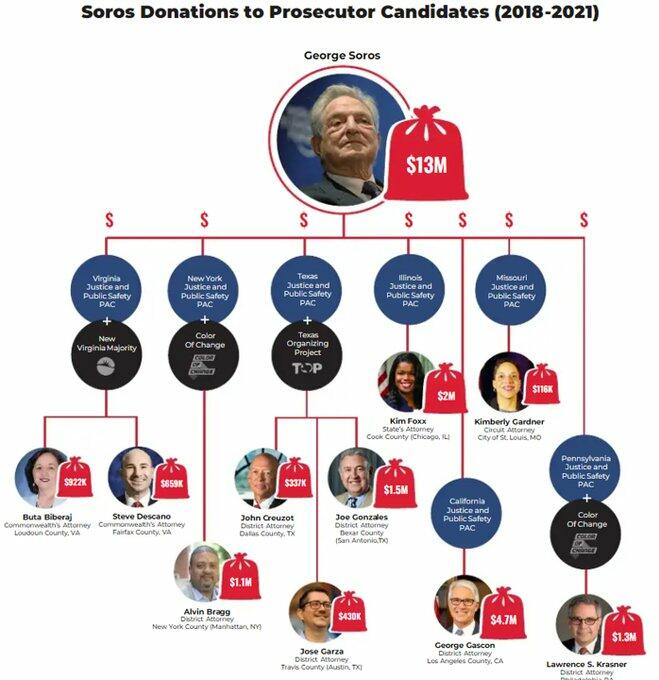
  • Soros slammed for America’s crime wave. Including this handy chart:

    In San Francisco, Soros-funded DA Chesa Boudin has seen a flood of departures from his office due to his criminal justice reform policies.

    Boudin campaigned on a platform to end mass incarceration, eliminate cash bail, and vowed to create a panel to review sentencing and potential wrongful convictions. Following his election in November 2019, Boudin announced he would deemphasize the prosecution of drug cases, so-called quality-of-life cases, and property offenses.

    Under his watch, vehicle break-ins increased 100-750% in parts of the city between 2020 and 2021, with the number of reported vehicle thefts reaching 1,891 in May 2021—more than double the 923 reported in May 2020.

    San Francisco also recorded one of the largest increases in burglaries among major cities last year, with a jump of 47 percent—a trend that has continued this year. Fatal and nonfatal shootings in the first six months of this year were up more than 100 percent from the year-earlier period, increasing to 119 from 58, the city’s police chief said at a July press conference.

    More than 700 people died of drug overdoses in 2021 in the city, a record that is likely to be surpassed this year, according to the chief medical examiner.

    Rudy Giuliani – the former Mayor of New York City whose claim to fame was a massive reduction in crime (and who’s traded barbs with Soros in the past), isn’t letting the billionaire off the hook.

    “If there is one single person responsible for the record increases in murder and violence in America’s cities it’s George Soros,” Giuliani said in a Monday tweet.

    “Major contributor to BLM, Antifa, Democrat Party, Biden, Harris and 40 or so pro Criminal DAs. The blood is on his hands,” he added.

  • Speaking of Soros, a resigning Chicago prosecutor slammed Soros-backed Illinois Attorney General Kim Foxx on his way out the door.

    Assistant State’s Attorney James Murphy described an understaffed office in turmoil in his email to colleagues, saying, “I cannot continue to work for an Administration I no longer respect.”

    “I would love to continue to fight for the victims of crime and to continue to stand with each of you, especially in the face of the overwhelming crime that is crippling our communities,” Murphy wrote. “However, I can no longer work for this Administration. I have zero confidence in their leadership.”

    Murphy, who could not be reached directly for comment, zeroed in on many of the issues that have made Foxx a target of opponents who argue she’s gone easy on some accused of violent crimes, as carjackings and gun violence have risen in the Chicago area.

    Murphy wrote that he first started thinking about leaving the office early in 2021 with Foxx’s involvement in the passage of the SAFE-T Act, a wide-ranging law that aims to reform the state’s approach to criminal justice, including by narrowing the definition of who can be charged with first-degree murder.

  • Florida Governor Ron DeSantis shows he plays for keeps by sending state police to physically remove a guy from his office for refusing to follow the law.

    DeSantis has suspended State Attorney Andrew Warren for ‘picking and choosing which laws to enforce based on his personal agenda,’ and has appointed Susan Lopez as his replacement during the suspension.

    Warren, who had served the Thirteenth Judicial Circuit, has most recently refused to follow state policy criminalizing abortion in the wake of the Supreme Court’s decision to overturn Roe v. Wade – and repeatedly refused to enforce laws cracking down on child sex-change surgeries, according to DeSantis.

    The liberal state attorney also declined to prosecute 67 protesters arrested in George Floyd demonstrations, and said in 2017 that he would only pursue the death penalty “in the very worst cases,” and not where “mental illness played a role.”

    “We are suspending Soros-backed 13th circuit state attorney Andrew Warren for neglecting his duties as he pledges not to uphold the laws of the state,” DeSantis’ office said in a statement, per Fox News.

    Update: DeSantis sent state police to physically remove Warren from his office, “with access only to retrieve his personal belongings, and (ii) to ensure that no files, papers, documents, notes, records, computers, or removable storage media are removed from the Office of the State Attorney…”

  • But that’s not the end of DeSantiss bad-assery this week. He also got PayPal to unfreeze Moms For Liberty’s account.

    PayPal has reportedly unfrozen Moms for Liberty’s account funds after Florida Gov. Ron DeSantis announced his state would crack down on woke banking.

    Payment platform PayPal allowed grassroots, anti-woke education group Moms for Liberty to access its funds after DeSantis’s new initiative against woke banking, Florida’s Voice reported. Moms for Liberty co-founder Tina Descovich reportedly told Florida’s Voice that her organization had been using PayPal for more than a year before the platform censored the group.

    Descovich reportedly said that many Moms for Liberty donors give monthly and automatically through PayPal. The payment processor not only stopped these donor payments but froze $4,500 belonging to Moms for Liberty, and prohibited any transfer of the money out of the account, according to Florida’s Voice. PayPal subsequently reversed its block by unfreezing the funds.

    PayPal notified Descovich that Moms for Liberty’s accounts were initially frozen during DeSantis’s July 15 speech at the Moms for Liberty National Summit, according to Florida’s Voice. The funds were unfrozen after DeSantis announced his initiative against woke banking.

    (Hat tip: Stephen Green at Instapundit.)

  • Biden’s Department of Agriculture is trying to destroy corn farming in America.

    The world is facing serious food and energy shortages as an outgrowth of the war in Ukraine and supply-chain shortages. Farmers are working to solve these problems, but we need help from the federal government if we are going to have any chance of success.

    That’s why national corn grower leaders recently called on the Biden administration to address regulatory overreach.

    That call comes after the U.S. Environmental Protection Agency recently revised its atrazine registration, a move that could restrict access to a critical crop protection tool that has been well tested and shown to be safe for use. Farmers fear that new requirements will impose arduous new restrictions and mitigation measures on the herbicide, limiting how much of the product they use.

    The atrazine decision comes on the heels of a development involving the herbicide glyphosate. In June, the U.S. Supreme Court refused to hear a case decided by a lower court from California, leaving in place a ruling that supports the claim that glyphosate use causes cancer – even as the EPA has repeatedly affirmed that the widely sold and well-studied herbicide is not carcinogenic.

    The Supreme Court’s decision came after the solicitor general in the Biden administration submitted an amicus brief advising the court against hearing the case.

    As a result, the door is now open for states to create a patchwork of regulations governing herbicide use, which will increase costs as manufacturers must now jump through hoops in every state, on top of making compliance difficult for the users of these products.

    Farmers in Iowa and across the country have also experienced major fertilizer price hikes and shortages over the last year, thanks in part to steps taken by the U.S. International Trade Commission to impose tariffs on fertilizers. Thankfully, ITC recently voted against adding tariffs on nitrogen fertilizers. But tariffs on phosphorous fertilizers from Morocco remain in place, driving up input prices for growers.

  • Speaking of foolish regulations that can contribute to famine, new “debarbonization” shipping rules could do just that.

    A new report found that more than 75% of ships will not meet the International Maritime Organization’s (IMO) new Environmental social and corporate governance (ESG) index aimed at decarbonizing the industry. This means that many ship owners will be forced to slow ships down to reduce emissions but doing so could deepen the global food and energy crisis by reducing available ship capacity.

    “IMO decarbonization targets will cause ships to slow down delaying food shipments and people will starve,” a global security analyst told gCaptain. “How many people will die as a result of the IMO’s ESG efforts is unknown at this time. I don’t think most shipowners even understand the severity of the EEXI threat but it could be millions of lives.”

    “Ships have to attain EEXI approval once in a lifetime, by the first periodical survey in 2023 at the latest.” The certification is currently voluntary, but banks and insurers may force ships to comply or be cut off. (Hat tip: Sarah Hoyt at Instapundit.)

  • Hanky panky in government jobs numbers?
  • Things the media doesn’t want to talk about: The leftwing whack-job who tried to assassinate Supreme Court Justice Brett Kavanaugh thinks he’s a woman. Which I guess makes him a slightly different type of leftwing whack-job.
  • Russo-Ukrainian War update: “Ukraine takes out Russian ammunition railway connecting Kherson to Crimea.” I keep seeing rumors of a big Ukranian counteroffensive to retake Kherson, but it seems like it’s slow to make much headway.
  • “Chuck Schumer’s son-in-law lands lucrative gig at private equity giant Blackstone.” Of course he has.
  • The Biden Administration wants to force religious hospitals to embrace tranny madness.

    In 2016, the Obama administration’s Department of Health and Human Services issued a rule that would have forced doctors across the country to assist in transitioning patients out of their biological sex, regardless of a provider’s medical opinion or conscience objections.

    “A provider specializing in gynecological services that previously declined to provide a medically necessary hysterectomy for a transgender man,” for example, “would have to revise its policy to provide the procedure for transgender individuals in the same manner it provides the procedure for other individuals.”

    The rule left no room for religious physicians or institutions to breathe, instead menacing them with draconian fines, were they not to toe the controversial new line.

    In stepped the Becket Fund for Religious Liberty, which swiftly secured a preliminary injunction in federal court that stopped the rule from going into effect, on the grounds that it violated the Administrative Procedure Act, and likely violated the Religious Freedom Restoration Act. It was a decision later confirmed in 2019, and made permanent by a 2021 ruling.

    On August 4, however, Becket attorney Luke Goodrich, who has been working on the case since the Obama-era rule was first issued, will march back into the courtroom, having been dragged back in by the Biden administration and Secretary of Health and Human Services Xavier Becerra.

    “They say that our lawsuit was only about the 2016 rule. . . . They say, ‘well, all you were challenging was the 2016 rule, and you won that, but now we’re using a different rule or a different rationale for imposing the same requirement on you, and so you have to file a new lawsuit,’” explained Goodrich.

    Under the Biden administration’s theory, the Affordable Care Act provides the administration with “all the authority” it needs “to punish groups that don’t perform gender transitions and abortions,” Goodrich told National Review. The 2016 rule also included language that Becket alleges would force religious institutions to perform abortions.

    Remember how Republicans said ObamaCare would endanger religious liberty and the MSM dismissed their concerns? Just like “If you like your doctor, you can keep your doctor.”

    According to Goodrich, “the merits are completely resolved and haven’t been appealed; the fight on appeal is about the scope of relief.” He described an effort to work around a losing legal argument by burdening religious objectors and opening up new fronts of battle.

    “They want religious organizations to have to play Whac-A-Mole every time the government violates the Religious Freedom Restoration Act, and they want a ruling that will leave them free to keep violating religious liberty every time they shuffle the same legal requirement from one volume of the Federal Register to another,” he said.

    That strategy is observable in the proposal of yet another, even broader rule — modeled after the 2016 one — issued by Becerra, who has made his political brand on waging one ruthless culture war after another.

    As attorney general of California, Becerra sought to punish independent journalists who exposed Planned Parenthood’s sale of fetal remains harvested during abortions. The Los Angeles Times editorial board described his decision to charge those involved with felonies “disturbing,” and the progressive Mother Jones called it “chilling.”

    He also happily enforced a plainly unconstitutional California statute requiring pro-life crisis pregnancy centers to provide pro-abortion materials to patrons, and, as a member of the U.S. House of Representatives, voted against legislation that would allow providers not to perform abortions without fear of government reprisal.

  • Has Tranny Madness peaked in the UK? There, the Rugby Football Union and Rugby Football League just banned men from playing women’s rugby. In other news, there’s evidently women’s rugby.
  • More signs of sanity in the UK: “UK Police Chief Says Investigating Offensive Speech Is ‘Waste Of Time.'”
  • “What’s the worst performing stock in the Dow Jones Industrial Average so far this year? Disney.”

    The Mickey Mouse company, headquartered in Burbank, has lost about 35% of its value this year versus a nearly 15% loss for the broader index. As a result, tens of millions of Americans who hold Disney stock either directly or indirectly as part of passive index funds have seen their finances take a hit at the worst possible time as inflation spirals out of control.

    Disney’s poor financial performance is a product of its own making. In recent months, the company has aggressively waded into controversial cultural issues such as gender identity, making it clear it is putting politics over its shareholders and customers. Disney is a prime example of the threat posed to shareholders and the broader economy of “woke” capitalism. Its story should serve as a cautionary tale for other companies looking to follow in its footsteps.

    Disney has all but admitted it’s leveraging its prized position as a top children’s content creator to push a divisive cultural agenda. In March, Disney’s president of content told employees the company plans to have at least 50% of its regular characters come from “underrepresented groups.” Another top producer boasted about Disney’s “not-at-all-secret gay agenda,” including “adding queerness” to children’s programming. Yet another senior executive promised that Disney would implement a “tracker” to ensure programs contain enough “canonical trans characters.”

    We’re getting a look at what this woke agenda looks like in practice. An upcoming episode of Disney’s new children’s show “Baymax!” features a transgender man buying menstrual pads. “I always get the ones with wings,” says the “man” wearing a shirt with the transgender flag. Disney is also abolishing the words “boys” and “girls” at its theme parks.

  • “BLM Activist Shaun King Used Donor Funds To Buy $40k Thoroughbred Show Dog.” That’s infuriating. Not that premagrifter Talcum X siphoned BLM money into his own pockets. That part’s hilarious and predictable. No, that he spent forty grand on a dog when they are so many shelter dogs who need a home.
  • Heads up! It’s a tax-free back-to-school weekend in Texas on clothes and schools supplies under $100.
  • “GEICO closes all California offices, lays off workers.” California regulation just keeps paying dividends…
  • Crazy story: U.S. Bank caught opening fake accounts and credit cards with customer money. Fine are not enough. People need go to jail for this.
  • Amazon flashlight lumen ratings are bunk.
  • A pretty good list of the 95 Best Action Movies Ever. Has all the stuff you would expect to be on there (Die Hard, Hard-Boiled, The French Connection, etc.), plus a good bit of Jackie Chan, Sorcerer, Safety Last, Hot Fuzz, and even Andy Sedaris’ hilarious low-budget breastsplotation “classic” Hard Ticket To Hawaii.
  • Test screens for Batgirl were so bad that DC simply isn’t going to release the film. “They think an unspeakable ‘Batgirl’ is going to be irredeemable.”
  • And, oh yeah, the Critical Drinker is there. “Warner Brothers may be the first domino to fall, but something tells me they won’t be the last. And when other companies realize that you can safely drop THE MESSAGE and the people peddling it…well, the next year or two could turn out to be very interesting.”
  • Charming or terrifying? You make the call.
  • We have a winner for for Most “Eww” Inducing Headline: “Morgue Assistant Uses Testicles From Corpses To Help Win Annual Spaghetti Cook-Off.”
  • “Government That Shut Down Businesses, Parks, Schools, Beaches, And Churches For 2 Years Says There’s Nothing We Can Do To Stop A Disease Spread By Gay Sex.”
  • Eric Schmitt Wins Missouri GOP Senate Race

    Wednesday, August 3rd, 2022

    Good news, everyone! Missouri’s Attorney General Eric Schmitt has won the Republican Senate primary.

    Eric Schmitt has won the Republican nomination for Senate in Missouri, NBC News projects, ending a comeback bid by the state’s disgraced former governor, Eric Greitens.

    Schmitt, the state’s attorney general, was leading Rep. Vicky Hartzler, with Greitens further behind in third place, according to early results. He will face the winner of Tuesday’s Democratic primary, Trudy Busch Valentine, a nurse and heir to the Anheuser-Busch beer fortune. NBC News projects that Valentine has beat out 10 other Democrats, including Lucas Kunce, a Marine veteran with national support among progressives, who earned a late endorsement from Sen. Bernie Sanders, I-Vt.

    The Democratic primary was sleepy compared to the GOP contest, which commanded extraordinary attention for a primary in a reliably red state.

    You may remember Schmitt smacking down Soros-backed Democratic St. Louis prosecutor Kim Gardner for trying to charge Mark and Patricia McCloskey with felonies for daring to exercise their Second Amendment rights to defend themselves. (Ironically, Mark McCloskey was one of the people he defeated in the primary, as the Democrat-mugged-by-reality-turned-Republican came in a distant fifth.)

    Schmitt received a whole lot of conservative endorsements, including Gun Owners of America, Ted Cruz, Mike Lee, and the Senate Conservative Fund.

    Like Texas Attorney General Ken Paxton, he also spends a good bit of time suing the Biden Administration for unconstitutional policies. “I wake up, I go to the office, I sue Joe Biden, I go home.”

    Schmitt should make a good, conservative senator.

    Is Russia’s Economy Collapsing?

    Tuesday, August 2nd, 2022

    Given the cutoff from SWIFT, the widespread economic sanctions, and the huge pullout of Western firms from Russia in the wake of their invasion of Ukraine, I would have expected more signs of the widely predicted economic decline on the part of Russia than we’ve been seeing.

    However, this report from the Yale Chief Executive Leadership Institute (CELI) says that the sanctions are indeed crippling Russia’s economy.

    Some skepticism is probably in order, as CELI’s head, Jeffrey A. Sonnenfeld, for all his talk of advising both Trump and Biden, is a Biden donor, and we all know the great lengths our political elites to lie in order to cover up the Biden Administration’s many manifest failures. But reading through the report there seems to be a substantial amount of evidence to support the thesis.

    The summary:

    As the Russian invasion of Ukraine enters into its fifth month, a common narrative has emerged that the unity of the world in standing up to Russia has somehow devolved into a “war of economic attrition which is taking its toll on the west”, given the supposed “resilience” and even “prosperity” of the Russian economy. This is simply untrue – and a reflection of widely held but factually incorrect misunderstandings over how the Russian economy is actually holding up amidst the exodus of over 1,000 global companies and international sanctions.

    That these misunderstandings persist is not surprising. Since the invasion, the Kremlin’s economic releases have become increasingly cherry-picked, selectively tossing out unfavorable metrics while releasing only those that are more favorable. These Putin-selected statistics are then carelessly trumpeted across media and used by reams of well-meaning but careless experts in building out forecasts which are excessively, unrealistically favorable to the Kremlin…

    Our team of experts, using Russian language and unconventional data sources including high frequency consumer data, cross-channel checks, releases from Russia’s international trade partners, and data mining of complex shipping data, have released one of the first comprehensive economic analyses measuring Russian current economic activity five months into the invasion, and assessing Russia’s economic outlook.

    From our analysis, it becomes clear: business retreats and sanctions are crippling the Russian economy, in the short-term, and the long-term. We tackle a wide range of common misperceptions – and shed light on what is actually going on inside Russia.

    Here are their main points (generic paper reference verbiage elided):

  • Russia’s strategic positioning as a commodities exporter has irrevocably deteriorated, as it now deals from a position of weakness with the loss of its erstwhile main markets, and faces steep challenges executing a “pivot to Asia” with non-fungible exports such as piped gas…
  • Despite some lingering supply chain leakiness, Russian imports have largely collapsed, and the country faces stark challenges securing crucial inputs, parts, and technology from hesitant trade partners, leading to widespread supply shortages within its domestic economy…
  • Despite Putin’s delusions of self-sufficiency and import substitution, Russian domestic production has come to a complete standstill with no capacity to replace lost businesses, products and talent; the hollowing out of Russia’s domestic innovation and production base has led to soaring prices and consumer angst…
  • As a result of the business retreat, Russia has lost companies representing ~40% of its GDP, reversing nearly all of three decades’ worth of foreign investment and buttressing unprecedented simultaneous capital and population flight in a mass exodus of Russia’s economic base…
  • Putin is resorting to patently unsustainable, dramatic fiscal and monetary intervention to smooth over these structural economic weaknesses, which has already sent his government budget into deficit for the first time in years and drained his foreign reserves even with high energy prices – and Kremlin finances are in much, much more dire straits than conventionally understood…
  • Russian domestic financial markets, as an indicator of both present conditions and future outlook, are the worst performing markets in the entire world this year despite strict capital controls, and have priced in sustained, persistent weakness within the economy with liquidity and credit contracting – in addition to Russia being substantively cut off from international financial markets, limiting its ability to tap into pools of capital needed for the revitalization of its crippled economy…
  • Looking ahead, there is no path out of economic oblivion for Russia as long as the allied countries remain unified in maintaining and increasing sanctions pressure against Russia…
  • I believe the first part of the first point is too speculative (“Rising Prices Mask Irreversible Deterioration in Long-Term Strategic Positioning”) and forward-looking to be worth examining. Russia isn’t worried about long-term positioning if it can use its gas pipeline leverage to crack the sanctions regime against it this year. The second “pivot to Asia difficulties” part is something I’ve covered here.

    First they cover why you can’t trust Russian statistics (duh):

    The Kremlin’s economic releases are becoming increasingly cherry-picked; partial, and incomplete, selectively tossing out unfavorable statistics while keeping favorable statistics. The Russian government is no longer disclosing certain economic indicators which prior to the war were updated on a monthly basis, including all foreign trade data, including those relating to exports and imports, particularly with Europe; oil and gas monthly output data; commodity export quantities; capital inflows and outflows; financial statements of major companies, which used to be released on a mandatory basis by companies themselves; central bank monetary base data; foreign direct investment data; and lending and loan origination data, and other data related to the availability of credit.

    The fact the data is so bad they’re not even trying to alter or spin it suggests things are pretty bad.

    Even Rosaviatsiya, the federal air transport agency, abruptly ceased publishing data on airline and airport passenger volumes. As a measure of comparison, prior to the war, the only economic data which have historically been classified and quarantined by the Russian government are sensitive metrics related to the trade of military goods, aircraft, and nuclear materials.

    Although the Kremlin explains away its newfound desperate obfuscation of its revenue and spending data and other macroeconomic indicators of overall economic health under the guise of “minimizing the risk of the imposition of additional sanctions”, what little data has trickled out from the Kremlin suggests the real reason may lie in the fact these statistics are unlikely to be positive for the Kremlin, and getting worse by the day. For example, total oil and gas revenues dropped by more than half in May from the month before, by the Kremlin’s own numbers. As one economist wrote, “it’s likely that the Kremlin is afraid of publishing data that reveal the full scale of the economy’s collapse”.

    Second, even those favorable statistics which are released are questionable if not downright dubious when measured against cross-channel checks, verification against alternative benchmarks and given the political pressure the Kremlin has exerted to corrupt statistical integrity. Indeed, the Kremlin has a long history of fudging official economic statistics, even prior to the invasion. Putin has on several occasions shunted aside heads of Rosstat who produced economic statistics which were not to his liking, and he personally transferred control of the agency to political appointees at the Economic Ministry, depriving the agency of its prior status as an independent branch of government free from political influence. Outside observers ranging from international organizations to foreign investors regularly sound alarm bells over “concerns about the reliability and consistency” of the Kremlin’s economic releases, especially given the propensity of Kremlin economists for “switching to new methodologies” with alarming frequency – many instances of which are not even disclosed. Concerns over meddlesome political interference must be given even more weight now that Putin appointed Sergei Galkin, the former Deputy Economic Minister and the most blatantly political pick in recent history as head of Rosstat in May.

    Third, and as mentioned briefly previously, almost all rosy projections and forecasts are irrationally extrapolating economic releases from the early days of the post-invasion period, when sanctions and the business retreat had not taken full effect, rather than the most recent, up-to-date numbers from recent weeks and months – partially due to the fact the Kremlin stopped releasing updated numbers, constraining the availability of datasets for economic researchers to draw upon. For example, many alarming forecasts projecting strong revenue from energy exports were based on the last available official export data from March, even though many business withdrawals and sanctions on energy had not yet taken effect, with orders placed prior to the invasion still being delivered.

    Take, as one instance of many, one widely cited study by Bloomberg decrying Russia’s surge in revenue from energy exports. The authors wrote: “even with some countries halting or phasing out energy purchases, Russia’s oil-and-gas revenue will be about $285 billion this year, according to estimates from Bloomberg Economics based on Economy Ministry projections. That would exceed the 2021 figure by more than one-fifth”. No doubt, Russia has continued to draw significant revenue from energy exports – a complex topic which we analyze in-depth in the sections below.

    But this specific Bloomberg analysis projected Russia’s 2022 energy export revenues based on its revenue through March of 2022 as disclosed by the Kremlin, even though the Kremlin has belatedly acknowledged that energy export revenues in May and June have diminished significantly. In fact, only after a long and unexplained delay did the Kremlin finally disclose that total oil and gas revenues dropped by more than half in May from prior months, by the Kremlin’s own numbers – along with the declaration that the Kremlin would cease releasing any new oil and gas revenues from that point on. Nevertheless, the misleading Bloomberg forecast carelessly extrapolating out initial energy export volumes into the rest of the year was then repeated by leading voices including Fareed Zakaria and others in proving the supposed “resilience” and even “prosperity” of the Russian economy.

    On the collapse of Russian imports:

    Imports consist of ~20% of Russian GDP, and the domestic economy is largely reliant on imports across industries and across the value chain with few exceptions, despite Putin’s bellicose delusions of total self-sufficiency.

    Snip.

    By far and large, the flow of imports into Russia has drastically slowed in the months since the invasion. A review of trade data from Russia’s top trade partners – since, again, the Kremlin is no longer releasing its own import data – suggests that Russian imports fell by upwards of ~50% in the initial months following the invasion.

    And China isn’t replacing western countries as a source of imports.

    In the initial days of the Russian Business Retreat, when hundreds of western businesses rushed to exit Russia, the authors – who were deluged with media inquiries given the prominence of the Yale CELI List of Companies curtailing operations in Russia – were frequently asked whether Chinese companies would rush to fill the spots vacated by western businesses. Many naïve observers cynically remarked that the Business Retreat would be futile, as Chinese companies would relish the opportunity to do more business in Russia, and the Russian economy would barely miss a beat. This is not at all what has played out – and quite to the contrary.

    In fact, according to recent monthly releases from the Customs General Administration of China, which maintains detailed Chinese trade data with detailed breakdowns of exports to individual trade partners, Chinese exports to Russia plummeted by 50% from the start of the year to April, falling from over $8 billion monthly at the end of 2021 to under $4 billion in April. This aligns with our anecdotal observations of several Chinese banks withdrawing all credit and financing from Russia following the start of the invasion, including ICBC, the New Development Bank, and the Asian Infrastructure Investment Bank, in addition to energy giants such as Sinochem suspending all Russian investments and joint ventures.

    The explanation for China’s reticence, once again, lies in the asymmetric nature of Russia’s relationships with its trading partners. Even on imports, it is clear that Russia needs its trade partners far more than its trade partners need Russia – and the power dynamic is not even close to being balanced.

    This imbalance is put into stark relief when the proportion of imports Russia draws from China is compared to the proportion of exports China sends to Russia. Russia is not even in the top ten destinations for Chinese exports; in 2021 alone, China exported over $500 billion in goods and services to its largest trade partner, the United States, representing ten times the amount of goods it sent to Russia ($72 billion). On the other hand, China represents Russia’s largest source of imports by far; in fact, the $72 billion in imports Russia draws from China is nearly three times the amount of imports Russia draws from its second largest partner, Germany ($27 billion), and five times the amount of imports Russia draws from its third largest partner, the United States.

    Given the extremely minor proportion of Chinese exports going to Russia vis-à-vis China’s trading relationship with the United States and Europe, clearly most Chinese companies are much more wary of losing access to US and European markets by running afoul of US sanctions and crossing US companies than they are of losing whatever erstwhile market share they had in Russia. The dangers of losing access to US technology are already readily apparent from China’s point of view. When the US imposed export restrictions on Chinese telecom companies Huawei and ZTE in 2020, they were unable to source advanced microchips and saw a massive reduction in their chip-dependent smartphone businesses – a fate which no Chinese company wants to suffer by running afoul of US sanctions related to Russia.

    China is the most prominent example, but other trade partners have been just as reticent to export to Russia. In fact, it appears that exports to Russia from sanctioning and non-sanctioning countries have collapsed at a roughly comparable rate in the months following the invasion. One analysis found that non-sanctioning countries saw exports to Russia fall by an average of 40%, while sanctioning countries saw exports fall an average of 60%, reflecting the disadvantaged economic position Russia finds itself vis-à-vis practically all its trade partners regardless of political rhetoric

    Snip.

    One survey done by the Central Bank of Russia found that well over two-thirds of surveyed companies experienced import problems, and manufacturers, in particular, reported a shortage of raw materials, parts, and components. Unsurprisingly, the focus has shifted towards import substitution – a topic analyzed in closer detail in Section IV. But in short, this has not been fruitful. Despite Russian companies’ desperate efforts to find alternative production and re-orient supply chains towards domestic substitutes, according to a survey by Russia’s Gaidar Institute for Economic Policy, a whopping 81% of manufacturers said they could not find any Russian versions of imported products they need, and more than half were “highly dissatisfied” with the quality of homegrown production even when domestic substitutes could be sourced.

    On to the failure to find adequate domestic substitutes. I’m going to skip over a lot of the stuff I don’t really give a rat’s ass about (radical declines in new car sales) as it’s not particularly important except as evidence of aggregate demand destruction. Others are much more surprising: Fruits and vegetables and fish production are down as well, despite Russia supposedly being the country that can supply all its own fertilizer needs. (And pesticides and fertilizers are also down.)

    When domestic industrial production is measured by volume rather than value added, cross- filtered against a more granular breakdown by sub-industry, the picture becomes even bleaker suggesting large-scale shutdowns of the Russian industrial base, which is evidently operating at a fraction of its usual capacity. Industrial production volume in crucial industries such as appliances, railways, steel, textiles, batteries, apparel, and rubber fell by well over 20%, while other sub-industries such as electronics, sports, furniture, jewelry, fertilizers, and fishing fell in excess of 10%.

    And despite Putin’s rallying cries of self-sufficiency, all of these industries share a crucial similarity: they simply cannot replace imported parts and components that Russia lacks the technological prowess to make, and illicit, shadowy parallel imports can only go so far. For example, the Russian tank producer Uralvagonzavod has furloughed workers based on input shortages.

    So much for the Russian trolls that claim Uralvagonzavod’s is still cranking out tanks unimpeded!

    Russian production of tanks, missiles and other equipment relies on imported microchips and precision components that simply cannot be sourced right now. Likewise, Russia’s Caspian pipeline has had challenges finding spare parts related to the US and EU’s ban on exports related to gas liquefaction. Each of these supply disruptions – which cannot be replaced by import substitution or parallel imports – leads to production shutdowns which then ripple across the entire supply chain, bringing various ancillary products and services into a simultaneous standstill.

    The breadth of this industrial production slowdown across the Russian economy is further worsened by a rapidly deteriorating outlook for new purchases and orders. A reading of the Russian Purchasing Managers’ Index (PMI) – which captures how purchasing managers are viewing the economy – shows that new orders have plunged across the board, both in terms of domestic Russian orders as well as Russian orders for foreign products and foreign orders of Russian products. Clearly, purchasing managers want nothing to do with placing new orders until the geopolitical environment stabilizes. Likewise, PMIs highlight that inventories have dropped and delivery times have increased in the context of widespread supply-chain problems, so even if new orders were to be placed, the fulfillment of those orders would continue to pose steep challenges to Russian domestic production.

    Also hurting Russia is the fact that over 1,000 global companies have curtailed operations there. (Though some still remain; why the hell is Cloudflare, Carl’s Jr. and Sbarro still doing business there?)

    When the list was first published the week of February 28, only several dozen companies had announced their departure from Russia. In the two months since, this list of companies staying/leaving Russia has already garnered significant attention for its role in helping catalyze the mass corporate exodus from Russia, with widespread media coverage and circulation across company boardrooms, policymaker circles, and other communities of concerned citizens across the world.

    Based on the authors’ proprietary database tracking the retreats of over 1,000 companies, our researchers found that across all these 1,000 companies aggregated together, the value of the Russian revenue represented by these companies and the value of these companies’ investments in Russia together exceed $600 billion – a startling figure representing approximately 40% of Russia’s GDP. We further found that these companies, in total, employ Russian local staff of well over 1 million individuals. The value of these companies’ investment in Russia represents the lion’s share of all accumulated, active foreign investment in Russia since the fall of the Soviet Union – meaning the retreat of well over 1,000 companies in the span of three months has almost single-handedly reversed three decades’ worth of Russian economic integration with the rest of the world, while undoing years of progress made by Russian business and political leaders in attracting greater foreign investment into Russia.

    To be sure, this is not to say that the GDP of Russia will contract 40% overnight. Many of the 1,000+ businesses who have curtailed operations in Russia are still in the process of winding down their operation, meaning it will take months if not even years to feel the full impact of their withdrawal. Other companies from this list of 1,000+ have already divested or sold their Russian businesses to local Russian operators, which means that even though these businesses will lack western technical and financial support and know-how and deteriorate in the long-run, in the short-term, they will still continue to operate to some extent and thus cannot be written off from Russian GDP immediately. There are also some companies which continue some operations in Russia while pulling out of other operations, so any hit to Russian GDP from these companies would be partial rather than total. It is impossible to capture the full economic impact of the Russian business retreat as many of the most devastating consequences will be felt years from now -with long-term structural losses to the Russian economy beyond any single dollar figure of lost revenue or lost investment. Nevertheless, the fact that the 1,000+ companies that have curtailed operations represent such a high proportion of Russia’s GDP – 40% – signifies the importance of these economies to the Russian economy prior to the war, and how the Russian economy must now undergo dramatic, forced transformations with these companies pulling out, as amplified throughout this paper.

    Some might argue that the companies that curtailed operations in Russia were forced to incur a short-term loss in Russian revenue and investment – despite the fact the impact on Russia is more painful in both the short-term and the long-term – but it is not even true to say that the companies leaving Russia incurred any losses. In fact, rather than penalizing companies for leaving Russia, in a separate study, we found that foreign investors by far and large rewarded companies for removing the risk overhang associated with exposure to Russia – that the value of aggregate stock market gained since the start of the invasion for companies that have left Russia far outweigh the value of Russian asset divestitures and lost Russian revenue, which for most multinational corporations, represented a small fraction of total revenue to start with – no more than 1-2% in most cases. Thus, clearly the loss of 1,000+ companies has been borne solely by Russia – in both the short-term and the long-term – while leaving Russia actually benefited companies.

    Not to mention the brain drain and capital flight:

    Unsurprisingly, the Russian business retreat has coincided with rapid “brain-drain” as talented, educated Russians flee the country in droves. It is impossible to assess the exact number of Russians who have left Russia permanently since the outset of the invasion, but most estimates peg the number as no less than five hundred thousand – with the vast majority being highly-educated and highly-skilled workers in competitive industries such as technology. The mass exodus of skilled Russian natives is further amplified by the forcible expulsion of a not-insignificant population of western expatriates working in Russia. These workers – who understand the structural challenges facing the Russian economy and technical hurdles obstructing Putin’s vows of self-sufficiency and import substitution – are joined by many of Russia’s few remaining high-net-worth and ultra-high-net-worth individuals, who understand that capital controls, taxes, the business and investment climate, and government restrictions are only likely to become worse in the years ahead, particularly for those holding financial capital. By one measure, 15,000 ultra-high-net-worth individuals have fled Russia since the invasion began, which would represent 20% of the population of Russia’s ultra-high-net-worth individuals at the outset of the war. These Russians, as the holders of significant capital, seek the safety, security, and stability of western financial markets, especially as Russia’s access to those markets shrinks.

    These high net worth individuals are bringing their wealth with them when they flee, contributing to soaring private capital outflows, even by the Central Bank of Russia’s own admission. The official level of capital outflows indicated by the Bank of Russia in Q1, nearly $70 billion USD, is likely to be a gross underestimate of the actual level of capital outflows, given strict capital controls implemented by the Kremlin restricting the amount of wealth Russian citizens can transfer out of the country, particularly foreign-currency denominated wealth. Any additional capital outflows which have skirted these capital controls are unlikely to have been captured by the Central Bank of Russia’s gauge, and indeed, by all anecdotal reports, wealthy Russians are flocking for safe havens in droves.

    Next up, just why we haven’t yet seen an actual collapse: unsustainable fiscal stimulus and capital controls.

    As global businesses swarmed for the exits and after the implementation of devastating sanctions by the US and EU in the early weeks following the invasion, many western economists and policymakers had unrealistic expectations that the Russian economy may collapse or that a financial crisis might take hold. Sanction regimes very rarely cause instantaneous financial crises or economic collapses; rather, they tend to be longer-duration tools designed to structurally weaken a nation’s economy while isolating it from global markets. Indeed, as this paper has shown, the impact of business retreats and sanctions on the Russian economy has been nothing short of catastrophic, eroding the Russian economy’s competitiveness while exacerbating internal structural weaknesses.

    But for those who expected a more rapid collapse in the Russian economy, and who were shocked this did not occur – much of the reason the Russian economy proved marginally more resilient than initially expected has to do with the unprecedented and unsustainable fiscal and monetary response initiated by the Kremlin. A little-understood but critically important component of Russia’s economic journey since the outset of the invasion, the Kremlin’s fiscal and monetary response has largely averted a credit/liquidity squeeze, which could have induced a financial panic, while propping up the economic livelihoods of many core constituencies of the Putin regime, ranging from state owned enterprises to pensioners and retirees – rescuing them from sudden economic catastrophe.

    One of the best case studies for how, through massive and unsustainable government intervention, the Kremlin has been able to temporarily prop up the Russian economy also happens to be one of Putin’s favorite propaganda talking points: the appreciation of the ruble, which is now the strongest-performing currency this year by some measures. Overnight, as soon as the invasion commenced, the exchange rate for the ruble relative to the dollar jumped from ~75 to ~110 – but the Kremlin immediately announced a rigorous set of capital controls on the ruble including a blanket ban on citizens sending money to bank accounts abroad and foreign money transfers; a suspension on cash withdrawals from dollar banking accounts beyond $10,000 per person; a mandate for all exporters to exchange 80% of foreign currency earnings for rubles; a suspension of direct dollar conversions for individuals with ruble-denominated banking accounts; a suspension of domestic lending in foreign currencies; a suspension of dollar sales across domestic banks; a mandate that companies pay foreign-denominated debt in rubles; and encouragement of individuals to redeem dollars for rubles out of patriotic duty. These restrictive capital controls – which rank amongst the most restrictive of any government in the world – immediately made it effectively impossible for domestic Russians to purchase dollars legally or even access a majority of their dollar deposits, while artificially inflating demand for rubles through forced purchases by major exporters. These capital controls, which have only weakened slightly in the four months since the outset of the invasion, continue to prop up the ruble’s official exchange rate with artificial strength across onshore and offshore markets.

    However, the official exchange rate given the presence of such draconian capital controls can be misleading – as the ruble is, unsurprisingly, trading at dramatically diminished volumes compared to pre-invasion on low liquidity. By many reports, much of this erstwhile trading has migrated to unofficial ruble black markets, where the spread between the official exchange rate and the actual exchange rate is equally dramatic – upwards of 20% to 100% higher than the official exchange rate, in some cases, given a shortage of obtainable, liquid dollars within Russia. Even the Bank of Russia has admitted that the exchange rate is a reflection more of government policies and a blunt expression of the country’s trade balance rather than freely tradeable liquid FX markets.

    The Kremlin’s implementation of capital controls pales in comparison to the unsustainable full-scale fiscal and monetary stimulus launched over the last few months, stretching to every corner of the Russian economy. That the Kremlin would flood the Russian economy with such a deluge of Kremlin-initiated spending was far from certain in the initial days of the war. Initial attempts by the Kremlin to intervene in the economy when the invasion started were marked by relative restraint, defined by measures such as shutting down trading on the Moscow Stock Exchange and suspending measures intended to be largely transitory in nature. But when it became apparent that western sanctions were not being lifted and that the Russian economy would not go back to “normal” anytime soon, Putin announced escalating waves of fiscal and monetary stimulus targeted at easing the economic pain faced by individuals and companies. These measures included subsidized loans and loan payment assistance to companies; transfer payments to affected industries; subsidized mortgages and mortgage payment assistance; increases in direct payments to individuals including families, pregnant women, government employees, pensioners, military, low-income; recapitalization of companies by the National Wealth Fund, the sovereign wealth fund of Russia; nationalization and recapitalization of certain companies and assets; subsidized credit forgiveness approaching a debt jubilee; subsidized protection from bankruptcy and foreclosure; drawdowns from the National Wealth Fund for state expenditures; and subsidized infrastructure development – to name only a few.

    The ultimate scale of these relief expenditures is still unclear as they are currently ongoing, but initial signs point towards a massive, unprecedented magnitude of spending. By the Central Bank of Russia’s own data releases, the Russian money supply – M2, which includes cash, checking deposits, and cash-convertible proxies of store-holders of value – ballooned by nearly two times from the start of the year through June.

    A good thing that doubling your money supply almost overnight can’t possibly have any negative repercussions!

    Putin’s remaining FX reserves are decreasing at an alarming pace, as Russian FX reserves have declined by $75 billion since the start of the war – a rate which, if annualized, suggests these reserves may be spent down within a few years’ time. Critics point out that official FX reserves of the central bank technically can only decrease, not increase, due to international sanctions placed on the central bank, and suggest that non-sanctioned financial institutions such as Gazprombank can still accumulate FX reserves in place of the central bank. While this may be true technically, there is simultaneously no evidence to suggest that Gazprombank is actually accumulating any sizable reserves, considering the distress facing its own loan book, pressure to fund increasing amounts of infrastructure loans and the fact that Gazprombank has been accused of being the conduit through which the Kremlin indirectly transfers the regular military pay and combat bonuses of Russian soldiers fighting in Ukraine. These signs point toward Gazprombank simply channeling massive government expenditures outward with the government spending down immediately rather than stashing away government revenues for later.

    Snip.

    The challenges facing Russia’s sovereign financing are exacerbated by Russia’s newfound lack of access to international capital markets. With Russia’s first default since 1917 on its sovereign debt, Russia is now frozen out of international debt issuances for years to come and unable to tap into traditional sovereign financing across international capital pools. Russia can continue to issue its version of domestic bonds, known as OFZs, but the total capital pool available within Russia domestically is a fraction of the financing needed to sustain these levels of spending by the Russian government over an entire economic cycle. And indeed, the Finance Minister has confirmed that Russia is not raising debt to pay for its fiscal program and has no plans to do so in the near-term.

    “Financial Markets Pricing In Sustained Weakness In Real Economy with Liquidity and Credit Contracting.” Yeah, I’m just going to skip over all that. Just note that not even Russians want to buy Russian real estate or stock.

    Let’s jump to the conclusion. After reiterating the main points:

    Looking ahead, there is no path out of economic oblivion for Russia as long as the allied countries remain unified in maintaining and increasing sanctions pressure against Russia.

    Is Russia’s economy collapsing? Not quite yet. Actual economic collapse is what we’re seeing in Sri Lanka: You can’t buy food, you can’t buy fuel, and you can’t keep the lights on. Russia isn’t there yet. However, the authors do present compelling evidence that Russia’s economy is contracting quite dramatically, and will continue to get worse as long as the war and sanctions continue.