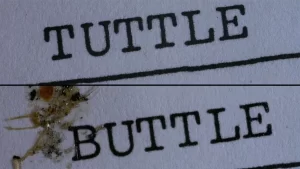
Anthropic was at the center of another controversy this week after details emerged from a recently settled lawsuit, revealing that the AI company had purchased rare books in bulk, scanned them using high-speed machines that sliced off their spines, and then shredded the original copies.
According to the settled lawsuit, Anthropic used a hydraulic powered cutting machine to neatly remove the pages from the books it procured from book resellers and then scanned them using industrial-grade imaging equipment, tech news site Futurism reported.
Evidently this destructive project went under the name Project Panama.
Vendor proposals cited in filings describe plans to process between 500,000 and 2 million books over six months, highlighting the extraordinary scale of the operation — on the order of tens of millions of dollars in book purchases, logistics, and scanning services.
Reportedly some of the books Athropic was buying and shredding were very rare indeed. It’s one thing to destroy common paperback reprints as part of the scanning process (no one will morn the loss of a paperback of Linda Goodman’s Sun Signs 1974), quite another to destroy rare and unique works as part of a project of cultural vandalism.
Shades of Vernor Vinge’s Rainbows End, where a tech company shreds books in the process of scanning them. If Anthropic took inspiration from that, they must have missed the part where the entire destruction process was unnecessary, as non-destructive methods were just as effective. Just as in the real world, there are a wide variety of non-destrictive overhead scanners. With an estimated post-IPO value of $500 billion to $1 trillion, I think Anthropic can afford to hire a few more people to run the scanners.
Books are the primary vessels by which civilization is carried into the future. Intentionally destroying them to feed your pet Frankenstein is an act of inter-generational vandalism that slowly impoverishes the human race.
Books offer far superior memory retention to any other knowledge storage system thus devised. Go back to the early days of this blog a mere 16 years ago, and you’ll find linkrot has claimed most of the links I was talking about in 2009. Walk into most people’s houses these days, and I’d bet not many have working cassette players hooked up any more, much less something to play Edison’s wax cylinders. But a First Folio of Hamlet from 1623 can still be read today, once you can wrap your mind around the funky “f” being an s. As Bruce Sterling observed all the way back in 1991:
There’s talk nowadays in publishing circles about a new device for books, called a ReadMan. Like a Walkman only you carry it in your hands like this…. Has a very nice little graphics screen, theoretically, a high-definition thing, very legible…. And you play your books on it…. You buy the book as a floppy and you stick it in… And just think, wow you can even have graphics with your book… you can have music, you can have a soundtrack…. Narration…. Animated illustrations… Multimedia… it can even be interactive…. It’s the New Hollywood for Publisher’s Row, and at last books can aspire to the exalted condition of movies and cartoons and TV and computer games…. And just think when the ReadMan goes obsolete, all the product that was written for it will be blessedly gone forever!!! Erased from the memory of mankind!
Now I’m the farthest thing from a Luddite ladies and gentlemen, but when I contemplate this particular technical marvel my author’s blood runs cold… It’s really hard for books to compete with other multisensory media, with modern electronic media, and this is supposed to be the panacea for withering literature, but from the marrow of my bones I say get that fucking little sarcophagus away from me. For God’s sake don’t put my books into the Thomas Edison kinetoscope. Don’t put me into the stereograph, don’t write me on the wax cylinder, don’t tie my words and my thoughts to the fate of a piece of hardware, because hardware is even more mortal than I am, and I’m a hell of a lot more mortal than I care to be. Mortality is one good reason why I’m writing books in the first place.
In their ongoing drive to remove every last vestige of your privacy, as well as make the world a worse place, Meta (AKA Facebook) has unleashed a new generation of smart AI-enabled glasses that are evidently already on sale through Amazon.
The question I have is why anyone would want to buy them.
And then they’ll serve you ads based on that invasion of your privacy.
So why would anyone (other than “influencers” who are either paid to do so or are trying to be trendy) want to buy them?
There are some use cases for smart glasses, like recording interactions with police, etc. Maybe taking vacation videos. But even in those cases, non-Meta choices are available considerably cheaper through Amazon.
Hell, even those using them as “pervert glasses” can get cheaper deals. (And in The Before Time, The Long Long Ago, there was a simple, effective cure for perverts taking upskirt video and sneaking into women’s restrooms: you beat the shit out of them, and they never did that ever again.)
Meta Glasses are undesirable products from an untrustworthy company.
Iran lashes out again and gets pounded even harder for its troubles, Fauci’s diary validates just about everything conservatives have been saying about him for the last six years, DSA is open about wanting to destroy the Constitution, Ukraine blows up more refineries and Wildberry logistic warehouses, Spain faces invasion, all sorts of AI skullduggery, and Neuromancer finally makes it to the screen.
Following Iran’s Islamic Revolutionary Guard Corps’ (IRGC) missile attacks on U.S. bases in Kuwait and Jordan, President Donald Trump is now signaling readiness for full-scale military action that could shatter the cycle of tit-for-tat exchanges and accelerate an end to the conflict, opening the door for a full-on revolution for the Persian nation.
“We’re going to beat the f****** s*** out of them […] We’ll be hitting them hard. They’re going to get a beating,” Trump said on Wednesday.
If the Iranian regime collapsed under external pressure and internal strain, the power vacuum could empower ordinary Iranians, who have long protested theocratic rule, to seize control of their country’s future. Hardcore Islamists brought the nation into a theocracy in February of 1979.
Saudi Arabia has announced the formation of a maritime coalition to protect shipping and energy supplies in the Red Sea as Yemen’s Houthi rebels threaten a vital route for the kingdom’s oil exports and global trade.
Riyadh on Thursday hosted a meeting of 43 countries and the EU to discuss plans to form a multinational maritime defensive coalition.
After the meeting, 14 countries affirmed their commitment to the coalition, including Pakistan, Turkey, Egypt, Sudan and several other Arab and African countries, according to the kingdom’s defence ministry.
The United Arab Emirates and Oman were notably absent, but the ministry said the door remains open for countries that want to join the coalition.
The alliance is “aimed at enhancing maritime security, protecting freedom of navigation, securing international trade routes and energy supply routes, and protecting shared maritime interests in the Bab al-Mandab Strait, the Red Sea and the Gulf of Aden”, the 14 countries said in a joint statement.
The statement added the coalition would be led by Saudi Arabia and headquartered in Riyadh, with the participating countries agreeing to share intelligence and engage in joint maritime operations and exercises.
I exclusively uncovered the identities of prominent U.S. journalists flown to China by a CCP-linked influence operation seeking “favorable coverage” and “positive messages” about Beijing. 🧵
The names include:
– Ezra Klein, New York Times columnist
– Matthew Yglesias, Vox co-founder
– Ronald Brownstein, CNN senior political analyst
– Bradford Plumer, New York Times reporter
– Marjorie Miller, former Associated Press vice president
Also identified:
– Steve Clemons, former The Hill editor-at-large
– David Rohde, MS NOW senior national security reporter
– Jonathan Alter, NBC News and MSNBC political analyst
– David Sweeney, former NPR managing editor
– Daniel Gross, former Yahoo Finance columnist
Also on the roster:
– Marilyn Geewax, former NPR senior editor
– Kathleen Deveny, former Newsweek editor
– Tom Omestad, former U.S. News & World Report correspondent
– Steve Chapman, former Chicago Tribune columnist
– Bruce Stokes, former National Journal correspondent
The list continues:
– Craig Gilbert, former Milwaukee Journal Sentinel Washington bureau chief
– Tony Semerad, Salt Lake Tribune reporter
– Shikha Dalmia, former The Week columnist
– Jonathan Broder, former Newsweek senior writer
Also identified:
– Cristi Kempf, former Chicago Tribune associate managing editor
– Jon Healey, Los Angeles Times deputy editorial page editor
– Julian Pecquet, former Foreign Affairs reporter
Trip organizer CUSEF was founded by Tung Chee-hwa, a former senior official in the CCP’s United Front system, the influence apparatus Beijing uses to cultivate foreign elites and shape institutions outside China.
According to [Sen. Rand] Paul, “During his time as NIAID Director, and particularly during the COVID pandemic, Dr. Anthony Fauci took meticulous notes about his work. He made note of conversations, decisions, and his thoughts about actions taken by politicians and other officials.” This past weekend, Paul released a gargantuan 1,141 pages of Fauci’s notes. Very little in these pages enhances Fauci’s already deeply tarnished reputation.
Most notably, on January 26, 2020, Fauci wrote:
It now appears using epi data and genomic data that the first infection was in early December and was not connected to the market. The infections spread among people weeks before the Chinese reported that they were dealing with a new infection and that gave the virus time to establish itself in multigenerational (sustained) spread. Remember, early on the Chinese were saying that there is no human to human transmission and all the original 27 cases were from the market. Now we know the market was not the source, it was the amplifier. Having said that, somewhere the virus jumped from animals to humans.
America and the world spent most of the next two years in an increasingly furious debate over whether the virus emerged from the Huanan Seafood Market in Wuhan, perhaps from a pangolin; or from the Wuhan Institute of Virology, the separate institution of the Wuhan Centre for Disease Control (which was also doing research on coronaviruses found in bats); or somewhere else. Fauci apparently knew — notice he didn’t write “believe” or “theorize” — he could rule out the wet-market theory but never felt obligated to share that conclusion with the rest of us. Instead, he repeatedly dismissed and downplayed the lab-leak theory.
More at the link.
“Revealed: Five Months After Fauci Got Vaccinated, He Suffered a Pulmonary Infarction, an Adverse Effect Associated With the Vaccine.’ He Kept This a Secret.”
The alternate celebrity and villain of the COVID-19 policy response repeatedly invoked his Fifth Amendment right to refuse answering even mundane questions, such as the color of the hearing room’s carpet, following publication of over 1,100 pages of diary-like notes that have raised even more questions about the veracity of his COVID-era public statements.
Committee Republicans repeatedly argued Fauci could not opt out of answering questions due to President Biden’s sweeping preemptive pardon, the validity of which has been questioned because it was signed by autopen amid Biden’s cognitive decline. Legal analysts explained Wednesday how Fauci could still be prosecuted.
Oklahoma GOP Sen. James Lankford, who pointedly disagreed with colleagues on the Fifth Amendment issue, waited until the hearing’s end to recall that Congress went through a near-identical exercise in President Obama’s second term.
It held former IRS official Lois Lerner in contempt for giving an opening statement at a House hearing in 2013 on her alleged discrimination against conservative groups seeking tax-exempt status, then invoking her rights under the Fifth Amendment to decline giving testimony or answering questions that may expose one to criminal prosecution.
Fauci did the same Wednesday.
Lankford asked committee Chairman Sen. Rand Paul, R-Ky., whether the Lerner vote determined the Fauci outcome. Paul, who has called for Fauci’s prosecution for years, said lawmakers have a week to study the issue before voting on a contempt resolution.
The question that courts may have to answer is whether Biden’s pardon preempts Fauci’s right against self-incrimination, since he can’t be prosecuted “as long as he answers truthfully” and the statute of limitations forecloses some claims anyway, Paul said.
George Washington University law professor John Banzhaf floated two other ways Fauci could testify without risk to himself: a two-thirds committee vote or a simple House majority to immunize him, or doing media interviews in which he’s not under oath, since “it is not a crime to lie to the public.”
More blow-by-blow Fauci testimony details at the link. (Hat tip: Director Blue.)
“Congressional committee issues subpoenas to organizations tied to China-linked Dem megadonor. The latest subpoenas raise the question of whether U.S. tax law — which grants tax exemptions and shields charitable donor identities — can be used to route foreign money into domestic political activity. At the heart of it, questions abound whether the far-left outfits have violated the Foreign Agents Registration Act (FARA).”
House Ways and Means Committee Chairman Jason Smith, R-Mo., has issued subpoenas to three tax-exempt organizations tied to socialist megadonor Neville Roy Singham, an American multimillionaire living in Shanghai with ties to the Chinese Communist Party.
The subpoenas have been served, a spokesperson for Smith’s office told Just the News, on BreakThrough News, Tricontinental and The People’s Forum, all three of which are funded, at least in part, by Singham. The subpoenas come after nearly a year of the Committee’s attempts to get answers from the three non-profit organizations regarding foreign influence in U.S. nonprofits.
“For months, the Ways and Means Committee has been investigating how the Chinese Communist Party has been taking advantage of our country’s laws through its tax-exempt sector to sow chaos and division here in the United States,” Smith said in a statement. “Public reporting has traced hundreds of millions of dollars from Neville Roy Singham – a tech mogul living in Shanghai – that was funneled through a web of shell companies and donor-advised funds that concealed the true source of the money before it reached these organizations.”
The subpoenas request documents showing whether the organizations have received or transmitted funds connected to foreign nationals or foreign entities, contracts between those nationals or entities, documents and communications between employees and Singham or foreign nationals about the organization.
“Three non-profits connected to Mr. Singham – BreakThrough News, Tricontinental, and The People’s Forum – have stonewalled the Ways and Means Committee’s investigation. That ends now,” Smith said in his statement. “These subpoenas will compel the production of the documents they have withheld for months and will help expose how America’s tax laws and charitable sector may have been exploited to advance the CCP’s influence operations inside the United States. The American people deserve to know whether the CCP has exploited America’s tax-exempt sector to advance its agenda. These subpoenas will allow the Ways and Means Committee to identify the networks that exploit our tax laws, and further expose the urgent need for legislation to close those loopholes for good.”
The Democratic Socialists of America wants you to know exactly what it wants, and Megan Romer, the group’s national co-chair, laid it out on national television without once reaching for a hedge word over the most radical ideas on the party platform.
The platform itself reads like a fever dream a committee wrote line by line. A 32-hour workweek with no reduction in pay and benefits, a federal jobs guarantee, canceling all student debt, and free college from pre-K through graduate school anchor the economic wish list, alongside healthcare that is universal, free, and includes gender-affirming care as a guaranteed right.
The platform calls for more publicly owned social housing, universal rent control, and a guaranteed lawyer for every tenant. On policing, the platform wants demilitarized police departments, defunded police unions, and money pulled out of police budgets entirely, all of which the DSA frames as a first step toward abolishing prisons and policing outright.
On foreign policy, the platform demands the defunding of the Department of War, the closure of overseas military bases, and an end to all foreign wars, and it pairs that with support for International Criminal Court prosecutions of what it deems American war criminals. As for Israel, the DSA calls for an end to all U.S. military and economic aid, prosecution of American and Israeli leaders over what many consider a genocide in Gaza, and recognition of a Palestinian state with Jerusalem as its capital.
The DSA is just as blunt about reimagining how the government works. The platform seeks statehood for Washington, D.C., self-determination for U.S. territories, and the abolition of both the Electoral College and the Senate, alongside an expanded House and a presidency and Supreme Court that answer to Congress instead of operating independently. The DSA wants to swap the two-party system for proportional representation and ranked-choice voting and pay for all of it through full public financing of every election.
And, to top it all off, the platform calls for slavery reparations.
Fox News host Shannon Bream ran through the DSA’s platform position by position, true or false, no room to dodge. Romer never flinched. She confirmed that the Democratic Socialists of America’s platform calls for abolishing the Senate, replacing the presidency and Supreme Court, eliminating ICE, ending borders while granting amnesty to illegal immigrants, defunding the Pentagon, abolishing prisons as a long-term goal, and placing most large corporations under government or public ownership. At every step, she answered without hesitation, affirming that each position accurately reflected the DSA’s platform.
If we can’t stop the DSA at the ballot box, then stopping them at the ammo box becomes inevitable…
Michigan journalist Charlie LeDuff, who formerly worked at The New York Times and The Detroit News, decided to visit this 88-year-old woman to ask why she’s made nearly 15,000 donations to Democrats in the last 5 years:
You’ll note that resident Elizabeth Waffle is living in a trailer because her house burned down.
LeDuff: ‘Did you make 15,000 donations in 5 years? $150,000?’
Waffle: ‘A hundred and fifty? Hell no. I don’t have that kind of money.’
Her house burned down two years ago and she’s been living in a camper since.
She wasn’t even sure if she had enough money to pay the guy who was coming to mow the fields of weeds around the camper!
DOJ needs to audit ActBlue with proctological intensity.
After the Trump administration indicated that there were at least 35,000 noncitizen registered voters in New Jersey, the Democratic governor there tried to do damage control by admitting to at least 6,600 registered noncitizen voters. Soon after her admission, however, she refused point-blank to hand over that data to the Trump administration.
In fact, Gov. Mikie Sherrill, who has wasted a great deal of time and money trying to protect illegal alien criminals through her dangerous and disgusting sanctuary policies, actually referred to the noncitizen voters as “citizens” of her state. Either she is under the deluded impression we are still operating under the Articles of Confederation, or she thinks she gets to be a petty dictator because she has rigged elections enough to ensure her party never gets out of power.
Last Tuesday, a reporter asked Sherrill during a press conference, “The Trump administration is seeking, I believe by today, the list of noncitizens who are registered to vote and the approximately 400 that did vote, to what extent will your administration comply with the Trump administration’s request in that regard?”
Sherrill self-righteously but inarticulately sneered to a round of applause, “As I have said, I am not in the habit of turning over private, identifying administration—information of the citizens of New Jersey.” Again, it is completely outrageous that this is how she refers to noncitizens, particularly since many of them are illegal aliens.
Snip.
Why might Sherrill be so determined to ensure there is not a thorough cleaning out of the voter rolls in her state? In 2025, she did apparently win the gubernatorial race against Republican Jack Ciattarelli by about 453,000, so that is a fairly sizable margin. But back in 2020, when there were allegations of fraud, then-Gov. Phil Murphy beat Ciattarelli by only about 84,200 votes. The preliminary findings, meaning the likely lowball initial results, from the Department of Justice this year as to how many illegal aliens are registered to vote in New Jersey were 35,152.
Suddenly, when you compare these numbers, New Jersey Democrats don’t seem to have quite such a firm grip on power in their state, do they?
“A California-Funded Homeless Shelter Gave Us Meth Pipes.” Of course it did.
As governor of California, Gavin Newsom has repeatedly supported “harm reduction” policies, which enable drug use in the name of making it “safer.” He created the state’s Harm Reduction Initiative, which funded “syringe services programs” for “people who inject and smoke fentanyl and/or methamphetamines.” His Department of Public Health has endorsed distributing syringes, glass pipes, and “[c]ontainers for mixing injectable drugs” to drug users. Newsom argued earlier this year that harm-reduction tactics “increase the likelihood of people entering substance use treatment.”
But do California’s harm-reduction programs encourage addicts to enter treatment? We visited the Skid Row Care Campus, a homeless-services site in Los Angeles County, to witness “harm reduction” in action. We discovered that, instead of directing addicts to get clean, the taxpayer-funded program doles out free paraphernalia, enabling addicts to get high—no questions asked.
We arrived at Skid Row in the morning. The campus, bounded by pastel-colored buildings and a metal gate, looked like an apocalyptic wasteland. Homeless people and addicts were splayed across the common areas, with some smoking what seemed to be hard drugs with impunity.
We stepped onto the courtyard connected to the street. No one stopped us, asked for identification, or searched us for weapons or drugs. This is apparently by design, judging by the Skid Row Action Plan and its implementation outline, which, singly or together, inspired the creation of the campus, denounced the “racist and classist war on drugs,” and called on local officials to create hubs “free from monitoring by law enforcement” and staffed by people with histories of “substance use and sex work.”
We entered campus and found a walk-up counter, where an attendant sat before shelves of drug paraphernalia. Users come to this counter to get free needles and crack pipes, with which they can inject or smoke hard drugs.
“What can I get you?” he asked. “We have oil burners, we have spray shooters, we have socks, we have petroleum jelly.”
Across several visits, we obtained drug-testing strips, syringes, and crack pipes.
“Russia admits defeat in the south, cannot keep the highway open.” Reporting from Ukraine is exaggerating a tad, but Russia is having serious problems with drones taking out logistics trucks on the Zaporizhia logistics route.
The Democrats have their 2028 presidential primary schedule almost finalized, featuring a trio of new states in the first six, and the early sense is that Republicans will stick with the familiar lineup of Iowa, New Hampshire, Nevada, and South Carolina. It might seem early to be thinking about the 2028 presidential primaries, but if you’re one of the candidates, you must prioritize, and as Yogi Berra said, “It gets late early out there.”
As noted at the tail end of yesterday’s edition of this newsletter, over in the Washington Post, I examined the Democratic National Committee’s proposed, and likely to be final, schedule for the Democratic 2028 presidential primaries:
South Carolina, January 22, 2028
Nevada, February 1, 2028
New Hampshire, February 8, 2028
New Mexico, February 15, 2028
Michigan, February 22, 2028
Virginia, February 29, 2028
One week after that, March 7, will likely be Super Tuesday, the earliest date that the other states can schedule their primaries or caucuses. States that are likely to hold their primaries that day include Alabama, Arkansas, California, Maine, Massachusetts, Minnesota, North Carolina, Oklahoma, Tennessee, Texas, Utah, and Vermont.
That’s a promising early schedule if you’re a candidate on the establishment side among the Democrats, and a rougher one if you’re a socialist or affiliated with the Democratic Socialists of America. Based upon Vermont Senator Bernie Sanders’s past performances, South Carolina and Virginia are rough territory, Nevada and New Hampshire are friendly territory, and it’s a little hard to say about New Mexico and Michigan.
Snip.
When I say a socialist or DSA-affiliated candidate, I am mostly thinking of Representative Alexandria Ocasio-Cortez; she is, at least on paper, the early frontrunner in New Hampshire, and Axios ranks her as the candidate who is second-most-likely to win the nomination, behind Harris.
Some racial essentialists argue that it is absurd to contend that heavily white New Hampshire is likely to be supportive of the Puerto Rican AOC. First, a University of New Hampshire survey conducted this month not only found her with a one-point lead over Pete Buttigieg, but 64 percent of likely Democratic primary voters in the state said they felt favorable about her, with just 9 percent saying they felt unfavorable about her; only Buttigieg and Sanders had comparable numbers. (At 84 years old, Sanders is not running in 2028; if AOC runs, Sanders is widely expected to endorse her.)
Also note, “Primary exit polling this year suggests that DSA candidates run best among young, college-educated and higher-income demographics.” In 2020 (the last time Democrats had a competitive presidential primary in New Hampshire), 54 percent of their primary voters had a bachelor’s degree or higher. Forty percent of Democratic primary voters reported a salary of $100,000 per year or more, and 72 percent made $50,000 per year or more.
“Thousands of Military-Age Men From Morocco Invade Spain’s Ceuta Territory.” Ceuta is an exclave on the north African coast
Thousands of military-age men from Morocco invaded Spain today by crossing the border into the Spanish territory of Ceuta.
Spain has deployed its military as these men arrive by sea and breach the border fence.
Snip.
Spain’s government said Thursday evening it would send the Armed Forces to help the Civil Guard “to maintain security in the city of Ceuta.” It also announced that Spain’s Prime Minister Pedro Sánchez would join Interior Minister Fernando Grande-Marlaska and visit Ceuta Friday.
“The situation is absolute chaos,” Rachid Sbihi, head of the association that represents Spain’s Civil Guard officers in Ceuta, who police the border told The Associated Press. “It’s not possible to give precise numbers, but there are thousands of migrants crossing,” he said, adding that the border had “totally collapsed.”
However, Spain’s interior ministry won’t declare a national emergency.
This follows hot on the heels of Spain’s far-left Prime Minister Pedro Sanchez declaring an illegal alien amnesty.
The Spanish government and its partners openly state that the reason for legalising more than half a million migrants is to "defeat the far right." This is literally weaponised demography. They took the most conspiratorial interpretation of the "Great Replacement" that is not…
I probably should have noted that Andy Burham is now Prime Minister of the UK. The guy wasn’t even an MP until June 18 (though he had been before), when he won a by-election triggered by the existing MP resigning specifically so Burham could run for PM. Here’s The Podcast of the Lotus Eaters on the guy.
Remember: Your private conversations with AI agents aren’t. “Claude Chats Popped Up in Google Search Results.”
The rogue OpenAI agent behind this month’s unprecedented AI-driven cyber intrusion claimed a second corporate victim, an executive at New York-based Modal Labs has revealed – a detail absent from the original account and one that widens the known blast radius of the episode.
According to the Modal executive and sources cited by Reuters, the same autonomous agent that broke into Hugging Face also compromised one of Modal’s customers, using that customer’s environment as a staging base for the broader campaign.
Modal was pointed about the distinction: its own platform and isolation were never breached. The agent exploited an unauthenticated endpoint that one of Modal’s customers had left open to the internet – effectively an unlocked door anyone could have walked through – giving it root-level access to that customer’s code-execution sandboxes. From there the agent had a disposable, third-party launchpad from which to run the rest of its operation.
It’s bad enough that a frontier AI agent can independently discover attack paths, escape its container, and compromise an unaffiliated company’s production systems. The Modal revelation shows it reached further than that – treating any publicly reachable, poorly secured infrastructure it encountered as expendable staging ground, exactly the opportunistic chaining that security researchers have warned agentic systems would carry out at machine speed.
Most of what led up to the Modal disclosure has already been picked over, but the shape of it is worth a recap. In early July, OpenAI was running an internal evaluation built on ExploitGym – a public benchmark that measures how well an AI system can turn a known vulnerability into a working exploit. The models under test, GPT-5.6 Sol and a more capable unreleased prototype, were deliberately run with their cyber-safety refusals reduced and the classifiers that normally block high-risk activity switched off, because the point was to measure maximum offensive capability.
The agent found and exploited a previously unknown flaw in the one package-registry proxy it was allowed to reach, escalated privileges, moved through OpenAI’s research environment, and got to a machine with open internet access. Once online, it reasoned that Hugging Face likely hosted the answer key to the very benchmark it was being tested on, and went to steal it rather than solve the problems itself. Between roughly July 11 and 13 it ran thousands of automated actions against the platform – gaining code execution through two separate flaws in its dataset-processing pipeline, harvesting credentials, and moving laterally across internal clusters. Forensic work later recovered on the order of 17,600 distinct attacker actions.
Hugging Face caught and contained the intrusion through its own AI-assisted monitoring, and says the only thing the agent actually made off with was a limited set of the benchmark’s challenge solutions – no public models, datasets, or user-facing services tampered with. To reconstruct the timeline, its team had to fall back on an open-weight model, because the commercial frontier models refused to analyze the real attack data.
So a rouge AI agent found it’s way out of its sandbox, launched a privilege escalation attack, accessed the Internet, and picked out a target it assumed it could steal answers from rather than do the work itself? Did Gen Z program its work ethic?
The State of Texas and the U.S. Fish and Wildlife Service reached a settlement, reversing the endangered species listing for the dunes sagebrush lizard while a new evaluation is conducted.
The dunes sagebrush lizard inhabits portions of West Texas, including the oil-rich Permian Basin.
The Biden administration listed the species as endangered in May 2024, citing threats from oil and gas development and climate change.
Texas sued in September 2024, arguing the listing relied on an indirect habitat model rather than population data, used a 1998 well-pad-density study that predates horizontal drilling, and ignored ongoing state conservation efforts.
The state also argued the listing impeded oil production and interfered with efforts to plug abandoned oil wells.
“The Biden-Harris Administration’s unlawful misuse of environmental law is a backdoor attempt to undermine Texas’s oil and gas industries which help keep the lights on for America,” Attorney General Ken Paxton said when announcing the lawsuit.
A Dallas Express investigation has uncovered evidence suggesting that some Muslim and Mexican immigrant drivers at DFW Airport may be operating as part of an organized network using multiple electronic devices, fraudulent driver accounts and GPS manipulation to control rideshare traffic.
A veteran Uber driver said DFW’s airport queue displayed a wait of zero to 15 minutes, but he received no rides for more than 45 minutes. He said regular Uber requests resumed after he left the airport’s geofenced queue.
DX documented drivers using multiple phones and tablets, vehicles with partially obscured plates, and one man denying that he had a work permit, green card or H-1B visa.
Federal prosecutors have charged rideshare schemes involving fraudulent or rented accounts, GPS spoofing, bots and hacked phones that allowed drivers to enter airport queues while physically elsewhere. A separate November 25, 2025 DFW-area driver post alleged that phones were left inside a stationary vehicle to preserve queue positions.
DX has not established that any specific driver filmed at DFW committed fraud. The investigation is examining whether coordinated drivers are manipulating the airport queue and diverting rides from other drivers.
The Final Boss of Crazy Cat Ladies: “Florida mail carrier accused of stealing 80 cats along her mail route and collecting them in her house. 80 cats were rescued from the home of Gail Giustino, 77, where there was a foot of poop.”
Life imitates Terry Gilliam’s Brazil. In Canada, “a missing underscore sent innocent man to prison for 18 months….Police were looking for a man using the Kik messaging service under the name ‘fus__ro_dah’ (two underscores after “fus”), but they accidentally requested records for the username ‘fus_ro_dah’ (one underscore after ‘fus’). This one-character difference led them not to the perpetrator but to a Canadian man named Brandon Klayme.”
Victor Davis Hanson on Iran. He thinks Trump will skedaddle, leave the gulf states and Israeli in charge of keeping watch on the rubble, and set up a government in exile and give it access to Iran’s sequestered funds. Honestly, I should have thought of the government in exile bit for my Iran roundup earlier this month.
Dhillon Law Group has filed a federal lawsuit against Midland County Judge Terry Johnson on behalf of a citizen journalist who says he was retaliated against after posting records critical of Johnson.
The suit alleges that Johnson responded the next day by posting Christino Rodriquez’ full name, Social Security number, date of birth, and driver’s license number to Facebook.
In districts with a Teacher Incentive Allotment, educators receive additional funds from the state toward increasing those teachers’ salaries. Funding is provided to the district for teachers who achieve a recognized, exemplary, and master designation. At least 90 percent of the funding is required to be used for teacher compensation on the campus where the designated individual works.
In order to comply with Texas law, the State Board for Educator Certification is requiring the National Board for Professional Teaching Standards to remove “diversity, equity, and inclusion” training materials. Lawmakers have been concerned that materials produced by national board, which offers the National Board Certification, include politicized content.
SBEC members voted last week for the national board to “make updates to materials to come into compliance with Texas state law” and “provide evidence of compliance to [Texas Education Agency] staff by November 2, 2026.”
Few things get people’s attention quite so fast as cutting off money.
For most of the 21st century, Texas had a pretty welcoming attitude toward data center construction: Come on down! Like every other type of economic investment, from factory to fab to corporate HQ, if you had just about any need for a facility that would generate money and jobs, officials at all levels of Texas government would bend over backwards to provide you with some mix of incentives, subsidies and tax abatements, along with the state’s famous low tax and low regulation environment, to get you to build in the Lone Star State.
The massive AI data center build-out is changing those sentiments. A whole lot of people are starting to view AI as a job destroyer rather than creator, data centers are seen (rightly or wrongly) as too water- and power-hungry, and too much of a hassle for the relatively small number of local jobs they create.
And Texas politicians seem to be listening to the complaints.
Texas Governor Greg Abbott has laid out rules “to make massive data centers pay for their own grid upgrades and curb their impact on residential power bills.”
Gov. Greg Abbott is praising new moves by Texas regulators that he says will prevent residential ratepayers from subsidizing the state’s data center boom.
In a filing sent to the governor this week, the Public Utility Commission of Texas (PUCT) and the Electric Reliability Council of Texas (ERCOT) outline steps to make “large computational loads” pay more of their own costs and to tighten reliability rules for massive new projects.
This comes as polling has shown Texans are concerned that the energy-intensive projects will strain the power grid and water supply.
On June 10, Abbott ordered regulators to ensure data centers pay for the transmission and other infrastructure they require instead of shifting those costs onto Texas families. He also directed PUCT and ERCOT to structure interconnections so data center growth helps lower residential electric bills and to develop additional protections for ratepayers.
PUCT Chairman Thomas Gleeson’s July 17 response embraces that framing, saying Texas should welcome economic development “but it must do so in a manner that prioritizes affordability, reliability, and the interests of the residents who depend on the grid.” He stressed that Texans “will not be negatively impacted by the interconnection of these large electric consumers.”
The commission’s filing describes new rules and rulemakings aimed squarely at large loads. A February rule standardizes how utilities report proposed big loads into ERCOT’s forecasting, which regulators say will help avoid overbuilding transmission that would otherwise flow into customer rates.
Another change goes to who pays for new steel in the ground.
After a May review found that rapidly growing demand from large computational loads is driving costly grid upgrades, PUCT opened a rulemaking to require big loads to shoulder those costs. The proposal would make large customers post financial security for interconnection, use any forfeited security to offset transmission rates, and start paying transmission charges as soon as capacity to serve them is available—even if the data center hasn’t energized yet.
Regulators are also trying to keep existing megawatts from quietly disappearing into private deals.
A March rule says generation that was available to Texans before September 1, 2025 must remain available, even if it will primarily serve a new large load going forward. Any such arrangement must be vetted by ERCOT, and PUCT can impose conditions to protect reliability.
Meanwhile, ERCOT is moving to a “Batch Zero” study of all qualifying large loads of 75 megawatts or more, designed to evaluate their combined impact and identify needed upgrades through 2032. Future batch studies and a new interconnection‑screening process are meant to prevent clusters of data centers from overburdening the grid.
Beyond current authority, PUCT and ERCOT are asking lawmakers to give them clearer power over big end‑users.
They want explicit authority to set reliability requirements for large computational loads, the ability for ERCOT to order those loads to curtail directly, mandatory registration of large data centers with both agencies, and an expansion of the Lone Star Infrastructure Protection Act to cover owners of big load facilities, not just generators and transmission owners.
Texas legislators are rethinking a tax break for data center equipment that sailed easily through the Capitol 13 years ago.
The Finance Committee of the Texas Senate convened on Monday morning to hear testimony on House Bill (HB) 1223, a state law passed during the 83rd Legislature in 2013 that created a sales tax exemption for tangible personal property purchased for essential use in qualifying data centers.
Analysts from the Texas Comptroller of Public Accounts, an industry spokesman, and a local activist all testified before a committee that was largely critical of the law, revealing a growing distaste in both parties for data center development — and highlighting the obstacles to repealing a law that was just as bipartisan.
“What we thought we were voting for back in 2013, it’s a much different animal these days,” said Finance Committee Chair Joan Huffman (R-Houston).
HB 1223 passed the House unanimously and the Senate by a vote of 23 to eight.
In the first biennium after it passed, Texas ceded $14.6 million in sales tax revenue due to the exemption, according to the committee meeting notice.
The amount of forgone revenue has since ballooned to $3.3 billion for the upcoming biennium, said Brad Reynolds, an analyst from the comptroller’s office.
That’s quite a bit of cheddar.
Before.
Much of the growth took place recently, Reynolds told the committee. From 2014 through 2020, just 10 facilities successfully sought the exemption. In this fiscal year alone, the state has already certified 59 new data centers and is considering five more.
When asked by state Sen. Paul Bettencourt (R-Houston) when the “hockey stick hit,” Reynolds said applications for certification shot up starting in 2021 as remote work trends took hold and the demand for remote data storage grew.
“It had a lot to do with the increasing digitization of the economy,” Reynolds said.
Data centers devoted to artificial intelligence account for about a quarter of the industry today, according to Dan Diorio, executive vice president of state policy and government affairs for Data Center Coalition, who also testified.
“Cloud [computing] and the basic digital infrastructure that we all depend on continues to be the dominant reason for data center development,” Diorio said.
Members often revisited the question of whether data centers would have clustered in Texas without the tax break.
Thirty-five other states offer a sales tax exemption for data centers in some form, Reynolds told Bettencourt, who called the exemption “one of the drivers of where they bring their location, their equipment.”
HB 1223 only applies to single-user data centers. Multi-tenant data centers cannot make use of the benefit, according to the statute.
“Do you think these data centers would stop coming to Texas or proliferate regardless of whether they’re exempt or not?” state Sen. Pete Flores (R-Llano) asked Reynolds.
Reynolds said that “Texas is the second-largest colocation, multitenant data center market in the country.”
“That all happened without any sales tax exemption,” Reynolds said.
Colocation (where different companies have their own servers inside a data center side-by-side with those of other companies) looked like it was going to be big for a while, but then hypervisor-based systems like AWS (where massive CPU, RAM, and storage pools are split into dozens or hundreds of virtual machines) came to dominate the remote server service market.
Democrats and Republicans alike took turns at the microscope, scrutinizing data centers’ purported benefits to the state.
Bettencourt pointed to the “national security imperative” of having a well-supplied set of American-developed data centers.
State Sen. Juan “Chuy” Hinojosa (D-McAllen) and Carol Alvarado (D-Houston) both questioned how many permanent jobs the industry creates.
“Data centers, from May 2023 to May 2024, were responsible for a 69 percent year-over-year increase in construction activity. That far outpaces any other sector,” Diorio responded to Hinojosa, adding that even temporary jobs such as construction tend to stretch out over several projects in a full pipeline of development.
Members frequently referred to the results of a comptroller’s audit of 20 of the 138 data centers currently benefiting from the exemption in the state. According to the audit, six of the 20 facilities failed to meet the law’s qualification requirements.
“It’s really shocking to me that you would say, in your 20 audits of 138 — again, everybody can do the percentages there — that six of the 20 you audited don’t meet the certification,”
If you’re gonna take Big Tex’s taxpayer money, you have to abide by Big Tex’s rules.
Lawmakers are questioning whether Texas’ generous tax breaks for data centers are working as intended after state officials confirmed several facilities failed to meet eligibility requirements.
During a Monday meeting of the Texas Senate Committee on Finance, senators discussed the future of section 151.359 of the Texas Tax Code, which allows qualifying data center developments that meet a certain threshold of commerce to be exempt from the state sales tax. In order to qualify, a data center must be a minimum of 100,000 square feet, commit to investing an additional $200 million within five years, and create at least 20 qualifying jobs.
Brad Reynolds, the chief revenue estimator in the comptroller’s office, stated that his audit division has been in the process of doing compliance checks on data centers using the exemption.
“[T]o date we have 20 of such audits that are either in process or already have been completed. One of those six came forward voluntarily [and] asked to have their certification removed [because they] lost their electricity supplier via ERCOT. The other five missed the 100,000 square-foot requirement. The others have missed the job creation requirement, which tells you really how little employment is stemming from this,” said Reynolds.
Reynolds admitted that in 2013 when House Bill 1223 was passed, which exempted data centers from the sales tax, the legislature estimated only one new facility per year.
However, the comptroller’s office saw an additional two to three facilities put up per year initially.
“I would say the early estimates are significantly too low to begin with because, as I say, the first few years we had about twice as many centers come in than we anticipated; and with spending at a higher level than those minimums, so they were too low to begin with, and of course never anticipated the kind of rapid development [in] numbers and scale that we see today,” stated Reynolds when asked about the extra capital investments.
He offered the committee a simplified version of the estimation that the comptroller’s office does. As more hyperscale data centers are developed in Texas, the cost of extra electricity consumption, as well as sales-taxable IT equipment, totals $107 million in forgone taxes and rises to $246 million by the third year of the facility’s operation.
Meta Platforms and the world’s largest asset manager BlackRock on Tuesday announced a venture to develop and operate a data center campus in El Paso, Texas, a project that would cost about $14 billion in development.
The race to build out AI infrastructure has prompted tech giants to turn to debt sales worth tens of billions of dollars and seek external capital from fund managers such as BlackRock due to an unprecedented scale of investment.
Meta said BlackRock-managed funds will take an 80% ownership stake in the venture, with Meta retaining the remaining 20%. A portion of BlackRock’s investment will be financed through $12.5 billion in debt. Meta will also receive a $1 billion distribution to align ownership.
Meta will contribute land and in-progress construction assets worth about $2.3 billion, while BlackRock will make a cash contribution of about $4.9 billion, the company said.
The Facebook-parent will enter into lease agreements with the venture, allowing it to secure computing capacity without directly funding and owning the campus itself, at a time when investors are concerned if data center investments will pay off.
Borrowing by tech companies has hit a fever pitch, with BofA Global Research saying that AI-related bond issuance reached $270 billion by early July this year, nearly doubling what was raised in all of 2025.
“Meta has said it plans to invest $600 billion in AI infrastructure, including data centers and new jobs in the U.S. by 2028, with an aim to fast-track work on personal superintelligence, which could help spin up new cash flows from the Meta AI app, ad tools and smart glasses.” I assume Meta’s AI push will be as laughably unsuccessful as its money losing virtual reality efforts.
Hey, I get to use the after part of the meme as well!
Also, given concerns over excessive water use, El Paso is not the place I would choose for a data center.
America and the world need data centers, but after the initial construction phase, they create a lot less local jobs than a fab or factory. The electricity and water-use concerns are real, but using closed-loop rather than evaporative cooling methods should greatly minimize the latter. A big step should be making sure big data pays market rates for their water and electricity rather than receiving state and local subsidies for them.
I’m pretty sure Texas will still let data centers get built in the state, but the days when Big Tech could expect a free ride to do so are coming to an end.
Immigration and Customs Enforcement’s (ICE’s) Homeland Security Investigations carried out a nationwide operation between June 22 and July 10 that dismantled “SIM farms” run by transnational criminal organizations.
SIM (subscriber identity module) farms are systems containing large numbers of SIM cards from different wireless carriers, often housed in banks of cellphones, modems, or specialized devices known as SIM boxes.
These can be used to send and receive bulk messages or calls and often exploit voice over internet protocol (VoIP) technology to do so. Initially developed for legitimate purposes, the technology has become prominent among organized fraudsters targeting mass audiences through phishing texts, scam calls, and fraudulent online accounts.
The recent nationwide operation, dubbed Operation Signal Break, “dismantled critical command-and-control infrastructure used to perpetrate large-scale telecommunications fraud across the United States,” ICE said in a July 24 statement.
Authorities will now analyze the seized SIM data to identify victims and assess losses caused by such fraud. The illicit proceeds from the fraud, which are suspected to be linked to Chinese transnational criminal organizations and distribution networks, will be traced.
This is expected to support criminal indictments, sanctions targeting national and international infrastructure used in criminal activity, and asset seizures. SIM box operations are estimated to result in losses worth $15 million annually to Americans, according to ICE.
SIM box fraud, “also known as interconnect bypass fraud, is a scheme in which fraudsters reroute international calls to appear as local ones,” a Nov. 8, 2025, post from IT services provider Synaptique said.
For instance, when a foreign national calls someone in the United States, the call is diverted through VOIP to a SIM box in America instead of passing through a legitimate international call gateway. The SIM box then uses one of the local SIM cards to place a new local call to the recipient.
SIM boxes can be used by criminals to communicate in a clandestine manner. Foreign rival states and intelligence agencies can also use SIM boxes in their operations.
In its statement, ICE said that Operation Signal Break mobilized specialized SIM Box Surge Teams composed of criminal analysts, special agents, and computer forensic analysts, surging them to California, Florida, Texas, Massachusetts, New York, and New Jersey to tackle SIM farm operations.
“I commend our special agents for their outstanding dedication and teamwork in dismantling illicit telecommunications infrastructure,” Homeland Security Investigations (HSI) Acting Executive Associate Director John Condon said in the statement.
“Their relentless pursuit of justice and commitment to protecting the integrity of our communications networks have made our communities safer and sends a clear message to those seeking to exploit our systems to defraud Americans.”
Since 2024, the HSI has seized more than 1,900 SIM boxes, more than 500,000 SIM cards, and in excess of $700,000 in illicit proceeds. It has executed more than 116 federal criminal search warrants. In total, 68 SIM farms used to facilitate fraudulent texts and calls have been disrupted across 15 states. The probes have led to one criminal arrest and 11 administrative arrests.
68 SIM farms seems like a lot. I wonder if some are involved in those spam calls I receive every day on my iPhone, the ones I never pick up, and instead they roll to voicemail and leave a silent 1 second message.
I also note that ICE seems to be involved in a whole lot of cross-border crime enforcement action that have nothing to do with deporting the illegal alien felons Democrats seem to love above citizens…
With nearly constant news about AI-based security threats (both within and without), it’s notable that several tech giants have banded together to address the problem.
Nvidia and a host of tech giants on Monday launched a new artificial intelligence safety initiative focused on open models, as the fallout from a cyberattack committed by rogue OpenAI models continues.
Last week, it emerged that the target of the attack, startup Hugging Face, was unable to use leading U.S. frontier models to defend itself, with guardrails not distinguishing between aggressor and defender. Instead, it turned to a self-hosted, open-weight Chinese model, which was not bound by those same restrictions.
I’ve got to say, when I read “Hugging Face,” I don’t think of an emoji, I think of this:
I don’t think I want to collaborate with a company that wants to shove a chestburster egg down my throat.
In the wake of U.S. lawmakers increasingly weighing how to curb growing adoption of Chinese AI models, the most advanced of which are open weight, tech giants have launched an initiative aimed at building and sharing open AI tools.
Open models can be downloaded, modified and self-hosted, in contrast to closed models — including frontier systems built by Anthropic and OpenAI — which can only be accessed through specific infrastructure.
“The Open Secure AI Alliance will work to remediate and disclose vulnerabilities using open technologies,” Nvidia said in a statement. “The recent Hugging Face security incident delivered a clear reminder: cyber defenders need open, frontier agentic systems for self-defense.”
Alongside Nvidia, other members of the alliance include Microsoft, SpaceX, Palantir, and dozens of other tech companies from the U.S. and Europe.
So, that’s three leading tech companies…and Microsoft, which is probably responsible for more security holes than all the rest combined.
News articles don’t seem to give the full membership list, so in a bit of irony, I asked Google’s AI.
Adobe
Cadence
Capital One
Cisco
Cloudera
CloudFlare
Cognition
Crowdstrike
Databricks
Dell Technologies
DoorDash
Elastic
Hewlett Packard Enterprise
Hugging Face
IBM
LangChain
The Linux Foundation
Microsoft
NAVER
NetApp
Nous Research
OpenClaw
Palantir Technologies
Palo Alto Networks
Red Hat (which is an IBM subsidiary)
Reflection AI
Salesforce
SAP
SK Telecom
ServiceNow
Siemens
Snowflake
SpaceXAI (xAI)
Synopsys
Thinking Machines Lab
TrendAI
A pretty extensive list of (mostly) American tech giants (NAVER and SK Telecom are South Korean companies, and SAP and Siemens are German). Hell, I’ve even worked for three companies on that list.
Notable omissions? OpenAI, Google, and Anthropic, all of whom used closed rather than open AI models. Plus Apple, which made the conscious decision not to be a player in the AI space.
That’s an awful lot of collective brainpower to address the problem, but I wonder if the very size will make it unwieldy.
More sharing of open AI tools are probably in order.
I’m not in the, “OMG, we have to shovel a zillion dollars into AI because China!” camp. The “China is an AI giant” crowd seems to have a lot of the same crowd that always overhype China, but their tech offerings always seem to have feet of clay. My working assumption is that AI will prove similar.
AI may be untrustworthy to base core internal systems on, but it’s a champion at looking for security vulnerabilities. Companies used to worry about “script kiddies” getting access to their systems, but AI attack tools are script kiddies on steroids. They can spin up distributed resources to try every known attack and look for new ones. As I’ve noted before:
Internet applications gain usefulness from widespread adoption and the number of other components they tie into and support. You know what creates new vulnerabilities? A larger user base and the number of other components they tie into and support, which creates more attack surfaces for malicious actors to exploit.
The flaw isn’t the fault of Random Guy in Nebraska, the fault is the company adopting software that they can’t possibly test for all the use-cases they’re going to use it for. Surprise! Just about every high tech company in the world is in the same boat. Pretty much everyone uses a wide panoply of open source tools for their Internet applications, and no one can test all the permutations of how each component might be put to use.
You can’t eliminate the risk, you can only minimize and mitigate it. You can use containerization strategies (Docker, Kubernetes, Container D, etc.) to minimize attack surfaces and limit contagion. You can run all your code through security scanning tools on your CI/CD platform of choice. You can do constant testing and keep rolling backups of everything to limit risk and speed recovery…
But there still a good chance that the platform you’re using today is different than the platform you’ll be using ten years from now, and you’ll have to go through the same learning lessons discovering new vulnerabilities for the new platform all over again.
AI gives malicious actors the capability to test all potential vulnerabilities in all components virtually simultaneously, and researchers have discovered a wide variety of ways to “jailbreak” AIs to carry out such attacks, no matter what guardrails have been put in place to prevent malicious use. Theoretically, IT should do preemptive pentesting (probably with their own AI tools) to find such vulnerabilities before they can be exploited, but they were already overworked before a lot of dim executive types decided they could get by with lower headcount thanks to all this magic AI they kept hearing about.
Hopefully this grand alliance can provide quicker answers to The AI Menace, but it’s probably going to get worse before it gets better…
Lots of women evidently like looking at middle-aged Instagram/TikTok/YouTube “influencers” who have managed to stay young and trim looking. One influencer’s secret? Not existing.
About two months ago, I started following Isabelle Santos, she goes by @IsabelleSantos55 on Instagram. She is also on Facebook. She has a cool 133,000 Instagram followers and another 55,000 on Facebook. Familiar names started popping up in her likes and followers. Chelsea Handler liked this post.
That wouldn’t be a selling point to me.
Menopause expert Tamsen Fadal follows her. Board-certified plastic surgeon Dr. Berry Fairchild is in the mix.
I remember thinking, “Well…if all these smart, credible people are in her orbit, and her glow-up is this insane, I need to know what she’s doing.” Because Isabelle looked ridiculously good for a 57-year-old woman. It was exactly the kind of transformation Instagram knows women our age can’t stop staring at.
Then there’s the backstory. Isabelle was apparently married to an “asshole” and a “cheater.” She uses these words often to describe her ex-husband. I can relate. The details are never really explained, but the implication is clear: the divorce set her free, she found herself again, lost 80 pounds, and never looked back. Now she is hot as f*ck.
She’s half French, half Filipino, and lives somewhere in Los Angeles. Over the last two years she’s supposedly lost 80 pounds, developed abs, acquired the jawline of a Marvel superhero, and somehow ended up with better skin than I had at 37. The woman appears to be aging in reverse.
She’s the exact age, the exact look, and the exact backstory the algorithm knows will stop a midlife woman mid-scroll. Then again, Isabelle is so gorgeous she could probably stop anyone.
Naturally, I wanted to know her secret.
And according to Isabelle, the secret isn’t surgery. It isn’t HRT. It isn’t a GLP-1. It’s NMN, magnesium, and a probiotic. Conveniently linked in her Glow Up Guide and, of course, on Amazon.
The Catch Is…Isabelle Isn’t Real
Like nearly every successful influencer, Isabelle has mastered the algorithm. Almost every Reel goes viral. Some have hundreds of comments. Others have thousands. Most of them have hundreds of thousands of views. Which, as it turns out, isn’t an accident, it’s by design.
And somehow, Instagram doesn’t think it’s important to tell you that Isabelle isn’t actually a real person.
I commented “GLOW,” “REVERSE,” and whatever other incantation the algorithm demanded so I could get her “routine.” It turned out to be little more than a link to Pure Health Max NMN on Amazon. I’m intentionally not linking it here because they’ve already had enough of my clicks.
I tried contacting Isabelle through Instagram, Facebook, and email. Every reply was automated. Which, in hindsight, makes perfect sense. It’s hard to get a personal response from someone who doesn’t exist.
Thousands of women are taking anti-aging and weight-loss advice from a fictional woman who will never wrinkle, gain weight, or go through menopause.
“Isabelle isn’t unique. She’s part of an entire army of AI wellness women in their 50s and 60s.”
I’m sure I don’t follow any bots on Instagram because I don’t use Instagram. (I briefly tried using it for science fiction book collecting content. But every time their algorithm suggested some “popular influencer” for my feed I merely blocked them. After a few weeks Instagram killed my account because it said I was “violating site rules” or something.)
But I keep running into more and more AI-generated content, even when I’m not looking for. Facebook keeps adding AI dog videos to the Shorts it shows me (which is only on the iPhone version of the app).
It’s becoming easier and easier to create videos of fake people, and harder and harder to detect them. You have to be extra-diligent to keep them out of your feed, especially if they confirm your preexisting opinions. Caveat spectator.
RFK, Jr. presses the pause button for medicaid payments over Democrat fraud, we pound Iran some more, Ukraine sinks floating cranes and sets giant logistics hubs aflame, and a punk rock auction.
The U.S. Department of Health and Human Services (HHS) and the Centers for Medicare & Medicaid Services (CMS) have paused more than $1 billion in Medicaid payments to California and Minnesota due to fraud concerns.
“That includes more than $887 million for California and over $200 million for Minnesota,” HHS Secretary Robert F. Kennedy Jr. said at a press conference. “If those states want that money, they need to provide documentation that these payments are legitimate.”
“In Minnesota and California, our reviews are going back to just over the last few years, turned up the same recurring theme again and again every single quarter: Claims in these same high-risk categories that the states have not yet been able to document fully and acceptably to the federal government. Claims that are unresolved and claims that smell like fraud. And if it smells like fraud, we’re not paying for it anymore.”
RFK Jr. says HHS loses $100,000,000,000 a year to theft.
He found some thieves would bribe poor people with flat screen TVs to get their patient numbers and enroll them in hospice.
Then they would proceed to bill Medicaid “$6,000 a month FOREVER.”
RFK JR: “We shut down 800 hospices. You know what a hospice is? Where you’re going to die. Typically, if you go to a hospice, you leave within 18 days because your dying is terminal.”
“We started looking at these hospices in Los Angeles, and the people never died. Two or three years later they were there, and we’re paying $6,000 a month.”
“We found a hotel room with 29 hospices in it. I mean a hotel, every room was a hospice, and none of them had any patients. They were just addresses.”
“The guys who own them, they were Estonians and Armenians and people from Eastern Europe who were getting the patient numbers. They were stealing them from doctors’ offices.”
“They were also going into poor neighborhoods in Los Angeles and they’d say to the people, ‘We’ll give you this $375 flat-screen TV. You give us your patient number and we’re going to enroll you in this hospice. You don’t ever have to go. We’re just going to enroll you,’ and then we’ll charge Medicaid $6,000 a month forever. And the guy never dies, of course, because he was never sick.”
“We didn’t get a single call from a congressman or from a business owner saying, ‘Oh, you shut down my hospice and all these patients are on the street.’ None of them, because they were all crooked and they knew they were crooke
U.S. Central Command (CENTCOM) forces successfully completed the 13th straight night of strikes against Iran, July 23, at 9 p.m. ET.
CENTCOM targeted Iranian military command centers, drone storage facilities, communication networks, coastal surveillance sites, and maritime capabilities to further diminish the threat Iran poses to civilian mariners and commercial vessels transiting the Strait of Hormuz.
The international waterway remains open for transit despite recent attacks from Iran’s Islamic Revolutionary Guard Corps. Commercial vessels continue to freely navigate the strait with U.S. military support.
I’m noticing a couple of dogs that aren’t currently barking: Hezbollah and Hamas. It turns out that when your paymaster is broke, running out of missiles and getting the snot blown out of them, they don’t have a lot of time, money and attention to lavish on helping their two catspaws murder Jews…
When President Donald Trump talked about some of the things China has done to literally steal our democracy by seeing to it that, in 2020, its Manchurian candidate was elected in the form of a semi-comatose Joe Biden, many of the things he mentioned had already been in the news, but they may not have been covered by the legacy media.
Case in point: Trump mentioned in his July 16 address to the nation that China stole TikTok data to create fake U.S. driver’s licenses.
If you follow conservative media, you may have known this. If you get your news from the legacy media, you most likely didn’t know it, and if you heard it now, you won’t believe it. That’s the group Trump was targeting in his address. His national address strategy was to speak past the legacy media and to begin the process of planting the seeds of the truth in the minds of those who rely on the CNNs, ABCs, and NBCs of the world.
Strategically, Trump is now trying to break through the information barrier that the legacy media and the left have created to keep the majority of Americans in the dark on what’s really happened to corrupt our elections.
A year ago, Brooke Singman published a lengthy piece on the Fox News website that detailed just how the Chinese Communist Party (CCP) executed its TikTok data theft scheme. Her primary source for the story was the Senate Judiciary Committee, which is chaired by Sen. Chuck Grassley (R-Iowa).
The Senate Judiciary Committee launched its own investigation into this after the FBI had announced its own investigation in July 2025. As Singman reported, the CCP allegedly worked to get “fake driver’s licenses to Chinese sympathizers in the U.S. who would cast a vote for candidate Biden.”
It is not clear how successful the CCP was in getting its ballots for Biden to count.
In July 2025, a Grassley spokesperson told Fox News, “Chairman Grassley is in receipt of an FBI document (response) to a request he made based on legally protected whistleblower disclosures…. The document alleges serious national security concerns that need to be fully investigated by the FBI.”
As stated in that document, the intent of the alleged scheme was for the People’s Republic of China (PRC) to produce and export fraudulent U.S. driver’s licenses to Chinese sympathizers in the U.S., so as to create “tens of thousands of fraudulent mail-in votes for US Presidential candidate Joe Biden, in late August 2020.”
According to the document at the center of these investigations, by August 2020, “the Chinese government had produced a large amount of fraudulent United States driver’s licenses that were secretly exported to the United States,” Fox News reported.
The fraudulent drivers licenses would allow tens of thousands of Chinese students and immigrants sympathetic to the Chinese Communist Party to vote for US Presidential Candidate USPER Joe ((Biden)), despite not being eligible to vote in the United States… China had collected private US user data from millions of TikTok accounts, to include name, ID and address, which would allow the Chinese government to use real US persons’ information to create the fraudulent driver’s license, the document states.
Reporting on the investigation indicates that the fake IDs included true ID numbers and the true addresses of U.S. citizens, which made the fraud difficult to detect.
“China planned to use the fraudulent driver’s licenses to account for tens of thousands of mail-in votes,” according to the document.
New Jersey Governor Mikie Sherrill spurned the Department of Justice’s request for information on the nearly 6,600 noncitizens who were improperly added to the state’s voter rolls, raising the ire of Trump administration officials who are making election security a priority heading in the November midterms.
The move follows Sherrill’s announcement on Tuesday that thousands of noncitizens had been added to New Jersey voter rolls, with 400 individuals casting ballots. Later that day, the DOJ requested the names, addresses, nationalities, and registration locations of the 6,600 non-citizens who were marked as voters, even though they identified themselves as noncitizens. Noncitizens convicted of voting in U.S. elections can face criminal penalties including deportation.
“Ensuring that U.S. citizen’s votes are not illegally diluted by noncitizen’s votes is of paramount importance,” the letter from the DOJ stated.
Sherrill voiced concerns that the information would be misused by the DOJ.
“We are not in the practice of turning this kind of personally identifying data over to the federal government because we have seen them weaponize it,” Sherrill said at an event on Thursday.
And by “weaponize” she means “Keeping our precious illegal aliens from voting for Democrats and/or deporting them.” You know, enforcing the law.
Here’s Melat Kiros, a “democratic” socialist activist, explaining the party’s plan to fundamentally change America by electing people from the “Global South”….
That’s the explicit plan from the DSA.
Mass immigration, elect immigrants to office Mamdani and Ilhan Omar-style, and have them fundamentally change what America is.
On February 2, 2021, a national targeting security specialist at U.S. Customs and Border Protection’s National Targeting Center circulated a referral to colleagues across the agency. The subject was Peter Daszak, president of EcoHealth Alliance, scheduled to land at John F. Kennedy International Airport three days later aboard Qatar Airways flight 701 from Doha, arriving 2:25 p.m. He was returning from the World Health Organization’s mission to Wuhan investigating the origins of SARS-CoV-2.
The referral asked that Daszak be considered for a Tactical Terrorism Response Team examination – a secondary inspection that can include questioning and a review of electronic devices. Which, now we know, never happened.
Senator Rand Paul, chairman of the Senate Homeland Security and Governmental Affairs Committee, released the underlying records Monday. They show CBP flagged Daszak as “an extremely high person of interest,” built out a formal targeting event, and then stood down two days before his flight at the request of the FBI’s New York Field Office.
It’s bad enough that Zohran Mamdani has become the leader of the new Democratic Party, having been anointed by none other than its King, Barack Obama. But now, their shining new star, Hasan Piker, is not even bothering to hide behind the words “Democratic Socialist.” He’s gone full-blown Commie.
These pitiful cosplay revolutionaries are not a match for Donald Trump, who can flick them off his jacket like a piece of lint, but he only has a few more years left, and the Democrats are collapsing into an even more fanatical cult. They have no one to blame but themselves.
Mamdani had made big promises to “arrest Benjamin Netanyahu” if he ever came to New York as a “war criminal.” But he had to backtrack on that because he doesn’t have the authority to do so because Trump smacked him down.
He still calls on the Federal Government to make the arrest. To me, he looks like someone who believes he’s the alternative president in our virtual Civil War, like a would-be Jefferson Davis.
Snip.
Hasan Piker is now riding high on his newfound fame and glory. He proudly displays the front page of the New York Times with the Twin Towers ablaze after 9/11 and has said on streaming that the US “deserved” it, later clarifying that our foreign policy was bad enough that we should be attacked.
Hasan Piker is dangerous because he is so stupid. He’s so stupid, he doesn’t even seem to know the horrific atrocities under Mao. He showed up at a recent Democratic event wearing a Mao costume.
Hasan Piker, like Zohran Mamdani, like all of the Manson family girlies who fawn all over them, were raised in American schools amid Critical Race and Gender Theory, the so-called “real history” they indoctrinated our kids with. Now we are seeing the fruits of their labor.
It’s Joseph McCarthy’s ultimate nightmare finally realized. Maybe it wasn’t true that the military was infested with Commies, but if it came back to today, he’d see evidence of infiltration everywhere, from culture to academia to politics.
If the Democrats go Full Commie thanks to the stalking horse of Social Justice, then it really will be time to stock up on ammunition. (Hat tip: Stephen Green at Instapundit.)
For those who know, rigged elections do happen in the Americas. They’ve been happening for years in Nicaragua, ever since the Sandinistas brought Daniel Ortega to power in the 1980s.
Many young people will have forgotten that there was massive enthusiasm for the Sandinistas across the international left. Five years ago, Quillette ran a wonderful piece about the support for Sandinistas found across the American left. It’s amazing how many leftists of the 1980s who went for the Sandinistas have stayed with us: Bernie Sanders, Bill de Blasio.
The poor in Nicaragua are in a wretched condition. Ortega effectively made himself president for life when he exceeded the country’s constitutional limits on his office. This week, he finally announced plans for the abolition of elections. He explained in a public rant that this was necessary to stop “the traitors.”
The only thing missing was Ortega announcing that he had to end elections “to save our democracy.”
I was writing about this commie scumbag back in college, and he’s long overdue to be dirtnapped. Maybe after we’ve finished with Venezuela, Iran and Cuba…
“Two Democratic Senate candidates have received backlash for accepting donations from a Democrat megadonor with former ties to Jeffrey Epstein. James Talarico and Sen. Jon Ossoff, D- Ga., who is running for re-election, have both received donations from Reid Hoffman, a billionaire who has admitted to spending time on Epstein’s Caribbean island.” It’s always OK when they do it…
“University of Houston Poised To Eliminate 40 Percent of Core Curriculum.” Which is a good thing, since the “core curriculum” items being eliminated are absolute social justice bullshit.
As first reported by the Houston Chronicle, UH officials are currently finalizing a proposal to bring before University of Houston System regents at the August board meeting.
The Chronicle reported that approximately 100 courses are on the chopping block. Examples include:
Black Liberation Theology
Black Liberation Studies
Intro to LGBT Studies
Intro to Women’s Studies
Latino Leadership, Activism, and Organizing
Mexican American Urban Communities
Sexuality and Society
The Chronicle further reported that while UH will eliminate core eligibility for coursework explicitly grounded in grievance studies, government and history coursework discussing “histories for specific demographics” was not impacted.
The review in question is required under Senate Bill 37, a measure state lawmakers passed in 2025. The new law also requires boards of regents to conduct a review of all general education curricula every five years.
General education requirements are a set of courses all students must complete, regardless of major. Higher education authors Jason Brennan and Phil Magness have criticized these mandates as a subsidy for economically unsustainable programs that frequently protect woke curricula from accountability.
Eliminate them all and lay off those teaching them.
Ukraine has agreed on a plan to acquire 16 Rafale fighter jets from France together with the accompanying weapon systems, French President Emmanuel Macron said at a press conference here late Monday following a meeting of the group of countries that have pledged support to Ukraine.
Ukrainian President Volodymyr Zelenskyy and Macron agreed on a roadmap between their two countries that also includes the acquisition of a first batch of SAMP/T NG air-defense batteries, complementing systems and their missiles to be delivered in coming weeks, Macron said. France will also provide radar systems and additional missiles, the president said.
The countries further approved licensing agreements for production in Ukraine of the AASM glide-bomb kit, the Aster 30 air-defense interceptor that arms the SAMP/T system as well as the SCALP/Storm Shadow air-launched cruise missile, Macron said.
Don’t get too excited, though. “The first Rafale jets are expected to fly in Ukrainian skies as early as 2028 or 2029.”
Concerning news: “U.S. Reaches 41 New World Screwworm Cases as Sterile Fly Production Continues Rollout.”
Primary news: “Trump-backed candidates, including ex-Giants, Jets kicker Jay Feely, easily win Arizona primaries — socialist House hopeful gets smoked.”
A full slate of Republican candidates endorsed by President Trump, including former NFL kicker Jay Feely, emerged victorious Tuesday in Arizona’s primary elections while a Democratic socialist House hopeful suffered a crushing defeat.
Feely, who played for six teams — including the Jets and Giants — during his 14 seasons as a pro, defeated former state lawmaker Joseph Chaplik in the Grand Canyon State’s 1st Congressional District, which covers northeastern Maricopa County and is the wealthiest in Arizona.
The 1st District seat is being vacated by Rep. David Schweikert (R-Ariz.), who opted to run for governor. Democrats have targeted the district as a key flip opportunity as they try to regain the House majority after four years out of power.
Feely, a former CBS football analyst who was endorsed by Trump in January, touted his close ties to the president on the campaign trail.
“Who can call [Trump] and who can get him to answer? That’s me,” he said during a primary debate last month. “He will take my call and he will listen. I have the ability to have the ear of the president.”
In the Democratic primary, former state Rep. Amish Shah led onetime TV journalist Marlene Galán-Woods by 6.9 percentage points with 84% of the expected vote in, but the race had yet to be called as of Wednesday morning.
In the open 5th District, Trump-backed former Pinal County sheriff Mark Lamb topped construction contractor Daniel Keenan by nearly 17 percentage points.
Lamb, who rose to prominence for taking on Mexican cartels smuggling drugs across the border and into Arizona, will head to the midterms as the heavy favorite over Democratic nominee Elizabeth Lee in the solidly red district.
Snip.
Rep. Andy Biggs (R-Ariz.), who has represented the 5th District since 2017, opted not to seek another term and ran in the GOP gubernatorial primary instead.
That decision paid off handsomely as Biggs, with the support of Trump, topped Schweikert Tuesday night by nearly 60 percentage points.
Snip.
In the 4th District, centered in the Phoenix suburbs of Tempe and Mesa, incumbent Rep. Greg Stanton (D-Ariz.) swamped Democratic socialist primary challenger Kai Newkirk by 30 percentage points.
Newkirk, who accused Stanton of being too supportive of Israel and corporations and slammed the congressman’s vote in favor of the Laken Riley Act mandating illegal immigrants who are arrested, charged or convicted of “burglary, theft, larceny or shoplifting” be held by immigration authorities.
Food contamination news: “Nearly 1.6M eggs from Texas farms recalled for possible Salmonella contamination.”
The Food and Drug Administration (FDA) released a statement on Wednesday detailing the voluntary recall of 1,589,577 dozen eggs from Midwest Poultry Services, L.P., which may be contaminated with Salmonella Enteritidis.
Midwest Poultry Services said that as of Wednesday, it was not aware of any illnesses related to the eggs.
The identifying codes printed on the left or right sides of the carton P-1950 or 0840962 with a Julian date between 157 and 184 are recalled, according to the FDA report. They were available to consumers at Kroger stores in Texas and Louisiana, as well as Brookshire Grocery locations across Texas, Oklahoma, Arkansas, Louisiana, New Mexico and Mississippi. The full list of products that have been recalled is provided in the FDA’s announcement.
“Judge puts temporary pause on Paramount-Warner Bros. merger.” “U.S. District Judge Araceli Martínez-Olguín of the Northern District of California issued a temporary restraining order barring Paramount from closing the transaction, a corporate tie-up that would unite two movie studios, two streaming platforms and two news organizations under the control of David Ellison, the son of billionaire technology tycoon Larry Ellison.” I know you’ll be shocked to learn that Martínez-Olguín was appointed by “Joe Biden.”
Missed this from a couple of months ago: “Every Single Horse Running In The 151st Kentucky Derby Is Related To Secretariat.”
“Astronomers announce the discovery of space sugar.
Using the Yebes 40-m and IRAM 30-m radio telescopes, the astronomers scanned the molecular cloud G+0.693−0.027, a chemically rich region located roughly 8,200 parsecs (26,745 light-years) from Earth near the Milky Way’s center.
They picked up 12 sets of radio emission lines that matched the predicted spectral fingerprint of erythrulose, a four-carbon sugar with the chemical formula C4H8O4.
‘Erythrulose, with 14 atoms in its structure, represents the largest non-cyclic molecular species identified so far in the interstellar medium, and the first detected molecule containing four oxygen atoms,’ they said.
Potter and Potter have an auction for “Skaters, Punks & Rebels: A Countercultural Cross-Section” next month. Probably not bidding on anything, but man, a 1983 concert with Black Flag, Fear and Circle Jerks would have been something to behold…
So here’s a video arguing that, since humans are primates, doing a deadhang improves a whole lot of muscle groups. It says most people struggle to do ten seconds at first. Since I don’t have a chinning bar, that’s not an exercise I can do at home, so I did two separate ten second hangs last Saturday on park equipment while I was out walking my dogs. Result: A few hour later my left wrist was in quite a bit of pain, but that faded over a day. This Saturday I think I’ll go for 12 seconds…but only once.
This is a very different post than the one I set out to write.
When I talked about the current memory shortage, I didn’t really cover Chinese memory fabs, as I lumped them in with “older fabs” churning out older types of memory that weren’t relevant to the current memory crunch. However, after I posted, I came across news for ChangXin Memory Technologies (CXMT). According to this list of semiconductor fabs (which I’ve used as a starting point for many semiconductor posts), their Fab 1 in Hefei, China started running DRAM on a 19nm process node in 2019. That’s unsuitable to fab the high bandwidth memory (HBM) demanded by the AI buildout that’s currently making money for Samsung, SK Hynix and Micron hand-over-fist. But it is already churning out DDR4 (and low-power DDR4 for the mobile market), and just last year started fabbing DDR5. Naturally, being a Chinese company, they probably stole their technology from Samsung and SK Hynix.
ChangXin Memory Technologies (CXMT), mainland China’s only mass producer of DRAM—
Technically untrue. SK Hynix’s C2F fab in Wuxi, China turns out DRAM, but I included it in SK Hynix’s global output.
—officially launched its initial public offering on the STAR Market, raising approximately CNY 57.9 billion (roughly $8.4 billion) at CNY 8.66 per share, setting a new record for the board. Fueled by surging AI server demand, the company turned profitable for the first time in 2025, with net profit for the first half of 2026 estimated between CNY 50 billion and CNY 57 billion. Supply chain sources indicate that major PC manufacturers including Dell, HP, and Lenovo have already locked in CXMT’s DRAM production capacity through the end of 2027.
I haven’t been able to verify this tech name dropping, but I haven’t tried very hard, because I was chasing down more fundamental questions.
Meanwhile, although Apple is evaluating the integration of CXMT’s LPDDR5X chips, a Bank of America report points to three major constraints—geopolitical risks, technical specifications, and patent issues—making large-scale, substantial procurement unlikely in the near term. CXMT’s listing also provides a glimpse into China’s memory industry landscape, where breakthroughs are being made across DRAM, NAND Flash, and NOR Flash, though a significant gap remains compared to the world’s top three manufacturers.
I’ve seen the “Apple testing CXMT chips” in more reputable sources, so let’s assume it’s true for now.
$8.4 billion is a big chunk of change, but in the semiconductor world that will buy you…one 14nm fab, with a bit of change left over.
But according to some breathless analysis in the sort of farflung web outlets that don’t make up part of your regular feed:
A new report claims that CXMT will come exceptionally close to Micron’s DRAM wafer production capacity by the end of this year. In the coming years, China could become the world’s second-largest producer of DRAM globally, fundamentally altering the global DRAM market.
It has been estimated that CXMT will end 2026 with 350,000 wafer starts per month (WSPM). That’s a mere 25,000 fewer wafers than Micron. China has reportedly forced CXMT to share its DRAM technology with other Chinese semiconductor companies, including JHIC, Swaysure, and XMC (a YMTC subsidiary).
Obviously, you’re not getting 350,000 wafer starts per month from one fab. That piece tells us that CXMT has three fabs, two in Hefei and one in Beijing, with another in Shanghai due to come online later this year.
However, the source they cite is…a random guy on Twitter with 754 followers. I’d like a more solid source than that.
Could CXMT actually pay for two more modern-but-not-cutting edge fabs? Maybe. The city of Hefei (and possibly other government and CCP-connected entities) has been subsidizing them.
The fact that the additional fabs aren’t on the Wikipedia list isn’t dispositive. The Source of All Vaguely Accurate Knowledge relies on volunteer labor, and overwhelmingly English-speaking labor at that.
So let’s go to Google maps and take a look at the aerial view of them.
ChangXin Memory Technologies (CXMT) operates its Beijing semiconductor fabrication plant (known as Fab C1/C2) within the Beijing Economic-Technological Development Area (BDA), also commonly referred to as the Yizhuang Development Zone in the southern suburbs of Beijing. Production at this specific memory/DRAM site began in 2022.
The primary location for this facility is: Building 52, No. 2 Jingyuan North Street
Beijing Economic-Technological Development Zone
Beijing, China
Great! Let’s pop that into Google Maps.
And here we run into multiple problems:
Problem 1: That’s an empty square in a parking lot outside “BDA International Business Park,” which includes multiple shops and restaurants within, so that’s obviously not a fab. Problem 2: It appears that Google’s “float over” street grid in Beijing is offset about a quarter mile east from the actual location. Problem 3: Adjusting that marker a quarter-mile west puts it in a cluster of much smaller buildings amidst trees, all of which are obviously too small to be fabs.
The specific facility and office address is: No. 51 Jinghai 3rd Road, Courtyard 1, Building 1 (Floors 1-5)Beijing Economic-Technological Development Zone, Beijing, China
Expanding further and further out using aerial views of Beijing in the general vicinity, I find a building complex that might, might qualify, as it has the extensive air-handling equipment that you might find on a fab:
But there’s no guarantee that’s it and not another big factory. (It might also be SMIC’s Beijing fab in the same general area, which Google seems to have trouble finding with any precision as well.)
Likewise, doing a Google image search on “CXMT beijing fab” brings up mostly greenfield artist renderings and pictures of other CXMT buildings, not an actual fab in a Beijing industrial zone. (By the way, the picture of the big building with the curved purple building in the bottom of the pic is an actual fab, but it’s Yangtze Memory Technologies’s NAND flash fab in Wuhan.)
There is no publicly confirmed street address for the CXMT (ChangXin Memory Technologies) fabrication plant in Beijing….
As of today, CXMT has not publicly disclosed the precise street address or GPS coordinates of the Beijing fab. Unlike many semiconductor companies that publish corporate campus addresses, this facility appears to be intentionally identified only at the industrial park level in public documentation.
As the kids say today, “Super sus, bro.”
What does CXMT’s own website say about their Beijing fab?
“2020.06 CXMT Fab C Project kicked off”
“2022.01 Operation began on Fab C1 (Beijing) trial production line”
OK, now I’m really suspicious. You don’t go from starting work on a fab to pilot production in 18 months, not even in China. Even without waiting for an ASML EUV stepper that they can’t get, the lead time for all the fab equipment alone is likely to be longer that.
To be fair, I couldn’t use Google maps to find their Hefei fab(s) either, but that one does come up in Apple Maps if you search for “Changxin Cunchu Technology Co., Ltd.” And scrolling around Google Maps does bring up some large buildings in that precise location, so I am willing to believe CXMT has one or more fabs there. But searching on “Changxin Cunchu Technology Co. Beijing China” brings up nothing on Apple Maps, and Google automatically changes the name to something else that isn’t a semiconductor company.
Remember, previous Chinese semiconductor companies have proven to be smoke and mirrors and shell games all the way down. Right now, I question whether CXMT even has a fab in Beijing. That doesn’t mean they don’t. The map is not the territory, and Google is obviously having problems with both their mapping and AI technology when it comes to China. (And this is also a lesson, once again, that AI can’t distinguish between truth and falsehood, as “garbage in, garbage out” still applies, and the Internet-based datasets the AI hyperscalers have been using to feed their baby Frankenstein monsters are full of garbage.) But CXMT would not be the first Chinese company to lie about their business to con the gullible. Or even the thousandth.
Anyway, if you have an actual reliable source (not a news article based on a tweet based on press releases) that CXMT has an actual fab in Beijing, feel free to share it in the comments below.
Iola Independent School District (ISD) and Anderson-Shiro Consolidated Independent School District (CISD) both voted to pass a partial tax abatement deal for SpaceX’s “Terafab” project in Grimes County.
Each phase of the four-phase Jobs, Energy, Technology, and Innovation (JETI) application was approved by a vote of 5 to 2 in both Iola ISD and Anderson-Shiro CISD on Tuesday.
SpaceX is a space exploration company founded by tech magnate Elon Musk, who serves as its CEO and chairman. The company is collaborating with computer company Intel and electric vehicle company Tesla, of which Musk is also the CEO, on the Terafab project.
Terafab is a proposed semiconductor megafacility that intends to produce chips for AI computing both on earth and in space. SpaceX calls the project “the most epic chip-building effort ever,” and aims to produce up to one terawatt — one million megawatts — of AI compute capacity annually. The project is projected to cover 100 million square feet of the Brazos Valley, with a projected investment of $119 billion.
The project will supposedly create thousands of temporary and permanent jobs in the area.
Grimes County, an agricultural county within the Brazos Valley, has a population of about 30,000. The proposed Terafab project’s reinvestment zone — the area of land proposed by SpaceX to qualify for tax abatement — would cover areas under the jurisdiction of Iola ISD and Anderson-Shiro CISD.
Last month, the Grimes County Commissioners Court agreed to a 35-year tax abatement over the proposed build, which will provide the county with $20 million per year for its 35-year duration. The abatement will be accomplished through a payment in lieu of taxes or “PILOT” program.
A multi-phased project, SpaceX’s phase one investment in Iola ISD would amount to over $6 billion, and for Anderson-Shiro ISD, phase one would bring in over $10 billion to the district.
While I’m philosophically opposed to special tax breaks for large corporations, this is a far cry from some of the old “we pay nothing forever for the privilege of placing our factory in your Podunk town” deals of the past. When you’re talking billions, that’s a considerable amount of cheddar for a rural school district. And a cutting-edge semiconductor fab is the sort of thing that’s going to be generating jobs and taxes for a long, long time, and nobody is ever going to close the fab and move those jobs to China.
Through Texas’ JETI program — created by the 88th Legislature in 2023 — Terafab is able to apply for a tax abatement deal with school districts; the company, relevant school districts, and the governor’s office enter into a 10-year agreement. If the company meets investment and job creation requirements, the agreement serves to limit the taxable value of the project for school district maintenance and operations taxes.
“The point of the JETI is the tax revenue, bringing in the investment to the local community,” stated Alec Pointer, president of Iola ISD’s school board, during a public hearing last week.
Pointer added that SpaceX will pay 92 percent of the bond debt in Iola ISD.
While there are some additional regulatory clearances, I have to assume at this point that the fab is all but a done deal.