Iran is beyond broke, more Trump assassination repercussions, FBI finally raids some fraudsters, racial carve-out congressional districts are unconstitutional, Russia loses more ships and planes, Cornyn amnesty pander unearthed, an oil theft ring busted, DEI earns some college pink slips, and a brand spanking new Microsoft Zero Day exploit.
The Wall Street Journal offers a deep dive into the state of Iran’s wartime economy. And it turns out that the mullahs are, effectively, broke:
Government revenue has dried up just as the needs of its population are rising.
The war has thrown around one million people out of work directly and another million indirectly, according to early estimates cited by Gholamhossein Mohammadi, an official at Iran’s Labor and Social-Affairs ministry. That is a significant portion of the roughly 25 million people who are normally employed in Iran.
The cost of living has soared, with the annual inflation rate reaching 67 percent in the month through mid-April from the same period a year earlier, according to Iran’s central bank. The subsidized price of red meat, which was mostly imported through sea routes, has gone up to the equivalent of around $3.60 a pound, beyond the reach of most in a country where the minimum wage is around $130 a month.
“Living is not affordable anymore,” said Mahdi Ghodsi of the Vienna Institute for International Economic Studies. “Iran is at its weakest point.”
Businesses across the country — from manufacturers to retailers — are closing, residents said. The lack of steel and other raw materials is hampering production in various industries. Electronic goods, which are mostly imported, are in short supply and expensive.
A 67 percent inflation rate? The worst we’ve experienced in recent memory was 9.1 percent in June 2022.
Snip.
“Iran’s rial weakened on Wednesday, with the dollar trading at around 1.8 million rials, according to market trackers. The rate reflects continued pressure on the local currency amid economic strains.” Back at the start of January, this newsletter informed you, “When Ruhollah Khomeini swept to power in 1979, one US dollar traded for 70 rials. Today, that same dollar commands a staggering 1,130,000 rials, more than 16,000-fold its price in 1979. In the last year alone, the rial has lost 50 percent of its value.” The Iran rial was the weakest currency in the world . . . back when one dollar could buy you 1.3 million rials.
Plus the specter of hunger riots.
Our ridiculous media referred to the attempted Trump assassination as a “security incident” or “loud noise.”
The security establishment has promised and made better security arrangements after the two prior attempts on Trump’s life in 2024 in Butler, Pa., and West Palm Beach, Fla., the assassination of Charlie Kirk at an open-air Utah college campus in 2025, or the wounding of congressman practicing baseball at a suburban Washington field all the way back 2017.
Those events – along with the BLM riots in summer 2020, the Antifa attacks on immigration agents, the execution of the United Health Care CEO and the attempted assassination of Justice Brett Kavanaugh near his personal home – have something more in common than just the exploitation of current security postures.
They all, according to publicly released evidence, involved perpetrators influenced by a vast left-wing machinery that bombards social media, community protests and even establishment television with an unrelenting message of hatred and intolerance that can dehumanize the targets of violence and motivate armed actors to action, experts said.
That machinery ranges from nonprofits like the Southern Poverty Law Center, which actually paid racist actors in the name of fighting extremism, to the organizers of the No Kings protests who unleashed hundreds of thousands of old and young protesters onto the streets on the false notion that America has somehow become a monarchy under Trump.
In between, elitists and teachers have infused the nation with claims that America’s history is racist and unrighteous and that young Americans are predestined to fates determined as oppressors or the oppressed based on their skin color. And well-funded nonprofits consorting with America’s enemies in China and Cuba are openly fomenting a color revolution in hopes of securing a Marxist future on U.S. soil.
Allen appears to have been influenced by some of that ideology, as well as Democrats’ incessant but unfounded claims that Trump was involved in the late Jeffrey Epstein’s sex trafficking.
The manifesto police said Allen wrote suggested he was “no longer willing to permit a pedophile, rapist, and traitor to coat my hands with his crimes,” and that he subscribed to the Marxist paradigm of critical race theory that divides people into oppressors and the oppressed.
Who funded American Nazis and the KKK? You did, through USAID.
The NGO funding machine is getting harder to ignore.
USAID funneled $27 million through the Tides Center, with some of it going directly into the Southern Poverty Law Center.
Finally: “FBI and DHS Raid Dozens of Minnesota Fraudsters, Including ‘Quality Learing Center.'”
Federal officers are conducting raids of suspected fraudsters in Minneapolis on Tuesday, including the most infamous Somali-linked false front, the “Quality Learing Center.”
The FBI and the Department of Homeland Security’s Homeland Security Investigations (HSI) are targeting more than 20 locations in their latest operation against the massive Minnesota fraud network, according to Fox News correspondent Bill Melugin, who said that he spoke with the Department of Justice (DOJ), the FBI’s parent agency. The size and scope of the Minnesota fraud scandal, which is heavily linked to the Somali community there, but also implicates multiple Democrat politicians, including Gov. Tim Walz, Attorney General Keith Ellison, and Rep. Ilhan Omar, continues to astound patriotic Americans.
Melugin posted on X April 28, “Sources tell FOX the locations are largely Somali linked businesses, including the infamous ‘Quality Learning Center’. I’m told these are court approved search warrants being served and they are tied to fraud, not immigration enforcement. Fox is told 22 search warrants were executed in Minnesota this morning.”
He also shared a statement from a DOJ spokesperson: “Today the FBI with federal, state and local law enforcement is involved in court-authorized law enforcement activity as part of an ongoing fraud investigation.”
While investigating apparent false fronts for taxpayer-funded daycares in Minnesota, journalist Nick Shirley found one that had even misspelled “learning” in its own name on its sign, calling the place a “Quality Learing Center.” Tikki Brown, the commissioner of Minnesota’s Department of Children, Youth, and Families, then asserted that the childcare facility in question closed down the previous week, explaining why Shirley didn’t see any children there. But on Dec. 29, the same location was “packed with kids.” Apparently, some fraudster panicked and summoned children to provide a veneer of legitimacy. It’s The Truman Show in real life.
A new pair of reports is shedding fresh light on how teachers unions across the country have quietly poured more than $1 billion into political causes over the past decade, with a top education watchdog warning the spending reflects a growing focus on activism rather than classroom priorities.
According to research from Defending Education, national teachers unions alone have directed roughly $669 million toward left-wing political groups, advocacy organizations and campaigns since 2015. When state and local affiliates are included, that figure balloons to more than $1 billion in total political spending.
The reports track spending from the two largest unions, the National Education Association (NEA) and the American Federation of Teachers (AFT), as well as their state-level affiliates, using federal filings and campaign finance records.
The Supreme Court just handed down one of the most consequential redistricting decisions in a generation — and Democrats are not going to like it one bit.
In a 6-3 ruling in Louisiana v. Callais, the majority held that Louisiana’s congressional map — redrawn to include a second majority-black district — constitutes an unconstitutional racial gerrymander under the Fifteenth Amendment. The Court stopped short of striking down Section 2 of the Voting Rights Act entirely, but it dramatically narrowed the ways in which states may use race when drawing congressional maps.
For Republicans eyeing the House in 2026, this is the kind of ruling that changes the math.
I’m sure I don’t have to tell you which justices dissented.
The ruling’s immediate implications are huge. As we’ve previously reported, Republicans could potentially pick up anywhere from 12 to 19 new House seats across the South, as states seize the opportunity to redraw maps that were previously constrained by Section 2 requirements.
Democrats in South face wipeout if Supreme Court guts Voting Rights Act — NYT pic.twitter.com/goHof93AS3
The Southern Poverty Law Center (SPLC) has been funded by big name businesses and philanthropists including George Soros, JPMorgan, ex-Apple CEO Tim Cook and George Clooney.
The group — indicted Tuesday for allegedly funneling millions to the hate groups it says it is ideologically against — also holds over $786 million in assets, yet still solicits donations.
In fact, it took in $106 million in donated cash 2024, according to its latest available financial disclosures, yet still ran “urgent” appeals for “emergency” cash.
Over the years, donations have been made by big name donors, many of whom pledged to the organization after clashes at a 2017 by “Unite the Right” white supremacist rally in Virginia, which resulted in the death of one protester.
“Ukraine Hits Shadow Fleet Tanker Marquise with Marine Drones.” “The vessel was hit about 210 kilometers southeast of Tuapse, Russia” in the Black Sea.”
“After Al-Qaeda in Mali (JNIM) [Jama’at Nasr al-Islam wal Muslimin] & FLA [Azawad Liberation Front] took the city yesterday, the Russian Africa Corps & Malian soldiers fled to a military base outside town where they got surrounded…The Russians negotiated an exit from the [base] and fled. But the agreement didn’t include the Marian soldiers who were left behind. So, Russia once again abandoning its supposed allies as soon as the going gets tough.” Mali rebels also shot down a Russian helicopter.
Speaking of Mali: “Defense minister killed in united al-Qaeda and ISIS jihad attack, country on verge of collapse.”
Mali was on the brink of collapse last year as al-Qaeda affiliate Jama’at Nusrat al-Islam wal-Muslimin (JNIM) unleashed attacks on the country. Then came a report that Jihad Watch covered yesterday about renewed attacks that injured 16 people, as efforts to create an Islamic state in Mali escalated. The new siege rapidly spiraled into much worse, with JNIM, ISIS and Northern rebels coordinating attacks. Mali’s defense minister was killed.
I’m guessing the ISIS here is the Islamic State in the Greater Sahara.
Mali’s military government, which Gen. Assimi Goïta leads, broke ties with France in 2021-2022 and hired the Russian Wagner Group (known as the Africa Corps) to fight the rebels.
Technically, Wagner Group and Africa Corps are different Russian mercenary groups, though I’m sure a lot of soldiers for the former ended up in the latter.
The siege also served as “a major blow to Russia as the mercenaries had no intelligence about the attacks and were unable to protect major cities.”
Mali now faces an existential threat, which Kurdistan24 News characterized as “a profound failure for Mali’s Russian-backed military junta, signalling severe regional instability.”
Governments in the Sahel have never been the most stable, but the Russian-backed coups there have made things measurably worse.
A resurfaced 2020 campaign ad shows U.S. Sen. John Cornyn promoting his support for the “legalization of Dreamers”—a message that has since been removed from his YouTube channel.
In the Spanish-language ad, a narrator proclaims that, while Cornyn supports secure borders, he “firmly supports legalization of Dreamers.”
The video, which was previously available on his official YouTube channel, was quickly removed after circulation on social media.
Created by executive action under President Barack Obama in 2012, the Deferred Action for Childhood Arrivals (DACA) program allows certain individuals brought to the United States illegally as children, known as “Dreamers,” to remain in the country and shields them from deportation.
The program was challenged by President Donald Trump and Attorney General Ken Paxton, who argued it was unconstitutional. The U.S. Supreme Court ultimately blocked the Trump administration’s attempt to end the program in a 5–4 ruling.
The messaging aligns with comments Cornyn made on the Senate floor in 2020 regarding recipients of the Deferred Action for Childhood Arrivals program following that Supreme Court ruling.
“DACA recipients must have a permanent legislative solution. They deserve nothing less,” Cornyn said at the time. “We need to take action and pass legislation that will unequivocally allow these young men and women to stay in the only home, in the only country, they’ve known.”
Cornyn also described the uncertainty surrounding their status as “terrifying” and said many recipients have built careers and families in the United States.
“These young people deserve better,” he added.
The senator further noted he had been working with advocacy groups and stakeholders—including the Texas Hispanic Chambers of Commerce, LULAC, and Catholic bishops—to find a long-term solution.
Cornyn has long been known as a squish on amnesty, but no Republican should be seeking the approval of the hard-left LULAC.
David Morens, 78, worked under Fauci while he served as director of the National Institute of Allergy and Infectious Diseases. The DOJ charged Morens with conspiracy against the United States; destruction, alteration, or falsification of records in federal investigations; concealment, removal, or mutilation of records; and aiding and abetting. The case is being prosecuted by the U.S. Attorney’s Office for the District of Maryland.
Morens, along with two unnamed co-conspirators, “concealed, removed, destroyed and caused the concealment, and removal of federal records to evade FOIA [Freedom of Information Act] and FRA [Federal Records Act],” according to the indictment.
During his time at NIH, which ran from 2006 to 2022, Morens used his personal email account to conduct government business, specifically discussing the origins of Covid-19 with Manhattan-based nonprofit EcoHealth Alliance president Peter Daszak. Morens deleted said emails after sending them.
He also spoke with NIH’s FOIA liaison, asking for tips on how to evade FOIA requests.
Sure acts like he’s guilty, doesn’t he?
“Despite state law, we’re secretly keeping DEI.” College: “All right, then, enjoy this pink slip.”
Fourteen defendants from Texas and New Mexico were federally indicted for large-scale oil theft in the Permian Basin.
The United States Attorney’s Office for the Northern District of Texas announced on April 22 that the 14 conspirators were indicted for the alleged transport and theft of crude oil across the Texas-New Mexico border.
The criminal activity allegedly took place in the Permian Basin, which is responsible for nearly 40 percent of all oil production in the U.S.
Snip.
The Texas defendants are Randell Wayne Reid, age 41, of Electra; his father, James Darrell Reid, 65, also of Electra; and Christopher Frederick Harris, 22, of Seminole. Randell Reid and James Reid are both owners of Reidco Enterprises, a Texas-based company.
The defendants allegedly conspired to steal crude oil from the Permian Basin, “some of which was then stored on land that one of the conspirators leased from the United States government,” according to the U.S. Attorney’s Office. Stolen crude oil was then sold to the other conspirators well below the market value set by West Texas Intermediate (WTI) pricing. WTI is used as a benchmark to set crude oil prices in the region.
The indictment of Randell and James Reid restates these claims, adding that the men conspired to trade oil across the state borders.
Spirit Airlines to cease operations tomorrow, thanks in part to Elizabeth Warren blocking a merger with JetBlue.
The zero-day flaw combines a time-of-check to time-of-use (TOCTOU) race condition and path confusion in Windows Defender’s signature update system, according to an advisory from the Retail & Hospitality-Information Sharing and Analysis Center (RH-ISAC). If exploited successfully, a local user can access the Security Account Manager (SAM) database, obtain password hashes, and eventually gain administrator rights using the pass-the-hash technique, which would give the attacker full system control.
Local user rather than remote, so that mitigates the potential attacker pool. (Hat tip: Borepatch.)
Louis Rossmann, call your office. “Conroe residents say city is stonewalling their requests for information on Flock Safety cameras.”
People in Conroe are asking city officials for answers about how Flock cameras are being used and where the collected information ends up.
Residents say they feel like they are not getting straight answers.
Residents are working to learn how these cameras operate and, on Thursday, spoke to ABC13 about their demands for city officials to be more transparent, as they feel their questions are being ignored.
“Everybody in the community wants to feel safe. Everyone agrees this could help with kidnappings and hit-and-runs. To me, I just haven’t seen the data that proves that,” said concerned citizen, James Fletes.
Officials have said in the past that Flock cameras read license plates and alert police if the plates are linked to any crimes.
This technology has been used in the greater Houston area for years. In Conroe, some people say they are worried about the number of cameras and the lack of information about them.
Fletes says this concern led him to file a public records request with the city of Conroe. He asked questions such as how many cameras there are, how they work, where the data goes, and who can access it.
He says the city told him it would cost $1,200 to release the information, so he and others in the community joined forces to cover the cost.
“This is no longer just my request. It’s the people of Conroe’s request. They funded it, and we’re tired of being stonewalled,” said Fletes.
The original request was sent in March. Now, it’s almost May, and he says no information has been released yet.
“They were quick to take the money and very slow to provide the documents,” said Fletes.
There seems to be a whole lot suspicious about the ways cities have surreptitiously rolled out AI-enabled cameras and hoped people wouldn’t notice. (Hat tip: TPPF.)
An Iran ceasefire (sorta, kinda) holds, still more Californian welfare state fraud, Governor HairGel simply isn’t all there, Colorado steps up its war on the First Amendment, France’s aircraft carrier gets rumbled by a jogging ap, and William Shatner isn’t dying of cancer. It’s the Friday LinkSwarm!
Personally, this has been a damn busy week. I’ve pretty much recovered from my bout of stomach flu, I’m in the home stretch for doing my taxes, and a bunch of other urgencies press.
Rather than provide a specific link, I’m just going to describe what I’m seeing of the ceasefire in the Iranian war. Like cannibalism in the the Royal Navy in that Monty Python skit, when Iran says they’re not lobbing any missiles, the mean that there is a certain amount. Just today, hostile drones were flying over Kuwait. And ships are free to transit the Strait of Hormuz, for values of “free” that include paying Iran protection money. Despite these violation of President Trump’s ceasefire terms, Iran is complaining that it’s no fair that Israel gets to continues kicking Hezbollah’s ass in Lebanon.
Speaking of Lebanon, three days ago the IDF reissued an evacuation notice for all Lebanese residents south of the Zahrani River. Note that the Zahrani is north of the Litani River, Israel’s previous line for evacuation. At this rate, IDF will enter Beirut in a few months…
Gladwin Gill, a 66-year-old psychologist, and his wife, Amelou Gill, a 70-year-old registered nurse, both of Covina, were arrested today on a federal criminal complaint charging them with health care fraud.
According to an affidavit filed with the complaint, the Gills owned and operated the Glendale-based 626 Hospice Inc., which did business as St. Francis Palliative Care.
The Gills allegedly schemed to defraud Medicare by paying illegal kickbacks for the referral of patients who were not dying.
The Gills’ business had a 97% survival rate … for hospice.
The Gills also submitted more than $5.2 million in fraudulent claims to Medicare for hospice services that either were not medically necessary or were not provided. Medicare paid the Gills more than $4 million on these fraudulent claims.
I’m sure the next part will be a huge surprise.
Gill is originally from Pakistan, and he’s served jail time before.
In 2008, he was sentenced to a year in prison for fraudulent political donations.
In 1995, he served two years in prison for real estate fraud.
He also fired a gun at gas company employees who came to his property to collect an unpaid bill.
Blue state officials can ignore any number of red flags as long as they expect to profit from the grift.
The insiders in Sacramento, Salem, and Olympia have been using social service non-profits, NGOs, and questionable charitable groups as passthroughs for their friends and pet constituencies for years. Billions have been gifted to insiders and friends. And now — at long last — actual taxpayers have gotten wise to the grift. You can thank independent journalists for highlighting these absurd expenses in a much simpler and understandable way than thick books or endless PDFs filled with intentionally confusing stats, opaquely written conclusions, and puffed-up executive summaries that don’t reflect the data can ever do.
And now people living on the West Coast, Messed Coast™ want to know one thing: Where’d all that money go?
It all starts with … Gavin
Because your longtime West Coast, Messed Coast™ correspondent has been highlighting this stupidity for years and chronicled it here and in my other writings, radio shows, and podcasts, I’m going to insist you stipulate that the Homeless Industrial Complex exists and began in earnest from about 2005-2010, when leftist leaders saw that a buck could be made by declaring and funding programs to “End Homelessness in 10 Years.” Obviously, it was a smashing success — for grifting, I mean.
In 2005, then-San Francisco Mayor Gavin Newsom harrumphed and gesticulated that he would, by dint of his own signature on a proclamation, “end homelessness” by 2015. Other cities followed. Billions went down the toilet as a result. And by toilet, I mean the streets of the Tenderloin and other Skid Rows along the West Coast, Messed Coast™.
There then follows a chart of various attempts to “end homelessness.” I’m sure you’ll be shocked to find out none of them succeeded.
Sen. Tom Cotton: “The New York Times just confirmed what we’ve long suspected: ActBlue knowingly let in fraudulent foreign donations to help Democrats win. Yet another example of the left’s embrace of fraud. Everyone involved must face the full weight of the law.”
“The bombshell Times story comes after a law firm that formerly worked with ActBlue warned the group that they almost certainly lied to Congress about their process of vetting foreign donations.”
After interviewing Gavin Newsom, Adam Carolla thinks “Something’s wrong with him.” “He’s a sociopath. Like he doesn’t really understand anything.”
“Konkivskyi Bridge Destroyed in 60-Day Ukrainian Drone Operation Using Heavy-Lift Drones.” The weird thing is that this is in Oleshky, down from the already-destroyed Antonovsky Bridge, and evidently built up explosive material under the bridge over a period of time.
The moment I heard the smashing of glass, I knew exactly what it was. I had heard that sound dozens of times over the last month. Before I even looked up, I grabbed my phone, turned toward the noise, and started taking photos. Ten feet away, a black Expedition SUV sat with its rear window blown out. Within seconds, a man in a black shirt and backpack sprinted off carrying a laptop, a briefcase, and a gym bag. I ran over, saw the shattered glass, and knew exactly what I had just witnessed: a smash-and-grab. A smash-and-grab is a particular kind of burglary. A thief smashes a car window, grabs whatever looks valuable, and gets out fast. What defines it is not just the speed. It is the confidence. The noise, the alarms, the cameras, the witnesses, none of it matters anymore. The criminal is not trying to avoid attention because attention no longer means consequences.
Without thinking, I took off after him. Just moments earlier, I had been across the street in Portland’s Pearl District with a few dozen volunteers doing a trash cleanup. We were on the sidewalk with gloves and garbage bags, doing what functioning cities are supposed to do: maintain public space, clean up disorder, and take pride in where they live. Then, right across the street, someone did what a broken city has learned to tolerate: smash a car window and steal from strangers in broad daylight. The contrast could not have been clearer. On one side were citizens trying to restore their city. On the other was someone actively tearing it down. Maybe it was that stark line between right and wrong that lit the fuse in me. Maybe I was just tired of watching decent people get victimized while everyone else acted like this was now normal.
I caught up to him as he turned the corner at Northwest 14th and Couch and screamed, “Stop!” Then louder: “STOP!” He looked back, startled, and dropped the first bag. My friend grabbed it and held onto it while I kept running. We ended up in a full sprint. He was at least twenty years younger than me, but adrenaline kept me close. He weaved through traffic, jumped over a garbage can, and slid across the hood of a car like this was routine, like he had done it many times before. Several blocks later, he started to slow down. He ducked behind a parked car, and I chased him around it twice. He was breathing hard and begging me to stop chasing him. I finally caught him and cornered him in a doorway. He shoved me with his left arm. I grabbed his shirt and pushed him back into the door. “Leave me the f*ck alone, bro,” he screamed. I did not let go. I demanded everything back. He tried to pull away, then handed over what he had stolen while repeating, “I didn’t do anything,” over and over. He looked scared, but he also looked stunned. His expression said something I could not ignore: I think I was the first person who had ever chased him down.
My friend called 911. We gave the operator a detailed description, and she told us it would take at least twenty minutes and that we needed to let him go. So we did and he took off running again. But we kept following from a distance so we could continue updating 911 with his location. And once I was no longer right on top of him, the thief stopped sprinting and started operating. That is the part most people do not understand. People imagine smash-and-grabs as chaotic, impulsive crimes, one desperate guy, one reckless decision, one lucky escape. What I witnessed was not chaos. It was choreography. He took off his shoes. Took off his shirt. Cut his jeans into shorts. Within thirty seconds, he looked like a different person. That is not panic. That is a practiced move. That is someone who has done this enough times to have a system.
Then came protection. A middle-aged man in a “Just Do It” Nike hat rolled up on a beat-up bike and grabbed my shoulder. “Stop following,” he said. “I’ll make serious trouble for you.” A random passerby does not physically confront a stranger for following a thief. He does not show up at the perfect moment, get physical
immediately, and start threatening people. That was not random. That was an enforcer, someone whose role was to discourage interference, someone who knew the routine. I knocked his arm off and stood my ground. Once he realized I was not going to back down, he backed off. A moment later, I watched two homeless individuals throw a blanket over the thief as if they were concealing contraband, then casually walk away. If I had not seen it happen, I would have walked right past him.
We called 911 again and gave his updated description and location. Then chaos became a weapon. A woman in a black jacket and mini skirt lunged at me and tried to rip my phone out of my hands. She grabbed it hard, pulling like her life depended on it. Another man rolled up on a BMX bike and grabbed my arm. This was not about stealing my phone. It was about destroying the evidence. They were trying to remove the one thing that made them vulnerable: documentation.
Chinese propaganda outlets linked to the Singham Network have repeatedly sought to raise the profile of self-described “MAGA Communist” Jackson Hinkle as the social media influencer praises the Chinese Communist Party and critiques the Trump Administration and the West.
The China-based propaganda partners of the Singham Network — most notably the pro-CCP Guancha outlet as well as the China Academy and its Wave Media video ecosystem — have repeatedly sought to elevate Hinkle, including hosting him for conferences in Shanghai, giving him favorable interviews, promoting his comments and appearances, and generally pushing his idea of so-called “MAGA Communism.”
Hinkle is openly “Marxist-Leninist” and, despite his use of the “MAGA Communist” label, he has been a harsh critic of President Donald Trump, repeatedly labeling him a “war criminal” as Hinkle openly sides with U.S. adversaries such as Chinese leader Xi Jinping and the CCP, Russian strongman Vladimir Putin, the Iranian regime, and terrorist groups such as Hezbollah, Hamas, and the Houthis.
Hinkle has also been promoted in China by Chinese state media outlets, some of which are also linked to Singham’s influence efforts. Singham leads and funds a global financial and activist network that operates inside the U.S. and many other countries, and while he rarely grabs the spotlight for himself in public speeches, he did so in November through the Chinese release of a report that sought to denigrate U.S. and Allied Power contributions to WWII.
Gov. Greg Abbott said he does not expect Texas to legalize gambling in the next legislative session, signaling a continued roadblock for casino interests that have spent millions trying to influence state elections.
Abbott made the remarks during a press conference Tuesday focused on his property tax plan, held after Galveston County Commissioners Court joined the Lone Star Property Tax Reform Council in support of his proposal.
The governor was asked about gambling, as well as a so-called “fuzzy animal” or “fuzzy bear” exception in Texas law—a colloquial term for a narrow provision allowing certain amusement machines to award low-value, non-cash prizes, which some “game room” operators have cited to justify machines critics say function as illegal gambling devices.
“I don’t know how that works, and I’m not sure about fuzzy bears and things like that,” said Abbott. “We’ll look into the fuzzy bears. All I can tell you is what the law says, and that is, gambling is unconstitutional in the state of Texas, and I don’t see that changing in the next session.”
Abbott’s comments come as casino interests, including groups tied to Las Vegas Sands and the Texas Defense PAC, have poured millions into Texas primary elections in recent cycles. Those efforts failed to unseat lawmakers who opposed expanding gambling.
Colorado is now arguably the most anti-free speech state in the union, pushing an array of measures attacking those with opposing social and political views. The irony is that the state has proved a bonanza for free speech with spectacular legal failures that reaffirmed rather than restricted the First Amendment. Now, the Democratic legislature and governor are back with new unconstitutional measures, including a requirement that lawyers not share information with federal immigration officials as a condition for filing with state courts.
Colorado legislators and judges have spent years attacking core free speech and associational rights. In the last election, the state attempted to strip President Donald Trump from the ballot with the support of a majority of its Democratic-controlled state supreme court. (The effort was later declared unconstitutional in a unanimous decision by the Supreme Court. Colorado could not even get any of the liberal justices to support its actions).
The state is responsible for the efforts to force business owners to create products celebrating same-sex marriages. That effort led to the Masterpiece Cake Shop case and then the 303 Creative case. Even after losing earlier efforts against Masterpiece Cake Shop owner Jack Phillips, the targeting of its owner continued for years. That litigation proved to be a tremendous victory for free speech.
Colorado has also been leading the fight to limit the speech and associational rights of professionals and parents on “conversion therapy.” Recently, that effort led to another massive loss before the Supreme Court in Chiles v. Salazar, resulting in a resounding 8-1 rejection of Colorado’s position. It could only secure the vote of Justice Ketanji Brown Jackson.
After that near-unanimous ruling against the state, Colorado responded by doubling down with legislation to expose any counselors engaged in conversion therapy to heightened legal liability, including waiving any statute of limitations. That case could also result in legal challenges as Colorado continues to spend a fortune on seeking to curtail free speech rights.
Now, the state is defending a new public accommodation law, HB 25-1312, that defines “gender expression” to include “chosen name” and “how an individual chooses to be addressed.”
As in past Colorado cases, the state secured favorable rulings from district court judges. President Biden-nominated U.S. District Judge Regina Rodriguez refused to grant a preliminary injunction against the Colorado public accommodation law.
The Alliance Defending Freedom is appealing the matter to the United States Court of Appeals for the Tenth Circuit on behalf of its clients, XX-XY Athletics and Born Again Used Books. Other appeals are also being brought in the matter.
At the same time, the state has moved forward on Senate Bill 25-276, which imposes a threshold condition for state e-filings that requires lawyers to certify annually “under penalty of perjury,” that they will not use “personal identifying information” from the system to help federal immigration enforcement.
California sheriff deputies try to serve an eviction notice, have the guy open fire on them for their troubles. Do they: A.) Taz him, B.) Shoot him, or C.) Roll over him in an armored vehicle? (Hat tip: Dwight.)
Speaking of Shatner, he’s been warning people about crazy “Shippers” (people who imagine relationships between fictional characters) for a while now. Even crazier? When a crazy anime shipper sends a death threat to a voice actress for not agreeing with them that an animated character is crazy shipper’s “soulmate.”
Follow-up: Remember Hamideh Soleimani Afshar, age 47, and her daughter, Sarinasdat Hosseiny, the niece and grandniece of dirtnapped Iranian revolutionary Guard scumbag Qasem Soleimani?
This cute dog is banned from the couch, so the moment its owner leaves the house it races straight onto it – but instantly drops to the floor the second it hears footsteps approaching. 😂😂 pic.twitter.com/WKcjPyr3u8
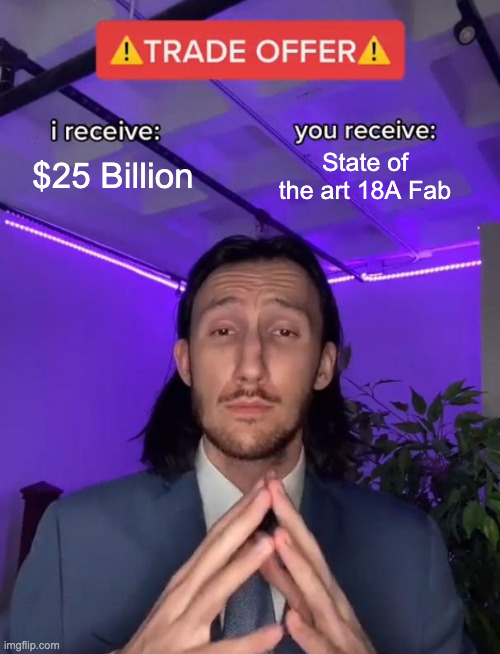
After the initial report on Elon Musk’s planned Terafab project, there were a whole lot of questions about how Musk was going to get his ambitious semiconductor fab project up and running. Now a very, very big piece of the puzzle (like, 85%) has been solved: Intel is going to build it for him.
In an unexpected turn of events, Intel on Tuesday said that it had joined Elon Musk’s TeraFab project. The announcement mentions Intel’s ability to develop, produce, and package advanced processors in high volumes, which could help Tesla, SpaceX, and xAI to get enough compute performance for next-generation AI and robotics applications. However, the announcement made in an X post you can expand below does not reveal how exactly Intel will help TeraFab.
“Intel is proud to join the Terafab project with SpaceX, xAI, and Tesla to help refactor silicon fab technology,” a statement by Intel reads. “Our ability to design, fabricate, and package ultra-high-performance chips at scale will help accelerate Terafab’s aim to produce 1 TW/year of compute to power future advances in AI and robotics. It was fun hosting Elon Musk at Intel this past weekend!”
The announcement is not accompanied by any press releases or SEC filings, which raises questions about the framework of the collaboration between Intel and TeraFab, as well as any possible legal bindings. In fact, the post in X is deliberately written in a way that barely reveals any concrete details about the structure of the partnership.
Officially, TeraFab is positioned as the “most epic chip-building effort ever” that is to combine “logic, memory and advanced packaging under one roof,” which implies localized production in a massive facility. Furthermore, the company is hiring managers to build a greenfield semiconductor fabrication plant in Texas. By contrast, Intel’s wording rather implies a virtual semiconductor production ecosystem, or even a consortium that involves chip design, manufacturing, and packaging at Intel and demand from Tesla, SpaceX, and xAI. How such a consortium would differ from a typical wafer supply agreement that large companies tend to have with their suppliers is something that is unclear at this point.
It makes perfect sense for one of only three global semiconductor manufacturers (and the only American company of the three) to help Musk realize his vision. Though nobody has spelled it out, my guess is it’s going to be very similar to the way Apple funds its manufacturer ecosystem through partner build-outs: Musk is going to pay Intel to build and run the fab, and Musk’s Telsa/SpaceX/xAI consortium is going to buy the dedicated output at a given price for x number of years, after which Intel can use the fab for other projects.
This makes a great deal of sense for both parties, especially if Intel has its 18A process dialed in. This is not a given, as Intel’s process screwups at previous nodes let TSMC and Samsung lap them in the sub-10nm race. But Intel yields at that node are reportedly rising.
And having Intel do all the heavy lifting means Musk’s new company doesn’t have to negotiate with Applied Materials, ASML, LAM, etc. Intel already has standing purchase agreements with all of them, and likely already knows what it wants and what the lead times will be to equip the new fab. Not to mention already knowing which contractors they’ll get to bid to build it.
If that’s actually what’s happening, that clears up a whole lot of questions about the project. Now, it doesn’t make Musk’s crazy “2027 volume production of 1 million wafer starts a months” any more feasible, but a fully functional Intel fab up and running at full-tilt by 2029 pumping out chips for xAI/SpaceX/Telsa is entirely feasible.
Russian authorities are working hard to tighten control over the internet. Roskomnadzor recently began blocking Telegram, but users continue to access the platform via VPNs. The Kremlin is now attempting to censor VPNs as well, and this onion-layered approach to censorship is disrupting some critical domestic online services.
According to Telegram CEO Pavel Durov, the Kremlin’s increasing efforts to control and censor the global internet are causing widespread problems for Russian users. The Russian-born entrepreneur confirmed that Telegram is now banned in the country, yet more than 50 million Russians continue to use it daily via VPNs.
Moscow authorities have spent years attempting to control and block VPN platforms, Durov said. However, their latest efforts to restrict encrypted traffic and tunneling protocols have led to widespread failures in banking apps. Over the weekend, cash became the only reliable payment method across much of Russia.
According to unnamed industry sources cited by Bloomberg, the crackdown on VPNs may have triggered significant connectivity issues for banking platforms. Roskomnadzor’s filtering system was reportedly overloaded, causing reliability and network stability problems across the Russian internet.
Russia is attempting to push its citizens toward a domestic “super-app” called Max, designed to provide access to social media and mobile payment services – similar to how China’s WeChat app, Weixin, operates. Beijing authorities have unrestricted access to all traffic on Weixin, and the Kremlin appears to be aiming for the same level of control with Max.
Here’s another example of the “new” Russia acting a whole lot like the old Soviet Union. Mere individuals will not be allowed to keep secrets from the glorious state, comrade.
But the Soviet Union barely lasted into the Internet age. Its communications infrastructure was built from the ground-up to spy on citizens, with entire floors dedicated to KGB agents constructed above telephone exchanges. It’s quite a different task to try to tap today’s vast array of encrypted digital communication channels. Ordinary companies frequently have a tough time locking down their own digital infrastructure, because it’s hard to tell just what systems are communicating with other systems on which ports.
Now scale up the problem to an entire nation that’s been cut out of the world financial system for waging an illegal war of territorial aggression, and a tyrannical government blocking vast swathes of what Internet is left in the name of information control like Hans Gruber’s minion chainsawing through the Nakatomi Tower’s trunk cables in Die Hard. All sorts of things you want to keep working are going to break.
I also suspect the attempt to be a futile one, at least for VPN users. I suspect the technical minds behind those are far more adept than the government censors trying to block them.
Russia citizens are getting a lose/lose/lose scenario. They’re losing a war, basic civilizational functions are breaking, and Vlad’s Big Adventure has Russia slipping back into totalitarianism.
A pilot is returned (at the cost of a few airframes), more high-ranking IRGC and Hezbollah scumbags dirtnapped, a ballistic warhead plant blows up real good, and a Soleimani offspring gets skanky.
Both F-15 pilots have now been safely rescued from Iran:
FROM PRESIDENT DONALD J. TRUMP
WE GOT HIM! My fellow Americans, over the past several hours, the United States Military pulled off one of the most daring Search and Rescue Operations in U.S. History, for one of our incredible Crew Member Officers, who also happens to be a highly respected Colonel, and who I am thrilled to let you know is now SAFE and SOUND! This brave Warrior was behind enemy lines in the treacherous mountains of Iran, being hunted down by our enemies, who were getting closer and closer by the hour, but was never truly alone because his Commander in Chief, Secretary of War, Chairman of the Joint Chiefs of Staff, and fellow Warfighters were monitoring his location 24 hours a day, and diligently planning for his rescue. At my direction, the U.S. Military sent dozens of aircraft, armed with the most lethal weapons in the World, to retrieve him. He sustained injuries, but he will be just fine. This miraculous Search and Rescue Operation comes in addition to a successful rescue of another brave Pilot, yesterday, which we did not confirm, because we did not want to jeopardize our second rescue operation. This is the first time in military memory that two U.S. Pilots have been rescued, separately, deep in Enemy Territory. WE WILL NEVER LEAVE AN AMERICAN WARFIGHTER BEHIND! The fact that we were able to pull off both of these operations, without a SINGLE American killed, or even wounded, just proves once again, that we have achieved overwhelming Air Dominance and Superiority over the Iranian skies. This is a moment that ALL Americans, Republican, Democrat, and everyone else, should be proud of and united around. We truly have the best, most professional, and lethal Military in the History of the World. GOD BLESS AMERICA, GOD BLESS OUR TROOPS, AND HAPPY EASTER TO ALL!
Evidently extracting the pilot was a considerable operation:
“Two C-130 Hercules & Little Bird Destroyed.” Evidently they got stuck in the sand and had to be destroyed by American forces after the crew were rescued. Plus reports of a running gun battle where American forces had to stomp more Iranian hostiles.
Ed Driscoll at Instapundit put up several tweets at foreigners not understanding that America cares a whole lot more about the lives of pilots than replaceable hardware.
Checking in on “Le Dying Empire” meme:
The US lost one 40 year old fighter jet over the course of 12,000 combat sorties then immediately rescued the pilot in hostile territory – while simultaneously sending astronauts to the moon. https://t.co/5XAulhMCWGpic.twitter.com/0Oti3WLAE5
You once were the feared boogie man of the Middle East. Instead, you get the complete shit kicked out of you for 5 weeks straight, your entire navy sunk, your supreme leader killed, and you FINALLY shoot down 1 plane
You once were the feared boogie man of the Middle East. Instead, you get the complete shit kicked out of you for 5 weeks straight, your entire navy sunk, your supreme leader killed, and you FINALLY shoot down 1 plane
This is finally your moment. You can parade the pilot on TV and use him as negotiating leverage
But instead, Air Force Pararescue puts boots on the ground on your home turf, we basically build a whole patrol base including a Forward Air Refueling Point, kill hundreds of your dudes, something goes wrong with one of the C-130s at the FARP on our way out, we’re not even cortisol spiked so we simply just fly in another plane and blow up the old one instead of even bothering to do any maintenance just because of how much money we have that we can simply buy a new plane
Good grief. I haven’t seen a beatdown this bad since Will Stancil got molested by Grok. This is honestly embarrassing for the IRGC at this point. That was LITERALLY your home territory where you know all the terrain and have home field advantage, we have never done real boots on the ground operations in Iran before, and you still lost.
“Iranian state-affiliated media report that Mohammad Ali Fathali-Zadeh, a brigadier general in the Islamic Revolutionary Guard Corps and commander of the Fatehin unit, was killed on Wednesday.”
“IDF Eliminates Senior Commander of Hezbollah’s 1800 Terror Unit in Beirut Strike… Israeli fighter jets “conducted a strike in Beirut and eliminated Hamza Ibrahim Rakin, Deputy Commander of Unit 1800, along with the unit’s Operations Officer.”
“Israel strikes ballistic warhead plant, ‘heart’ of Iran’s military complex in air strikes on Tehran.” It blew up real good.
Caveat: Real explosions are interspersed with AI videos of the tunnels underneath.
“Iran’s highest bridge linking Tehran to Karaj is struck in a joint US-Israeli strike.”
Tousi is reporting inter-regime strife between different elements over controlling the government.
A financially motivated data theft and extortion group is attempting to inject itself into the Iran war, unleashing a worm that spreads through poorly secured cloud services and wipes data on infected systems that use Iran’s time zone or have Farsi set as the default language.
Experts say the wiper campaign against Iran materialized this past weekend and came from a relatively new cybercrime group known as TeamPCP. In December 2025, the group began compromising corporate cloud environments using a self-propagating worm that went after exposed Docker APIs, Kubernetes clusters, Redis servers, and the React2Shell vulnerability. TeamPCP then attempted to move laterally through victim networks, siphoning authentication credentials and extorting victims over Telegram.
Also from Ed Driscoll, the niece of Qasem Soleimani living like a slutty American girl here while supporting the mullah regime:
I was considering this from the American perspective, but from the Arabic, Iranian, and Muslim perspective this is a huge propaganda coup for the American government. These photos completely discredit Iran, at a moment when Iranian soldiers are deserting and demoralized. https://t.co/oGsNeTh97opic.twitter.com/3zRcJ1eIMB
Iranian is still lobbing missiles at its neighbors. “Iranian forces struck Bahrain’s BAPCO oil refinery this morning, setting the facility’s tank farm ablaze.”
Prophecy for two days from now: “U.S. President Donald J. Trump in a post Easter Sunday directed at Iran via TruthSocial: “Tuesday will be Power Plant Day, and Bridge Day, all wrapped up in one, in Iran. There will be nothing like it!!! Open the Fuckin’ Strait, you crazy bastards, or you’ll be living in Hell – JUST WATCH! Praise be to Allah. President DONALD J. TRUMP.”
As always, these are just the stories I was able to gather I thought important enough to include. If you think I missed anything important, feel free to share it in the comments below.
Back when I was doing regular Texas vs. California updates, this is the sort of video I would feature. It covers why Texas is doing so much better than Europe, though the framing misses a few things I’ve tried to highlight below.
Caveat: I don’t know who “The Economic Matrix” is, but what they’re saying is generally right, but a bit incomplete.
“This is Texas. To most of the world, it’s just one of 50 American states. But if you pulled it off the US map and dropped it into the global rankings as its own nation, it would sit eighth in the world, sandwiched directly between France and Italy, with a staggering GDP of $2.77 trillion. But that’s just the start. In 2025, the Texas economy was bigger than the equivalent of the Netherlands, Belgium, Denmark, and Austria combined.”
“Texas and Europe are separated by more than an ocean. They’re separated by two completely different ideas of how a state should operate. And right now, one of those ideas is winning by a distance that gets harder to close every year. In 2024, the Texas economy grew by nearly 4%. The entire European Union managed 1%, and the gap is only getting wider.”
“The EU spent most of the last 15 years in crisis mode. A sovereign debt collapse left Greece, Spain, and Portugal on the edge of ruin.” I covered the European Debt Crisis (especially among the PIIGS (Portugal, Italy, Ireland, Greece, Spain)) as it was happening, and the thing to remember is that it was (and is) a deficit spending crisis. Like the federal government, European governments insist on spending more than they take in. Real austerity, i.e. cutting outlays until they match receipts, hasn’t failed, it’s been declared difficult and left untried.
“Years of near zero growth followed. The in 2022, Russia cut off the gas and sent inflation across the Euro zone spiking to 9.2%.” Here the video also avoids noting that another big inflation driver was the effects of the Flu Manchu lockdown across most EU economies.
“Through all of that, the Texas economy just kept climbing. The productivity gap tells the same story. Between late 2019 and mid 2024, labor productivity per hour in the Euro zone rose by 0.9%. In the US, it rose by 6.7%. Texas led that charge.”
“Look at the Permian Basin. Oil production nearly tripled in a decade while the rig count was cut almost in half because horizontal drilling and AI-guided extraction meant fewer rigs producing more oil. Same workforce, three times the output.” Oil industry-specific AI has very little do with the current general AI build-out bubble.
“There’s a mathematical reality that makes this trajectory almost impossible to reverse. At 1.5% annual growth, the EU takes roughly 47 years to double in size. At the 3.5% rate Texas usually averages, it takes 20. By the time the EU doubles once, Texas will have doubled twice. That gap compounds and it means every year the distance between these two economic models doesn’t just persist, it accelerates.”
“Mario Draghi, the former head of the European Central Bank, released a landmark report warning that without serious reform, the EU is heading toward what he called a slow agony. Leaders held a retreat to discuss it. Then they went back to their committees.” Future pain is abstract, while the electoral pain of trying to reform things is far more immediate.
“Since 2020, more than 200 companies have moved their headquarters to Texas. Tesla relocated to Austin in 2021. Chevron, one of the largest energy companies on Earth, announced its move to Houston in 2024. Charles Schwab, CBRE, SpaceX. More than half of these relocations came from California alone.”
“These are not satellite offices or mailbox moves. The reason they gave was simple. The regulatory environment in California made expansion too slow and too expensive. Texas made it fast, cheap, and permanent.”
“Spotify was founded in Stockholm, but listed on the New York Stock Exchange. Skype was built in Estonia and Luxembourg, then bought by Microsoft and absorbed into Redmond. ARM was designed in Cambridge, England, then acquired by a Japanese conglomerate and listed in New York. Europe keeps building the talent. America keeps cashing the check.”
“Beneath the growth stats and the corporate migrations, there’s one factor that explains this gap better than anything else: Energy. Texas produces more energy than almost any country on Earth. Not other American states, actual nations. Between 2007 and 2023, while the rest of the United States saw energy consumption drop by about 5%, Texas went in the other direction. Energy use in the state climbed by 21% and the industrial sector alone saw a 28% jump in demand. This was not a state focused on conservation or cutting back. Texas was building oil rigs, refineries, chemical plants, and massive wind installations, all at the same time.” Those wind farm installations were the result of subsidies, and they’re not really building new ones anymore.
“The reason Texas could pull this off comes down to one decision made decades ago. Texas built its own power grid, specifically to escape the slow motion gears of federal regulation. The result, solar capacity that grew 32% in just 2024, wind generation that leads every other American state, and a massive natural gas fleet running underneath it all to keep the lights on when the sun goes down, cheap, abundant, predictable, and fast to build.” Again, the solar build-out was aided by subsidies.
“For decades, the European energy models rested on one assumption. Buy cheap gas from Russia, build out renewables slowly, and keep industrial costs manageable. When Russia invaded Ukraine in 2022, that assumption collapsed overnight. Wholesale energy prices went vertical. Industrial electricity costs in Germany suddenly hit three to four times what businesses in Texas were paying for the exact same power.”
“Look at what happened to BASF, the largest chemical company in the world. For over 150 years, their home was Ludwigshafen, Germany, a sprawling industrial complex on the Rhine that employed tens of thousands. After 2022, they announced billions in cuts to that site. Plants shuttered, thousands of jobs gone. But BASF didn’t disappear. At the exact same time, they were breaking ground on new facilities in Freeport, Texas. Same company, same products, two completely different decisions driven entirely by the price of electricity.” Probably not just electricity. Union work rules in Germany are considerably less flexible than those in right-to-work Texas.
“France tried to escape this trap by leaning into nuclear power, which once covered 75% of French electricity needs. But that infrastructure is aging. New reactor projects like Flamenville have run tens of billions over budget and more than a decade behind schedule, and the political will to build more has been stuck in debate for a generation. The old Russian gas model is dead. The nuclear renaissance has not arrived. And permitting a single wind farm in the EU can take 7 to 10 years.”
“In Texas, the same process often takes a few months. Energy prices act like a hidden tax on everything from manufacturing steel to running a server farm to heating a bakery. European businesses pay that tax every single day. And Europe does not have the gas, does not have the grid independence, and does not have the permitting speed to change that.” Actually, Europe does have oil and gas reserves it refuses to develop.
“Cheap energy is a huge piece of the puzzle. But the real accelerant for the Texas economy has been something even harder for Europe to copy. And it starts with one number. The average top personal income tax rate across 35 European countries is 38.5%. In Denmark, that number hits a staggering 60.5%. In Germany, France, and Italy, high earners face rates between 45 and 50%.”
“In Texas, the state income tax rate is zero. It’s always been zero, and the Texas Constitution actually makes it illegal for the state to introduce one without a direct vote from the public. This is not a temporary policy that a new government can reverse after the next election. It’s locked into the foundation of the state.”
“Texas still has high property taxes, so the total burden on a normal resident is not as dramatic as that 0% headline suggests. But for the people these economies are competing over, the math is brutal. A senior software engineer in Munich earns roughly €75,000 and takes home about $45,000 after income tax and social contributions. The same engineer in Austin earns $140,000 and takes home over $105,000. same skills, same screen, more than double the money in their pocket at the end of the year. Between 2020 and 2024, Texas startups pulled in over $46 billion in venture capital. In Q1 2025 alone, Texas tech companies raised nearly $3 billion, the biggest single quarter the state had seen in over 2 years, with massive deals in cyber security, defense tech, and biotech.”
“Compare that to the other side of the Atlantic. The entire European Union raised about $17.5 billion for AI funding in all of 2025. The US raised nearly $70 billion for generative AI alone by midyear. Not total tech, not all venture capital, generative AI alone. These two regions are not competing in the same category.”
“The EU’s regulatory framework was designed to protect consumers and level the playing field. GDPR [General Data Protection Regulation], the AI Act, 27 different national compliance regimes stacked on top of each other. The intentions were sound, but the unintended result is that the compliance costs favor massive American companies like Google and Microsoft, who can absorb them easily over smaller European rivals who can’t.”
“None of this means Texas has it all figured out, because the truth is it hasn’t. The most visible problem is housing. In 2019, a median Texas family earned 62% more than they needed to buy a median home. By 2023, that cushion had collapsed to just 7%. Not 62%, 7%. Over a third of Texas households now spend more than 30% of their income on housing.” That’s a national problem, partially engendered by the Flu Manchu shutdowns, partially by restrictive local building codes. “Affordable housing” blather snipped, since this is just more unnecessary government subsidy and intervention.
“The workers who actually build the Texas economy, the Tesla line workers, the nurses, the warehouse staff, can’t afford to live in the cities their labor is building anymore. They commute in from further and further out, and the roads, the housing, and the services all fall behind.” Partially true, partially false. Austin housing prices exploded, but have come down dramatically. Dallas and San Antonio prices spiked, then plateaued. Houston prices have continued climbing, but gradually.
“When a place grows this fast, the infrastructure simply can’t keep up.” True of Austin, less true of Houston, though having to rebuild certain interchanges is making things a nightmare for certain commuters.
Discussion of energy grid problems and the 2021 ice storm snipped, since I think we’ve covered those enough here.
“The problems in Texas are the problems of a place growing too fast. The problems in Europe are the problems of a place that is barely growing at all. In that sense, Texas and Europe have something in common. Both are stuck. The difference is that Texas is gridlocked because too many people are trying to get to work. Europe is gridlocked because too many committees are still deciding whether to build the road. Right now, Texas has its sights set on overtaking France, a G7 nation. At current growth rates, that gap closes faster than most people realize. And France’s response, like the rest of Europe’s, has been to wait and see.”
“The real question isn’t whether Europe can change. It’s whether it actually wants to change badly enough to feel the pain that comes with it. Because while Brussels is still writing the rule book, the game is already over for the economies Texas has already passed. The ones still in its path just haven’t checked the scoreboard yet.”
Left out of this coverage: Texas has a constitutionally mandated balanced budget, while the overwhelming majority of European nations keep running budget deficits to keep their cradle-to-grave welfare states afloat.
Not to mention a government run by Republicans rather than unstable coalitions including the Greens…
Happy Good Friday! More Democrat voting fraud, Iran manages to shoot down a couple of planes, more California fraud under Governor Hairgel, Commies gonna commie, Microsoft behaving (and performing) badly, Pakistan’s nefarious actions backfire (yet again), the best rifle for a militia, and a list of bad actors in the job market.
This is Democrat Joel Caldwell of the “Coalition for the People’s Agenda,” a Fulton County ballot-harvesting NGO chief—caught on tape admitting it all.
Democrats are stuffing ballot drop boxes with fraudulent votes, and it’s all caught on videotape. He also admits this is how they rigged the 2020 election and why Democrats fight to the death against voter ID.
• They pay people to illegally ballot-harvest.
• They bribe ballot counters and election officials.
• They forge and falsify ballots.
And the Atlanta mayor straight-up stole the election.
He says it all himself—on tape.
Joel Caldwell:
“That’s what happened in 2020, ’cause that’s when the ballots—they started stuffing them ballots and people stuffing them ballots, and they got videotape of them, but nobody talks about it. That’s why Trump was making that big deal about it, because you see it on videotape. It’s like, come on. We see the man pull up and put a hundred ballots in this box. You know? You can’t do that sh*t.
So groups were paying people to do just that—drop off ballots.”
He continues: That’s why Democrats fight to the death against voter ID laws.
Joel Caldwell:
“That’s why the Republicans are always trying to fight the ballot—you know, that’s the whole argument, because Republicans are the ones who put out that kind of stuff, so they want voter IDs and stuff. Democrats are fighting voter ID laws. It’s a two-sided thing. That’s what they’re fighting over. Republicans are trying to say, ‘Hey, look, we got proof of this sh*t.’
And the Democrats are like, well, we don’t want voter ID laws, and we want to make it where you can just drop your ballot off—online voting and different things they try to come up with.”
Iran manages to shoot down both an F-15 and an A-10 on the same day. Two of the three downed airmen have already been rescued. It’s worth noting that neither of those planes are remotely stealthy.
Earlier this week, Jose Medina-Medina, an illegal immigrant whom the Biden administration caught and released at the border, murdered Loyola University freshman Sheridan Gorman. Medina-Medina had previously been arrested at least twice in Chicago, yet was released by local authorities, thanks to their sanctuary policies. According to reports, he approached her, raised a gun, and opened fire as she tried to flee. She was pronounced dead at the scene.
The Democratic Party’s response has been nothing short of horrific.
Snip.
The reaction from Democrats to Gorman’s death has been so despicable that Sen. John Fetterman (D-Pa.) unloaded on his own party over it.
“Why can’t we just talk about that life lost?” Fetterman told Fox News’s Bill Hemmer. “Why can’t we just acknowledge that this is serious, serious failure?”
Fetterman also invoked the Laken Riley Act, the legislation requiring the detention and deportation of illegal immigrants who commit crimes. Fetterman was one of only a handful of Democrats to vote for it — a fact he’s clearly not going to let his colleagues forget.
“I think only seven or eight Democrats even voted for [the] Laken Riley [Act],” he said. “Why can’t you just agree that if you’re breaking the law and you’re already here illegally, deport them? I just don’t understand.”
He continued, “Tragedies like what happened to that young woman, they are gonna continue to happen,” he said. “That’s beyond common sense.”
Hemmer pressed him on why Democrats can’t seem to get there, and Fetterman gave an honest, if uncomfortable, answer.
A Just the News investigation has detailed how a wealthy Marxist activist best known for the funding of a global financial network both inside the U.S. and around the world has extensive ties to Chinese Communist Party-linked organizations inside of China.
China-based entrepreneur Neville Roy Singham lives and works in Shanghai, — which the American businessman now calls home — where he runs his network of pro-CCP news sites and other China-linked endeavors. Singham, who sold his ThoughtWorks tech company in 2017, has used the money to fund openly communist endeavors worldwide. Just the News can show that inside of China, Singham and his network collaborate with an array of Chinese propaganda sites, Chinese universities, and other Chinese groups committed to advancing the CCP.
Singham leads and funds a global financial and activist network that operates inside the U.S. and many other countries, and while he rarely grabs the spotlight for himself in public speeches, he did so in November through the Chinese release of a report that sought to denigrate U.S. and Allied Power contributions to WWII.
Singham admitted during a CCP-backed forum in Shanghai in November that he had written the 174-page report to combat the U.S.-backed “international rules-based order” — which he called a “lie” — and to help the CCP and its longtime strongman Xi Jinping achieve a “new world order” more favorable to China. This report and the conference where it was introduced helped expose the extensive CCP-linked network in which Singham is ensconced within China.
Just the News reviewed hundreds of pages of Chinese business documents and U.S. tax records, English and Chinese language news sites, Chinese government websites, and more in an effort to provide the most comprehensive look yet at Singham’s operations from his perch in Shanghai.
Also: “Singham colludes with CCP to rewrite history of WWII to advance Xi Jinping’s ‘new world order.'”
The wealthy Marxist businessman behind a sprawling far-left network is collaborating with the Chinese Communist Party to denigrate the Allied actions in World War II in an effort to upend the U.S.-led international system and to advance Chinese leader Xi Jinping’s “new world order.”
China-based businessman Neville Roy Singham leads and funds a global financial and activist network that operates inside the U.S. and many other countries, and while he rarely grabs the spotlight for himself in public speeches, he did so in November through the release of a report that denigrates U.S. and Allied Power contributions to WWII.
Singham directly admitted during a CCP-backed forum in Shanghai in November that he had written the 174-page report to combat the U.S.-backed “international rules-based order” — which he called a “lie” — and to help the CCP and its longtime strongman Xi achieve a “new world order” more favorable to China.
The wealthy communist activist summed up the crux of his WWII argument thusly: “As we commemorate the 80th anniversary of the victory in the World Anti-Fascist War (WAFW), the Western powers spin their familiar tale: U.S. industrial might and British resolve saved the world from fascism. This is a lie. The truth burns in the numbers: while the Western powers calculated their economic advantage, the Soviet and Chinese peoples paid in blood. Fascism was defeated not by Anglo-American capital but by socialist leadership and mass heroism – a brilliant strategy from Moscow and Yan’an, unbreakable resilience from workers and peasants who refused to surrender, and a sacrifice that saved humanity from slavery.”
Multiple senior HHS officials estimate that, under Gavin Newsom, California’s state Medicaid program has lost 25 percent of its budget to fraud. This would mean it is currently losing $50 billion a year to scammers, fraudsters, and organized crime rings.
Snip.
We conducted interviews with public officials, fraud experts, and political figures, and reviewed hundreds of pages of government reports, state audits, criminal indictments, and other public records on California fraud. From unemployment insurance and Medicaid to failed homeless initiatives and welfare programs, seemingly every state program has been compromised by criminals. The best estimates suggest that, on the governor’s watch, fraudsters, scammers, and organized crime rings have stolen at least $180 billion from taxpayers.
In this firehose torrent of news, less attention than is proper has been paid to the fact that we’re finally going back to the moon. Or, technically, around it, since they’re doing the figure flyby of the dark side. They’re already halfway there…
Though the mainstream media will undoubtedly portray them as “mostly peaceful,” much of what we saw at the “No Kings” protests Saturday was anything but, whether through actions or symbols used during the demonstrations.
We’ll start off with New York City, where the Communist flags were in full effect:
BREAKING: Leftists in NYC chant “There is only one solution, Communist revolution” at the No Kings rally.
Communist flags at the NYC ‘No Kings’ protest pic.twitter.com/bIh2UiwkDI
— NJEG Media (@NJEGmedia) March 28, 2026
Snip.
Meanwhile, in Minnesota, Gov. Tim Walz (D) was pledging solidarity with the Somali community:
“We will never leave the side of our Somali Minnesotans. Here’s our pledge to you, our Somali Minnesotans, your grandchildren will still be here when that orange clown is in the dustbin of history.”
I guess its too much to ask a Democrat governor to stand with actual Americans. Plus rioting in Denver.
Earlier this week the U.S. Supreme Court heard oral argument in a case challenging a Mississippi statute allowing mail-in ballot received up to five days after Election Day to be counted.
The law appears to defy three federal laws that require that federal elections be held the first Tuesday after the first Monday of November. The question is what did Congress mean by Election Day. Was it a day, five days later, a month later. Does Election Day mean election season.
The 5th Circuit ruled against Mississippi, which brought the case to SCOTUS. It could have profound impact on Democrats’ mail-in ballot strategy if ballots must be received by election official by Election Day.
I discussed the case and oral argument, plus redistricting and the Equal Protection Projects challenge to discriminatory NY State education practices, with Jesse Kelly, who tweeted out the portion regarding NY State: “It appears Kathy Hochul is defying the Supreme Court.”
Pam Bondi is out as attorney general, President Trump announced Thursday, and Deputy Attorney General Todd Blanche will serve as acting attorney general.
“Pam Bondi is a Great American Patriot and a loyal friend, who faithfully served as my Attorney General over the past year,” Trump said in a statement on Truth Social. “Pam did a tremendous job overseeing a massive crackdown in Crime across our Country, with Murders plummeting to their lowest level since 1900.”
“We love Pam, and she will be transitioning to a much needed and important new job in the private sector, to be announced at a date in the near future, and our Deputy Attorney General, and a very talented and respected Legal Mind, Todd Blanche, will step in to serve as Acting Attorney General,” he added.
The announcement came just one day after Bondi was at the White House to attend Trump’s address to the nation on the Iran war. She had also accompanied Trump to the Supreme Court to watch oral arguments in a birthright citizenship case.
The handling of the Epstein files and the lack of progress on indicting anti-Trump conspirators like James Comey were suggested as reasons for Trump letting her go.
Target has gone from pushing the radical transsexual agenda to being boycotted by Randi Weingarten for not condemning ICE. I haven’t shopped there once since they started boosting the tranny agenda, but maybe it’s time to go back again…
Pakistani is enjoying a nice, rich dinner of blowback.
For decades, the Islamabad establishment has played a dangerous game, nurturing the Taliban as a strategic depth agent against India. Today, this plan backfires, and the resulting explosion of violence threatens to send a fresh wave of illegal immigration toward the already strained borders of the European Union.
The “open war” declared by Defence Minister Khawaja Asif marks the end of a thirty-year illusion. The apprentice has not only left the master. He has now turned openly against him. The March 16 strike on Kabul was the moment masks fell. When Pakistani warplanes hammered a rehabilitation centre in the heart of the Afghan capital, the “Islamic brotherhood” of the two neighbours officially ceased to be.
Islamabad claims it is hunting the TTP — the Pakistani Taliban who find sanctuary under the wings of their Afghan cousins. Kabul denies it. The result is a cycle of diplomacy-in-name-only, where the only language spoken is the language of the air strike, the AK-47 and the suicide vest. This is the reality of the post-American vacuum.
Critics of the Biden presidency, watching from America and Europe, see the vindication of their most cynical instincts. They warned that the vacuum left by the 2021 withdrawal would be filled by chaos. They were right. Just look at Bagram Airfield. It once was the crown jewel of American power. It has now become a trophy in a war between two states the West can no longer control.
While the world’s eyes are fixed on the Iranian plateau, South Asia is burning. The region’s most volatile border is no longer Kashmir. It is the frontier where the Taliban’s jihadist agenda meets Pakistani nuclear-armed desperation. How safe is the world when a nuclear power goes to war with a ghost? The answer is terrifying. Pakistan’s military capacity dwarfs that of the Taliban, yet the Taliban have time, resolve and a complete lack of accountability.
While the Pakistani economy teeters and its domestic security implodes with a second insurgency front up against Baloch separatists in the south, the Afghan Taliban are playing the long game. They see a Pakistan that is overextended and a West that is exhausted. They are not interested in ceasefires brokered by Qatar or Turkey. They are interested in survival and the expansion of their ideological reach.
Almost nobody talks about it, but we are witnessing the “Gaza-fication” of the Durand Line. The same knowhow of displacement and grazing the land is being applied to the tribal areas. Millions of thousands of people have already been displaced. But the humanitarian cost is only a footnote in a larger, more brutal calculation.
For Islamabad, this is an existential fight against the TTP thorn in its side. For Kabul, it is about defending the sovereignty they fought for twenty years to reclaim. Neither side can afford to blink. The light of the old order is fading. The era where the Pakistani military could manage Afghanistan like a colonial fiefdom is over. The trust is dead.
Trump’s “America First” doctrine means that if Pakistan wants to fight this war, it will do so without a blank check from the Pentagon. The bitter truth for the region is that old security guarantees are gone. We are entering an era of fluidity, where borders are written in fire. The “special relationship” between Islamabad and Kabul has become hatred. The Taliban have proven they can survive an American occupation. Surviving Pakistan’s aggression should not be that hard.
And then there are all of those “refugees” Euroelites seem bound and determined to import. (Hat tip: Director Blue.)
The attack involved a sophisticated mix of long-range unmanned systems, likely between eight and fifteen primary strike drones supported by smaller decoys designed to saturate Russian air defenses. These drones traveled approximately one thousand kilometers from Ukrainian territory, penetrating deep into Russian airspace and reaching the Gulf of Finland near the Estonian border. Evidence suggests the use of fixed-wing kamikaze drones optimized for endurance and precision. Ukrainians also utilized small prop-planes modified to fly as unmanned aircraft, mounting droppable Fab bombs on the bottom, which could be dropped on target, in addition to the craft being used as a kamikaze platform.
Also:
Ukraine has delivered a decisive strategic blow just as Russia expected to capitalize on soaring oil prices driven by the Iran war, but got its export system crippled instead. With unimaginable 40% of its oil export capacity wiped out, ports burning for days, and follow-up strikes continuing, the question is no longer whether Russia can recover quickly, but whether Ukraine will strike again before Russia has the chance to do so.
After over four years of war, Ukraine’s military says it’s testing an exoskeleton in the field that can help soldiers more easily load artillery and run at speeds of up to 12 mph over sustained periods. The tests would mark one of the first known examples of exoskeletons used on the front lines of an active military operation.
A Facebook video shared late last week by Ukraine’s 7th Air Assault Corps shows a handful of soldiers putting on the device while inside of a muddy artillery trench. The device itself wraps around a soldier’s waist and legs and is supported by a back brace. The military claims that it can reduce overall load on leg muscles by 30 percent. In practice, that means the devices should make it easier for soldiers to pick up and load heavy artillery rounds. Each round can weigh upwards of 100 pounds, depending on the particular caliber used. Since a soldier on the battlefield may load several dozen of those runs every day, all of that weight adds up and can increase the odds of injury or fatigue.
Not quite Heinlein’s powered armor, but we’re getting there…
Paxton’s office has now proposed detailed rules to implement the statute. The proposal was submitted to the Secretary of State on March 16 and published in the Texas Register on March 27, triggering a public comment period before the rules can be finalized.
The draft rules flesh out how SB 17 will work in practice, with the Office of the Attorney General as the central enforcement hub for the ban.
One of the most significant features is a new duty to report suspected violations.
Under the proposal, anyone involved in facilitating a real estate transaction—such as mortgage lenders, title insurance companies, property insurers, appraisers, and licensed real estate professionals—would be required to report any suspected SB 17 violations to the attorney general.
Complaints would have to be submitted either through an online complaint form on the OAG’s website or by mail to a designated address. Failure to report may subject entities to enforcement action once the rules are in place, potentially deputizing the real estate industry to help police foreign adversary land deals.
The rules would also place a tight lid on information that reaches Paxton’s office.
All complaints, civil investigative demands, and related materials submitted to or issued by the OAG would be treated as confidential and not subject to public disclosure, except when disclosure is required by law. That means Texans may see enforcement actions and lawsuits, but not necessarily the complaints and background investigation files that triggered them.
Wither Canada? “The 177,000 signature threshold has now been passed, officially clearing the requirement for an Alberta independence referendum on October 19th.”
John Cleese: “The British do not like the kind of diversity that intends to take over Britain and kill any infidel who does not convert to Islam.”
Weirdly, Microsoft is also saying that “Microsoft says Copilot is for entertainment purposes only, not serious use — firm pushing AI hard to consumers and businesses tells users not to rely on it for important advice.” Which is ironic, since right now its website touts Copilot as “AI built for work.”
Stephen Green: And the first piece of software to break on the moon mission? Microsoft Outlook.
And speaking of Microsoft woes, “Microsoft closes worst quarter on Wall Street since 2008 on AI concerns.”
Speaking of bad actors in the job market: “Outrage as Oracle makes thousands of foreign-worker requests amid layoff bloodbath.”
As thousands of Oracle employees awoke on Tuesday to an email informing them they were being laid off, the workers likely didn’t know the tech company had been busy trying to hire foreign staff.
According to U.S. Citizenship and Immigration Services data, Oracle filed for roughly 3,126 petitions to employ H-1B workers in fiscal years 2025 and 2026. Employers must submit the paperwork when seeking to hire foreign workers in specialty occupations like technology. Some 436 of those petitions were filed this year alone.
Amazon, which in January said it would axe 16,000 corporate employees, has filed for some 2,675 H-1B petitions during the same two-year fiscal period. That came on top of news in October that the retail giant was axing 14,000 corporate workers.
What’s the best gun for a militia? No surprise that three different gun experts (including Ian McCollum) all pick the AK-47.
Critical Drinker finally watches Mr. Inbetween, and really likes it. It’s been on my radar for a while, but there doesn’t seem to be a US DVD or Blu-Ray release of it, and I don’t have any streaming service.
As usual, open video tabs start to accumulate on things that aren’t quite worth a separate post, but a bit too interesting to throw into a LinkSwarm. So here’s a tab-clearing roundup.
Inside Apple’s push for domestic semiconductor production:
Includes a look at TSMC’s Arizona fab complex, an ASML EUV stepper (which we covered here), and a Foxconn assembly line.
The title of this Jordan Petersen lecture is “Why South Park Works,” but it’s actually about how human perception works.
As a bonus, here’s a version of the basketball-gorilla test he talks about.
Critical Drinker on Paramount winning Warner Brothers:
New boss David Ellison is a fan of male action heroes, and not a fan of “The Message.” “I think it’s fair to say this guy sees middle America for what it is, a potentially huge market that’s been badly neglected in recent years, mostly by people who absolutely hate them.”
“If ever there was a definitive signal that the age of identity politics and the message has come to an end in Hollywood, I think this just might be it. The great experiment that’s decimated pop culture for the past decade is well and truly over. Good fucking riddance.”
Testing Ukrainian anti-drone shotgun slugs:
Basically metal petals attached with string.
Why Teddy Roosevelt didn’t fight in World War I:
To grossly boil down: because Woodrow Wilson didn’t want a no-win situation of either an ex-president ending up dead in a trench or making Roosevelt so popular again that he could beat him in the 1920 presidential election.
More proof of widespread Biden Administration abuse and fraud uncovered, more news from the Iran war, the Trump Administration fights welfare fraud, LA displays both welfare and voting fraud, more lefty sorts stealing funds to feather their own nests, Muslim EPIC City development runs into more roadblocks, and some weird video game news.
It’s the Friday LinkSwarm!
Thanks for everyone who contributed to the Pay For Buddy’s Vet Bill Fund. He’s already doing so much better that you can’t tell he was hurt, though some of that is probably the pain pills.
Newly released records in the Senate investigation into the weaponization of government raise questions about whether the FBI went on a fishing expedition targeting Trump advisors who were never charged with crimes and whether Special Counsel Jack Smith’s prior testimony to Congress was truthful.
The documents were made public by Chairman Chuck Grassley, R-Iowa, before a Senate Judiciary Committee subcommittee hearing into alleged abuses by the Biden-era FBI and Justice Department in their investigations into then ex-president Donald Trump before and during the 2024 presidential election during its probe code-named “Arctic Frost.” Just the News previously reported that Biden’s FBI paid anti-Trump ‘Sedition Hunters’ as informants in the Arctic Frost probes.
“If Watergate taught us anything, it is that even a single abuse of power carried out by a handful of individuals can shake the foundations of our Republic,” said Sen. Ted Cruz, R-Tex., Chairman of the Judiciary Committee’s Subcommittee on Federal Courts, Oversight, Agency Action, and Federal Rights.
“What we confront today, the Biden administration’s Arctic Frost scheme, is not a single act,” he continued in his opening remarks. “It is a modern Watergate trading a break-in at one office for a digital sweep into approximately 100,000 private communications, more than a dozen senators and 1000s of individuals lives.”
Cruz said that ultimately, “just like Watergate,” the judges, FBI and Justice Department officials involved should be “investigated, tried, impeached, and brought to justice.”
The scope of Smith’s probe, which centered on Trump’s challenge to the 2020 election results and the events of January 6, 2021, was truly expansive. Grassley previously released records showing that Smith’s office issued nearly 200 subpoenas in his sweeping Arctic Frost-linked case, secretly seeking records on more than 400 Republican personalities and groups. This included more than 160 Republicans–many closely connected to Trump.
The Arctic Frost was one of four separate probes that targeted Trump and his allies stretching from summer 2016 to January 2025. The other probes were code-named Crossfire Hurricane, Round River, and Plasmic Echo, Just the News reported earlier this month.
As FBI Director, Patel has personally led the effort to review those probes, uncovering evidence of a far-reaching dragnet that in some cases may have been predicated on false, misleading or uncorroborated justifications, officials previously told Just the News.
The newly-disclosed records show that the FBI ordered two sweeping subpoenas of FBI Director Kash Patel’s phone records, while he was a private citizen in Trump’s orbit. Each subpoena covered an approximately two-year time frame.
The FBI’s requests for information included demands for highly personal data of Patel’s, including Patel’s addresses (“mailing addresses, residential addresses, business addresses, and e-mail addresses”), a “call detail record” which lists inbound and outbound calls, text messages and voicemail messages, as well as sources of payment for the phone service, including credit card and bank account numbers. The FBI also demanded expansive internet session data including exact IP addresses, the document shows.
The FBI also sought–and was granted–non-disclosure orders (NDOs) from federal judges, shielding the existence of the subpoenas from Patel and his lawyers on the grounds that revealing them could result in his “flight from prosecution, destruction of or tampering with evidence, intimidation of potential witnesses and serious jeopardy to the investigation.”
Susie Wiles, Donald Trump’s then campaign manager and future chief of staff, was also targeted in the probe. The Biden-era FBI reportedly even went so far as to record a private phone call between Wiles and her lawyer in 2023 while she was actively managing the campaign of President Joe Biden’s chief political rival, according to Reuters.
U.S. intelligence intercepted Ukrainian government communications discussing a plot to route hundreds of millions of American tax dollars earmarked for clean energy in the war-torn country and move them to the United States to enrich then-President Joe Biden’s 2024 re-election campaign and the Democratic National Committee, according to a declassified intelligence report summarizing the intercepts that was obtained by Just the News….
‘The Ukrainian Government and unspecified U.S. Government personnel, through USAID in Kyiv, reportedly developed a plan that would provide hundreds of millions of US taxpayer dollars to fund an infrastructure project for Ukraine that would be used as a cover to send approximately 90% of funds allocated to the DNC to fund Joe Biden’s reelection campaign,’ the declassified summary of the intercepts stated.
Every American involved in the scheme should be prosecuted. Still doesn’t justify taking Russia’s side in their illegal war of territorial aggression.
Long overdue: “Trump Administration Launches Whole-of-Government Effort to Fight Welfare Fraud.”
Vice President JD Vance and Federal Trade Chairman Andrew Ferguson convened members of the administration’s newly created anti-fraud task force on Friday to lay out the administration’s hopes for rooting out fraud in public programs across the country.
Established by President Trump via executive order earlier this month, the task force includes newly confirmed fraud-focused Assistant Attorney General Colin McDonald and spans multiple government agencies tasked with implementing new fraud detection and reporting protocols, investigating Biden-era policies regarding fraud prevention, proposing new legislative and regulatory tools to combat fraud, and prosecuting illegal behavior when necessary to recover as much in improperly obtained funds as possible.
According to a task force memo authored by Vance and Ferguson and shared with National Review, the White House will focus primarily on high-spend, low-verification programs that “pay out large sums of money with low confidence or limited information about the ultimate recipients and uses of those funds.” Key programs that fall into this category include benefits administered through Medicare, Medicaid, the Supplemental Nutrition Assistance Program, and Small Business Administration loans.
The task force divides fraud into four main categories, according to the memo. The first category is so-called “ghost” billing where there is no real beneficiary and no real service provided, a prime example being a fake business that applied for Paycheck Protection Program relief during the Covid-19 pandemic. The second category are low-quality services provided to real beneficiaries, such as substandard medical care provided to elderly patients at nursing homes or memory-care facilities.
The third category is “upcoding” or “overbilling,” where fraudsters hand patients manipulated bills. “When hospitals commit fraud, for example, there are often real patients receiving necessary hospitalizations but with exaggerated diagnoses purporting to justify more expensive services than the patient actually needed or received,” the memo reads.
And the final category outlined by the task force is “necessity” fraud, where a real service is provided to an unqualified beneficiary. “Medicare fraud, for example, often involves real doctors giving real people treatments they don’t need, such as a person who can walk getting a wheelchair or a patient getting a lab test they don’t need,” the memo adds.
During a brief news conference on Friday, the vice president spotlighted egregious practices by autism daycare programs in Minnesota, where earlier this month one defendant, a Somali man named Abdinajib Yussuf, pleaded guilty to one count of wire fraud in a $6 million Medicaid reimbursement scheme.
“The first tragedy is that you have people who pay into the federal government, who pay into the IRS, who pay their taxes, expecting that those taxes will go to help their fellow citizens, and it’s not going to. It’s going to help fraudsters,” Vance said in remarks to the press before leading a closed-door strategy meeting with cabinet members and other senior administration officials working on the effort.
And the more important tragedy is that you have families who need these services who are unable to get them because people are getting rich off of fraud schemes, instead of making sure that autistic children and their families get access to these resources,” he added.
The task force has already cracked down on blue states and cities like Los Angeles, where the Centers for Medicare & Medicaid recently suspended 70 home-health providers and hospice centers identified as high-risk fraudulent medical programs.
Another target is also Minnesota, where federally funded nutrition-assistance fraud and state-agency-related mismanagement ran rampant during Democratic Governor Tim Walz’s tenure while somehow failing to disqualify him from Vice President Kamala Harris’s running-mate shortlist. The White House paused $259 million in federal Medicaid payments to Minnesota earlier this month as part of the administration’s response to the state’s baffling degree of fraud.
Over the coming months, task force members are also looking to highlight lax verification protocols at the state level that amplify this problem, particularly in states run by Democrats.
“I think that most citizens probably assume that there’s some verification process that takes place for the receipt of most federal benefits,” said White House Deputy Chief of Staff for Policy Stephen Miller. “The reality is that there is not. This is particularly true in blue states — willfully true in blue states in which all of these programs are operating entirely on the honor system, no verification takes place before individuals are enrolled in or receive these benefits.”
“Vance’s Anti-Fraud Task Force Suspends 70 Hospices in Los Angeles. The Senate also confirmed federal prosecutor Colin McDonald to lead the DOJ’s anti-fraud division.”
Yesterday the Telegraph told us about a “sinister new power” pulling the strings in Iran: “Ahmad Vahidi is the key cog in the regime’s chain of command.”
Unlike [Mohammad Bagher] Ghalibaf, Vahidi has remained in the shadows since the war. This is not without reason: our analysis suggests he is likely to be operating as the key cog in the regime’s chain of command and his survival is essential to its continuity. Long before the war, Ali Khamenei had entrusted Vahidi to draw up plans to further militarise the regime. If he outlasts this conflict and the regime survives, he will finally be able to implement this vision – a design that will produce a far more radical and extremist Islamic Republic.
Vahidi has unmatched experience and influence across the regime’s military, intelligence, and bureaucracy. His career began in the 1980s in the IRGC’s Intelligence Bureau, made up of the regime’s most ideologically loyal operatives. As the IRGC’s deputy for intelligence, he was hand-picked to join a secretive cohort to accompany Khamenei to visit North Korea – a trip designed to acquire missile and nuclear technology.
During the Iran-Iraq War (1980-1988), Vahidi was also one of the original members of the Ramadan Headquarters, a unit within the IRGC created to form Islamist terrorist groups globally and overseen by Khamenei.
Upon assuming the supreme leadership in 1989, Khamenei created the notorious Quds Force – the IRGC’s extraterritorial terror branch – and appointed Vahidi as its first commander. It was a testament to his loyalty. Vahidi demonstrated in that role that his vision to export terrorism was far more global than his notorious successor Qasem Soleimani.
Under Vahidi’s command, the IRGC orchestrated the bombing of a Jewish cultural centre in Argentina in 1994, the 1996 Khobar Towers attack in Saudi Arabia, and secretly dispatched operatives to Europe to train Islamist Mujahideen – including members of al-Qaeda – during the Bosnian war. This résumé would earn him a spot on Interpol’s wanted list in 2007.
Today:
🚨🇮🇷BREAKING: General Ahmad Vahidi who was appointed as commander-in-chief of the Islamic Revolutionary Guard Corps (IRGC) on March 1, 2026, reporadaly has been ELIMINATED in U. S. & Israel strikes. pic.twitter.com/7wuxWVRV6X
US signals to allies no ground invasion coming, with thousands of troops still en route: Iran denies requesting Donald Trump’s 10-day halt; Israel attacks steel & industrial sites. Also, Khondab Heavy Water Research Reactor, part of the Arak Nuclear Complex, targeted. Yellow Cake factory in Yazd province hit.
Escalation on all fronts: IRGC HQ targeted by US-Israsel; Iran signals expansion by naming UAE targets, hitting Kuwait ports and sending drones on Riyadh. Iran newly warning it will hit Gulf industry.
Rubio tells G7 foreign ministers war will continue for another 2-4 weeks.
Israel doubles down amid reports of manpower strain: IDF chief warns of manpower pressure even as Defense Minister Katz vows to “intensify and expand” strikes.
Risk rises that Iran is holding back more advanced missiles for a prolonged war: WSJ writes “The US and Israel are pounding Iran’s missile-launching sites… But Tehran’s missiles keep flying.”
The last seems tinged with ZeroHedge’s usual Iran war pessimism. Ever fewer missiles have been flying as time goes on, and the places they’re manufactured have been hammered.
“Iranian Atomic Energy Organization: US and Israeli airstrikes target uranium processing plant.” Good. Bomb every nuclear-related facility twice-over, then make the rubble bounce.
A special House Ethics Committee found Representative Sheila Cherfilus-McCormick guilty of 25 total ethics violations, after a three-year investigation into allegations that the Florida Democrat stole millions in federal relief funds.
Following a seven-hour televised trial, members deliberated through the night before voting, finding Cherfilus-McCormick guilty of almost all the charges against her — 25 of the 27.
“I’m as pure as the driven snow!” denials snipped.
In November, a federal grand jury indicted Cherfilus-McCormick, alleging she stole $5 million from the Federal Emergency Management Agency. Cherfilus-McCormick’s family operates a health care company, Trinity Healthcare Services, and received FEMA funds for a Covid vaccination contract.
According to the DOJ, the $5 million payment was an overpayment, and the congresswoman and her brother never paid back the funds to the government. Rather, the pair funneled the funds through various accounts and used the money to back Cherfilus-McCormick’s 2022 special election campaign, which she ultimately won.
Snip.
Cherfilus-McCormick and her siblings “funneled more than $500,000 originating from Trinity into various outside organizations that made expenditures on behalf of the campaign,” Sydney Bellwoar, the committee’s lawyer, said.
Further, Bellwoar said “the most egregious example” was when Cherfilus-McCormick received $2 million directly from Trinity Health into her campaign in July 2021, to forge the appearance of a robust campaign infrastructure.
Seize everything she owns to pay back and sentence her to extended prison time.
Sen Rand Paul offers up a simple, elegant solution that Democrats will fight tooth and claw against:
DataRepublican says that John Thune is trying to pull a sneaky maneuver to kill the SAVE Act.
Hello Senator Thune,
Let’s expose what you’re really doing with “reconciliation.”
You announced it yesterday, eleven months after the House passed the SAVE America Act. You’re not trying to pass this bill. You’re trying to kill it in a way you can blame on process.
Here’s how we know:
Reconciliation requires the Senate parliamentarian to rule that provisions are “budgetary.” Citizenship verification is not budgetary. Photo ID mandates are not budgetary. The parliamentarian will gut the bill. Then you’ll shrug and say “we tried.” We see through you.
Meanwhile, you WON’T use the tools that actually work:
Rule XIX limits each senator to two speeches per legislative day. Keep the Senate in continuous session, file cloture daily, and the filibuster exhausts in ~12-20 days. You dismissed it as “complicated.” Because if you tried and succeeded, you’d have to actually pass the bill.
Harry Reid nuked the filibuster in 2013 when he wanted results.
Mitch McConnell changed Senate rules THREE times and canceled the August recess.
Chuck Schumer used reconciliation within months on a 50-50 Senate.
You have 53 seats. You’ve changed nothing, canceled nothing, and waited eleven months.
Now let’s talk donors:
• Goldman Sachs: $150K to you – top H-1B user
• Google: $75K – lobbies against E-Verify
• Meta: $72.5K – Zuckerberg’s FWD[.]us pushes mass immigration
• Wells Fargo: $90K – banks undocumented immigrants
Same corporations sponsor Punchbowl News, where you sit for “Fly Out Days” which nobody watches except Congress staffers and K Street lobbyists who pays premium bucks for legislative intelligence. Their reporter then telegraphs to the audience the SAVE Act “will ultimately fail.”
Corporate money flows to you AND to the outlet that frames your inaction as inevitable.
We see the loop.
You called grassroots anger a “paid influencer ecosystem.” YOU are the paid influencer. You take the wrong side of a 80% issue because you are indistinguishable from a K Street mouthpiece, and an ineffective one to boot who won’t bend the rules to get anything passed.
What we want:
1. Force a real talking filibuster.
2. Stop hiding behind process.
3. Pass the SAVE America Act.
YOU will become the reason that we will have our butts kicked in midterms. Not Candace Owens, not Nick Fuentes, not anyone else. You and you alone, and all because you want to make the 200 or so viewers of Punchbowl Fly Out Days happy. You’re living in a K Street information bubble, addicted to the comforts and praises of lobbyists masquerading as journalists. You mistake the steak and martini dinners you get invited to as your own constituents.
You are not “moderate.” The SAVE America Act has 98% support among Republicans. Name one other thing that has 98% support. You are an extreme minority who prides himself on being a calm leader, when in reality you are well in the running for the most ineffective Majority leader of all time.
Prove me wrong. Do the bare modicum of effort. Not symbolic. Actual effort. Cancel the recess. Get SAVE America Act passed.
Paid activists in Los Angeles, California, have been caught on hidden camera paying homeless people on skid row to forge signatures of registered voters on ballot initiatives.
O’Keefe Media Group (OMG) released part Two of its undercover investigation into the Democrats’ blatant election fraud operation in L.A. on Tuesday.
California’s Republican gubernatorial frontrunner Steve Hilton commented on X: “They paid homeless people cash and drugs on Skid Row to forge your signature. Your name. Your vote. Stolen by a crackhead with a clipboard — while Gavin Newsom looked the other way.”
Hilton added: “This isn’t a conspiracy theory. It’s on tape. And not one Democrat is outraged. That’s because THEY DID IT ON PURPOSE.”
Part One showed petitioners offering cash to homeless people and drug addicts for their signatures. The shocking new video shows the activists, armed with printed lists of voter names and addresses, taking the scheme to another level.
“Fraudulent petitioners on Skid Row are now paying the homeless people to forge names, forge addresses and forge signatures of registered voters,” O’Keefe says at the beginning of Part Two.
Rather than registering the Skid Row denizens to vote, activists gave them $2–$3 in cash to commit forgery and election fraud in what OMG called “a coordinated system.”
O’Keefe stated that the operation was observed on nearly every street corner in downtown Los Angeles.
“The scheme appeared to be present in whatever direction we walked,” he noted.
The goal of the operation, according to OMG, is to “ensure the information matches official records so he signature passes verification.”
The workers handed out post-it notes with the names of a single voter written on them to each of the homeless dupes.
Lots of “activists” need to go to prison.
“‘Not a done deal‘: Democrats start to sweat over Virginia’s redistricting referendum. The unique nature of the April special election and the state’s recent redistricting history have presented challenges for Democrats, even as they hold a financial edge in the race.” “Some supporters of the Virginia referendum acknowledge the challenge of convincing voters to back a gerrymandered map when Democrats, who several years ago backed the formation of the state’s bipartisan redistricting commission, have criticized Republicans for similar moves.” Ya think? (Hat tip: Sarah Hoyt at Instapundit.)
Democrats have been hyping their wins in very specialized races. And the Left has been declaring that it’s going to finish devouring and digesting the Democrats.
On paper, it should be looking good. The public is dissatisfied. The Left’s program of socialism disguised as economic populism and antisemitism disguised as anti-Zionism should be selling. Except the Illinois wipeout suggests it’s not.
Again, on paper Obamaville, where the dead vote and the unions run everything, should have been a good choice. Plenty of leftists have been elected here. And the Democrat primaries in many urban areas are virtually owned by the Left.
But 6 potential Squaddies, including two Muslim candidates, lost Democrat congressional primary races.
The media and the Left (but I repeat myself) are blaming AIPAC and the newly combative pro-Israel lobby, which sees itself being NRA’d out of the Democrats, is happy to take credit, but its results were mostly mixed.
So what does explain the Left taking a beating in primaries it should have been able to dominate?
Despite all the anti-ICE hysteria, radicalism fatigue may be setting in. Enough Democrat primary voters showed no interest in voting for the ‘podcast class’, the Bernie Brats, Hamas fan girls and the rest of the radicals.
The Left was hoping that Mamdani’s victory was a bellwether, but just like Obama’s win what it really showed was that a smooth radical isn’t supposed to sound like one. Democrats didn’t want. The Bernie people, the Justice Dems and that ilk lost badly in Illinois because maybe radicalism isn’t what the Democrat voter wants right now.
They also hit the Ust-Luga oil terminal in the same general area, and it was still burning 24 hours later. They also hit two oil tankers in the same strike.
But that’s not all! They hit the same Ust-Luga oil terminal again less than a day later. “Russia has lost 40% of its oil export capacity.”
One of Russia’s newest warships, a Project 23550 icebreaker, is now damaged and listing heavily after drone strike.
“U. North Texas Cutting up to 70 Programs in Effort to Trim Deficit” including “women’s and gender studies, LGBTQ studies, Mexican American studies, Africana studies, Asian studies as well as dance, geology and special education.” Most of those sound like they should be killed, and the rest are unnecessary luxuries if no one is taking them.
Attorney General Ken Paxton has obtained a court order halting actions by an EPIC City-linked municipal utility district.
The case centers on allegations that the Double R Municipal Utility District No. 2A has been used to advance a controversial development project organized by the East Plano Islamic Center by skirting state oversight and standard MUD-creation procedures. The project, originally known as EPIC City, has been rebranded as the Meadow.
Judge Christine Nowak’s order blocks the district and its board from taking further steps to support the development while the litigation continues.
The state’s lawsuit focuses on a 2025 special meeting where the Double R MUD board allegedly resigned en masse, installed new directors at a remote roadside location identified only by GPS coordinates, and then quickly voted to annex more than 400 acres tied to the EPIC project.
State lawyers say that maneuver effectively transformed the MUD into a vehicle for EPIC City’s backers, allowing them to expand taxing authority and infrastructure support without going through the process of forming a new district.
After the annexation, regulators requested documents to confirm that the new board members met legal requirements to hold public office and levy taxes on residents inside the district.
According to the suit, records submitted by Double R MUD showed the individuals did not meet statutory qualifications—a finding the attorney general’s office said casts doubt on every action the board took, including the EPIC City annexation.
The state is asking the court to remove the disputed board members, unwind the 402.5-acre annexation tied to EPIC City, and restore what Paxton describes as lawful governance of the utility district.
More: “Hunt County Rejects Plans for Controversial EPIC City. Commissioners disapproved the Islamic development based on deficiencies in the plat application.”
“Monica Cannon-Grant, a Black Lives Matter activist who was named ‘Bostonian of the Year’ by the Boston Globe, was ordered to pay back every dime she stole from her nonprofit, unemployment benefits, and other fraudulent practices, amounting to almost $225,000. U.S. District Court Judge Angel Kelley sentenced Cannon-Grant to four years’ probation, six months of home detention, and 100 hours of community service. Federal prosecutors, however, recommended 18 months in prison. Although Cannon-Grant dodged time behind bars, she must return all of the money she managed to bilk from her nonprofit.” Kelley was appointed by Biden, and I bet if Cannon-Grant hadn’t been a leftwing political activist, she would have received prison time.
Important tip: “Ultra-pure copper” bought from China shouldn’t stick to a magnet. Plus, make sure the Chinese companies you’re buying materials from actually exists…
Just hours after Irish rappers Kneecap blasted the amps and turned a Havana concert into a rave for Code Pink activists chanting anti-blockade slogans, reports claim local hospital went dark and ventilator patients died.
Meanwhile, members of the communist flotilla stayed in 5-star hotels with the lights blazing and AC running.
No one cashes in on capitalism faster than the clowns preaching communism.
The U.S. Attorney’s Office for the Southern District of New York has charged associates of an unidentified U.S. server maker with illegally diverting billions of dollars in Nvidia-powered servers to China.
The U.S. government has been trying to figure out how high-powered chips have reached China without authorization, as American artificial intelligence companies such as Anthropic and OpenAI face challenges from DeepSeek and other Chinese rivals.
In an indictment unsealed Thursday, the U.S. government alleged that Yih-Shyan “Wally” Liaw, Ruei-Tsan “Steven” Chang and Ting-Wei “Willy” Sun worked together to violate the Export Control Reform Act.
The server company’s products containing Nvidia chips “are subject to strict U.S. export controls barring their sale to China without a license,” the plaintiff said in the indictment. “Those controls are in place to protect U.S. national security and foreign policy interests, among other things.”
Artificial intelligence may well be the most important technological development of the coming decade-and that is exactly why the current capital surge around it warrants skepticism. History is littered with transformative innovations that were nonetheless disastrously overbuilt and mispriced in their early phases. Austrian Business Cycle Theory was never a children’s story in which every boom ends with clowns, ashes, and worthless machinery; its real claim is subtler and nastier. When the price of time is falsified-when interest rates are pushed below their natural rate-often proxied, however imperfectly, by modern estimates of the neutral rate-entrepreneurs are encouraged to undertake projects that are more roundabout, more capital-intensive, and more time-sensitive than underlying saving and final demand can actually support. The neutral rate is a policy construct; the natural rate is an economic reality. Some of those projects may still embody genuine innovation.
The problem is not that AI must be fake; it is that a very real technological advance can be financed, priced, and physically built in ways that are wildly uneconomic.
That distinction matters because AI is about as roundabout as modern capitalism gets. This is not a boom in apps and slogans alone; it is a boom in data centers, power, cooling, transformers, specialized semiconductors, fiber, land, and the commodities and construction needed to house and feed all of it. Reuters reports that Alphabet, Amazon, Meta, and Microsoft are expected to spend more than $630 billion combined on AI-related infrastructure in 2026, up sharply from 2025, while separate Reuters reporting says Amazon alone projects roughly $200 billion of 2026 capex. Analysts also expect the hyperscalers’ debt issuance to keep climbing, with BofA lifting its 2026 forecast to $175 billion after Amazon’s jumbo deal and Reuters noting that these firms issued $121 billion in bonds in 2025 versus a 2020–2024 annual average of just $28 billion. In Austrian terms, this is not consumption drunkenness; it is higher-order production marching deep into the structure of capital with a flamethrower and an Excel model.
Snip.
The most charitable case is that AI is a genuine general-purpose technology whose economics are merely messy in the early innings. OpenAI says ChatGPT had more than 900 million weekly users as of late February, and Bloomberg reports OpenAI’s annualized revenue topped $20 billion in 2025 while Anthropic is tracking near that level as well. There are also signs of real productivity gains in narrow use cases, especially coding and selected support tasks. But the bill is arriving much faster than the profits: Bain estimated the industry would need roughly $2 trillion in annual revenue by 2030 to support projected compute demand, yet expected a gap of about $800 billion. That is not a business model; that is a promissory note written in GPU ink.
The more worrying Austrian angle is not simply overvaluation in public equities, but miscoordination in the capital structure. If chips depreciate economically faster than accountants admit, if grid interconnections lag by years, if open models compress pricing power, and if customers love AI demos more than they love paying enterprise invoices, then the industry has a classic ABCT problem: complementary capital arrives in the wrong proportions and at the wrong times. And though not easily captured in formal models, technological history is clear: infrastructure-heavy systems rarely stay that way for long, and early capital often pays the price. The New York Fed warns that r-star is an estimate, not an oracle, but the larger point survives that caveat: if market rates were held too low relative to the economy’s true intertemporal balance, then the resulting investment pattern will look profitable only until bottlenecks, replacement cycles, and cost of capital reassert themselves. Bloomberg reports OpenAI has discussed infrastructure commitments above $1.4 trillion, while Anthropic has announced a $50 billion U.S. data-center push; meanwhile, the IEA has warned of grid-connection queues, transformer shortages, and permitting delays for the power build-out data centers require. A boom can survive many indignities, but not all of them at once.
So: does AI constitute malinvestment? The best answer is that AI almost certainly contains both real innovation and a large malinvestment component.
Barksdale Air Force Base (BAFB), a major U.S. strategic bomber installation in northwest Louisiana, has just experienced an unusually serious series of unauthorized drone incursions over its most sensitive areas.
More than a dozen unsanctioned drones repeatedly swarmed a US Air Force base that is home to a nuclear bomber fleet — and were able to resist efforts to bring them down via jamming technology, according to military officials.
The restricted airspace of Barksdale Air Force Base in Bossier City, Louisiana, was infiltrated by “multiple unauthorized drones” between March 9 and March 15, a base spokesperson told The Post.
The 22-acre installation located east of Shreveport, hosts a fleet of B-52 bombers which can carry out nuclear strikes with “worldwide precision,” according to the Air Force.
As an Air Force Global Strike Command base, Barksdale also plays a crucial role in the Air Force’s nuclear defense capabilities…
Military officials report that more than 12 to 15 unauthorized drones swarmed the base, which hosts the U.S. nuclear B-52 bomber fleet.
The drones resisted jamming efforts, with multiple waves detected.
Snip.
The briefing includes a determination that the drones were different than what the typical consumer could purchase off the shelf. They appeared to be custom built and required “advanced knowledge” of signal operations.
The analysts said “with high confidence” they expected unauthorized drones to continue to operate in and around Barksdale Air Force Base in the immediate future.
“The drone incursions at BAFB pose a significant threat to public safety and national security since they require the flight line to be shut down while also putting manned aircrafts already inflight in the area at risk,” the document said.
Maybe his hatred for the police will finally be his undoing. “Resignation Demands Mount for Travis County DA Garza over Prosecutorial Misconduct Allegations.”
Travis County District Attorney Jose Garza is facing calls for his resignation over accusations that he withheld evidence in prosecuting a police officer for actions taken during a 2020 Black Lives Matter protest in Austin.
“Jose Garza’s habitual misconduct and his lack of prosecutorial experience puts our entire community at risk,” said Austin Police Retired Officers Association (APROA) President Dennis Farris in a statement.
“Felony cases, when properly handled, present opportunities for the innocent to be absolved of serious allegations, for the guilty to be held accountable and for the residents of Travis County to have confidence in the judicial system. In order for these principles to be upheld, Travis County needs a new district attorney.”
Farris was responding to recent revelations about Garza’s prosecution of Austin police officer Chance Bretches.
In 2022, Garza charged Bretches with Aggravated Assault, two years after an anti-police demonstration spurred by the death of George Floyd. During the protest, Bretches fired a “less lethal” bean bag round, resulting in severe injury to a woman who said she was a volunteer providing medical assistance to protestors.
In 2024, Garza brought additional charges against Bretches for Aggravated Assault by a Public Servant, Deadly Conduct, and Assault.
Although prosecutors are required to provide the defense with exculpatory evidence in accordance with a U.S. Supreme Court ruling in Brady v. Maryland and Texas’ Michael Morton Act, Garza did not disclose alleged “secret” meetings in 2023 with city officials to discuss the possibility of charging the City of Austin.
Last week, attorney Doug O’Connell asked Travis County District Court Judge Karen Sage to dismiss the case on the grounds that Garza violated Bretches’ constitutional due process rights and violated the law by not disclosing the meetings or related communications. O’Connell also argued that Garza’s actions are part of a pattern of misconduct.
“This goes to the issue of why dismissing the case is the only solution, because how will the judge ever know whether they turned over all the evidence,” O’Connell told The Texan.
Courts previously sanctioned Garza for withholding evidence in the manslaughter prosecution of two Williamson County Sheriff’s deputies, and an investigator also accused the DA of hiding evidence in the trial of Daniel Perry.
Perry was convicted in 2023 of murdering Air Force veteran and Black Lives Matter protester Garrett Foster. Gov. Greg Abbott pardoned Perry in 2024.
In addition to APROA, the Combined Law Enforcement Associations of Texas (CLEAT) has also called for Garza’s resignation, and the incoming president of the nonprofit Central Texas Public Safety Commission, Jennifer Stevens, told CBS Austin that Garza’s prosecution of police officers instead of criminal defendants is contributing to division between the Travis County District Attorney’s Office (TCDAO) and law enforcement.
“There can be no worse violation of the oath taken by a district attorney than to intentionally deny a defendant a fair trial. It is a direct violation of their constitutional rights,” said CLEAT Executive Director Robert Leonard in a statement.
In December, a Texas appeals court overturned the conviction of Austin police officer Christopher Taylor, who had been prosecuted by Garza over the 2019 shooting death of Mauris DeSilva.
Abbott responded to the new allegations against Garza in a social media post.
“All of this will be taken into consideration when I have the final say on the fate of the police officer. This DA’s failure to prosecute murderers & repeatedly letting dangerous criminals go free, while prioritizing prosecuting police, will have consequences,” wrote Abbott.
The sooner Garza is gone, the sooner citizens can stop dying because he let criminal scumbags back on the street.
“Dallas and Williamson County GOPs to Return to Countywide Voting After Primary Election Day Confusion. At least 13,000 Dallas residents reportedly showed up to the wrong polling place on March 3.”
America’s most prolific serial killers now burns in hell. Kermit Gosnell dies in prison at 85.
A Philadelphia grand jury, in its investigation of Gosnell’s Women’s Medical Society abortion center, labeled it a ‘house of horrors’ and initially sought charges for hundreds of murders of babies born alive and then killed.
Charges were ultimately limited to seven murder counts ‘after pressure from senior political and law enforcement officials,’ according to accounts from those covering the case.
The facility functioned as a ‘pill mill by day and an ‘abortion mill’ by night,’ federal authorities noted….
Witnesses described shocking details: Baby A was large enough that employees took photos after the killing, with Gosnell joking the baby was ‘big enough to walk around with me or walk me to the bus stop.’
Other infants showed signs of life, including breathing and movement, before being killed.
Gosnell was also convicted of involuntary manslaughter in the 2009 death of 41-year-old patient Karnamaya Mongar, a Bhutanese refugee who died from an overdose of anesthesia during a botched abortion.
He faced more than 200 additional counts and was found guilty on most, including 21 felony counts of performing illegal abortions beyond Pennsylvania’s 24-week limit and violations of the state’s 24-hour informed-consent law.
Finally. “International Olympic Committee Bans Male Athletes from Women’s Sports.” Pretty soon the only place radical transsexism will still hold sway is among 2028 Democratic Presidential candidates…
The House Select Committee on Governmental Oversight will have over a dozen members, with state Rep. Cody Vasut (R-Angleton) serving as the chair and state Rep. Armando Walle (D-Houston) as co-chair.
The other representatives on it will be state Reps. Richard Hayes (R-Denton), Brooks Landgraf (R-Odessa), Mitch Little (R-Lewisville), AJ Louderback (R-Victoria), Christian Manuel (D-Beaumont), Eddie Morales (D-Eagle Pass), Richard Raymond (D-Laredo), Shelby Slawson (R-Stephenville), Carl Tepper (R-Lubbock), Ellen Troxclair (R-Lakeway, and Erin Zwiener (D-Driftwood).
“Meta to Pay $375 Million Penalty After Jury Finds Company Endangered Children in Landmark Case.”
A jury in New Mexico determined on Tuesday that Meta misled consumers about the safety of its platforms and put children in harm’s way by failing to protect them from sexual predators.
The jury ordered meta to pay a $375 million penalty, significantly lower than the $2.2 billion that New Mexico sought, based on the total number of violations and a $5,000 fine per violation. Meta was found to have violated New Mexico’s unfair-practices act
Adam Savage reorganizes his storage drawers. I’m not saying everyone should watch all 40 minutes of this, but if you have a workshop full of tiny components you have trouble organizing, you might find his method useful.
Tom Scott returns to YouTube after a two year absence. I’m not necessarily super excited for the particular shows he’s returning with (a tour through all of England’s counties, with something interesting in each), but I’ll probably dip into it because I liked his previous work, where he traveled around the world and explained interesting things.
Elon Musk on Saturday announced that his rocket making company SpaceX and electric vehicle major Tesla will jointly run a new chip manufacturing facility in Austin, Texas, AFP reported.
The chips will be for use in artificial intelligence projects, robotics and data centres for space, with aim to produce 1 terawatt of computing power per year, it added, citing Musk. (1 terawatt = ¬1 trillion watts).
Why is Elon Musk starting his own chip manufacturing facility?
The world’s richest man said the so-called “Terafab” was necessary because Tesla and SpaceX’s demand for computing power is expected to far exceed that of global chip suppliers. While he did not disclose how much initial investment is being made, reports pegged the initial infusion between $20-25 billion, it added.
“We’re very grateful to our existing supply chain, to Samsung, TSMC, Micron, and others… but there’s a maximum rate at which they’re comfortable expanding. That rate is much less than we would like… and we need the chips, so we’re going to build the Terafab. The advanced technology fab in Austin will have the facilities to design, manufacture, test and improve each chip,” Musk said.
Other articles have made clear the the initial pilot line will be in Austin on Tesla’s Gigafab land, but that the eventual full-scale production fab may be located somewhere else.
The project aims to make chips to support 100 to 200 GW of computing power on Earth, and 1 TW in space.
Musk did not share a timeline for the production or output. The AFP report noted that the billionaire has many times in the past announced timelines that his companies failed to meet, i.e. robotaxis, SDF, etc.
According to Musk, the Terafab would ultimately help humanity become a “galactic civilization” capable of harnessing the resources of other planets and stars.
A Bloomberg report added that Musk has said previously that the facility would produce 2 nanometer chips.
It added that the Austin facility is expected to make two types of chips, one of which will be optimized for edge and inference, primarily for his vehicle, robotaxi and Optimus humanoid robots.
The other will be a high-power chip, designed for space that could be used by SpaceX and xAI. Musk said he expects xAI to use the vast majority of the chips, it added.
Musk also unveiled a speculative rendering of a future “mini” AI data center satellite with 100 kW power. This is part of a larger installation he wants SpaceX to build to do complex computing in space.
In January, SpaceX requested a license from the Federal Communications Commission (FCC) to launch one million data center satellites into orbit around Earth. “We expect future satellites to probably go to the megawatt range,” Musk added.
Let’s skip over addressing the feasibility (or desirability) of the space half of this grand vision. Never mind that Musk has evidently been freebasing back issues of The L5 News and G. Harry Stine’s Analog columns circa 1979 to conceive his solar-powered orbital cathedrals of vast, cool machine intellects.
No, I want to focus on the task of getting a purely ground-based, cutting edge, 2nm semiconductor fab up and running. There’s nothing impossible about that part, and $25 billion is right around the current price to build a state-of-the-art fab. Other reports say:
Production targets are specific. The facility is designed to produce between 100 and 200 billion custom AI and memory chips per year, targeting an initial output of 100,000 wafer starts per month with a stated ambition to scale toward one million — roughly 70% of TSMC’s current total output, in a single US facility.
Tesla is targeting 2 nanometre process technology, the most advanced node currently in commercial production. Tesla’s fifth-generation AI chip, AI5, is among the first products Terafab is designed to produce, with small-batch production expected in 2026 and volume production projected for 2027.
And here’s where my deep skepticism kicks in, over both the output and timeline.
Having more cutting-edge fabs here in the continental United States is a great idea, and there’s nothing wrong with vertical integration for companies to combine design, fabrication and test under one roof. Indeed, Musk has merely reinvented Integrated Device Manufacturing, which used to be the norm until the foundry model took hold, and that’s still the norm with companies like Intel (though not necessarily all under one roof). And Intel, Samsung and TSMC already have their own mask manufacturing facilities in-house. So based on the little information available now, Musk’s radical new approach isn’t.
But that timeline of initial production in 2026 and volume production in 2027? Unless Musk has already placed orders for the critical semiconductor manufacturing equipment (especially however many ASML TWINSCAN EXE:5000 or TWINSCAN EXE:5200B EUV lithography systems the fab will need) long before now, that’s simply not happening. The lead time for the most critical machines are a year or more. And that’s just one machine.
There are five essential semiconductor equipment manufacturers:
Applied Materials
ASML
KLA
LAM Research
Tokyo Electron
If you’re building a modern, 2nm fab, chances are pretty good you need all five. You need the ASML litho machines mentioned above. You need KLA inspection tools to raise and maintain yields, and you need, at the very least, one of AMAT, LAM or TEL to provide the rest. Take away all three and you can’t equip a fab, period.
And that’s after you’ve poured the agonizingly precise, ridiculously level concrete slab for the equipment to rest on, installed huge networks of high voltage power systems (ASML machine alone now run at 1,000 watts), ultra-high purity air handling equipment and ultra-high purity de-ionized water handling systems. All that needs to be installed, up and running before you even start installing the tools. And then all the tools need to be brought up and qualified for production. And that all needs to be done before tape-out, mask production and the first wafer is run.
But the timeline isn’t the only thing that’s delusional about Musk’s announcement.
Terafab is designed for an initial output of 100,000 wafer starts per month, with ambitions to scale to 1 million wafer starts per month at full capacity. For context, that full-scale target would represent roughly 70% of TSMC’s entire current global output — from a single facility operated by companies that have never fabricated a chip.
Musk said the facility would produce between 100 and 200 billion custom AI and memory chips per year, powering Tesla’s “Full Self-Driving” software, the Cybercab robotaxi program, and the Optimus humanoid robot line. He also said millions of Optimus robots would help build and operate the facility.
Put aside the swarms of robots for now. A lot of what can be automated for a fab already has been with automated FOUP-handling equipment. What hasn’t been automated is routine maintenance, troubleshooting, etc. I’m guessing it will be quite a while before Frankie Fabbot is ready to take on any of those tasks.
100,000 wafer starts a month is around what TSMC’s cutting edge fabs produce a month. Samsung has a huge fab supposedly capable of 450,000 wafer starts a month. A million starts a month in one extremely big fab is possible, but it’s going to take multiple lines, lots of money, and throughput will still be gated by the lowest capacity machines on the line (again, I’m guessing the ASML litho machine). Modern fabs have already maxed out production speeds for modern high-yield plants. You can’t simple pull a lever to make the line go faster.
Then there are his plans to build memory chips and space-hardened versions of the xAI chips in the same megafab. Neither of those goals is impossible, but it’s going to require more equipment than his $25 billion estimate to essentially run three production lines in the same building. And preparing chips to operate in space generally involves completely different “rad-hard” processes, involving different types of wafer chemistry, that are nowhere near the 2nm process node.
Musk is a smart guy. I bet he can eek a few performance gains out of how his fabs are organized, AI line optimization, etc. But unless he’s smarter than Einstein, Thomas Edison, Tony Stark and Reed Richards combined, I’m hard-pressed to see how he can optimize more than, say, 15% over existing cutting edge fabs.
Nothing Musk has proposed for the earth-bound side of Terafab is impossible, but it is all-but-impossible to implement in the time-frames he’s alleging, for the money he’s claiming. One million wafer starts a month in a single fab? Doable, but not by 2027, and not for $25 billion. Having such a fab up and running full tilt in 2029-2030, for $100 billion, seems at least at the edge of feasibility. Whether the AI boom will still be a “thing” by then is unknown, but a fab actually capable of one million wafer starts a month (robots or no robots) is still a license to print money…