I’ve touched on some of the logistical difficulties Russia has experienced in its Ukrainian invasion. But this video goes into more detail about how Russia built up logistical support for the invasion, the importance of its rail systems, and how it hasn’t been able to keep up post-invasion.
Some takeaways:
Ukrainian forces destroyed all rail links between the two countries.
Russian forces are relying on analog, unsecured radio communications rather than scrambled digital channels, and Ukrainian forces are listening in and jamming.
Poor logistics also helped Soviet forces lose in Afghanistan.
Russia has 30,000 strong military rail organization.
“Russia doesn’t have enough trucks.” They can’t operate effectively more than 90 miles from supply dumps.
A large percentage of truck transport was dedicated to rocket resupply, not fuel and food.
Russia only had 3-5 days of supplies when they invaded. When those ran out, they were screwed.
Russia’s military works on a “push” logistic system rather than a “pull” system used by the U.S. military, meaning it’s not very flexible.
Russia has the capability to set up the infrastructure for a longer war, but it’s going to take time.
Russia’s failure to quickly achieve it’s objectives has seen it resort to more desperate and indiscriminate tactics.
And here’s a related Twitter thread that touches on rail network logistic issues.
The most logistically dangerous axis is east-west, because the rail runs that way direct from Russia without worrying about a seaport and sealift. That doesn't mean a southern thrust isn't dangerous but the UA must prioritize.
I’ve been too busy to post earlier today, and the Texas Primary voting day is TOMORROW, so this may be brief.
Yesterday’s post noted: “Russia has failed to encircle and isolate Kyiv with the combination of mechanized and airborne attacks as it had clearly planned to do. Russian forces are now engaging in more straightforward mechanized drives into the capital along a narrow front along the west bank of the Dnipro River and toward Kyiv from a broad front to the northeast.”
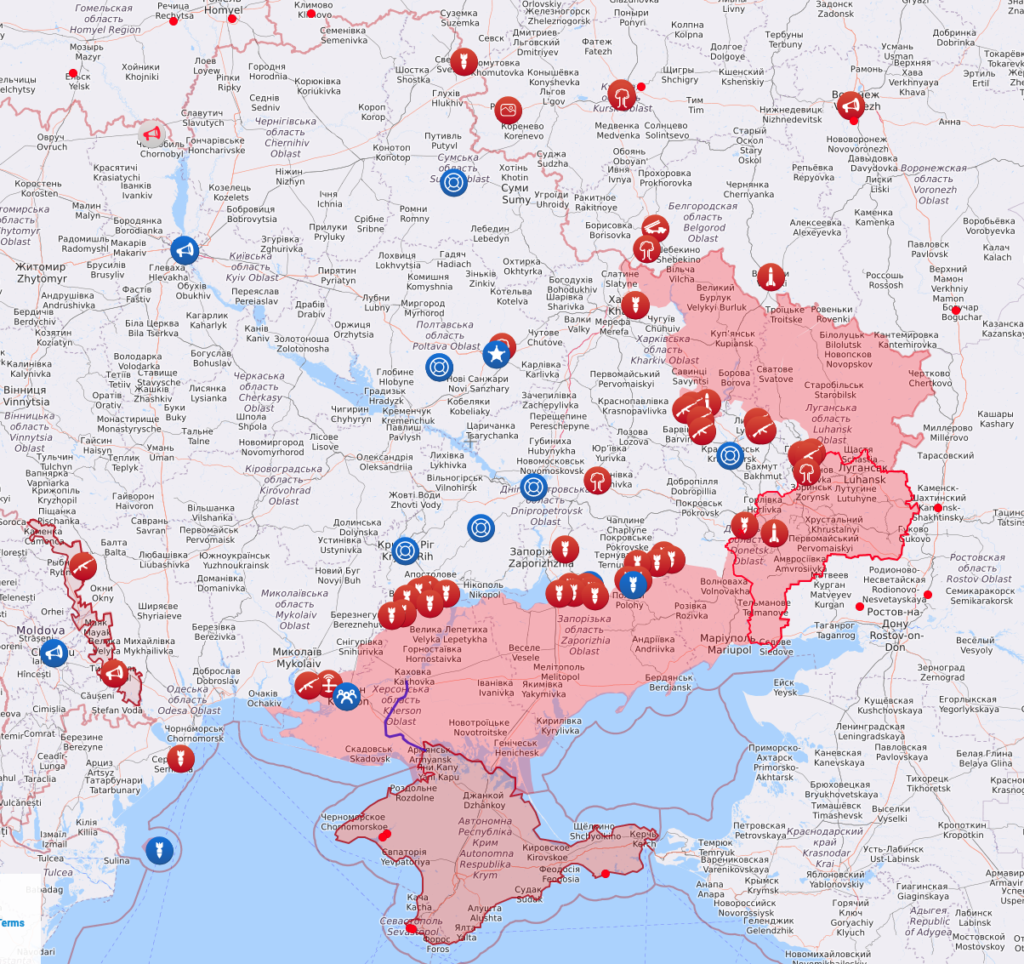
That’s what you can see on the Livemap of Kiev here, with that red area being controlled by Russian forces:
If Ukrainian forces can keep them from entering Kiev proper, that will go a long way toward stopping Putin’s invasion cold.
The “swift and severe” sanctions of the U.S. and its allies took a while to arrive, not taking effect until 96 hours or so after the first steps of the Russian invasion of Ukraine.
But to give credit where its due, once those sanctions did kick in, the consequences were indeed intense:
At one point, “The ruble plunged to a record low of less than one U.S. penny” — at one point 118 rubles to a dollar, before recovering to 84 rubles to a dollar.
The Economist noted, even with the recovery, that it was “one of the largest one-day slumps in the Russian currency’s modern history, similar in scale to the one-day declines recorded during the worst moments of the country’s financial crisis in 1998, when Russia defaulted on its debt. In mid-morning in Moscow, the Russian central bank raised its key interest rate from 9.5 percent to 20 percent in an effort to stem the ruble’s slump, and the country’s finance ministry ordered companies with foreign-currency revenues to convert 80 percent of their income into rubles.”
One analyst on CNBC summarized that the Russian currency has “pretty much lost all value outside of the country. . . . To me, it doesn’t really feel like we’re looking at or at least we’re going to see the bottom in the ruble here. I think there still is plenty more room for weakness to come.”
The Moscow stock exchange initially delayed its opening this morning, then declared it would be closed for the day.
Russians no longer have faith that their banks will remain solvent: “Russians waited in long queues outside ATMs on Sunday, worried that bank cards may cease to function, or that banks would limit cash withdrawals. ‘Since Thursday, everyone has been running from ATM to ATM to get cash. Some are lucky, others not so much,’ St Petersburg resident, Pyotr, who declined to give his last name, said.”
CNN reports that, “One early casualty was the European subsidiary of Sberbank, Russia’s biggest lender that has been sanctioned by Western allies. The European Central Bank said Sberbank Europe, including its Austrian and Croatian branches, was failing, or likely to fail, because of ‘significant deposit outflows’ triggered by the Ukraine crisis.”
It’s now five days since Russian President Vladimir Putin sent his mostly conscript army into Ukraine to overthrow the government of President Volodymyr Zelenskyy, and it hasn’t gone as planned. In what may signal frustration, Putin has put his nuclear forces on alert in one last desperate move to beat his chest and show the world who’s in charge.
Time has given some clarity to the operation and allows the drawing of some conclusions.
I’m a retired Army lieutenant colonel—an intelligence officer. My training, from 1983 to 2007, was a Cold War focus on the old Soviet Union, the predecessor state to the Russian Federation. Never in my time as an intelligence officer was I able to see the worst-case scenario of a large-scale conventional Russian attack in Europe—until now.
I’ve seen multiple reports of Russian conscripts who didn’t know they were invading Ukraine. They’re confused. They don’t know who to shoot at, as “Ukrainians look the same as us.” The Russian force appears to suffer from: Poor training; poor leadership (bad officers); and a cultural disregard for information-sharing down the chain of command, which prevents lower-ranking soldiers from making informed decisions in the chaos of war.
The result of all this is a lack of initiative from soldiers when non-commissioned officers and officers are killed or wounded.
It is important to note that the Russian army hasn’t fought a conventional war against a near-peer enemy since 1945. It’s out of practice, poorly trained, poorly led, and poorly motivated. It does have plenty of heavy armaments—very large thermobaric bombs. It can destroy, but it can’t fight effectively.
Regarding the “Father of Bombs,” a large thermobaric or “vacuum” bombs capable of destroying a city block, killing 10,000 or more civilians and soldiers. Using one on Kyiv would horrify the world and likely increase calls for war crimes charges on Russian leaders. The Russians have used smaller thermobaric weapons against Ukrainian bunkers.
This opens another question: How powerful are Russia’s reconstituted zampolit? Putin brought them back in 2018. The zampolit were political officers in the old Red Army, previously called “commissars” until 1942 when the position’s battlefield power was scaled back in response to negative military command implications.
If a Russian field commander is ordered to use a city-busting thermobaric bomb, will he? Or will he refuse to carry out the order, like German Gen. von Choltitz when Adolf Hitler ordered him to destroy Paris—unless a zampolit is looking over his shoulder with a pistol?
Logistics is also manifesting itself as a Russian weak spot. Logistics is hard—it’s harder in combat. It requires synchronizing the delivery of fuel, ammo, and food to frontline forces all while the enemy is shooting at your resupply trucks. At four days in, Russian forces are running out of basic supplies. This has a powerfully negative effect on morale.
Complicating Russian resupply efforts are indications that Ukrainian light forces hunkered down during the initial Russian wave passed by, only to reemerge when the lightly armored supply columns entered Ukraine. Also of note is the increasingly effective Ukrainian use of Turkish-designed BayraktarTB2 drones. These low-cost, slow, non-stealthy drones have scored dozens of kills on Russian columns. Ukraine has about 60 of them.
As Ukrainian resistance stiffens and tens of thousands of Ukrainian citizens rush to defend their nation, other nations in the region have been emboldened. Germany is sending 1,000 antitank missiles and 500 Stinger antiaircraft missiles. The Czech Republic and the Netherlands are sending small arms and ammunition.
His successor Shoygu knew better than that. Now who's Shoygu? Shoygu is the *only* single Russian minister who uninterruptedly worked in government since 1991, since the very beginning of Russian Federation. He worked for all presidents, all prime ministers avoided all purges pic.twitter.com/EOx5MH6lb3
There was another issue. Shoygu is ethnic Tuvan. In such a country as Russia minority member can hardly become the supreme leader. People don't perceive him as ethnic Russian (see his palace) which means he's not dangerous for the leader and you can safely delegate him the army pic.twitter.com/a4zJA1ePa0
He also says Russia is only using one echelon of troops:
How is a Blitzkrieg organised? By echelons. First echelon is moving forward as fast as they can. Ofc this means that lots of defenders will be left in their rear. But then the second echelon comes, then third, etc. They finish defenders, occupy territory, control the supply lines pic.twitter.com/AQtm8ntLfO
Secondly, launching several echelons would require long arduous preparation. You need to mobilise them, move to the borders, quarter, maintain and supply. It's not that easy. It's a hard job that should have been done well in advance to wage a Blitzkrieg. And it hadn't been done
The Russian offensive in Ukraine continues to bog down against stiff resistance, Putin puts his nukes on alert, a rumor of peace talks, momentum to suspend some Russian banks from SWIFT builds, and a whole lot of aid from the rest of the world is pouring into Ukraine.
Russia invaded Ukraine from three sides on Wednesday night Eastern time, and as of now, early afternoon Saturday, the Russian army has yet to seize any Ukrainian cities.
This morning, a senior defense official at the Pentagon briefed reporters and declared, “We continue to believe, based on what we have observed that this resistance is greater than what the Russians expected and we have indications that the Russians are increasingly frustrated by their lack of momentum over the last 24 hours particularly in the north parts of Ukraine… As of this morning we have no indication still that the Russian military has taken control over any cities. As of this morning we still believe that Russia has yet to achieve air superiority. Ukrainian air defenses including aircraft do continue to be operable and continue to engage and deny access to Russian aircraft in places over the country.”
There is an intriguing but unverified claim from Ukrainian intelligence that Putin is furious, that he expected a quick surrender from Kiev, and that the invading Russian forces weren’t equipped for a long war – and that after ten days, the Russian forces will face serious problems with supply lines, fuel, equipment, ammunition, etc. Maybe this is just Ukrainian propaganda, meant to keep up morale for the next week or so. But there are some intriguing anecdotes of Ukrainians hitting Russian supply columns and videos of Russian tanks running out of fuel. (It turns out supply chain problems are just everywhere these days!)
Sending in armored columns without dedicated infantry, artillery and air support is a big risk, big reward move. Patton did it successfully in the race across France in 1944, but he had air superiority, a friendly population, and the greatest war machine ever assembled in the history of mankind up to that time backing him, and even he had to halt when he outran his supply lines.
Putin’s initial goal, the Russian reabsorption of Ukraine or the transformation of it into a lackey state of a renewed Russian empire, is now probably impossible. Any Russian-backed Ukrainian puppet government is likely to be vehemently rejected by the Ukrainian people. Russian forces will find it difficult to go out on patrol when every citizen’s got a rifle and every grandma on every street corner is handing them sunflower seeds, telling them they are going to be fertilizer soon.
Russia may take large chunks of Ukraine, but they will have an exceptionally difficult time keeping it.
The last three days of combat should put a serious dent in the reputation of this new Russian army. We should, however, try to understand why the Russians are struggling. First, the Russian army’s recent structural reforms do not appear to have been sufficient to the task at hand. Second, at the tactical and operational level, the Russians are failing to get the most out of their manpower and materiel advantage.
There has been much talk over the last ten years about the Russian army’s modernization and professionalization. After suffering severe neglect in the ’90s, during Russia’s post-Soviet financial crisis, the army began to reorganize and modernize with the strengthening of the Russian economy under Putin. First the army got smaller, at least compared to the Soviet Red Army, which allowed a higher per-soldier funding ratio than in previous eras. The Russians spent vast sums of money to modernize and improve their equipment and kit — everything from new models of main battle tanks to, in 2013, ordering Russian troopers to finally retire the traditional portyanki foot wraps and switch to socks.
But the Russians have also gone the wrong direction in some areas. In 2008, the Russian government cut the conscription term from 24 to twelve months. As Gil Barndollar, a former U.S. Marine infantry officer, wrote in 2020:
Russia currently fields an active-duty military of just under 1 million men. Of this force, approximately 260,000 are conscripts and 410,000 are contract soldiers (kontraktniki). The shortened 12-month conscript term provides at most five months of utilization time for these servicemen. Conscripts remain about a quarter of the force even in elite commando (spetsnaz) units.
As anyone who has served in the military will tell you, twelve months is barely enough time to become proficient at simply being a rifleman. It’s nowhere near enough time for the average soldier to learn the skills required to be an effective small-unit leader.
Yes, the Russians have indeed made efforts to professionalize the officer and the NCO corps. Of course, non-commissioned officers (NCOs) have historically been a weakness of the Russian system. In the West, NCOs are the professional, experienced backbone of an army. They are expected to be experts in their military speciality (armor, mortars, infantry, logistics, etc.) and can thus be effective small-unit commanders at the squad and section level, as well as advisers to the commanders at the platoon and company level. In short, a Western army pairs a young infantry lieutenant with a grizzled staff sergeant; a U.S. Marine Corps company commander, usually a captain, will be paired with a gunnery sergeant and a first sergeant. The officer still holds the moral and legal authority and responsibility for his command — but he would be foolish to not listen to the advice and opinion of the unit’s senior NCOs.
The Russian army, in practice, does not operate like this. A high proportion of the soldiers wearing NCO stripes in the modern Russian army are little more than senior conscripts near the end of their term of service. In recent years, the Russians have established a dedicated NCO academy and cut the number of officers in the army in an effort to put more resources into improving the NCO corps, but the changes have not been enough to solve the army’s leadership deficit.
Now, let’s talk about the Russian failures at the operational and tactical level.
It should be emphasized again that the Russian army, through sheer weight of men and materiel, is still likely to win this war. But it’s becoming more and more apparent that the Russians’ operational and tactical choices have not made that task easy on themselves.
First, to many observers, it’s simply shocking that the Russians have not been able to establish complete air superiority over Ukrainian air space. After three days of hostilities, Ukrainian pilots are still taking to the skies and Ukrainian anti-air batteries are still exacting a toll on Russian aircraft. The fact that the Russians have not been able to mount a dominant Suppression of Enemy Air Defenses (SEAD) campaign and yet are insistent on attempting contested air-assault operations is, simply put, astounding. It’s also been extremely costly for the Russians.
To compound that problem, the Russians have undertaken operations on multiple avenues of advance, which, at least in the early stages of this campaign, are not able to mutually support each other. Until they get much closer to the capital, the Russian units moving north out of Crimea are not able to help the Russian armored columns advancing on Kyiv. The troops pushing towards Kyiv from Belarus aren’t able to affect the Ukrainians defending the Donbas in the east. As the Russians move deeper into Ukraine, this can and will change, but it unquestionably made the opening stages of their operations more difficult.
Third, the Russians — possibly out of hubris — do not appear to have prepared the logistical train necessary to keep some of their units in action for an extended period of time. Multiple videos have emerged of Russian columns out of gas and stuck on Ukrainian roads.
The classic saying is “Amateurs talk about tactics, but professionals study logistics” (attributed to Marines Corps commander Gen. Robert H. Barrow, but I suspect the general sentiment is much older). An army runs on its stomach, and a modern mechanized army runs on its gas tank, and something has clearly gone wrong in with Russian logistical support for this war.
Russia seemed to have expected Ukrainian President Volodymyr Zelenskyy to fold. He hasn’t.
America offered to evacuate Ukrainian President Volodymyr Zelenskyy. Zelenskyy replied, “The fight is here; I need ammunition, not a ride.”
Zelenskyy’s reply was reminiscent of past heroes in times of war: Gen. Anthony McAuliffe who replied in “NUTS” in response to the German demand for surrender at Bastogne during the Battle of the Bulge in 1944; and the Texans striving for independence from dictator Santa Anna’s Mexico with their “Come and Take it Flag,” which was itself appropriated from Spartan King Leonidas and his response the Persian surrender demand at the Battle of Thermopylae.
This bravery, in a day when modern communications allow all Ukrainians and the world to see it, has rallied Ukrainians to defend their nation. And now that the fighting has gone on for three days, what might that mean?
Russian President Putin is said to have assembled 200,000 troops for the invasion. It is estimated that half of them have been committed so far. Further, Putin has called on 10,000 battle-hardened Chechen mercenaries. More than half of Russian forces are likely committed to the battle of Kyiv.
Ukraine has 245,000 active-duty members, but most are in the east, facing the Russian-led and equipped militia in the separatist regions of Donetsk and Luhansk. Ukraine also has another 220,000 reservists. Many of these are spread across the nation slightly larger than the state of Texas.
The strategic target is Kyiv and its independent government. To move the reservists to the fight, they must contend with Russian air superiority, slowing their march. More importantly, given this struggle for national survival, 7,000,000 men of military age and fit for military service are taking up arms. Every day, many more older men — and many Ukrainian women — are also being issued weapons, making Molotov cocktails, and joining the fight.
The ongoing Ukrainian mobilization means that the Russian military will soon be outnumbered most everywhere on the battlefield. The Ukrainians may not have the same level of modern equipment — missiles, jets, helicopter — but they have numbers and will power. And, the Russians need to eat, they need fuel, and ammunition — their resupply trucks must get through. They won’t, not in large enough numbers; everyday Ukrainians will see to that.
Zelensky: ‘We successfully fought off enemy attacks. We are defending our country, our land, future of our children. Kyiv & key places near the capital are under our control. The occupiers wanted to capture our capital and install their puppets like Donetsk. We broke their idea.’ pic.twitter.com/3PtnzXmPoy
Russian forces’ main axes of advance in the last 24 hours focused on Kyiv, northeastern Ukraine, and southern Ukraine. Russian airborne and special forces troops are engaged in urban warfare in northwestern Kyiv, but Russian mechanized forces are not yet in the capital. Russian forces from Crimea have changed their primary axes of advance from a presumed drive toward Odesa to focus on pushing north toward Zaporizhie and the southeastern bend of the Dnipro River and east along the Azov Sea coast toward Mariupol. These advances risk cutting off the large concentrations of Ukrainian forces still defending the former line of contact between unoccupied Ukraine and occupied Donbas. Ukrainian leaders may soon face the painful decision of ordering the withdrawal of those forces and the ceding of more of eastern Ukraine or allowing much of Ukraine’s uncommitted conventional combat power to be encircled and destroyed. There are no indications as yet of whether the Ukrainian government is considering this decision point.
Ukrainian resistance remains remarkably effective and Russian operations especially on the Kyiv axis have been poorly coordinated and executed, leading to significant Russian failures on that axis and at Kharkiv. Russian forces remain much larger and more capable than Ukraine’s conventional military, however, and Russian advances in southern Ukraine may threaten to unhinge the defense of Kyiv and northeastern Ukraine if they continue unchecked.
Key Takeaways
Russia has failed to encircle and isolate Kyiv with the combination of mechanized and airborne attacks as it had clearly planned to do. Russian forces are now engaging in more straightforward mechanized drives into the capital along a narrow front along the west bank of the Dnipro River and toward Kyiv from a broad front to the northeast.
Russian forces have temporarily abandoned failed efforts to seize Chernihiv and Kharkiv to the northeast and east of Kyiv and are bypassing those cities to continue their drive on Kyiv. Russian attacks against both cities appear to have been poorly designed and executed and to have encountered more determined and effective Ukrainian resistance than they expected.
Russian movements in eastern Ukraine remain primarily focused on pinning the large concentration of Ukrainian conventional forces arrayed along the former line of contact in the east, likely to prevent them from interfering with Russian drives on Kyiv and to facilitate their encirclement and destruction.
Russian forces coming north from Crimea halted their drive westward toward Odesa, and Ukrainian forces have retaken the critical city of Kherson. Some Russian troops remain west of the Dnipro River and are advancing on Mikolayiv, but the main axes of advance have shifted to the north and east toward Zaporizhie and Mariupol respectively.
Russian forces have taken the critical city of Berdyansk from the west, threatening to encircle Mariupol even as Russian forces based in occupied Donbas attack Mariupol from the east, likely to pin defenders in the city as they are encircled.
Russian successes in southern Ukraine are the most dangerous and threaten to unhinge Ukraine’s successful defenses and rearguard actions to the north and northeast.
Russian troops are facing growing morale and logistics issues, predictable consequences of the poor planning, coordination, and execution of attacks along Ukraine’s northern border.
It appears that the various armored column incursions were secondary to or distractions from the attempted paratroop-powered decapitation strike to be launched from Antonov International Airport. When that went awry (as airborne assaults often do; see the SNAFU that was Operation Market Garden in World War II), there appeared to be no coherent backup plan.
Indeed, the entire operation seems to have been hastily planned and executed, which is odd, since Ukraine has obviously been much on Putin’s mind since 2014.
This is not the way competent troops act in hostile urban environments. It’s like the Russian army forgot all they learned from getting their asses kicked in the First Battle of Grozny, where driving ill-supported mechanized columns filled with untrained conscripts into the city resulted in horrible losses for the Russians.
The Kiev assault seems even less thought out, and their opponents appear much better equipped and trained than the Chechens were.
On the other hand, here’s a report that Kiev is surrounded. I’d take that with several grains of salt.
Putin puts Russian nuclear forces on alert. The idea that Putin would actually contemplate nuclear war with the west because his own ill-conceived and badly-executed invasion of Ukraine has gone off the rails is hardly credible. Russia would be annihilated.
“As you can see, not only do Western countries take unfriendly measures against our country in the economic dimension – I mean the illegal sanctions that everyone knows about very well – but also the top officials of leading NATO countries allow themselves to make aggressive statements with regards to our country,” Putin said on state television.
“Mommy, they’re saying bad things about me!” Those unfriendly measures would, of course, stop instantly if Putin were to withdraw his forces from the territory of other sovereign nations.
Here’s a video of Putin explaining himself:
Does that look or sound like an all-powerful conqueror at the top of his game? No, that’s the tone and the body language of a guy trying to explain why he just fucked up. “We had no other choice!” Yeah, except, you know, not invading another country.
There are evidently plans for talks between Ukrainian and Russian delegations on the Ukraine border with Belarus. Don’t expect much. Zelenskyy: “I do not really believe in the result of this meeting, but let them try, so that no citizen of Ukraine would have any doubt that I, as president, did not try to stop the war when there was even a small chance.”
The U.S. is sending $350 million in military aid. “The defense aid will include anti-armor, small arms and various munitions, and body armor and related equipment.” Let’s hope none of it disappears into the pockets of people connected to members of the Senate Foreign Relations Committee…
Speaking of reversing course, Germany has also done an about-face and is now in favor of removing some Russian banks from SWIFT. “The sanctions, agreed with the United States, France, Canada, Italy, Great Britain and the European Commission also include limiting the ability of Russia’s central bank to support the ruble.” I get the impression that the Eurocrats were hesitant to cut Russia off from SWIFT because they thought it would be a useless gesture. Now that Russia’s invasion has gone off the rails, they’re rethinking. The quick reverse also indicates how pissed they are at Russia right now.
Europe has effectively closed its airspace to Russia:
Based on published NOTAMs, adding Austria, Germany, Iceland, and Italy to the list of airspace unavailable to Russian flights — all in effect by 14:00 UTC. Based statements by government officials, we expect further prohibitions on Russian flights. https://t.co/3GtCYRmZUQpic.twitter.com/O0WTcsdRlz
A final word: There are a few Twitter pundits suggesting that some sort of “wag the dog” scenario of a fake war might be unfolding in Ukraine. I don’t buy it. There’s too much real reporting from too many points in Ukraine for such an elaborate, two-part deception to be unfolding. Lots of weird things happen in warfare.
I will say one thing: The manifest incompetence with which Russia has tried to carry out this assault suggests that Putin felt he had to launch it then due to some sort of time pressure or deadline, but I don’t know what it is. Maybe Putin has late stage cancer, or he felt Ukraine was about to join NATO, or a major Russian oilfield is about to run dry. Whatever it is, this war appears to be a panic move that’s gone very badly for Putin.
Ukraine fights back, Biden isn’t going to do jack about it, Kyle Rittenhouse is going to sue everyone, inflation soars, the Canadian “emergency” is ended, disaster looms for Democrats, and Ilhan Omar gets an unusual challenger. It’s the Friday LinkSwarm!
While reports of the battle are confused and preliminary, it appears that Ukrainian forces counterattacked, shot down some Russian helicopters, and have so far been able to prevent the Russians from landing reinforcements. Initial claims that the Russian force at the airfield had been “destroyed” were later clarified; it now seems that the battle at Gostomel is continuing. It’s easy to understand how crucial this battle is, simply by looking at a map. If the Russians could gain control of the Gostomel airfield, they could score a quick knock-out of the Ukrainian capital as part of what is being called their “decapitation” strategy.
Russian news services are claiming they’ve taken the airfield, but that may be stale news or propaganda.
Ukrainian forces take up positions in Kiev. Also: “Reports that the Ukrainian military has delivered a strike on a Russian airfield in Millerovo, Rostov Oblast have now been confirmed.”
The invasion of Ukraine by the armed forces of Russia at Russian President Vladimir Putin’s orders marks the first time since 1945 that Russia has engaged in a conventional war with a near-peer nation.
Ukraine isn’t restive Warsaw Pact nations, it isn’t Afghanistan, it isn’t Chechnya, it isn’t Georgia, and it isn’t Crimea.
The conflict launched by Putin is on a far grander scale than the invasion of Crimea in 2014, launched as Ukraine’s last pro-Russia president, Viktor Yanukovych, was driven from office in a popular uprising.
Putin, by choosing to reach beyond the ethnic-Russian majority separatist provinces of Donetsk and Luhansk in the Donbas Basin, has decided to end the independent, Western-looking Ukrainian government of President Volodymyr Zelenskyy and install a pro-Putin quisling.
And while the fog of war, some deliberate mis-and disinformation operations by the combatants, and the far-from-perfect filter of Western media leaves much unknown at this time, what is known is that Zelenskyy is still in power a day after the Russian offensive. Further, the Ukrainian military appears to be taking a toll on the Russians invading from three sides: south across the Pripyat Marshes from Russian satellite Belarus; west from Russia, including Donbas; and north from the Black Sea in the region of Odessa and Transnistria, a Russian client breakaway state in Moldavia.
Modern conventional war is extremely difficult to do well. Imagine being a conductor of an orchestra, all while the audience was lobbing soccer balls at you and your musicians as you perform J.S. Bach’s Chaconne in D — that’s modern warfare. Putin is attempting a highly complicated operation over large distances in the face of a determined foe. Further, he’s doing so with an army largely composed of conscripts serving for only one year.
Since Putin has decided to oust the Ukrainian government, this means that every day Zelenskyy remains in office is another day that adds to Ukrainian national confidence to resist — and another day that Putin looks to have miscalculated.
A Russian Military Ship telling 13 Ukrainian troops on Snake Island to surrender. They were met with a response of " Russian military Ship, go fuck yourself."
Both the EU and the Biden Administration offer sanctions they admit will not do Jack Squat.
FULL DOCUMENT: This is the general license that US Treasury has issued exempting any "energy" related dealings from the sanctions imposed on some of the biggest Russian banks. It's so wide ranging that even includes "wood" as a form of energy exempted | #Ukraine#OOTTpic.twitter.com/3X5t0LFi3W
WATCH: AP reporter roasts Biden's State Department spokesman over the "frankly huge" list of exemptions in Biden's sanctions on Russia.pic.twitter.com/gzAWB4LwMg
Taiwan joins sanctions against Russia, including their semiconductor industry. I don’t know if any fabless Russian chip design company gets their chips fabbed at TSMC, so I’m not sure how badly this hurts their economy in the long run.
It is the West’s wacko environmentalists who handed Russian President Vladimir Putin the leverage and money to invade Crimea in 2014 and Ukraine this week.
Without these wackos, Putin would be just another gangster in charge of a crumbling country, and maybe one on the verge of a revolution to depose him.
But the facts are the facts are the facts, and the facts are these… Thanks to the West’s environmentalists, those smug greenies who are more concerned with carbon output than world peace, this gangster controls much of the energy going to the European Union (E.U.).
Thanks a lot, Greta…
A great mystery:
Under Carter, Russia invaded Afghanistan. Under Obama, Russia took over Crimea. Under Biden, Russia is invading the rest of Ukraine. Russians do land grabs when Democrats control the White House. Democrats get pissed when you point it out. But it is still true.
Biden is demonstrably more hostile to American oil and gas companies than he is to Russian companies, having frozen oil and gas leasesdespite a court order otherwise.
Thanks to Biden’s inflation, the cost of everything is going up. “70 percent of Americans are living paycheck to paycheck.”
Fellow former finance reporter Chrystia Freeland — someone I’ve known since we were both expat journalists in Russia in the nineties — announced last week that her native Canada would be making Sorkin’s vision a reality. Freeland arouses strong feelings among old Russia hands. Before the Yeltsin era collapsed, she had consistent, remarkable access to gangster-oligarchs like Boris Berezovsky, who appeared in her Financial Times articles described as aw-shucks humans just doing their best to make sure “big capital” maintained its “necessary role” in Russia’s political life. “Berezovsky was one of several financiers who came together in a last-ditch attempt to keep the Communists out of the Kremlin” was typical Freeland fare in, say, 1998.
Then the Yeltsin era collapsed in corrupt ignominy and Freeland immediately wrote a book called Sale of the Century that identified Yeltsin’s embrace of her former top sources as the “original sin” of Russian capitalism, a “Faustian bargain” that crippled Russia’s chance at true progress. This is Freeland on Yeltsin’s successor in 2000. Note the “Yes, Putin has a reputation for beating the press, but his economic rep is solid!” passage at the end:
It looks as if we’re about to fall in love with Russia all over again…
Compared to the ailing, drink-addled figure Boris Yeltsin cut in his later years, his successor, Vladimir Putin, in the eyes of many western observers, seems refreshingly direct, decisive and energetic… Tony Blair, who has already paid Putin the compliment of a visit to Russia and received the newly installed president in Downing Street in return, has praised him as a strong leader with a reformist vision. Bill Clinton, who recently hot-footed it to Russia, offered the equally sunny appraisal that “when we look at Russia today . . . we see an economy that is growing . . . we see a Russia that has just completed a democratic transfer of power for the first time in a thousand years.”
To be sure, some critics have lamented Putin’s support for the bloody second war in Chechnya, accused him of eroding freedom of the press…and worried aloud that his KGB background and unrepenting loyalty to the honor of that institution could jeopardize Russia’s fragile democratic institutions. But many of even Putin’s fiercest prosecutors seem inclined to give him the benefit of the doubt when it comes to the economy…
Years later, she is somehow Canada’s Finance Minister, and what another friend from our Russia days laughingly describes as “the Nurse Ratched of the New World Order.” At the end of last week, Minister Freeland explained that in expanding its Financial Transactions and Reports Analysis Centre of Canada (FINTRAC) program, her government was “directing Canadian financial institutions to review their relationships with anyone involved in the illegal blockades.”
The Emergencies Act contains language beyond the inventive powers of the best sci-fi writers. It defines a “designated person” — a person eligible for cutoff of financial services — as someone “directly or indirectly” participating in a “public assembly that may reasonably be expected to lead to a breach of the peace.” Directly or indirectly?
She went on to describe the invocation of Canada’s Emergencies Act in the dripping-fake tones of someone trying to put a smile on an insurance claim rejection, with even phrases packed with bad news steered upward in the form of cheery hypotheticals. As in, The names of both individuals and entities as well as crypto wallets? Have been shared? By the RCMP with financial institutions? And accounts have been frozen? As she confirmed this monstrous news about freezing bank accounts, Freeland burst into nervous laughter, looking like Tony Perkins sharing a cheery memory with “mother.”
Angeleno’s tax dollars at work:
A city audit found LA spends $837,000 to house one homeless person. Perhaps this is why Newsom has done everything he can to block my statewide audit.
China is getting a good return on its investment in the Biden clan: “DOJ shuts down China-focused anti-espionage program. The China Initiative is being cast aside largely because of perceptions that it unfairly painted Chinese Americans and U.S. residents of Chinese origin as disloyal.” We can’t let national security stand in the way of political correctness…
In what may be remembered as one of the greatest miracles of all time, it seems that an upcoming American election cycle is set to put an end to the great COVID pandemic in regions that have been clinging to “mitigation” tactics despite them being proven ineffective long ago. What science couldn’t do for blue state governors, politics is about to. Meanwhile, much of the rest of the country has already adopted an “endemic” approach to COVID. In my Indiana community, for instance, school systems have been in-person and maskless for well over a year.
A combination of experience and common sense led local officials to recognize that while COVID was a serious virus, and an often-times unpleasant condition to endure, we just weren’t experiencing the kind of mortality rates or critical hospitalizations that would require the suspension of normal life. If I was guessing, I would say that there are more counties, cities, and communities in the United States like mine than not.
While mainstream media may be drawn like a moth to the bright lights of urban areas with all the restrictions, mandates, and panic-fueled policies enacted there, most Americans have been “living with” the virus for a long time now.
In fact, if my community is any bellwether for the nation, most Americans are already wondering why anyone is still attempting to take a non-endemic approach at this point. The virus has proven itself to be, like all other viruses, prone to seasonal surges that are largely unaltered by our theatrical mitigation techniques. Not that anyone with their head screwed on straight ever thought there was value in wearing a porous cloth mask while standing up at a restaurant, then taking it off while sitting down, but the comical nonsense of mask histrionics is now widely appreciated as a goofy spectator sport. Behold:
So silly. And so as opinion polls continue showing that an ever-increasing number of Americans are infuriated by this nonsense, and that they are done with all the aggressive pandemic restrictions that proved unnecessary a long time ago, a public pivot of massive proportions is underway amongst the political class.
Whether it’s big blue state governors like California’s Gavin Newsom hilariously announcing that he will be transitioning his state to the country’s first “endemic” virus policy – meaning they’re going to start doing some things that Texas, Florida, South Dakota, Indiana, and so many others have been doing for over a year – or whether it’s blue city school boards like San Francisco’s being recalled by angry voters for their abusive and needless shutdown and masking policies, it’s clear where we’re headed.
Despite that, the midterm news for Democrats is not good.
Democrats know that they should be preparing for a brutal showing in this November’s midterm elections. Glenn Youngkin’s victory in the Virginia gubernatorial race last year — and, more to the point, the substance and style of his successful campaign — were the first sign of it.
But the hits have kept on coming. In San Francisco last week, two progressive parents succeeded in their campaign to oust three school-board members for being . . . too progressive. Irked initially at how long it was taking for area schools to reopen for in-person learning during the pandemic, these two single parents did some digging and discovered even more to be upset about: an enormous budget shortfall, an intensive campaign to rename dozens of school buildings, and the replacement of a merit-based admissions program with a diversity-minded lottery, among other issues.
Suggesting just how central education has become to politics, San Francisco’s intensely progressive mayor, London Breed — who last fall violated her own mask mandate at a concert and defended herself by saying she was “feeling the spirit” — endorsed the school-board recall effort.
“My take is that it was really about the frustration of the board of education doing their fundamental job,” Breed said after the results were in. “And that is to make sure that our children are getting educated, that they get back into the classroom. And that did not occur. . . . We failed our children. Parents were upset. The city as a whole was upset, and the decision to recall school-board members was a result of that.”
San Francisco–based writer Gary Kamiya suggests in a piece for the Atlantic that the results of the recall seem to confirm the conservative narrative. Kamiya writes that conservatives have argued “that the Democratic Party is out of step not just with Republicans, but with its own constituents. . . . Progressives rejected such conclusions, insisting that the recall was simply about competence and was driven by an only-in-San-Francisco set of circumstances.” Kamiya concludes that the best way to read the outcome is “closer to the conservative view.” “At a minimum,” Kamiya writes, “the recall demonstrates that ‘woke’ racial politics have their limits, even in one of the wokest cities in the country.”
Over in Texas, meanwhile, failed Senate candidate and failed presidential hopeful Beto O’Rourke is gearing up to become a failed gubernatorial candidate, too. Running against incumbent Republican governor Greg Abbott, O’Rourke was most recently seen trying to pretend that he isn’t a fan of radical gun-control measures.
Asked about the promise he made during his run for president that he would “take away AR-15s and AK-47s,” O’Rourke attempted a hard about-face.
“I’m not interested in taking anything from anyone,” he said. “What I want to make sure that we do is defend the Second Amendment. I want to make sure that we protect our fellow Texans far better than we’re doing right now. And that we listen to law enforcement, which Greg Abbott refused to do. He turned his back on them when he signed that permitless-carry bill that endangers the lives of law enforcement in a state that’s seen more cops and sheriff’s deputies gunned down than in any other.”
As Charlie Cooke has noted, this is utter tripe. It also isn’t working. The latest poll of the race from the Dallas Moring News has Abbott up by seven points, 45 percent to 38 percent. O’Rourke himself remains underwater with voters: Only 40 percent view him favorably, while 46 percent say they have an unfavorable view of the candidate.
Republicans win a Jacksonville City Council race:
It's a citywide race, and this result will more or less match the average partisanship of the city for the past decade or so. But this was a Dem-held seat, and losing it in this fashion has to hurt the local party. And doesn't portend well in other races.
Kyle Rittenhouse is finally ready to sue, including lawsuits against Whoopi Goldberg and Cenk Uygur. I hope he bankrupts anyone who called him a white supremacist.
Former Houston Rockets draft bust Royce White is running for Congress as a Republican against “Squad” member Ilhan Omar. Hopefully he can be on the campaign trail more than he was on the floor for the Rockets…
BBC correspondents heard loud bangs in the capital Kyiv, as well as Kramatorsk in the Donetsk region of eastern Ukraine. Blasts have also been heard in the southern port city of Odesa.
Ukraine’s President Volodymyr Zelensky said Russia had carried out missile strikes on Ukraine’s infrastructure and on border guards.
Russia’s defence ministry has denied attacking Ukrainian cities – saying it was targeting military infrastructure, air defence and air forces with “high-precision weapons”.
Tanks and troops have poured into Ukraine at points along its eastern, southern and northern borders, Ukraine says.
Russian military convoys have crossed from Belarus into Ukraine’s northern Chernihiv region, and from Russia into the Sumy region, which is also in the north, Ukraine’s border guard service (DPSU) said.
Belarus is a long-time ally of Russia. Analysts describe the small country as Russia’s “client state”.
Convoys have also entered the eastern Luhansk and Kharkiv regions, and moved into the Kherson region from Crimea – a territory that Russia annexed from Ukraine in 2014.
If multiple Russian convoys just crossed the border without significant opposition from ground troops (either tanks or hidden soldiers with antitank and RPGs) it’s quite the indictment of Ukrainian war-planning.
The Russian offensive was preceded by artillery fire and there were injuries to border guards, the DPSU said.
There have also been reports of troops landing by sea at the Black Sea port cities of Mariupol and Odesa in the south. A British resident of Odesa told the BBC many people were leaving.
As I mentioned last night, Putin’s fiction that this is “a military operation in Ukraine’s eastern Donbas region” is an obvious lie. Here’s a tweet highlighting the wide range of Russia’s operations:
Here is a map of all the verified Russian attacks on Ukraine as of 3:30 am last night. Just a reminder that just a day and a half ago, Putin was claiming he was just sending in “peacekeeping” forces to defend the area circled in yellow. pic.twitter.com/f7byy9WARK
(Some of the footage circulating on Twitter is evidently from previous conflicts. Hopefully the above are not among them, but if they are let me know.)
There are conflicting reports on whether Antonov International Airport on the outskirts of Kiev is currently in Russian hands or not. The fighting there has reportedly gone back and forth.
At least 16 cities in Ukraine are reporting explosions. Footage of cruise missiles flying over Ukrainian heads is appearing on social media. Apparently, a Russian soldier parachuting into Ukraine has posted video of himself on TikTok. There are reports that Belarusian military forces have joined the Russian forces in attacks on Ukrainian border guards.
We are witnessing, on our television screens and through the web, the largest land war in Europe since 1945, an unprovoked attack by an autocratic superpower with nuclear weapons against a flawed but independent democracy that had committed no crime or provocation. The world is less safe today than it was at the start of the week. Many Ukrainians are already dead, some Russian forces have likely also been killed, and a lot more people will die in the near future.
This is exactly the nightmare scenario that U.S., NATO, and European Union policy aimed to prevent; short of a Russian invasion of NATO member states, this is the worst-case scenario. This is not another relatively small-scale, minimal-conflict land grab like the Russian seizure and occupation of Crimea in 2014. This is the full wrath of the Russian war machine coming down like a ton of bricks on a country of 80 million people.
At the most basic level, realism begins with the recognition that wars occur because there is no agency or central authority that can protect states from one another and stop them from fighting if they choose to do so. Given that war is always a possibility, states compete for power and sometimes use force to try to make themselves more secure or gain other advantages. There is no way states can know for certain what others may do in the future, which makes them reluctant to trust one another and encourages them to hedge against the possibility that another powerful state may try to harm them at some point down the road.
Liberalism sees world politics differently. Instead of seeing all great powers as facing more or less the same problem—the need to be secure in a world where war is always possible—liberalism maintains that what states do is driven mostly by their internal characteristics and the nature of the connections among them. It divides the world into “good states” (those that embody liberal values) and “bad states” (pretty much everyone else) and maintains that conflicts arise primarily from the aggressive impulses of autocrats, dictators, and other illiberal leaders. For liberals, the solution is to topple tyrants and spread democracy, markets, and institutions based on the belief that democracies don’t fight one another, especially when they are bound together by trade, investment, and an agreed-on set of rules.
After the Cold War, Western elites concluded that realism was no longer relevant and liberal ideals should guide foreign-policy conduct. As the Harvard University professor Stanley Hoffmann told Thomas Friedman of the New York Times in 1993, realism is “utter nonsense today.” U.S. and European officials believed that liberal democracy, open markets, the rule of law, and other liberal values were spreading like wildfire and a global liberal order lay within reach. They assumed, as then-presidential candidate Bill Clinton put it in 1992, that “the cynical calculus of pure power politics” had no place in the modern world and an emerging liberal order would yield many decades of democratic peace. Instead of competing for power and security, the world’s nations would concentrate on getting rich in an increasingly open, harmonious, rules-based liberal order, one shaped and guarded by the benevolent power of the United States.
Had this rosy vision been accurate, spreading democracy and extending U.S. security guarantees into Russia’s traditional sphere of influence would have posed few risks. But that outcome was unlikely, as any good realist could have told you. Indeed, opponents of enlargement were quick to warn that Russia would inevitably regard NATO enlargement as a threat and going ahead with it would poison relations with Moscow. That is why several prominent U.S. experts—including diplomat George Kennan, author Michael Mandelbaum, and former defense secretary William Perry—opposed enlargement from the start. Then-Deputy Secretary of State Strobe Talbott and former Secretary of State Henry Kissinger were initially opposed for the same reasons, though both later shifted their positions and joined the pro-enlargement bandwagon.
Proponents of expansion won the debate by claiming it would help consolidate the new democracies in Eastern and Central Europe and create a “vast zone of peace” across all of Europe. In their view, it didn’t matter that some of NATO’s new members were of little or no military value to the alliance and might be hard to defend because peace would be so robust and enduring that any pledge to protect those new allies would never have to be honored.
Moreover, they insisted that NATO’s benign intentions were self-evident and it would be easy to persuade Moscow not to worry as NATO crept closer to the Russian border. This view was naive in the extreme, for the key issue was not what NATO’s intentions may have been in reality. What really mattered, of course, was what Russia’s leaders thought they were or might be in the future. Even if Russian leaders could have been convinced that NATO had no malign intentions, they could never be sure this would always be the case.
One need not buy all of Walt’s assertions to realize that liberal foreign policy wonks got Russia badly wrong.
One of the problems with using economic sanctions as your primary tool of deterrence in foreign policy is that eventually you’ll run into a hostile foe or force that does not care about trading with the U.S. or even money at all. In fact, it is fair to wonder how much money motivates any of America’s current foes.
The Taliban certainly don’t particularly care about money; they think they’re on a mission from Allah. Iran has been hit with just about every sanction in the book, and no doubt it’s had an impact on the Iranian economy, but the mullahs don’t seem to care much. Kim Jong-un and the North Korean regime have been sanctioned many, many times, and they just keep getting better and better at evading them. The U.S. and China are too economically intertwined to easily enact sanctions that are serious enough to alter the decision-making in Beijing.
And then there’s Vladimir Putin’s Russia — a government that foresaw the types of moves the West was likely to make, and prepared accordingly:
Russia has drastically reduced its use of dollars, and therefore Washington’s leverage. It has stockpiled enormous currency reserves, and trimmed its budgets, to keep its economy and government services going even under isolation. It has reoriented trade and sought to replace Western imports.
But even more than that, for a greedy kleptocrat, Putin doesn’t seem primarily motivated by money or his country’s economic prospects. Putin’s address yesterday was a long stream of grievances, and it is clear that what really enrages him is that Russia is not as powerful as it was when he was a younger man and the Soviet Union existed.
The Society for Worldwide Interbank Financial Telecommunication, or SWIFT, is a cooperative of financial institutions formed in 1973 and headquartered in Belgium. It is overseen by the National Bank of Belgium with cooperation from other major central banks, including the U.S. Federal Reserve System, the Bank of England and the European Central Bank.
But SWIFT is not a traditional bank and does not transfer funds. Rather, it acts as a secure messaging system that links more than 11,000 financial institutions in over 200 countries and territories, alerting banks when transactions are going to occur. (For instance, American banks have a unique SWIFT code that customers use for incoming wire transfers in U.S. dollars.)
In 2021, SWIFT said it recorded an average of 42 million messages per day, an 11 percent increase from the year before. In 2020, Russia accounted for 1.5 percent of transactions.
For the U.S. and its European allies, cutting Russia out of the SWIFT financial system would be one of the toughest financial steps they could take, damaging Russia’s economy immediately and in the long term. The move could cut Russia off from most international financial transactions, including profits from oil and gas production, which accounts for more than 40 percent of the country’s revenue.
“But doing so, which some financial analysts have likened to a ‘nuclear option,’ would be an unprecedented move against one of the world’s largest economies.”
No, a financial sanction for one nation invading another is not a “nuclear option.” When it comes to war, the nuclear option is literally the nuclear option.
Putin will happily trade some short-term economic sacrifice for rebuilding an empire. China will gladly undergo some trade sanctions to take Taiwan. Iran will cheerfully be excised from global trade to destroy Israel.
There is a reason that Stalin is still the highest-polling leader in Russia. In her Nobel Prize–winning oral history Secondhand Time, Svetlana Alexievich quotes a former Communist factory worker imprisoned and beaten half to death by the regime.
As an old man, the imprisoned worker said, “When I go into my grandchildren’s room, everything in there is foreign: the shirts, the jeans, the books, the music…Savages! I want to die a Communist. That’s my final wish.”
The West is failing because it not only doesn't understand why other countries feel this way, but because we ourselves have given up any belief in a higher purpose.
Putin’s Big Ukrainian Adventure isn’t doing wonders for the Russian stock market.
Russia’s stock market has lost nearly 40% of its value today — and at one point was down nearly 45%. It’s one of the biggest single-day meltdowns in modern market history.
Though Russian forces are quite formidable on paper (especially now that Russia has reportedly achieved air superiority over most of Ukraine), a whole lot of variables are at play in this war. How well maintained are all those old Soviet weapons Russian has lying around? How much of it has been modernized? How long can they sustain this rapid pace of operation? How much has Soviet doctrine changed following what they learned in Grozny? Soviet/Russian experience in counter-insurgency operations has generally not been a happy one. How stiff a resistance can Ukraine put up against the Russian invasion?
Finally, what is Putin’s real goal: Ukraine acquiescing to his previous territorial conquests, Findlandization and agreement never to join NATO, incorporation of all Russian-speaking areas into Russia proper, installing a Russian-friendly puppet government, or actual outright conquest of all of Ukraine? Which he’s aiming for will determine how much pain he’s willing to let Russia endure and how difficult the military task will be.
My god: “An invasion has begun” by Russia into #Ukraine. Our @mchancecnn is reporting right now that an advisor to Ukraine Interior Minister says the sounds of explosions are missle strikes and Russia is invading. The explosions can be heard in the Capitol Kyiv. War has begun. pic.twitter.com/ho0KzoEbn6
Biden’s weakness and cognitive decline clearly emboldened Putin, and Ukrainians will be paying the price. It remains to be seen whether he just wants control over Russian-speaking portions of Ukraine, or actually wants to wipe it off the globe and incorporate the territory into Russia.
Justin Trudeau’s storm troopers start arresting peaceful protesters, he wants to kidnap the children and dogs of free Canadian citizens who dared to bruise his fragile ego, Texas sends more lawsuits flying, and another case of Sudden Epstein Death Syndrome. It’s the Friday Saturday LinkSwarm!
Canadian Prime Minister Justin Trudeau cancelled parliamentary debate today as federal police began arresting protesting truckers and confiscating vehicles. Trudeau did not want to face government while the operation to break the back of the freedom protestors begins.
Early this morning, federal police assembled a convoy of heavy tow trucks to begin the operation. The identities of the tow truck companies were masked by painting over the logos to avoid retaliation. RCMP and Ottawa police then brought in Armored Personnel Carriers (MRAP’s and APC’s) to support the operation.
Media were told to leave the enforcement zone to help hide the optics of heavily armed RCMP tactical units, and they began breaking the windows of the trucks and forcibly removing the truck drivers. For the same reason, popular social media YouTuber’s, who had been broadcasting livestreams, were arrested as the operation began.
They’re also threatening to take children from protesting parents. “Just imagine the uproar that would ensue if Trump had taken children from Black Lives Matters protesters.”
“When Fascism Comes To America, It Will Look Like Justin Trudeau’s Canada. Trudeau’s dangerous not just because he’s abusing Canadians, but because he is providing the wish list for crackdowns by Democrats in the U.S.: Every single bank, credit union, investment broker and insurance provider in the country has been deputized to figure out if they have a blockader as a client, and to immediately freeze their accounts if so.”
It’s public health 101: if you want to protect people from a +99% survivable virus, you trample them with horses in front of their kids and euthanize their pets and freeze their bank accounts
The Chicago Teachers Union provides a real-world example of what happens when a government union has too much power.
CTU has gone on strike three times in three school years. In the latest work stoppage, over 330,000 schoolchildren missed five days of school. Parents were notified of the walkout after 11 p.m. on a school night, leaving them just hours to develop a back-up plan after the union decided not to show up.
This shut-down follows the 2020-2021 school year, when Chicago Public Schools was fully remote for most of the year, rolling out hybrid options starting in February 2021. All told, Chicago students had gone 17 months without fully in-person education by the time they started the current school year Aug. 30, 2021.
And students’ academic achievement suffered for it. One example: On the SATs, there was a 6.1 percentage point decrease in the number of Chicago students at least meeting standards in math – and a drop of 6.7 percentage points for the same category for low-income students – in 2021 compared to 2019.
But CTU’s political muscle – and their willingness to flex it – could become the blueprint for schools and government at all levels if Illinois’ powerful government-sector unions get what they’re asking for at the polls in November. They want an amendment to the Illinois Constitution that would give unelected government union bosses more power than state law or the people elected to represent residents’ best interests.
Snip.
Amendment 1 is billed as a right-to-work ban in a state that already doesn’t allow right to work, but it’s much more than that. It would give unions a “fundamental” right to organize and bargain over wages, hours, working conditions, economic welfare and safety at work – i.e., virtually anything – and explicitly prohibit lawmakers from ever interfering with or diminishing those rights.
Unions would be able to demand anything during negotiations and go on strike to get their demands met. Resulting contracts would carry the weight of the state constitution. Lawmakers wouldn’t be able to restrict what unions can negotiate or limit when they can go on strike without running afoul of the state constitution.
What’s more, lawmakers would never be able to repeal a little-known Illinois provision that allows many union contracts to override conflicting state and local laws and regulations.
Known in legal parlance as a “supercedence clause,” the practical effect is that a union will be able to rewrite laws it doesn’t like just by negotiating a contrary provision in its contract. If the employer doesn’t agree? The union goes on strike. And government officials’ hands will be tied.
That includes laws in place to protect children.
A provision requiring “background information” on employees of the Illinois Department of Children and Family Services – the department charged with protecting children who are reported abused or neglected – could be contradicted in the union’s contract with the state.
So could the provision prohibiting employment of “sexually dangerous” persons.
Paxton and Texas also sued Facebook over facial recognition. “Facebook unlawfully captured the biometric identifiers of Texans for a commercial purpose without their informed consent, disclosed those identifiers to others, and failed to destroy collected identifiers within a reasonable time.”
“San Francisco police linked a woman to a crime using DNA from her rape exam, D.A. Boudin says.” Though the charges were dropped, this seems like not only a clear Fourth Amendment violation, but an absolute abuse of trust. “Sure, just give your DNA to the government! There’s no way they would ever abuse that!” Can you believe that Soros-backed Boudin is the subject of a recall petition?
This isn’t just the crest of a wave: if Republicans offer a positive, credible alternative, as @GlennYoungkin did in Virginia, it’s the making of a realignment. https://t.co/5lzpE6B7IL
Let me see if I have the timeline on this story correct: 1. Leftwing racial justice activist Quintez Brown attempts to assassinate Louisville Democratic mayoral candidate Craig Greenberg, and 2. He’s almost immediately bailed out for a paltry $100,000 by #BlackLivesMatter? How often is bail set so low for attempted political assassinations?
CRT got blown away by a massive truth bomb dropped by North Carolina dad — and local GOP candidate — Brian Echevarria at his school board meeting on Monday.
“As a parent, I speak to other parents,” he told Cabarrus County School Board members, “And there’s a few things we don’t want.”
“I’m biracial, I’m multilingual, I’m multicultural. The fact is in America and North Carolina, I can do anything I want — and I teach that to my children. And the person who tells my little pecan-color kids that they’re somehow oppressed based on the color of their skin,” he justly insisted, “would be absolutely wrong and absolutely at war with me.”
Speaking of pedophilia: “Alternatively described as Jeffrey Epstein’s ‘best mate’ and ‘pimp’, Jean-Luc Brunel, a former French modeling agent who has been imprisoned since 2020 on charges he aided Epstein’s sex-trafficking enterprise, has committed suicide in his cell.” I think we’ve seen this movie before, and we didn’t believe the ending the first time…
Speaking of Adams: “I want to discuss the new fuckface mayor of New York City that replaced the old fuckface mayor.” The mayor that wants to force employers to enforce vaccine mandates also wants them to force workers back to their NYC offices.
What’s in it for those businesses that now realize that three hundred thousand dollars a month in office space “We don’t need it anymore.” What’s in it for those employees that figured out that they can have homes that are two or three times the size for half as much money and not have to deal with a commute every day? What’s in it for them?”
With oil prices up, so are U.S. rig counts, up to a four year high.
New Bloom County animated TV show in development for Fox. I view this with more trepidation than hope. There’s about a 95% chance the screw it up, and if they don’t, there’s a good chance Fox will cancel it anyway, since that’s their MO…
P. J. O’Rourke, RIP. I reviewed Holidays in Hell for Reason back in the day…
In 2017, a pilot aborted takeoff after V1, the inflection point for when a safe abort was still possible. “Still traveling at 100 knots, but decelerating rapidly, the plane rumbled across the grass overrun area, plowed over the airport perimeter fence, struck a raised embankment, lost its landing gear, crossed a road, and ground to a halt straddling a ditch.” Post-incident analysis showed why that was the right call. (Hat tip: Dwight.)
FLOCK DROP MYSTERY: A security camera in Chihuahua, Mexico, captured the moment hundreds of yellow-headed blackbirds suddenly fell from the sky — many nosediving to their death https://t.co/45WA052YZOpic.twitter.com/FsZkEorTc7
Over the past year, DeSantis has emerged as one of the most articulate political spokesmen for the anti–critical race theory movement. His new policy agenda builds on successful anti-CRT legislation in other states but goes two steps further. First, it provides parents with a “private right of action,” which allows them to sue offending institutions for violations, gain information through legal discovery, and, if they win in the courts, collect attorney’s fees. Second, it tackles critical race theory in corporate “diversity, equity, and inclusion” training programs, which, DeSantis says, sometimes promote racial stereotyping, scapegoating, and harassment, in violation of state civil rights laws.
At heart, the battle against critical race theory is a fight against entrenched bureaucracies that have used public institutions to promote their own racialist ideology. “This is an elite-driven phenomenon being driven by bureaucratic elites, elites in universities, and elites in corporate America, and they’re trying to shove it down the throats of the American people,” DeSantis said. “You’re not doing that in the state of Florida.”
Following his speech, DeSantis invited me to address the crowd. I explained that the reason critical race theory has upset so many Americans is that it speaks to two deep reservoirs of human sentiment: citizens’ desire for self-government and parents’ desire to shape the moral and educational development of their children. Elite institutions have attempted to step between parent and child.
DeSantis has deftly positioned himself as a protector of middle-American families. One of the guest speakers, Lacaysha Howell, a biracial mother from Sarasota, said that left-wing teachers tried to persuade her daughter that the white side of their family was oppressive. Another speaker, Eulalia Jimenez, a Cuban-American mother from the Miami area, said that left-wing indoctrination in schools reminded her of her father’s warnings about Communism in his native Cuba. Both believed that critical race theory was poison to the American Dream.
As they begin their next session in January, Florida legislators have the opportunity to craft the gold standard for “culture war” policy. The governor’s team has worked with a range of interested parties, including the Manhattan Institute, which has crafted model language for prohibiting racialist indoctrination and providing curriculum transparency to parents. The battle is ultimately about shaping public policy in accord with public values. “I think we have an ability [to] just draw a line in the sand and say, ‘That’s not the type of society that we want here in the state of Florida,’” said DeSantis yesterday. The stakes are high—and all eyes are on Florida to deliver.
How the Democratic Media Complex managed to destroy what was left in the public’s trust in it:
That episode single-handedly destroyed trust in public health officials, proving they'd politicize their expertise when convenient.
Corporate media celebrated a douchebag-lawyer shaming families at deserted beaches, then — overnight! — cheered densely packed street protests. pic.twitter.com/DvOzIr5JX8
As usual, elite institutions — media, government, public health authorities — love to whine about the refusal of the public to trust their pronouncements, complaining people turn to other less credentialed and worthy sources.
Earlier this month, a federal grand jury in Houston indicted four men on charges of conspiracy, wire fraud, and money laundering in a scheme to rip off the Paycheck Protection Program (PPP) by submitting over 80 false applications for forgivable loans and writing checks to relatives and fictional employees, among other fraudulent activities.
The United States Department of Justice (DOJ) stated in a press release on December 15 that 29-year-old Hamza Abbas of Richmond, 55-year-old Khalid Abbas of Richmond, 55-year-old Abdul Fatani of Richmond, and 53-year-old Syed Ali of Sugar Land could be sentenced to up to 20 years on each count of wire fraud.
The indictments against them are the most recent in an apparent scheme that prosecutors say involved 15 defendants from Texas and Illinois, all of whom are accused of wire fraud and conspiracy to commit wire fraud.
The DOJ stated that Khalid Abbas, Fatani, Ali, and another defendant, Houston resident Amir Aqeel, 53, have been charged with money laundering in the superseding indictment. The money laundering counts carry potential sentences of up to 10 years.
Last year, a grand jury also indicted Aqeel on a charge of aggravated identity theft. The government accuses Aqeel of using stolen identities to apply for the PPP loans.
According to the DOJ, several of the accused have already pleaded guilty for their involvement, including Siddiq Azeemuddin, 42, of Naperville, Illinois, Richard Reuth, 58, of Spring, and Raheel Malik, 41, of Sugar Land, all of whom entered their pleas in October. Houston residents Abdul Farahshah, 70, Jesus Perez, 31, and Bijan Rajabi, 68, pleaded guilty in late November.
Rifat Bajwa, 53, of Richmond, Pardeep Basra, 52, of Houston, Mayer Misak, 41, of Cypress, and Mauricio Navia, 42, of Katy were also indicted last year on charges of participating in the conspiracy and committing wire fraud.
Why, it’s almost like just about all the defendants share some characteristic in common. If only I could put my finger on it…
Speaking of criminals, did mentioned that a second CNN employee was being investigated for child sex allegations? “The allegations against Rick Saleeby, a former senior producer for Jake Tapper’s “The Lead,” appear to be connected to reporting by Project Veritas. Saleeby resigned from CNN this month.” It’s hard to keep the media pedophiles straight without a scorecard…
The City of Austin’s director of the Office of Police Oversight (OPO), Farah Muscadin, abused her authority, a third-party arbitrator decided this week.
In a 31-page decision, Lynn Gomez, the arbitrator, ruled that Muscadin and the OPO violated Article 16 of the Austin Police Department’s employment contract that was negotiated in 2018. Article 16 governs the parameters of civilian oversight of the department, which progressive groups lobbied hard for during the labor standoff.
“Contrary to the city’s claim, Director Muscadin was not acting within the scope of her authority…[she] clearly was seeking to dictate some future outcome rather than simply making a recommendation as Art. 16 permits,” Gomez ruled.
“[T]he evidence and arguments raise[d] by the city indicate that the city does not consider itself or OPO bound by Article 16’s provisions.”
Has the Biden Amdenistration tipped its hand that considers Taiwan too strategically important to not defend it in the case of a Chinese attack?
Ely Ratner, assistant secretary of defence for Indo-Pacific security affairs, told a Senate hearing three weeks ago that Taiwan was “critical to the region’s security and critical to the defence of vital US interests”. In words strikingly similar to MacArthur’s, he emphasised the island’s location “at a critical node within the first island chain, anchoring a network of US allies and partners”.
This may well be remembered as the moment Washington came clean on its intentions regarding Taiwan. In Beijing at least, the statement is being read as dropping all pretence that the US could acquiesce to a unification of Taiwan with China.
Wu Xinbo, director of the Center for American Studies at Fudan University in China, believes that US strategic thinking regarding Taiwan has always followed the lines laid out by MacArthur.
Even after establishing diplomatic relations with China, the US “worked to ensure the continuation of a state of separation across the Taiwan Strait”, Wu said. “When we ask the US if they do not hope to see the unification of China, they deny that. But judging from the US’s concrete actions, it is clear that they indeed do not hope to see China unify. Ely Ratner has now said this out loud.”
In Washington, too, some observers think the testimony allows little conclusion other than that the US should not allow Taiwan to become part of China under any circumstances.
Hopefully true, but betting on Joe Biden’s stalwart fortitude is putting your hopes on an extremely weak horse…
Alexandria Ocasio Cortez spotted in Miami Beach while New York City Flu Manchu cases hit alltime highs. As always, Covid Theater rules are for the little people.
I really should have bought this for Dwight for Christmas.
The Critical Drinker is not thrilled at the latest Matrix film:
Ultimately The Matrix Regenerations fails on just about every level possible. It fails to properly honor the past by leaving it well enough alone. It fails to tell a compelling new story, or add new ideas to the world it created. It fails to establish interesting new characters, or take old ones in a new direction. It fails to surpass the spectacle, energy and originality of a 20 year old film. And most of all it fails to deliver a compelling reason for its own existence. The Matrix Retaliations is a film that never should have been made in the first place.
Left-wing sponsors vs. right-wing sponsors:
This satirical video is based on an undeniable truth: the bulk of mainstream corporate and billionaire money resides in and supports liberal-left, not right-wing, media. As the Dem Party became the preferred vehicle of oligarchs, their largesse goes to those urging votes for it. https://t.co/UpuF2ZuGxr
77 year ago today, General George S. Patton’s 4th armored division relieved the siege of Bastogne.
Everyone who knows anything about The Battle of the Bulge knows about Bastogne, but here Nicholas Moran offers up five lesser known facts about the battle.
Smaller than a LinkSwarm, here’s a list of foreign hot spots that we might want to pay more attention to than we are right now. And by “we,” I mean “The U.S. Department of State,” which seems to be run by feckless, corrupt Obama Administration retreads. So I doubt they’re up to the task.
Here goes nothing:
Cartel gunmen stormed as prison in Tula, Hidalgo, central Mexico and broke out Pueblos Unidos cartel leader Jose Artemio “El Michoacano” and “La Rabia” Maldonado Mejia, plus his brother and a whole bunch of gunmen. Cartel violence in Mexico is nothing new, but the brazenness of the jailbreak suggests continued weakness on the part of the criminal justice system.
Remember how our chattering classes got their knickers in a knot over Marine La Pen? Well, Eric Zemmour, reportedly a self-styled Gaullist and (get this) Bonapartist just declared he’s running for President of France.
PARIS — Éric Zemmour, a polarizing far-right writer and television star, announced on Tuesday that he was running for French president in elections next year, ending months of speculation over a bid that upended the race before he had even made it official.
Mr. Zemmour, 63, is a longtime conservative journalist who rose to prominence over the past decade, using prime-time television and best-selling books to expound on his view that France was in steep decline because of Islam, immigration and leftist identity politics, themes he returned to in his announcement.
“It is no longer time to reform France but to save it,” Mr. Zemmour said in a video with dramatic overtones that was published on social media, conjuring images of an idealized France and then warning about outside forces that threatened to destroy it.
He has fashioned himself as a Donald J. Trump-style provocateur lobbing politically incorrect bombs at the French elite establishment — saying, for instance, that the law should require parents to give their children “traditional” French names — and rewriting some of the worst episodes from France’s past. He has been charged with inciting racial or religious hatred several times over his comments, and twice convicted and fined.
Mr. Zemmour spoke over 1950s footage full of men in hats and vintage Citroën cars, contrasted with recent clips of crowded subways, crumbling churches, burning cars and violent clashes with the police.
“You feel like a foreigner in your own country,” Mr. Zemmour said, reading from notes at a desk in front of old bookshelves in a way that seemed intent on replicating Charles de Gaulle’s posture when he issued a call to arms against Nazi Germany from London in June 1940.
Mr. Zemmour said he was running “to prevent our children and our grandchildren from experiencing barbarity, to prevent our daughters from being veiled and our sons from being subdued.”
He accused elites — journalists, politicians, judges, European technocrats — of failing France, which he said was represented by a long list of illustrious men and women, including Joan of Arc, Louis XIV and Napoleon.
“We will not be replaced,” added Mr. Zemmour, who has espoused the theory of a “great replacement” of white people in France by Muslim immigrants.
Oh, he’s also bigger on Russians than Americans. Which seems strange for a Bonapartist, given that whole “invasion of Russia” thing.
Given the notorious unreliability of our media in reporting on any figure considered even mildly right of center, it’s hard to tell whether Zemmour is indeed a radical extremist, a conservative populist, or something in-between. We’ll find out if he’s a real Bonapartist if he invades Germany and crowns himself Emperor. As a pre-TDS National Review once said about Jean Le Pen, “we have no frog in this fight.”
Minutes before President Tayyip Erdogan delivered a speech renouncing high interest rates once again, the Turkish central bank said it was selling dollars to support the lira. The bank has $25 billion of net reserves as of November, down from $28 billion the month before. But that includes another $48 billion of swaps from local banks, without which reserves are firmly in negative territory.
It’s a flawed bid to support Erdogan’s ultra-loose monetary policy, which has caused the lira to fall more than 40% versus the dollar this year. Propping up the currency might slow Turkey’s descent into hyperinflation, but the country’s pot of dollars risks running out. The bank sold some $128 billion to steady the lira in 2019-2020 and still had to hike rates. When net reserves were at $28 billion in August 2020, it took just five months to run them down to $11 billion – the lowest since at least 2003. The lower reserves fall, the more likely another depreciation becomes.
I’m not an international economic expert, but usually you raise interest rates to stem inflation. The timeless meme protocols call for posting this:
Iranian border guards clashed with Taliban forces along the Iran-Afghanistan border on Wednesday after the Taliban opened fire on Iranian farmers, according to reports.
Local journalist Reza Khaasteh shared unverified video of the scene on Twitter, which appeared to show Iranian soldiers using heavy artillery to push back against the Taliban militants.
Khaasteh tweeted that the Taliban managed to capture several Iranian border posts; however, other reports citing unnamed sources claimed that was false.
OK, the Mullahs and the Taliban is maybe less of a “worry” story and more of a “sit back and watch the fireworks” one…