Alex Jones is one of those gadfly media personalities that gets lumped in with regular conservative media, partial to smear said media (“Alex Jones, Sean Hannity, Tucker Carlson, they’re all lunatics!”) and partially because sometimes Jones exposes some of the same holes in The Narrative that sane people do (Flu Manchu vaccines come to mind). He’s more of a loony libertarian fringe figure than a traditional conservative.
Jones gets lots of things wrong, and many of his ideas are crazy, as indicated by the whole Sandy Hook trial. No one should mistake his views for mainstream conservative thought. That said, I think it is a grave mistake to push Jones off social media like YouTube and Twitter. Let him be wrong, and let people point out he’s wrong.
Tyler “Hoovie” Hoover is a car YouTuber (“Welcome to Hoovie’s Garage, the dumbest automotive channel in all YouTube!”) who buys, drives, and pays to have repaired various interesting cars, some of which he later resells. I think he popped up in my YouTube feed because I watch a lot of Top Gear/Grand Tour videos.
Today’s lesson in why you can’t trust Alex Jones comes from the intersection of these two.
Act II: Hoovie tries to use the Lightning to tow an old Ford Model-A truck on a lightweight aluminum trailer, and find outs that the range while towing is absolutely horrible. “I used 90 miles of range in 30 miles!”
I wouldn’t ding a car manufacturer for towing eating up that much range in, say, a Tesla car or a Prius. But towing a trailer is one of the primary use cases for a big pickup like the Ford F-150. Moreover, it’s a use case that other large gas or diesel powered pickup trucks handle pretty well.
Act III: Alex Jones finds Hoovie’s video on the Lightning and then proceeds to Alex Jones all over it:
It’s a pretty bad look when you’re commenting on the video in real time and just making shit up that isn’t there. Hoovie didn’t say it couldn’t get above 25 miles an hour, or that it lacked torque, he said it had range problems when towing.
There are real concerns about the ability of electric vehicles to replace gasoline-powered transportation, especially under the pressure of irrational green mandates. But if Alex Jones was rational, he wouldn’t have to make up crazy shit that people didn’t say to make his point.
This is an interesting video of Ukrainian tanks taking out a Russian strongpoint dubbed “Moscow.”
Takeaways:
They had to break off the attack and return to base for more ammunition. “A tank has 22 shells, which isn’t enough for attack.” By contrast the M1A2 holds 42 rounds. The rapid depletion of ammo in the Yom Kippur War was one reason the Israelis designed the Merkava with a rear access door to allow quick ammo resupply.
“They didn’t expect our tanks. They thought it would be just infantry.”
“We used all our ammo up in two minutes.”
Instead of the squadron commander participating in the attack (as per Soviet doctrine), “he used quadracopter drones and could see the combat scenes and command the tanks in real time.”
“Our personnel worked with infantry and special forces. We cleared the way through the forest for them.” That involved clearing lots of mines and booby traps.
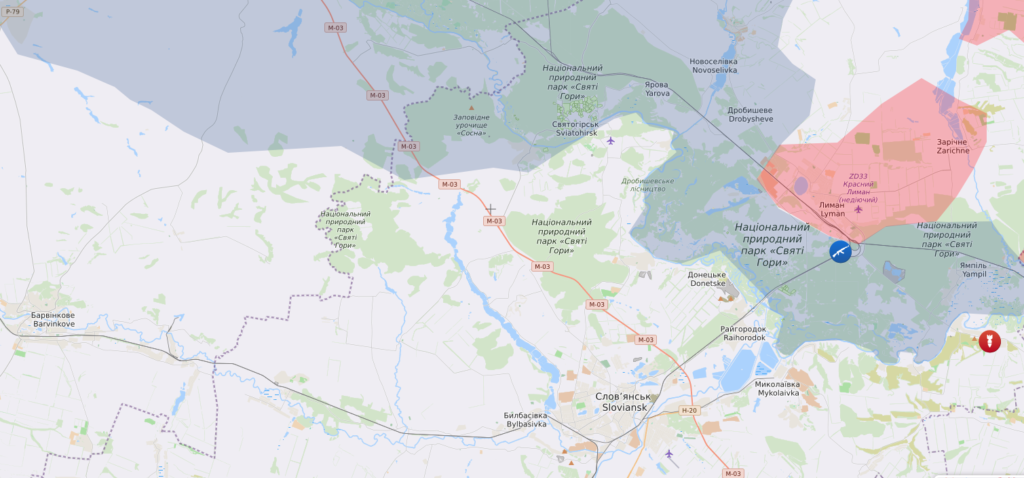
They said they cleared the way from Husarivka to Bayrak. Which means they were probably involved in the push on Lyman. Husarivka is just east of Barvinkova in the bottom left of this map.
As has become the norm, retreating Russian soldiers left behind buttloads of ammo. The Russians may have depleted their smart munitions, but they don’t appear to have any shortage of the dumb variety. “A 15 kilometer forest was full of empty ammo boxes.”
Troops breaking and retreating despite plenty of ammo suggests continuing low morale among the invading Russians (or their local conscript cannon fodder).
“There was good coordination between our infantry, tanks and artillery.” Classic western combined arms doctrine, something the Russians have seemed mostly incapable of pulling off.
Also, the Ukrainian military have reported entering Lyman:
Can the pound reach parity versus the dollar? It’s now a one-in-four chance when it comes to options pricing.
The UK currency is heading for its biggest daily loss since early May after Chancellor of the Exchequer Kwasi Kwarteng outlined the government’s plans to stimulate the economy with tax cuts and spending. The simultaneous sharp sell off in Gilts [historical term for UK government bonds – LP] suggests that tackling inflation will be a very hard task for UK authorities and that the currency market sees no easy way out for the Bank of England.
To attract foreign investors, a weaker pound may be the answer and that is what FX traders are betting on.
Cable fell as much as 2.1% to touch $1.1021, the lowest since March 1985, and was at $1.1036 as of 12:38pm in London. Risk reversals, a barometer of market positioning and sentiment, show that traders see the greatest downside risks for the pound over the medium term in two years.
According to Bloomberg’s options pricing model, the pound holds a 26% chance of touching parity versus the greenback in the next six months. That compares to a reading of 14% Thursday.
I think the real odds are probably higher than that.
Dollar-pound parity is something that’s never happened, with the nearest it came to some 1.05 dollars to the pound in the mid-1980s. But there’s always a first time for everything, and with the Bank of England doing more quantitative easing and the UK government going on a spending spree during soaring inflation while the Fed ratchets up interest rates, now is as good a time as any.
Besides making imports from the UK less expensive, what effects will dollar-pound parity have on the financial world? Hard to say for sure, but my prediction is: Weird things.
There are a variety of reasons for this, starting with the fact that currency trading is itself a weird thing. You may think “American financial houses buy pounds to purchase English goods, while UK financial houses buy dollars to purchase American goods,” but there’s a whole ecology of counter-party trades, hedging strategies, currency reserve requirements, portfolio balancing, and a host of other considerations.
Here’s a brief video that cover some of the basics for how brokerages handle FX trading:
That’s a fairly streamlined view, as it doesn’t cover how liquidity pools are set up, different hedging strategies, etc.
There are even traders who specialize in just trading different duration T-Bills, selling the eight-week-out and buying the four-week-out (or vice versa) for esoteric arbitrage reasons.
None of that will change if the market hits dollar-pound parity. So where’s the danger? That comes from the possible non-linear effects of the market doing something that a lot of algorithmic instrument designers never considered a possibility.
For a simple example, let’s talk about the swaps cases. To summarize a whole lot of very complex cases, a whole bunch of local UK governments entered into interest rate swap agreements. Interest rate swap agreements are a legitimate hedging strategy to minimize exposure to interest rate swings, but a few municipalities saw it as a license to print money. To quote Wikipedia, the source of all vaguely accurate knowledge:
The position of Hammersmith and Fulham London Borough Council was quite different from most of the other local authorities. From about 1985 onwards Hammersmith had entered into interest rate swap transactions on an extremely large scale. At one stage it was calculated that Hammersmith was a counterparty to 0.5% of the global trade in swaps, and 10% of the sterling denominated trade. Moreover, quite exceptionally, all of Hammersmith’s positions in the swap market were betting on a fall in interest rates. Most large participants in the swap market have their exposure balanced by taking positions on both sides and across multiple currencies, but Hammersmith was essentially repeatedly entering into one-way bets that sterling interest rates would fall; a bet that they would end up losing spectacularly when interest rates climbed from around 8 per cent to 15 per cent in the space of ten months.
This was, to put it in technical terms, “a really fucking stupid thing to do.” The swaps cases were unwound with great expense and difficulty, and various English banks ended up taking a bath (which you know they must have regarded as some sort of diabolical violation of the natural order) after courts determined that the authorities in question didn’t have the authority under English law to enter into such agreements.
The possibility that interests rates can rise should be an obvious one. But the idea that the pound might be worth less than the dollar is one that people have probably thought about a good deal less, since it hasn’t happened ever. It’s quite possible it hasn’t been contemplated in some percentage of the trillions in derivatives markets and hedging instruments around the world.
For many financial systems, this is going to be an untested use case. Some systems may work just fine, others may break down, and still others may experience race conditions or cascading failures; think of the flash crash of 2010, or the 1987 Black Monday crash. Somewhere, somehow, something is likely to go off the rails.
Hopefully, whatever does blow up won’t be big enough to take down the entire market, or at least not for long. Hopefully it won’t uncover massive problems like the 2008 subprime meltdown uncovered, and there won’t be a firm of systemic importance like AIG was there.
This video, covering a scaled down prototype of the Ultra Heavy-Lift Amphibious Connector (UHAC) craft, caught my attention:
The UHAC drives across the water on treads that double as paddlewheel-style water propulsion.
That video dropped this week, but most of the UHAC testing seemed to have happened back in 2014. (Another sign that the video is old is the mention of the USS Bonhomme Richard as though it were still in service, when it infamously burned up in 2020. In fact, the arson trial of Ryan Sawyer Mays, the disgruntled SEAL washout accused of setting the fire, is going on this week.)
If the program is dead, I can understand why. The UHAC seen in the video is only one-fifth of the projected size of the final vehicle, which was supposed to be 84 ft long and 34 ft high. That’s roughly 75% as big as Nazi Germany’s contemplated but never-even-attempted Landkreuzer P. 1000 Ratte tank, a project remembered for being long on imagination and short on practicality. Things that large tend to be a big magnet for air and artillery targeting.
Another thing probably dooming it: the Marine Corp decision to move away from tanks. An amphibious assault vehicle that (as per the video) can carry three M1A1 Abrams tanks probably won’t be a priority if you don’t have any in inventory.
At lot of details of how Russia will carry out its projected 300,000 man mobilization discussed yesterday are unclear. Binkov’s Battlegrounds, which covers a lot of different military topics, discusses some of the details about how it would (theoretically) be carried out.
Takeaways:
“Officially, Putin said mobilization will draw on reservists: only those who served in the armed forces with a certain experience. He further stated those called upon will undergo additional military training.”
“He also said no students will get mobilized.”
“By law some two million Russians are kept listed as being qualified to serve as reservists. Those are people who had served in the military in the previously; several years, most of them, excluding officers and specialists, between six to eight years ago in theory.”
“Even 300 000 might be quite hard for Russia to pull off quickly.”
No refresher training for the vast majority.
“The social and political climate in Russia is such that many reservists will likely try to dodge service. Russian law was amended alongside the mobilization calling for greater prison sentences for such and similar transgressions. The fact the new law included the provision for prison sentences for voluntary surrenders may already mean even the Russian government expects some people will try to surrender outright to the enemy.” Hard to see how expecting reservists to fight to the death for Vlad’s Big Adventure will increase morale.
300,000 is the number of reservists who left in the last two years.
If almost all of those new reserves are to serve in the land forces, with the Army being a third of the overall military, it might mean people called upon will mostly be five years past their military service. [Defense Minister] Shoigu further said mobilization will also be limited to those with combat experience. All the Russian troops rotated in Syria since 2014 are unlikely to reach that figure, but there are veterans of operations in Ukraine 2014 of Georgia in 2008 and the wars in Chechnya. Those may indeed yield a force over 300 000, but it also may mean that some of those mobilized reservists will have not seen military training for 15 or more years.
Veterans of the Georgian war (which Russia won handily) probably won’t be a problem, but I doubt the others were such happy affairs that veterans of those campaigns will be eager to repeat the experience against the far better-armed and better-trained Ukrainians.
“In 2019, Russia had perhaps 5,000 reservists receive refresher training. A new push was done in 2021 with plans of 38,000 troops adjusting the Southern military District. But allegedly only 10% of the called upon men actually enlisted in the reserves.”
Conscripts can’t be sent outside of Russia, but surprise! When Russia announces that their sham referendum passed, that means they can be sent to Ukraine then.
“Seven months ago, such mobilization might have been more effective. But as Ukraine has a seven month lead in mobilization and training of reservists, it’s not likely Russia will be able to stop Ukrainian counter-offensives right away.”
Judging from how well Russia has previously run this war, expect badly equipped and under-trained reservists to be thrown piecemeal into the battle lines to be slaughtered.
Faced with the continued erosion of Russia’s military position in Ukraine, Vladimir Putin has chosen to double-down on failure.
Russian President Vladimir Putin on Wednesday announced the partial mobilization of military reservists, a significant escalation of his war in Ukraine after battlefield setbacks have the Kremlin facing growing pressure to act.
In a rare national address, he also backed plans for Russia to annex occupied areas of southern and eastern Ukraine, and appeared to threaten nuclear retaliation if Kyiv continues its efforts to reclaim that land.
It came just a day after four Russian-controlled areas announced they would stage votes this week on breaking away from Ukraine and joining Russia, in a plan Kyiv and its Western allies dismissed as a desperate “sham” aimed at deterring a successful counteroffensive by Ukrainian troops.
Before this announcement it was apparent that Russia basically had no reserves, so a mobilization isn’t a surprise. Why admit failure when you can simply get more of your countrymen slaughtered for doubling-down on your own mistake?
It won’t be easy or fast to call up that many reservists, according to military experts, because Russia basically doesn’t have a reserve.
A 2019 RAND study noted that “Russia has paid little attention to developing an effective and sizable active reserve system that might be immediately required in the event of a major war.” RAND estimates that Russia has an effective reserve of only 4,000-5,000 men.
The country’s former army reserve units had been disbanded from 2008-2010 as part of the military’s modernization program, with their equipment — all of it older — going into storage or scrapped.
That doesn’t mean that Russia can’t conscript, train, organize, and arm 300,000 new soldiers, but it won’t be quick or easy.
One problem, as Foreign Affairs analyst Oliver Alexander put it, is “effectively readying and equipping these reservists. Russia already has problems equipping its professional armed forces.”
Then there’s the speed problem. Dara Massicot wrote back in August — weeks before Kyiv’s stunning counteroffensive in Kharkiv — that “Even if the Kremlin pulls all levers available, declaring a general mobilization to call up sufficient armored equipment and trained personnel, that process would still take time.”
That’s because with something like 80% of Russia’s combat power already fighting in Ukraine, plus wartime losses to their NCO and officer corps, the Russian army will need to train more trainers before anything like 300,000 men can be mobilized.
Just last month, Putin ordered an increase in the size of the Russian military of 137,000 troops. But as I reported to you then, Putin’s order only meant that “Starting next year, the Russian military will be authorized to find another 137,000 troops.” The country has long had a problem with draft dodgers, one that Putin’s “special military operation” won’t help.
He also notes the problem of obtaining new equipment. Even the first wave of Russian invasion included troops who were armed with ancient rifles. With the sanctions in place, none of that is going to get any better. Plus the fact that Russia essentially used up all their smart ordinance during the first stage of the war and that sanctions ensure they can’t easily make more.
Is there a Peter Zeihan video on the topic? Of course there is.
Some takeaways:
Reiterates why everything in the Russia army travels by rail. “The Ukrainians were able to take a couple of re-up depots in eastern Ukraine and Kharkiv a couple weeks ago and the front just collapsed.”
“We might be seeing a repeat of that in the Donbas.”
“The Russians are now discovering that they’re actually outnumbered locally, and that with all the captured equipment, the Ukrainians actually now have more artillery and more ammo.”
“This is the sort of war the the Russians know how to fight: Just throw bodies after it.”
The influx of new troops “doesn’t mean that the nature of the war is
fundamentally changed,” but now they’ll be able to rotate fresher troops in, “and continue fighting the war more or less the way that they have been now, which is to say poorly.”
Russia is already crashing demographically, and the main cohort of this war is coming from the men who should be fathering children. “This is a potentially a country killer. Before I thought that this was Russia’s last war. Now I’m certain of it.”
Says Ukraine can still win, but they need to do the Kharkiv counteroffensive twenty times over.
Says they need to continue hitting Russian logistics nodes. “The one I am most interested in, of course, is Miriapol. Because if the Ukrainians can reach Mariupol, they basically isolate Russian forces throughout southern Ukraine, and then you’re talking about a hundred thousand Russian troops that are just stranded with no hope of resupply at all.” (Assuming his later mention of taking out the Kerch Strait Bridge.)
Nor are the sham referendums likely to make any difference either.
Russian-appointed occupation officials in Luhansk, Donetsk, Kherson, and Zaporizhia oblasts announced on September 20 that they will hold a “referendum” on acceding to Russia, with a vote taking place from September 23-27. The Kremlin will use the falsified results of these sham referenda to illegally annex all Russian-occupied parts of Ukraine and is likely to declare unoccupied parts of Donetsk, Kherson, and Zaporizhia oblasts to be part of Russia as well.
The Kremlin’s annexation plans are primarily targeting a domestic audience; Putin likely hopes to improve Russian force generation capabilities by calling on the Russian people to volunteer for a war to “defend” newly claimed Russian territory. Putin and his advisors have apparently realized that current Russian forces are insufficient to conquer Ukraine and that efforts to build large forces quickly through voluntary mobilization are culminating short of the Russian military’s force requirements. Putin is therefore likely setting legal and informational conditions to improve Russian force generation without resorting to expanded conscription by changing the balance of carrots and sticks the Kremlin has been using to spur voluntary recruitment.
Putin may believe that he can appeal to Russian ethnonationalism and the defense of purportedly “Russian peoples” and claimed Russian land to generate additional volunteer forces. He may seek to rely on enhanced rhetoric in part because the Kremlin cannot afford the service incentives, like bonuses and employment benefits, that it has already promised Russian recruits. But Putin is also adding new and harsher punishments in an effort to contain the risk of the collapse of Russian military units fighting in Ukraine and draft-dodging within Russia. The Kremlin rushed the passage of a new law through the State Duma on September 20, circumventing normal parliamentary procedures. This law codifies dramatically increased penalties for desertion, refusing conscription orders, and insubordination. It also criminalizes voluntary surrender and makes surrender a crime punishable by ten years in prison. The law notably does not order full-scale mobilization or broader conscription or make any preparations for such activities.
ISW has observed no evidence that the Kremlin is imminently intending to change its conscription practices. The Kremlin’s new law is about strengthening the Kremlin’s coercive volunteerism, or what Chechen leader Ramzan Kadyrov called “self-mobilization.”
The Kremlin is taking steps to directly increase force generation through continued voluntary self-mobilization and an expansion of its legal authority to deploy Russian conscripts already with the force to fight in Ukraine.
Putin’s illegal annexation of occupied Ukrainian territory will broaden the domestic legal definition of “Russian” territory under Russian law, enabling the Russian military to legally and openly deploy conscripts already in the Russian military to fight in eastern and southern Ukraine. Russian leadership has already deployed undertrained conscripts to Ukraine in direct violation of Russian law and faced domestic backlash. Russia’s semi-annual conscription cycle usually generates around 130,000 conscripts twice per year. The next cycle runs from October 1 to December 31. Russian law generally requires that conscripts receive at least four months of training prior to deployment overseas, and Russian President Vladimir Putin has repeatedly denied that conscripts will be deployed to Ukraine. Annexation could provide him a legal loophole allowing for the overt deployment of conscripts to fight.
Russian-appointed occupation officials in Kherson and Zaporizhia oblasts announced the formation of “volunteer” units to fight with the Russian military against Ukraine. Russian forces will likely coerce or physically force at least some Ukrainian men in occupied areas to fight in these units, as they have done in the territories of the Russian proxy Donetsk and Luhansk People’s Republics (DNR and LNR).
The Russian State Duma separately passed new incentives for foreign nationals to fight in Russia’s military to obtain Russian citizenship and will likely increase overseas recruitment accordingly. That new law, which deputies also rushed through normal procedures on September 20, allows foreign nationals to gain Russian citizenship by signing a contract and serving in the Russian military for one year. Russian law previously required three years of service to apply for citizenship.
Putin’s appeals to nationalism may generate small increases in volunteer recruitment from within Russia and parts of occupied Donetsk and Luhansk. However, forces generated from such volunteers, if they manifest, will be small and poorly trained. Most eager and able-bodied Russian men and Ukrainian collaborators have likely already volunteered in one of the earlier recruitment phases.
Local Russian administrators will continue to attempt to form volunteer units, with decreasing effect, as ISW has previously reported and mapped.
Russian forces and the Wagner Private Military Company are also directly recruiting from Russian prisons, as ISW has previously reported. These troops will be undisciplined and unlikely to meaningfully increase Russian combat power.
Putin likely hopes that increasing self-mobilization, and cracking down on unwilling Russian forces, will enable him to take the rest of Donetsk and defend Russian-occupied parts of Luhansk, Kherson, and Zaporizhia oblasts. He is mistaken. Putin has neither the time nor the resources needed to generate effective combat power. But Putin will likely wait to see if these efforts are successful before either escalating further or blaming his loss on a scapegoat. His most likely scapegoat is Defense Minister Sergei Shoigu and the Russian Ministry of Defense. Reports that Shoigu would accompany Putin while Putin gave a speech announced and then postponed on September 20 suggest that Putin intended to make Shoigu the face of the current effort.
That decree is every bit as popular as you would expect.
Takeaways:
“Today, people went to the streets from Moscow to the Far East to protest. Even though it only concerned those in reserve, everyone sees where this is going.”
“Former Security Minister of the Donetsk People’s Republic called on Russia’s military command to better supply existing units on the ground. He also added that lack of equipment is the main reason why the Ukrainians keep advancing in Kherson.”
He thinks the conscripts will work logistics jobs, free up contractors to do the fighting. I remain doubtful that the effective military contractor pool for this war is terribly deep.
Neither the mobilization nor the sham referendums change any immediate facts on the ground in Ukraine. It will take many months to take new “recruits” up to even the most basic soldiering standards. Or maybe they’ll just give them three days training and send them into battle with old rifles and old ammunition like they did before, with the same results.
Either way, it doesn’t solve any of Putin’s immediate problems…
Like a Marvel crossover comic that features two characters you’re interested in, having both Ian McCollum of Forgotten Weapons and tank expert Nicholas Moran talk about the .50cal machine gun (and why the Germans never adopted it) did indeed peak my interest.
A few takeaways:
“That the M2 I think is so well known today, it’s so recognized and … is ubiquitous. During World War Two, the U.S. kind of did a like a massive industrial flex on the rest of the world with the M2. It’s a bit memey, but you could think of this as like the classic Uncle Sam painting with like glowing red eyes of fire. Because the US manufactured about 2 million Browning .50 caliber machine guns.”
“We’re going to put them on trucks, we’re going to put them on tanks, we’ll put them on some Jeeps, we’ll put them on half-tracks. We’ll put four of them together in a big mount and put that on a half-track or on a trailer. It’s like Oprah just handing out .50 cal machine guns.”
Because McCollum didn’t know, he asked Moran, leading to the special Gun Jesus/Chieftain Crossover Issue.
Moran’s first cut: “Dunno! Let me ask around.”
For starters, the Germans used small canons instead of big machine guns.
It was a hell of a lot safer to be buttoned up in the tank with aircraft shooting at you than outside it trying to score an unlikely machine gun kill.
“The reality was that aircraft generally were horrible at killing tanks.” (Caveat: I hear the Stuka version with the 37mm cannon was actually pretty good at it, but German tankers obviously didn’t have to worry about that.)
Also, since they thought taking out aircraft with machine guns was unlikely, one light machine gun with tracers was just as good as four heavy machine guns at “giving pilots something to think about” on their strafing runs.
The Germans did have “the MG 131, a 13mm weapon, and thus as close to a caliber .50 as possible. Though primarily an electrically primed aircraft gun, it could be converted to a ground mount and percussion fired. It could thus be mounted on a tank much like an American caliber .50, yet it never was.”
Germans had a doctrinal preference for saving ammo wherever possible if the possibility for effective fire was too low. Americans had a doctrinal preference for turning out giant piles of ammo.
“If you want something which provides a lot of coverage, and has a good chance of actually shooting down a target, especially an armoured one like an IL-2, you’re better off with a heavier gun on a dedicated platform with a trained, dedicated anti-aircraft crew.”
I talked about buildings made of Chinesium and rotten tail buildings, upon which construction stops but upon which mortgage owners are still expected to make payments.
Shoddy Chinese construction practices don’t stop there. This week an entire Chinese residential skyscraper went up in flames:
Fires are hardly unknown among American skyscrapers, but usually they occur in older buildings, not ones built this century, as modern construction practices like firewalls and sprinkler systems generally prevent fires from spreading from floor to floor. The Lotus Garden China Telecom building in Changsha was finished in 2000.
Buildings made from subpar constriction materials in China are know as “Tofu Dregs” buildings, as though they were built out of tofu:
Shoddy construction practices extend to buildings, roads, bridges, flood walls and other infrastructure. It’s hard to do quality work when cutting corners seems to be your national ethos…
Peter Zeihan says the abysmal performance of the Russian Army is going to have a whole lot of ramifications around the world, many in Russia’s own near abroad. “It means that the image of the Russians as a regional power, much less a global one, is gone, and it’s not coming back.”
Some takeaways:
“The countries that had signed on to kind of a Russian Alliance, if you will, [they’re] on their own completely, and that provides opportunities for their rivals to take matters into their own hands.”
Belarus: “Here’s a country of 10 million people that has basically hitched itself to Putin’s star. And the Poles, the Latvians, the Lithuanians, the Estonians, the Finns, and the Swedes they have been chomping at the bit for years to try to take Alexander Lukashenko of Belarus down to size and basically peel Belarus out of the Russian orbit. They will now have the opportunity, and it’s unlikely that anyone in Europe or the United States is going to try to stand in the way.”
“Unless Lukashenko sues for peace with the Balts and the Nordics, very quickly we should count on seeing him being brought up on war crimes before very long. Because after all he did provide the access that was necessary for the assault on Kiev early in the war.”
Georgia: “Here I do expect things to be a little bit more circumspect. The Georgians tried to call Russia’s bluff and invade their former secessionist Republics of North Ossetia and Abkhazia several years ago in 2004, and it was a trap and the Russians were able to destroy the Georgian Army. So the Georgians are not going to do this until a couple of other countries in the region have already pulled this off successfully.”
Moldova:
There’s a small secessionist republic there called Transnistra. It’s only 10 percent of the population of a country of like three and a half million people. There’s not much going on there, but the Russians intervened decisively right at the end of the Soviet collapse to basically make sure that Transnistra could be functionally independent under Russian sponsorship, but unlike the Georgian secessionist territories, which share a land border with Russia proper, Transnistra is on its own. The only way to supply it is through Ukraine, and that has obviously stopped. So the Moldovans and their sponsors in Romania have now a vested interest in ending this historical aberration, and I would expect to see that being wrapped up within a year or two.
Israel: Without big brother Russia providing help, Syria may be screwed.
The Russians have very publicly, unfortunately for them, relocated a lot of hardware from Syria to Ukraine, specifically air defense equipment to help them with their assaults. Which means that if you are Israel, the only thing that is standing in your way of going after the Syrian regime is someone from the Biden Administration saying “You know what? We really don’t want a nuclear event to erupt because there are Russian troops involved.” Well, the tone of the Biden Administration in the last 72 hours has kind of changed. Now it’s more of “You kids go have fun” sort of vibe, so I expect us to see some very interesting pyrotechnics between the Israelis and the Syrians in a very short period of time, followed by the Syrians suing for peace. Which means that we get to revisit the entire Syrian Civil War now without the Russians being players.
Two caveats from my viewpoint: 1. Given the history of Israeli striking Syria with impunity several times over the past decade, with possibly one Israeli plane hit during that period, I don’t think Russian anti-aircraft equipment have provided any significant deterrent to Israel doing whatever it wanted in Syria. I view it more likely that Israel views a weakened Assad continually beset by a grinding civil war against numerous enemies a preferable option to taking him out entirely. 2. Not sure where Zeihan is getting his information on a change in the Biden Administration’s messaging to Israeli, but I readily concede that he likely does have better sources than I do. It may also be that the most recent failure of the asinine Iran deal has changed the collective mind of whatever passes for a Biden brain trust.
Speaking of Iran: “Tehran has lost its primary weapons sponsor, and its primary Security Council sponsor, and that is going to force the Iranians to think differently and act differently in every theater.”
Plus possible policy changes in (or toward) Cuba and Venezuela.
Azerbaijani forces shelled Armenia’s territory on Tuesday in a large-scale attack that killed at least 49 Armenian soldiers and fueled fears of even broader hostilities.
Azerbaijan and Armenia have been locked in a decades-old conflict over Nagorno-Karabakh, which is part of Azerbaijan but has been under the control of ethnic Armenian forces backed by Armenia since a separatist war there ended in 1994. Azerbaijan reclaimed broad swaths of Nagorno-Karabakh in a six-week war in 2020 that killed more than 6,600 people and ended with a Russia-brokered peace deal.
Moscow, which deployed about 2,000 troops to the region to serve as peacekeepers under the deal, moved quickly to broker a cease-fire on Tuesday morning, but it wasn’t immediately clear whether it was holding.
The hostilities erupted minutes after midnight, with Azerbaijani forces unleashing an artillery barrage and drone attacks in many sections of Armenian territory, according to the Armenian Defense Ministry.
Azerbaijan charged that its forces returned fire in response to “large-scale provocations” by the Armenian military, claiming that the Armenian troops planted mines and repeatedly fired on Azerbaijani military positions, resulting in unspecified casualties and damage to military infrastructure.
Azerbaijan’s ally Turkey also placed the blame for the violence on Armenia. Turkish Foreign Minister Mevlut Cavusoglu called for Yerevan to halt its “provocations” and Defense Minister Hulusi Akar condemned “Armenia’s aggressive attitude and provocative actions” following talks with their counterparts in Baku.
Speaking in parliament early Tuesday, Armenian Prime Minister Nikol Pashinyan said that Azerbaijani shelling has killed at least 49 Armenian soldiers.
He said the Azerbaijani action followed his recent European Union-brokered talks in Brussels with Azerbaijani President Ilham Aliyev that revealed what he described as Azerbaijan’s uncompromising stand.
Christian Armenia has a long, unhappy history with Turkey, including genocide at the hands of Muslim Turks in the waning days of the Ottoman Empire. Like the Balkans, the Caucuses are an unstable cauldron of mixed ethno-religious-nationalism, with a side-order of Jihadism thrown in for good measure (the Islamic State – Caucasus Province, the successor to the Caucasus Emirate, has been relatively quit recently, but such groups seldom wither away entirely). Russia still occupies the parts of Georgia it conquered in 2008, but the blooding it’s taken in Ukraine has probably weakened its hand regionally. And coming food and energy security issues (Azerbaijan in energy rich, but Armenia is energy-poor) are likely to exacerbate tensions in the coming months.
Putin’s Russia may be receiving a well-deserved comeuppance in Ukraine, but its resulting weakness could very well result in interesting times for many ex-Soviet states.