Posts Tagged ‘Litani River’

LinkSwarm For April 10, 2026

Friday, April 10th, 2026

An Iran ceasefire (sorta, kinda) holds, still more Californian welfare state fraud, Governor HairGel simply isn’t all there, Colorado steps up its war on the First Amendment, France’s aircraft carrier gets rumbled by a jogging ap, and William Shatner isn’t dying of cancer. It’s the Friday LinkSwarm!

Personally, this has been a damn busy week. I’ve pretty much recovered from my bout of stomach flu, I’m in the home stretch for doing my taxes, and a bunch of other urgencies press.

  • Rather than provide a specific link, I’m just going to describe what I’m seeing of the ceasefire in the Iranian war. Like cannibalism in the the Royal Navy in that Monty Python skit, when Iran says they’re not lobbing any missiles, the mean that there is a certain amount. Just today, hostile drones were flying over Kuwait. And ships are free to transit the Strait of Hormuz, for values of “free” that include paying Iran protection money. Despite these violation of President Trump’s ceasefire terms, Iran is complaining that it’s no fair that Israel gets to continues kicking Hezbollah’s ass in Lebanon.
  • Speaking of Lebanon, three days ago the IDF reissued an evacuation notice for all Lebanese residents south of the Zahrani River. Note that the Zahrani is north of the Litani River, Israel’s previous line for evacuation. At this rate, IDF will enter Beirut in a few months…
  • California hospice fraud arrest made.

    Gladwin Gill, a 66-year-old psychologist, and his wife, Amelou Gill, a 70-year-old registered nurse, both of Covina, were arrested today on a federal criminal complaint charging them with health care fraud.

    According to an affidavit filed with the complaint, the Gills owned and operated the Glendale-based 626 Hospice Inc., which did business as St. Francis Palliative Care.

    The Gills allegedly schemed to defraud Medicare by paying illegal kickbacks for the referral of patients who were not dying.

    The Gills’ business had a 97% survival rate … for hospice.

    The Gills also submitted more than $5.2 million in fraudulent claims to Medicare for hospice services that either were not medically necessary or were not provided. Medicare paid the Gills more than $4 million on these fraudulent claims.

    I’m sure the next part will be a huge surprise.

    Gill is originally from Pakistan, and he’s served jail time before.

    • In 2008, he was sentenced to a year in prison for fraudulent political donations.
    • In 1995, he served two years in prison for real estate fraud.
    • He also fired a gun at gas company employees who came to his property to collect an unpaid bill.

    Blue state officials can ignore any number of red flags as long as they expect to profit from the grift.

  • A succinct discussion of Cali’s homeless scam.

    The insiders in Sacramento, Salem, and Olympia have been using social service non-profits, NGOs, and questionable charitable groups as passthroughs for their friends and pet constituencies for years. Billions have been gifted to insiders and friends. And now — at long last — actual taxpayers have gotten wise to the grift. You can thank independent journalists for highlighting these absurd expenses in a much simpler and understandable way than thick books or endless PDFs filled with intentionally confusing stats, opaquely written conclusions, and puffed-up executive summaries that don’t reflect the data can ever do.

    And now people living on the West Coast, Messed Coast™ want to know one thing: Where’d all that money go?

    It all starts with … Gavin

    Because your longtime West Coast, Messed Coast™ correspondent has been highlighting this stupidity for years and chronicled it here and in my other writings, radio shows, and podcasts, I’m going to insist you stipulate that the Homeless Industrial Complex exists and began in earnest from about 2005-2010, when leftist leaders saw that a buck could be made by declaring and funding programs to “End Homelessness in 10 Years.” Obviously, it was a smashing success — for grifting, I mean.

    In 2005, then-San Francisco Mayor Gavin Newsom harrumphed and gesticulated that he would, by dint of his own signature on a proclamation, “end homelessness” by 2015. Other cities followed. Billions went down the toilet as a result. And by toilet, I mean the streets of the Tenderloin and other Skid Rows along the West Coast, Messed Coast™.

    There then follows a chart of various attempts to “end homelessness.” I’m sure you’ll be shocked to find out none of them succeeded.

    (Hat tip: Stephen Green at Instapundit.)

  • Speaking of Blue Grift: “Democrat PAC ActBlue appears to have LIED TO CONGRESS about accepting foreign money in their effort to help Democrats win elections.” Try to contain your shock.

    Sen. Tom Cotton: “The New York Times just confirmed what we’ve long suspected: ActBlue knowingly let in fraudulent foreign donations to help Democrats win. Yet another example of the left’s embrace of fraud. Everyone involved must face the full weight of the law.”

    “The bombshell Times story comes after a law firm that formerly worked with ActBlue warned the group that they almost certainly lied to Congress about their process of vetting foreign donations.”

  • After interviewing Gavin Newsom, Adam Carolla thinks “Something’s wrong with him.” “He’s a sociopath. Like he doesn’t really understand anything.”
  • “Huge Drone Strike On .”
  • Konkivskyi Bridge Destroyed in 60-Day Ukrainian Drone Operation Using Heavy-Lift Drones.” The weird thing is that this is in Oleshky, down from the already-destroyed Antonovsky Bridge, and evidently built up explosive material under the bridge over a period of time.
  • “Ukraine Attacks Admiral Grigorovich Frigate At Novorossiysk Port, Syvash Oil Platform and Be-12″ aircraft.
  • Crime in blue Portland is so organized that random people on the street protect criminals from justice.

    The moment I heard the smashing of glass, I knew exactly what it was. I had heard that sound dozens of times over the last month. Before I even looked up, I grabbed my phone, turned toward the noise, and started taking photos. Ten feet away, a black Expedition SUV sat with its rear window blown out. Within seconds, a man in a black shirt and backpack sprinted off carrying a laptop, a briefcase, and a gym bag. I ran over, saw the shattered glass, and knew exactly what I had just witnessed: a smash-and-grab. A smash-and-grab is a particular kind of burglary. A thief smashes a car window, grabs whatever looks valuable, and gets out fast. What defines it is not just the speed. It is the confidence. The noise, the alarms, the cameras, the witnesses, none of it matters anymore. The criminal is not trying to avoid attention because attention no longer means consequences.

    Without thinking, I took off after him. Just moments earlier, I had been across the street in Portland’s Pearl District with a few dozen volunteers doing a trash cleanup. We were on the sidewalk with gloves and garbage bags, doing what functioning cities are supposed to do: maintain public space, clean up disorder, and take pride in where they live. Then, right across the street, someone did what a broken city has learned to tolerate: smash a car window and steal from strangers in broad daylight. The contrast could not have been clearer. On one side were citizens trying to restore their city. On the other was someone actively tearing it down. Maybe it was that stark line between right and wrong that lit the fuse in me. Maybe I was just tired of watching decent people get victimized while everyone else acted like this was now normal.

    I caught up to him as he turned the corner at Northwest 14th and Couch and screamed, “Stop!” Then louder: “STOP!” He looked back, startled, and dropped the first bag. My friend grabbed it and held onto it while I kept running. We ended up in a full sprint. He was at least twenty years younger than me, but adrenaline kept me close. He weaved through traffic, jumped over a garbage can, and slid across the hood of a car like this was routine, like he had done it many times before. Several blocks later, he started to slow down. He ducked behind a parked car, and I chased him around it twice. He was breathing hard and begging me to stop chasing him. I finally caught him and cornered him in a doorway. He shoved me with his left arm. I grabbed his shirt and pushed him back into the door. “Leave me the f*ck alone, bro,” he screamed. I did not let go. I demanded everything back. He tried to pull away, then handed over what he had stolen while repeating, “I didn’t do anything,” over and over. He looked scared, but he also looked stunned. His expression said something I could not ignore: I think I was the first person who had ever chased him down.

    My friend called 911. We gave the operator a detailed description, and she told us it would take at least twenty minutes and that we needed to let him go. So we did and he took off running again. But we kept following from a distance so we could continue updating 911 with his location. And once I was no longer right on top of him, the thief stopped sprinting and started operating. That is the part most people do not understand. People imagine smash-and-grabs as chaotic, impulsive crimes, one desperate guy, one reckless decision, one lucky escape. What I witnessed was not chaos. It was choreography. He took off his shoes. Took off his shirt. Cut his jeans into shorts. Within thirty seconds, he looked like a different person. That is not panic. That is a practiced move. That is someone who has done this enough times to have a system.

    Then came protection. A middle-aged man in a “Just Do It” Nike hat rolled up on a beat-up bike and grabbed my shoulder. “Stop following,” he said. “I’ll make serious trouble for you.” A random passerby does not physically confront a stranger for following a thief. He does not show up at the perfect moment, get physical

    immediately, and start threatening people. That was not random. That was an enforcer, someone whose role was to discourage interference, someone who knew the routine. I knocked his arm off and stood my ground. Once he realized I was not going to back down, he backed off. A moment later, I watched two homeless individuals throw a blanket over the thief as if they were concealing contraband, then casually walk away. If I had not seen it happen, I would have walked right past him.

    We called 911 again and gave his updated description and location. Then chaos became a weapon. A woman in a black jacket and mini skirt lunged at me and tried to rip my phone out of my hands. She grabbed it hard, pulling like her life depended on it. Another man rolled up on a BMX bike and grabbed my arm. This was not about stealing my phone. It was about destroying the evidence. They were trying to remove the one thing that made them vulnerable: documentation.

    (Hat tip: Dwight.)

  • Europeans demonstrate they’re clueless about “leave no man behind.”
  • “Singham Network collaborators in China promote pro-Iran, pro-Putin, ‘MAGA Communist’ Jackson Hinkle.”

    Chinese propaganda outlets linked to the Singham Network have repeatedly sought to raise the profile of self-described “MAGA Communist” Jackson Hinkle as the social media influencer praises the Chinese Communist Party and critiques the Trump Administration and the West.

    The China-based propaganda partners of the Singham Network — most notably the pro-CCP Guancha outlet as well as the China Academy and its Wave Media video ecosystem — have repeatedly sought to elevate Hinkle, including hosting him for conferences in Shanghai, giving him favorable interviews, promoting his comments and appearances, and generally pushing his idea of so-called “MAGA Communism.”

    Hinkle is openly “Marxist-Leninist” and, despite his use of the “MAGA Communist” label, he has been a harsh critic of President Donald Trump, repeatedly labeling him a “war criminal” as Hinkle openly sides with U.S. adversaries such as Chinese leader Xi Jinping and the CCP, Russian strongman Vladimir Putin, the Iranian regime, and terrorist groups such as Hezbollah, Hamas, and the Houthis.

    Hinkle has also been promoted in China by Chinese state media outlets, some of which are also linked to Singham’s influence efforts. Singham leads and funds a global financial and activist network that operates inside the U.S. and many other countries, and while he rarely grabs the spotlight for himself in public speeches, he did so in November through the Chinese release of a report that sought to denigrate U.S. and Allied Power contributions to WWII.

  • “DHS confirms ICE arrested Salah Sarsour today, the president of the Islamic Society of Milwaukee. DHS says he is a terrorist, a Jordanian national who was convicted of throwing Molotov cocktails at the homes of Israeli soldiers, then lied on his U.S. immigration applications and got a green card under President Clinton.” He should be denationalized and deported.
  • “Abbott Throws Cold Water on Gambling Push Ahead of Next Session.”

    Gov. Greg Abbott said he does not expect Texas to legalize gambling in the next legislative session, signaling a continued roadblock for casino interests that have spent millions trying to influence state elections.

    Abbott made the remarks during a press conference Tuesday focused on his property tax plan, held after Galveston County Commissioners Court joined the Lone Star Property Tax Reform Council in support of his proposal.

    The governor was asked about gambling, as well as a so-called “fuzzy animal” or “fuzzy bear” exception in Texas law—a colloquial term for a narrow provision allowing certain amusement machines to award low-value, non-cash prizes, which some “game room” operators have cited to justify machines critics say function as illegal gambling devices.

    “I don’t know how that works, and I’m not sure about fuzzy bears and things like that,” said Abbott. “We’ll look into the fuzzy bears. All I can tell you is what the law says, and that is, gambling is unconstitutional in the state of Texas, and I don’t see that changing in the next session.”

    Abbott’s comments come as casino interests, including groups tied to Las Vegas Sands and the Texas Defense PAC, have poured millions into Texas primary elections in recent cycles. Those efforts failed to unseat lawmakers who opposed expanding gambling.

  • “Colorado Doubles Down On New Assaults On The First Amendment.”

    Colorado is now arguably the most anti-free speech state in the union, pushing an array of measures attacking those with opposing social and political views. The irony is that the state has proved a bonanza for free speech with spectacular legal failures that reaffirmed rather than restricted the First Amendment. Now, the Democratic legislature and governor are back with new unconstitutional measures, including a requirement that lawyers not share information with federal immigration officials as a condition for filing with state courts.

    Colorado legislators and judges have spent years attacking core free speech and associational rights. In the last election, the state attempted to strip President Donald Trump from the ballot with the support of a majority of its Democratic-controlled state supreme court. (The effort was later declared unconstitutional in a unanimous decision by the Supreme Court. Colorado could not even get any of the liberal justices to support its actions).

    The state is responsible for the efforts to force business owners to create products celebrating same-sex marriages. That effort led to the Masterpiece Cake Shop case and then the 303 Creative case. Even after losing earlier efforts against Masterpiece Cake Shop owner Jack Phillips, the targeting of its owner continued for years. That litigation proved to be a tremendous victory for free speech.

    Colorado has also been leading the fight to limit the speech and associational rights of professionals and parents on “conversion therapy.” Recently, that effort led to another massive loss before the Supreme Court in Chiles v. Salazar, resulting in a resounding 8-1 rejection of Colorado’s position. It could only secure the vote of Justice Ketanji Brown Jackson.

    After that near-unanimous ruling against the state, Colorado responded by doubling down with legislation to expose any counselors engaged in conversion therapy to heightened legal liability, including waiving any statute of limitations. That case could also result in legal challenges as Colorado continues to spend a fortune on seeking to curtail free speech rights.

    Now, the state is defending a new public accommodation law, HB 25-1312, that defines “gender expression” to include “chosen name” and “how an individual chooses to be addressed.”

    As in past Colorado cases, the state secured favorable rulings from district court judges. President Biden-nominated U.S. District Judge Regina Rodriguez refused to grant a preliminary injunction against the Colorado public accommodation law.

    The Alliance Defending Freedom is appealing the matter to the United States Court of Appeals for the Tenth Circuit on behalf of its clients, XX-XY Athletics and Born Again Used Books. Other appeals are also being brought in the matter.

    At the same time, the state has moved forward on Senate Bill 25-276, which imposes a threshold condition for state e-filings that requires lawyers to certify annually “under penalty of perjury,” that they will not use “personal identifying information” from the system to help federal immigration enforcement.

  • “After nearly a decade, the final charge against David Daleiden for his exposé of Planned Parenthood has been dropped.”
  • French aircraft carrier Charles de Gaulle’s operational security blown by someone using a fitness app on their smart phone.
  • California sheriff deputies try to serve an eviction notice, have the guy open fire on them for their troubles. Do they: A.) Taz him, B.) Shoot him, or C.) Roll over him in an armored vehicle? (Hat tip: Dwight.)
  • Important note: William Shatner is not dying of cancer.
  • Speaking of Shatner, he’s been warning people about crazy “Shippers” (people who imagine relationships between fictional characters) for a while now. Even crazier? When a crazy anime shipper sends a death threat to a voice actress for not agreeing with them that an animated character is crazy shipper’s “soulmate.”
  • Follow-up: Remember Hamideh Soleimani Afshar, age 47, and her daughter, Sarinasdat Hosseiny, the niece and grandniece of dirtnapped Iranian revolutionary Guard scumbag Qasem Soleimani?

    Important, totally relevant visual reminder.

    Turns out they’re actually being held at a South Texas detention center.

  • “So, all the animation studios are already using AI. They’re just not saying anything about it because they don’t want to get cancelled on BlueSky.”
  • Evidently a Ford GT Mk IV just set the third fastest Nürburgring Lap ring time ever, and the fastest internal-combustion time ever.
  • Tom Scott goes paragliding, which, to be honest, looks pretty damn cool.
  • Rick Beato has a pretty swell story that’s about playing golf, but not really.
  • Six unwritten rules for British pubs.
  • “World In Shock As Trump Takes Seemingly Extreme Position To Negotiate Best Possible Deal.”
  • “Battle-Hardened Drone Returning From Iran War Struggling To Re-Enter Life Of Delivering Amazon Orders.”
  • Sneaky.

    (hat tip: Ace of Spades HQ.)

  • I’m still between jobs. Feel free to hit the tip jar if you’re so inclined. But I did have job interviews this week!




    Iran Strikes: Day 31

    Monday, March 30th, 2026

    The Iran war is one months old and the usual Negative Nellies in the Democrat Media Complex are whinging that the war’s not won yet, or suggesting that the Trump Administration is looking for an “off ramp.” Funny how it takes time to defeat a nation of 92 million, even one where the regime is hated by its citizens and whose prewar air force looked like a museum. Everything we hear from CENTCOM is that the air campaign is on schedule.

    And the “off ramp” for the war is regime change in Tehran.

  • “The USS Tripoli and USS New Orleans arrived in the Middle East, carrying with them 2,200 Marines — with more on the way — hours after an Iranian strike left dozens of U.S. service members hurt at a Saudi air base. The Tripoli and New Orleans are two of several additional vessels and personnel the Pentagon has deployed to the region as the U.S.-Israeli war in Iran enters it’s second month. The Tripoli Amphibious Group brings with it F-35B Strike Fighters, as well as transport aircraft, amphibious assault vessels and other tactical assets.”
  • “Israel struck secret facility for production of Iran’s naval weapons and storage of boats and ships.”

    • “The facility located in the city of Yazd served as a key production center for advanced missiles and sea mines intended for Iran’s naval forces.”
    • “The site that was hit was reportedly involved in designing, assembling, and testing advanced missiles that could be launched from ships, submarines, and helicopters, targeting both moving and stationary vessels at sea.”
    • “The Israeli Defense Forces described the location as the central hub of Iran’s naval strike capabilities, noting that weapons produced there had been used in operations that posed a threat to navigation in the Strait of Hormuz.”
    • “Following the strike, the facility’s production infrastructure and stores of ready-to-use missiles were said to have been completely destroyed.”
  • Israeli also obliterated the Space Propulsion Engines Research Institute in Tabriz.
  • “An airstrike hit a petrochemical plant in Tabriz.”
  • “A reported Israeli airstrike on Tehran has killed Hassan Hassanzadeh, a senior commander of the Islamic Revolutionary Guard Corps’ Mohammad Rasul‑Allah Corps, which oversees security in Greater Tehran and counter‑ unrest operations.” I’ve also seen his name rendered “Hassan Hassan Zadeh,” for those playing IRGC Dirtnap Bingo at home…
  • “Majid Zakriyai, commander of the Iranian Army’s Natural Resources Organization protection unit, was killed.”
  • “IRGC General Abbas Karami killed in Tehran.”
  • President Trump promised some absolute scorched earth on Iran if they don’t fall in line, promising to blow up their electric grid, their oil wells and Kharg Island…but then deleted the tweet. 🤷
  • E-3 Sentry and KC-135 destroyed at Prince Sultan Air Base in Saudi Arabia.

    The anti-air capabilities of Prince Sultan Air Base still leave much to be desired.

  • Iran also hit the Bazan oil refinery in Haifa, Israel.
  • “One killed, severe damage caused following Iranian attack on a service building at a Kuwaiti power & water desalination station.” Nothing says “respect for life” like attacking a desalination plant…
  • The Houthis had been unusually quiet during the open stages of the war. Well, that’s ended, and they’re now tossing missiles at Israeli. Not sure how many they have, given that Iran has been both broke and busy…
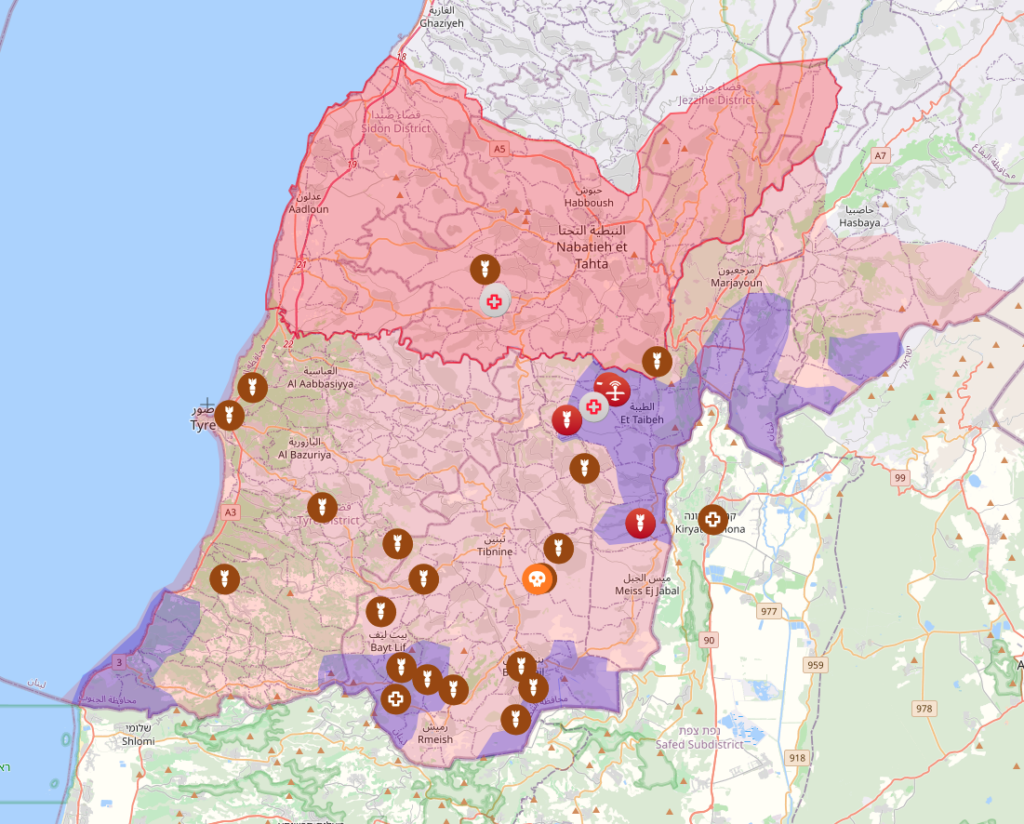
  • It’s always hard to tell what the state of the war in Lebanon is, but to my casual observation, it looks like the intensity of strike has lessened on both sides, but Hezbollah attacks seem to have fallen sharply. On the other hand, today’s status map show that Israeli forces are already at the Litani River in the eastern part of Lebanon:

  • “US military has been working on Iran ground raid plans for years.” One would hope.

    Retired Gen. Frank McKenzie, the former commander of U.S. Central Command (Centcom), said Sunday that the U.S. military has been working on plans for a ground raid in Iran for years, as President Trump is reportedly considering sending troops into the war.

    “Margaret, for many years we’ve considered options along the southern coast of Iran, seizing islands, seizing small bases. Typically raids. And a raid is an operation with a planned withdrawal. You’re not going to stay. But some of those islands you could seize and hold. That would have a couple effects,” McKenzie told CBS News’s Margaret Brennan on “Face the Nation.”

    “First of all, it would be profoundly humiliating for Iran and would give us great weight in negotiations. The second, the example of Kharg Island, which everyone talks about, if you seize Kharg Island, you really can shut down the Iranian oil economy completely. And the beauty of seizing it is, you’re not destroying it,” he said.

  • Is China pushing Iran for a ceasefire?

    • “The risks to global trade through the Strait of Hormuz have surged and the dynamics of Iran’s relationships with Russia and China are constantly in the spotlight. Recently, both countries have pressured Iran, urging diplomatic solutions to the crisis. On March 24th, China’s foreign ministry reported that Foreign Minister Wang Yi held a phone call with Iran, calling for seizing the opportunity for peace and negotiating as soon as possible.” So did Russian Foreign Minister Sergei Lavrov.
    • “Analysts believe Russia has explicitly urged Iran to back down, signaling that Moscow views Iran as unable to continue fighting. Shortly afterward, China followed suit, aligning with Russia in terms of diplomatic timing. This indicates coordination between the two countries. Their shared goal is to maintain the stability of the Iranian regime, ensuring it continues to act as a strategic counterbalance to the United States.”
    • “From Beijing’s perspective, Iran is not only a major energy supplier, but also a key node in the Belt and Road Initiative. Chinese investments in the country amount to at least hundreds of billions of dollars, covering oil and gas field development, port construction, and transportation networks. If the Iranian regime were completely overthrown, it would directly threaten China’s energy and geopolitical interests. Therefore, Beijing must intervene diplomatically and urge Iran to turn to negotiations.” A lot of observers believe that Belt and Road is already moribund.
    • “A source close to China’s Foreign Minister, Wang Yi, revealed to the Epoch Times that Iran has refused any purely diplomatic arrangements and instead pressured Beijing with selective security, linking substantial aid to the safe passage of Chinese commercial ships through the Strait of Hormuz. This is soft extortion. Without military assistance, China cannot ensure the smooth passage of its trade routes. Beijing’s multiple secret negotiations have ended in failure and its efforts to profit from the geopolitical game are now facing the dual impact of diplomatic imbalance and economic stagnation.”
    • China also thought it could be a negotiating mediator between Washington and Tehran. Yeah, fat chance.
    • “This crisis is essentially the inevitable backlash of China’s ‘wolf warrior diplomacy” and camp confrontation mentality.”
    • “China’s leaders have fallen into a self-entangling dilemma. The forces they’ve supported are now cutting off their own economic lifelines. The disruption in the Straight of Hormuz is not only a rupture in global logistics, but also a microcosm of the complete collapse of China’s geopolitical strategy.”
    • “You’re starting to see the Iranian regime looking for an exit ramp.”
  • “USAF A-10s are arriving in the UK tonight as the U.S. surges more Warthogs to the Middle East.”
  • Your guide to Iranian naval mines:

    Caveat: Not the best voiceover quality.

  • “Pope Leo Explains God Does Not Listen To People Who Wage War So Long As You Don’t Count Moses, David, Joshua, Elijah, Saul, Gideon, Samson, Or Anyone Else In Bible.”
  • As usual, this is just the Iran news I felt significant enough to include in the roundup. If you think I’ve missed anything, feel free to share in the comments below.

    Iran Strikes: Day 20

    Thursday, March 19th, 2026

    Another Iran update: More Jihadis dirtnaped, Iran’s neighbors want the Islamic regime finished off, Mossad gives regime members person-to-person call warnings, Uncle Sam fast-tracks a lot of weapon sales to the Middle East, and the BRRRRRRRTTTTTTTT of Freedom rings out over the Strait of Hormuz.

  • Two more scumbags bite the dust.

    Israel Defense Forces killed top Iranian intelligence official Esmaeil Khatib and Hamas commander Yahya Abu Labda in separate airstrikes in the Middle East overnight.

    The IDF confirmed Khatib, Iran’s intelligence minister, was killed in the strike in Tehran on Wednesday morning.

    “Khatib played a significant role during the recent protests throughout Iran, including the arrest & killing of protestors and led terrorist activities against Israelis & Americans around the world,” the IDF wrote in a post announcing Khatib’s death. “Similarly, he operated against Iranian citizens during the Mahsa Amini protests.”

    The Hamas commander was reportedly killed during an IDF airstrike in the Gaza Strip on Tuesday, according to the Times of Israel.

    The strikes come a day after Israel killed Ali Larijani, secretary of Iran’s National Security Council, in an airstrike.

    Abu Labda was a prominent figure in the development of Hamas’s precision missile project, according to the Times of Israel.

  • “In first, IDF sinks Iranian missile ships in Caspian Sea, continues to strike hundreds of IRGC & Basij targets.”

    The Israeli Air Force (IAF) for the first time hit Iranian naval targets in the Caspian Sea on Wednesday, striking infrastructure and ships at the port of Bandar Anzali in northern Iran, at a distance of some 1,300 kilometers (over 800 miles) from Israel.

    In addition, the IAF continued striking targets belonging to the Iranian regime’s Islamic Revolutionary Guard Corps (IRGC), the Basij militia, and the Air Force, among others.

    The Israeli military confirmed on Thursday that the strikes in Bandar Anzali hit several ships, a repair facility, as well as a headquarters controlling naval operations in the Caspian Sea.

  • Both A-10 Warthogs and Apache helicopters are working to clear Iraian boats out of the Strait of Hormuz.

    The US has deployed A-10 Warthogs attack jets, Ah-64 Apache helicopters, and 5,000-pound ground penetrator bombs to take out Iranian drones, boats, and mines to help secure the Strait of Hormuz, America’s top general said Thursday.

    Gen. Dan Caine, chairman of the Joint Chiefs of Staff, vowed at a Pentagon news conference that the US would “hunt and kill” all of Tehran’s weapons facilities and assets being used against the strait, a critical trade route through which 20% of the world’s oil supply is transported.

    “We continue to hunt and kill afloat assets, including more than 120 vessels and 44 minelayers,” Caine told reporters alongside War Secretary Pete Hegseth.

  • Simon Whistler has a meaty update on the war, including how all the Persian Gulf nations now agree that the Islamic Republic of Iran must go.

    • “Iran’s response to this war has managed to achieve something truly remarkable. [Ali Larijani]’s own neighbors, who had previously gone to bat for them, are now done dodging missiles and are reportedly pushing Washington to eliminate the Iranian threat for good, destroying the tools of repression.”
    • Skipping over the deaths of Ali Larijani and Gholam Reza Soleimani, previously reported here.
    • “Since the war began, American and Israeli forces have been running what amounts to a parallel campaign alongside the more headline grabbing strikes on nuclear sites and missile infrastructure. This campaign has been aimed squarely at the regime’s domestic repression capabilities and infrastructure, and it’s been accelerating massively in recent days. These targets should tell you something about what this part of the campaign is actually designed to do. Destroying missile launchers and stockpiles might degrade Iran’s ability to hit back, but destroying a law enforcement station and the men who run it degrades Iran’s ability to keep the lid on a country that it only barely had a grasp on before all of this kicked off.”
    • Skipping lightly over news of Iranians celebrating the traditional Chaharshanbe Suri fire festival, and the regime cracking down on same (no Zoroastrian fire festivals allowed in Islamic Iran), because it’s hard to get a sense of scale there.
    • “Noras, or Persian New Year falls on March 20th this year. This holiday is historically one of the largest public gatherings in Iranian life and has often been a flash point for protests against the regime. Last year, they arrested dozens of people across multiple provinces during Nar and that was before any of this broke out. this year. Suffice it to say, the situation has uh changed a bit. We don’t want to rest too much on Naras as a make or break moment, though. But it nevertheless represents a significant test of the coalition’s core theory for ousting or at least seriously pressuring the regime. Degrade their tools of oppression enough and the population will be able to do the rest.”
    • “The Guards have never been a domestic military force, but instead an ideologically driven group of hardliners explicitly set up to defend the Islamic Republic’s continued existence, no matter what the cost. Whatever comes next on the streets of Tehran, it does not appear likely that these men will simply lay down their weapons and go quietly into that good night.”
    • “The IRGC’s hardliner stance did not just reveal the power dynamics going on in Tehran, though. It helped to reshape the entire region’s posture in ways that would have been difficult to imagine just a few weeks ago. Before the war started, the Gulf States were the closest thing that Iran has to a coalition against American military action. Despite hosting US bases, most of them had adamantly pushed the White House not to strike Iran and were actively working to try and find common ground between Washington and Iran so they can avoid conflict.”
    • “While this was partially out of self-preservation interests, they knew the conflict in the region is never good for their bottom line, at least in the short term. They were still some of the best friends that Tehran had left. The Emirates had spent years rebuilding its relationship with Iran, and Aman’s foreign minister was in Washington discussing the matter with Vice President JD. Vance the day before the strikes took place. None of them doubted that Iran posed a threat. They hosted US bases for a reason, after all. But they calculated that living with the Iranian threat would be preferable instead of being largely defenseless in a war.”
    • “Iran’s response to Operation Epic Fury settled that debate in about 72 hours. Since February the 28th, Iran has launched over 1,800 projectiles split between ballistic missiles and drones at the UAE alone.”
    • “Bahrain took it even further, branding Iran treacherous. Bahrain even took the lead in sponsoring a UN Security Council resolution condemning Iran for its targets in this conflict which passed with unusually lopsided support. While not everyone throughout the Gulf was quite as forceful as that, they’ve all been moving in the same direction.”
    • “Behind the public statements urging peace, the private messaging to Washington has been far more direct: ‘Finish the job.'”

    • “Gulf officials have been pushing the Trump administration for what amounts to a permanent end to Iran’s ability to threaten their infrastructure.”
    • “In the space of three weeks, Iran has managed to turn every Gulf state that was lobbying Washington on its behalf into a partner actively backing the campaign to destroy its military capabilities. It is by almost any measure one of the most self-defeating foreign policy decisions a country has made in the modern Middle East.”
    • “A recent Goldman Sachs stress test published on March 15th showed that if the strait remained effectively closed through April, Qatar and Kuwait could see their full-year GDP contract by 14%, the worst since the 1990 Gulf War. The UAE and Saudi Arabia wouldn’t be quite as hard hit, but they’d both take a 5 and 3-point hit, respectively.”
    • Whistler also offers up a nice roundup of the current state of Israel’s incursion into Lebanon: “By March 16th, at least three separate IDF divisions were operating simultaneously inside of southern Lebanon, pushing through Kiam, Bins Jabel, and Marion in the most significant ground operations since their 2006 intervention. Evacuation orders are now covering everything south of the Latani, which when combines with the evacuated areas in the Bekaa Valley and southern Beirut totals to roughly 14% of the entirety of Lebanon’s territory.”
    • “Israeli Defense Minister [Israel] Katz has said at least parts of the operation are modeled explicitly on Gaza, offered no timeline for withdrawal, and some ministers are already floating the idea of a semi-permanent security zone. For now, there are no signs of a push toward Beirut or anything beyond the Litani.”
    • “In the last 48 hours alone, [Lebanese President Joseph Aoun] publicly called Hezbollah’s decision to enter the war a trap and an almost overt ambush serving Iranian interests, warned that the country is on the path to become a second Gaza, and floated a four-point plan calling for an immediate ceasefire, international backing for the Lebanese armed forces to oversee disarmament, direct negotiations with Israel, and long-term border security agreements.”
    • “While all of this is unprecedented for a Lebanese president, Beirut is currently falling short of Israeli expectations for two reasons. First, Lebanon has a long history of promising to finally get tough on Hezbollah that, well, hasn’t exactly materialized. Second, and more pertinently, the LAF [Lebanese Armed Forces] are already struggling to implement the ban on Hezbollah’s military operations that we reported on just a week ago. Hezbollah’s attack was earth-shattering for Beirut, which appeared to have finally found a moment of cross sectarian agreement that Hezbollah simply had to go. And while there were initially promising signs that the LAF was taking this seriously, the army has largely stalled. LAF commander [Rodolphe Haykal] has essentially refused to enforce the government’s ban on Hezbollah military activities, and the United States has even suspended some coordination with the LAF over it. The country’s prime minister has considered firing him for the whole debacle.”
    • “Now look, in fairness to Haykal, this isn’t just some random act of indifference where he’d rather sit around and watch Warfronts than go out and disarm the group. Though we couldn’t blame him if that was the case, could we? Rather, his calculation is that 20 to 30% of the LA Shia and would possibly refuse to mobilize against Hezbollah entirely, risking a total fracture of the military. Keep in mind that in Lebanon, sectarian identity is front and center just about everything that happens, especially in politics, and the LAF is broadly considered to be the last cross-sector institution in the country.”
    • “All that said, the inaction here is seriously jeopardizing the country’s sovereignty. The lesson that Israel took away from the October 7th attacks, rightly or wrongly, was that they couldn’t afford to allow a hostile force to exist along its borders anymore. In the aftermath of the 2024 ceasefire with Lebanon, Israel made it clear that disarmament of the group was an absolute bare minimum condition. And the tragic thing is that the LAF largely delivered on this. Earlier this year, they completed phase one of the operation. And while it was slowgoing, potentially so slow that Hezbollah was actually rearming faster elsewhere in the country than it was being disarmed, the LAF nevertheless demonstrated that it could deliver.”
    • “And all of this isn’t helped by the fact that even today, right now, Hezbollah continues to launch on Israel. While their stockpile has been severely reduced and seems likely to be further reduced in their ongoing clashes with the IDF, they don’t appear to be anywhere close to surrender.”
  • Before the Israelis are reaching out and touching Islamic regime personnel with bombs and missiles, they’re also calling them up on the phone to threaten them personally.

    One of the reasons Iran was caught off guard at the opening of this war is that its leadership did not take Yahya Sinwar or Hassan Nasrallah’s approach. The Iranian regime—a state built on terror—was acting like a state and forgot what happens to those who spread terror. What Hezbollah and Hamas understood, and what Iran forgot, is that when you attack Israel, you become prey.

    After the regime’s decapitation on the first day, Larijani grasped that reality. As Iran’s most senior surviving security official, he never stayed in the same place twice, and maintained exceptionally high security awareness.

    In the end, it took a combination of precise intelligence, special ground capabilities, and rapid decision-making at both the political level and the by chief of staff to complete the operation. The time between the intelligence alert and the order for the strike was less than an hour; that’s an incredibly tight kill chain. This wasn’t a Hamas or Hezbollah target; exploiting this opportunity meant scrambling aircraft all the way to Iran.

    Snip.

    According to The Wall Street Journal, Israel is chasing internal repression forces from their headquarters to secret muster points at sports stadiums, even to neighborhood police stations. All in an effort to demonstrate to the Iranians that the regime’s fangs have been removed.

    Meanwhile, Israel is calling mid- and low-level commanders, threatening them and their families if they don’t stand aside in the event of an uprising.

    One conversation is worth recounting.

    “Can you hear me?” a Mossad agent can be heard, speaking in Farsi. “We know everything about you. You are on our blacklist, and we have all the information about you.”

    “OK,” the commander said in the recording.

    “I called to warn you in advance that you should stand with your people’s side,” the Mossad agent said. “And if you will not do that, your destiny will be as your leader. Do you hear me?”

    “Brother, I swear on the Quran, I’m not your enemy,” the commander said. “I’m a dead man already. Just please come help us.”

    Last night, a very senior Israeli source outlined to me Israel’s five objectives in this war:

    1. To act jointly with the United States to reopen the Strait of Hormuz.
    2. To permanently deny any future Iranian regime the ability to again close the strait — including through the development of alternative pipelines.
    3. To dismantle Iran’s weapons industry, with an emphasis on ballistic missile capabilities — this time targeting not just equipment but the factories that produce it.
    4. To complete the destruction of Iran’s nuclear program.
    5. To create the conditions for regime change.
  • Moreover, Israeli forces are cleared hot.

    Israeli Defense Minister Israel Katz has authorized the country’s military to kill Iranian and Hezbollah officials without explicit approval from higher-ups.

    Katz announced the blanket order as he alerted Israeli residents that the military had taken out top Iranian intelligence official Esmaeil Khatib. Katz said he and Prime Minister Benjamin Netanyahu authorized the directive overnight.

    The purpose of the authorization is to thwart the possibility of delays in Israel’s Operation Roaring Lion against Iran, according to Israeli network Channel 12. Katz vowed that there were more “significant surprises” to come as part of the development.

    In the past several days, targeted Israeli strikes have assassinated several top Tehran officials, dealing a devastating blow to the Iranian regime’s power structure as the war moves well into its third week.

    Snip.

    The assassinations come as Israel has ramped up its attacks targeting Basij checkpoints and infrastructure. The Guard’s Basij unit has notably been targeted in the war, as the paramilitary force has long been seen as the leading military unit behind the deadly crackdown on Iranian protesters over the winter and behind repression in general against regime dissidents.

    The Israeli military is targeting Basij personnel and facilities as the country seeks to weaken the Islamic regime enough to encourage Iranian citizens to topple the power structure.

    “We’re undermining this regime in the hope of giving the Iranian people a chance to oust it,” Netanyahu said in a statement on Tuesday.

    (Hat tip: Stephen Green at Instapundit.)

  • Next regime figure to get droned announced. “Hossein Dehghan, who was sanctioned in 2019 for his alleged role in an attack that killed 241 American troops, has been named to replace the assassinated Ali Larijani. According to a report by Iran International, Iran appointed former Defense Minister Hossein Dehghan on Thursday as the new secretary of the Supreme National Security Council,”
  • The U.S. fast-tracks arms sales to the Middle East.

    The Trump administration announced plans to sell more than $16.5 billion worth of radar systems, air defense equipment, and fighter aircraft weaponry to the United Arab Emirates, Kuwait and Jordan Thursday, as Iranian missiles and drones continued to hit sensitive infrastructure across the Gulf region.

    US Secretary of State Marco Rubio issued an emergency waiver to bypass the mandatory congressional review period for the sales, the Pentagon said in its press release.

    For the UAE, the State Department approved $2.1 billion worth of 10 FS-LIDS counter-drone interception systems, along with 240 Coyote backpack-carried drone interceptor systems, along with related sensors and munitions.

    Another planned sale to the UAE includes a THAAD long-range discrimination radar, as well as Sentinel A-4 uplinkers and THAAD tactical operations and launch and control systems. A third sale set for Abu Dhabi includes $644 million worth of F-16 munitions and upgrades, including GBU-39/B small diameter bombs and Joint Direct Attack Munitions guidance systems (JDAMs), along with 400 AIM-120C AMRAAM air-to-air missiles and eight guidance sections, the Pentagon said.

    Kuwait is set to receive $8 billion in Lower-Tier Air and Missile Defense Sensor (LTAMDS) radars, the administration further announced Thursday, along with a slew of accompanying electronic equipment. Jordan, meanwhile, is slated to receive $70.5 million worth of maintenance, logistics, and munitions support for its F-16s, C-130s and F-5 aircraft.

    The planned sales come as Iran has targeted sensitive early warning and missile defense radar sensors in several US-aligned countries in the Gulf. Iran has also repeatedly struck civilian centers and, increasingly over the last 48 hours, oil and gas infrastructure with drones and missiles.

    US Defense Secretary Pete Hegseth on Thursday praised Gulf states for their support for Washington’s war effort, saying Iran’s “reckless” pattern of counterattacks has brought some of those countries “squarely into our orbit.” He specifically named the UAE, Qatar, Bahrain, Kuwait and Saudi Arabia.

    Speaking alongside Hegseth at the Pentagon, the US’ top-ranking general, Chairman of the Joint Chiefs of Staff Gen. Dan Caine, said the US military will continue to work with Gulf states “to help them to improve any defensive capabilities that they need.”

  • Missile plant hit: “Karaj Surface-to-Surface Missile Plant” destroyed by U.S. strikes. This was March 1, but CENTCOM only released the images today.
  • Iran evidently managed to damage an F-35:

    “Likely hit by a Qaem-118 short range SAM.” The pilot returned to base safely and made an emergency landing.

  • “Kevin The Janitor Now Most Senior Military Official Left In Iran.”
  • “Iran Update: Current Tax Dollars Winning Battle Against Tax Dollars From Three Years Ago.”
  • Once again, this was just what I was able to gather from various sources. If you think I’ve missed something, feel free to share it in the comments below.