Posts Tagged ‘Prince Sultan Air Base’

Iran Strikes: Day 31

Monday, March 30th, 2026

The Iran war is one months old and the usual Negative Nellies in the Democrat Media Complex are whinging that the war’s not won yet, or suggesting that the Trump Administration is looking for an “off ramp.” Funny how it takes time to defeat a nation of 92 million, even one where the regime is hated by its citizens and whose prewar air force looked like a museum. Everything we hear from CENTCOM is that the air campaign is on schedule.

And the “off ramp” for the war is regime change in Tehran.

  • “The USS Tripoli and USS New Orleans arrived in the Middle East, carrying with them 2,200 Marines — with more on the way — hours after an Iranian strike left dozens of U.S. service members hurt at a Saudi air base. The Tripoli and New Orleans are two of several additional vessels and personnel the Pentagon has deployed to the region as the U.S.-Israeli war in Iran enters it’s second month. The Tripoli Amphibious Group brings with it F-35B Strike Fighters, as well as transport aircraft, amphibious assault vessels and other tactical assets.”
  • “Israel struck secret facility for production of Iran’s naval weapons and storage of boats and ships.”

    • “The facility located in the city of Yazd served as a key production center for advanced missiles and sea mines intended for Iran’s naval forces.”
    • “The site that was hit was reportedly involved in designing, assembling, and testing advanced missiles that could be launched from ships, submarines, and helicopters, targeting both moving and stationary vessels at sea.”
    • “The Israeli Defense Forces described the location as the central hub of Iran’s naval strike capabilities, noting that weapons produced there had been used in operations that posed a threat to navigation in the Strait of Hormuz.”
    • “Following the strike, the facility’s production infrastructure and stores of ready-to-use missiles were said to have been completely destroyed.”
  • Israeli also obliterated the Space Propulsion Engines Research Institute in Tabriz.
  • “An airstrike hit a petrochemical plant in Tabriz.”
  • “A reported Israeli airstrike on Tehran has killed Hassan Hassanzadeh, a senior commander of the Islamic Revolutionary Guard Corps’ Mohammad Rasul‑Allah Corps, which oversees security in Greater Tehran and counter‑ unrest operations.” I’ve also seen his name rendered “Hassan Hassan Zadeh,” for those playing IRGC Dirtnap Bingo at home…
  • “Majid Zakriyai, commander of the Iranian Army’s Natural Resources Organization protection unit, was killed.”
  • “IRGC General Abbas Karami killed in Tehran.”
  • President Trump promised some absolute scorched earth on Iran if they don’t fall in line, promising to blow up their electric grid, their oil wells and Kharg Island…but then deleted the tweet. 🤷
  • E-3 Sentry and KC-135 destroyed at Prince Sultan Air Base in Saudi Arabia.

    The anti-air capabilities of Prince Sultan Air Base still leave much to be desired.
  • Iran also hit the Bazan oil refinery in Haifa, Israel.
  • “One killed, severe damage caused following Iranian attack on a service building at a Kuwaiti power & water desalination station.” Nothing says “respect for life” like attacking a desalination plant…
  • The Houthis had been unusually quiet during the open stages of the war. Well, that’s ended, and they’re now tossing missiles at Israeli. Not sure how many they have, given that Iran has been both broke and busy…
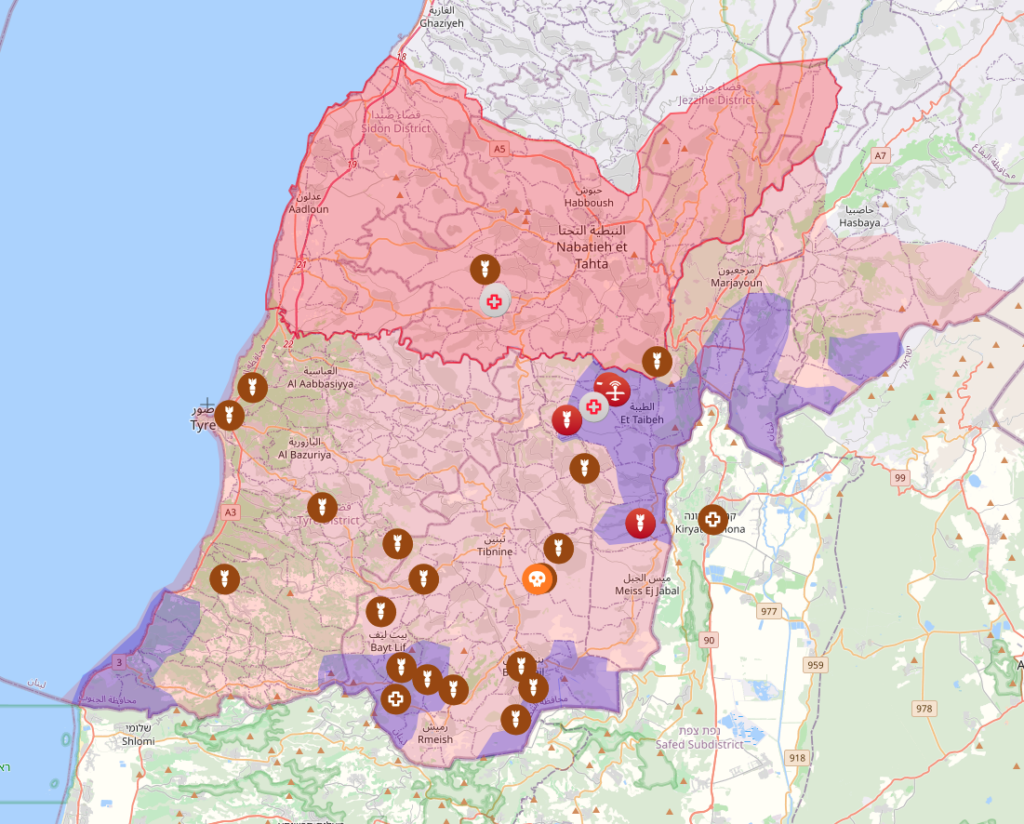
  • It’s always hard to tell what the state of the war in Lebanon is, but to my casual observation, it looks like the intensity of strike has lessened on both sides, but Hezbollah attacks seem to have fallen sharply. On the other hand, today’s status map show that Israeli forces are already at the Litani River in the eastern part of Lebanon:

  • “US military has been working on Iran ground raid plans for years.” One would hope.

    Retired Gen. Frank McKenzie, the former commander of U.S. Central Command (Centcom), said Sunday that the U.S. military has been working on plans for a ground raid in Iran for years, as President Trump is reportedly considering sending troops into the war.

    “Margaret, for many years we’ve considered options along the southern coast of Iran, seizing islands, seizing small bases. Typically raids. And a raid is an operation with a planned withdrawal. You’re not going to stay. But some of those islands you could seize and hold. That would have a couple effects,” McKenzie told CBS News’s Margaret Brennan on “Face the Nation.”

    “First of all, it would be profoundly humiliating for Iran and would give us great weight in negotiations. The second, the example of Kharg Island, which everyone talks about, if you seize Kharg Island, you really can shut down the Iranian oil economy completely. And the beauty of seizing it is, you’re not destroying it,” he said.

  • Is China pushing Iran for a ceasefire?

    • “The risks to global trade through the Strait of Hormuz have surged and the dynamics of Iran’s relationships with Russia and China are constantly in the spotlight. Recently, both countries have pressured Iran, urging diplomatic solutions to the crisis. On March 24th, China’s foreign ministry reported that Foreign Minister Wang Yi held a phone call with Iran, calling for seizing the opportunity for peace and negotiating as soon as possible.” So did Russian Foreign Minister Sergei Lavrov.
    • “Analysts believe Russia has explicitly urged Iran to back down, signaling that Moscow views Iran as unable to continue fighting. Shortly afterward, China followed suit, aligning with Russia in terms of diplomatic timing. This indicates coordination between the two countries. Their shared goal is to maintain the stability of the Iranian regime, ensuring it continues to act as a strategic counterbalance to the United States.”
    • “From Beijing’s perspective, Iran is not only a major energy supplier, but also a key node in the Belt and Road Initiative. Chinese investments in the country amount to at least hundreds of billions of dollars, covering oil and gas field development, port construction, and transportation networks. If the Iranian regime were completely overthrown, it would directly threaten China’s energy and geopolitical interests. Therefore, Beijing must intervene diplomatically and urge Iran to turn to negotiations.” A lot of observers believe that Belt and Road is already moribund.
    • “A source close to China’s Foreign Minister, Wang Yi, revealed to the Epoch Times that Iran has refused any purely diplomatic arrangements and instead pressured Beijing with selective security, linking substantial aid to the safe passage of Chinese commercial ships through the Strait of Hormuz. This is soft extortion. Without military assistance, China cannot ensure the smooth passage of its trade routes. Beijing’s multiple secret negotiations have ended in failure and its efforts to profit from the geopolitical game are now facing the dual impact of diplomatic imbalance and economic stagnation.”
    • China also thought it could be a negotiating mediator between Washington and Tehran. Yeah, fat chance.
    • “This crisis is essentially the inevitable backlash of China’s ‘wolf warrior diplomacy” and camp confrontation mentality.”
    • “China’s leaders have fallen into a self-entangling dilemma. The forces they’ve supported are now cutting off their own economic lifelines. The disruption in the Straight of Hormuz is not only a rupture in global logistics, but also a microcosm of the complete collapse of China’s geopolitical strategy.”
    • “You’re starting to see the Iranian regime looking for an exit ramp.”
  • “USAF A-10s are arriving in the UK tonight as the U.S. surges more Warthogs to the Middle East.”
  • Your guide to Iranian naval mines:

    Caveat: Not the best voiceover quality.

  • “Pope Leo Explains God Does Not Listen To People Who Wage War So Long As You Don’t Count Moses, David, Joshua, Elijah, Saul, Gideon, Samson, Or Anyone Else In Bible.”
  • As usual, this is just the Iran news I felt significant enough to include in the roundup. If you think I’ve missed anything, feel free to share in the comments below.

    Iran Strikes: Day 18

    Tuesday, March 17th, 2026

    More regime honchos dead, America and Irseal are (try to contain your shock) winning, a bad weekend for the KC-135, a Dem uber-lawyer backs Trump on Iran, and Israel is hunting Basij in the streets of Tehran. It’s your Iraq war update, incorporating news from late Friday until now.

    Also, I keep getting the occasional 429 errors that require Bluehost support to snip long-running processes that they won’t give me access fix without handing them more money (which isn’t happening). An optimization scan brought up suggestions for improving performance, some highly impractical (no, I’m going to hand-optimize WordPress generated JavaScript), but one of the things spinning up long threads is Twitter embeds, so I’m going to try to do less of that and just link and summarize rather than embed. I’ve also updated and turned the caching plugin back on (turned off in a previous Bluehost troubleshooting session), so I’m hoping that will speed things up as well.

    Now on to the update!

  • “Israel Eliminates Iranian Regime Security Chief and De Facto Leader Ali Larijani.”

    Israeli forces killed the Iranian regime’s security chief and de facto leader, Ali Larijani, in a Tuesday morning airstrike that has the potential to foment greater chaos within the Islamic Republic’s remaining leadership.

    The IDF announced that Larijani was killed through “a precise strike” on his location near Tehran.

    “His elimination adds to the elimination of dozens of senior commanders and leaders of the Iranian terror regime, who were eliminated by the IDF during Operation Roaring Lion, and constitutes a further blow to the Iranian regime’s abilities to manage and coordinate hostile activity against the State of Israel,” the IDF wrote in its statement.

    After Ali Khamenei’s death, Larijani emerged as the country’s de facto leader, consolidating his power and overseeing combat operations against Israel and other Arab nations in the region. Along with his brother, Sadeq, Larijani waged outsized influence in the Iranian leadership and positioned himself as a successor after Khamenei’s death. He also served as secretary of the Iranian Supreme National Security Council, the body that orchestrated attacks on Israel and led efforts to violently suppress the Iranian people.

    “During the most recent wave of protests against the Iranian terror regime, Larijani advanced violent enforcement measures and repression operations, and personally oversaw the massacre that was carried out against Iranian protestors,” the IDF said. “Larijani led the regime’s national-security coordination and directed its international activity, including engagement with members of the axis.”

    (Hat tip: Ed Driscoll at Instapundit.)

  • “Israeli army confirms it killed the head of the Basij in a strike in Tehran, Gholam Reza Soleimani.” Definitely good news for the Iranian people.
  • Hilarious if true: “Missile hit Sepah Bank digital security center in Tehran.”

    A missile strike hit the digital security center of Sepah Bank in Tehran early on Wednesday, according to information received by Iran International.

    The building, located on Haghani Street, was destroyed in the attack while the bank was processing salary payments for military personnel.

    The services at Sepah Bank and Melli Bank Iran remained widely disrupted for a second day, with online banking unavailable and only card-based services operating.

    (Hat tip: Regular commenter Malthus.)

  • DataRepublican scrapes the publicly available information and comes to some conclusions.

    FACT 1: Iran’s missile capability has been functionally destroyed.

    As of Day 6, Adm. Brad Cooper (CENTCOM) confirmed Iranian missile attacks declined roughly 90 percent since strikes began [ISW, March 5, 2026]. Per joint intelligence assessment (IDF/CENTCOM briefing), approximately 75% of all launchers destroyed; 100–200 remain. The IRGC Aerospace Force — Iran’s primary instrument of long-range conventional power projection — has been catastrophically degraded in nine days. “Hundreds” of warheads destroyed (conventional missile warheads — Iran has no deployed nuclear warheads). Defense industrial base under systematic attack. This is not a setback. This is the functional end of Iran’s power projection capability.

    Fact 2 has been edited back from Iran’s nuclear program being 8-15 years to reconstitute, to being substantially destroyed for the the immediate future.

    FACT 3: The Strait of Hormuz is closed — not by mines, but by insurance actuaries.

    Seven of twelve International Group P&I Clubs cancelled war risk coverage on March 1–2, 2026. These seven clubs insure approximately 90% of the world’s ocean-going commercial tonnage. War risk premiums surged over 1,000%. The result: tanker traffic through Hormuz collapsed from a pre-conflict baseline of approximately 138–153+ vessels per day (figures vary by data provider: Lloyd’s List/Kpler cite ~138; CSIS/Starboard cite 153+) to as few as 3 commercial transits recorded by Windward.ai AIS tracking on March 7; a near-total shutdown. Iran achieved a de facto blockade by making the risk-reward calculation of commercial transit economically irrational, without firing a single mine.

    FACT 4: The US is the primary economic beneficiary of this crisis.

    Brent crude has risen from $72/barrel (pre-conflict) to $106.81/barrel on March 8, 2026 (Day 9), with an intraday spike to $110 when Asian markets opened Sunday evening — the first time Brent has exceeded $100 in nearly four years, and up 50%+ from the $60/barrel that started 2026. WTI (US crude futures) hit $106.57 (+17.2% on the day). A new cascade has begun: Gulf producers are being forced to cut output as storage fills — Iraq’s production has collapsed 60%, UAE and Kuwait have begun cuts. Goldman Sachs warned Friday night that the Hormuz shock is now “17 times larger” than the peak Russia disruption of April 2022 and projects Brent could reach $150/barrel by end of March if Hormuz flows remain depressed. The US is a net petroleum exporter. Every $10/barrel increase in oil costs China and Japan hundreds of millions per day while benefiting US shale producers and LNG exporters (Cheniere, Shell, ExxonMobil). Qatar suspended LNG production. CSIS senior fellow Clayton Seigle: “A deficit of 20 million barrels per day is hitting global oil market balances with no sign of relief.” The Washington Post confirmed explicitly: “The conflict has hit Europe and Asia harder than the United States.”

    FACT 5: Ali Khamenei is dead. His son is not a legitimate successor.

    Supreme Leader Ali Khamenei was assassinated February 28, 2026, in a joint US-Israeli airstrike on his Tehran compound — Israeli jets dropped 30 bombs in daylight with zero effective Iranian air defense response. Mojtaba Khamenei, his son, was named Supreme Leader by the Assembly of Experts on March 8. Mojtaba is a Hojjatoleslam (mid-ranking cleric), not an Ayatollah — his theological credentials are below what the constitution’s spirit requires. He has never held a formal government position. The regime has chosen dynastic succession in a self-described revolutionary republic. This legitimacy deficit is the long-term vulnerability. [CONFIRMED — NYT, Reuters, P1B]

    DataRepublican assume there will be no land war. But she’s working from the assumption that such a land war will require occupying all of Iran, rather than, say, Tehran and various oil exporting ports.

    FACT 7: China is losing 1.7 million barrels per day of discounted Iranian oil and faces secondary sanctions.

    China bought approximately 90% of Iran’s oil exports at sanction-discount prices. That supply is gone. Higher global oil prices hit China’s economy directly. The February 2026 Executive Order imposes tariffs on any country purchasing Iranian oil — aimed directly at Chinese “teapot” refineries in Shandong Province. The US simultaneously disrupted both of China’s discounted petro-state suppliers (Iran and Venezuela). China is watching US military capabilities through its satellites and reading the Taiwan signal.

    FACT 8: The Mosaic Defense kept Iran fighting but cannot project offensive power.

    Iran’s 31 autonomous provincial IRGC commands, each with pre-delegated launch authority, are firing pre-authorized strike packages without central coordination. This means the regime cannot be decapitated; missiles keep flying. But the same decentralization that enables survival prevents the complex multi-axis offensive operations that would actually threaten US interests at scale. The 90% launch decline is the empirical proof: what remains is dispersed residue, not a coherent military campaign. [ASSESSED — CEPA, P1B, P2A mosaic paradox]

    FACT 9: The Iranian economy was already at collapse threshold before the war began.

    Pre-war data: rial at 1.45 million per US dollar (December 2025 peak); 49% inflation; negative GDP growth; government budget deficit at 6%+ of GDP. The January 2026 protests — the largest in Iranian history, with 3,000–30,000 killed by the regime — were triggered directly by rial collapse. The war adds destroyed infrastructure, disrupted trade, severed oil revenue, and accelerating secondary sanctions. The economic collapse is not a future risk; it is an ongoing reality that predates Operation Epic Fury.

    FACT 10: The Axis of Resistance has been substantially degraded.

    Syria land bridge severed (Assad fell December 8, 2024). Hezbollah “dramatically weakened” by 2024 Israeli offensive; Nasrallah killed September 2024; Iran-Hezbollah land corridor gone. Hamas catastrophically degraded after 18+ months of Israeli ground operations; IRGC’s Hamas portfolio manager Saeed Izadi killed June 2025. Houthis’ stockpiles reduced by Operation Rough Rider (2025); Houthis “staying out of the Iran-US fight for now” (Al Jazeera, March 7, 2026). Iraqi PMF taking active US strikes. Iran’s 40-year investment in regional proxy power has been substantially degraded — not dismantled. Hezbollah retains organizational structure, partial rocket inventory, and political control of southern Lebanon. Hamas retains organizational elements outside Gaza.

    I feel that most of this is probably correct. And that’s just the topline analysis; there’s a lot more in-depth data and analysis at the link. (Hat tip: Borepatch.)

  • You know who likes the chances of America and Israel winning the war? Al Jazeera.

    When you look at what has actually happened to Iran’s principal instruments of power – its ballistic missile arsenal, its nuclear infrastructure, its air defences, its navy and its proxy command architecture – the picture is not one of US failure. It is one of systematic, phased degradation of a threat that previous administrations allowed to grow for four decades….

    The campaign has moved through two distinct phases. The first suppressed Iran’s air defences, decapitated its command and control, and degraded its missile and drone launch infrastructure. By March 2, US Central Command announced local air superiority over western Iran and Tehran, achieved without the confirmed loss of a single American or Israeli combat aircraft.

    The second phase, now under way, targets Iran’s defence industrial base: missile production facilities, dual-use research centres and the underground complexes where remaining stockpiles are stored. This is not aimless bombing. It is a methodical campaign to ensure that what has been destroyed cannot be rebuilt.

    Iran now faces a strategic dilemma that tightens every day. If it fires its remaining missiles, it exposes launchers that are promptly destroyed. If it conserves them, it forfeits the ability to impose costs of the war. Missile and drone launch data suggest Iran is rationing its remaining capacity for politically timed salvoes rather than sustaining operational tempo.

    This is a force managing decline, not projecting strength.

    The closure of the Strait of Hormuz is dominating the critical commentary. US Senator Chris Murphy has called it evidence that President Donald Trump misjudged Iran’s capacity to retaliate. CNN has described it as proof that the administration has lost control of the war’s escalation.

    The economic pain is real: Oil prices have surged, a record 400 million barrels of oil will be released from global reserves, and Gulf states are facing drone and missile strikes on their energy infrastructure.

    But this framing inverts the strategic logic. Closing the strait was always Iran’s most visible retaliatory card, and always a wasting asset. About 90 percent of Iran’s own oil exports pass through Kharg Island and then the strait.

    China, Tehran’s largest remaining economic partner, cannot receive Iranian crude while the strait is shut. Every day the blockade continues, Iran severs its own economic lifeline and alienates the one major power that has consistently shielded it at the United Nations. The closure does not just hurt the global economy; it accelerates Iran’s isolation.

    Meanwhile, the naval assets Iran needs to sustain the blockade – fast-attack boats, drones, mines, shore-based antiship missiles – are being degraded daily. Its naval bases at Bandar Abbas and Chahbahar have been severely damaged.

    The question is not whether the strait reopens but when and whether Iran retains any naval capacity to contest it. Critics compare the challenge of escorting a hundred tankers daily to an impossible logistical burden. But you do not need to escort tankers through a strait if the adversary no longer has the means to threaten them. That is the operational trajectory.

    (Hat tip: Instapundit.)

  • Strait of Hormuz update: “War risk insurance peaks at 5% of hull value. Insurance costs reach highest level since Iran-Iraq Tanker War (1980s). Oil tanker valued at $100M now costs $5M to insure for single transit. Strait effectively closed despite technical navigation possibility.”
  • Israeli drones are hunting Basij in Tehran.
  • “Reports indicate clashes between security forces and citizens around Chaharbagh Square in Tehran. The sound of gunfire can be heard.” Not the only area where such clashes are reported.
  • Five KC-135 tankers damaged in an Iranian missile strike at Prince Sultan Air Base in Saudi Arabia:

    Suchomimus notes that there’s simply not a lot of space to park at that base, so there’s going to be risk parking so many tankers (or other large aircraft) there. None of the planes were destroyed, and all are being repaired.

  • Iranian hovercraft base at Bandar Abbas hit:

    I don’t get to use the “Hovercraft” tag nearly enough…

  • Adventures in self-delusion: “Iran’s new supreme leader demands US, Israel ‘brought to their knees.'”

  • More than a dozen $16M Reaper drones have been destroyed in Iran operations, US officials say.” Well, they’re far cheaper than losing a plane with a pilot, so they’re quite acceptable losses.
  • Famous Democrat lawyer David Boies thinks Trump is doing the right thing in Iran and “Democrats should get behind the President, and make sure that he finishes the job.”

    Boies, a Democrat, argues passionately in favor of the war, and scolds people—mainly other Democrats—for, in his mind, letting their dislike of President Trump affect their opinion of attacking Iran. As he writes, “If we believe that Iran presents a serious threat, we need to support the president on this issue. There’s plenty to disagree with him about, and we don’t need to like or admire him. But on Iran we should be on common ground.”

    Chances of Democrats heeding this advice:

    (Hat tip: Ann Althouse.)

  • Another successful Iranian strike (or possibly Iranian-linked militia) in Iraq:

  • Footage of the Yak-130 intercept:

    Not being tied into Air Force slang, I was previously unaware that the F-35 was nicknamed “Fat Amy”…

  • OK, I’ll embed one Tweet:

    (Hat tip: Stephen Green at Instapundit.)

  • Babylon Bee: “Ayatollah Disappointed To Learn 72 Virgins Awaiting Him In Paradise Are All Women.”
  • Once again, this was just what I was able to gather from the news. If you think I’ve missed something, feel free to share it in the comments below.