Adobe said CEO Shantanu Narayen will step down after a successor has been appointed, and he will remain as the design software company’s chair. Shares tumbled 7% in extended trading.
Narayen joined Adobe in 1998 as a vice president and general manager, and he became CEO in 2007. Under Narayen, Adobe pushed from software licenses to subscriptions to its Creative Cloud application bundle, and the company is now working to expand through generative artificial intelligence. He sought to acquire fast-growing design software company Figma, but regulators pushed back, and the companies called off the deal, resulting in Adobe paying Figma a $1 billion breakup fee.
Just about every creator using Abode figured the ludicrously overbroad terms and conditions were designed to let Adobe train their AIs on creator’s work, and make them pay for the privilege of doing so to boot.
Narayen, 62, is lead independent director of Pfizer in addition to his responsibilities at Adobe, where he received $51 million in total compensation for the 2025 fiscal year, according to a filing. He owns $118 million in Adobe shares, according to FactSet.
Most CEO’s limit their work to one company enraging their customers.
Adobe shares are down nearly 23% so far in 2026 as of Thursday’s close, while the S&P 500 index is down about 3% in the same period.
Adobe’s stock is more than 60% off its record from 2021 after dropping more than 20% in each of the past two years.
People don’t like companies forcing AI into every crevice of their product line (see also: Microsoft), and they don’t like being forced into a subscription model without any options (ditto).
That previously mentioned lawsuit from Uncle Sam over Adobe making it difficult to cancel subscriptions has been settled. “Adobe agreed to pay $75 million to the Department of Justice and an additional $75 million worth of free service to its customers.”
Here’s Clownfish TV on how Adobe has alienated their own user base:
Kneon: “We’ve been covering Adobe because Adobe’s stock is in the gutter. It’s been declining for the last two years now. Adobe is chasing after AI when their core customer base is made up of creatives, who a lot of them don’t want to use AI, but they’re shoving AI into everything.”
K: “They’ve had some some very aggressive anti-consumer practices. They were apparently training their AI on people’s documents stored in the cloud. Two or three months ago they were going to pull the plug on an industry standard animation software package and people were panicking about that. This company has made nothing but anti-consumer bad decisions for three or four years now, and it finally has caught up with them, and now their CEO is leaving.”
K: “Nobody knows what the hell this company is now.”
Geeky Sparkles: “People can’t trust them. They all, especially animators in those industries, they’re looking for another program to use cuz they were all like it was the standard. Well, now they’re trying to find something else because, you know, they said they weren’t going to take it away as fast as they originally said. But you can’t trust them. They just dropped this on them before. You know, the rug’s going to be pulled out from underneath them.”
K: “AI is happening very quickly, but the people that use your tools, a lot of them afraid of being replaced with AI.”
Adobe’s entire business model has been creating tools for creatives, and now they’re going “Hey companies, you can use our AI tools to completely replace all those expensive creatives!”
K: “Again, what separates Adobe from any other AI platform at this point?”
GS: “This is why you’re going to fail. I’m just going to tell you know what, let me save you a lot of trouble. This is why you fail. Investors want AI. Investors don’t know what the fuck they’re doing. Investors keep hearing AI is the coolest thing ever. And they keep pushing for these things. Like when they hear layoffs, they immediately get excited and invest. It’s not going to go the way you think it is. And especially when it comes to Adobe, when you’re talking about artist software, talking about aggressive AI, it’s probably the kiss of death.”
GS: “When it comes to things like Adobe, you’re going to lose money, and you kind of deserve to lose money, because some things you can’t shove aggressive AI into.”
There’s a place for IA, but Adobe didn’t make it an extra or a stand-alone, they shoved it into everything and said if their users didn’t like it, then tough.
GS: “They basically just came out and said was, ‘Okay, all the stuff you’re relying on, we’re gonna we’re getting rid of.’ It’s really stupid.”
K: “They were like, oh yeah, we’re an AI company now.”
K: “They’re all like, ‘Oh yeah, you gotta subscribe. You gotta subscribe. Subscribe.’ Because they don’t like it when you just drop a couple hundred bucks and you own the thing outright.”
Microsoft CEO Satya Nadella might buy Adobe.
GS: “Hey, I’m not trying to be a dick here. I am going to mention it. Why are all these CEOs sound like they’re all Indian?”
K: “Because they are.” And they seem to be the ones wanting to push AI into everything.
K: “See also Google. See also YouTube. See also…I’m just I’m just saying, you know, it’s statistically significant.”
Like Tulipmania and the South Sea Bubble, AI madness is going to become a cautionary tale of the madness of crowds for centuries to come…
Jobs are down, more Minnesota fraud uncovered, a bunch of military action outside the Persian Gulf, an Austin jihad shooter, Noem gets the Old Yeller treatment, Bill Clinton remains Bill Clinton, and Microsoft, amazingly, manages to get even worse.
It’s the Friday LinkSwarm!
Also consider this your “Iran Strikes: Day 7” update with a smattering of news as well. There are reports that Kurdish forces have entered Iran from Iraq, but I’m not seeing sufficient evidence for that yet.
Interesting chart showing Iran has likely “blown its wad” on missiles and drones, as day by day fewer and fewer are being launched.
Update Numbers as of Mar. 6, 12.00 AM The numbers are rounded and compiled from various media reports, with a margin of error of ±10% 15% **Corrected previous Post there was a Mistake https://t.co/eDlVfc3nzApic.twitter.com/UiHAU0yNHe
The Supreme Court upheld the standard for reviewing asylum cases, keeping it in the hands of immigration agencies.
Yes, even the leftist justices agreed. 9-0.
“We granted certiorari to determine whether the Court of Appeals applied the appropriate standard of review under the INA [Immigration and Nationality Act],” wrote Justice Ketanji Brown-Jackson. “We conclude that the statute requires application of the substantial evidence standard to the agency’s conclusion that a given set of undisputed facts does not constitute persecution.”
Top officials in Minnesota were made aware of fraud concerns surrounding government assistance programs as early as 2019 but failed to take action as billions of dollars were stolen and warnings piled up.
Former Minnesota state officials testified to the House Oversight Committee that Governor Tim Walz and Attorney General Keith Ellison were first informed that the state’s social services programs had been compromised by widespread fraud in 2019 and 2020, according to a new report from the committee.
“Testimony obtained by the Committee reveals that Governor Tim Walz and Attorney General Keith Ellison were aware of widespread fraud in social service programs, lied about their knowledge of the fraud, and retaliated against employees who dared to raise concerns. Instead of protecting vulnerable Americans, they handed over billions in taxpayer dollars to fraudsters and threw their own state employees under the bus,” said House Oversight Committee chairman James Comer (R., Ky.).
Several different entities and state-level programs are implicated in Minnesota’s fraud scandal. The most prominent program is Feeding Our Future, which fraudsters targeted during the Covid era to steal $300 million from the Minnesota Department of Education that had been designated to provide food to poor children. Feeding Our Future is now dissolved and dozens of defendants have been convicted in connection with the scheme since 2022.
According to the committee report, Minnesota Department of Education officials first received allegations of fraud against Feeding Our Future from the U.S. Department of Agriculture in 2019. The USDA alleged Feeding Our Future was created with forged signatures and misled sponsored food distribution sites about certain federal requirements. Minnesota officials dismissed the allegations at the time. By April 2020, Walz and Ellison’s offices were briefed about the Minnesota Department of Education’s concerns regarding Feeding Our Future, Assistant Commissioner Daron Korte testified to the committee. State officials contacted the USDA about Feeding Our Future in late 2020, but the agency’s inspector general did not act, a failure that emboldened the scammers at Feeding Our Future.
The Oversight Committee report asserts that Minnesota officials could have suspended payments to Feeding Our Future but chose not to because of potential litigation and racism accusations. Minnesota officials blamed the USDA and Feeding Our Future for perpetuating the large-scale fraud. In March 2021, the Minnesota Department of Education stopped payments to Feeding Our Future, but resumed payments voluntarily the following month after a court hearing on the matter. A court order was never issued requiring the payments, contradicting Walz’s 2022 assertion to the contrary. The lack of a court order was confirmed during the course of the Oversight Committee’s investigation.
In early 2019, Walz’s administration became aware of fraud tied to two programs administered by Minnesota’s Department of Human Services, former agency commissioner Tony Lourey testified. Another former commissioner, Jodi Harpstead, testified that Walz’s administration believed fraud connected to a child care program run out of the Department of Human Services had already been resolved. But the Oversight Committee report references two auditor reports showing otherwise, both of which were issued in 2019. The Department of Human Services lacked fraud mitigation mechanisms and felt pressure to get money out the door to justify state appropriations, the committee found. Despite credible allegations of fraud, the agency failed to act on the warnings and unilaterally stop making payments to the social services programs in question.
The Oversight Committee’s report is based on testimony from nine top current and former state officials, documents and communications, and briefings with federal and state officials. The Minnesota U.S. Attorney’s office recently speculated that the interwoven fraud schemes totaled nearly $9 billion in misallocated funds. Of the fraud defendants, 85 percent of them come from Minnesota’s Somali-American immigrant community. Social services programs that provide food, child care, housing, and special education have all come under scrutiny as federal investigators unravel the fraud scheme.
I know it’s been easy to overlook in all the other military news this week, but Afghanistan and Pakistan have been going at it as well, though only at a border skirmish level rather than a full-scale conflict. Since the Pakistani ISI helped create the Taliban, this is what’s known as “blowback.”
Rene Campos, a registered sex offender, is seeking elected office in California – launching a campaign for Fresno City Council amid fierce backlash and renewed questions about whether someone with his record should hold public office.
Campos was arrested in 2018 following a cyber tip to the Central California Internet Crimes Against Children Task Force. He was found in possession of child sex abuse material, according to court records. In 2021 he entered a no-contest plea to a single misdemeanor charge of possessing and controlling child pornography/child sex abuse material (likely under California Penal Code § 311.11). He served only one month in prison and a two year probation period.
Campos describes himself as a gay man who is running for office on the platform of “reduced crime and rehabilitation.”
Possession of child pornography is typically treated as a felony, even in a woke haven like California. How the Fresno candidate was able to make a deal for a misdemeanor charge and spend only one month in prison is a mystery, but this does help to confirm ongoing suspicions that California’s legal system is falling into steep decline.
California is notoriously soft on child sex abusers. Recently, a Sacramento parole board released Daniel Allen Funston, who was convicted in 1999 of sixteen counts of kidnapping and child molestation after a horrific crime spree in Sacramento County, during which he kidnapped, raped, and beat eight children ages 3 to 7.
Funston was originally sentenced to three consecutive life terms plus 20 years, but was set free at age 64 due to a California elderly inmate program (maybe he’ll run for office, too).
Data from 2022 shows that the Golden State released over 7000 child sex offenders after less than one year of incarceration. Interestingly, “digital blocks” were added to the Megan’s Law website that prevent more recent analysis.
Virginia Governor Abigail Spanberger is demanding that Immigration and Customs Enforcement provide warrants before violent illegal criminals are turned over to federal authorities, following the stabbing of a Virginia woman by an illegal immigrant with a long and violent criminal history.
Abdul Jalloh was charged with second-degree murder after Stephanie Minter was brutally stabbed in the neck at a Virginia bus stop. Jalloh had previously been charged more than 40 times, including for egregious crimes such as aggravated assault, malicious wounding, and rape. Prosecutors dropped 20 of the 43 charges against Jalloh. The Fairfax County Commonwealth’s Attorney’s office said the charges were dropped because Jalloh often chose victims who did not have permanent addresses, making the proceedings more difficult.
The Department of Homeland Security said Jalloh is an illegal immigrant from Sierra Leone. He entered the United States in 2012.
“ICE previously lodged a detainer against Jalloh in 2020, and he was granted a final order of removal by a judge who found he could be removed to any country other than Sierra Leone,” DHS said in a statement. “This case illustrated the importance of third country removals to get criminal illegal aliens out of the U.S.”
Spanberger insists that in order for Virginia to work with federal authorities, ICE must provide a signed judicial warrant, regardless of the alien’s criminal history. DHS requested cooperation with Virginia and Spanberger to deport Jalloh following his alleged involvement in the fatal stabbing.
“We are calling on Virginia Governor Abigail Spanberger and Virginia’s sanctuary politicians to commit to not releasing this murderer and violent career criminal from their jail without notifying ICE,” Deputy Assistant Secretary Lauren Bis said in a statement. “This illegal alien’s murder of an innocent, beautiful American woman came less than 24 hours before Governor Spanberger’s demonization of ICE law enforcement. This heinous criminal is a perfect example of why we need cooperation from sanctuary jurisdictions and the importance of third country removals for the safety of the American people.”
What the Trump administration has done on the DEI front represents the beginning of a general reorientation of our politics away from wokeness. One need only survey what prominent leaders of the Left are saying about the political price the Democratic Party has paid on that score. What they are saying indicates a large political change, even if the Dems prove incapable of unmooring themselves from woke politics for the near future.
The first sign of this reorientation is a general shift in the popular mindset: the spell of woke politics has broken. This matters because it was always the way in which woke politics commanded assent in the citizens’ hearts and minds that was crucial. That assent has been questioned or denied now in a broad way, with the backing of public authority (Supreme Court decisions, executive orders, agency directives), and with widespread public support. Wokeness’s public hectoring, punitiveness, and censoriousness, and the extremism of many of its positions on the issues, is unpopular at the level of 70–30 or 80–20 opinion poll divides.
We ought to be confident, therefore, that the broken spell of wokeness augurs a permanent shift in our public life. What that means precisely, however, depends very much on how we understand wokeness and what is done going forward to ensure that woke excess does not return. Now, if, as many say, wokeness was the product of cultural Marxism (Christopher Rufo and a host of followers) or postmodernism (Jordan Peterson and another host of followers), then all that needs to be done is to combat bad ideas. On these interpretations, our universities in particular, and other cultural institutions where the influence of such ideas holds sway, need our attention. Certainly, cultural Marxism and postmodernism represent bad ideas, and the world would be a better place without their influence.
But if what wokeness represents above all is the explosive power of the civil rights revolution and the influence of an aggressive leftist interpretation of anti-discrimination politics, as another band of interpreters claims (I among them), then the task ahead is much bigger and much more difficult.
Trump’s anti-DEI measures, on this view, would represent only the first step in a broader campaign of civil rights reform. One could look long and hard without seeing much in the way of evidence for any such thing so far. Are these current efforts against DEI an illusion, a brief moment of political opportunism that will recede as public hatred of wokeness recedes—only to return in a few years when the next wave of anti-discriminatory passion rises up?
I don’t think that worry is justified. The anti-DEI campaign to date will have enduring consequences because even if it is not yet clear that what is at stake in DEI is civil rights politics, the current reorientation can only have the effect of raising our awareness of the role of anti-discrimination in our public life. This has begun on the all-important moral plane of civil rights politics. Precisely by breaking the spell of its puritanical commands, our anti-woke moment is reworking something essential to civil rights politics. Because public morality is the crucial filter of the human mind, a shift at this level will change what we see, what we think, and what we think we can say. Anti-woke sentiment, backed by changes in the law, is providing a moment of political, cultural, and mental freedom that will necessarily lead, after many decades during which this was not possible, to a general reappraisal of the moral power and the meaning of the civil rights revolution.
Sources have identified the alleged gunman as 53-year-old Ndiaga Diagne to Nexstar’s KXAN and The Associated Press…
Diagne is originally from Senegal, according to multiple people briefed on the investigation. One of the people told the AP that Diagne came to the U.S. in 2006 and was a naturalized U.S. citizen…
Austin mass killer captured on video wearing ‘Property of Allah’ hoodie during rampage.
“Dallas Democrats Decide To Let DA Creuzot Go. With no Republican in the race, Democrat primary winner Amber Givens will become Dallas County’s next district attorney.” Creuzot was yet another Soros-backed DA, so maybe Dallas Democrats are ever so slowly moving back to sanity.
I’m just going to embed this Asmongold clip of Bill Clinton’s Jeffrey Epstein deposition without comment.
President Trump announced Thursday that Senator Markwayne Mullin (R., Okla.) will replace Kristi Noem as Homeland Security Secretary.
The announcement comes after Noem struggled to stand up to a public grilling by members of the Senate Judiciary Committee who pressed the former South Dakota governor on Tuesday about a $220 million ad campaign contract that was subcontracted to one of her longtime allies. Trump was furious at Noem for insisting during the hearing that he had personally approved the contract and began floating Mullin’s name as a potential replacement, National Review first reported early Thursday.
Mullin will replace Noem effective March 31. It’s unclear whether Trump plans to nominate Mullin to serve in the position permanently or whether he will serve in an acting capacity, sparing him the necessity of Senate confirmation.
“I am pleased to announce that the Highly Respected United States Senator from the Great State of Oklahoma, Markwayne Mullin, will become the United States Secretary of Homeland Security (DHS), effective March 31, 2026,” Trump wrote on Truth Social. “The current Secretary, Kristi Noem, who has served us well, and has had numerous and spectacular results (especially on the Border!), will be moving to be Special Envoy for The Shield of the Americas, our new Security Initiative in the Western Hemisphere we are announcing on Saturday in Doral, Florida. I thank Kristi for her service at ‘Homeland.’”
Already under significant scrutiny due to bipartisan criticism of her handling of Trump’s deportation agenda, Noem ran into further trouble this week during a series of hearings in which multiple lawmakers, most notably Republican Senator John Kennedy of Louisiana, asked her to explain why the agency had awarded a $220 million contract to a firm that was founded just days before, without ever opening up the bid to a competitive process. Kennedy also pointed out that part of that ad campaign was subcontracted to a strategy firm owned by Ben Yoho, the husband of former DHS spokeswoman Tricia McLaughlin.
A $220 million no-bid ad contract isn’t just wasteful, it’s actively criminal.
More defeats for the gambling lobby: “Two House Chairs Defeated by Challengers. State Reps. Cecil Bell and Stan Kitzman were ousted by Kristen Plaisance and Dennis Geesaman respectively.”
Plaisance ran on a platform of fiscal responsibility, securing Texas’ elections, and defending state sovereignty.
Bell’s campaign and allied groups—including the Las Vegas Sands–backed casino lobby and Texans for Lawsuit Reform—reportedly spent more than $1 million attempting to defend the incumbent.
Bell, who chairs the Intergovernmental Affairs Committee, had been censured by the Montgomery County Republican Party last year.
Incumbent State Rep. Stan Kitzman of Brookshire has been defeated by Dennis “Goose” Geesaman for the GOP nomination for House District 85. Kitzman served as chair of one of the House’s subcommittees on appropriations.
Geesaman, a pilot and Air Force Academy graduate, retired as a Lt. Colonel. He served five terms on the Flatonia City Council and later served as mayor.
While Texans for Lawsuit Reform and casino-funded PACs backed Kitzman’s reelection campaign, Geesaman ran on a platform of ending magnets for illegal immigration, DOGE-ing Texas, and supporting parental rights.
Kitzman also recently came under investigation for his paid work for a local governmental entity while serving in the Legislature.
Kitzman also voted to impeach Paxton, so I think we’re well rid of both of them.
The war against tranny madness continues. “Paxton Opinion Targets Therapists Behind Child ‘Psychological Transitioning.’ Psychiatric providers who help facilitate prohibited treatments may be barred from receiving public funds and could risk losing their licenses.”
Samsung Electronics America Inc. is one of five companies that have been accused by Attorney General Ken Paxton of collecting and monetizing consumers’ viewing data on smart TVs.
Following the agreement, Samsung will now make changes to not only halt the collection of viewing data without consent, but also update their TVs to include disclosures and consent screens.
Heard from some state agency people that this was coming: “Texas Dismantles DEI-Oriented HUB Network. The comptroller’s office has ended race- and sex-based preferences in state contracting.” Good.
“Former Warren Campaign Worker Says the U.S. Must Be ‘Abolished’ to Atone for Death of Ayatollah Khamenei…Calla Walsh, the communist activist who campaigned for Elizabeth Warren, Ed Markey, Bernie Sanders, and others, said the only way to exact “justice” is the complete deconstruction of the U.S. and Israel.” What percentage of the ideological core of the Democrat Party are actively communist?
One thing that reportedly helped kill Netflix’s acquisition of Warner Brothers: GOP congressmen visiting Netflix headquarters and discovering tampons in the men’s room.
Microsoft seems to be going from bad to worse: “Microsoft Copilot to hijack your browser… for your own convenience, embeds Edge into AI assistant, ignores questions about opt-in.”
Microsoft is rolling out a Copilot update to Windows Insiders that embeds web browsing directly into the assistant, opening links in a side panel rather than launching your default browser.
The plan is that users of the Copilot app in Windows will show content in the assistant’s window “so you don’t lose context.”
Copilot will also (with permission) have access to the context of tabs opened in that conversation, so the assistant can look across them when responding to user prompts. Opened tabs will be saved with the conversation so that they can be returned to, and, if a user chooses to enable it, passwords and form data can be synchronized.
Enabling password and form data synchronization might give some users pause for thought, particularly after the Windows Recall fiasco, but users worried about Redmond slurping data should probably consider an alternative to Windows anyway.
At first glance, it looks like embedding Edge into Copilot via the WebView2 control is an attempt to steer the user away from their default browser. Convenient, yes. Good for competition, possibly not. We asked Microsoft whether this would be an opt-in experience and which browser was being used, but, other than acknowledging receipt of our questions, the company did not respond.
It looks like this is going to be limited to corporate users for now, but launching web links without user control strikes me as a huge attack vector for malicious code. (Previously.)
New Zealand “Lesbian Navy Captain Faces Court Martial After $100M Ship Ran Aground, Caught Fire, Sank.” Since that happened all the way back in 2024, they’re certainly not rushing to justice…
Apple has some new computers out, so here’s M5 Pro vs. M5 Max benchmarks. My trailing edge consumer ass is still on an Intel-based MacBook Pro…
“Japanese companies are paying older workers to sit by a window and do nothing—while Western CEOs demand super-AI productivity just to keep your job.” Seems like there should be a happy medium between those two extremes…
Endorsements issued by President Donald Trump in recent days for Texas statewide races displayed a split between Gov. Greg Abbott and the president, as the two put support behind different candidates in a handful of contests.
These include one of the more fiery Republican primaries — the race for Texas Agriculture Commissioner. President Donald Trump threw his support behind incumbent Sid Miller, breaking from Abbott’s selection of Nate Sheets as his favored candidate.
Abbott endorsed Sheets in January, with strong words about his capability to lead the Texas Department of Agriculture and Miller’s alleged inability to do so. Abbott and Miller have repeatedly clashed over issues throughout both their tenures in office, spanning back to 2020 when Miller joined a lawsuit against the governor regarding the extension of the early voting period during the COVID-19 pandemic.
In Trump’s endorsement on Friday night, he described Miller as a “MAGA Warrior who has been with me from the very beginning,” and “is doing a terrific job as Agriculture Commissioner for the Great State of Texas…”
“An Eighth Generation Farmer and Rancher, Sid is an incredibly effective Voice for Texas Agriculture, and our amazing Farmers and Ranchers,” Trump added.
Leading up to this, Abbott has been traveling across the state alongside Sheets for several “Get Out The Vote” rallies, emphasizing his support for the challenger.
Trump also endorsed former state senator Don Huffines for Texas Comptroller, over Abbott’s pick: former state Sen. Kelly Hancock and current Acting Comptroller, after he joined the agency as an employee to avoid a constitutional issue.
Huffines has been a frequent critic of Abbott’s, particularly over his response to COVID-19, also challenging him in the GOP gubernatorial primary in 2022.
Trump similarly described Huffines as a “MAGA warrior” in his endorsement issued via a Truth Social post, adding that “as a successful Businessman, Don knows the America First Policies required to Grow our Economy, Create GREAT Jobs, Cut Taxes and Regulations, Promote MADE IN THE U.S.A., and Unleash American Energy DOMINANCE.”
The President also issued a number of key congressional candidate endorsements earlier in the week, splitting from Abbott in two distinct primaries: one for Congressional District (CD) 9, and another in CD 35.
Trump threw his support behind Republican candidate Alex Mealer in her bid for Congressional District (CD) 9, against state Rep. Briscoe Cain (R-Deer Park), who is endorsed by Abbott.
Cain and Mealer are running in the district currently held by U.S. Rep. Al Green (D-TX-9), which was heavily impacted by the GOP-favored redistricting map that passed the Texas Legislature during the summer of 2025 — legislation initiated at the White House’s request and voted for by Cain in the Texas House.
Trump also endorsed one of the Republican primary opponents to State Rep. John Lujan (R-San Antonio) — Carlos De La Cruz, brother of Congresswoman Monica De La Cruz (R-TX-15), in his bid for CD 35. Lujan was endorsed by Abbott for CD 35 in January.
Super PAC “Forge The Future,” founded by California-based tech giant Meta, reported $1.3 million in Texas expenditures ahead of the upcoming March 3 primary.
Formed earlier this year, Forge The Future is one of four super PACs controlled by Meta. The PAC’s Texas site states an objective of supporting “conservative candidates” with favorable stances on tech policy issues.
Three specific focuses listed are support for domestic tech companies, advocacy for an AI-friendly regulatory environment, and increased parental control over children’s online activities.
Of Forge The Future’s Texas contributions, $800,000 went to a slate of three Texas Senate and eight Texas House candidates, including Rep. Trent Ashby (R-Lufkin) and Rep. David Cook (R-Mansfield) for Senate Districts 3 and 22, respectively.
Those districts’ proximity to the greater Dallas-Fort Worth area makes them a key early target for placement of AI-friendly legislators, as the area has been a long-time hotbed of Texas technology interests and currently hosts several ongoing data center developments.
The remaining $500,000 was spent on digital advertising campaigns supporting former state senator and now Acting Comptroller Kelly Hancock’s bid for a full term as Texas comptroller. The ads focus on Hancock’s efforts to lower taxes and improve education, making no specific mention of tech-related issues.
Forge The Future is one of two super PACs formed by Meta this year, alongside Making Our Tomorrow, which is dedicated to similar technology issues but instead supports Democratic candidates. Making Our Tomorrow has initially focused on contributing to candidates in Illinois, another key state for Meta’s infrastructure.
Meta’s super PACs, all formed within the last year, represent an overall $65 million investment in political activity and mark a distinct shift from the company’s previous, mostly neutral stance on political spending. This new investment from the tech giant comes at a time of increased scrutiny from legislators and the general public alike on many tech policy issues, including social media, artificial intelligence, and data centers.
Aside from AI, social media regulation could also pose a problem for Meta. The Facebook, Instagram, and WhatsApp parent company has been in and out of court in relation to child safety concerns on its platforms; CEO Mark Zuckerberg was most recently called to testify in a landmark tech addiction lawsuit in California court on February 18.
Meta isn’t the only large tech company ramping up its political spending. Last August saw the formation of Leading The Future, an AI-focused super PAC boasting Silicon Valley backing, which includes names from OpenAI, Perplexity, and Palantir Technologies.
Lots of outside money is being poured into Texas races, but Texans are the ones with the power in their hands. Go vote!
Microsoft has long had a reputation of an abusive company, all the way back to its origins, when Gary Kildall accused Bill Gates of stealing parts of CP/M for DOS. The list of lawsuits against Microsoft for anti-competitive or shady business business practices is so extensive it has its own Wikipedia article. But it’s latest moves to force both subscription models and AI into every nook and crevice of its software may be the final straws that break the Borg’s back, as longtime Windows users finally seem to be abandoning ship.
Last month, I met with a mid-sized law firm facing a common dilemma. Their Windows 10 laptops were nearing the end of support and needed to be replaced. Typically, this meant buying new hardware and software—predictable and straightforward. But this time, Microsoft suggested a different approach: move to Windows 365 Cloud PCs, a PC that operates with a monthly subscription and is accessible from any device, scalable, secure, and AI-enhanced. The catch? The shift from ownership to a subscription model and reduced local control led their IT team to question how “personal” these computers truly were.
Cloud subscriptions replace personal computing
The experience of this law firm encapsulates a major industry shift: Today, you don’t buy Windows, you rent access to it. Windows 365 Cloud PCs began as a business-only experiment at Microsoft but have grown into its central product and are now the primary road map, with local Windows installations becoming a mere stepping stone to cloud-based desktops. With tools like Windows 365 Boot, users can bypass the traditional local operating system altogether, landing directly into a personalized, cloud-streamed environment, even on third-party or bring-your-own devices.
Hardware no longer anchors the user’s experience; the familiar PC is now a portal into a metered utility controlled, updated, and managed by Microsoft. Windows 365 Switch blurs the line even further, allowing seamless migration between cloud and local environments. With each step, more user agency is surrendered in exchange for the convenience of a cloud-managed world.
The AI revolution and hardware
As if the cloud weren’t enough, artificial intelligence is muddying the waters. Microsoft is loud about a future built on AI PCs, touting Copilot integration, neural processing units (NPUs), and specialized hardware. But as Dell’s own product head recently admitted, customers aren’t flocking to buy these new devices for AI alone; the proposition is too abstract, and the day-to-day benefits too unclear. In reality, most significant leaps in AI are happening in the cloud, not on the desktop. Even Jeff Bezos framed the future simplistically: AI will appear everywhere, but it will live in the cloud.
Meanwhile, Microsoft is aggressively pushing its users to rely on its AI-powered tools and ecosystem, with access controlled through subscriptions. Gone is the idea of installing and running your own AI applications locally; instead, users are nudged to rent access to AI services, hosted and updated in Microsoft’s cloud. The notion of the self-managed PC is fast giving way to a persistent, subscription-based rental of power and capability, with AI primarily serving as another tool for vendor lock-in.
Hidden costs and loss of control
Businesses and individuals face new economic realities. The traditional model—investing in hardware for five years—is replaced by an ever-escalating treadmill. A basic Windows 365 Cloud PC costs about $41 a month for 8GB, excluding Office or AI add-ons. Vendors pitch this as a trade-off against the hidden costs and complexity of managing local computers in hybrid work. Before long, subscription fees will become just another line item in ballooning IT expenses.
Perhaps more concerning is the core loss of control. The local PC gave users the keys. They owned, updated, installed, and protected their own digital spaces. The new cloud-and-AI reality puts Microsoft in charge of software, identity, AI tools, and even privacy decisions. The old personal computer offered freedom; the new model is managed, metered, and routinely adjusted to fit Microsoft’s evolving business interests. Yes, security can benefit. Yes, patching and remote management are simplified for companies. But every user now sits one step further removed from the heart of their own computing experience.
That was linked by this piece, which was linked from Borepatch, who has further thoughts.
What this means is that you don’t own any Microsoft software. Sure, you may think that because you paid them money (most often when you bought your computer – some of that purchase price went to Microsoft in the form of a license fee for Windows). But you actually don’t own “your” copy of software. At all.
Rather, you have the right to run the software on your computer. That may not seem like a big difference, but it is. The license agreement (you know, the one you didn’t read before you clicked “I Agree”) allows Microsoft to change the terms of the agreement at any time, at their pleasure.
Microsoft has just done this in a big, big way. Key new stuff in Windows 11 is:
AI integrated with your operating system
Online presence is critical for lots of Windows now (e.g. AI)
Windows will nag you until you put all your data online (OneDrive) whether you want to or not.
The proper technical term for that first bullet point is that your Windows operating system is essentially now an “AI Agent” which if you are a regular reader you know is very, very bad security juju.
Combine this enormous security hole with the requirement to essentially be online 100% of the time (bad security) and the liklihood that OneDrive will slurp all your data to some Internet black hole in a Microsoft data center, Windows is simply unsecurable.
Yes, I know that is inflammatory, but there is simply no way that you can get assurance that your security is sane. I say that as someone who has spent decades inn Internet Security (and particularly in security assurance). Not to put too fine a point on it, but I don’t think that I could get decent assurance that things aren’t going “bump in the Net”. For most of the readers here, it’s not even worth trying.
And that AI, Copilot, is not only widely loathed by users, but is creating brand spanking new security holes.
“We’ve been following Microsoft and all their massive missteps over the last several months. Most of it related to AI and pushing AI into consumer products and pushing it on to people who don’t want it.”
“There’s an error with Copilot. Apparently, it can can read your email. That’s great. And Copilot is sort of the bedrock of Windows 11. It’s very hard to get rid of Copilot. They want to put it in everything, including Notepad.”
“Copilot slows everything down. I would highly recommend you turn it off.” If you can figure out how. Kneon recommends Linux Mint if you want a Windows-like experience.
“Look, Microsoft is not secure. And just realize if you’re using it, especially for business, if you don’t want anybody to see it, you probably shouldn’t use their tools.”
“A work tab within Copilot chat had summarized email messages stored in a user’s draft and sent folders even when they had a sensitivity label on it and a data loss prevention policy configured to prevent unauthorized data sharing.” Sounds like Copilot is as indifferent to your privacy and security as Microsoft on the whole.
“I don’t know if you can hurt Xbox anymore, because Xbox is a dying brand, but the new boss, who comes from an AI background, promises not to flood it with soulless AI slop. This is Asha Sharma, formerly the head of Microsoft’s AI division, which is causing problems. Now she’s in charge of Xbox. She promises many more great games made by humans.”
Sharma blather about how Xbox will run across multiple platforms instead of a console snipped. “Are we seeing first signs that Xbox is dead and about to be consumed by Microsoft? I think that’s 100% what’s going to happen.”
“I think they’re going to basically AI themselves into the wood chipper. I think it’s very clear that that’s all they care about right now, if they’re putting the head of AI in charge of gaming and she’s talking cloud and AI and all that. Yeah, it’s over, man.”
Microsoft CEO Satya Nadella is facing some accusations of “Indian nepotism” for putting Sharma in charge of Xbox, especially since she has no background in gaming development. Of course, Microsoft has long been accused of abusing the H1-B visa system to bring over cheap workers. Indeed, this MSN India piece crows about it.
According to official H-1B filings submitted to the US Department of Labor between 2012 and 2023, Microsoft filed over 50,000 H-1B visa applications, and approximately 70 to 80 percent of these applications were for Indian nationals. This makes Indians the largest group in Microsoft’s US-based technical talent pipeline. The data shows a consistent year-on-year trend where Indian engineers make up the majority of Microsoft’s skilled immigrant workforce.
Snip.
Multiple research estimates and workforce studies indicate that 26 to 30 percent of Microsoft’s global technical workforce is Indian or Indian-origin.
Snip.
Microsoft operates one of its biggest global R&D centres in Hyderabad, which works on products including Azure, Office, Windows, LinkedIn integration, AI/ML systems and cybersecurity. The India Development Center (IDC), established in 1998, is one of Microsoft’s oldest and largest development facilities outside Redmond. This drives significant recruitment of Indian engineers for advanced research and product development roles.
Snip.
A review of Microsoft’s global leadership roster shows notable Indian-origin executives including Satya Nadella (CEO), Rajesh Jha (EVP), Suresh Kumar (EVP), Anil Bhansali (VP Engineering), and dozens of corporate vice presidents and product heads. This demonstrates the substantial representation of Indian-origin professionals in high-level technical and management roles within the company.
But Microsoft also has a Jeffrey Epstein problem. Do a search on founder and former CEO Bill Gates in the Epstein files and you get 2,616 results. Nor is he the only Epstein-connected person of interest high in the ranks of Microsoft. Financier and Democrat megadonor Reid Hoffman is still listed on the Microsoft board, despite being notoriously close to Epstein and showing up in the Epstein files 2,667 times. (Also on the board: Former Obama Commerce Department head Penny Pritzker, sister of Illinois Governor J.B. Pritzker and aunt to Epstein friend Tom Pritzker, whose name shows up 2,524 times in the Epstein files.)
Even before Microsoft jumped on the AI bus (or, if you prefer, off the AI cliff), it was notorious for security holes in its software, and there’s precious little evidence that the AI age has made anything better. The latest “Patch Tuesday” featured fixes for no less than six Zero Day exploits.
What all this amounts to: Anyone still on Windows should look to move to Linux if they have the technical chops to do so, or Apple if they don’t. Though Apple has dabbled with subscription services as well, they’re still overwhelmingly a hardware company that wants to sell you the latest shiny. And Apple has been dinged for its “lazy” approach to AI, which may turn put to be the smartest move after all. “Amazon, Microsoft, Meta Platforms, and Alphabet are projected to spend around $700 billion combined on capital expenditures in 2026, much of it on AI data centers and hardware — Apple plans just $14 billion.” That means they’re less likely to try and shove it into every damn thing. And I know my now-relatively-ancient MacBook Pro keeps working even when the Internet is down.
If you’re still on Windows, now might be the time to get out while the getting is good…
Megacorporations are telling businesses that their AI offerings are good enough to run vital company functions. The problem is, those AIs are still screwing up, and frequently in ways humans wouldn’t screw up. That’s what Amazon found out when they tried to eat their own dogfood, putting their AI in charge of Amazon Web Services. It didn’t go well.
Are AI tools reliable enough to be used at in commercial settings? If so, should they be given “autonomy” to make decisions? These are the questions being raised after at least two internet outages at Amazon’s cloud division were allegedly caused by blundering AI agents, according to new reporting from the Financial Times.
In one incident in December, engineers at Amazon Web Services allowed its in-house Kiro “agentic” coding tool to make changes that sparked a 13-hour disruption, according to four sources familiar with the matter. The AI, ill-fatedly, had decided to “delete and recreate the environment,” the sources said.
When something is “in the cloud,” that means it’s sitting on someone else’s computer. More specifically, it’s probably running as a containerized instance on any of a number of other CPU and storage pools being run under a hypervisor to scale up or scale down resources as demand requires. This allows efficient use of those resources, and it’s made AWS Amazon’s most profitable business. And most of the time AWS works pretty well.
Amazon employees claimed that this was not the first service disruption involving an AI tool.
“We’ve already seen at least two production outages [in the past few months],” one senior AWS employee told the FT. “The engineers let the AI [agent] resolve an issue without intervention. The outages were small but entirely foreseeable.”
AWS launched its in-house coding assistant, Kiro, in July. The company describes the tool as an “autonomous” agent that can help deliver projects “from concept to production.” Another AI coding assistant developed by Amazon, described as an AI assistant, was involved in the earlier outage.
The employees said the AI tools were treated as an extension of an operator and given operator-level permissions. In both of the outages, the engineers didn’t require a second person’s approval before finalizing the changes, going against typical protocol.
In a statement to the FT, Amazon claimed the outage was an “extremely limited event” that affected only one service in parts of China.
I’m not sure I was aware AWS operated in China, but I guess I’m not surprised. Is it too much to ask that the China data centers are adequately segmented and firewalled from the American data centers?
Moreover, it was a “coincidence that AI tools were involved” and that “the same issue could occur with any developer tool or manual action,” it said.
Except usually code changes are usually run through rigorous testing in a continuous integration/continuous deployment pipeline, and then deployed to a test server for performance and regression testing. It’s not clear that was done here.
It also claimed that its Kiro AI “requests authorisation before taking any action,” but that the engineer involved in the December outage had more permissions than usual, calling this a “user access control issue, not an AI autonomy issue.”
“In both instances, this was user error, not AI error,” Amazon insisted.
True, in the sense that an Amazon engineer evidently allowed an AI to alter production code.
The company also claimed that it had not seen evidence that mistakes were more common with AI tools. To which we retort: is Amazon living under a rock? While AI and its foray into commercial applications remain nascent, there’s no shortage of evidence showing that the tools are prone to malfunctioning. Their proclivity for producing hallucinations, or instances in which they fabricate facts, is well documented. So are their weak guardrails. Even some of Amazon’s own employees are reluctant to use AI tools because of the risk of error, they told the FT.
Veteran programmers are finding that AI coding assistants consistently spit out botched code, with several studies showing that the frequent double and triple-checking the questionable outputs require in reality slow down software engineers, even though the AI, on a surface level, may be producing the code faster. The rise of “vibe coding” with AI has resulted in numerous blunders in which an agentic AI makes decisions that its owners didn’t intend.
Of course, it would not be much of a ringing endorsement if tech companies weren’t using the AI tools they claim will supercharge productivity in their own operations, and they’ve been more than willing to get high on their own supplies. Both Microsoft and Google boast that over a quarter of their code is now written with AI. Engineers at Anthropic and OpenAI have suggested that nearly 100 percent of their code is AI written.
This does not inspire me with confidence. Let’s pull out the relevant XKCD comic again:
The only reason the modern technological world works is that someone, somewhere understands at a deep level how each of those boxes work, and can fix it if something goes wrong. And for Open Source software, the source code for those boxes is available somewhere other people can look at it and understand it.
When you start replacing the code in some of those boxes with AI-generated code, you start losing the knowledge of how everything works and why. Maybe the AI is producing clear, well-documented code, but you can’t count on it. And the AI doesn’t understand code the way a human does, because and AI doesn’t understand anything in the way we mean it, it’s running on artificially evolved heuristics that have performed well designing things to pass documented test cases, but which have zero frameworks for handling unanticipated exceptions. And when it breaks, there’s no guarantee a human will understand how and why it broke.
And given competitive time-to-market pressures, you can be sure companies will increasingly ship AI code without adequate safeguards or sufficient testing because their service is down hard and the latest code fixes the last AI bug, so they’ll end up rolling the fix straight to production, and something in the fix will be an even more disasterous bug none of the test cases caught and everything will come tumbling down.
And if you do that with enough of those little boxes of digital infrastructure, the entire underpinings of modern online life may come tumbling down with it. And you can’t find people to fix it because you laid them off last year and replaced them with AI.
The problem with eating your own dog food is that sometimes it can be lousy, especially if you have no idea what went into it…
It’s hard to know just what the state of the Chinese economy is, given the CCP’s constant lies, but this Joe Blogs video suggests that Chinese manufacturers are in a world of hurt, with four straight years of deflation and falling profit margins.
“Chinese businesses are continuing to suffer from margin erosion. And this is an absolute disaster from China’s perspective, because Chinese businesses have very thin margins in the first place. And if these margins are now being cut, then many businesses in China have now actually fallen into a loss-making situation.”
“More than 50% of the companies in China are now estimated to be banking losses.”
“If you’re posting losses, you don’t pay any taxes, and that will drag down GDP growth in China. The Chinese authorities have said that they’re going to hit 5% again in 2026, but I think there is a major question mark over whether or not that is realistically achievable.” My working assumption is they just lied about hitting that target last year as well. And probably meany years before that.
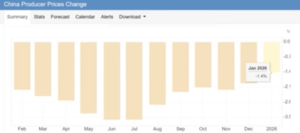
“If we have a look at this table, it shows what’s been happening with producer prices over the past 12 months. And the scale on the right hand side here starts at zero and goes down to minus 4%. And as you can see, in every single one of the past 12 months, Chinese producers have been cutting their prices. This chart is also referred to as the factory gate prices. So this is the price of products when they’re leaving Chinese factories. And the latest data for January 2026 shows that year on year prices were down by 1.4%.”
“If you put that into the context of your economy, if prices were going down by 1.4%, then you’d be very happy as a consumer, because that means that you’re paying less at the tills.”
“But as a company, this is an absolute disaster. Because the reason why we want some form of inflation in the economy is because it allows companies to pass on their cost increases.”
“But if your end price is going down by 1.4%, then clearly you can’t pass on those cost increases. You have to absorb them. And this is why Chinese businesses are seeing their profit margins being wiped out.”
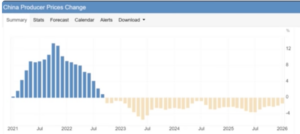
“And if we widen the scale of this chart to show the last five years, you can start to see the scale of the problem in China, because producer prices, factory gate prices have now been falling since May 2022.”
“What we’ve got here is a compounding of year-on-year falls in factory gate prices.”
“We have a look at this table I’ve put together. It shows what the impact of this has been on the sales price for a product. So if we assume that January 2022, which was the last time that we saw a price increase year-on-year in China, if we assume that a product that Chinese company was selling for $100 at that time, this shows what the impact has been on that product. So in the year to January 2023, prices fell by 8% producer prices. So that means that that $100 product would have then been selling for $99.20. In January 2024, the year-on-year fall was 2.5%. So that $100 product would then be have sold would have been been selling for $96.72. In 2025 there was a 2.3% fall in producer prices. So that product by then would have been down to $94.50. And the 1.4% that we’ve just seen posted means that that $100 product that was being sold in 2022 would now be selling for $93.17.”
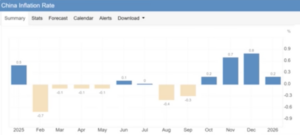
Is this deflation mirrored in Chinese consumer inflation prices? No. “It has been a bit of a mixed story. The scale on the right hand side here goes from 1% positive at the top to 1% negative at the bottom. And as you can see, in six out of the past 12 months, prices did actually fall, but they’ve been increasing over the past four months. And you can see that the latest data that we have for January 2026 shows that year on year prices are up by .2%. So that doesn’t explain the 1.4% fall in producer prices in January 2026.”
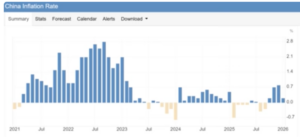
“And we widen the scale of this chart to show the past five years. You can see that whilst there has been a few months where we’ve seen deflation, it’s predominantly been inflation in China. It’s a relatively low level compared to other countries, we’re talking between 1% and 2%. So a lot less than we’ve seen in the West over the past five years. But we’ve still seen prices going up.”
“And if we have a look at this table, it shows what’s happened to prices over the same period. So if we assume the same $100 product in January 2022 that we just looked at for producer prices, in 2023 prices actually went up by 2.1%. So that product would have been selling for $102.10 at that time. We saw deflation in January 2024, which would have brought the price back down to $101.28. In 2025, we saw a year-on-year increase of .5%. So it would have pushed that that price to $101.79. And the most recent data for January 26 of 2% increase tells us that that product would now be selling for $101.99. So an increase in the price.”
“And if we have a look at the comparison between those two tables, then you can see here the producer prices between January 22 and 26, the $100 product has gone from $100 to $93.17. That’s what the companies are receiving for that same product. At the same time, inflation has gone up by 1.99% over that period. That pushed up the price to 101.99. So the gap between those two metrics, what’s been happening with inflation? If producer prices had just been moving at the same rate as inflation, the difference between the two is $8.82 over the past five years. That represents lost profit margin for Chinese businesses over the past five years of 8.6%. So that’s how much profit has been taken out by the fall in producer prices compared to what should have been happening if they were matching inflation.”
“Now why is this happening?”
“Why are Chinese businesses constantly cutting their prices when prices in the domestic market are going up? Well, there’s a number of reasons for it, but one of the main reasons is down to overcapacity.”
“Chinese industry has been gearing up heavily over the past 20 years. So in areas where China believes that it’s strong, it’s put a lot of investment and the government has subsidized a lot of these companies in many situations to enable them to grow rapidly to take a dominant global market position. So we have got some huge businesses in sectors where China has tried to become dominant.”
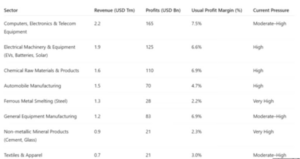
“If we have a look at this table, it shows the different industries in China that are the biggest in terms of revenue and what that should mean in terms of profitability for those businesses.”
“So the biggest sector in terms of manufacturing is computers, electronics, and telecom equipment. So I’m sure you’ve seen lots of different equipment that’s been made in China over the past 20 years. It’s estimated that that sector has revenue of around about $2.2 trillion US, and that should be equating to around about $165 billion of profits. The usual profit margin is around 7.5% for Chinese businesses in those sectors. But those sectors are currently under a lot of pressure.”
“Firstly, we’ve seen its biggest single market, the USA, applying tariffs against Chinese imports. So, that’s causing problems because it’s pushing up the price. And in order to counteract those tariff increases, some Chinese businesses have actually been cutting their cost to absorb some of those tariffs. But also, we’re seeing competition from the rest of the world.”
“So Chinese businesses are constantly slashing their prices to be the cheapest on the shelf because, realistically, that’s why a lot of consumers choose the Chinese option.”
“So that sector is under pressure at the moment. So that’s one of the reasons why those companies are cutting back on their prices.”
“Now another area which is absolutely huge for Chinese businesses is electric vehicles, batteries and solar. So this is an area that China has really specialized in. It’s cornered the market in batteries and solar panels. Most of them are made in China these days. But also electric vehicles. It decided to take a big slice of the global market and those electric vehicles are being sold at very low prices compared to local competition. So if you compare a Chinese electric vehicle the actual list price of that versus things like BMW, Volkswagen, Ford, they are a lot cheaper.”
“That’s one of the reasons why a lot of countries have been applying tariffs on the electric vehicles. So this is aside from Donald Trump’s tariffs. We’re talking about the whole industry globally is saying that it’s not fair that EVs are being subsidized. In terms of revenue, it’s around about $1.9 trillion for China and the usual profit margins around about 7% on that. But they’re under a lot of pressure because of the tariffs. Now a lot of countries are saying that China is trying to put the rest of the world out of business so that it can become completely monopolistic in these areas. So they’re under high pressure, and that’s another reason why Chinese companies are cutting their prices.”
“Jump down to some of the things that are related to property. Look at ferrous metals, which are basically steel. China has some of the biggest steel smelting plants in the world. It’s a big producer of steel. The revenue is about $1.3 trillion. Now the profit margin on steel is wafer thin. 2.2%. And the problem that China has is twofold at the moment.”
“Firstly, a lot of that steel was being sold into the Chinese market for the property market, because the property market over the past 25 years was booming the first 20 years of the 20th century. It was absolutely on fire. Lots of massive property developers like Evergrande were building whole cities all across China and they were using a huge amount of steel to do that. They building these huge tower blocks and you have to put a lot of steel in there.”
“The properties sector has absolutely crashed in China over the past few years, since the government changed the rules and made it more difficult for property developers to borrow money. There hasn’t been anywhere near as much production. So that’s caused a huge drop off in demand in China for steel itself.”
“So that’s meant that Chinese steel businesses have had to look to the export markets. But similar to what’s been happening in the electric vehicle market, a lot of countries, including the USA, have pushed back on Chinese steel imports because they are so cheap that they are killing local steel production. And in the UK, the British government had to recently take over the last virgin steel producer in the UK to make sure that it could actually produce steel that was needed for things like the defense sector. So we’ve seen a major attack globally on the whole steel industry, and lots of countries have pushed back on that.”
“So the steel industry in China is now under a lot of pressure. It’s struggling with regards to demand and those profit margins have been wiped out.”
“But we’ve got a lot of different sectors here that are under intense pressure at the moment from competition. And that’s one of the factors why Chinese businesses are cutting their prices.”
“In addition to that, Chinese businesses are also seeing weak demand at home. Chinese consumers are not buying as much stuff as they used to. So Chinese companies are cutting their prices to try to encourage consumers to keep buying.”
“And as that demand falls at home, what that means is that Chinese businesses are having to depend on the export markets more. So, Chinese companies are struggling with regards to its biggest single market, because the USA has hit all Chinese imports with additional tariffs. So, that’s led to a further cutting of prices and Chinese businesses basically across the board are geared up for high volume, low margin. And when demand starts to fall, then the only thing that you can do is cut your price.”
“Because if you’ve got a huge fixed cost business, if you’ve spent billions building up your business, maybe it’s lots of machinery, you’ve got lots of people, you’ve got huge factories, you need to hit those volume numbers just to keep the wafer thin profit margins going.”
“If demand starts falling, you can’t cut back on your costs because these are very high fixed cost businesses. So what Chinese businesses are doing instead is slashing their prices to maintain their volume of sales. But that is wiping out their profit margins. And that’s why many Chinese businesses, over 50%, are now banking losses.”
“And of course, this is an absolute disaster from the Chinese economy point of view, because it needs those companies to keep contributing to make profits to pay taxes to contribute to GDP in order to hit that 5% GDP total.”
“What we’re seeing from the data that’s just been published is that producer prices are continuing to fall.”
“Inflation is still very, very low in China. Consumer demand is very weak. So China remains dependent on the export markets. Many export markets are pushing back against Chinese imports.”
“Chinese businesses are having to cut their prices, which is further reducing their profit margins. Many have moved into losses, and this is a complete nightmare, vicious circle from many of these companies’ perspective. And I can’t see how they’re going to get out of this situation.”
China’s economy has long been smoke and mirrors all the way down. To be sure, China has made real gains, joining (and gaming) the world economic system just in time to see explosive growth thanks to global trade deals, the container ship era, rampant IP theft, and western capitalists eager to exploit cheap labor. But the rest of the world slowly caught on to China’s tricks, especially since China thought they could get away with belligerent, militarist, expansionist rule-breaking aggression against at the same time it was striving to become the world’s manufacturing hub.
Now that the world’s caught on, people are starting to realize that much of China’s “economic miracle” was an illusion. The opaque banking rules, the government subsidies, the insane “ghost cities” property boom and the regime’s strict currency controls all helped to hide the manipulations, making China’s economy look healthier than it actually is. But now the entire house of cards is tumbling down, and China has no one to blame but itself.
Everyone favors Voter ID except Democrats trying to cling to power, America’s big stick gets bigger, Trump’s tariffs hit a setback at the Supreme Court, another insane tranny shooter, Ukraine recaptures more land from Russia, another Pulitzer Prize winning leftist pedo, more Paxton lawsuits, and a new party rises on the right in the UK.
It’s the Friday LinkSwarm!
On the personal front, I may need to buy a new dryer. We’ll see what the repairman says Monday…
Are voter ID requirements considered a controversial idea in the eyes of US citizens? If you watch the establishment media or follow leaders in the Democratic Party then you might think bills like the SAVE Act are the end of freedom as we know it. However, outside the echo chambers of DNC propaganda, the vast majority of Americans have no problem whatsoever with people proving their US citizenship before they vote in local and federal elections.
The widespread support for voter ID is undeniable. Surveys from the past year including those from Pew and Gallup show that, regardless of party or ethnicity, Americans citizens want elections to be protected from manipulation through mass illegal immigration.
A Pew Research Center survey from August 2025 found that 83% of Americans favor requiring all voters to show government-issued photo ID to vote. This includes:
95% of Republicans
71% of Democrats
Only 16% of people oppose it.
A Gallup poll from 2024 shows 84% support for requiring photo ID to vote, with 98% of Republicans, 84% of independents and 67% of Democrats in approval.
A recent CNN segment featuring number cruncher Harry Enten confirms that the backing for the SAVE Act is also dominant regardless of ethnicity: 85% of white voter, 82% of Latino voters and 76% of black voters all want voter ID. It’s difficult to find many issues which the American public universally supports at this level.
Democrat leaders, however, don’t care that the majority of their own base wants voter ID laws. Party officials and the left-wing media have engaged in a shameless propaganda campaign designed to frighten the public into opposing the SAVE Act, despite their previous platforms defending majority rule.
That’s because they view voter integrity laws as an existential threat to their power. If they can’t cheat, they can’t win…
The big stick gets bigger. “Ford Carrier Group Enters Mediterranean To Join Biggest US Build-Up Since 2003 Iraq War.”
Open source monitors as well as US and Middle East media have confirmed that the USS Gerald R. Ford, the world’s largest aircraft carrier, has entered the Mediterranean Sea, having sailed passed the Strait of Gibraltar on Friday.
This is the second carrier strike group expected to soon operate directly in the CENTCOM area of responsibility, amid the massive military build-up and pressure campaign against Iran. It was sent from the Caribbean earlier this month, extending its planned deployment.
The USS Mahan Arleigh Burke-class destroyer, which is accompanying the USS Gerald R. Ford, is also now crossing the Strait of Gibraltar, maritime tracking analysis shows.
The aircraft carrier will likely take several more days to reach the Middle East and be poised to operate against Iran – so it looks to be in place by start of next week.
According to Bloomberg and other outlets, the US has now amassed the biggest force in the Middle East since the 2003 invasion of Iraq. There is administration talk of “limited strikes” – but clearly Washington is getting ready for all escalation scenarios.
The Supreme Court (6-3 in a majority opinion written by CJ Roberts) has ruled that Trump’s tariffs exceeded his authority.
We decide whether the International Emergency Economic Powers Act (IEEPA) authorizes the President to impose tariffs.
***
The President asserts the extraordinary power to unilaterally impose tariffs of unlimited amount, duration, and scope. In light of the breadth, history, and constitutional context of that asserted authority, he must identify clear congressional authorization to exercise it. IEEPA’s grant of authority to “regulate . . . importation” falls short. IEEPA contains no reference to tariffs or duties. The Government points to no statute in which Congress used the word “regulate” to authorize taxation. And until now no President has read IEEPA to confer such power. We claim no special competence in matters of economics or foreign affairs. We claim only, as we must, the limited role assigned to us by Article III of the Constitution. Fulfilling that role, we hold that IEEPA does not authorize the President to impose tariffs.
Trump says he has alternative means to impose tariffs. “Effective immediately, all national security tariffs under Section 232 and existing Section 301 tariffs remain in place… Today, I will sign an order to impose a 10% global tariff under Section 122 over and above our normal tariffs already being charged.”
In the past 12 months (January 2025 to January 2026) there are fewer foreign-born workers employed and more native-born workers in jobs. The time period roughly corresponds to the first year of Pres. Trump’s second term.
The murder-suicide at a Rhode Island hockey rink on Monday is just the latest in a recent string of murders allegedly carried out by self-identifying transgender perpetrators or by those seemingly inspired by transgender ideology.
Robert Dorgan — who police say shot and killed his ex-wife and one of their sons during a high school hockey game this week — had previously insisted he believed he was actually a transgender woman despite being a man. A local TV station said that “An unnamed woman, who identified herself as Dorgan’s daughter, has since come forward, telling WCVB that her father ‘has mental health issues.'”
“He shot my family and he’s dead now,” she reportedly said. Dorgan, who killed himself after the murders on Monday, had also expressed pro-Nazi sentiments, and according to The New York Post, was adorned with “vile neo-Nazi tattoos.”
He is only the most recent example of high-profile attacks linked to transgender perpetrators or transgender ideology, including mass shootings at Christian schools, the assassination of Charlie Kirk, and the attempted assassination of Supreme Court Justice Brett Kavanaugh.
Progress: “Major Manhattan Hospital, Massachusetts Health Care System End ‘Gender-Affirming Care’ for Minors.”
Setback: “Judge Orders California Hospital to Resume Gender Transition Procedures for Minors.” Democrats seem to love mutilating children too much to give it up.
“Kansas’ governor vetoed a bill that banned men from the women’s room. The legislature overrode her.” “Even in an uber-red state, Democrat governors are still going to toe the party line.”
Scott Pinkser thinks Trump’s deal with India spells doom for the Russian economy, because they won’t allow those shadow fleet tankers to continue on to China. Quoting Peter Zeihan:
If the Russians have lost their single largest source of income, that will manifest on the battlefield. The Chinese may be supplying the Russians with all the gear that they can pay for, but the key thing there is: pay for.
And if the Russians can’t [pay], then a drone war where the Russians can’t get enough drones is one where the Russians start losing territory.
Price of cucumbers double in Russia. I’m mildly fascinated by those per-country yearly cucumber consumption numbers. 12 kilograms about 26 pounds a year, which doesn’t seem high if you’re including pickles, as that’s only one small jar of pickles every other week. But China’s 55 kilograms a year works out to two pounds a year per person. That’s a lot of damn cucumbers…
Democracy dies in protecting sex offenders that check the right boxes:
Wow I missed that Wesley Lowrey, the ex-WaPo reporter who won a Pulitzer and wrote a famous editorial urging journos to forgo objectivity in lieu of ‘moral clarity,’ was chased out of his journalism professorship for multiple sexual assault allegations.
Attorney General Ken Paxton is suing Dallas officials, accusing them of defying a voter‑approved mandate to boost police funding under Proposition U.
Proposition U, approved by Dallas voters in November 2024, amended the city charter to require at least 50 percent of “excess” annual revenue be directed to public safety. The charter language earmarks those dollars first for the Dallas Police and Fire Pension System, then for increasing officer pay and growing the force to at least 4,000 sworn officers.
Paxton’s lawsuit, filed in a Dallas County district court, targets the City of Dallas, City Manager Kimberly Bizor Tolbert, and Chief Financial Officer Jack Ireland Jr. for allegedly underfunding public safety in violation of the charter.
The attorney general argues that city officials “acted beyond their legal authority” by using an improper calculation of excess revenue that drastically reduced the amount legally owed to police priorities.
For the 2025–26 fiscal year, the city’s own projections reportedly show about $220 million in excess revenue above the prior year. But Ireland told the Dallas City Council that excess revenue totaled only $61 million—roughly a quarter of that amount—after excluding large categories of city income from the calculation.
Paxton’s filing notes that the city did not cite any state or federal law restricting the use of the excluded revenue, which would be required to legally omit those funds from the Proposition U formula.
Because of this narrower calculation, the proposed city budget allocates far less money to police pensions, officer pay, and hiring than voters required, Paxton says. The lawsuit contends that Dallas’ current hiring plan leaves the department hundreds of officers short of the 4,000‑officer minimum mandated in the charter amendment.
Paxton’s lawsuit also points to another provision of Proposition U that city officials allegedly ignored altogether. The charter requires Dallas to hire an independent third‑party firm each year to conduct a police compensation survey comparing Dallas officer pay and benefits to those of other major North Texas departments.
According to information obtained by the state, no such survey was conducted, despite the charter’s mandatory language. That failure, Paxton argues, makes it impossible for city leadership to honestly claim they are meeting the voter‑approved requirement to make Dallas police pay competitive in the region.
Blue city functionaries hate funding the police because the hard left can’t get any of their sticky fingers into that pile of money…
Two former Harris County Tax Office employees and two local business owners are facing first-degree felony charges in connection with what authorities say was a coordinated vehicle registration fraud operation.
Court filings allege the group worked together to process registrations and title transfers that bypassed required state safeguards, collecting bribes in exchange for pushing transactions through the system.
Adriana De La Rosa, 43, owner of Bella’s Multiservices in South Houston, has been arrested. Oswaldo “Oz” Perez, 51, who is affiliated with the same business, remains wanted.
Former tax office employees Sarah Ambria Anderson, 31, and Renisha Touche Wilkins, 35, were also charged. Both were dismissed from their positions in April 2024.
Investigators allege the activity centered on the Scarsdale branch of the Harris County Tax Office, where nearly 200 questionable transactions were processed. According to reporting from KPRC 2, the employees allegedly accepted cash and gifts in exchange for overriding verification requirements tied to insurance coverage, emissions inspections, and residency. Some vehicles were allegedly coded as tax-exempt, allowing customers to avoid paying required fees.
Authorities further allege that Anderson charged approximately $300 per transaction and transported paperwork in a personal binder to avoid detection.
The case reportedly began after employees in another Texas county noticed Bella’s Multiservices promoting vehicle registration stickers on TikTok and Facebook. Social media posts advertised expedited service and claimed inspections were not necessary. That tip prompted an internal review, which eventually led to a criminal investigation.
This is not known as “keeping a low profile.” One wonders if they might also be charged as accessories for Grand Theft Auto.
The first priority is to control who comes to our country, and more importantly, who stays in our country. Restore Britain will not just stop mass immigration; we will reverse it.
Every single illegal migrant will be securely detained, and then deported. The message will be unrelenting: If you are in this country without permission, you will be removed. For the foreseeable future, far more people must leave Britain than arrive.
If a foreign national is unable to speak English, lives in social housing, claims benefits, refuses to work, fails to integrate, commits crime, or even actively hates our way of life and wishes to do us harm, then they must leave, or be made to leave…
Restore Britain will make our communities safe again for women and children. That I promise you. If that means millions go, then millions go.
We’re constantly told that the economy needs vast swaths of low-skilled migrants. We know that’s simply not true. What we need is to get millions of healthy Brits back into work – a radical overhaul of how welfare is delivered. Protecting those in genuine need, but not funding healthy shirkers to live off the back of hard working men and women. If you can work, you must work. It really is that simple.
There seems to be a lot of enthusiasm for Restore Britain, given their willingness to tackle the illegal alien invasion head on. The irony is the reform leader Nigel Farage looks poised to go from a fringe figure on the right to being ,i>outflanked on the right without ever being elected Prime Minister…
The face of evil: “This Karen called CPS on students’ parents because they chartered a TPUSA chapter at school…A liberal woman in Maryland, Nancy Krause, is facing mass calls to be charged after she weaponized CPS against Calvert County high school students for starting a TPUSA chapter at their school.”
I hope they sure her for every penny she has, and then some.
Stephen Colbert and James Talarico are lying about Trump blocking an interview. CBS merely told Colbert there were equal time considerations for such an interview, and that he might have to interview other Texasw Democratic senate candidates like Jasmine Crockett.
After text messages obtained by news media appeared to corroborate prior reports alleging that U.S. Rep. Tony Gonzales (R-TX-23) engaged in a relationship with his now-deceased regional director, Regina Ann Santos-Aviles — which would violate U.S. House rules — her husband has now come forward in a tell-all interview affirming the claims.
Gonzales, however, continues to deny the allegations and now says he is being “blackmailed” following a settlement request from the husband’s attorney.
Santos-Aviles died months after her husband discovered the affair and confronted Gonzales in what authorities ruled a suicide by self-immolation.
The story has set off a bombshell of controversy, with the most recent evidence being released at the beginning of early voting for the March primary election, where Gonzales faces three challengers in the GOP primary.
Santos-Aviles served as Gonzales’ regional director based in Uvalde, overseeing constituent affairs across 11 of the congressional district’s 23 counties near Texas’ southern border.
Emergency responders found her in the backyard of her home on the night of September 13. A gasoline can was nearby where she laid severely burned. She was taken to the hospital, where she was pronounced dead the next day.
News of the affair was first reported by Current Revolt, which was met with silence by Gonzales until an interview with the Texas Tribune wherein he claimed the reports were not true.
Fast forward, and the San Antonio Express News obtained text messages between Santos-Aviles and another former staffer that purportedly show her writing,“I had an affair with our boss.”
This prompted Gonzales’ main opponent in the GOP primary, Brandon Herrera, to call for his resignation, saying an affair would have violated House rules.
“Tony Gonzales must resign. He not only broke House ethics rules by having an adulterous affair with a member of his congressional staff and by using taxpayer money to fund the affair, but he also broke trust with the public by insisting that the initial reporting of the affair was false,” Herrera wrote in a press statement.
Speaking of Texas politicians behaving badly, here’s a story that doesn’t cover anyone in glory.
After personal details about U.S. Rep. Wesley Hunt were posted online by a senior John Cornyn advisor, the Houston Republican has filed a police report documenting what some are describing as a possible crime under federal or state law.
Cornyn advisor Matt Mackowiak posted images of documents late last week that purportedly listed Hunt’s address, Texas driver’s license number, and the last four digits of his Social Security number. What Mackowiak seems to have designed as a last-minute attack on Hunt has turned a spotlight on Cornyn’s struggle to remain relevant with Texas voters ahead of the March 3 Primary Election.
Mackowiak, who runs Save Austin Now and was head of the Travis County GOP, is someone I know casually. We followed each other on Twitter before my suspension there, and we’ve bumped into each other at various events. As a political consultant/head of Potomac Strategies Group, Mackowiak has worked for some pretty squishy, swampy Republicans.
Cornyn is being challenged by Attorney General Ken Paxton and Hunt for the GOP nomination. Most public polling has consistently shown Paxton leading the field, followed by Cornyn and Hunt. Recent polls have shown Hunt closing that gap. The “doxxing” of Hunt by a senior Cornyn advisor has led some to suggest that perhaps the incumbent’s polling is even worse.
“The only reason you direct fire at someone behind you in the polls is you thinking their momentum will overtake you,” explained a political consultant not working the race. “Whether Cornyn is worried or not, Mackowiak’s actions make their campaign look desperate.”
Yeah, that was pretty stupid of Mackowiak. His post was evidently designed to ding Hunt over some provisional ballot he wasn’t entitled to file in 2016, and frankly my care meter isn’t even twitching. A three-term incumbent attacking a third place candidate does indeed reek of desperation. That said, in my (admittedly limited) understanding of federal laws on personally identifiable information is that none of that stuff quite qualifies as actual PID, so the Hunt campaign is probably going to see that criminal complaint dismissed.
In one of his more unanticipated endorsements, Trump threw his support behind Republican candidate Alex Mealer in her bid for Congressional District (CD) 9, against state Rep. Briscoe Cain (R-Deer Park) and seven other GOP primary candidates.
The district, currently held by U.S. Rep. Al Green (D-TX-9), was heavily impacted by the GOP-favored redistricting map that passed the Texas Legislature during the summer of 2025 — legislation initiated at the White House’s request and voted for by Cain in the Texas House. CD 9 is one of the five congressional districts expected to flip from blue to red in 2026, with a majority of the current CD 9 folded into the new boundaries of the Democratic stronghold of CD 18, where Green is now running instead.
Trump stated in his endorsement of Mealer, “A West Point Graduate, and Combat Decorated Army Bomb Squad Officer, Alex knows the Wisdom and Courage required to Defend our Country, Support our Military/Veterans, and Ensure PEACE THROUGH STRENGTH.”
Cain was supported by Trump for re-election to the Texas House in a mass endorsement issued by the president for House Republicans who voted to pass education savings accounts legislation. The endorsement did not include any members’ pursuit of an alternative office.
According to a recent survey, Mealer leads the Republican primary for CD 9 with 34 percent of the vote, followed by Cain at 26 percent. When the poll was taken there were 10 candidates in the race, but one, Dwayne Stovall, ended his campaign on Tuesday and endorsed Dan Mims.
Among the other endorsements announced by Trump via Truth Social posts on Monday night was for Jon Bonck in his bid for CD 38, left open by U.S. Rep. Wesley Hunt’s (R-TX-38) run for U.S. Senate against incumbent U.S. Sen. John Cornyn (R-TX) and Texas Attorney General Ken Paxton in the Republican primary.
Bonck is up against nine other Republican candidates, including businesswoman Shelly deZevallos, businessman Larry Rubin, and Tomball Independent School District President Michael Pratt. The district’s partisan makeup did not alter after redistricting, remaining at R-65%, per The Texan’s Texas Partisan Index (TPI).
“Jon Bonck is an incredible Candidate,” Trump said in his endorsement.
“He is supported by many MAGA Patriots, including Senator Ted Cruz [(R-TX)], Congressmen ‘Doc’ Ronny Jackson [(R-TX-13)], Brandon Gill [(R-TX-26)], Jim Jordan [(R-OH-4)], and Tim Burchett [(R-TN-2)], among others.”
“A successful Business Executive, Jon knows the America First Policies required to Create GREAT Jobs, Cut Taxes and Regulations, Promote MADE IN THE U.S.A., Unleash American Energy DOMINANCE, and Champion our Nation’s Golden Age,” Trump added.
Trump also endorsed Carlos De La Cruz, brother of Congresswoman Monica De La Cruz (R-TX-15), in his bid for CD 35. The district is currently represented by U.S. Rep. Greg Casar (D-TX-35), but went from a TPI rating of D-70% to R-55% due to redistricting — drawing in a number of Republican candidates eyeing the new GOP-favored seat.
“A Brave, 20 Year Air Force Veteran, and now, as a successful Businessman, Carlos has a Proven Record of Success — He is a WINNER!” Trump posted.
“In Congress, Carlos will work tirelessly to Grow the Economy, Promote our Amazing Farmers and Ranchers, Cut Taxes and Regulations,” he continued, with similar language used in his several other endorsements that night.
He also endorsed in the race to replace retiring U.S. Rep. Morgan Luttrell (R-TX-8), throwing his support behind attorney Jessica Hart Steinmann, who served as the director for the Office of Victims of Crime in the U.S. Department of Justice during Trump’s first presidential term.
Steinmann, now with an edge up, is running in a field with five other Republican candidates, including U.S. Army veteran Nick Tran, Deddrick Wilmer, Jay Fondren, and Stephen Long. Businessman Brett Jensen suspended his campaign following Trump’s endorsement.
Trump said of Steinmann, “As a former appointee in my First Term, and now, as a Highly Respected Attorney, Jessica continues to prove that she has the Wisdom and Courage necessary to uphold our Constitution, and ensure LAW AND ORDER.”
Good news: “The Department of Veterans Affairs (VA) announced that the VA will no longer report veterans to the FBI’s National Instant Criminal Background Check System (NICS) solely because they have been assigned a fiduciary to assist them with their finances. Further, the VA is working with the FBI to remove all the names of veterans who have been unjustly reported to NICS under this guise.
Former Democratic Presidential candidate Jesse Jackson died. Oddly enough, President Trump had good things to say about him.
Well, I didn’t know Jackson, so I’ll always consider him a race-hustling poverty pimp who ran a shakedown operation. He’s probably among the five people most responsible for strained race relations in modern America, behind Obama, George Soros, Al Sharpton and Ibram X. Kendi.
Less frequently recalled is the distress Jackson’s rise caused within the American Jewish community during the 1980s. For many identifiable Jews, and especially for Orthodox Jews, his candidacy was not merely another political development but a moment of rupture. His reference to Jews as “Hymie” and to New York City as “Hymietown” was not dismissed as a careless aside. It was recognized as an anti-Jewish slur, and it left a lasting mark, even becoming the subject of an Eddie Murphy Saturday Night Live skit that captured the moment with uncomfortable precision, as comedy often can.
The episode revealed how quickly old language could reemerge, even from figures celebrated as moral leaders within liberal politics. Jackson’s campaigns compelled Jewish institutions to confront questions about alliance, dignity, and communal security that they had long preferred to manage discreetly. They did more than provoke private discomfort; they produced public argument. On the pages of Jewish newspapers, the debate unfolded in real time, week by week, as each issue went to print, and it was not confined to the usual institutional voices. Orthodox writers, in particular, entered the conversation with a directness that many establishment Jewish leaders found unwelcome but that the moment required.
Three figures responded with unusual clarity. Rabbi Emanuel Rackman, writing in The Jewish Week; Dr. Marvin Schick, writing in The Jewish World; and Rabbi Meir Kahane, writing both in The Jewish Press and in the periodical Kahane: The Magazine of the Authentic Jewish Idea all confronted the Jackson candidacy directly. Each treated Jackson’s candidacy not as an isolated controversy but as a diagnostic moment, asking what it revealed about Black-Jewish relations, the credibility of coalition politics, and the judgment of Jewish leadership itself. They disagreed about almost everything, but they shared one conclusion: The assumptions that had governed Jewish political alliance since the 1960s were beginning to fray.
The desire of western liberal elites to import unassimilated Muslims into the country would pretty much break those assumptions apart.
Dallas officials aren’t the only ones Paxton sued this week: “Texas Sues Temu for Deceptive Marketing and CCP‑Linked Data Harvesting.”
Attorney General Ken Paxton is escalating his campaign against China‑linked tech companies, filing a new lawsuit targeting one of the most downloaded shopping apps in the United States, Temu.
Paxton’s suit names PDD Holdings, Inc. and WhaleCo Inc., the companies behind Temu, alleging they deceptively market the platform as a simple discount marketplace while secretly using it as a vehicle for aggressive data harvesting.
Though PDD moved its principal executive offices from Shanghai to Dublin, Ireland, it still maintains significant operations in China, and Temu has rapidly grown to more than 80 million active users in the United States as of late 2023.
According to the lawsuit, the Temu app is not just a shopping tool—it runs “dangerous software functions” that are “completely inappropriate” for a normal e‑commerce platform.
Paxton characterizes Temu as a digital “trojan horse” capable of bypassing security protocols and creating backdoor access into a user’s private data, all while presenting itself as a harmless way to buy “affordable great products.”
The attorney general alleges that when Texans use Temu, they are unknowingly exposing themselves to a serious digital security threat.
The Temu security threat has been known for a while. Security-aware shoppers will have to forgo such great products as this:
Kurt Schlichter has a word of warning to dog-hating Muslims thinking of moving to the west:
2/16/26 – On Dogs And Those Who Hate Them
Some of us have lived in Muslim countries and understand how they treat dogs, @jaketapper. During one of my deployments, we had to inform the locals, in no uncertain terms, that no, they would not conduct their annual dog cull. In other… https://t.co/eVWowrKwkH
“This is not open to debate. We’re going to keep our dogs as we always have. If you come to our civilization, you’re going to respect our pets, or there’s going to be trouble. John Wick is the moderate position on this issue.”
A fungus among us: “Dangerous superbug spreads in US hospitals…Candida auris infections reported in more than half of US states as healthcare facilities struggle with containment.”
“Western Digital is completely sold out of hard drive production capacity through 2026 due to massive demand from—” (You know exactly what’s coming next, don’t you?) “—AI data centers.”
Today’s Ken Paxton lawsuit falls at the intersection of a lot of this blog’s interests: Drone technology, Chinese infiltration, and fraud. The Texas Attorney General has filed a lawsuit against “Austin-based” Anzu Robotics, claiming its “American” drones are made in China.
Attorney General Ken Paxton has filed a second lawsuit this week targeting companies he says are tied to the Chinese Communist Party, this time accusing a drone manufacturer of deceptively marketing products that allegedly pose national-security risks to Texans.
The lawsuit, filed against Anzu Robotics, alleges the company misled consumers by presenting its drones as a secure American alternative to Chinese-made devices while allegedly relying on technology from Shenzhen-based DJI, a manufacturer that federal agencies have flagged for security concerns.
DJI are the makers of the Mavic 3T drone, used heavily by both sides in the Russo-Ukraine War, as covered here.
According to the petition, Texas officials contend Anzu’s drones are effectively rebranded versions of DJI products, using identical hardware, firmware, and software while marketing themselves as free from the risks associated with Chinese-manufactured drones.
State attorneys argue that the company’s representations about its independence, data security, and software protections were false or misleading, potentially exposing Texans to surveillance risks or supply-chain vulnerabilities tied to the Chinese Communist Party.
“Anzu Robotics products are nothing more than a 21st century trojan horse linked to the CCP,” Paxton said in a statement. “My office is taking several targeted actions against CCP-aligned companies this week to protect the people of Texas and stop Communist China’s influence in Texas. No company will be allowed to deceive Texans and serve as a pathway for foreign adversaries to exploit American markets, access personal data, or threaten our national security.”
The lawsuit seeks civil penalties, consumer restitution, and court orders requiring the company to disclose its ties to DJI and to halt allegedly deceptive practices.
I’m not sure Anzu Robotics is precisely hiding its ties to DJI, as they’re mentioned in this blog post, supposedly from 2024, where they admit the drone technology is licensed from DJI and claim the drones are built in Malaysia. The Malaysian bit might well be a lie, and even if true, it doesn’t ease the concerns about all the tech being Chinese. Anzu also claims “Powered by Aloft Technologies software and with all data hosted on US-based servers, Anzu puts security at the forefront of operations.” But Aloft seems to make situational awareness apps that run on your phone, not the software that actually controls the drone. Anzu also claims “Anzu is headquartered and operated within the United States, giving you the peace of mind that your solution is delivered by your neighbors.” That part may be technically correct (“the best kind of correct”), but there’s a lot of semantic slight of hand going on there. And yes, the Anzu Raptor and Raptor T bear a striking resemblance to the DJI Mavic 3 Classic and Mavic 3 pro.
The most likely explanation is that they are indeed merely relabeled DJI drones, but even if they are manufactured in Malaysia, that doesn’t reduce the potential threat of using Chinese-controlled hardware, firmware, and software, nor does it make the drone any more “American.”
There’s definitely something fishy going on Anzu Robotics, and it highlights the grave risks involved in offshoring so much of our technology and manufacturing to China.
Microsoft’s AI CEO is joining a chorus of executives who say they anticipate widespread job automation driven by artificial intelligence.
Mustafa Suleyman, the Microsoft AI chief, said in an interview with the Financial Times that he predicts most, if not every, task in white-collar fields will be automated by AI within the next year or year and a half.
“I think that we’re going to have a human-level performance on most, if not all, professional tasks,” Suleyman said in the interview that was published Wednesday. “So white-collar work, where you’re sitting down at a computer, either being a lawyer or an accountant or a project manager or a marketing person — most of those tasks will be fully automated by an AI within the next 12 to 18 months.”
The CEO said the trend is already observable in software engineering, in which employees are using “AI-assisted coding for the vast majority of their code production.”
“It’s a quite different relationship to the technology, and that’s happened in the last six months,” he said.
I really, really doubt that. AI has been able to do surprisingly well on a number of programming tasks mainly because it was created by programmers. It’s no wonder that it should be good at something like, say, creating a program to ingest JSON REST data into an SQL database. But the further you get from technical domains, the further you’re getting from people who can correct the AI when it gets things wrong.
Not every white collar employee is absolutely necessary, but as a class they possess the vital wells of institutional knowledge that lie beyond the datasets AI have been trained on. They also understand exception handling, knowing what to do when things go wrong. AI systems generally do poorly when faced with input combinations they’ve never seen before, which is why you have those videos of dozens of Waymo taxis blocking roads in clumps.
Also, given how zealously IT teams work to secure company data, are they really going to just blithely set AIs loose in their databases? Especially when their jobs may be among the ones target for elimination? Especially when AI is still prone to notorious hallucinations?
There are places where where AI might replace experts, namely those that use wide but highly structured datasets for narrow decision points, like some areas of regulatory law. But are decision makers really going to remove the ability to blame underlings for mistakes? “Sure we lost $100 million, but the AI told me it was OK!” is probably not going to wash as an adequate ass-covering maneuver. And, as I noted before, who is going to put an AI in charge of Accounts Payable when a single glitch could drain your entire bank account?
Plus there are entire classes of white collar jobs (sales comes to mind) where I don’t see AI making any headway replacing the fleshy incumbents.
Second, even where AI might effectively replace some humans, I don’t see companies letting Microsoft AIs in the front door. Copilot is a product people hate so much that current users won’t even turn it on even though they’re getting it free. Maybe Microsoft will make money getting in the back door via investments in OpenAI and Anthropic, but I doubt that’s going to reflect glory on Mustafa Suleyman.
But finally, let’s assume that his prediction is true and that most white collar jobs will be automated out of existence in the next 18 months. Just how does Microsoft expect to profit in the inevitable widespread economic collapse? If you think New York City’s trajectory is dire under Mandami now, how much direr is it going to get when vast swathes of people who pay the most taxes (and buy the most stocks) lose their income almost overnight? The subprime meltdown will look like a cakewalk in comparison when everyone starts selling their investment holdings just to pay for food and rent.
And if it’s known that the big AI companies are the direct causes of their immediate penury, how are such grandees going to protect themselves from the fury of the newly unemployed mobs? There were probably just a few thousand of Ned Ludd’s boys smashing mill machinery in early 19th century England. If Suleyman’s prediction came to pass, there would be what, 30 or 40 million people hurled into unemployment at the same time? In that sort of environment, thousands of Luigi Mangiones would bloom. And if it’s a global phenomena, neither the French Riviera nor Davos will be safe from the fury of the mobs. And that’s assuming congress doesn’t step in with something like the Execute Mustafa Suleyma Live On National Television Act.
So I’m reasonably certain that Suleyman’s prophecy will not come to pass. (Wait, a Microsoft CEO’s predictions turning out to be wrong? What are the odds?)
And anyway, if his prediction does have a chance of coming true, the best move isn’t investing in Microsoft, it’s investing in canned goods and ammunition…
Happy Friday the 13th, everyone! Good job numbers drop, a court win for Trump on deportations, more California fraud, more Chinese researchers stealing secrets, and the cure for global warming is global warming.
It’s the Friday LinkSwarm!
Naturally, a week after I blog about the “no hire, no fire” economy, it comes out that the economy added 130,000 in January, the most since December 2024. “However, the report shows the U.S. only added 181,000 jobs in 2025.” And the numbers for previous months keep getting revised downwards.
As I’ve said before, I’ll believe we’re out of the Biden Recession when I have a job again…
Petitions for Habeas Corpus to release illegal aliens from detention, or at least grant them bond hearings, have overwhelmed the federal courts, with most district court judges who have ruled on the subject siding with the detained aliens. It was the practice of prior administration from both parties to grant bond hearings. But is it a legal requirement?
A ruling by the 5th Circuit Court of Appeals, which covers critical border state Texas, has rejected the argument that a bond hearing and release is required by law. To the contrary, it held that the applicable legislation passed by congress does not require such bond hearings or release. That prior administrations did not exercise their full powers of detention under the law did not mean the present Trump administration could not do so, the court ruled.
Another win for secure borders and the rule of law in the face of massive leftwing judicial resistance.
The House of Representatives on Wednesday night passed the new Republican-led Safeguard American Voter Eligibility (SAVE) America Act, which requires individuals to present proof of citizenship to register to vote and requires Americans to show ID when voting.
The House passed the legislation, which combined two bills, in a 218-213 vote. The bill saw little support from House Democrats, with Texas Rep. Henry Cuellar being the sole Democrat to join Republicans in passing the legislation.
“It’s just common sense,” House Speaker Mike Johnson told reporters of the legislation. “Americans need an ID to drive, to open a bank account, to buy cold medicine, to file government assistance. So why would voting be any different than that?”
Senate Democrats, of course, with the exception of John Fetterman, will do anything to prevent it from being passed. If they can’t cheat, they can’t win…
Stephen Green: California raked off $370M in taxpayer money to bankroll leftwing activism.
1. Californians voted to fund youth drug prevention through the Cannabis Tax. Instead, $370M in revenue is bankrolling leftwing activism.
2. The money flows through a single unelected nonprofit – The Center at Sierra Health Foundation’s Elevate Youth program.
3. The Center has gotten rich off this arrangement – growing from $11.8M in 2018 to $197M in 2024. The CEO makes over $600K.
4. The Center runs Prop 64 dollars through to a web of NGOs, including the Jakara Movement, Young Invincibles, and Asian Refugees United – for activism, organizing, and voter registration.
5. This is not drug prevention – it’s a taxpayer funded pipeline from the governor’s office to leftwing political organizing.
Snip.
“The state does not pick who gets the grants,” CAL DOGE said. “The intermediary does, bypassing the rigorous procurement processes mandated for direct government contracts under the Department of General Services and State Controller oversight.”
That’s a multimillion-dollar slush fund, in other words, in which tax dollars pass through to the well-connected for the purpose of maintaining Democrat control of the state. And, one presumes, lining pockets along the way —allegedly including Newsom’s:
According to the California Fair Political Practices Commission’s Behested Payment Transparency Report (pg.19-20), in 2020 alone, Sierra Health Foundation was the third-largest payor of behested payments statewide at $14,747,724 and the single largest payee of behested payments statewide at $30,869,901 — payments Newsom solicited from private companies.
“Newsom himself was the top behesting official in the state that year at $226.8 million total,” the report continued, “and Sierra Health Foundation ranked among his top three financial partners in the system.
Los Angeles spent about $418 million on homelessness programs in 2025, yet only a small share went toward helping people leave the streets for good, according to the New York Post. A recent City Hall report suggests most of the money supports short-term services that manage homelessness rather than resolve it.
The review, released as the city prepares major budget cuts, shows that hundreds of millions were directed to hygiene facilities, outreach teams, temporary housing, and vehicle-living programs with limited long-term success. These efforts often keep people in transitional situations instead of moving them into permanent homes.
The Post noted that councilwoman Monica Rodriguez condemned the system, saying, “We’re hemorrhaging money on a homelessness system that was never designed to succeed — and no one is being held accountable for the failure.”
She also argued that ineffective programs are protected instead of evaluated: “If we really wanted to do something about this crisis, we would be advancing real oversight, demanding results, and shutting down programs that don’t work — not protecting a system that keeps spending more while delivering less.”
It’s not designed to end homelessness, its designed to line the pockets of the Homeless Industrial Complex and leftwing activists.
Indeed, California’s entire NGO funding structure is designed to avoid scrutiny.
The money moves smoothly, the explanations pile up, and the ability to see end-to-end quietly disappears. The deeper the look went, the more consistent the pattern became. California doesn’t struggle to explain where the money goes. It has arranged things so the explanation never quite arrives.
Snip.
When the information is pulled in its entirety and organized outside the state’s presentation layer, the scope becomes impossible to miss. More than 1,100 vendors associated with humanitarian-related contracts. Roughly $8.8 billion flowing through them. Not scattered grants. Not pilot programs. An economy of vendors, operating continuously, funded at scale. The dashboard never highlights that universe. It doesn’t need to. It only needs to make seeing it difficult enough that most people never try.
At the same time, at the federal level, the Small Business Administration acknowledged what everyone working in procurement already understands. Billions of dollars under review. Tens of thousands of entities flagged for potential fraud exposure. Large systems, large sums, limited verification, delayed audits. The numbers don’t have to match perfectly to rhyme. They already do. When separate data streams begin pointing toward the same structural vulnerabilities, the story stops being about isolated actors and starts being about architecture.
Requests for clarity meet resistance long before they reach conclusions. Public records requests stall. Narrow questions expand into bureaucratic negotiations. Specific funding totals become “unavailable.” Amy Reihart’s experience in San Diego fits neatly into this rhythm. The data is said to be public, but pulling it cleanly proves elusive. The formal channels exist, but they lead nowhere quickly. What’s left is a familiar posture from the state: the information is technically available, practically unreachable, and always just one more step away.
The same rhythm shows up in how California moves money on the ground. Childcare subsidies offer a clean example. In many states, the government pays providers directly. The path is short. Attendance aligns with eligibility. Eligibility aligns with reimbursement rates. Payments can be checked against records without heroic effort. In California, that line bends. Funds are routed through intermediary NGOs charged with administering the program. The state pays the intermediary. The intermediary interfaces with providers. Documentation flows inward. Payments flow outward.
Following that path takes work. First, identify which NGO controls which geography. Then locate its audit filings, assuming they are current and complete. Then reconcile those filings with procurement records that are already difficult to interrogate. Only after that does the provider level come into view. Each step adds distance. Each handoff adds discretion. Sources describe monthly subsidy flows exceeding $1,400 per child with minimal verification. Whether every dollar is misused is unknowable from the outside. What is visible is how easily the structure absorbs misuse without producing alarms.
That same opacity shows up beyond childcare. Walk through downtown Los Angeles and the conversations repeat. Not policy debates. Observations. Barbers, bartenders, people who work late and walk home early. The homeless system comes up unprompted. Everyone knows how much money moves through it. Everyone knows how little seems to change. Deliveries arrive at storefronts with no customers. Benefits circulate with minimal identification. Stories circulate about organized applications and quiet laundering through approved channels. None of this appears on a dashboard. It doesn’t need to. It lives in the gap between official narratives and daily experience.
The system doesn’t rely on secrecy. It relies on diffusion. Money enters labeled as humanitarian assistance, housing support, community partnership. It passes through nonprofit layers that soften scrutiny and multiply explanations. By the time it reaches the ground, responsibility is spread thin enough that no single ledger tells the whole story. Each participant can point upward or downward and remain technically correct. Oversight exists everywhere in theory and nowhere in practice.
Organizations operating at the intersection of activism and public funding sit comfortably inside this environment. The Solidarity Research Center in Los Angeles, connected to broader political networks, is one example drawing attention. Not because of slogans or mission statements, but because proximity to power and insulation from scrutiny tend to travel together. When funding, politics, and moral language overlap, questions are framed as attacks and audits become optional. The structure does the work long before anyone has to defend it.
The contrast between damage and response is hard to ignore. Drive through the Palisades fire zone and the destruction remains visible. Burned properties. Long stretches untouched. The rebuild lags. The NGO signage does not. Clean placards promise recovery, resilience, and renewal, often paired with donation links. The messaging arrives faster than the materials. The branding arrives faster than the permits. Money is already being organized, even as the outcomes remain distant. It’s a familiar sight in California: urgency in fundraising, patience in results.
None of this happens by accident. The systems are too consistent. The barriers appear in the same places. Presentation layers substitute for access. Intermediaries substitute for accountability. Requests for detail meet friction rather than answers. The result is a machine that keeps moving regardless of whether anyone outside it can explain how. For the people inside, it works. For the public, it produces impressions instead of records.
The report’s overview notes the beaming confidence of Georgia Secretary of State Brad Raffensperger on the morning after the election. Appearing on the Today Show, Raffensperger said a record 4.7 million Georgia voters cast a ballot in the election. More importantly, the secretary of state said only 2 percent of the ballots remained to be counted. Trump, at that time, led Biden by nearly 104,000 votes, seemingly more than enough for a Georgia win. Raffensperger, at the time, said about 94,000 ballots had yet to be counted.
“We can see where the candidates are right now in both presidential, congressional, senatorial. When you look at how many votes are out there, even if one of the candidates got 100 percent it probably wouldn’t be enough to move it on way or another,” the elections official told the Today Show crew. He should know, the report notes. The secretary could see the numbers in real time through the state elections database.
Raffensperger added that his office would wait until everything was done.
When the dust settled, the confident secretary turned out to be very wrong. The final vote count — at least then — was an incredible 5.023 million. Between the time Fulton County’s polls closed on Election Day and the final ballot was tallied, the number of absentee ballots soared from 74,000 to more than 148,000, according to the report.
Trump went from the verge of winning a key battleground state to losing it. Just like that.
“At the time of this writing, no known explanation has been provided to justify” the surge in ballots, the report states.
Snip.
The number of absentee ballots counted doesn’t match the number of credited voters, the report notes. It draws from Fulton County and state records that show 148,318 ballots were counted in the 2020 election, although only 125,784 voters were recorded as casting an absentee ballot. That’s a difference of 22,534 votes between the absentee ballots tallied and the number of individuals given credit for voting.
“Remember: the margin between President Trump and Joe Biden was 11,779 votes…and that was the THIRD certified number and didn’t match either of the first two counts….the counties could not get their numbers to match from the first count to the second to the third…..
Ukraine also hit a GRAU arsenal in Volgograd with multiple missiles. GRAU is the umbrella organization for Russian logistics.
While Russia has continued to eek out ever smaller territorial gains at high cost, Ukraine just liberated 100 square kilometers of territory in Huliaipole, Zaporizhzhia oblast. “Ukrainian forces have liberated the towns of Dobropillia, Pryluky, Olenokostiantynivka and part of Varvarivka in an assault south on the Zaporizhzhia Frontline.”
Scientists at the University of California, Irvine have discovered that climate change is causing nitrous oxide, a potent greenhouse gas and ozone-depleting substance, to break down in the atmosphere more quickly than previously thought, introducing significant uncertainty into climate projections for the rest of the 21st century.
A recent watchdog report revealed that several top-ranked American universities have brought in Chinese academics who have links to Chinese military-linked technology firms like tech behemoth Huawei and other Chinese firms linked to the CCP’s state security endeavors.
A conservative non-profit watchdog group, the American Accountability Foundation, reported that it found nearly two dozen Chinese academics working at elite U.S. schools and labs “who, because of the dual-use threat of their research, close ties to the military research sector in China, and/or clear ties to the Chinese Communist Party” and as such “should be expelled from the United States or never be re-admitted.”
The new AAF report pointed out that multiple Chinese students working at American universities had previously collaborated on projects with researchers at Huawei, including working with researchers at the Internal Cybersecurity Lab at Huawei.
Just the News also found that at least one of the Chinese academics had also worked at iFlytek — a similarly blacklisted Chinese company which often collaborates with Huawei. The U.S. National Security Commission on Artificial Intelligence stated in 2021 that “national champion” firms such as Huawei and iFlytek help “lead development of AI technologies at home” and “advance state-directed priorities that feed military and security programs.”
Snip.
The AAF report argued that Guangyao Chen “poses a high national-security and dual-use risk due to his expertise in adversarial machine learning” and that “this risk is amplified by his training at Peking University, PRC government funding, and collaborations with PRC universities and Huawei, placing his work squarely within China’s military-civil fusion ecosystem.”
Chen currently appears to be affiliated with Cornell. The ResearchGate page for Chen says that his “top co-authors” include Lin Du, a researcher at Huawei. Chen appears to have conducted multiple research projects with the Huawei researcher. The Huawei scientist’s ResearchGate profile lists Du’s skills and expertise as being “computer vision,” “object recognition,” and “machine learning.”
Snip.
Meng Wanzhou, Huawei’s CFO and the daughter of the company’s founder, was arrested by Canadian authorities in December 2018 at the request of the U.S., indicted in the Eastern District of New York in January 2019, and charged with bank fraud and wire fraud as well as conspiracy to commit both, but was allowed to walk free by the Biden Administration in 2021 in a deferred prosecution agreement wherein she admitted violating U.S. law.
Snip.
Fengqui You, a Cornell professor, leads the Fengqui You Research Group at Cornell, which is “pushing the boundaries of systems engineering, artificial intelligence, and data science.”
Chen is listed as a member and Fengqui You is listed as the principal investigator for the lab. You attended Tsinghua University, which the House Select Committee on the CCP has warned about. You did not immediately respond to a request for comment.
Snip.
The report by AAF said that Cen Zhang’s “prior work with Chinese entities and his influential role at Georgia Tech is highly concerning given the nature of computer science’s impact on U.S. national security.”
Zhang co-authored a 2021 paper on “Practical Binary Fuzzing Framework for Programs of IoT and Mobile Devices” — related to security vulnerabilities for mobile phones and other smart devices — with co-authors Xiaoxing Luo and Miaohua Li from the Internal Cyber Security Lab at Huawei Technologies.
Zhang has also conducted research with Hongxu Chen, who now lists himself as a lead engineer at Huawei, and who also went to Nanyang Technological University.
Zhang’s personal curriculum vitae also says he was previously an algorithm and engine development engineer for iFlytek. Zhang says on his GitHub page that he won the “Best New Employee Award of Year” at iFlytek in 2017.
The firm has long received state support and recognition from China’s government. The company was named a national “AI champion” by the Chinese Ministry of Science and Technology in 2018.
The Commerce Department said in October 2019 that iFlytek was among more than two dozen Chinese entities added to a U.S. blacklist, saying they were “implicated in human rights violations and abuses in the implementation of China’s campaign of repression, mass arbitrary detention, and high-technology surveillance against Uighurs, Kazakhs, and other members of Muslim minority groups.” Liu Qingfeng, iFlytek’s founder and CEO, is also a deputy to the National People’s Congress, the CCP’s rubber-stamp national legislature.
There are problems with how this piece is organized, but I wanted to capture the names (some of which are are already familiar) to keep track of them. At this point, any organization that hires a Chinese national for scientific research should assume they’re stealing data.
The legislation raises the current $10 billion asset threshold that caps debit card fees for banks and index annually to inflation.
Sen. Cruz said, “The Durbin Amendment was not designed for the current economic and regulatory reality and subjects community banks to fee limits that the original language intended for much larger institutions. My legislation modernizes the interchange fee cap to reflect inflation, helping small banks support local economies while lowering banking costs for Americans.”
Sen. Britt said, “As we’ve seen in so many instances, countless regulations in the Dodd-Frank Act were not only onerous but set fixed thresholds that have become outdated over time, and the Durbin Amendment is no exception. The largest burden is on our smallest financial institutions who provide vital sources of credit to Main Streets that drive our local economies. This commonsense legislation would simply index, to both inflation and COLA, the outdated threshold in this provision of Dodd-Frank, ultimately providing relief for our community banks who were never intended to be burdened by this regulation.”
Companion legislation was introduced in the House by Rep. Andy Barr (R-KY-6).
Rep. Barr said, “The Durbin Amendment was sold as a win for consumers in the Dodd-Frank Act by Democrats. Instead, it’s hurt Kentucky’s community banks and credit unions that do so much for underserved communities by limiting their ability to grow and compete with larger financial institutions. I’m working with Senator Cruz to fix this — because Washington shouldn’t be picking winners and losers at the expense of our local banks and the families they serve.”
This bill is supported by Americans for Tax Reform, Independent Bankers Association of Texas, and the Texas Bankers Association.
A new political organization has launched with the stated goal of countering one of Austin’s most powerful and long-standing special interest groups.
Republicans Against Texans for Lawsuit Reform, a 501(c)(4) organization, announced its formation this week. It is positioning itself directly against Texans for Lawsuit Reform (TLR), the influential tort reform group that has played a major role in Texas politics for decades.
On its website, Republicans Against Texans for Lawsuit Reform (RATLR) accuses TLR of abandoning its original mission and becoming what it describes as a major player in the “Austin swamp.” The group argues that TLR, which began in the mid-1990s advocating civil tort reform, now prioritizes the interests of “big business, big pharma, and big insurance” over conservative policy outcomes and Texas citizens.
RATLR also points to millions of dollars in political donations—including contributions to Democrats and Republican incumbents it labels as “RINOs”—as evidence that TLR wields outsized influence at the Texas Capitol.
“Protecting big business, big pharma, and big insurance should never override protecting you, Texas’ citizens,” the group states.
RATLR says it plans to focus on grassroots education and outreach, including speaking engagements with conservative groups across the state. The executive director is James Wesolek, the former communications director for the Republican Party of Texas.
So here’s a longish essay by Hugh Hendry on gold, Bitcoin and fiat money. I don’t necessarily agree with everything, but he has a provocative argument that creation of fiat money was justified to keep the entire economic system from breaking down.
he defining monetary lesson of the twentieth century was not ideological. it was traumatic. it emerged not from debates about socialism versus capitalism, or keynes versus hayek, but from the lived experience of what happens when economic systems impose rigidity on societies already under extreme stress.
after the first world war, germany was not a failed society. it was bruised, diminished, politically unstable, and deeply resentful, but it remained functional. industry existed. labour existed. institutions existed. the system was strained, not yet broken. the collapse came later, and it was not inevitable.
versailles changed that.
the treaty was not merely punitive. it was vindictive and economically illiterate. reparations were demanded in hard terms, payable in gold, at precisely the moment germany’s productive capacity was being constrained. forgiveness was absent. flexibility was absent. economic reality was ignored.
when germany struggled to meet those obligations, the response was not renegotiation but enforcement. in 1923, french and belgian forces occupied the ruhr valley, seizing control of germany’s industrial heartland, its coal, its steel, its metal production, while still demanding gold payments to the allied victors. output was taken. gold was still required. rigidity was imposed from both ends.
this was the breaking point.
what followed was not ideological radicalisation in the abstract, but economic paralysis in practice. unemployment surged. production collapsed. a growing share of the adult population became economically useless. not inefficient. not underpaid. useless. idle. watching. waiting. that condition does not produce reflection or moderation. it produces rage. and hyper-inflation.
hard money did not cause the collapse of weimar germany. but it failed catastrophically to absorb the trauma. and when institutions fracture under mass unemployment, money fractures with them. hyperinflation wasn’t softness. it was panic. it was the monetary expression of legitimacy evaporating in real time.
that sequence mattered. and it was remembered.
a decade later, the world faced another shock that threatened to replay the same pattern at a far larger scale. the crash of 1929 produced mass unemployment, collapsing demand, and the genuine possibility that the american system would follow germany down the same path. the ingredients were familiar: idle men, shuttered factories, political stress, and a rigid monetary framework that transmitted pressure rather than absorbing it.
this time, the response changed.
gold was abandoned as the governing constraint, not because it was immoral or discredited, but because it was brittle. too rigid to cope with systemic trauma. under gold, pressure concentrates until something snaps. under fiat, pressure disperses. elasticity replaced purity. monetary doctrine abandoned to keep the system intact.
the response was ugly. it was unfair. it produced deserved anger. but it worked.
the united states survived intact. unemployment was brutal, but the political centre held. extremism remained marginal. fiat didn’t heal the trauma, but it prevented it from metastasising. that became the lesson: in moments of economic shock, hardness accelerates entropy, while monetary elasticity buys time. and time, in stressed societies, is the difference between repair and collapse.
this was not an argument against scarcity. it was an argument against rigidity in the wrong place, at the wrong time. fiat emerged not as an ideological triumph, but as an adaptive response to the catastrophic failure of hard constraints under conditions of mass unemployment.
that distinction matters, because bitcoin did not arrive to overturn this lesson. it arrived long after, in its aftermath.
fiat’s ugly success.
over the subsequent century, that logic has been tested repeatedly, and each time it has been reaffirmed under pressure.
the global financial crisis of 2008 was not a scare or a stress test. it was a system-wide cardiac arrest. the banking system was insolvent in any meaningful sense. the only open question was whether circulation could be restarted before institutional damage became permanent. the response was not elegant. rules were bent. balance sheets were expanded. losses were socialised. hard constraints were suspended to keep the system alive. it was ugly, unfair, and morally nauseating to me and many others. it also worked.
the same pattern repeated during the pandemic. supply chains froze. borders closed. hospitals filled. the phrase “human extinction” escaped the laboratory and entered the bloodstream of culture. belief alone was enough to threaten collapse. once again, fiat leaned in. too much some say. money expanded. credit expanded. time was frozen. people were paid to stay home while the system was held upright. once again, rigidity was rejected in favour of elasticity. once again, the worst tail events were avoided.
this is what fiat does well.
it absorbs shocks that hard systems transmit. it disperses pressure instead of concentrating it. it allows societies to survive periods of mass dislocation without forcing immediate liquidation of people, institutions, or legitimacy. in a world repeatedly exposed to financial crises, pandemics, and geopolitical shocks, this has proven to be a feature, not a bug.
elasticity, however, is not free.
the cost shows up as inflation. not as a temporary inconvenience, but as a ratchet. prices spike, settle, and then remain elevated. grocery bills do not return to their old levels. this is the mechanical consequence of pushing risk forward in time. fiat smooths the present by borrowing from the future.
this matters most for those without assets. for the disenfranchised, inflation is not a macroeconomic abstraction or a debate about models. it is a daily budgetary pressure. rent before wages. food before leisure. energy before dignity. when prices ratchet higher, there is no portfolio adjustment, no rebalancing, no clever hedge. there is only less room to breathe.
modern financial systems are exceptionally effective at protecting those who already participate in them. the franchise holders. equities rise with nominal growth. property absorbs inflation and then some. credit, leverage, index-linked instruments, real assets, productive ownership. the menu is broad, liquid, and proven. elasticity doesn’t destroy capital for insiders. it often enriches them. asset prices inflate faster than wages precisely because the system is designed to keep capital mobile and solvent.
the burden falls elsewhere.
what inflation punishes is not thrift in some moral sense, but exclusion. money left idle because it must be. capital that cannot move because it does not exist. patience without agency. this is not a judgment about behaviour. it is a structural outcome. fiat rewards participation and mobility, not fairness. and over long periods of sustained monetary elasticity, that distinction compounds into something corrosive. something unfair.