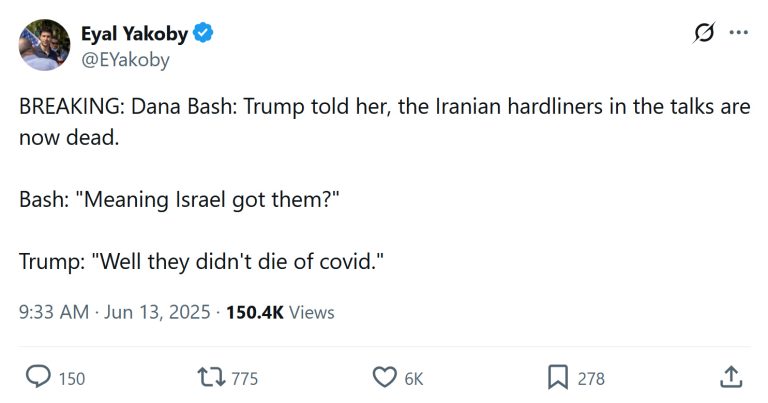
If it wasn’t clear from yesterday’s roundup, it appears that a whole lot of Islamic Republic of Iran leaders were physically meeting at Ayatollah Ali Khamenei’s bunker in Tehran when the successful decapitation strike was carried out as part of Operation Epic Fury/Roaring Lion. The operations are still ongoing, and here are some news updates.
“‘All’ of [Ali Khamenei’s] likely successors are ‘probably dead’ following US-Israeli strikes.”
Mick Mulvaney, former Trump OMB head and Chief of Staff: “A high risk, high reward type of operation.”
A “once in a lifetime opportunity” to both end the nuclear program and effect regime change. “All the [Iranian] senior leadership gathered together at one place at one time.”
The daylight attack must have meant we had really solid intel on the regime meeting. Most of our Middle East strikes happen at night during a new moon. “An opportunity they simply couldn’t pass up.”
“All of [Ali Khamenei’s] likely successors are probably dead as well.”
“The chances of getting a pro-Western, pro-American regime in Iran were as high as it ever was going to be.”
John Bolton was lamenting that these actions weren’t taken six or seven years ago, but the situation on the ground now is very different. “Everything has to come together at the same time for this to work.”
“This can’t be a forever war.”
Taking out the mullahs is “a step toward peace.”
New Guy steps into the leadership crosshairs. “Iranian Vice President Mohammad Reza Aref informed officials of plans to have him take charge of the nation during wartime, according to a report from the Iranian Students’ News Agency (ISNA) published on social media late Saturday night. There was no explicit note of President Masoud Pezeshkian’s ability to carry out presidential duties.”
Simon Whistler covers the strikes:
Much of this covers information included here yesterday, but here are a few new tidbits.
Whistler states Iran is claiming they hit Riyadh in Saudi Arabia. LiveUAMap shows a strike against Prince Sultan Air Base, which is over a 100 miles from Riyadh. I mean, they’re both in central Saudi Arabia, but, eh.
In Yemen, Houthis threaten retaliation. Nothing yet.
The gulf states are plenty pissed at Iran tossing drones and missiles at them.
Russia issued a single proforma condemnation of U.S. attacks. China, on the other hand, hasn’t even done that.
A lot of Chinese MilTech deals were supposedly in the works when things kicked off, but it looks like very little (if any) actually made it to Iran.
Suchomimus video the first:
“It is quite telling that [Khamenei]’s death is being celebrated on the streets.”
Khamenei was likely killed in the opening strike. “A few sources are now saying it was Israel that hit this.”
“Iran isn’t showing any signs of giving up. Well, these could just be the last temper tantrum of the finished regime. The generals and remaining politicians lashing out knowing their time is over and that a surrender is inevitable and just trying to inflict damage.”
Suchomimus sees regime change as unlikely without “boots on the ground.”
Suchomimus video the second, which is all damage assessment:
One Iranian frigate hit, but two more showing no signs of damage.
Bandar Abbas radar site hit. Bandar Abbas is the port city directly north of the Strait of Hormuz.
Four MiG-29 fighters destroyed out of 30 in service.
Israel took out a Basij installation in northern Tehran, they being the hated Iranian religious police. The video shows four large buildings all exploding in a matter of seconds. “Iran’s air defense is completely ineffective here.”
Iran’s counterstrikes have had some limited success. In Kuwait “Ali al-Salim air base was hit.” The image shows smoke rising up from three different points, one evidently from a fuel storage strike. “One of Iran’s most successful strikes to date.” Plus a car park and a support facility.
Iran also hit Erbil air base in Iraq, where a large fire was seen burning. No information yet on what was hit.
Iran also hit Al-Udeid air base in Qatar. “This is the largest American base in the Middle East.” Videos show Patriot intercepting Iranian vehicles, but also one miss and one Patriot interceptor wandering off course and hitting the ground.
I see Tomahawks, F-18s and F-35s, and a lot of Iranian targets going boom. And other American assets are poised to join the action:
B-2s will likely show up tonight, making direct attacks on key targets in a way no other platform can. Yes this could include MOPs, but also lots of JDAMs against less fortified targets. They can achieve massive effects in a single sortie. One B-2 can carry 80 500lb JDAMs. Entire… pic.twitter.com/d0ztfmHYVN
TAMPA, Fla. – As of 9:30 am ET, March 1, three U.S. service members have been killed in action and five are seriously wounded as part of Operation Epic Fury.
Several others sustained minor shrapnel injuries and concussions — and are in the process of being…
🚫Iran’s IRGC claims to have struck USS Abraham Lincoln with ballistic missiles. LIE. ✅The Lincoln was not hit. The missiles launched didn’t even come close. The Lincoln continues to launch aircraft in support of CENTCOM’s relentless campaign to defend the American people by… pic.twitter.com/AjaeHMemtA
Plus President Trump was stating that Iranian retaliation was less than expected.
Also this: “Imagery circulating points to Iranian attacks in the vicinity of France’s naval base in Abu Dhabi in the United Arab Emirates.” In other news, there’s a French naval base in Abu Dhabi…
Beware of Astroturf protesters. “CCP-Linked NGO Network Prepares “Emergency Protests” In US After Trump’s Iran Strikes Jeopardize Oil Flows To China.”
Planned demonstrations branded “Hands Off Iran” or “Stop The War On Iran” are scheduled to take place this afternoon in major cities across the U.S. From New York to Los Angeles, left-wing organizers have circulated digital flyers, coordinated social media blasts, and activated email lists urging supporters to mobilize within hours of the announcement. This activation alert for the protest-industrial complex occurred shortly after the Department of War’s “Operation Epic Furry” began in Iran.
To the average person, this afternoon’s protests may look like a groundswell of outrage over the U.S. strikes on Iran, especially given that the Trump administration campaigned on no new foreign wars. But the speed, uniform messaging, and coordinated national footprint suggest something highly more organized – and familiar for readers, as we’ve diligently followed the activities of the protest-industrial complex.
This is the same mobilization network that has repeatedly demonstrated its ability to move tens of thousands of social justice warriors into the streets in under 12 hours.
Earlier this year, that same protest infrastructure powered nationwide pro-Maduro demonstrations almost immediately after developments in Venezuela made national headlines. In the months prior, overlapping coalitions were instrumental in organizing the anti-Israel encampments at Columbia University and other campuses, as well as anti-ICE demonstrations in Los Angeles and other sanctuary cities. The causes shift. The slogans change. The logistical infrastructure – or the machine that makes this spark – remains the same.
What we are witnessing is not a loose collection of anti-war activists or 1970s-style hippies responding independently to global events. It is a coordinated ecosystem of dark-money funded nonprofits, advocacy groups, campus organizations, and ideological networks that can rapidly repurpose whatever geopolitical flashpoint dominates the news cycle. From the George Floyd riots to pro-Palestine protests to anti-Tesla protests to anti-Trump protests and anti-Elon Musk protests to anti-DOGE protests to anti-ICE protests/riots, these movements are not dedicated to a single issue. They are part of omni-cause mobilizers, sowing chaos deep within the nation’s core.
Whether the banner reads “Free Palestine,” “Hands Off Venezuela,” “Abolish ICE,” or now “Hands Off Iran,” the same names frequently appear on sponsorship lists. The same fiscal sponsors provide infrastructure. The same activist pipelines appear.
This brings us to far-left billionaire Neville Roy Singham, whom The New York Times recently described as “known as a socialist benefactor of far-left causes” and as someone who “works closely with the Chinese government media machine and is financing its propaganda worldwide.”
Singham’s network, shortly after Operation Epic Furry began, announced on X “New York City Emergency Protest” to “Stop The war On Iran.”
“The U.S. and Israel are carrying out an unprovoked, illegal bombing campaign on Iran. This war serves no one but a tiny elite and oil executives and is a continuation of more than two years of genocide in Palestine and US-Israeli aggressions throught the region,” the People’s Forum, a Manhattan far-left non-profit also linked to Singham, wrote on X.
Other left-wing groups on the flyer tied to Singham’s network include the ANSWER Coalition and CODEPINK. Also on the list are the Democratic Socialists of America, American Muslims for Palestine, the National Iranian American Council, the Palestinian Youth Movement, Black Alliance for Peace, and 50501.
November 4, 1979 — almost 47 years ago — Iran seized the American embassy in Tehran and held its staff hostage. Ever since then, American presidents have struggled with what to do.
Jimmy Carter temporized for many months, even as ABC’s newly created Nightline — a nighttime news show created specially to cover the hostage crisis — opened every night with “America held hostage, day XXX.” His wife, First Lady Rosalynn Carter, finally prodded him to do something. The “something” turned out to be a shambolic rescue mission that ended in disaster.
President Reagan intimidated the mullahs a bit, but never seriously retaliated for the Beirut barracks bombing that killed over 200 Marines along with over a score of other service personnel. George H.W. Bush invaded Iraq but left the mullahs largely alone. Bill Clinton did nothing of substance. George W. Bush had a chance to bring the Iranians to heel after the conquest of Iraq, but inexplicably failed to press his advantage. Barack Obama was, basically, complicit in their nuclear program, to the point of famously sending them pallets of cash totaling over a billion dollars.
President Trump, on the other hand, killed General Soleimani and told other Iranian leaders that they could be next. And now they are next.
So what have we learned, and what’s likely to happen in the future?
Well, first, with the capture of Maduro and now this, we’ve learned that our military can do things no one else can. We seized a leader of a hostile nation from his largest military base and brought him to custody without losing a single American life. Now we’ve killed the single biggest threat to American interests in the Mideast, along with much of his senior leadership, again without losing a single American life.
Why didn’t we do this before? And why could we do it now? The reason we can do it now is mostly leadership. Secretary of War Pete Hegseth quickly prioritized precision and lethality in the military; President Trump was willing to use the military in ways prior presidents were not.
Why didn’t we do this before? Part of that is because the foreign policy establishment, like the domestic policy establishment, doesn’t exist to solve problems. It exists to manage those problems in ways that keep its members cushily employed. To, in Myres McDougal’s words, “maintain tensions at a level short of unacceptable violence.”
Trump, on the other hand, wants to solve things, even if it involves inflicting unacceptable violence on the enemy. Also, he regards our enemies as actual enemies, not as “foreign colleagues” or “partners in peace.” To quote author Keith Laumer, “there’s nothing as peaceful as a dead troublemaker.” Khamenei is now peaceful.
In fact, Trump’s approach across the board, which has brought him success after success in his first 13 months back in office, is to solve problems the way the guys in the bar say they would do it. Too much illegal immigration? Close the border and deport the illegals. Problems with Iran? Kill their leaders and encourage a revolution. Venezuela shipping drugs and gangs to the U.S.? Capture their leader and encourage his successor to cooperate or share his fate. You can just do things.
The thing is, though, that there’s a subtlety in this approach. Just doing things turns out to work. But if you take a step back from these actions of Trump’s, the big picture shows a pretty coherent strategy. Trump wants to weaken China without going to war with China. He has now cut off two major suppliers of oil to the PRC, which produces hardly any oil of its own. (It’s worse than that, because China wasn’t paying for that oil with dollars, and now it will need dollars to buy oil elsewhere.) That applies a squeeze to an already squeezed CCP, and will make Xi’s position, domestically and internationally, weaker. Also the military excellence recently displayed has to inspire second, third, and fourth thoughts about invading Taiwan.
Trump’s tactics typically have two characteristics: He goes after his opponents’ source of sustenance (usually that means money, but not always) and he accomplishes more than one thing at a time. In neutralizing Iran, Trump accomplishes a lot of things. First, of course, he neutralizes a major hostile regional threat.
But second, he cuts the ground out from under what’s left of Hamas and Hezbollah. He also shuts off the pipeline of cash that was being used to bribe politicians and journalists in Europe (the Iranians have basically admitted that they do that) and support various NGOs and the like that serve anti-American and anti-Israeli ends. Iran has been a major sponsor of terrorism around the world; that will end.
With Iran gone (and India, thanks to tariffs, eager to be on our team) the threat of the BRICS has been sharply reduced. Brazil under Lula isn’t friendly, but isn’t a power house. Russia and China don’t like us but China needs oil and Russia is broke and mired in an endless and ruinous war of its own devising.
With Iranians free to say what they think of the mullahs’ regime, he also delegitimizes the left’s narrative that fundamentalist Islam somehow has some sort of anti-colonial virtue. In fact, the mullahs ran Iran as a Persian colony of an Arab ideology. The Iranian public is well aware of this, and will be saying that a lot.
And if he’s able to see a new pro-American government in Iran (distinctly likely) we’ll have a regional ally that will encourage the Arab states, currently friendly to us and Israel out of fear of Iran, to remain friendly to us and Israel out of a different sort of fear of Iran.
Iranian President Masoud Pezeshkian claims he’s alive and in charge:
Iranian President Masoud Pezeshkian is alive, stating this morning on state-run television that the Interim Leadership Council is now operational and has assumed constitutional control of the Islamic Republic of Iran. Pezeshkian adds that, “We will continue the path of the Leader… pic.twitter.com/QIhDTeRxub
Power struggle between him and Mohammad Reza Aref, or just confusion?
Iranian foreign minister is suggesting that no one is actually in charge, that the chain of command has broken down and the military is just sort of acting on general vibes:
Iranian Foreign Minister Araghchi:
What happened in Oman was not our choice.
We have already told our Armed Forces to be careful about the targets they choose.
Our military units are now, in fact, independent and somewhat isolated, and they are acting based on general… pic.twitter.com/g0l9Te2HNa
Which is not what you want to hear less than 48 hours into a shooting war…
Mojtaba Khamenei, Ayatollah heir apparent, is apparently dead as well.
Iranian media: Khamenei’s son, Mojtaba Khamenei, who has long been discussed as one of the potential successors, has been eliminated. pic.twitter.com/6Fy8mkHe47
That four building complex previously described as Basij headquarters is here described as “Sarallah Headquarters” or “security crisis management command center of the Islamic Revolutionary Guard Corps (IRGC) in Tehran”:
Israeli Air Force strikes that hit Tehran this morning targeted a complex the IDF described as the “headquarters of the terror regime.”
Now technically, the Basij is a subset of the IRGC, so that may be where the confusion comes in. Or the complex could be both. Google Maps isn’t helping me out here…
More of Iran’s classic aircraft destroyed:
Video published this morning by the Israeli Air Force showing the targeting and destruction of a two awaiting to takeoff F-4 Phantom IIs and an F-5 Tiger II with the Iranian Air Force, during strikes on Tabriz Air Base in the East Azerbaijan Province on Northwestern Iran. pic.twitter.com/n8NkNhGjle
Despite claims of not being involved, UK fighters are reportedly flying CAP over the Persian Gulf:
British Royal Air Force Typhoons officially started flying combat air patrols over the Persian Gulf today, have already shot down multiple Iranian drones headed towards Qatar. pic.twitter.com/hQ7WOiZYjr
"Iran’s chief of army staff and defense minister were killed in an airstrike targeting a meeting of the country’s defense council, Iranian state television reported Sunday.
Gen. Abdol Rahim Mousavi and Defense Minister Gen. Aziz Nasirzadeh were…
“Gen. Abdol Rahim Mousavi and Defense Minister Gen. Aziz Nasirzadeh were killed at the meeting alongside the head of Iran’s paramilitary Revolutionary Guard and security adviser Ali Shamkhani.”
❗️Iranian state media confirmed the killing of seven senior Armed Forces commanders in the US-Israeli strikes. Those killed include Supreme Leader's office chief Mohammad Shirazi, his deputy Akbar Ebrahimzadeh, Armed Forces intelligence deputy Saleh Asadi, logistics deputy Mohsen… pic.twitter.com/6ptzq6r06Q
“Iranian state media confirmed the killing of seven senior Armed Forces commanders in the US-Israeli strikes. Those killed include Supreme Leader’s office chief Mohammad Shirazi, his deputy Akbar Ebrahimzadeh, Armed Forces intelligence deputy Saleh Asadi, logistics deputy Mohsen Darreh Baghi, police intelligence chief Gholamreza Rezaeian, Armed Forces operations planning chief Bahram Hosseini Motlaq, and Armed Forces logistics chief Hasanali Tajik.”
More regime buildings go boom:
Iran's Ministry of Intelligence (VAJA/Vezarat-e Ettela'at Jomhuri-ye Eslami-ye Iran) has been struck in central Tehran. #Iranpic.twitter.com/aQjeTwoed4
U.S. President Donald Trump announced Sunday that nine Iranian naval ships have been sunk as part of combat operations against Iran.
“I have just been informed that we have destroyed and sunk 9 Iranian Naval Ships, some of them relatively large and important,” Trump wrote in a post on X, adding that Iran’s naval headquarters has been “largely destroyed” in a different attack.
“We are going after the rest — They will soon be floating at the bottom of the sea, also!” Trump wrote.
U.S. Central Command officials said earlier Sunday that an Iranian Jamaran-class corvette was struck by U.S. forces at the beginning of Operation Epic Fury.
“The ship is currently sinking to the bottom of the Gulf of Oman at a Chah Bahar pier,” the statement reads. “As the president said, members of Iran’s armed forces, IRGC and police ‘must lay down your weapons.’ Abandon ship.”
❗️A suspected strike has hit the British RAF Akrotiri base in Limassol, Cyprus, with a loud explosion heard in the area, alarms sounding at the base, and aircraft scrambled, Israeli Channel 14 journalist Hallel Bitton Rosen reported. #Iranpic.twitter.com/xB6mvhrbFt
Result: Craven jihad apologist Keir Starmer grows something vaguely resembling a spine and gives the U.S. permission to use Cyprus base for “defensive purposes.” With so many Middle East bases to chose from, I’m not sure the US actually has any assets they can usefully deploy there, but still.
Clarification: Here Starmer makes clear that “defensive purposes” includes letting American assets use British bases, including those in the Persian Gulf, to hunt Iranian missile launch sites and storage facilities:
One problem the Navy has in a potential fight with China is that its carrier strike groups would need to be dangerously close to the Chinese mainland to launch strike aircraft close enough for them to return. The MQ-25 Stingray is designed to solve that problem.
“This is the Boeing MQ-25 Stingray. It is the world’s first operational, carrier-based unmanned aircraft.”
“Despite looking like a futuristic stealth bomber, its job isn’t to bomb or dog fight. Its job is a bit boring. It’s a flying gas station.”
“In the Pacific theater, the distances between safe bases and potential combat zones are measured in thousands of kilometers. The Pacific Ocean is really big. Yet, modern carrier fighters like the F/A-18 Super Hornet and the F-35C actually have shorter combat radiuses than the old Cold War workhorses like the A-6 Intruder.”
“To fix this, the Navy has been forced to use its own fighters as improvised tankers. Currently, somewhere between 20 and 30% of all Super Hornet sorties are just refueling missions. They hang extra fuel tanks on the wings and fly out just to top off their friends. This is kind of like buying a fleet of high-end Ferraris and then using a third of them to deliver Uber Eats. It works, yes, but it is an incredibly stupid use of money and airframe life.”
“The MQ-25 is designed to stop that waste by spending billions of dollars. It can launch from the carrier and deliver between 14,000 and 16,000 lb of fuel to other aircraft 500 nautical miles away. To put that in perspective, that’s roughly 2,400 gallons. That’s enough gas to fill up about 160 family cars.”
“If you’re a carrier-based drone with that kind of range and internal volume, you don’t have to fill it with gas. You could fill it with radar arrays. You could fill it with sensor packages or one day you could indeed fill it with stealthy anti-ship missiles.”
The Intruder could “strike targets hundreds of miles away and loiter for hours, keeping the aircraft carrier itself well out of harm’s way. But those aircraft are gone. They were retired years ago, leaving the modern air carrier deck dominated by the F/A-18 Super Hornet and the F-35C. Now, these are fantastic high-tech multiroll fighters. But compared to their ancestors, they’ve got short legs. Their unrefueled combat radius is significantly tighter.”
“Potential adversaries, specifically China, have spent the last 20 years developing long-range anti-ship ballistic missiles. These are weapons designed to hunt carriers, and they can hit targets from well over a thousand km away. So, here is the problem the Navy is facing. If you put a US carrier in the Philippine Sea and draw a circle representing how far its jets can fly without refueling, there is a very good chance that that circle doesn’t even touch the Chinese mainland. But if you draw a circle for the range of China’s land-based missiles, it easily encompasses the carrier, which is not brilliant news for the US Navy.”
“The obvious solution here is aerial refueling. If you can gas up the fighters in midair, you can extend their range and the carrier can stay safe.”
The Stingray started out as an unmanned stealth bomber program, the Northrup Grumman X-47B, but got repurposed as a duller but badly needed tanker. Boeing got the revised contract.
“Yet, when Boeing unveiled their design, it didn’t look like a flying fuel truck. With its blended fuselage, flush air intake that hides the engine fan blades, and a distinct V-tail, the Stingray looks suspiciously like the stealth drone that the Navy said it didn’t want. Defense analysts, including those at The War Zone, have pointed out lingering questions about the origins of this shape. The strong implication there is that Boeing had already done the heavy lifting on a stealthy U-class design, and rather than just throwing it away, they essentially repurposed it. They gave the Navy a gas station, but they disguised it as half a stealth bomber.”
“The MQ-25 is a beast. It’s 51 feet long. That’s roughly the length of a standard city bus. Its wingspan is 75 feet, which is massive for a carrier deck aircraft. To fit into the ship’s garage, the hanger deck, the wing tips fold up, which means it’s just 31 feet across. Powering this frame is a single Rolls-Royce AE307N turbo fan,” a workhorse commercial engine.
“The Navy’s objective for the Stingrays to offload 14 to 16,000lb of fuel at a range of 500 nautical miles. To put that in perspective, that’s about 2,400 gallons of jet fuel.”
It’s stealthy, but not that stealthy, carrying fuel pods under its wings.
“The actual tanking part of the drone is surprisingly old school. Under the wing, the MQ-25 carries the Cobham buddy store refueling pod, the exact same hardware used on the Super Hornets today. It uses a hose and drogue system. The drone unreels a hose with a basket on the end and the receiver pilot plugs their probe into it.”
“The MQ-25 has no rear-facing camera or proximity sensors dedicated to the refueling basket. It doesn’t see you approaching. Just like with a human flown tanker, the robot flies a steady line, and it relies entirely on the skill of the human pilot in the fighter jet to plug in.”
“On the carrier, the Stingray is managed via the unmanned carrier aviation mission control system or UMCS. The Navy has even installed a dedicated room aboard the USS George H. W. Bush called the Unmanned Air Warfare Center, or UAWC. Inside, air vehicle operators sit at consoles. They don’t have a stick and rudder. Instead, they pre-program the mission with way points, refueling tracks, and contingencies. Once the drone launches, it is largely autonomous. It executes the plan on its own.”
It’s positioned and launched off the deck of the carrier using a hand-held device.
Aerial refueling with it was successfully tested in 2021.
“As of 2025, the official program of record calls for the Navy to buy 76 Stingrays, 67 operational aircraft, and nine for testing and development. The total price tag for this fleet is estimated at roughly $15.9 billion. Doing the maths, that works out to an acquisition cost of around $209 million per aircraft, a number that includes its share of the research and development costs.”
“Originally, the Navy hoped to have production representative aircraft flying by 2022. Nope.”
“The schedule has slipped repeatedly.”
“By late 2025, reports confirmed that the first flight of the Navy’s production representative jet had slipped again into early 2026, as the team wrestled with structural tests and software certification. The target for actual combat readiness is now listed vaguely as by the end of fiscal year 2027.”
“To try and clear the bottleneck, Boeing opened a new $200 million dedicated facility at St. Louis airport in 2024 designed specifically to churn out these drones.”
Critics argue for cheaper alternatives. “Supporters counter that the fuel is just the appetizer. They argue the MQ-25 is a pathfinder. Its real value isn’t just in gallons delivered, but in teaching the Navy how to integrate unmanned aircraft into the carrier airwing at scale. It is the entry fee for the future of naval warfare.”
“If you talk to naval strategists and especially, if you look at what analysts are whispering about it, it is very clear that tanker is kind of just the beginning here. The most immediate impact is range. The Royal Aeronautical Society notes that by offloading 15,000 lb of fuel at 500 nautical miles from the carrier, the MQ-25 effectively doubles the combat radius of the airwing. This is the big metric that Chinese military planners are reportedly getting quite worried about.”
“The fighters can top up their tanks deep in the combat zone, allowing them to strike targets that were previously untouchable, while the carrier stays hundreds of miles further back in safety.”
“But the Stingray is a big aircraft with a lot of internal volume and long endurance, which makes it perfect for a secondary role, the sensor truck. The Navy’s own documents explicitly list intelligence, surveillance, and reconnaissance, or ISR, as a secondary mission.”
“Because it doesn’t need a cockpit or life support, there’s plenty of room inside for radar arrays, electronic warfare jammers, or heavy communications gear. Analysts envision the Stingray acting as a cell tower in the sky, orbiting silently for hours, linking manned fighters, ships, and other drones into a single network, relaying data back to the fleet while the fighters focus on the fighting.”
“Then there’s the spicy option, the missile truck. In 2024, photos surfaced of an MQ-25 model at a trade show. It wasn’t just carrying fuel pots. Under its wings were two massive AGM 158C LRASM stealth anti-ship missiles. And under its nose was a new sensor ball.”
“While the Navy hasn’t officially committed to this armed Stingray configuration yet, the logic is pretty seductive. If you have a drone that can fly long distances and has low observable shaping, why not use it to launch long-range missiles? It could allow the carrier to launch salvos of stealthy anti-ship weapons from well outside the range of enemy defenses, turning the humble tanker into a lethal standoff striker.” While true, the already-in-service MQ-9 Reaper has a 1,000 nautical mile range.
“Navy leaders are already talking about a future, perhaps by 2040, where up to 60% of the carrier airwing is unmanned. The Stingray along with the mission control infrastructure UAWC being built into carriers right now is the foundation for that future.”
My concern is that each of these is basically refueling one F/A-18 or F-35 if you’re using them to double the strike range; that’s a lot of tail to extend the teeth, especially since they’re taking up additional carrier hanger space. A lot of the same benefit for the China scenario can be achieved by flying longer range, less stealthy ground-based refueling aircraft (like the KC-46 Pegasus) out of U.S. airbases at Luzon or Okinawa. Of course, both of those (and other theater airbases) might be hit with Chinese missiles in a conflict.
But the sensor and long-range strike configurations are intriguing…
Uncle Sam assembles another big stick for Iran, the radical leftwing networks in Minnesota continue to get exposed, silver shatters, two state Democrats get clipped in separate forgery cases, the rise of the Amelia memes, Microsoft update breaks everything (again), and are malls actually reviving?
And Neville Roy Singham’s fingerprints are visible everywhere.
It’s the Friday LinkSwarm!
As of right this moment, America hasn’t gone kinetic on the Mullahs yet, but we’re assembling an awful big stick.
USS Abraham Lincoln has gone dark, with no transponder or communication, signaling possible preparation for action against Iran.
A third US carrier strike group, USS George H.W. Bush (CVN-77), is moving into the Middle East theater.
Snip.
Some very interesting developments in the last 48 hours indicate something big is about to happen.
The EU all of a sudden has decided the next thing on their agenda is to declare the IRGC a terrorist group. Curious timing, that.
Minnesota agitators, including elected officials, have been organizing efforts to stalk, harass, and even hunt ICE agents in a Signal group chat that was infiltrated by Cam Higby and others.
It has been insane looking at the messages and the actual people involved.
And now DataRepublican has the donor list … you know, the people actually paying to make sure this all happens.
DataRepublican has also helpfully linked to their social media profiles.
You can download he data yourself. And DataRepublican has already turned in all the captured information to the Feds…
This is the story of how Minnesota became a political laboratory—first for the 2020 George Floyd protests, then for a sustained campaign against federal immigration enforcement. The players are the same. The money flows through familiar channels. And the strategy, according to those who designed it, was always meant to be replicated.
Snip.
Understanding how The People’s Forum operates requires following the money. And the money leads to Shanghai.
Neville Roy Singham is an American tech entrepreneur who sold his software company, ThoughtWorks, for approximately $785 million in 2017. He now lives in Shanghai, where, according to a 2023 New York Times investigation, he “works closely with the Chinese government media machine and finances propaganda worldwide.”
The Network Contagion Research Institute (NCRI), a Rutgers University-affiliated research organization, published a comprehensive report in May 2024 documenting what it calls the “Singham Network”—a web of nonprofits, fiscal sponsors, and alternative media outlets that share funding, personnel, and messaging.
According to NCRI, The People’s Forum received over $20 million from Singham and his wife, Jodie Evans (co-founder of the anti-war group CODEPINK), between 2017 and 2022. The money moved through a complex network of donor-advised funds and shell companies, including the Justice and Education Fund, the United Community Fund, and the Goldman Sachs Philanthropy Fund.
The People’s Forum has acknowledged receiving Singham funding. In a December 21, 2021 post on X (then Twitter), the organization defended its financial relationship with Singham against critics.
Congressional investigators have taken notice. On September 4, 2025, House Ways and Means Committee Chairman Jason Smith sent a formal letter to [People’s Forum Executive Director Manolo] De Los Santos demanding records and alleging that The People’s Forum had “acted as a foreign agent of the Chinese Communist Party” while enjoying tax-exempt status.
“Public reporting suggests that The People’s Forum has received over $20 million from Mr. Singham and his wife,” Smith wrote. “Multiple reports have found that The People’s Forum is part of Mr. Singham’s network of non-profit organizations that serve as his conduits to spread pro-CCP narratives.”
The Senate Judiciary Committee separately requested that the Department of Justice investigate whether The People’s Forum should register under the Foreign Agents Registration Act.
De Los Santos himself has deep ties to Cuba. According to his biography at the Black Alliance for Peace, he “was based out of Cuba for many years” and “worked toward building international networks of people’s movements and organizations.” The New York Post reported that De Los Santos first traveled to Cuba in 2006 and was there as recently as March 2024. He has been photographed meeting with Cuban President Miguel Díaz-Canel.
Footnotes excised. Snip.
What makes Minnesota different from other immigration flashpoints is the degree to which organizers have been explicit about their strategy.
The NCRI report notes that activists in the Singham network view the 2020 protests as proof that “the ability for mass struggle now exists inside the United States.” This framing treats George Floyd’s death not as a singular tragedy but as a tactical validation—evidence that the right combination of outrage, infrastructure, and outside support can produce transformational results.
De Los Santos’s April 2024 call to recreate “the violent protests of the summer of 2020” was not a slip of the tongue. It was a statement of doctrine.
The IDN’s establishment before Operation Metro Surge began—funded by nearly $1 million from the Bush Foundation—demonstrates pre-positioning rather than organic response. The explicit training of thousands in “rapid response” and “legal observation” tactics, the encrypted communication networks, the coordinated media strategies: none of this materialized spontaneously after Good’s death.
It was waiting.
The evidence assembled here—from congressional investigations, foundation records, tax filings, academic research, and organizers’ own statements—establishes that what is happening in Minnesota is neither spontaneous nor accidental.
The same network that helped turn George Floyd’s death into a national uprising has spent five years building the capacity to do it again. They have studied what worked in 2020, professionalized their operations, secured substantial funding, and pre-positioned infrastructure across Minnesota.
When Renée Good was killed on a Minneapolis street, that infrastructure activated precisely as designed.
Minnesota was chosen—first as the place where 2020 proved the model, then as the laboratory where that model would be refined and redeployed. The current crisis is not an accident of geography or politics.
A collection of far-left groups — led by a Communist activist network tied to CCP-linked millionaire Marxist Neville Roy Singham — is attempting to organize a nationwide anti-ICE school and business shutdown, with anti-Israel activist Linda Sarsour declaring that “we will bring this country to a halt.”
The general strike effort, scheduled for this Friday, is an attempt to replicate a Minnesota-wide anti-ICE shutdown which occurred last Friday and which was organized by many of the same far-left groups — but now with designs to do so on a national scale. The planned “National Shutdown” announced early this week includes plans for large-scale marches and a day of “no work, no school, no shopping” around the country.
The Manhattan-based Marxist revolutionary People’s Forum, the left-wing BreakThrough News media outlet, the Party for Socialism and Liberation (PSL), the far-left Code Pink anti-war group, and the Act Now to Stop War and End Racism (ANSWER) Coalition are all involved in either promoting or organizing the nationwide shutdown effort.
Just the News recently reported on how the forum, its propaganda machine, and the PSL were key players in pushing last week’s Minnesota-focused shutdown effort. Just the News also previously reported on how these and other radical activist groups have leadership links or financial ties to the funding network backed by Singham, whom others in his network call “Comrade.”
Social media used as organizing platform
The plans for Friday allegedly started with calls by a number of student groups at the University of Minnesota — the Somali Student Association, the Liberian Student Association, the Ethiopian Student Association, and the Black Student Union — who called for “Justice for Alex Pretti & Renee Nicole Good — NATIONWIDE SHUTDOWN” on Instagram on Sunday.
An investigation by Just the News shows that the forum was likely involved in creating the “National Shutdown” website which is now serving as an organizational hub for the coming Friday strike.
Did anyone notice a “nationwide shutdown” today? Mother Nature did a 100,000% better job shutting things down with Winter Storm Fern…
You gotta hand it to those Soros-sponsored district attorneys across the nation because when it comes to playing with fire, they play like they’ve never been burned.
The latest example is Philadelphia DA Larry Krasner. Not exactly a household name across the country,
But one that should be well-known to BattleSwarm readers.
Soros-linked groups have been his single largest financial backing source — helping him bypass traditional party fundraising and local contribution limits.
About a decade ago, Soros contributed about $1.7 million to the Philadelphia Justice and Public Safety PAC while Krasner was still a relative unknown in a seven-candidate race for district attorney. The Philly PAC is part of Soros’s nationwide Justice and Public Safety groups that fund “progressive” DAs in blue city contests.
According to public sources, in 2017, Soros’s donation to just one candidate accounted for nearly 30% of all campaign spending in the seven-person race. For his 2021 reelection, Soros groups gave Krasner another $1.2 million, including $259,000 for Philadelphia Justice and Public Safety PAC to run ads on Krasner’s behalf. Soros supported Krasner again last year, although I wasn’t able to find the dollar amounts before going to press.
Prior to getting all that Soros money to run for D.A., Krasner defended Black Lives Matter and Occupy Philadelphia members in court — and let’s just say Soros got his money’s worth. Or maybe it’s our money, given how intermingled Soros’s private funds are with taxpayer-funded NGOs purpose-tuned to push his causes.
Snip.
Here’s the quick and dirty transcript of Krasner talking about ICE officers: “This is a small bunch of wannabe Nazis — that’s what they are — in a country of 350 million. We outnumber them… If we have to hunt you down the way they hunted down Nazis for decades, we will find your identities, we will find you, we will achieve justice.”
What have I been repeating since the first attempt on President Donald Trump’s life last summer?
The left paints its enemies — we are no longer mere political rivals — as enemies, over and over, until some crazy decides to take justice into his own hands.
The FBI raided a Fulton County election office, evidently looking for evidence of the elction fraud carried out against president Trump in 2020. And it might be connected to…Nicolas Maduro?
Silver prices just plunged plunged over $30 an ounce today after a huge run-up. This means I’m either a genius when I sold a small amount of it last week (when prices were above where they are now), or an idiot for not selling all of it…
For three years, the world has waited for the Russian economy to implode. Instead, we watched a “Kalashnikov economy” defy gravity, fueled by high oil prices and a “friendship without limits” with Beijing. But as of January 2026, the gravity of basic math has finally caught up with Vladimir Putin.
The catalyst isn’t just the stalemate on the front lines; it’s a legislative “kill shot” from Washington and a quiet betrayal from the East. Between the new Graham-Trump Sanctioning Russia Act and a mounting domestic liquidity crisis, the Kremlin isn’t just running out of options—it’s running out of time.
The most significant development of 2026 isn’t a new missile system; it’s a tariff. The Graham-Trump Bill, greenlit by the White House on January 7, has fundamentally rewritten the rules of economic warfare. By threatening a mandatory 500% tariff on any country—including China and India—that continues to purchase Russian petroleum or uranium, the U.S. has finally weaponized the one thing Russia’s allies value more than cheap crude: access to the American consumer.
The shockwaves were instantaneous. On January 15, reports emerged that China’s largest state banks, including ICBC and Bank of China, began halting Ruble-denominated settlements. They aren’t waiting for the bill to be signed into law; they are pre-emptively cutting Russia loose to save their own export margins. When Beijing chooses its $500 billion trade surplus with the U.S. over its “strategic partner” in Moscow, the Russian war machine loses its primary life support system.
While the external walls are closing in, the internal floor is rotting. On New Year’s Day, Russia’s VAT officially jumped to 22%. This isn’t a sign of strength; it’s an act of desperation. The Kremlin is cannibalizing its own middle class to plug a federal budget revenue gap that fell 20% short of targets in 2025.
We are now seeing the first signs of a systemic banking fracture. In cities like Yekaterinburg and Novosibirsk, reports of ATM shortages are no longer fringe rumors—they are the physical manifestation of a “liquidity trap.” When the state raises taxes while inflation remains double-digit and interest rates hover near 20%, the result is a “medically induced coma” for the civilian economy.
Federal officials have charged two contractors with conspiring to disrupt Immigration and Customs Enforcement officers in Knoxville earlier this month.
The U.S. Attorney’s Office for the Eastern District of Tennessee unsealed a multi-count indictment on Friday against Tyler Shane Wells, 33, of Morristown, and 18-year-old Alexander Bonilla Servin of Smyrna.
They are charged with conspiracy to conceal and harbor illegal aliens, conspiracy to forcibly impede federal agents while engaged in performance of official duties, and conspiracy to prevent, by force, intimidation, or threat, federal agents from discharging their official duties from January 5 through January 13.
Bonilla-Servin is also charged with forcibly impeding federal agents engaged in the performance of their official duties.
Wells appeared in court on Friday and pleaded not guilty to the charges and a detention hearing is set for Monday. A trial date has been set for March 31, 2026.
Federal authorities accuse the two of plotting to block the entrance to a Hardin Valley construction site with Bonilla-Servin’s pickup truck in an effort to impede ICE agents. According to a Department of Justice release, the vehicle was put in position after federal agents were seen surveilling the site. Servin is also accused of hitting agents’ vehicle with the truck as it attempted to enter the site on January 13.
After more than a year of digging, Statehouse candidate Bailey Templeton’s most public records collection shows 1,085 Illinois children under 18 without SSNs had Medicaid bills of $66 million in 2025. That’s up 725% from $8 million for 450 children in 2021.
“It’s roughly $40 million spent on inpatient treatment, that’s a lot of time for children to be in hospitals,” Templeton told The Center Square Friday.
The data only generates more questions for Templeton.
“It raises questions about what would be called medical trafficking, where things are conducted on to children when they’re too young to be able to consent to these things,” she said.
Why, it’s almost like Democrats imported millions of illegal aliens and put them on welfare rolls…
Man tries to kill mayor in the Philippines with an RPG. (Never mind that The Sun calls it a bazooka.)
Idiot Hawaiian Democrat Senator Brian Schatz asks Marco Rubio a really stupid question, and Rubio hands him his ass:
“That’s statutory. The Helms Burton Act, the US embargo on Cuba, is codified. It was codified in law and it requires regime change in order for us to lift the embargo.”
Transportation Secretary Sean Duffy just dropped what I’ve been calling the nuclear option.
In an appearance on Katie Pavlich Tonight Thursday, Duffy made clear that withholding $200 million in federal funding isn’t the end of this fight. If California doesn’t come into compliance on the non-domiciled CDL issue, Duffy said, “we will eventually pull their ability to issue commercial driver’s licenses to anybody in California.”
Not just the 17,000 non-domiciled CDLs at the center of this fight. Every single CDL in the state.
I’ve written extensively about this standoff since the FMCSA released its audit findings last September, which showed that roughly 25% of California’s non-domiciled CDLs were improperly issued. I’ve covered the $160 million funding hit. I’ve warned about the decertification authority in 49 U.S.C. 31312 and 49 CFR 384.405, which most people in this industry didn’t even know existed.
This didn’t start with the Trump administration’s September 2025 emergency rule restricting non-domiciled CDLs to certain visa categories. That rule, which limited eligibility to H-2A, H-2B, and E-2 visa holders, has been stayed by the D.C. Circuit since November. The court found that petitioners were “likely to succeed” on their claims that the FMCSA violated federal law in its rulemaking.
The California problem predates all of that.
FMCSA’s August 2025 Annual Program Review found California had been violating federal regulations that existed long before Duffy took office. The state was issuing CDLs with expiration dates extending years beyond drivers’ lawful presence documentation. In one case that still makes my blood boil, California issued a driver from Brazil a CDL with passenger and school bus endorsements that remained valid months after his legal presence expired.
That’s not a new rule problem. That’s a California screwed-up problem.
California agreed in November to revoke all 17,000 improperly issued licenses by January 5, 2026. Then, on December 30, the California DMV unilaterally announced a 60-day extension to March 6, citing the need to ensure it doesn’t wrongfully terminate licenses for drivers who actually qualify.
Duffy’s response on X was blunt: “Gavin Newsom is lying.”
FMCSA never agreed to the extension. California proceeded anyway. On January 7, DOT made good on its threat and withheld approximately $160 million in National Highway Performance Program and Surface Transportation Block Grant funds. That’s on top of the $40 million already withheld over California’s refusal to enforce English language proficiency requirements.
California has more than 700,000 CDL holders. The state is home to the nation’s largest trucking workforce, with over 138,000 truck drivers moving freight through the ports of Los Angeles and Long Beach, the agricultural heartland of the Central Valley, and every retail distribution center feeding the country’s largest consumer market.
Under full decertification, California would be prohibited from issuing, renewing, transferring, or upgrading any commercial learner’s permits or commercial driver’s licenses until FMCSA determines the state has corrected its deficiencies. Previously issued CDLs would technically remain valid until their stated expiration dates, but here’s where it gets ugly.
Other states could refuse to recognize California credentials during the noncompliance period. FMCSA could issue guidance declaring CDLs issued by a noncompliant state invalid for interstate commerce. The Commercial Driver’s License Information System, which enables interstate verification, could flag every California license.
For the 700,000 CDL holders in the Golden State, decertification wouldn’t just be an administrative headache.
It would effectively ground them from operating in interstate commerce.
Blue state governors should stop trying to protect their precious illegal aliens and start following federal law.
TikTok has finalized a deal to create a new American entity, avoiding the looming threat of a ban in the United States that has been in discussion for years on the platform now used by more than 200 million Americans.
The social video platform company signed agreements with major investors including Oracle, Silver Lake and the Emirati investment firm MGX to form the new TikTok U.S. joint venture. The new version will operate under “defined safeguards that protect national security through comprehensive data protections, algorithm security, content moderation and software assurances for U.S. users,” the company said in a statement Thursday. American TikTok users can continue using the same app.
Tesla North America announced the completion of a major lithium refinery in Robstown, Texas, with Elon Musk calling it “the most advanced lithium refinery in the world.”
Robstown is just west of Corpus Christi.
In the promotion video, Jason Bevon, the site manager at the Gulf Coast lithium refinery, explains that the refining process used in Robstown is “inherently much more environmentally friendly.” The company claims that the process used by the refinery eliminates hazardous byproducts of the refining process and is more sustainable than traditional methods.
Bevon explained that the refinery “enables us to have access to the critical minerals for energy storage, for battery manufacturing, and ultimately for [electric vehicle (EV)] growth.”
“It enables us to accelerate Tesla’s mission by regionalizing supply chains for battery minerals and materials, by providing jobs, by cutting emissions from the transportation network that is required for these supply chains.”
“It really allows us to usher in energy independence for North America.”
Columbia University’s Center on Global Energy Policy explains that raw lithium needs to be processed into a “chemical in the form of lithium carbonate or lithium hydroxide, before being used in batteries,” which is done through refining. Currently, China dominates the global trade and production of key minerals, and leads the world in lithium refinement capabilities.
The need for lithium batteries has grown exponentially in recent years, with lithium batteries being required for EVs, smartphones, laptops, and renewable energy receptacles such as solar panels.
Also, you’re partially paying for it:
This political shift and the operation of the refinery are complemented by recent grants through the Texas Semiconductor Innovation Fund (TSIF), which was established when the Texas CHIPS Act, House Bill 5174, was signed into law in 2023. The TSIF totals “approximately $948 million in total appropriations” and is used for “semiconductor manufacturing and design,” according to the Texas Economic Development and Tourism Office.
Webb County’s sheriff and his assistant chief are facing federal charges for allegedly using office resources to create and profit from a disinfecting business during the COVID-19 pandemic.
Sheriff Martin Cuellar Jr., 67, and Assistant Chief Alejandro Gutierrez, 47, have both appeared before a federal grand jury after turning themselves in. Their indictments have now been unsealed, revealing that they both are accused of misappropriating Webb County Sheriff’s Office funds between 2020 and 2022.
Cuellar is the brother of U.S. Rep. Henry Cuellar (D-Laredo).
According to the indictment, around April 2020 Cuellar opened a for-profit business called Disinfectant Pro Master (DPM), which used resources belonging to the WCSO. He reportedly enlisted Gutierrez and Ricardo Rodriguez, an assistant chief, to assist in the start of the venture that provided disinfecting services to local businesses, residents, and the local school district.
Federal prosecutors allege none of the three made any personal investments in the startup company but used county resources, vehicles, and equipment. DPM also reportedly used county funds on multiple occasions to purchase supplies for the company. Staff from the sheriff’s office were often utilized to conduct the company’s operations during their regularly scheduled shifts according to the indictment.
The indictment also claims records show that payroll was not ever issued from the company to compensate the staff that was utilized to carry out its business.
During its operation, DPM received multiple contracts with local businesses, including a $500,000 contract with the United Independent School District, where Rodriguez served on the school board.
The company eventually closed in August 2022 after UISD did not renew its contract following media coverage and public scrutiny at a school board meeting over the contract being awarded to a board member’s company.
During the duration of the company’s operation, Cuellar, Gutierrez, and Rodriguez each reportedly received over $175,000. It is alleged in the indictment that Cuellar used his revenue to purchase a 10-acre property in Laredo.
As you might expect, Martin Cuellar is a Democrat.
Dwight documents not one but two of state-level Democrat congresscritters (state rep Ayshia “Ajay” Pittman in Oklahoma and former state senator Sonya Jaquez Lewis in Colorado) being involved in forgery scandals.
Nose-ringed leftist “Grace Carol Brown is charged with arson and burglary, and is ‘accused of smashing an exterior window, unlawfully entering the Comal County (TX) Republican Party headquarters, and starting a deliberate fire inside the building’ overnight on January 13/14.”
Oh, for fuck’s sake! “Parents say their trans son killed himself because his church employer wouldn’t let him wear French maid outfit, cat ears.”
Simon Whistler on Every Saudi Gigaproject in Vision 2030. Neom is still a ridiculous pipe dream, and Whistler is far too easily impressed with “zero carbon” claims, but some of these projects are actually worth doing and on-track.
Keir Starmer’s Labour government created the character of Amelia, a purple-haired nationalist Goth girl, for a lame Flash-style game to “combat far right extremism” (i.e., anyone who objects to importing illegal alien Islamist rapists into the UK), but now that she’s been adopted and memed by the right, that move backfired big time.
Louis Rossmann reports that downgrading to an earlier operating system bricks the latest OnePlus Android phone. I’d never heard of OnePlus, but it turns out it’s a Chinese brand, so you shouldn’t be buying it in the first place…
Surprise! American shopping malls aren’t dying off.
Shopping malls, long an economic and cultural fixture of American life, are facing sustained pressure but are not disappearing altogether.
Instead, the sector is undergoing creative destruction, as traditional mall formats give way to new concepts that reflect shifting consumer behavior and market conditions, according to recent industry data.
A research report by Capital One Shopping (COS) outlines the magnitude of the challenge facing the mall sector, citing rising mall closures that remain vacant for an average of nearly four years, as well as vacancy rates that are 112 percent higher than the overall retail vacancy rate.
COS also estimates that as many as 87 percent of large shopping malls could close over the next decade.
At the same time, COS data indicate a reversal of earlier trends. From 2021 through 2025, mall openings exceeded mall closures, suggesting adaptation rather than terminal decline. In 2025 alone, 9,410 new mall stores opened, nearly double the number that closed.
Additional evidence of revival appears in a recent article published by Growth Factor. Author Clyde Christian Anderson reported that indoor mall foot traffic in March 2024 rose 9.7 percent year over year, open-air shopping center traffic increased 10.1 percent, and outlet mall traffic climbed 10.7 percent—each exceeding pre-COVID-19 pandemic levels.
Every book I bought in 2025, most from early in the year when I still had a contract job and money in the bank…
Megaprojects (AKA Simon Whistler) takes a look at the forthcoming, radically advanced F-47 stealth fighter.
“The F-47 is the United States Air Force’s new sixth generation air superiority fighter.”
“It’s being built by Boeing as the centerpiece of the Next Generation Air Dominance program, or NGAD. Because the military loves a good acronym almost as much as they love overspending.”
“It is designed to be the successor to the F-22 Raptor, which means its primary job is simple: Go to a place where the enemy has absolute control of the air, kill everything flying, and then come home safely.”
“It’s built to operate as the quarterback of a swarm of semi-autonomous drones fighting in environments that are far too dangerous for today’s aircraft.”
“Why F-47? Well, it turns out the designation is a piece of triple layered symbolism. Historically, the F-47 designation was used in 1947 for the legendary P47 Thunderbolt, the unkillable heavy fighter of World War II. It also conveniently nods to 1947, the year the US Air Force was founded as an independent branch. And perhaps most importantly for the people signing the checks, it lines up oh so perfectly with the 47th president who pushed the program over the finish line.”
The F-22 was designed for the Cold War, but the Cold War ended.
“The threat shifted to the vast empty expanse of the Pacific. And in the Pacific, the Raptors got a bit of a problem. In military speak, it’s called combat radius. Basically how far the jet can go, do its job, and then get back home without running out of fuel. The F-22’s got a combat radius of about 590 nautical miles. The F-35 is a little bit better at around 670. That sounds like a lot until you look at a map of the Pacific Ocean, which is really big. In that theater, 600 mi gets you from your air base to, well, the absolute middle of nowhere.”
“The requirement for this new jet is a combat radius of over 1,000 nautical miles.” That’s a 70% increase over the F-22. “It means this jet can take off from London, fly a combat mission over Moscow, and fly back to London without needing to refuel.”
“The F-47 isn’t just a super fighter designed to go out and dogfight alone. It’s that quarterback we mentioned of a family of systems. It’s designed to fly into battle surrounded by loyal wingman drones, sensors, and electronic warfare platforms.”
“Internal estimates from the Air Force have put the price of a single F-47 around $300 million. For context, that’s roughly three times the price of an F-35. It is a staggering amount of money.”
“By the time President Trump announced the F-47 name, there hadn’t just been one prototype. There had been multiple X-planes flying hundreds of hours in secret test ranges.”
Boeing beat out competing finalist Lockheed Martin for the contract.
“But in 2024, the whole program almost drove off a cliff. Air Force Secretary Frank Kendall looked at that $300 million per jet price tag and hit the pause button. The service spent months frantically studying alternatives. Could they just buy more F-35s? Could they upgrade older F-15s? By early 2025, the answer came back. No, that’s not going to be enough. If they want to beat China in the 2030s, they need this plane.”
“The timeline here is super aggressive. The Air Force claims that the real F-47, not just the demonstrators, will take its first flight around 2028. The goal is to have the first operational units ready by early 2029.”
Top speed is over Mach 2, and it’s capable of supercruise (i.e., fly over Mach 1 without afterburners for fuel efficiency).
The planned buy is 185 units, roughly the size of the current F-22 fleet. “This tells us the Air Force isn’t planning to replace every F-16 with an F-47. This is a plane that is going to be reserved for the absolute hardest missions”
“And finally, there’s the most controversial spec of all, its stealth rating. On the official Air Force graphic, the F-35 is labeled as stealth. The F-22 is labeled as stealth+. The F-47 is labeled as stealth++.”
“The F-47’s shape suggests that it’s designed to be invisible to everything.” Including low-frequency radar.
“Every official rendering shows a blended wing body, a shovel-nosed diamond-shaped wedge with no tail fins. This is the holy grail of stealth.”
“Without computers making micro adjustments a thousand times a second, a tailless fighter is just going to flip over and have a bad time.”
“The new adaptive engines, likely either GA’s XA102 or Prattt & Whitney’s XA103, can literally change their internals in mid-flight. They use a third stream of air flow to switch between a fuel sipping cruise mode and a high thrust combat mode. It gives you 30% more range and 20% more thrust from the same tank of gas.” Sort of like how the SR-71 engine switched internal configurations during different phases of flight.
“The F-47 is built with a modular open systems [computer] architecture…The hardware is just a shell for software that could be constantly updated. If a new missile or sensor is invented in 2035, well, you can just plug it in.”
Some speculate it could carry nuclear weapons if need be.
“But the most radical part of the F-47 isn’t the plane itself. It’s its mates. The F-47 is designed to never fight alone. It is the leader of a pack of robotic wingmen called collaborative combat aircraft, or CCAs. These are semi-autonomous drones that fly alongside the manned fighter. They’re jet powered, stealthy, and crucially, they’re affordable. The Air Force is targeting a price of $25 to $30 million per drone, which does sound like a lot, but compared to the $300 million mothership, these things are practically disposable. In March 2025, the Air Force designated the first two demonstrators for this program: The YFQ42A from General Atomics and the YFQ44A from Anduril.”
“The pilot in the F-47 is not flying them with a joystick. They’re just giving them commands like a quarterback calling a play. Drone One, jam that radar. Drone Two, fly ahead and scout. Drone Three, shoot anything that moves. The onboard AI is going to do the rest, which is pretty cool. This completely changes the job of the pilot. You’re no longer just an ace looking through a HUD. You’re essentially a sort of distributed air battle manager commanding a small robot squadron from the cockpit.”
“You can use the drones as missile trucks carrying extra weapons so the F-47 doesn’t have to ruin its stealth. You can send them ahead as decoys to trigger enemy defenses. You can even have them sacrifice themselves to save the manned jet. Like we said, they’re disposable $30 million drones.”
The Boeing contract for the F-47 is structured differently than Lockheed Martin’s was for the F-35, which was a walled garden. “If the Air Force wants to upgrade the F-35, they’ve got to go and pay Lockheed to do it, which is fantastic for Lockheed, but not so much for the Air Force. Secretary of the Air Force Frank Kendall has publicly called that arrangement a quote serious mistake. For the F-47, the government is demanding government purpose rights for all that data.” It’s going to be a much more plug-and-play option, allowing different defense contractors to upgrade different components.
Unlike the F-22, Boeing might be allowed to sell slightly less capable versions of the F-47 to allies.
Snipping the section on potential rivals, like China, since right now it’s vaporware, and China’s capabilities always seem to radically lag their outsized boasts.
“The level of technical risk here is honestly pretty terrifying. The Air Force is trying to develop a new stealth airframe, a revolutionary adaptive cycle engine, a brand new mission system architecture, and a fleet of autonomous AI drones all at the same time. And they are trying to do it on a schedule that is significantly faster than the F-35s.” All true. But we’re radically far ahead of anyone else.
“Many aviation analysts, including those at the Warzone, have described the F-47 as likely being the Air Force’s last manned tactical jet.”
“There’s a human in the cockpit, but they’re not really there to pull Gs and dog fight. They’re there to make moral decisions and manage the swarm. It’s less Maverick and more systems administrator in a G-suit.”
“The pilots training today might be the last generation to ever actually sit inside the weapon that they are flying. After the F-47, the human likely moves to a ground control station and the cockpit becomes empty forever.”
Very possibly. Technology improves by leaps and bounds, while humans remain human. Plus an unmanned aircraft can pull radically more Gs than a manned one can…
Here’s a tab-clearing roundup of longer videos on the Russo-Ukrainian War, drones, tanks, etc. I’m not going to go point-by-point on everything covered here, just pull out a few of the more important bits.
First up: Perun does one of those “tier rankings” so popular on YouTube, this one about supposed “game changing” weapons in the war.
He ranks glide bombs, used heavily by the Russians, as one of 2025’s most effective weapons. “In 2025 there has been no month where the Ukrainians claim the Russians dropped fewer than 3,000 of these things, roughly 100 per day. In April that number was north of 5,000, getting close to the likes of 170 per day.” I had no idea the numbers were that high.
Also top tier: Drones. “Far from drones fading away as people found ways to counter them over time, I’d argue that drones have just become more dominant with every month that passes. Drone performance improved, their payloads became more dangerous, their operators more expert, the tactics of their use evolved, and the relevant production figures added progressively more zeros. To the point where, while in 2022 drones were a significant enabling element on the battlefield, in 2025 they are one of the most definitive elements. Back in February, RUSI assessed that Ukrainian drones now account for about 2/3 of Russian losses. But if you factor in their contributions to the use of other systems, providing reconnaissance for the infantry, spotting for the artillery and the air force, resupply for forward elements, and all the tasks the Ukrainians leverage UAS to do, I’d argue it goes well beyond even just that. And at the core of the military challenge here is the fact that drones are just very effective, very accessible, and hard to counter.” “So far I’d argue in Ukraine for example, small drones have evolved faster than the defenses intended to counter them.” He also covers the rise of fiber-optic drones. More on drones in another video below.
Also ranked very high: Ukraine’s passive acoustic drone detection systems, which are cheap and widely dispersed, and are key to guiding anti-drone kill teams deep behind the front lines to the right spots to take out drones.
Ukraine is also having a lot of success designing and manufacturing cheap interceptors to take out drones. “During one recent Russian attack, about 20% of all the incoming Russian UAVs were brought down by interceptor drones.”
Just about all the Russian wunderwaffen (like the Oreshnik missile) gets ranked pretty low. (He also wants to see more of Ukraine’s Flamingo cruise missle, as he had only one confirmed strike on that. See below for more on that topic.)
Combat shotguns are making a return as anti-drone weapons, but they’re last-ditch options and not ideal.
Russia is still using turtle tanks (AKA “assault sheds”) as the leads for mechanized assault columns. They can soak up a lot of punishment and mount a lot of drone-jamming equipment, but are still getting taken out by skilled drone operators or artillery. “A lot of Russian shed-equipped vehicles now appear to dispense with the main gun.” They also look even more Mad Max now, with arrays of spikes and branches to further tangle drones. “This isn’t just an approach being used by armored vehicles, and also it is not just the Russians. Drones are a survivability problem for everyone.”
Next up: Nicholas Moran talks about what armies can do to counter the drone threat without shiny new anti-drone weapons. “Getting away from the M is US Army speak for talking about something other than equipment. The M stands for material and is one of the factors in DOTMLPF.” (Doctrine, Organization, Training, Material, Leader Development and Education, Personnel, Facilities.)
“Drones have been around since World War II, but it’s only been ten years since the US military officially declared the small UAS as a significant threat. We are still very much in the early phases of integrating such drones into warfare. And nobody knows exactly where the chips are going to lie down when they complete their fall.”
“We’re now some five years on from what quite a few would consider the first war in which drones were highly influential and three years into a major large power conflict. So, I think we can at least have a couple of trends observed by now, which are forming.”
“We see lots of videos of drones killing things which are selectively released often from equipment which inherently has inbuilt cameras. The 60 to 80% of drone strikes which don’t kill their target normally aren’t released as there’s not much propaganda benefit to doing so. Artillery shells don’t have cameras and an ISR drone footage of an artillery strike is not really particularly dramatic anymore.”
“The whole truth does not come from videos. The big killers in war today are the same that they’ve always been. Mines, then artillery. Not for nothing are we seeing the largest minefields in history, or a shortage of artillery ammunition and tubes.”
“Now, to be fair, in early 2025, drones were being estimated to have caused more Russian casualties than artillery, but that was also during a period of shortage of indirect fire assets in Ukraine. At the same time, both armies on the front lines of Ukraine have dispersed to incredible amounts by 20th century standards. Not for fear of a small drone with an explosive charge, which frankly really doesn’t care if you dispersed or not, but because they don’t want to be a tempting clustered target for artillery or SRBMS.”
“Infantry is still king or queen. Ultimately, to take and hold ground, someone with hand grenades and a rifle, maybe with a stabby thing on the end, is going to have to close with and destroy the enemy supported by everything else in the inventory. And it’s going to be someone in the dugout with their own grenades and rifles, supported by everything else in the inventory, trying to stop them.”
“Drones are also not great at killing tanks. As one general put it, the only place more dangerous than being in a tank in the Ukraine battle area is not being in a tank in the Ukraine battle area.” More on this below as well.
“There there are always exceptions, but the vast majority of tanks which have been destroyed by drones have first been immobilized by something else, such as mines, artillery, ATGM, cannon fire, whatever. The response times for kinetic drones right now are just too long to have practical effect unless they happen to be in the right place and they don’t show up in mass. Then when the tank is immobilized by these other assets, the drone can come at its leisure and try to hit the stationary or abandoned tank which likely has the hatch still open as nobody bailing out after a hit is going to be standing on the top of the tank trying to close the hatch in an ongoing battle. And if something happens to that drone, which historically is quite likely, another drone can be sent and another and another.”
“Some disabled tanks have had a score of drones try to destroy them. Still didn’t work until finally one drone might show up, which actually does the job. Now, yes, an argument can be made that this is still beneficial on a pure dollar value basis, but it also comes with a slew of caveats related to anything from the availability of recovery assets through to the lack of anything more important for those drone operators to be doing that particular moment in time.”
“Some Ukrainian crews have simply given up counting how many times their tanks have been hit by drones. The best Ukrainian units are reporting a 40% hit rate with their FPVs. Typical units won’t be that good, and that’s flying one drone at a time over the course of hours. Hardly something suitable when a major battle starts, but perfectly suited for the current static warfare environment that we see. Now, that’s the hit rate, not the kill rate.”
“They are also not capable of all weather operations, at least the flying ones. Many are just too small. And when it gets to nighttime, for obvious reasons, the drones used are a little bit more expensive. If an enemy attacks in a storm, you want to have something other than quadcopters to rely upon for your defense. What drones have also failed to do is change the nature of war. The principles of war have not changed. The fundamentals of the offense or the defense have not changed.”
“Drones come and kill things, hardware. Then jammers come to get them to lose control, hardware. Then fiber optic cables come to reduce the vulnerability to jamming hardware. Then kill systems like cannons come. Hardware.”
But we don’t fight with things, we fight with formations that use things.
“A drone may not be able to easily kill a tank but it certainly has a reasonable effect on a bunker, on somebody riding an ATV, or on a supply truck for that tank.”
“I believe the claim is that DJI are making a drone a second and they are being used by both sides in Ukraine. The leader being the Mavic 3.” For more information on that, see here.
“As of early last year, 10,000 drones a month were being expended. And the chances are that that figure is well higher now. The things are being expended like ammunition and a low proportion of them are self-exploding. Most are being shot down, forced down, or crash.”
“Currently, the pendulum is swung in favor of the offensive use of drones. And well, defense is playing catch-up. As it currently stands, the dollar exchange is pretty much in favor of the drone.”
“Using a $200,000 stinger to drop a $10,000 surveillance drone is economically questionable, even if it has to be done. Because if you don’t do that, that $10,000 surveillance drone is going to call in a target for a $400,000 ballistic missile, which will then drop on your $2 million brigade headquarters if you don’t expend a $3 million Patriot missile to kill it. As a result, kill mechanisms need to get cheaper, and the drones need to be forced to become more expensive. And both are happening again.”
“Things like DJIs are civilian grade. They’re not equipped to handle electronic attack. The change and counter change in EM spectrum right now is its own battle which is apparently going on four-week cycles. But if you want to equip the drone so that loss of signal doesn’t immediately result in loss of drone or worse that the drone doesn’t just get hijacked, other measures need to be taken. Be it some form of self-targeting, the use of fiber optics, which leads to its own set of limitations and expense.”
“Then there is resistance to hard kill electronic systems. Currently, microwave weapons are the leading contenders. A single microwave can quickly and efficiently fry the electronics of a whole bunch of drones at once for not much cost.”
“Systems have been demonstrated that are in effect remote weapon stations such as you’ll find on top of a Stryker, or you can put in the back of a pickup truck. They are capable of autonomously detecting, identifying, tracking, and engaging small UAS with a short burst.”
“The reality is the drone swarms don’t work for the simple reason that they take up too much jammable bandwidth talking to each other or controllers. And there aren’t enough operators with enough magazine depth to make a go of it by coordinating conventional operations.”
“Drones may end up flying in packages. Bandwidth concerns may limit the feasibility of true automated swarming.” Better AI may help solve that problem.
“One of the organizational problems or doctrinal problems that the army needs to work on, and this will apply to all armies, is how do you set up the layered network so that the most efficient system is used to engage the best target. So, just because you can shoot down a bomber drone with a Coyote doesn’t mean it’s the best move. Maybe it’s worth letting him get a lot closer to be shot down with a caliber 50 or a microwave.”
“The intent is that ground troops will always make first contact with the enemy by use of a drone or UGV. Now, there are advantages to both. I still haven’t seen the front line of robots in official doctrine, but I still think it’s coming.”
The army is already experimenting with self-driving road vehicles for logistics.
Some of the lessons the Ukrainians have learned may not be appropriate for the more modern and well-equipped U.S. armed forces. ” To kill Orlan and the like at altitude, the Ukrainians have been resorting to things like mothership drones and balloon lifted drones. The US has an air force capable of dominating at 15,000 ft and an F-35 or F-15 with a couple of APKWs hydropods would be a reasonably cost-effective and more responsive way of dealing with the problem. The US has satellite or airborne recon abilities which may take care of tasks that other nations may need drones for. Just how good is an F-35’s radar? Can it detect a number of drones and then hand off to a cheaper system to engage? Or maybe it can illuminate for passive radar purposes without being at risk itself.”
“If we are dramatically reducing our command post sizes, increasing dispersion, massively increasing our air defense EW components, reintroducing air guards, or telling people to break out their ET tools like in the old days, then it’s very obviously demonstrating the case that the US has understood that we need to change things.”
“Remember the [Hans] von Seeckt appraisals after World War I? Nearly four years of terrible trench warfare followed the German attempt at maneuver warfare. After chewing on the matter a bit, the German response about 1921 was the key is still maneuver warfare. And they were right.”
“The trend appears to be that we’re going to use automation to further enable what we’re doing, not change what we’re doing. Is the how, not the what.”
“The characteristics of the offense remain concentration, audacity, tempo, and surprise.”
LazerPig takes aim at what he calls Hurr Durr Drone Syndrome (HDDS), including the idea that drones have made tanks obsolete. He goes into more detail about how the ability of drones to take out tanks is considerably overstated, noting that “cheap” drones capable of taking out tanks aren’t really cheap any more.
(Note: LazerPig had to reupload this video due to a copyright strike, so there’s a chance some of the below is no longer in this version.)
“Symptoms of HDDS include flashy clickbait titles that proclaim any new technology from tanks to jets is doomed, because why spend billions of dollars on a weapon system if a 20 buck drone can take it out?”
“It makes casual references to the ever-increasing loss of Western tanks on the Ukrainian front. Makes grandiose gestures that inflate the actual capability of small FPV drones and surreptitiously, usually just by not knowing any better, parrot Russian propaganda that all Western tanks are too big and too heavy.”
“It ignores the actual opinions of Ukrainian tank crews and fails to take into account that of the 95 Western tanks that have been lost on the Ukrainian front, very few of those were actually taken out by drones. And of that 95, 73 were highly outdated models that have either since been replaced or are in the process of being replaced. Out of those 73, 71 were models built before 1990, and 21 of those were tanks designed in the 1960s.”
“Even under the less than ideal conditions Ukraine fights in, with a comedic list of tanks from various periods and in various states of repair, at the time of recording, for every one Western tank they have lost, 43.7 Russian tanks have been destroyed.”
He says those $20 commercial drones are useless for combat. “The simplest of drones currently on the Ukrainian front cost in excess of $400 to make each. And that is with volunteers, 3D printers, and importing the cheapest made parts from TEMU. And these factories don’t run at a profit. They absorb the full cost through donations, not selling the drones to the military.”
“In the UK, a vast number of drone factories were set up in the hopes of cashing in on the drone military craze. And most of them have failed to expand beyond a single office, 3D printers, small teams of eager 20somes, and a dream. simply because, well…
“Firstly, the actual cost of setting up mass production is far greater than first anticipated, especially when one realizes that it’s not just drone parts they’d need, but camera equipment, night vision, thermals, long-range battery packs, and radio equipment capable of resisting interference, triangulation, and interception, most of which is beyond the capability of these companies.”
“All of this is how a $400 drone becomes a $10,000 drone. Even then, those $400 drones carry about enough munitions to kill a person or knock out light vehicles or generally unarmored targets.”
“In some of these interviews, they have talked about how tanks generally survive multiple hits from drones because the Russians don’t always have access to the heavier munitions required to take them out. Those are considerably more expensive, harder to produce, and considerably more rare, allowing those tanks to race into drone hotspots, take out their target, and withdraw before those munitions arrive.”
“A good example of one of those munitions is the famous Russian Lancet. In a full-time war economy, one of these costs around $20,000 to manufacture, or to put that in perspective, the cost of five artillery shells. This is of course assuming Russia is telling the truth when it gives these numbers up and aren’t just calculating the cost of materials and not including labor setup or the cost of the launcher.”
“The thing about the Lancet is it’s a drone in name only. It’s technically a loitering munition which have been around for quite some time. Every country has been developing them for the past 10 years and some of those were given to Ukraine.”
Just about every country that produces tanks is working on loitering munitions versions for tanks to launch.
“The Switchblade, currently in use by both the US and Ukrainian Army, costs around $60,000 per unit, with the more dedicated anti-tank version costing somewhere in the region of $100,000 per
unit.”
He says he had to delete a long rant about the difference between the Lancet and the Switchblade. “What you need to know is the Switchblade can be carried by one soldier in a backpack, thrown on the ground, and then fired like a mortar within seconds. It’s got infrared as standard. It can do a whole bunch of really clever things like guide other Switchblades onto targets or coordinate with other drones and have multiple Switchblades hit multiple different targets simultaneously, you know, to lower the chances of your enemy going, ‘Oh no, a drone.’ And then doing something really wild like taking cover.”
“The Lancet does none of that. It’s basically just a TV missile on a catapult.”
Cheap drones started out effective until units adapted. “As they develop new systems or techniques or tactics against this cheap weapon, then that system is going to gradually become less effective over time and therefore must evolve to remain potent. The Lancet has gone through multiple versions, each time trying to increase its lethality or counter the defenses Ukraine has developed specifically against it.”
“The Lancet, though it is estimated at costing roughly $20,000 to manufacture via various Russian reports. It was offered at export at $32,000 back when it was only seeing use in Syria. And now it’s no longer offered for export. And that $20,000 number has never been updated as the weapon has grown in complexity…the reality is we don’t know how much it actually costs.”
“It has more than likely now matched the Switchblade in terms of cost.”
We don’t know how effective Lancet is because our information comes from Russian propaganda websites, and Russia has claimed Lancet tank kills on western tanks that were clearly taken out by other means.
“In the later stages of 2022, in response to Ukraine’s increased counterbattery effectiveness, the Russians began pulling hordes of towed artillery out of storage, some of which dated as far back as the Second World War. Yet with the limited ability to retain these units in service due to excessive barrel wear or move them around after they had been fired through the loss of transport vehicles, Russia’s artillery dominance has finally began to wane. And as a result, systems like the Lancet have been forced into this role. The irony here being that a $20,000 drone system, is now doing the work of an artillery shell, which the Russians once bragged they could make for under $1,500.”
“Both sides are potentially lacking the equipment that would have traditionally performed that job and are falling back onto cheaply-made drones to fill the gap.”
HDDS also ignores all the anti-drone technology developed in the last three years.
“In spite of the existence of heavy drone-based munitions that can take out tanks, Ukraine still uses tanks quite a lot.”
One correction: LazerPig says the cope cage were deployed in response to Ukraine’s use of drones, but mentions actually date to the beginning of the Russian invasion in 2022.
“In the first days, Lancets were being used on mass, the Russians would be forced to stop jamming the frequency that the Lancet was being used in. The Ukrainians would simply cycle through frequencies, find the one that wasn’t being jammed, and then jam it themselves, causing the lancets to just fall out of the sky.” The technical difficulties involved here make me wonder if this is a “just so” story.
“In a response, the Russians are now forced to turn off their jamming systems when firing a Lancet to prevent the Ukrainians from figuring out the frequency.”
Counter-jammer technology is not something you find on a $400 drone.
“You might think the best defense against [jamming] is to simply have the drone change frequencies, and you’d be right. But changing frequencies isn’t as easy as pressing a button or changing a dial. In fact, in many cases, the aerial assembly has to be completely ripped off and replaced with one with a newer frequency. Hence why a lot of drones [are] shipped without an aerial, allowing the receiving unit to add their own as needed.”
“Sometimes the drone automatically picking one that is not actively being jammed is quite expensive. And another reason why things like the Switchblade are more expensive than the Lancet. But that’s the old idiom, you get what you pay for.”
“Putting soldiers lives at risk with cheaper equipment that might not always work is the lesson the US military has learned the hard way. Ask any US veteran and they will happily bitch to you about any number of equipment problems based entirely on that topic, often for several hours without ever stopping for breath. It’s quite impressive.”
The response to drone jamming has been the advent of fiber-optic drones. “These drones have caused all kinds of hell for both sides, to the point where parts of the front lines are littered in webs of fiber optic.”
The response to fiber optics has been barbed wire and more cages. “In the front lines of both sides, supply routes are now covered in large arc structures, a cope cage supreme, if you will, that prevent drones attacking convoys and supply trucks. And both sides will typically spend days or often weeks trying to find holes or discreetly make holes in these nets and then have several drones lie in weight across the road ambushing any vehicles they find.”
“This has led to Ukraine up armoring everything from medevac to supply trucks in order to minimize the damage caused by these ambush drones. In much the same way US and British forces in Iraq were forced to up armor their patrol vehicles owing to the threat of IEDs.”
“Ukraine’s best counter to drones remains, and has surprisingly remained, old radar-guided anti-air systems from the Cold War.” Most drones are not remotely stealthy.
“Mobile anti-air systems like the Gepard have proven exceedingly effective at taking them down. Meaning to avoid systems like this, drones have to fly low to the ground, which makes finding targets considerably harder.”
Countries are also developing electronic warfare and laser systems to take out drones. “Where these systems fit into our current doctrine is still being written. And where these things are now technologically will be considerably different in a few years time. Ultimately, these weapons will need mounting onto something. And why can’t that something be a tank? Laser tanks are finally here.”
“It is not the biggest army that wins. It is the one that is the most adaptable to change.”
A lot of this is true, but I’m wondering if the atomized nature of the Ukrainian front isn’t a big factor against cheap drones here. I imagine smaller, cheaper drones with only a few pounds of explosives might be considerably more useful in an urban combat environment that limits jamming and countermeasures. There’s also, I think, a drone class heavier than the lightest drones but lighter than Lancet or Switchblades that could still be racking up mobility kills against tanks and other armored vehicles in such an environment.
Next up: Megaprojects Simon Whistler breaks down Ukraine’s new Flamingo cruise missile.
“If the missile you’re launching at the enemy is easy to take down because it’s not very fast or stealthy, the least you can do is pack it with so many explosives, you basically guarantee complete destruction if just one of them breaks through the enemy lines. And this at least is the basic logic behind the FP5 Flamingo, Ukraine’s new heavy hitter missile.”
“Experts, both domestic and foreign, hailed its arrival. But they warn against obsessive optimism. Because while the Flamingo packs a hell of a punch, it also leaves a lot to be desired.”
“The missile “is constructed mostly of recycled ordinance and aircraft parts.”
“The Flamingo excels in two key areas: warhead capacity and range. The missile is armed with a 1.15 ton or 2500lb warhead, which is just a comically large amount of explosive material for a single missile. For comparison, the BGM 109 Tomahawk land attack missile, which is a reliable American long-range missile, packs about 450 kilos or 1,000 lb of explosives, and the Flamingo comes with 2.5 times that.”
“The engine used with the Flamingo is believed to be the AI-25. This engine is comparably much larger than engines on similar missiles, and it’s used with several aircraft, including Turkey’s combat drone, the Bayraktar. The use of a large engine, one that measures 3.3 m in length and 62 cm in diameter with a weight of over 350 kilos or 770 lb, allows the engineers to skip miniature turbo jets and turbo fans. These propulsion systems are usually preferred for long-range cruise missiles, but they’re really expensive, unlike the AI-25.”
“The AI-25 was incredibly available for Fire Point to purchase in huge numbers from stockpiles. Officials said that they found thousands of these engines at dumps and landfills around Ukraine, in a very practical and literal showcase of the adage, ‘One man’s trash is another man’s treasure.’ Fire Point did not restore these engines to full usage, which would allow them a maximum flight time of 10 hours, but only enough power for the Flamingo to go for 4 hours. They replaced the titanium parts with cheaper materials to save both time and money, and engines that were deemed too damaged were used for spare parts.”
“The biggest advantage of such a powerful engine, which is usually used with much heavier aircraft, is the incredible range of this missile, which is reported to be 3,000 km or about 1,850 miles. This is almost double the range of the block five Tomahawk missile mentioned earlier, and it’s more than enough to strike Russia anywhere in the European part of the country.” Though he notes that claim hasn’t been verified yet.
“The missile travels at speeds about 900 km or 560 mph, which is comparable to the speeds of western missiles.”
“The Flamingo does not have a complex visual guidance system, such as terrain contour matching systems or digital scene matching area correlation systems, which are very common with Western missiles, which are also, of course, a lot more expensive. It does, however, use satellite navigation to guide itself toward the target.”
“The Flamingo uses a jamming resistant controller reception pattern antenna layout, which kind of feels like word salad, doesn’t it? But what it means is that the antenna layout is designed to resist radio jamming and spoofing, keeping the missile on its course.”
“However, the Flamingo lacks any technology to hide from radar, which makes it extremely unstealthy.” But it’s fiberglass construction is less visible on radar than metal.
“Similar to how the A-10 Warthog is an aircraft built around a 30mm rotary cannon, the FP5’s airframe is built around its massive warhead.”
“At first glance, it might remind you of the V1, but the Flamingo is much larger at a length of between 12 and 14m and a wingspan of six.”
He notes the missile’s vulnerability to Russian fighter aircraft, but given how heavily those are overtaxed, I wonder how much they can “fly cap” over the vast distances of Russian airspace, especially after the further dispersion away from Ukraine following successful drone attacks on Russian airbases.
Skipping the history of Ukraine development/acquisition of long range strike platforms.
“After the official unveiling on August the 17th, 2025, production rolled out at a rate of about 50 missiles a month, and Fire Point announced that they plan to increase production to seven missiles a day by the end of the year.”
“The majority of the missile is created from already existing components that can be put together in a factory that’s relatively safe. Even if the factory were to be destroyed, the Flamingo is so easy to put together, the entire manufacturing process can be moved as long as the warheads and the engines are kept safe.”
“And Ukraine’s not alone in this task either. To help streamline production, Denmark announced that a Fire Point subsidiary would start solid fuel production in Denmark by the end of the year.”
“At the time of recording, there is only a single documented use of Flamingo missiles by Ukraine. And their effectiveness is, to quote the Chernobyl TV show, not great, not terrible. Three missiles is a nice reference. Not great, not terrible.”
“Three missiles were launched in a poorly defended target in northern Crimea, and yet only two arrived on site, proving the Flamingo is fairly easy to shoot down. One of the missiles that actually arrived missed the target by about 100-200 meters. The second missile, however, caused significant damage to the building, also damaging six hovercraft despite landing between 15 and 40 meters away from the target.”
“This shows that there are still a lot of kinks for Fire Point to work through to perfect these missiles. The claimed accuracy of the Flamingo is 14 meters, but neither of the two missiles hit within that mark. However, the missile that hit the closest still managed to cause enough damage to deem it a successful strike, showing that the massive warhead can compensate for the lack of accuracy.”
Skipping over his analysis of which Russian air defense systems can shoot it down, since there’s ample evidence of numerous Russian systems letting a wide range of drones and missiles through without shooting them down.
Also skipping over his analysis of the Ukraine campaign against Russian oil infrastructure, as that’s been well documented here. But: “To add insult to injury, the FB5 Flamingo makes the drones used in those attacks look like firecrackers.”
“With this in mind, it’s almost guaranteed that Ukraine won’t be mindlessly launching flamingos at Russia, but will instead carefully plan the flight routes to maximize their effectiveness.”
The Flamingo currently takes a lengthy 20 minutes to set up and launch.
“Valerie Romanenko, a leading aviation expert and researcher with the Ukrainian State Museum of Aviation, says that upon exploding, the Flamingo will destroy any production plant. The facility will be impossible to rebuild because the explosion will result in complete destruction, leaving behind itself a 20 meter crater.”
Large Russian oil facilities are, naturally, likely to be targets.
“It’s interesting how all of the news outlets used Novosibirsk as the designation point of the Flamingo’s range capabilities, because Novosibirsk just happens to be close to Biysk, the home of the Biysk Oleum plant. The Biysk Oleum plant is Russia’s largest producer of military grade explosives and artillery shells. Every month, Russia supplies its forces with about 120,000 artillery shells. And normally, these shells are produced in Nizhny Novagrod, which is about 1,300 km away by road from Ukrainian borders, which means that the shipments are well within the reach of Ukrainian weapon systems. Because of this, Moscow decided to move their production to the Biysk Oleum plant, thinking that production there would be safe.”
“Cue the Flamingo: A huge missile that could in theory destroy the entire plant with one strike and a 3,000 km range. The is just outside of the Flamingo’s range by a few hundred km. But both Ukrainian and Russian forces are well aware that the Flamingo is a huge threat for this production plant.”
“The Biysk Oleum plant isn’t the only arms manufacturing factory at risk. Shahhead drones, which Russia has adopted from Iran, are produced in Yelabuga and Izhevsk factories which are well within range for the FB5. And the same can be said for the Oreshnik missile factory in Votkinsk.”
“Ukraine, for its part, obtains the capability to destroy virtually any defense industrial facility on the Russian territory. This entails a fundamental change in the balance of power.”
The usual new weapon system caveats apply.
As I’ve stated before, one of the first targets for a long-range drone with a large warhead (assuming they can make the targeting more accurate) should be the Omsk Transiberian railway bridge over the Irtysh river, some 2500km from Ukraine. As far as I can tell, that’s the only rail line in Russia that connects Moscow with Russia’s far eastern territories, and is presumably a key supply gateway to China. Russia could reroute some traffic through Kazakhstan’s rail network (which runs on the same Soviet 1,520 gauge rails), but I imagine there would be considerable pain in rerouting things that way. Plus the sort of floating bridges needed to repair that span seem to be in short supply.
Anyway, I though all of those videos had interesting points to make, even though that’s a lot of video to watch (or texts to read).
Israeli’s strike on Iran may be shocking to some, but I remember talking to co-workers about the possibility literally two decades ago. The Ayatollah Khomeini made the complete destruction of Israel a stated policy goal at the very outset of the Iranian revolution. Multiple Israeli PMs and American Presidents have made it clear to the Islamic Republic of Iran that they would not be allowed to produce nuclear weapons. Now the mullahs are reaping the whirlwind. And the strikes are still going on. As of this writing, there have been at least nine waves of Israeli strikes on Iran.
Other news: Trump racks up more legal victories, somebody SWATs the head of the FBI, more illegal alien felons deported from Houston, and a couple of callbacks to the 1970s. Plus a whole lot of bullet lists.
“It’s a complete embarrassment for the air defense here. Zero confirmed interceptions of missiles and aircraft so far.” Which is what you would expect after Israel took out Iran’s shitty Russian SAM systems. Not to mention the fact that Iran’s most capable fighter aircraft are pre-revolutionary F-14s…
WILD FOOTAGE! Mosaad had bulit an entire drone facility deep inside Iran, which was activated as the IAF struck with 200 aircraft. The drones took out many surface-to-air missile launchers and ballistic missiles aimed at Israel. The entire Iran now has zero air defenses left. pic.twitter.com/x9IxtfiO1V
If you’ve followed the Middle East at all over the past few decades, you’ve understood that the region was on a path to a conflict — the mullahs in Iran kept inching closer to a functioning nuclear weapon, and Israel — and multiple American presidents — kept declaring that that outcome was unacceptable and had to be prevented at all costs. On June 12, 2025, the Israeli military did something about it. Read on.
Last night’s Israeli air strike was surprising, but also inevitable.
Israel could not live in a world where the Iranian regime had nuclear weapons — or to put it another way, once the mullahs in Tehran had a nuclear weapon, Israel was certain to die, it was just a matter of when. It was just about inevitable that the world’s foremost sponsor of terrorism — the primary sponsor of Hamas, Hezbollah, Palestinian Islamic Jihad, and Yemen’s Houthis, among others — would sooner or later use those weapons against Israel.
If America were hit by half-dozen nuclear bombs, the effects would be devastating, but America would still function and carry on. If Israel were hit by six nuclear bombs — say one each in Jerusalem, Tel Aviv, Haifa, and three other targets of your choice — it would likely cease to exist as a state. Almost three-quarters of Israelis live in cities. Israel’s land area is smaller than New Hampshire.
Two months ago I gave Iran a 60 day ultimatum to “make a deal.” They should have done it! Today is day 61. I told them what to do, but they just couldn’t get there. Now they have, perhaps, a second chance!
Also:
Two Israeli officials claimed to Axios that Trump and his aides were only pretending to oppose an Israeli attack in public — and didn’t express opposition in private. “We had a clear U.S. green light,” one claimed.
The goal, they say, was to convince Iran that no attack was imminent and make sure Iranians on Israel’s target list wouldn’t move to new locations.
Netanyahu’s aides even briefed Israeli reporters that Trump had tried to put the brakes on an Israeli strike in a call on Monday, when in reality the call dealt with coordination ahead of the attack, Israeli officials now say.
While mainstream news outlets, cable networks and social media obsess over Elon Musk’s latest antics, they have neglected a far more important story — the Trump administration is accumulating a significant catalogue of appeals court and SCOTUS victories. Last Friday alone three more wins were added to the list. The D.C. Circuit Court of Appeals ruled that the White House may exclude AP from its press pool while SCOTUS stayed a district court order requiring DOGE to heed a Freedom of Information Act request and ruled that it can access Social Security Administration records.
These rulings follow a spate of similar wins last month. On May 30, the Supreme Court stayed a district court ruling that DHS Secretary Kristi Noem couldn’t revoke former President Biden’s parole of 532,000 non-citizens. On May 29, the U.S. Court of Appeals for the Federal Circuit stayed a U.S. Trade Court ruling that President Trump’s tariffs are somehow unlawful. On May 22, SCOTUS stayed a district court order reinstating two Biden administration officials fired by Trump. On May 19, SCOTUS stayed a district court ruling that Secretary Noem does not possess the legal authority to terminate the temporary protected status of 350,000 Venezuelan non-citizens.
The seven cases noted above do not exhaust the list of the Trump administration’s wins. During April the administration won three Supreme Court cases. On April 17, Justice Elena Kagan declined to stay a deportation order involving four Mexican nationals without referring the case to the full court. On April 8, SCOTUS stayed a district court order to reinstate 16,000 fired federal employees. On April 7, the Court vacated a district court order blocking deportations pursuant to the Alien Enemies Act. This particular ruling, combined with two others, led the editors of the Wall Street Journal to conclude that the Supreme Court was sending a message to the district courts:
President Trump is exercising executive power in aggressive and often novel ways, and opponents are suing to stop him. But in a trio of recent orders, the Supreme Court has sent lower-court judges an important reminder that they must still respect judicial rules and procedures. A 5-4 majority handed Mr. Trump a partial victory Monday by allowing his Administration to continue deporting Venezuelans believed to be members of the Tren de Aragua gang under the Alien Enemies Act.
The same radical leftists who love burning down cities during their “peaceful protests” are looking to do the same thing this Saturday.
The pro-open-borders riots that have set parts of Los Angeles on fire and have spread to other U.S. cities, including New York, Chicago, Dallas, Atlanta, were anticipated more than a year ago by Democratic Party operatives gaming out ways to destabilize a second Donald Trump administration. Press reports and war-game scenarios from early 2024 predicted domestic unrest caused by the Trump administration’s arrest and deportation of illegal aliens. Consequently, according to the forecasts, the president’s decision to use the military to quell the violence triggers a crisis at the Pentagon and threatens to split the leadership of the U.S. armed forces.
Whether those scenarios were simply Democratic Party fan fiction or early evidence of a genuine plot to destabilize the government in the event Trump was reelected is likely to become clearer this Saturday. Trump has scheduled a large military parade in the nation’s capital for June 14—the U.S. Army’s 250th anniversary, Flag Day, oh, and Trump’s birthday—while his adversaries have planned for a massive nationwide anti-deportation protest the same day. If the point is to overwhelm the capacities of local law enforcement agencies across the country, the administration may have no choice but to mobilize National Guard units and regular troops, like those now on the streets of Los Angeles. And it is the mass mobilization of the U.S. military in American cities, according to the 2024 scenarios, that prompts a crisis in the administration.
According to border czar Tom Homan, the ICE raid that sparked the mayhem in Los Angeles wasn’t detailed to catch illegal aliens, but to serve warrants for a cartel’s money-laundering operation. But to Americans left and right, the protests are about open borders. The Democratic Party base broadly supports the policy, or lack of one, with the radical left leading the violence, and relatively normal Democratic voters believing that it’s a betrayal of American values to refuse anyone a shot at the American dream. Trump voters, on the other hand, expect the president to fulfill his campaign promise to deport tens of millions of illegal aliens. Therefore, Trump couldn’t ignore the riots, even if they directly affected only those who oppose him on open borders, and virtually everything else.
Plans to destabilize the second Trump term have been in the works for at least a year and a half, and the Pentagon was virtually announced as home-base of the next anti-Trump plot.
Copied link
The FBI is investigating “any and all monetary connections responsible for these riots.” But some of the funding streams are already evident—they’re the usual sources of left-wing activist groups and donors, like the Neville Roy Singham-funded Party for Socialism and Liberation—which is to say that money isn’t the crucial factor. For instance, Elon Musk’s shutdown of USAID, which former administrator Samantha Power had used as a slush fund to advance progressive causes here and abroad, emptied only the public sector’s progressive piggy bank. America is teeming with private-sector donors, from “disruptive” tech billionaires to the wan and loveless heiresses who are keen to spend their inheritance on violence that impoverishes others. In America, no leftist will ever go hungry.
The crucial issue is never money but leadership. That top figures and institutions of the Democratic Party have lined up behind the protests already suggests we’re not dealing simply with supposedly fringe elements on the far-left flank of the party. In fact, the operatives who in 2024 gamed out this latest anti-Trump effort are among the party bosses who ran the plot against the president during his first term. Among others, there’s Marc Elias, the Hillary Clinton campaign lawyer who paid for the dossier falsely alleging Trump’s ties to Russia; Mary McCord, a former Barack Obama Justice Department official who oversaw federal law enforcement’s unlawful investigation of the Trump circle; and Rosa Brooks, a former Obama Pentagon official who led the Transition Integrity Project, a 2020 war-game exercise forecasting how Trump was likely to contest the flagrant irregularities that would mark that year’s election and shape its aftermath. TIP was also a communications campaign, feeding press reports that outlined what the Democratic Party and allied institutions—including the court system and Congress—were preparing in order to stop the Republican leader and his supporters.
It seems the same Obama-led crew that’s been targeting Trump since 2015 is still running the same op.
DataRepublican has more info on those funding the protests (with your tax dollars):
🚨 JUST RELEASED: Follow the Money Behind the No Kings Rally 🚨
DataRepublican has launched an interactive, open-source map showing how your tax dollars flow to organizations involved in the No Kings rally.
The House Committee on Oversight and Reform is about to focus its investigative powers on Neville Roy Singham, the pro-China Marxist multimillionaire behind many of the destructive far-left demonstrations plaguing the United States in recent years.
The Committee is reportedly issuing a formal document request to Singham over his alleged financial support of the Party for Socialism and Liberation (PSL)—an extremist Marxist group that has been helping to organize violent anti-ICE riots in Los Angeles and elsewhere.
As the main funder of The People’s Forum, Singham, 71, has also bankrolled the “Free Palestine” protests that erupted after 1,400 innocent Israelis were slaughtered by Hamas on October 7, 2023. The People’s Forum works closely with other organizations in Singham’s network, including PSL and the ANSWER Coalition, all of which have been involved in the anti-Israel protests and anti-ICE riots.
PSL describes itself as a revolutionary socialist party that believes “only a revolution can end capitalism and establish socialism.”
The group supports the Communist Party of China (CCP) and argues that “militant political defense of the Chinese government” is necessary to stave off “counterrevolution, imperialist intervention and dismemberment.”
Trump has shifted the Overton window in the culture away from woke, and it’s hard to imagine it shifting all the way back.
Corporations aren’t going to play ball again the way they did after the death of George Floyd. Trump could well lose his legal battle with Harvard and other schools, but they’ve admitted that they need to change. DEI and other race-conscious policies may go subterranean under different rubrics, although that, in itself, is a sign of weakness. Black Lives Matter has been discredited by scandal, and “anti-racism” now feels more like a relic than the hot new thing.
Let’s hope so, but the left’s embrace of wokeness seems essentially religious (or “religious substitute”) in nature, and religions are notoriously hard to stamp out…
The Wagner Group is bugging out of Mali in favor of new Russian military backed “Africa Corps.”
The Russian Wagner Group formally withdrew from Mali, as the Kremlin continues to transition control of its military operations in Africa to the Ministry of Defense–backed Africa Corps. The shift to more overt Russian state military involvement in Africa creates myriad domestic and geopolitical risks for the Kremlin. Russia may accordingly adapt its engagement in Africa to the detriment of its current and prospective partnerships.
According to this Warfronts (AKA Simon Whistler) video, Wagner is leaving because the Jama’at Nusrat al Islam (JNIM) jihadis have been kicking their ass using motorcycle-based battleswarm tactics, which are well suited for sparsely inhabited, mostly desert environments like Mali.
Harris County gives up on its socialist guaranteed income program.
U.S. Immigration and Customs Enforcement has deported 142 criminal aliens from the Houston area to Mexico.
Among them were eight known gang members, 11 convicted child predators, and one individual who had entered the country illegally 21 separate times.
Collectively, the group illegally entered the country 480 times and accumulated 473 criminal convictions for a wide range of serious crimes, including:
11 convictions for child sex crimes
76 convictions for driving while intoxicated (DWI)
43 convictions for aggravated assault and domestic violence
22 convictions for human smuggling
ICE Houston Field Office Director Bret Bradford said, “Unfortunately, this is not an anomaly. For the past few years, there has been virtually no deterrent to illegal entry into the country.”
As a result, millions of illegal aliens, including violent criminals, child predators, transnational gang members, and foreign fugitives, have poured into the U.S.
Among the most egregious cases:
Benito Charqueno Zavala, 60, was convicted of continuous sexual abuse of a child and is one of the 11 convicted child predators deported.
Johnny Urbina Carillo, 37, was convicted of sexually exploiting a minor and had prior convictions for cocaine possession and illegal reentry.
Luis Angel Garcia-Contreras, 40, a documented member of the Sureños 13 gang, had illegally entered the U.S. 21 times and had four convictions for illegal entry.
Aaron Reitz, a former deputy attorney general under Ken Paxton and recent Trump administration appointee, announced his campaign for the Republican nomination for Texas attorney general.
Reitz made the announcement Thursday, a day after resigning as assistant attorney general for legal policy under Pam Bondi in the Department of Justice. He previously served as Paxton’s deputy attorney general for legal strategy and as chief of staff to U.S. Sen. Ted Cruz.
“We are in a fight for the soul of Texas, our nation, and Western civilization itself,” said Reitz in a campaign statement. “This is no time for half-measures or untested cowards.”
“As Attorney General, I’ll use every ounce of legal firepower to defend President Trump, crush the radical Left, advance the America and Texas First agenda, and look out for everyday Texans,” he added.
State senator Mayes Middleton is already in the race.
Finally, an excuse to dig out this classic meme from the depths of time.
Forty electric busses burn in Philadelphia. “They were parked in such a way that there was NO chance for firefighters to do anything. They could[n’t] get close to the fire. The buses were parke[d] so close together that a fire in 1 bus was almost guaranteed to destroy a bunch of them. And with electric buses mixed in, whatever caused the fire, toxic fumes were going to be released.”
Richard Hammond drives the new Morgan Supersport. I’m not a candidate to spend £125,000 on a two seater sports car, even if it were available in the U.S., but that really is a nice looking car.”
“Rather than being a point and shoot offensive weapon, Leonidas is meant to provide defensive area coverage, creating less a contiguous force field in the surrounding area and more an area of denial where no unfriendly drone system can operate.”
“The core of the Leonidas system is its use of high power microwave energy fired in beams that create an electromagnetic pulse or EMP.”
“EMPs are nothing new in modern warfare, and their effects are well known, primarily their ability to disable electronic systems.”
“But rather than, say, the natural EMPs that come from lightning strikes, or the uncontrolled EMPs that result from the detonation of nuclear weapons, the EMPs that come from the Leonidas system are able to be channeled precisely.”
“Cutting in a wide beam, they can fry anything in their path neutralizing say an oncoming drone swarm all at once, orthey can focus on precise individual targets, sniping drones out of the sky one by one as soon as they violate perimeters.”
“Using specialized transistors rather than traditional magnetrons to generate its microwave beam, Leonidas is considered more compact than would otherwise be expected for a weapon of this kind, and at a relatively low cost of energy expenditure.”
“It can focus a beam for a relatively long duration of time, or fire off shots in Rapid succession relying on a digitally beamformed antenna that beam is kept tight and highly precise, such that it’s unlikely that nearby friendly drones will be impacted when the beam is targeted against a single foe.”
“Leonidas can fire very rapidly without overheating, and its effect on a target is near instantaneous, rather than needing to train the beam on the target for any length of time. It doesn’t require reloading, and its voltage is low enough that humans nearby aren’t in danger from its emissions.” All of this sounds almost too good to be true.
“It’s efficient, it’s easily transported, and by all indications it’s highly effective against the consumer grade drone technology that the US military is so worried about. Any drone of that sort that comes into Leonidas’s protective bubble will be fried, regardless of the specific internal electronics.”
It too can fit on a Stryker. It can also fit in the back of a pickup truck “without too much trouble.”
“The system has been adapted into an aerial attachment pot, giving it the option to be fitted onto a heavy lift drone of its own and defend in midair.”
“It’s just as successful in stopping fully autonomous drones that don’t require active operator control in order to function.”
Can also take out sea drones.
Designed to be modular and upgradeable.
“The ground-based version is ready for testing. In January of 2023, the U.S. cut the Epirus corporation a check for $66 million after it beat out six different competitors, with the expectation that the check would be used to develop four prototypes as soon as possible. 14 months later, all four prototypes have been delivered and for about half a year now, they’ve been in the hands of the US government.” Some are reportedly being tested in the middle east.
Called Indirect Fire Protection Capability (IFPC) Increment 2, the U.S. program will include a range of technologies—guided-missile interceptors, high-energy lasers and high-power microwave blasters—to shoot down multiple threats and provide a layered defense against weapons such as drone swarms. Each of these technologies is already in development and being readied for troops over the next two years.
IFPC’s high-power microwave component should be ready for operational use as soon as next summer. In January the Army tapped a Los Angeles–based company called Epirus to build four prototype microwave systems as one layer of its planned IFPC. These prototypes are versions of Epirus’s Leonidas system. Each one sits on a wheeled trailer that can be detached for remote operation and has a square panel that rests on a gimbal so it can pivot 360 degrees. This panel is packed with software-controlled radio frequency amplifiers that tailor the energy and frequency of the microwave blast.
“The Leonidas design incorporates a lot of lessons identified coming out of Ukraine and a lot of forecasting into what we think a fight in the Western Pacific might look like,” says Aaron Barruga, vice president of federal growth at Epirus.
Leonidas’ HPM prototype passed muster with Army evaluators in early November, and testing is underway as the Army develops tactics, techniques and procedures for the system’s operational use. The goal is to put the four prototype high-power microwave weapons into the hands of operationally deployed units—possibly in the Middle East—next summer.
All of this sounds a bit too good to be true. Designing microwave ICs means dealing with mixed signal and analog design, and analog is something of a dark art. RF engineers are in high demand and pricey when you find them. Various microwave weapons have been announced over the years, and none seem to have made it to volume production.
I’ve long documented the failures of California’s still unbuilt high speed rail, and now a video from Simon Whistler (yeah, him) covers a similar doomed British high speed rail project:
“Even in a country used to paying absurd prices for everything from houses to a pint of beer, it was still a pretty eye-watering figure. After initially being projected to cost under £40 billion in 2012, Britain’s second high-speed rail project, HS2, was recently calculated to be facing a price tag closer to £100 billion.”
“Just the first phase alone the 34 miles connecting London and Birmingham is in danger of becoming one of the most expensive railways ever built.”
It was originally supposed to pay for itself by offering high speed connections between London and three English industrial cities in the north: Manchester, Leeds and Sheffield. But ballooning costs forced the cancellation of those two line extensions.
“All rationale for HS2 vanished, leaving the UK with a multi-billion pound bill just to slightly reduce travel time between London and Birmingham.”
HS1 was the 62 mile high speed rail line from London to the channel tunnel. It only cost three times the estimated price.
One reason it was considered a success: “It had added significant extra capacity to commuter lines running into London from Kent, as much as 40% extra in peak times.”
In the dying days Gordon Brown’s Labor government in 2010, Transport Secretary and rail freak Lord Adonis published a white paper outlining his Utopian high speed rail vision for Britain. Unfortunately, incoming conservative George Osborne had a soft spot for flashy infrastructure projects.
“Neither Adonis nor Osborne nor anybody else could have envisaged a budget that would soon balloon wildly out of control.” Actually, I suspect anyone familiar with the many failures of high speed rail projects in the U.S. could indeed have envisaged it.
By 2015 it was up to £55 billion.
By 2019 it was £71 billion, or over £22,000 for every UK household.
After 2020 and Flu Manchu, it was over £100 billion, and PM Rishi Sunak pulled the plug on everything but the London to Birmingham stretch, which was still going to cost £53 billion, or £396 million per mile.
“The fast train from Euston Station to Birmingham New Street takes around 1 hour and 40 minutes. All H2 will do will shave 25 to 35 minutes off that.”
All infrastructure projects in the UK cost more than their equivalents in continental Europe. “The insane costs associated with planning applications in the UK, something that you could see in the proposed London Themes Crossing, which recently spent £267 million just on planning paperwork.”
There’s a ton of NIMBYism along the route, forcing them to spend billions building rail tunnels despite it being perfectly feasible to build it overland.
Between London and Birmingham lies the sort of gentile English landscape that people who’ve never visited the UK believe the whole country looks like, a green swath of rolling hills, country lanes and posh blokes wearing tweed. Unfortunately, it turns out that the sort of people who live in this landscape hate the idea of London politicians plonking a fancy new train line right in the middle of it.
“Some countries like Japan can do tunneling at a reasonable cost. The UK is not among that group.”
Then there’s the well-paid army of white collar consultants, which will be familiar to any observer of California’s high speed rail project. “Among them were 40 employees paid more than £150,000 a year, and chief executives with higher salaries than any other public official in Britain.” Nice work if you can get it.
“In July of 20123 the government’s own infrastructure watchdog branded HS2 as unachievable saying it could not be delivered in its current form.”
The kicker: HS2 may never make it to central London, as building there is too expensive. “Rather than terminating at Euston Station in central London, HS2 would now end at Old Oak Common,” a suburban station, where they’re expected to catch local connections. “The new line will cost of tens of billions get you from Birmingham to central London less quickly than you can do it at the moment.”
But they’ve already spent £40 million for two top-of-the-line boring machines from Germany to dig the Old Oak Common to Euston segment. Current plans are to bury them in hope they might be used later.
“Hearing about stuff like this, it is tempting to wonder if, just maybe, the UK shouldn’t have listened to the results of the 2006 independent review into high speed rail written by Rod Edington before HS1 was even finished it concluded that highspeed rail simply isn’t worth it in Britain.”
“The money would be better spent on less sexy improvements, like line electrification and improving local bus services.”
And we all know why they’d never go that route: There simply aren’t enough opportunities for bureaucratic empire building and graft…
I have rarely heard it mentioned in the mainstream media, but, according to reports, during the 1990s in communist China, thirty thousand members of Falun Gong were rounded up and executed. The founder of Falun Gong, Li Hongzhi, fled China and now lives in the U.S., while in China members of the order went underground. According to Freedom House, “Falun Gong practitioners across China have since [July 1999] been subjected to widespread surveillance, arbitrary detention, horrific torture, and extrajudicial killing — abuses which continue today.” Nonetheless, there are still some 100 million practitioners worldwide, and the movement continues to grow.
Information concerning the repression of Falun Gong is a Chinese state secret, with severe penalties for anyone attempting to obtain data. As the Falun Data Infocenter puts it: “The CCP has also used political and financial influence around the world to either keep journalists silent, or drive false narratives about Falun Gong.” With total control inside China and compliance by foreign journalists, the Chinese Communist Party has driven a false narrative that minimizes the number of Falun Gong practitioners and hides data on the number of those abducted, tortured, killed, and killed for their organs, thus totally obscuring the record.
Not exactly new, but worth mentioned that, yes, communists are still oppressive scumbags who murder people who essentially practice Tai Chi for their organs because they dared to object to being repressed.
So i went looking for a good, recent video on the subject, only to find him again.
Yes, it’s bald, bearded, bespeckled British bloke again. (Actually, his accent is a bit posh to be a proper “bloke,” but, you know, alliteration.) If you watch YouTube videos about technology, history, etc., pretty soon he’s going to show up. And it’s not like he has just one channel, he has multiple channels on different subjects.
Bald, bearded, bespeckled British bloke is Simon Whistler.
Media personality Simon Whistler was brought up in the south-east of England. After completing his university education (undergrad business BA, postgrad law diploma PGDL), he worked abroad for one year where he met his now wife and eventually ended up permanently moving to her home country, the Czech Republic.
After working as a freelance voice over artist and podcast host, at the age of 28 he started working on his first YouTube channel, a collaboration with the popular website TopTenz.net. From there he launched another channel in collaboration with another website TodayIFoundOut.com.
Soon enough both those channels had over a million subscribers, and Simon expanded his content to cover biographies on his Biographics channel and geography on his Geographics channel.
From there is was a move into comedic business content with Business Blaze and later to covering humanities greatest achievements with his channel Megaprojects.
Simon also runs a number of podcasts, merchandise lines, and has had his work featured on television and in print.
Oh, multiple channels with over a million subscribers. Nuthin to it.
That page lists seven channels Whistler has:
Business Blaze (which is now Brain Blaze) (posted three days ago)
So that’s, what, twelve videos in four days? And I’m not sure I’ve found all his channels. There are also some sister channels to Today I Found Out (Higher Learning, Origins, Fact Quickie, etc.) where Whistler doesn’t seem to be in front of the camera but may still be involved in.
This brings up a few questions:
When does this man sleep? Even assuming he has a staff of writers, editors, etc., that still seems like a grueling production schedule.
I’ve only clicked on a few of his videos before today, so why does he show up with such frequency in my feed? Why is he so beloved to the all-powerful algorithm?
How do we know that Simon Whistler isn’t, in fact, an AI host generated deep within the bowels of YouTube’s server farm?
Assuming he is but flesh and blood, I have to think he makes a somewhat handsome living from all this content. But in an era of rising interest rates, how long will the likes of Raid: Shadow Legends, Ridge wallets and Nord VPN continue to underwrite the YouTube economy?
None of this particularly sinister, but it is curious…