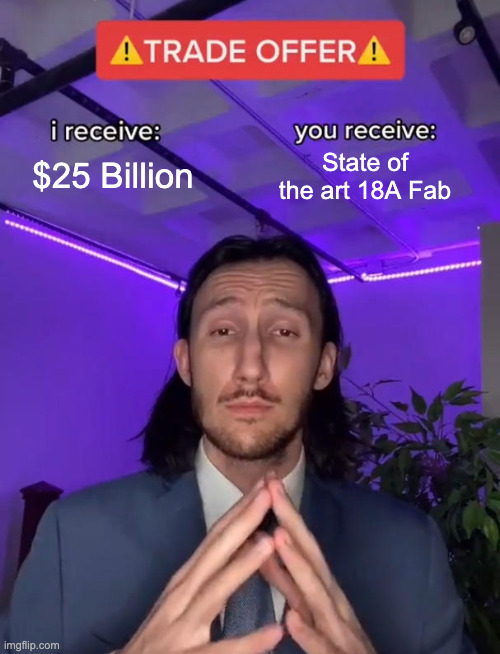
After the initial report on Elon Musk’s planned Terafab project, there were a whole lot of questions about how Musk was going to get his ambitious semiconductor fab project up and running. Now a very, very big piece of the puzzle (like, 85%) has been solved: Intel is going to build it for him.
In an unexpected turn of events, Intel on Tuesday said that it had joined Elon Musk’s TeraFab project. The announcement mentions Intel’s ability to develop, produce, and package advanced processors in high volumes, which could help Tesla, SpaceX, and xAI to get enough compute performance for next-generation AI and robotics applications. However, the announcement made in an X post you can expand below does not reveal how exactly Intel will help TeraFab.
“Intel is proud to join the Terafab project with SpaceX, xAI, and Tesla to help refactor silicon fab technology,” a statement by Intel reads. “Our ability to design, fabricate, and package ultra-high-performance chips at scale will help accelerate Terafab’s aim to produce 1 TW/year of compute to power future advances in AI and robotics. It was fun hosting Elon Musk at Intel this past weekend!”
The announcement is not accompanied by any press releases or SEC filings, which raises questions about the framework of the collaboration between Intel and TeraFab, as well as any possible legal bindings. In fact, the post in X is deliberately written in a way that barely reveals any concrete details about the structure of the partnership.
Officially, TeraFab is positioned as the “most epic chip-building effort ever” that is to combine “logic, memory and advanced packaging under one roof,” which implies localized production in a massive facility. Furthermore, the company is hiring managers to build a greenfield semiconductor fabrication plant in Texas. By contrast, Intel’s wording rather implies a virtual semiconductor production ecosystem, or even a consortium that involves chip design, manufacturing, and packaging at Intel and demand from Tesla, SpaceX, and xAI. How such a consortium would differ from a typical wafer supply agreement that large companies tend to have with their suppliers is something that is unclear at this point.
It makes perfect sense for one of only three global semiconductor manufacturers (and the only American company of the three) to help Musk realize his vision. Though nobody has spelled it out, my guess is it’s going to be very similar to the way Apple funds its manufacturer ecosystem through partner build-outs: Musk is going to pay Intel to build and run the fab, and Musk’s Telsa/SpaceX/xAI consortium is going to buy the dedicated output at a given price for x number of years, after which Intel can use the fab for other projects.
This makes a great deal of sense for both parties, especially if Intel has its 18A process dialed in. This is not a given, as Intel’s process screwups at previous nodes let TSMC and Samsung lap them in the sub-10nm race. But Intel yields at that node are reportedly rising.
And having Intel do all the heavy lifting means Musk’s new company doesn’t have to negotiate with Applied Materials, ASML, LAM, etc. Intel already has standing purchase agreements with all of them, and likely already knows what it wants and what the lead times will be to equip the new fab. Not to mention already knowing which contractors they’ll get to bid to build it.
If that’s actually what’s happening, that clears up a whole lot of questions about the project. Now, it doesn’t make Musk’s crazy “2027 volume production of 1 million wafer starts a months” any more feasible, but a fully functional Intel fab up and running at full-tilt by 2029 pumping out chips for xAI/SpaceX/Telsa is entirely feasible.
As usual, open video tabs start to accumulate on things that aren’t quite worth a separate post, but a bit too interesting to throw into a LinkSwarm. So here’s a tab-clearing roundup.
Inside Apple’s push for domestic semiconductor production:
Includes a look at TSMC’s Arizona fab complex, an ASML EUV stepper (which we covered here), and a Foxconn assembly line.
The title of this Jordan Petersen lecture is “Why South Park Works,” but it’s actually about how human perception works.
As a bonus, here’s a version of the basketball-gorilla test he talks about.
Critical Drinker on Paramount winning Warner Brothers:
New boss David Ellison is a fan of male action heroes, and not a fan of “The Message.” “I think it’s fair to say this guy sees middle America for what it is, a potentially huge market that’s been badly neglected in recent years, mostly by people who absolutely hate them.”
“If ever there was a definitive signal that the age of identity politics and the message has come to an end in Hollywood, I think this just might be it. The great experiment that’s decimated pop culture for the past decade is well and truly over. Good fucking riddance.”
Testing Ukrainian anti-drone shotgun slugs:
Basically metal petals attached with string.
Why Teddy Roosevelt didn’t fight in World War I:
To grossly boil down: because Woodrow Wilson didn’t want a no-win situation of either an ex-president ending up dead in a trench or making Roosevelt so popular again that he could beat him in the 1920 presidential election.
Elon Musk on Saturday announced that his rocket making company SpaceX and electric vehicle major Tesla will jointly run a new chip manufacturing facility in Austin, Texas, AFP reported.
The chips will be for use in artificial intelligence projects, robotics and data centres for space, with aim to produce 1 terawatt of computing power per year, it added, citing Musk. (1 terawatt = ¬1 trillion watts).
Why is Elon Musk starting his own chip manufacturing facility?
The world’s richest man said the so-called “Terafab” was necessary because Tesla and SpaceX’s demand for computing power is expected to far exceed that of global chip suppliers. While he did not disclose how much initial investment is being made, reports pegged the initial infusion between $20-25 billion, it added.
“We’re very grateful to our existing supply chain, to Samsung, TSMC, Micron, and others… but there’s a maximum rate at which they’re comfortable expanding. That rate is much less than we would like… and we need the chips, so we’re going to build the Terafab. The advanced technology fab in Austin will have the facilities to design, manufacture, test and improve each chip,” Musk said.
Other articles have made clear the the initial pilot line will be in Austin on Tesla’s Gigafab land, but that the eventual full-scale production fab may be located somewhere else.
The project aims to make chips to support 100 to 200 GW of computing power on Earth, and 1 TW in space.
Musk did not share a timeline for the production or output. The AFP report noted that the billionaire has many times in the past announced timelines that his companies failed to meet, i.e. robotaxis, SDF, etc.
According to Musk, the Terafab would ultimately help humanity become a “galactic civilization” capable of harnessing the resources of other planets and stars.
A Bloomberg report added that Musk has said previously that the facility would produce 2 nanometer chips.
It added that the Austin facility is expected to make two types of chips, one of which will be optimized for edge and inference, primarily for his vehicle, robotaxi and Optimus humanoid robots.
The other will be a high-power chip, designed for space that could be used by SpaceX and xAI. Musk said he expects xAI to use the vast majority of the chips, it added.
Musk also unveiled a speculative rendering of a future “mini” AI data center satellite with 100 kW power. This is part of a larger installation he wants SpaceX to build to do complex computing in space.
In January, SpaceX requested a license from the Federal Communications Commission (FCC) to launch one million data center satellites into orbit around Earth. “We expect future satellites to probably go to the megawatt range,” Musk added.
Let’s skip over addressing the feasibility (or desirability) of the space half of this grand vision. Never mind that Musk has evidently been freebasing back issues of The L5 News and G. Harry Stine’s Analog columns circa 1979 to conceive his solar-powered orbital cathedrals of vast, cool machine intellects.
No, I want to focus on the task of getting a purely ground-based, cutting edge, 2nm semiconductor fab up and running. There’s nothing impossible about that part, and $25 billion is right around the current price to build a state-of-the-art fab. Other reports say:
Production targets are specific. The facility is designed to produce between 100 and 200 billion custom AI and memory chips per year, targeting an initial output of 100,000 wafer starts per month with a stated ambition to scale toward one million — roughly 70% of TSMC’s current total output, in a single US facility.
Tesla is targeting 2 nanometre process technology, the most advanced node currently in commercial production. Tesla’s fifth-generation AI chip, AI5, is among the first products Terafab is designed to produce, with small-batch production expected in 2026 and volume production projected for 2027.
And here’s where my deep skepticism kicks in, over both the output and timeline.
Having more cutting-edge fabs here in the continental United States is a great idea, and there’s nothing wrong with vertical integration for companies to combine design, fabrication and test under one roof. Indeed, Musk has merely reinvented Integrated Device Manufacturing, which used to be the norm until the foundry model took hold, and that’s still the norm with companies like Intel (though not necessarily all under one roof). And Intel, Samsung and TSMC already have their own mask manufacturing facilities in-house. So based on the little information available now, Musk’s radical new approach isn’t.
But that timeline of initial production in 2026 and volume production in 2027? Unless Musk has already placed orders for the critical semiconductor manufacturing equipment (especially however many ASML TWINSCAN EXE:5000 or TWINSCAN EXE:5200B EUV lithography systems the fab will need) long before now, that’s simply not happening. The lead time for the most critical machines are a year or more. And that’s just one machine.
There are five essential semiconductor equipment manufacturers:
Applied Materials
ASML
KLA
LAM Research
Tokyo Electron
If you’re building a modern, 2nm fab, chances are pretty good you need all five. You need the ASML litho machines mentioned above. You need KLA inspection tools to raise and maintain yields, and you need, at the very least, one of AMAT, LAM or TEL to provide the rest. Take away all three and you can’t equip a fab, period.
And that’s after you’ve poured the agonizingly precise, ridiculously level concrete slab for the equipment to rest on, installed huge networks of high voltage power systems (ASML machine alone now run at 1,000 watts), ultra-high purity air handling equipment and ultra-high purity de-ionized water handling systems. All that needs to be installed, up and running before you even start installing the tools. And then all the tools need to be brought up and qualified for production. And that all needs to be done before tape-out, mask production and the first wafer is run.
But the timeline isn’t the only thing that’s delusional about Musk’s announcement.
Terafab is designed for an initial output of 100,000 wafer starts per month, with ambitions to scale to 1 million wafer starts per month at full capacity. For context, that full-scale target would represent roughly 70% of TSMC’s entire current global output — from a single facility operated by companies that have never fabricated a chip.
Musk said the facility would produce between 100 and 200 billion custom AI and memory chips per year, powering Tesla’s “Full Self-Driving” software, the Cybercab robotaxi program, and the Optimus humanoid robot line. He also said millions of Optimus robots would help build and operate the facility.
Put aside the swarms of robots for now. A lot of what can be automated for a fab already has been with automated FOUP-handling equipment. What hasn’t been automated is routine maintenance, troubleshooting, etc. I’m guessing it will be quite a while before Frankie Fabbot is ready to take on any of those tasks.
100,000 wafer starts a month is around what TSMC’s cutting edge fabs produce a month. Samsung has a huge fab supposedly capable of 450,000 wafer starts a month. A million starts a month in one extremely big fab is possible, but it’s going to take multiple lines, lots of money, and throughput will still be gated by the lowest capacity machines on the line (again, I’m guessing the ASML litho machine). Modern fabs have already maxed out production speeds for modern high-yield plants. You can’t simple pull a lever to make the line go faster.
Then there are his plans to build memory chips and space-hardened versions of the xAI chips in the same megafab. Neither of those goals is impossible, but it’s going to require more equipment than his $25 billion estimate to essentially run three production lines in the same building. And preparing chips to operate in space generally involves completely different “rad-hard” processes, involving different types of wafer chemistry, that are nowhere near the 2nm process node.
Musk is a smart guy. I bet he can eek a few performance gains out of how his fabs are organized, AI line optimization, etc. But unless he’s smarter than Einstein, Thomas Edison, Tony Stark and Reed Richards combined, I’m hard-pressed to see how he can optimize more than, say, 15% over existing cutting edge fabs.
Nothing Musk has proposed for the earth-bound side of Terafab is impossible, but it is all-but-impossible to implement in the time-frames he’s alleging, for the money he’s claiming. One million wafer starts a month in a single fab? Doable, but not by 2027, and not for $25 billion. Having such a fab up and running full tilt in 2029-2030, for $100 billion, seems at least at the edge of feasibility. Whether the AI boom will still be a “thing” by then is unknown, but a fab actually capable of one million wafer starts a month (robots or no robots) is still a license to print money…
The Iran war continues, with attacks on energy grids and refineries across the Persian Gulf, (maybe) another bunker buster strike, serious regime confusion, countries reporting impending shortages, and part of the 82nd Airborne moving into the theater.
ZeroHedge has piece up that starts with a nice state-of-play summary.
WSJ, Fox reporting 3,000 elite Army [82nd] Airborne soldiers to be ordered to Middle East. Axios says US awaits Iran response to proposed Thursday peace talks.
Backchannel diplomacy vs skepticism: Abbas Araghchi reportedly signaled openness to negotiations with the US via envoy Steve Witkoff, but Israel has appeared cool on deal prospects or offramp.
Heavy exchange of fire and testing red lines: Iran continues missile and drone waves targeting Israel and US bases, amid reports of overnight airstrikes on military and gas infrastructure near Isfahan.
Iran reshuffles its security leadership, appointing Mohammad Bagher Zolghadr: he’s a former IRGC commander and replaces the assassinated Ali Larijani.
Iran halts natural gas exports to Turkey: follows last week’s Israeli strike on the massive South Pars gas field; QatarEnergy declares force majeure on some LNG contracts due war.
“The Israeli Air Force recently struck an Iranian nuclear research and development site in Tehran, the military announces. According to the Israeli army, the “strategic” site at the Malek Ashtar University was used by Iran’s military industries to develop components for nuclear weapons. Malek Ashtar University, subordinate to Iran’s defense ministry, is under Western sanctions over its activities relating to Iran’s nuclear and ballistic missile programs.”
This falls into the “Big if true” category: “Three heavy bombers of the U.S. Air Force are currently conducting heavy strikes on the underground missile base of the IRGC Aerospace Force in Yazd, central Iran (Al-Qadir missile base). A total of six bunker-buster bombs have been dropped on the site by either B-1B heavy bombers flown from RAF Fairford in the United Kingdom or B-2A Spirit stealth bombers flown directly from Whiteman AFB in the United States.” I haven’t seen enough of Babak Taghvaee’s work to gauge the accuracy of this. (The few bits of his I’ve read have seemed accurate.) It seems like the sort target we would hit, but not knowing which bomber hit these targets suggests a source lacking firsthand knowledge. If anyone has a better bead on Taghvaee’s accuracy, feel free to share it in the comments below.
Not just over the Strait: The Warthog is also engaging Iranian back militias in Iraq.
USAF A-10 Warthogs spent most of the day strafing Iranian-backed militia positions around Mosul, Iraq. pic.twitter.com/5GLcm1XVnN
Victor Davis Hanson has spent fifty years studying how wars end. When he says the tide is turning, it’s worth listening to why.
His argument isn’t based on what the Pentagon is saying. It’s based on how everyone else is behaving.
𝗧𝗵𝗲 𝗘𝘂𝗿𝗼𝗽𝗲𝗮𝗻𝘀. VDH’s rule: Europeans never agree to go anywhere near a conflict unless they think the winning side has already been determined. They didn’t help in the early days. Now they’re starting to move. That movement is not idealism. It’s a calculation. They’ve looked at the battlefield and decided which way this ends.
𝗧𝗵𝗲 𝗚𝘂𝗹𝗳 𝗽𝗲𝘁𝗿𝗼-𝗻𝗮𝘁𝗶𝗼𝗻𝘀. The Saudis, the Emiratis, the Qataris — these governments have survived for generations by reading the regional climate with precision. When they expel Iranian military attachés, when they intercept Iranian missiles over their own capitals and say nothing about American strikes, when the UAE reaffirms its $1.4 trillion investment commitment to the United States mid-war — they are not making ideological statements. They are placing bets. And they are betting on the United States.
𝗔𝗹 𝗝𝗮𝘇𝗲𝗲𝗿𝗮. This is the one that should stop you cold. Al Jazeera — the Qatari state media network, historically critical of American military action, the network Tucker Carlson and the anti-war right love to cite against Israel — is now calling the U.S. bombing campaign brilliant and effective, and saying it has been underestimated. When the media outlet of a nation that hosts both the largest American air base in the Middle East and a Hamas political office starts praising American military effectiveness, the message is unmistakable: 𝘵𝘩𝘦𝘺 𝘵𝘩𝘪𝘯𝘬 𝘸𝘦’𝘳𝘦 𝘨𝘰𝘪𝘯𝘨 𝘵𝘰 𝘸𝘪𝘯.
𝗧𝗵𝗲 𝗺𝗶𝗹𝗶𝘁𝗮𝗿𝘆 𝘀𝗶𝗴𝗻𝗮𝗹. A-10 Warthogs and Apache helicopter gunships are now flying strike missions in Iranian airspace at will. VDH’s point: you only deploy those aircraft when there is effectively no air defense left to threaten them. They are slow, low-flying, close-support platforms. Their presence confirms what the Pentagon has been claiming — Iran has no meaningful air defense remaining.
Iran’s strategy now is rope-a-dope. Run out the clock. Wait for American public opinion to shift. Hope the midterms create political pressure on Trump to stop. It is the only play they have left.
VDH’s conclusion: if Trump sees it through — and he believes he will — the regime falls. Not in years. 𝗣𝗿𝗲𝘁𝘁𝘆 𝘀𝗼𝗼𝗻.
Since President Trump revealed contacts with the Islamic Republic, we’re seeing something very telling inside Iran: chaos at the top.
Regime officials are either turning on each other, pointing fingers, accusing one another of negotiating with the United States or in their own media and social platforms, they’re warning against character assassination of figures like Ghalibaf or Rouhani, because suspicion is spreading inside the regime itself.
Some are even calling for arrests or worse. Others are publicly shaming officials, accusing them of secret talks.
This is the atmosphere on the Islamic Republic’s side of social media. Total panic.
Jim Geraghty wonders “Why Are We Lifting Sanctions on Iranian Oil During a War with the Mullahs?” It’s a good question, though Trump seems to have a more intuitive grasp of alternating between carrots and sticks in negotiations than anyone I’ve ever seen. Also: “We have seen oil tankers carrying Russian oil divert from China to India in the aftermath of the Treasury Department’s lifting of sanctions on their cargo: ‘At least seven tankers carrying Russian oil have switched their destinations mid-voyage from China to India, according to Vortexa Ltd., with all of India’s major refiners now in the market for the country’s crude.'”
“Three explosions in Bushehr following attacks on the airbase and airport in Iran.” Bushehr is reasonably close to Kharg Island.
“Iran launches 10 million rial note.” Hyperinflation is rarely a sign of military strength. Also: The 5 million rial note was introduced “just weeks earlier.”
The Guardian (usual caveats apply) is saying that “Hundreds of petrol stations across Australia run out of fuel,” but Australian Energy Minister Chris Bowen states “Australia’s fuel supply remains strong and there are no immediate plans to ration fuel,” though the article admits “localized shortages.”
In Japan, gasoline prices have evidently hit record highs and the government is tapping national reserves, but tankers from UAE and Saudi Arabia bypassing the Strait of Hormuz are on the way.”
“Taiwan has about 11 days of liquefied natural gas reserves—a limited buffer that has become critical after Iran disrupted shipping through the Strait of Hormuz, cutting off key supplies from Qatar. Because Taiwan relies heavily on LNG to power its grid and semiconductor industry, any prolonged disruption could force energy rationing and threaten chip production.”
“Philippine president declares ‘national energy emergency‘, citing risks to fuel supply created by Middle East war.”
When last we checked, Microsoft CEO Satya Nadella was busy trying to shove Copilot, their AI tool, into every crevice of every Microsoft product. Finally, enough users seem to have complained loudly enough to get them to rethink the strategy.
Microsoft is vowing to focus on quality with future Windows 11 releases, which includes better performance and reeling in the company’s Copilot footprint over the OS.
“Quality” and “performance” go together with Windows like vanilla ice cream and used motor oil.
On Friday, Microsoft President for Windows and Devices, Pavan Davuluri, announced the “commitment to quality” in both a blog post and an email to users.
The plan calls for bolstering the “performance, reliability and well-crafted experiences” over the OS for this year.
That sort of suggests that “performance, reliability and well-crafted experiences” were not priorities for Windows in previous years, doesn’t it?
“These areas have meaningful impact on how you experience Windows: how fast it starts and responds, how stable it is under real workloads, and how consistent and thoughtful the experience feels,” Davuluri wrote.
PC users will be happy to know that one goal is reducing Windows 11’s resource usage to free up more capacity.
This would be great news if anyone trusted them to do that. Countless times in the past, Microsoft has pledged to reduce resource usage in Windows, but the bloat always returns.
Another priority is “less noise, less distraction and more control across the OS.”
Surprisingly, the blog post makes little mention of AI. Instead, Davuluri merely says the company wants “to be thoughtful about how and where we bring AI into Windows.”
“You will see us be more intentional about how and where Copilot integrates across Windows, focusing on experiences that are genuinely useful and well‑crafted. As part of this, we are reducing unnecessary Copilot entry points, starting with apps like Snipping Tool, Photos, Widgets and Notepad,” he said. Users can expect the change to roll out this month and in the next for Windows 11 preview releases.
Finally, the backslash against MicroSlop has gotten so loud that it’s even penetrated Redmond’s C-Ring. This is indeed progress, given that earlier this month Microsoft was literally banning users from its Discord for using the term. So give them credit for at least realizing that they have a problem.
Davuluri made the announcement months after he faced backlash for tweeting that “Windows is evolving into an agentic OS,” which caused some users to retort the company was obsessing about AI over basic Windows 11 performance. A January Windows 11 release that prevented PCs from booting up or going to sleep sparked more complaints about the OS’s stability.
There’s that vaunted Microsoft quality again.
Last month, Davuluri indicated he was taking the criticism seriously. Microsoft is also facing increased competition from Apple, which released its most affordable MacBook so far, the Neo, which has been a hit among consumers and reviewers.
Yeah, let’s talk about the state of Windows-based PCs and the competition. This was supposed to be a big year for PCs, but then reality hit.
There was supposed to be a massive tailwind for the PC market this year. Windows 10 reached end-of-life in late 2025, meaning that somewhere around 1 billion PCs worldwide stopped receiving security updates. This is less of an issue in the consumer PC market, but it’s a big deal in the business PC market.
PC OEMs like HP were set up for success in 2026, but the AI boom has complicated the situation. Enormous demand for DRAM and NAND chips from the AI infrastructure build-out, coupled with memory chip manufacturers shifting production to server products, has left the PC market with scraps. Memory chip prices have surged, pushing up the bill of materials and forcing price increases.
Gartner expects PC prices to surge by 17% this year, prompting consumers and businesses to hold onto their current PCs for longer. Budget PCs as a category could essentially disappear, leaving a large swath of consumers in a bind. Gartner expects PC shipments to tumble by 10.4% in 2026.
In one of life’s little ironies, the same AI bubble that Microsoft was trying to shove down user’s throats is what’s making buying a new PC less affordable and crushing sales. But it’s not stopping Apple.
HP is an obvious loser in this scenario, but there’s a surprising winner as well: Apple….
Apple is also exposed to rising memory chip prices across its entire device business. However, the company is seizing an opportunity to bring Windows PC users into its ecosystem.
Apple announced the MacBook Neo last week. The 13-inch entry-level MacBook starts at $599, a price that PC OEMs like HP will have trouble hitting as memory prices spiral higher. The Neo is powered by the A18 Pro chip, the same SoC used in the iPhone 16 Pro family. Higher-end MacBooks use Apple’s M-series chips, but the underlying technology is essentially the same.
Apple has equipped the Neo with 8GB of unified RAM, shared between the CPU and GPU, as well as a 256GB solid-state drive. These are really the bare minimums for a usable PC, but it’s enough for a solid entry-level experience. Early reviews have been positive, although full third-party reviews haven’t yet arrived ahead of launch.
Apple is playing the long game here. If there was ever a time to launch a budget MacBook, it’s right now. With memory prices driving up the cost of Windows PCs, a $599 MacBook should be appealing to budget-conscious consumers. Apple also offers the Neo to the education market for a discounted price of $499.
If Apple can grow its Mac install base and steal away market share from Windows-based PCs, the company will be setting up its Mac business for stronger growth down the road. Once the memory situation normalizes and the macroeconomic environment improves, Apple will have a larger base of Mac users eager to upgrade when the time comes.
This is probably correct. $599 is getting down around the price range for what used to be called netbooks, though that market segment seems to have largely died, at least among Windows users. (There still seems to be a market there for Linux users.)
Remember: Apple is the company that saw other companies dumping dump-trucks full of cash into AI build-outs and went “Nah, bro, I’m good.”
Google will spend approximately $90 billion on AI infrastructure this year. Meta has committed $65 billion. Microsoft, Amazon, and Alphabet are collectively spending over $300 billion. Apple, meanwhile, is spending just $12.7 billion on capital expenditure for the entire fiscal year.
As a hardware manufacturer, Apple can just wait for the AI wars to shake out and partner with the winner (if any).
And here’s a mildly amusing video on the whole situation.
I’m pretty sure Microsoft users wouldn’t object to Copilot if it was something optional you could turn off, and if the granularity of control allowed users to keep it entirely out of products they don’t want it in. But no, letting users decide isn’t the Microsoft Way, and they had to try shoving it into everything to justify the huge sums of money they were throwing into AI.
Iran Strikes: Day 14, lots of counter-drone measures, more welfare state fraud in California and Pennsylvania, a bishop raids the children’s fund, a new refinery rises in Brownsville, Old Glory 1, dirty antifa commie 0, caffeine is good for your brain, BuzzardFeed, and the cutest hotel greeters. It’s the Friday LinkSwarm!
President Donald Trump said that he thinks new Iranian Supreme Leader Mojtaba Khamenei, whose father, the former supreme leader, was killed on the first day of the U.S. and Israel’s war on Iran, is alive but “damaged.”
Khamenei has not been seen by Iranians since his selection on Sunday by a clerical assembly, and his first comments were read out by a television presenter on Thursday.
An Iranian official told Reuters on Wednesday that the newly appointed supreme leader was lightly injured but was continuing to operate, after state television described him as war-wounded.
“I think he probably is (alive). I think he is damaged, but I think he’s probably alive in some form, you know,” Trump said in an interview on Fox News’ “The Brian Kilmeade Show.” His remarks were published by Fox News late on Thursday.
Military targets on Iran’s Kharg Island – the loading site for most of the Islamic Republic’s oil exports – were “totally obliterated” by US airstrikes during a historic bombing raid in the Persian Gulf, President Trump announced Friday.
“Moments ago, at my direction, the United States Central Command executed one of the most powerful bombing raids in the History of the Middle East, and totally obliterated every MILITARY target in Iran’s crown jewel, Kharg Island,” Trump wrote on Truth Social.
The island, located about 16 miles off the Iranian coast, is one-third the size of Manhattan and controls 90% of Iranian crude oil exports.
Trump said the island’s oil infrastructure was not targeted but may be hit in future strikes, if the Iranian regime doesn’t allow ships to pass through the Strait of Hormuz.
Most IRGC facilities have been bombed into oblivion, but the IRGC is still functioning as a Secret Police force, threatening Iranians with death if they take to the streets to protest or rise up against the regime.
Snip.
Iranian state media claim the overnight strikes on Basij checkpoints were meant to stir unrest inside the country.
“This is an attempt to undermine public confidence in Iran’s stable security apparatus. The enemy is trying to open a new internal front,” one outlet said.
Fars news agency reported that at least 10 security and Basij personnel were killed in attacks at several sites across Tehran.
At this point, the crucial war-winning strategy is to destroy the IRGC’s ability to intimidate a populace desperate to get rid of them.
loitering munition-type drones now appear to be operating over Tehran.
More than 10 checkpoints, as well as several mobile IRGC (IRGC) military vehicles in different areas of the city, are said to have been targeted and destroyed by drone strikes. (@etelaf10)
This type of weapon can patrol for a long time over an area, wait for targets to appear, and then strike. This is all the easier when enemy air defense systems are degraded or neutralized.
This could facilitate the emergence of a broader national uprising, by weakening the regime’s control at the street level.
Uncle Sam cues up more Whoop Ass: “The USS Tripoli, and the 2,500 Marines on the amphibious assault ship, are headed to the Middle East to bolster U.S. military power there as the war in Iran enters its third week.” Maybe they’ll be occupying Kharg Island in the near future, and we’ll let China beg us to sell them Iranian oil…
Iran also attacked a refinery in northern Iraq. Maybe Iran is trying to see if they can survive as a state that exports nothing but terror…
Communist China is facing a devastating energy crisis as massive gas lines stretch for miles across the country, with desperate Hong Kong residents rushing across the border to fill their tanks amid fears that escalating war with Iran could cripple global oil supplies.
The scenes coming out of China paint a picture of panic and desperation — exactly what happens when authoritarian regimes fail to secure reliable energy for their people. While President Trump’s America First energy policies have made us energy independent, China’s reliance on hostile nations like Iran has left them vulnerable and scrambling.
Hong Kong citizens, already suffering under Beijing’s iron fist, are now forced to join endless queues just to get basic fuel for their vehicles. The images are reminiscent of the Carter administration’s gas crisis — a stark reminder of what happens when nations don’t prioritize energy independence.
The Carter-era gas lines weren’t from a shortage of supply, they were from the federal government’s monkeying with allocation.
Medicare is federally administered, and hospices must be certified for reimbursements. But the state issues the licenses for hospices to operate.
Three years ago, California’s state auditor sounded the alarm that Los Angeles County had seen a 1,500% increase in hospice companies since 2010 – more than six times the national average relative to its elderly population.
Auditors estimated LA County hospices overbilled Medicare by $105 million in a single year.
The state revoked 280 hospice licenses, but things have only gotten worse since then.
The CBS News analysis reveals that over 700 of the roughly 1,800 hospices in LA County trigger multiple red flags for fraud as defined by the state.
It goes downhill from there:
There are about 1,800 licensed hospices in Los Angeles County, California, which is more than six times the national average for the county’s senior population.
Nearly 500 hospices are operating within a 3-mile radius, the densest concentration of agencies in the county.
89 companies are registered to a single building in Van Nuys.
The illegal alien voter fraud that Democrats swear up and down never happens happened again. “ICE arrests illegal migrant who allegedly fraudulently voted in seven federal elections.”
The Department of Homeland Security has announced the arrest of an illegal migrant who allegedly voted in seven federal elections since 2008, despite being deported over 20 years ago.
DHS said Mahady Sacko, who came to the United States illegally from the African country of Mauritania, was arrested by Immigration and Customs Enforcement officers and the FBI in Philadelphia. He has been charged with voter fraud.
“This criminal illegal alien committed a felony by voting in federal elections dating back to 2008.”
If you’re waiting in long lines at the airport, you can thank Democrats love of illegal aliens. “Democrats Block DHS Funding Despite Airport Delays, Rising Iranian Threat.”
Senate Democrats have blocked another test vote on Thursday, pushed by Republicans attempting to end the ongoing 27-day partial government shutdown impacting the Department of Homeland Security (DHS). Republican leaders contend that Democrat lawmakers refuse to negotiate in good faith and are only interested in abolishing U.S. Immigration and Customs Enforcement (ICE), a subagency under DHS.
Nairobi-based contractors have seen footage capturing bathroom visits, naked people, and intimate moments, according to an investigation from two Swedish newspapers.
That’s right. This report from the newspapers Svenska Dagbladet and Göteborgs-Posten claims Meta is outsourcing video to Sama, a tech firm in KENYA, where human workers pore over millions of hours of video to help train Meta’s A.I. assistant that is paired with the glasses.
See, A.I. isn’t really A.I. That’s just a marketing label. These programs are Large-Language Models (LLMs) that can search and summarize vast quantities of data in a split second, but they require an army of human input to train them so they can provide accurate answers to users. Once the programs run out of data provided by humans, they stall out.
Sama was also used by OpenAI to train its LLM. Why? Well, labor in Africa is CHEAP. If you can pay thousands of workers $2 an hour instead of $30 an hour to train your overhyped search bot, you save billions of dollars.
The other advantage is anonymity … for the companies, that is. If you were paying Americans to watch videos of fellow Americans undressing and having sex, they would probably report it to the media en masse.
What a shock that Facebook “smart glasses” are simply another way to invade your privacy…
“HUGE Storm Shadow Strike on Bryansk Electronics Factory.” Plus a look at the aftermath. “90-94% of its production goes into Russian weapons – semiconductors, circuit boards, power modules for missiles, radars, drones, aircraft and more.” And as we know, Russia has very little in the way of semiconductor production.
Russian planes can barely fly in the right direction. They are catching fire in midair. Technical failures are increasing. Emergency landings are happening one after another…There is a dramatic increase in both military and civilian plane crashes.
Hundreds of thousands of Russians are now afraid to even buy tickets. Flights are being postponed indefinitely. This is not a scene from a disaster movie. These images are from Russia.
And for millions of people, airports are now like giant open air prisons. The collapse of the system has reached such a terrifying scale that it can no longer be hidden.
A good bit of this was predicted when sanctions against Russian aviation came down in 2022.
Then there’s the story of civilians flown on an unheated military cargo plane in sub-zero temperatures…
Stephen Green: “I Have Seen the Future of Anti-Drone Warfare, and It’s Dirt-Cheap (Really!)”
Today’s news about Ukraine’s Sting counter-drone caught my eye, and what it might mean for U.S. and other Western forces going forward.
I vaguely remembered reading something about the Sting a year or more ago, but I just learned today that they’re both dirt-cheap and extremely effective — mostly at shooting down Russia’s Geran-2 one-way attack drones, which are licensed copies of Iran’s Shahed that have caused us considerable trouble in Operation Epic Fury.
Ukraine needs tons of these things, because Geran is essentially a terror weapon aimed in large numbers — currently 100 to 200 per attack — at Ukraine’s cities and infrastructure. Larger attack waves include anything from 300 up to just over 800 Geran-2s in one night.
So the concept behind Sting is simply enough: Make something cheap and fast to build, easy to use, yet still capable of knocking a Geran-2 out of the sky far enough out from its target for some degree of safety.
And a local startup firm called Wild Hornets delivered on all three counts.
A typical quadcopter design and just over a foot tall, Stings are made mostly from 3D-printed parts and can be assembled in about two minutes. Unlike some drones that must be launched into the air via catapult (really), Sting takes off vertically like a helicopter before tipping over and using its stubby wings to fly like a plane, with an intercept range of 15 miles or so. Vertical takeoff allows operators to deploy and launch in less than 15 minutes.
The Ukes designed themselves a mini Osprey. That goes boom. Nifty.
There’s a camera on board, which the operator then uses to fly into incoming Geran-2s. With a top speed of about 190 MPH, they’re fast enough to enjoy a reported 80-90% successful intercept rate — and better than 90% in more recent operations. There’s a faster — and presumably more difficult to intercept — jet-powered Geran-3, but they’re much more expensive to build, require more fuel, and have shorter range. Russia uses far fewer of those.
The best part of Sting? The basic model costs about $2,500 to manufacture, compared to an estimated $70k–$80k for each Russian-built Geran-2. The economics of mass drone warfare are brutal.
A federal jury in Philadelphia has delivered a resounding guilty verdict against two Pennsylvania brothers and a longtime associate, convicting them of masterminding one of the most elaborate and prolonged racketeering operations uncovered in recent years. The scheme, which prosecutors say drained more than $32 million from Pennsylvania’s Medicaid program while exploiting vulnerable foreign workers through the H-1B visa system, spanned over a decade and involved layers of deception across multiple states.
At the center of the criminal enterprise – self-dubbed the “Savani Group” – were brothers Bhaskar Savani, 60, a trained dentist from Ambler, Pennsylvania, and Arun Savani, 58, from Blue Bell, Pennsylvania. Bhaskar controlled the group’s extensive network of dental practices, while Arun oversaw finances and real estate holdings. Together, they built what U.S. Attorney David Metcalf described as a “complex web” of sham entities and fraudulent operations, amassing tens of millions through outright fraud “at every turn.”
A third defendant, Aleksandra “Ola” Radomiak, 48, of Lansdale, Pennsylvania—a longtime associate—was also convicted for her role, primarily in the healthcare fraud components.
The multi-faceted conspiracy encompassed several interlocking schemes:
Visa fraud and worker exploitation: The group filed numerous false H-1B visa petitions with the U.S. Department of Labor and U.S. Citizenship and Immigration Services. These applications misrepresented job titles, duties, and other details to bring in foreign workers—most from India—who were dependent on the Savani Group for their legal status. Once employed, many were coerced into kicking back portions of their salaries and paying additional fees back to the enterprise, creating a captive, underpaid workforce.
Healthcare fraud against Medicaid: After the Savani Group’s legitimate dental practices lost their Medicaid contracts due to prior issues, the conspirators pivoted to using nominee-owned shell entities and sham dental practices. They fraudulently billed Pennsylvania Medicaid in the names of non-treating dentists for services that were either unnecessary, never performed, or grossly inflated. This alone resulted in over $32 million in improper payments, robbing taxpayers and depriving the healthcare system of vital resources.
Money laundering and tax evasion: Proceeds from the fraud were funneled through a sophisticated network of financial transactions, including concealment and transactional money laundering. The group also conspired to defraud the U.S. Treasury via wire fraud tied to false tax returns.
Obstruction of justice: When federal investigators closed in, the conspirators actively obstructed a grand jury probe.
Two cooperating government witnesses, Lynette Sharp and Seth Sikes, both pleaded guilty to one count of providing material support to terrorists and testified against [Benjamin] Song.
Sharp alleged Song admitted to shooting someone when she helped him evade law enforcement after the officer was shot.
Likewise, Sikes alleged that Song said, “Get to the rifles,” and testified he heard gunshots coming from behind him where Song was and turned to see a muzzle flash.
Sharp met Song in 2022, and Sikes met him in 2024 while Song was teaching martial arts at a Fort Worth community center.
Both witnesses testified that they became friends with the defendants.
“I love them,” Sharp said on the stand, after wiping tears.
Sikes testified he and others trusted Song, whom he described as a “very charismatic person” that people would follow.
Cameron Arnold (also known as Autumn Hill), Zachary Evetts, Bradford Morris (also known as Meagan Morris), Maricela Rueda, and Song face the most serious charges of attempted murder, discharging a firearm during a crime of violence, and providing material support to terrorists.
Other defendants facing lesser charges include Savanna Batten, Elizabeth Soto, Ines Soto, and Daniel Rolando Sanchez-Estrada.
All have pleaded not guilty.
Sharp and Sikes said group members considered themselves victims of society or those who wanted to protect “marginalized” people.
This ideology led them to become caught up in protest culture, offering a rare glimpse into the inner workings of protestors known as Antifa.
Antifa is modeled after a group that worked as the violent arm of the Communist Party in Germany in the 1930s. Some symbols from the original group are still used by the movement today, such as the logo and the raised-fist salute.
Song, who received an “other than honorable” discharge from the Army, recruited Sharp and Sikes to train with the Socialist Rifle Association (SRA), often described as a left-wing alternative to counter the National Rifle Association (NRA).
Sharp and Sikes said they learned gun safety and practiced marksmanship. Various defendants in the Antifa case frequently trained with AR-style weapons, they said.
The First Circuit U.S. Court of Appeals lifted a block Wednesday on a lower court ruling that prevented the Trump administration from deporting illegal migrants to “third countries” that are willing to accept them.
The Trump administration had appealed U.S. District Judge Brian Murphy’s ruling last week, after he ruled in February that the Department of Homeland Security’s deportation policy was unlawful and violates due process protections under the U.S. Constitution.
The administration argued Murphy’s order violated two previous Supreme Court rulings and created an “unworkable scheme” that threatened to derail negotiations with other countries, along with thousands of deportations, per Fox News.
California’s climate-cult-driven political leaders assumed gasoline demand would fade quickly as electric vehicles took hold. Acting on that prediction, they created conditions that forced refineries to close, blocked new projects, and added regulations expecting everyone would share their disdain for fossil fuels and reliable internal combustion engines.
But reality didn’t match their models. Tens of millions of drivers still rely on gasoline every day, and by shrinking supply faster than demand declined, our eco-activist bureaucrats created a fragile, high‑risk system.
Californians are being warned to brace themselves for the FO phase of the FAFO cycle.
Gavin Newsom’s green agenda and global oil turmoil will risk sending California’s gas prices above a wallet-crushing $8 a gallon — potentially returning drivers to the desperate fuel rationing not seen since the 1970s, state lawmakers and industry experts warned.
With drivers in the Golden State already facing the highest gas prices in the US, Southern California state Sen. Suzette Valladares has urged the governor to scrap California’s cap-and-invest program that charges oil makers for carbon emissions. She dubbed Newsom’s program the “cap-and-tax” scheme, and warned that closing any further oil refineries in the state could trigger economic collapse.
“It’s not scaremongering at all,” Valladares told The California Post of a report from the USC Marshall School of Business that found gas prices could reach $8 a gallon by the end of 2026.
The way things are going, it wouldn’t shock me to see California gas prices hit $8 a gallon this month…
Things that make you go “Hmmmm“: “FBI secretly seizes election records from Arizona’s largest county as voting probe expands.”
The FBI is expanding its criminal probe into suspected election irregularities, secretly obtaining a large tranche of voting records from Arizona’s largest county with a recent grand jury subpoena, multiple people familiar with the probe told Just the News.
The sources, who spoke only on condition of anonymity because of the secrecy of the grand jury probe, said FBI agents are receiving terabytes of electronic election data from Maricopa County, about a month after the bureau first disclosed an investigation into election irregularities by raiding a warehouse near Atlanta and seizing ballots from the 2020 election conducted in Fulton County, Georgia’s largest metropolis.
The subpoena comes five years after the GOP-led Arizona state Senate conducted a lengthy investigation into the 2020 election and concluded there were significant irregularities.
“As Democrats make anti-ICE messaging a centerpiece of their midterm election strategy, a new NBC poll shows that the Democratic Party is more unpopular than ICE. Of the 14 subjects surveyed—a list that also included “AI, that is Artificial Intelligence”—only Iran had a lower approval rating than the Democratic Party.”
Chairman and CEO Darren Woods said about the decision, “Texas has made a noticeable effort to embrace the business community. In doing so, it has created a policy and regulatory environment that can allow the company to maximize shareholder value.”
Its attraction to the state, according to ExxonMobil, is due in part to its de facto status as the company’s home, with 30 percent of the company’s global employee base and 75 percent of its domestic employee base located in Texas. The company is already headquartered in Spring.
“Texas’ legal and regulatory environment, including its modernized business statutes” was also referenced as a strategic reason for the relocation, along with the presence of the Texas Business Court, which ExxonMobil praised as “designed to resolve complex disputes efficiently.”
Thanks to Democrats’ soft on crime policies in California, not even luxury apartments are immune from rampaging mobs.
A group linked to a late-night street takeover forced its way into a luxury downtown Los Angeles apartment tower early Sunday, fighting with staff and leaving shattered glass and overturned furniture behind, according to police and video of the incident, according to the NY Post.
The disturbance happened around 3 a.m. at the Circa LA Apartments on South Figueroa Street, the Los Angeles Police Department said.
Authorities told KTLA that a crowd involved in a nearby street takeover moved toward the upscale high-rise and began vandalizing the property.
Video shows a large group gathering outside the building before targeting the lobby. One person is seen throwing an object at a suited employee who appeared to be working near the front desk. The worker initially stood outside but retreated inside as other staff gathered in the lobby.
The crowd soon forced its way into the building. Outside, several people smashed glass doors and windows, while one individual used a metal barricade to ram the entrance.
The Post writes that once inside, members of the group knocked over furniture and ran through the lobby as the scene descended into chaos. At one point, a person appeared to grab a box from the front desk while others rummaged through it before the group dispersed as sirens approached.
This is your city on Democrats…
“Michigan rep not seeking reelection because she can’t “be a faithful follower of Jesus Christ while remaining a member of the Democratic Party.” “Michigan State Representative Karen Whitsett announced she will not seek re-election and will not run for public office again, saying the decision is faith-based and rooted in her commitment to Jesus Christ and the authority of Scripture.”
I have compromised my relationship with Jesus for too long, and I’m grateful God did not give up on me. He gave me time to repent, turn, and be fully devoted to Him
That conviction includes the issues I cannot reconcile with Scripture: abortion, the normalization of the gay lifestyle, and the push to redefine gender.
Pope Leo XIV accepts San Diego bishop’s resignation over embezzlement scandal. Bishop Emanuel Shaleta stepped down from his post at Saint Peter’s Chaldean last month, the Vatican said in a bulletin Tuesday. Bishop Saad Hanna Sirop has replaced him in the interim.”
Shaleta has been charged with eight counts of embezzlement, eight counts of money laundering, and an “aggravated white collar crime” enhancement related to $272,000 in missing funds from the church, according to NBC News, and pleaded not guilty to all charges during a court appearance Monday.
Authorities allege that Shaleta spent months pocketing $30,000 in monthly cash payments from a tenant and hid the crime by moving money from a church account that held funds to help the less fortunate into the church’s operations account.
“PM who ran New Zealand into the ground during Covid flees country for greener pastures.” Former Prime Minister Jacinda Ardern, who locked down harder and longer than just about any other country, has emigrated to Australia. Hopefully a Bunyip or Drop Bear will eat her…
BlackRock is like a roach motel: Your money can check in, but it can never check out. “BlackRock (NYSE:BLK) is blocking investors from fully exiting its $26 billion HPS Corporate Lending Fund after redemption requests hit 9.3% of shares in Q1, well above the fund’s 5% quarterly cap. It marks the first time withdrawal requests have exceeded that limit.”
“Trump Set To Suspend Jones Act To Help Tame Oil Prices.” The century old Jones Act “that requires American-built ships to be used to transport goods between US ports.” I’m sure that right now Peter Zeihan is already working on a video to celebrate…
Unexpected South Carolina Democrat senate candidate Alvin Greene, RIP. They didn’t even mention his comic book…
Speaking of novelty candidates, Literally Anybody Else is running for mayor of North Richland Hills, a Metroplex city northeast of Fort Worth. That’s the name of the guy running: Literally Anybody Else. His cause for running against incumbent mayor Jack McCarty is “lying to the people about carport regulations.”
Ian McCollum examines whether force reset triggers will destroy the value of existing legal-to-own machine guns. The answer, from recent auction results, is probably not. Particularly eye-opening is two registered drop-in auto-sears, which allow conversion of certain modern sporting rifles to full-auto, went for $40,000 and $52,000. For what is essentially a stamped bit of metal.
Rick Beato has a theory that all those people building AI data centers are going to go bankrupt, because people can run AI tools and datasets on their own computers. He compares this to how recording studios who had borrowed money to buy expensive mixing boards circa 1999 went out of business when Napster crashed the music business. I think his larger point is correct, but I think a lot of musicians were already already into cheaper prosumer digital tools in the early 1990s.
Finally, my excessive Diet Dr Pepper habit is paying off! “Large Study Shows High Caffeine Intake Linked To Reduced Dementia Risk.”
BuzzFeed is buzzard feed. “BuzzFeed, the digital media empire that captured the attention of millennials in the mid-2010s through shareable listicles, viral video content and more, expressed ‘substantial doubt’ Thursday about its ability to continue operations.”
(Hat tip: Clownfish TV, from whom I’ve stolen the buzzard feed line.)
Critical Drinker is considerably less than impressed with The Bride! “Jesus Fuck Mothering Christ. I have seen a lot of crappy movies in my time, but I don’t think I’ve seen many that were so completely determined to waste such an insane amount of money and talent.”
Today’s Habitual Linecrosser:
“Aloha Snackbar.” I’m pretty sure I’ve heard that one before, but it’s still funny…
A bunch of AI-related news has popped up this week, so let’s do a roundup.
Some AI companies are complaining that TSMC is killing the AI boom by not expanding rapidly enough:
Asianometry notes that TSMC’s caution at expanding is amply justified by the boom-and-bust nature of the semiconductor industry:
“I’m hearing many similar views in the Silicon Valley Borg that TSMC is the break or limiter on the AI boom, as if they’re the reason why we don’t have AGI yet. Because they didn’t and still don’t believe.”
“If we can ever say that a company that spent $41 billion on capital expenditure in 2025, with another $53 to $56 billion in 2026 planned, is sitting on its hands, doing nothing.”
“TSMC having 90% share of the AI chip market looks pretty unhealthy. That should go down and it will. Samsung seems to be doing well so far.”
“The cold, hard reality is that shortages are a fact of life in semiconductors, as are horrific gluts.”
“What we are flippantly labeling as TSMC we really mean is the AI supply chain. And that supply chain is as complicated as you can possibly imagine. Like an iceberg, it looks big enough on the surface of the water, but goes way far deeper underneath. TSMC has thousands of suppliers in two categories: Equipment like the famed ASML lithography tools and materials like photoresist, silicon wafers, acid etch gases and so on. These are not generalized tools and materials. They are not fungeible like AWS compute units.”
“And then there are the memory guys. You cannot ship an AI system without memory. DRAM and NAND. Nvidia’s AI chips use a special form of DRAM called high bandwidth memory, and they use quite a lot of it. The memory industry is just as consolidated as the logic industry, with the major players being Samsung, SK Hynix and Micron.”
“The chip guys are last to know when the party is getting started, but first they get batoned in the face when the police shut things down.”
He points out that semiconductor manufacturers have log supply chains. He uses a different metaphor (the beer distribution game, or a bullwhip), but back when I was working at Applied Materials, it was described as trains linked together with slinkys. First software takes off, then hardware gets yanked along, then the chip manufacturers get yanked, and then, finally, semiconductor equipment manufacturers get yanked into motion, and shortly after that happens, the bust hits the front of the train, and the trailing cars all crash into each other. It’s a regular boom/bust cycle.
“From 1961 to 2006, electronics consumption in the United States grew positively but with wild volatility swings between 0 to 20%. But for the semiconductor makers, that translates to swings anywhere from 20% to 40%. And for the equipment makers, it is amplified even more, plus or minus 60%. The whip hits particularly hard in the semiconductor industry because of the industry’s long lead times. It takes 4.5 months to fabricate and package a chip. It takes 18 months to 2 years to build a fab. Meaning from shovels down to producing chips, and it takes 12 to 18 months to produce and install something like an EUV machine into the fab. Another 6 months before that machine actually starts patterning wafers.”
“Long lead times mean having to make very long demand forecasts, which leads to extreme volatility swings during up and downturns even if those up or downturns are relatively small.” People forget that in 1998, during the time we now think of as the DotCom Boom, there was a small semiconductor downturn that had Applied Materials forcing employees to take unpaid leave.
“ASML just reported 2025 earnings, and we see the bullwhip in full effect. TSMC raised capital expenditure 35% but ASML announced €13.2 billion of net new bookings. Analysts had expected just €6.32 billion. This is because ASML collected orders not just from TSMC, but also Samsung, Intel and the memory guys. When it rains it pours, right? Again, this is why I fear that another AI foundry would not mean our compute shortage is solved, because ultimately, when those foundries start scaling their capacity, they all go to the same suppliers.”
He goes over how car manufacturers cancelled orders during Flu Manchu, and then scrambled when the economy took off afterwards. “TSMC was trying to discern between double booked orders and real demand, which is not an uncommon experience for them. Customers lie about their own demand all the time, or at least we can say that they are eternally optimistic. TSMC tried to respond in 2022. The Taiwanese giant poured $36 billion into capital expenditure. They went to their suppliers and pushed like no tomorrow.”
“It turned out those customers really were double booking orders and artificially inflating demand. When the macro environment turned in 2022, the automotive, smartphone, and PC chips that were so hot during the COVID era fell out of vogue and customers started cutting orders.”
“Meanwhile, deeper down in the supply chain, TSMC and the rest of the semiconductor industry were getting bullwhipped by COVID hangover. Utilization at TSMC’s multi-billion dollar N7 fabs crashed, Semi analysis wrote in April 2023. Now, Semi analysis data indicates that the 7nm utilization rates were below 70% in Q1. Furthermore, Q2 gets even worse with 7nm utilization rates falling to below 60%. This is primarily due to weakness in both smartphones and PCs, but there is a broader weakness in most segments. A fab’s break even utilization rates are about 60% to 70%. So those N7 Taichung fabs were taking financial losses potentially on the order of hundreds of millions, maybe even billions. The financial burdens of low utilization are another reason why I’m skeptical another AI foundry could have rushed into the AI chip fray to save the day.”
He says that Intel incurred losses during this period due to an unnecessary fab expansion, which is probably true, but that was a secondary factor next to their longer running problem of getting their process wrong.
“ChatGPT was released in November 2022, and that kicked off a massive increase in capex amongst the hyperscalers in particular, but it sure seems like TSMC didn’t buy the hype. That lack of increased investment earlier this decade is why there is a shortage today and is why TSMC has been a de facto break on the AI buildout/bubble.”
“I recall news in mid 2024 of TSMC struggling with CoWoS capacity bottlenecks and yield problems, including one design issue that caused cracks in the Nvidia chips packaging.” CoWoS is Chip on Wafer on Substrate, which involves fabbing an interposer as a substrate for faster connections between your processing chips and memory.
“I also recall news in late 2024 noting how the vendors in charge of making the server racks for Nvidia’s Blackwell servers struggled with overheating, liquid cooling leaks, software bugs, and connectivity issues. Such technical difficulties delayed server deployment until early to mid 2025, creating a weird situation for several months where TSMC was pumping out chips that just went into storage. So that gated things, because you don’t scale until you first fix the technical problems.”
Then there’s the power-scaling issue, which is a whole ‘nuther can of worms.
There’s a lot of talk about a SaaSpocalypse going on thanks to a new AI tool. (SaaS is “Software as a Service.” Instead of hosting your own payroll or sales-tracking or whatever servers, you hire a company that already has cloud software setup to do it and you just tie into that, which can considerably reduce startup costs. A whole lot of successful new tech companies over the last decade plus have been SaaS companies.)
The software sector was jolted overnight with what analysts are calling a “SaaSpocalypse” — a sudden and severe selloff triggered by new artificial intelligence tools unveiled by US AI startup Anthropic. The episode has sharpened investor fears that AI is no longer merely helping software companies but may now begin replacing them.
Anthropic has expanded its enterprise AI platform, Claude Cowork, by launching 11 new plugins aimed at automating a wide range of professional tasks. Claude Cowork is an agentic, no-code AI assistant built for corporate users, allowing companies to automate workflows without writing software. The new plugins are designed to handle tasks across legal, sales, marketing and data analysis functions. The most recent addition is Anthropic’s Claude Legal agent, which can perform routine legal work such as document and contract review, and compliance checks.
Anthropic has said that the tool does not provide legal advice and that all AI-generated outputs must be reviewed by licensed attorneys. Even so, the breadth of automation signals a step change in how much white-collar work AI systems can now perform.
Productivity — Manage tasks, calendars, daily workflows, and personal context
Enterprise search — Find information across your company’s tools and docs
Plugin Create/Customize — Create and customize new plugins from scratch
Sales — Research prospects, prep deals, and follow your sales process
Finance — Analyze financials, build models, and track key metrics
Data — Query, visualize, and interpret datasets
Legal — Review documents, flag risks, and track compliance
Marketing — Draft content, plan campaigns, and manage launches
Customer support — Triage issues, draft responses, and surface solutions
Product management — Write specs, prioritize roadmaps, and track progress
Biology research — Search literature, analyze results, and plan experiments
A lot of those are already automated elsewhere, but I suspect a lot accountants and paralegals just felt a goose strut across their grave. On the other hand, who is really going to turn over, say, Accounts Payable to an AI? One glitch, and your entire bank account is drained…
If it works (a big if, give so many AIs are prone to hallucinations), this is potentially good news for Anthropic and the companies using their tools, and bad for SaaS companies and the employees currently doing those jobs.
I note there’s no plugin for technical writing…yet.
And Google Cloud ended 2025 at an annual run rate of over $70 billion, representing a wide breadth of customers, driven by demand for AI products.
We’re seeing our AI investments and infrastructure drive revenue and growth across the board. To meet customer demand and capitalize on the growing opportunities we have ahead of us, our 2026 CapEx investments are anticipated to be in the range of $175 to $185 billion.”
Remember how Nvidia was going to invest $100 billion in OpenAI? Yeah, not so much.
In September 2025, Nvidia and OpenAI announced a letter of intent for Nvidia to invest up to $100 billion in OpenAI’s AI infrastructure. At the time, the companies said they expected to finalize details “in the coming weeks.” Five months later, no deal has closed, Nvidia’s CEO now says the $100 billion figure was “never a commitment,” and Reuters reports that OpenAI has been quietly seeking alternatives to Nvidia chips since last year.
Reuters also wrote that OpenAI is unsatisfied with the speed of some Nvidia chips for inference tasks, citing eight sources familiar with the matter. Inference is the process by which a trained AI model generates responses to user queries. According to the report, the issue became apparent in OpenAI’s Codex, an AI code-generation tool. OpenAI staff reportedly attributed some of Codex’s performance limitations to Nvidia’s GPU-based hardware.
After the Reuters story published and Nvidia’s stock price took a dive, Nvidia and OpenAI have tried to smooth things over publicly. OpenAI CEO Sam Altman posted on X: “We love working with NVIDIA and they make the best AI chips in the world. We hope to be a gigantic customer for a very long time. I don’t get where all this insanity is coming from.”
Microsoft’s Copilot chatbot has become central to its artificial-intelligence strategy as the company’s close partnership with OpenAI diminishes. But the effort to build it up as a ChatGPT alternative has been tough going.
Confusing brand positioning and interoperability problems have frustrated users, current and former employees who have worked on Microsoft’s AI products said.
Interoperability problems? With a Microsoft product?
Only a small proportion of subscribers to Microsoft’s enterprise suite use Copilot, and the percentage who favor it over Google’s Gemini or other tools has decreased in recent months, according to data reviewed by the Journal.
The stakes are high for Microsoft because Copilot is core to a push by Chief Executive Satya Nadella to transform Microsoft into an AI-first company, much as he transformed it into a cloud-first company around a decade ago. Copilot is one of Nadella’s top priorities, current and former executives said.
Microsoft shares tumbled after its earnings report last week sparked investor concern that growth in its most important unit, the Azure cloud-computing business, is slowing, and that its AI business is reliant on OpenAI while Copilot remains unproven. Shares fell nearly 3% Tuesday amid a slide in software stocks prompted by fresh concerns that AI tools will make enterprise subscriptions less necessary.
For other AI companies, we merely suspect they’re evil. For Microsoft (and Google), we already know they’re evil…
Uncle Sam assembles another big stick for Iran, the radical leftwing networks in Minnesota continue to get exposed, silver shatters, two state Democrats get clipped in separate forgery cases, the rise of the Amelia memes, Microsoft update breaks everything (again), and are malls actually reviving?
And Neville Roy Singham’s fingerprints are visible everywhere.
It’s the Friday LinkSwarm!
As of right this moment, America hasn’t gone kinetic on the Mullahs yet, but we’re assembling an awful big stick.
USS Abraham Lincoln has gone dark, with no transponder or communication, signaling possible preparation for action against Iran.
A third US carrier strike group, USS George H.W. Bush (CVN-77), is moving into the Middle East theater.
Snip.
Some very interesting developments in the last 48 hours indicate something big is about to happen.
The EU all of a sudden has decided the next thing on their agenda is to declare the IRGC a terrorist group. Curious timing, that.
Minnesota agitators, including elected officials, have been organizing efforts to stalk, harass, and even hunt ICE agents in a Signal group chat that was infiltrated by Cam Higby and others.
It has been insane looking at the messages and the actual people involved.
And now DataRepublican has the donor list … you know, the people actually paying to make sure this all happens.
DataRepublican has also helpfully linked to their social media profiles.
You can download he data yourself. And DataRepublican has already turned in all the captured information to the Feds…
This is the story of how Minnesota became a political laboratory—first for the 2020 George Floyd protests, then for a sustained campaign against federal immigration enforcement. The players are the same. The money flows through familiar channels. And the strategy, according to those who designed it, was always meant to be replicated.
Snip.
Understanding how The People’s Forum operates requires following the money. And the money leads to Shanghai.
Neville Roy Singham is an American tech entrepreneur who sold his software company, ThoughtWorks, for approximately $785 million in 2017. He now lives in Shanghai, where, according to a 2023 New York Times investigation, he “works closely with the Chinese government media machine and finances propaganda worldwide.”
The Network Contagion Research Institute (NCRI), a Rutgers University-affiliated research organization, published a comprehensive report in May 2024 documenting what it calls the “Singham Network”—a web of nonprofits, fiscal sponsors, and alternative media outlets that share funding, personnel, and messaging.
According to NCRI, The People’s Forum received over $20 million from Singham and his wife, Jodie Evans (co-founder of the anti-war group CODEPINK), between 2017 and 2022. The money moved through a complex network of donor-advised funds and shell companies, including the Justice and Education Fund, the United Community Fund, and the Goldman Sachs Philanthropy Fund.
The People’s Forum has acknowledged receiving Singham funding. In a December 21, 2021 post on X (then Twitter), the organization defended its financial relationship with Singham against critics.
Congressional investigators have taken notice. On September 4, 2025, House Ways and Means Committee Chairman Jason Smith sent a formal letter to [People’s Forum Executive Director Manolo] De Los Santos demanding records and alleging that The People’s Forum had “acted as a foreign agent of the Chinese Communist Party” while enjoying tax-exempt status.
“Public reporting suggests that The People’s Forum has received over $20 million from Mr. Singham and his wife,” Smith wrote. “Multiple reports have found that The People’s Forum is part of Mr. Singham’s network of non-profit organizations that serve as his conduits to spread pro-CCP narratives.”
The Senate Judiciary Committee separately requested that the Department of Justice investigate whether The People’s Forum should register under the Foreign Agents Registration Act.
De Los Santos himself has deep ties to Cuba. According to his biography at the Black Alliance for Peace, he “was based out of Cuba for many years” and “worked toward building international networks of people’s movements and organizations.” The New York Post reported that De Los Santos first traveled to Cuba in 2006 and was there as recently as March 2024. He has been photographed meeting with Cuban President Miguel Díaz-Canel.
Footnotes excised. Snip.
What makes Minnesota different from other immigration flashpoints is the degree to which organizers have been explicit about their strategy.
The NCRI report notes that activists in the Singham network view the 2020 protests as proof that “the ability for mass struggle now exists inside the United States.” This framing treats George Floyd’s death not as a singular tragedy but as a tactical validation—evidence that the right combination of outrage, infrastructure, and outside support can produce transformational results.
De Los Santos’s April 2024 call to recreate “the violent protests of the summer of 2020” was not a slip of the tongue. It was a statement of doctrine.
The IDN’s establishment before Operation Metro Surge began—funded by nearly $1 million from the Bush Foundation—demonstrates pre-positioning rather than organic response. The explicit training of thousands in “rapid response” and “legal observation” tactics, the encrypted communication networks, the coordinated media strategies: none of this materialized spontaneously after Good’s death.
It was waiting.
The evidence assembled here—from congressional investigations, foundation records, tax filings, academic research, and organizers’ own statements—establishes that what is happening in Minnesota is neither spontaneous nor accidental.
The same network that helped turn George Floyd’s death into a national uprising has spent five years building the capacity to do it again. They have studied what worked in 2020, professionalized their operations, secured substantial funding, and pre-positioned infrastructure across Minnesota.
When Renée Good was killed on a Minneapolis street, that infrastructure activated precisely as designed.
Minnesota was chosen—first as the place where 2020 proved the model, then as the laboratory where that model would be refined and redeployed. The current crisis is not an accident of geography or politics.
A collection of far-left groups — led by a Communist activist network tied to CCP-linked millionaire Marxist Neville Roy Singham — is attempting to organize a nationwide anti-ICE school and business shutdown, with anti-Israel activist Linda Sarsour declaring that “we will bring this country to a halt.”
The general strike effort, scheduled for this Friday, is an attempt to replicate a Minnesota-wide anti-ICE shutdown which occurred last Friday and which was organized by many of the same far-left groups — but now with designs to do so on a national scale. The planned “National Shutdown” announced early this week includes plans for large-scale marches and a day of “no work, no school, no shopping” around the country.
The Manhattan-based Marxist revolutionary People’s Forum, the left-wing BreakThrough News media outlet, the Party for Socialism and Liberation (PSL), the far-left Code Pink anti-war group, and the Act Now to Stop War and End Racism (ANSWER) Coalition are all involved in either promoting or organizing the nationwide shutdown effort.
Just the News recently reported on how the forum, its propaganda machine, and the PSL were key players in pushing last week’s Minnesota-focused shutdown effort. Just the News also previously reported on how these and other radical activist groups have leadership links or financial ties to the funding network backed by Singham, whom others in his network call “Comrade.”
Social media used as organizing platform
The plans for Friday allegedly started with calls by a number of student groups at the University of Minnesota — the Somali Student Association, the Liberian Student Association, the Ethiopian Student Association, and the Black Student Union — who called for “Justice for Alex Pretti & Renee Nicole Good — NATIONWIDE SHUTDOWN” on Instagram on Sunday.
An investigation by Just the News shows that the forum was likely involved in creating the “National Shutdown” website which is now serving as an organizational hub for the coming Friday strike.
Did anyone notice a “nationwide shutdown” today? Mother Nature did a 100,000% better job shutting things down with Winter Storm Fern…
You gotta hand it to those Soros-sponsored district attorneys across the nation because when it comes to playing with fire, they play like they’ve never been burned.
The latest example is Philadelphia DA Larry Krasner. Not exactly a household name across the country,
But one that should be well-known to BattleSwarm readers.
Soros-linked groups have been his single largest financial backing source — helping him bypass traditional party fundraising and local contribution limits.
About a decade ago, Soros contributed about $1.7 million to the Philadelphia Justice and Public Safety PAC while Krasner was still a relative unknown in a seven-candidate race for district attorney. The Philly PAC is part of Soros’s nationwide Justice and Public Safety groups that fund “progressive” DAs in blue city contests.
According to public sources, in 2017, Soros’s donation to just one candidate accounted for nearly 30% of all campaign spending in the seven-person race. For his 2021 reelection, Soros groups gave Krasner another $1.2 million, including $259,000 for Philadelphia Justice and Public Safety PAC to run ads on Krasner’s behalf. Soros supported Krasner again last year, although I wasn’t able to find the dollar amounts before going to press.
Prior to getting all that Soros money to run for D.A., Krasner defended Black Lives Matter and Occupy Philadelphia members in court — and let’s just say Soros got his money’s worth. Or maybe it’s our money, given how intermingled Soros’s private funds are with taxpayer-funded NGOs purpose-tuned to push his causes.
Snip.
Here’s the quick and dirty transcript of Krasner talking about ICE officers: “This is a small bunch of wannabe Nazis — that’s what they are — in a country of 350 million. We outnumber them… If we have to hunt you down the way they hunted down Nazis for decades, we will find your identities, we will find you, we will achieve justice.”
What have I been repeating since the first attempt on President Donald Trump’s life last summer?
The left paints its enemies — we are no longer mere political rivals — as enemies, over and over, until some crazy decides to take justice into his own hands.
The FBI raided a Fulton County election office, evidently looking for evidence of the elction fraud carried out against president Trump in 2020. And it might be connected to…Nicolas Maduro?
Silver prices just plunged plunged over $30 an ounce today after a huge run-up. This means I’m either a genius when I sold a small amount of it last week (when prices were above where they are now), or an idiot for not selling all of it…
For three years, the world has waited for the Russian economy to implode. Instead, we watched a “Kalashnikov economy” defy gravity, fueled by high oil prices and a “friendship without limits” with Beijing. But as of January 2026, the gravity of basic math has finally caught up with Vladimir Putin.
The catalyst isn’t just the stalemate on the front lines; it’s a legislative “kill shot” from Washington and a quiet betrayal from the East. Between the new Graham-Trump Sanctioning Russia Act and a mounting domestic liquidity crisis, the Kremlin isn’t just running out of options—it’s running out of time.
The most significant development of 2026 isn’t a new missile system; it’s a tariff. The Graham-Trump Bill, greenlit by the White House on January 7, has fundamentally rewritten the rules of economic warfare. By threatening a mandatory 500% tariff on any country—including China and India—that continues to purchase Russian petroleum or uranium, the U.S. has finally weaponized the one thing Russia’s allies value more than cheap crude: access to the American consumer.
The shockwaves were instantaneous. On January 15, reports emerged that China’s largest state banks, including ICBC and Bank of China, began halting Ruble-denominated settlements. They aren’t waiting for the bill to be signed into law; they are pre-emptively cutting Russia loose to save their own export margins. When Beijing chooses its $500 billion trade surplus with the U.S. over its “strategic partner” in Moscow, the Russian war machine loses its primary life support system.
While the external walls are closing in, the internal floor is rotting. On New Year’s Day, Russia’s VAT officially jumped to 22%. This isn’t a sign of strength; it’s an act of desperation. The Kremlin is cannibalizing its own middle class to plug a federal budget revenue gap that fell 20% short of targets in 2025.
We are now seeing the first signs of a systemic banking fracture. In cities like Yekaterinburg and Novosibirsk, reports of ATM shortages are no longer fringe rumors—they are the physical manifestation of a “liquidity trap.” When the state raises taxes while inflation remains double-digit and interest rates hover near 20%, the result is a “medically induced coma” for the civilian economy.
Federal officials have charged two contractors with conspiring to disrupt Immigration and Customs Enforcement officers in Knoxville earlier this month.
The U.S. Attorney’s Office for the Eastern District of Tennessee unsealed a multi-count indictment on Friday against Tyler Shane Wells, 33, of Morristown, and 18-year-old Alexander Bonilla Servin of Smyrna.
They are charged with conspiracy to conceal and harbor illegal aliens, conspiracy to forcibly impede federal agents while engaged in performance of official duties, and conspiracy to prevent, by force, intimidation, or threat, federal agents from discharging their official duties from January 5 through January 13.
Bonilla-Servin is also charged with forcibly impeding federal agents engaged in the performance of their official duties.
Wells appeared in court on Friday and pleaded not guilty to the charges and a detention hearing is set for Monday. A trial date has been set for March 31, 2026.
Federal authorities accuse the two of plotting to block the entrance to a Hardin Valley construction site with Bonilla-Servin’s pickup truck in an effort to impede ICE agents. According to a Department of Justice release, the vehicle was put in position after federal agents were seen surveilling the site. Servin is also accused of hitting agents’ vehicle with the truck as it attempted to enter the site on January 13.
After more than a year of digging, Statehouse candidate Bailey Templeton’s most public records collection shows 1,085 Illinois children under 18 without SSNs had Medicaid bills of $66 million in 2025. That’s up 725% from $8 million for 450 children in 2021.
“It’s roughly $40 million spent on inpatient treatment, that’s a lot of time for children to be in hospitals,” Templeton told The Center Square Friday.
The data only generates more questions for Templeton.
“It raises questions about what would be called medical trafficking, where things are conducted on to children when they’re too young to be able to consent to these things,” she said.
Why, it’s almost like Democrats imported millions of illegal aliens and put them on welfare rolls…
Man tries to kill mayor in the Philippines with an RPG. (Never mind that The Sun calls it a bazooka.)
Idiot Hawaiian Democrat Senator Brian Schatz asks Marco Rubio a really stupid question, and Rubio hands him his ass:
“That’s statutory. The Helms Burton Act, the US embargo on Cuba, is codified. It was codified in law and it requires regime change in order for us to lift the embargo.”
Transportation Secretary Sean Duffy just dropped what I’ve been calling the nuclear option.
In an appearance on Katie Pavlich Tonight Thursday, Duffy made clear that withholding $200 million in federal funding isn’t the end of this fight. If California doesn’t come into compliance on the non-domiciled CDL issue, Duffy said, “we will eventually pull their ability to issue commercial driver’s licenses to anybody in California.”
Not just the 17,000 non-domiciled CDLs at the center of this fight. Every single CDL in the state.
I’ve written extensively about this standoff since the FMCSA released its audit findings last September, which showed that roughly 25% of California’s non-domiciled CDLs were improperly issued. I’ve covered the $160 million funding hit. I’ve warned about the decertification authority in 49 U.S.C. 31312 and 49 CFR 384.405, which most people in this industry didn’t even know existed.
This didn’t start with the Trump administration’s September 2025 emergency rule restricting non-domiciled CDLs to certain visa categories. That rule, which limited eligibility to H-2A, H-2B, and E-2 visa holders, has been stayed by the D.C. Circuit since November. The court found that petitioners were “likely to succeed” on their claims that the FMCSA violated federal law in its rulemaking.
The California problem predates all of that.
FMCSA’s August 2025 Annual Program Review found California had been violating federal regulations that existed long before Duffy took office. The state was issuing CDLs with expiration dates extending years beyond drivers’ lawful presence documentation. In one case that still makes my blood boil, California issued a driver from Brazil a CDL with passenger and school bus endorsements that remained valid months after his legal presence expired.
That’s not a new rule problem. That’s a California screwed-up problem.
California agreed in November to revoke all 17,000 improperly issued licenses by January 5, 2026. Then, on December 30, the California DMV unilaterally announced a 60-day extension to March 6, citing the need to ensure it doesn’t wrongfully terminate licenses for drivers who actually qualify.
Duffy’s response on X was blunt: “Gavin Newsom is lying.”
FMCSA never agreed to the extension. California proceeded anyway. On January 7, DOT made good on its threat and withheld approximately $160 million in National Highway Performance Program and Surface Transportation Block Grant funds. That’s on top of the $40 million already withheld over California’s refusal to enforce English language proficiency requirements.
California has more than 700,000 CDL holders. The state is home to the nation’s largest trucking workforce, with over 138,000 truck drivers moving freight through the ports of Los Angeles and Long Beach, the agricultural heartland of the Central Valley, and every retail distribution center feeding the country’s largest consumer market.
Under full decertification, California would be prohibited from issuing, renewing, transferring, or upgrading any commercial learner’s permits or commercial driver’s licenses until FMCSA determines the state has corrected its deficiencies. Previously issued CDLs would technically remain valid until their stated expiration dates, but here’s where it gets ugly.
Other states could refuse to recognize California credentials during the noncompliance period. FMCSA could issue guidance declaring CDLs issued by a noncompliant state invalid for interstate commerce. The Commercial Driver’s License Information System, which enables interstate verification, could flag every California license.
For the 700,000 CDL holders in the Golden State, decertification wouldn’t just be an administrative headache.
It would effectively ground them from operating in interstate commerce.
Blue state governors should stop trying to protect their precious illegal aliens and start following federal law.
TikTok has finalized a deal to create a new American entity, avoiding the looming threat of a ban in the United States that has been in discussion for years on the platform now used by more than 200 million Americans.
The social video platform company signed agreements with major investors including Oracle, Silver Lake and the Emirati investment firm MGX to form the new TikTok U.S. joint venture. The new version will operate under “defined safeguards that protect national security through comprehensive data protections, algorithm security, content moderation and software assurances for U.S. users,” the company said in a statement Thursday. American TikTok users can continue using the same app.
Tesla North America announced the completion of a major lithium refinery in Robstown, Texas, with Elon Musk calling it “the most advanced lithium refinery in the world.”
Robstown is just west of Corpus Christi.
In the promotion video, Jason Bevon, the site manager at the Gulf Coast lithium refinery, explains that the refining process used in Robstown is “inherently much more environmentally friendly.” The company claims that the process used by the refinery eliminates hazardous byproducts of the refining process and is more sustainable than traditional methods.
Bevon explained that the refinery “enables us to have access to the critical minerals for energy storage, for battery manufacturing, and ultimately for [electric vehicle (EV)] growth.”
“It enables us to accelerate Tesla’s mission by regionalizing supply chains for battery minerals and materials, by providing jobs, by cutting emissions from the transportation network that is required for these supply chains.”
“It really allows us to usher in energy independence for North America.”
Columbia University’s Center on Global Energy Policy explains that raw lithium needs to be processed into a “chemical in the form of lithium carbonate or lithium hydroxide, before being used in batteries,” which is done through refining. Currently, China dominates the global trade and production of key minerals, and leads the world in lithium refinement capabilities.
The need for lithium batteries has grown exponentially in recent years, with lithium batteries being required for EVs, smartphones, laptops, and renewable energy receptacles such as solar panels.
Also, you’re partially paying for it:
This political shift and the operation of the refinery are complemented by recent grants through the Texas Semiconductor Innovation Fund (TSIF), which was established when the Texas CHIPS Act, House Bill 5174, was signed into law in 2023. The TSIF totals “approximately $948 million in total appropriations” and is used for “semiconductor manufacturing and design,” according to the Texas Economic Development and Tourism Office.
Webb County’s sheriff and his assistant chief are facing federal charges for allegedly using office resources to create and profit from a disinfecting business during the COVID-19 pandemic.
Sheriff Martin Cuellar Jr., 67, and Assistant Chief Alejandro Gutierrez, 47, have both appeared before a federal grand jury after turning themselves in. Their indictments have now been unsealed, revealing that they both are accused of misappropriating Webb County Sheriff’s Office funds between 2020 and 2022.
Cuellar is the brother of U.S. Rep. Henry Cuellar (D-Laredo).
According to the indictment, around April 2020 Cuellar opened a for-profit business called Disinfectant Pro Master (DPM), which used resources belonging to the WCSO. He reportedly enlisted Gutierrez and Ricardo Rodriguez, an assistant chief, to assist in the start of the venture that provided disinfecting services to local businesses, residents, and the local school district.
Federal prosecutors allege none of the three made any personal investments in the startup company but used county resources, vehicles, and equipment. DPM also reportedly used county funds on multiple occasions to purchase supplies for the company. Staff from the sheriff’s office were often utilized to conduct the company’s operations during their regularly scheduled shifts according to the indictment.
The indictment also claims records show that payroll was not ever issued from the company to compensate the staff that was utilized to carry out its business.
During its operation, DPM received multiple contracts with local businesses, including a $500,000 contract with the United Independent School District, where Rodriguez served on the school board.
The company eventually closed in August 2022 after UISD did not renew its contract following media coverage and public scrutiny at a school board meeting over the contract being awarded to a board member’s company.
During the duration of the company’s operation, Cuellar, Gutierrez, and Rodriguez each reportedly received over $175,000. It is alleged in the indictment that Cuellar used his revenue to purchase a 10-acre property in Laredo.
As you might expect, Martin Cuellar is a Democrat.
Dwight documents not one but two of state-level Democrat congresscritters (state rep Ayshia “Ajay” Pittman in Oklahoma and former state senator Sonya Jaquez Lewis in Colorado) being involved in forgery scandals.
Nose-ringed leftist “Grace Carol Brown is charged with arson and burglary, and is ‘accused of smashing an exterior window, unlawfully entering the Comal County (TX) Republican Party headquarters, and starting a deliberate fire inside the building’ overnight on January 13/14.”
Oh, for fuck’s sake! “Parents say their trans son killed himself because his church employer wouldn’t let him wear French maid outfit, cat ears.”
Simon Whistler on Every Saudi Gigaproject in Vision 2030. Neom is still a ridiculous pipe dream, and Whistler is far too easily impressed with “zero carbon” claims, but some of these projects are actually worth doing and on-track.
Keir Starmer’s Labour government created the character of Amelia, a purple-haired nationalist Goth girl, for a lame Flash-style game to “combat far right extremism” (i.e., anyone who objects to importing illegal alien Islamist rapists into the UK), but now that she’s been adopted and memed by the right, that move backfired big time.
Louis Rossmann reports that downgrading to an earlier operating system bricks the latest OnePlus Android phone. I’d never heard of OnePlus, but it turns out it’s a Chinese brand, so you shouldn’t be buying it in the first place…
Surprise! American shopping malls aren’t dying off.
Shopping malls, long an economic and cultural fixture of American life, are facing sustained pressure but are not disappearing altogether.
Instead, the sector is undergoing creative destruction, as traditional mall formats give way to new concepts that reflect shifting consumer behavior and market conditions, according to recent industry data.
A research report by Capital One Shopping (COS) outlines the magnitude of the challenge facing the mall sector, citing rising mall closures that remain vacant for an average of nearly four years, as well as vacancy rates that are 112 percent higher than the overall retail vacancy rate.
COS also estimates that as many as 87 percent of large shopping malls could close over the next decade.
At the same time, COS data indicate a reversal of earlier trends. From 2021 through 2025, mall openings exceeded mall closures, suggesting adaptation rather than terminal decline. In 2025 alone, 9,410 new mall stores opened, nearly double the number that closed.
Additional evidence of revival appears in a recent article published by Growth Factor. Author Clyde Christian Anderson reported that indoor mall foot traffic in March 2024 rose 9.7 percent year over year, open-air shopping center traffic increased 10.1 percent, and outlet mall traffic climbed 10.7 percent—each exceeding pre-COVID-19 pandemic levels.
Every book I bought in 2025, most from early in the year when I still had a contract job and money in the bank…
Iran teeters, Walz falls, more Russia’s shadow fleet has an epically bad week, more Minnesota Somali fraud fallout, more computer security vulnerabilities, and a policeman transformed into a frog using the power of AI! Plus the Austro-Hungarian and Achaemenid empires. It’s the Friday LinkSwarm!
Personally, this week has been deeply frustrating, as I’ve been trying to withdraw money from my 401K account to pay my property taxes, a process I began mid-December, and it’s still not done. “Oh, these things take time,’ says 401K company. Then it’s “Oh, we haven’t heard back from your former employers.” Former employer: “Oh, we haven’t received the request from your 401K company.” Then: “Oh, the third party company we hired to handle 401K requests hasn’t received the request.” Now it’s “Oh, they’ve just started working on it, but they’re always slow at the end of the year.” It’s frustrating to have to jump through so many hoops to access my own money.
On to the LinkSwarm!
From the outside, it’s hard to tell how serious the chances of protesters are to free their own country, but they’re so fed up with the mullah’s rule that they’re burning mosques.
Iranian protestors demonstrating against the theocratic regime will face harsh punishment with absolutely zero leniency, Iran’s top judge has warned — as footage emerged Friday of mosques burning on the streets of Tehran amid the ongoing riots.
Chief Justice Gholamhossein Mohseni Ejei, the head of Iran’s judiciary, issued the stark warning after President Trump vowed to back those peacefully demonstrating across the country.
Signaling a potentially violent crackdown, Ejei vowed the punishment for rioters would “be decisive, maximum and without any legal leniency.”
Protesters gather as vehicles burn in Tehran, Iran.
Things in Iran seem to be moving very fast indeed…
“Authorities report that Mahmoud Haqiqat, a police station commander in Iranshahr, Iran’s southeastern Sistan and Baluchestan Province, was shot and killed by unknown assailants this week in a drive-by attack. Video circulating online appears to show gunmen firing on Haqiqat’s vehicle before it crashed. Social posts and video descriptions identify him as the former head of the city’s intelligence and allege that he was involved in operations targeting anti-regime Baluch groups in the area.” Add Balochs to Kurds and Lurs as ethnic minorities pissed at the mullah’s government. There’s also a substantial Baloch population in Pakistan, and they don’t like the Pakistani government either. Hell, history records the Balochs rebelling against the Achaemenid Empire three millennia ago…
With constant pressure from liberal activists, some states now dispatch mail-in ballots 45 to 60 days before Election Day and allow the counting of such absentee votes as many as three weeks afterward, creating an election trimester that causes vote tallies to wildly fluctuate days after polls close and increasingly erodes Americans’ trust.
But conservatives are now fighting back, first with an executive order by President Donald Trump requiring all ballots to be counted on election night, followed by a challenge to Mississippi’s counting process that has not reached the U.S. Supreme Court and then the Ohio legislature’s vote to require all its ballots to arrive on election night to be tallied.
“It’s common sense that ballots should arrive by Election Day,” Ohio Secretary of State Frank LaRose told Just the News this week after his state became the 35th to require mail-in ballots to arrive by Election Night in order to be counted. Previously, the state had a four-day grace period for ballots to arrive after Election Day.
“I think that trying to reduce complexity should be our goal in government, and certainly when it comes to the rules for how elections run,” LaRose said in a wide-ranging interview with the John Solomon Reports podcast. “If you were to stop the average person on the street last year and say, what’s the deadline for your ballot to get back to the board of elections, they would not know that it’s four days after. It’s kind of an arbitrary date.”
The National Conference of State Legislatures reported that many states now mail out ballots as early as 45 days to two months before Election Day and about a dozen states allow them to be counted days later — as long as three weeks afterward in Washington state, 14 days in Illinois, 10 days in Maryland and seven days in California and New York.
Tim Walz is dropping his bid for a third term as governor of Minnesota amid a national political firestorm sparked by the identification of massive welfare fraud in the state’s Somali community.
Walz released a statement Monday morning ahead of a late morning press conference announcing his withdrawal from the race.
“But as I reflected on this moment with my family and my team over the holidays, I came to the conclusion that I can’t give a political campaign my all. Every minute I spend defending my own political interests would be a minute I can’t spend defending the people of Minnesota against the criminals who prey on our generosity and the cynics who prey on our differences,” Walz said. “So I’ve decided to step out of the race and let others worry about the election while I focus on the work.”
Translation: “I got caught, and I need to see if I can get away from this giant pile of graft as quickly as possible.”
Walz and fellow Minnesota Democrats have been subjected to withering attacks at the hands of Trump and his allies over the staggering scale of welfare fraud that’s taken place under their noses in recent years. Federal prosecutors announced last month that the cost of the welfare fraud perpetrated against state-run Medicaid services alone could exceed $9 billion, half or more of the $18 billion paid out since 2018.
A federal probe into the matter has been initiated, and Minnesota officials have until January 9 to provide the administration with more information regarding who is receiving the welfare benefits in the state.
It’s amazing that anyone can give Gavin Newsom a run for the title of America’s Most Incompetent Governor, but Walz is just that special.
It’s been going on a while. “Minnesota Inspector General [Carolyn Ham] covered up hundreds of millions in Somali childcare fraud in 2018.”
You know how the Somali childcare fraud has been a big thing, kind of an open secret in Minnesota for years now?
Well, not only has this been happening for at least a decade, but, according to this report, the state has known about it for at least that long.
Check out these receipts from Maze on X detailing a nine-year-old investigation into the fraud at Minnesota’s Child Care Assistance Program — an investigation that went nowhere.
The Minnesota child care fraud saga is so strange because years ago it was fully investigated, documented, and reported on by a team of state investigators set up to catch and stop child care fraud.
They spent years gathering evidence including many hours of surveillance footage. In 2018 they compiled a detailed report and delivered it to their boss, the DHS Inspector General.
Directly from the report: ‘Investigators, as well as the Supervisor and Manager of this unit believe that the overall fraud rate in this program is at least 50% of the $217M paid to child care centers in CY2017.’
What did the Inspector General do with this information? She refused to meet with her own team, refused to discuss the findings of the report, and then spent $90,000 of taxpayer money to have an outside company write a report saying the fraud isn’t quite as bad as her own team of investigators was claiming.
Woke is a heckuva drug, isn’t it?
So is corruption, scamming, and Democratic politics in general.
Former Wall Street Journal reporter Asra Nomani, now at Fox News, is investigating the left-wing, billionaire-funded dark money networks in the nonprofit world and offering much-needed coverage for mainstream Americans on how these NGOs influence protest movements, unleash riots, and conduct sophisticated political pressure campaigns.
Snip.
Key details from the report:
MacKenzie Scott disclosed sending at least $5 million in a new round of donations to the Solidaire Network, on top of a $10 million gift in 2021 via her philanthropy vehicle, Yield Giving.
Solidaire funds a network of radical anti-Israel activist groups, including Students for Justice in Palestine and American Muslims for Palestine, both of which are under House and Senate investigation for alleged coordination with Hamas-linked activities.
Other Solidaire-backed groups include the Palestinian Youth Movement and the US Palestinian Community Network, which publicly justified Hamas’s October 7, 2023 attack on Israel.
Scott’s grants are unrestricted, allowing recipients to spend funds freely. Solidaire used this flexibility to finance campaigns promoting “Palestinian liberation,” campus protests, and direct-action activism, including efforts to block U.S. military logistics supporting Israel.
Funding was often routed through fiscal sponsors such as WESPAC Foundation and Tides Foundation, structures that have drawn scrutiny from Republican lawmakers investigating possible links to extremist groups.
Scott’s cumulative charitable giving has reached roughly $26 billion since 2019, surpassing the lifetime donations of George Soros, and placing her at the center of growing political controversy over billionaire-funded activist networks.
The Somali ambassador to the United Nations, Abukar Dahir Osman, who is tied to a daycare company in Ohio under investigation in Washington, might have acquired an American citizenship fraudulently, according to a source in Somaliland.
Ambassador Osman, who currently serves as the rotating president of the UN Security Council, first entered America in the mid-1980s and again in 1989. He claimed to be a refugee of a minority in Somaliland persecuted by the Somali regime at the time, a Somaliland ambassador at large who tweets under the name of Haggoogane, tells the Sun via text.
Haggoogane, whose real name is Mustafa Osman but is unrelated to the ambassador, says that the current Somali UN ambassador was far from a refugee fearing extermination by the Somali regime. Instead, he tells the Sun, the UN ambassador was part of that regime in the late 1980s. “His job was to identify anyone the regime saw as a threat,” Haggoogane says.
Between 1960 and 1991 the government of Somalia killed hundreds of thousands of ethnic Isaaq and others in Somaliland, which declared independence of Mogadishu in 1991.
Following Israel’s recognition of Somaliland last month, the Israeli foreign minister, Gideon Sa’ar, visited its capital, Hargeisa, on Tuesday, and met with President Abdirahman Mohamed Abdullahi. After Israel became the first UN member to recognize Somaliland’s independence, Mr. Osman, the Somali UN ambassador, convened an “emergency session” of the security council.
At Washington on Tuesday, the deputy secretary at the Department of Health and Human Service, Jim O’Neill, confirmed a rumor regarding the Somali ambassador, which has long been whispered in UN corridors.
“I can confirm public speculation that Ambassador Abukar Dahir Osman, Permanent Representative of Somalia to the UN and President of the Security Council, is in fact associated with Progressive Health Care Services, a home health agency in Cincinnati,” Mr. O’Neill wrote on X. “HHS has previously taken action against Progressive in response to a conviction for Medicaid fraud. More to come.”
The United States seized a Russian-flagged oil tanker in the North Atlantic this week while also intercepting a separate stateless “dark fleet” vessel tied to Venezuelan oil exports, US officials said, marking a significant escalation in Washington’s enforcement campaign against sanctioned energy shipments.
According to US officials, the Russian-flagged tanker Marinera, previously known as Bella-1, was seized on Wednesday near Iceland after being tracked for more than two weeks across the Atlantic, reports Reuters. The operation occurred as Russian military assets, including a submarine, were operating in the general area, though officials said there were no signs of confrontation.
In a post on X, US European Command said the tanker was seized for violating US sanctions. Defense Secretary Pete Hegseth responded, writing, “The blockade of sanctioned and illicit Venezuelan oil remains in FULL EFFECT — anywhere in the world.”
Two US officials said the operation was carried out by the US Coast Guard with support from the US military. The Coast Guard declined to comment. Russian officials have not issued a response, though Russian state media outlet RT published an image showing a helicopter hovering near the ship.
The Marinera had previously evaded US enforcement efforts in the Caribbean and refused boarding attempts. After those encounters, it re-registered under a Russian flag and changed its name, officials said. Sources indicated the vessel may now be heading toward British territorial waters, though its final destination has not been confirmed. The UK Ministry of Defence declined to comment.
Separately, US Southern Command confirmed that the Coast Guard intercepted another tanker, the Panama-flagged M/T Sophia, in Latin American waters early Wednesday. The vessel was described as a “stateless, sanctioned dark fleet motor tanker” linked to Venezuelan oil shipments.
U.S. First Assistant Attorney Bill Essayli Thursday called California Gov. Gavin Newsom “the king of fraud,” accusing him of a lack of oversight on spending to address homelessness.
Essayli made the comments on the “Fox and Friends” telecast, during which he discussed the federal fraud charges that were filed in October against real estate executives Steven Taylor and Cody Holmes for allegedly misusing grant money meant for homeless housing.
Holmes, 31, of Beverly Hills was charged with mail fraud charge that was allegedly linked to millions of dollars in grant money that the state paid Shangri-La Industries to purchase, build and operate homeless housing in Thousand Oaks, just north of Los Angeles. Holmes was Shangri-La’s chief financial officer.
Taylor, 44, of Brentwood, was charged with seven counts of bank fraud, one count of aggravated identity theft and one count of money laundering.
Essayli Thursday said the charges are the “tip of the iceberg” in an investigation he launched with a task force in April. He said more charges would be coming, probably later this month.
The state spent $24 billion in the last five years to address homelessness and can’t account for where the money went, Essayli said on “Fox and Friends.”
California Democrats: “Hey, let’s institute a wealth tax on billionaires!” California billionaires: “See ya!”
A ballot measure that could tax the wealthiest people in California may reportedly push billionaires Larry Page and Peter Thiel to leave the state, while other wealthy residents have condemned the idea, whose supporters claim could generate up to $100 billion—though the measure has yet to be considered by state officials or voters.
Thiel, who cofounded PayPal and Palantir, and Google cofounder Page have held discussions to reduce their ties to California by the end of the year because of the billionaire tax proposal, The New York Times reported, citing people familiar with their thinking.
Thiel operates the investment firm Thiel Capital and may open an office for the company in another state, with plans to spend more time outside of California, while Page has filed documents to incorporate three limited liability companies in Florida, according to the Times.
Bill Ackman weighed in, calling California “on a path to self-destruction,” adding, “Hollywood is already toast and now the most productive entrepreneurs will leave, taking their tax revenues and job creation elsewhere.”
Billionaire Chamath Palihapitiya wrote on X the proposed ballot measure would result in an “exodus of the state’s most talented entrepreneurs” who would opt to “build their companies in less regressive states,” and argued the middle class would be the worst hit by the tax.
Dear Fleeing Billionaires: Welcome to Texas! Please be sure to discard any liberal ideas you brought with you in the nearest trash receptacle…
“Major train crash on key route used to feed Putin’s war machine with North Korean military equipment…A freight train hauling 35 wagons spectacularly derailed in Russia’s remote Amur region on the Transbaikal Railway – a strategic line linked to the famed Trans-Siberian route.”
Ukraine also hit Russian shadow fleet tanker Elbus in the Black Sea off the coast of Turkey. It’s been a bad week all around for Russia’s shadow fleet…
France and UK bomb Islamic State targets in Syria. This isn’t the first time France has bombed Islamic State terrorists, as they also participated in Operation Chammal in 2014, back when the would-be caliphate was much closer to the extremely short zenith of its limited powers.
Minnesota woman tries to run over ICE agent, immediately enters find out phase.
Immigration and Customs Enforcement officers fatally shot a woman during an operation in Minneapolis Wednesday.
As videos of the incident went viral, the Department of Homeland Security justified the shooting on self-defense grounds, calling the slain woman a “violent rioter” who “weaponized her vehicle” by driving towards federal agents.
Today, ICE officers in Minneapolis were conducting targeted operations when rioters began blocking ICE officers and one of these violent rioters weaponized her vehicle, attempting to run over our law enforcement officers in an attempt to kill them—an act of domestic terrorism. An ICE officer, fearing for his life, the lives of his fellow law enforcement and the safety of the public, fired defensive shots,” said DHS assistant secretary Tricia McLaughlin.
“The alleged perpetrator was hit and is deceased. The ICE officers who were hurt are expected to make full recoveries. This is the direct consequence of constant attacks and demonization of our officers by sanctuary politicians who fuel and encourage rampant assaults on our law enforcement.”
She wasn’t the only idiot dirtnapped trying to run over ICE agents. A Tren de Aragua scumbag tried the same trick, and met the same fate, in Portland. Naturally, the usual leftist idiots there rioted.
Yesterday, Border Patrol officers had to shoot a dangerous criminal gang member in self-defense after he committed a vehicular assault on them to evade arrest. Leftists in the sanctuary city of Portland, Ore., promptly turned out to protest his shooting — and apparently to try to accomplish his deadly intention against federal officers.
In case you still have any illusions that the Democratic Party is not essentially a criminal organization, just look at the fury and violence the last few days in blue cities over the shootings of individuals who deliberately tried to seriously injure or kill Immigration and Customs Enforcement (ICE) or Border Patrol officers. Renee Good in Minnesota and the Venezuelan Tren de Aragua member in Oregon were both violently and dangerously ramming their vehicles into officers at the time they were shot. That makes them leftist heroes and martyrs, it seems.
The American left is trying to do a repeat of the summer of love and mostly peaceful protests in 2020. They want to burn down what is still standing after their previous riots. With Democrat politicians and media lying to fuel violence and their followers cheering for murder, how can we avoid the conclusion that the Democratic Party is acting like a terror organization?
The U.S. Department of Homeland Security (DHS) has suspended the funding for Catholic Charities of the Rio Grande Valley (CCRGV) pending an investigation into whether or not the charity is complying with federal grant requirements.
According to CCRGV, the charity learned of the suspension in late November 2025. It claims that it is “committed to compliance with federal grant requirements and will work expeditiously with DHS to resolve the matter.”
The charity stated that all of its funding was used to care for people brought to CCRGV by U.S. Customs and Border Patrol (CBP) — individuals who were “released by CBP with a document that gave them permission to travel to their points of destination with instructions on where to follow up with their immigration proceedings.”
CCRGV runs the Humanitarian Respite Center in McAllen, a place that offers food and shelter to immigrants who are awaiting court hearings.
According to reporting by Fox News, CCRGV was suspended after a DHS investigation revealed what the outlet called “major grant violations.”
The suspension follows “months of warnings and data reviews that auditors say uncovered sweeping inaccuracies, large gaps in migrant records, and significant billing outside federally allowed timeframes,” Fox News reported.
The investigators also reportedly found 248 instances in which CCRGV billed the federal government for services to immigrants outside of the 45-day window allowed by federal rules.
Surging liquefied natural gas exports from new North American export plants likely pushed global LNG shipments in 2025 by the most since 2022, Kpler data showed on Tuesday.
The annual rise in 2025 would be the steepest increase in global LNG exports since 2022, when shipments grew by 4.5% compared to 2021, the data showed.
North America was the key supplier of new LNG volumes, as Canada’s first-ever export facility, LNG Canada, started shipments in the middle of 2025, and Plaquemines LNG in Louisiana launched operations and ramped up shipments throughout the year.
Thanks to rising capacity and volumes, the U.S. is set to become the first LNG exporter in the world to have passed in 2025 the threshold of 100 million tons of LNG exports in one year.
Additional LNG supply is poised to hit the market between 2026 and 2030 as more U.S. export plants come online and Qatar begins shipments from its huge capacity expansion of the North Field export facilities.
The U.S. is set to export 14.9 billion cubic feet per day of LNG in 2025, up by 25% from 2024, the Energy Information Administration (EIA) said in its latest Short-Term Energy Outlook (STEO) for December. With new projects ramping up, the EIA expects U.S. LNG exports to jump to an average of 16.3 billion cubic feet per day in 2026.
President Donald Trump on Friday blocked the Delaware firm HieFo Corporation from acquiring assets in New Jersey-based aerospace and defense specialist Emcore for $3 million, citing national security and China-related concerns.
The president claimed HieFo was “controlled by a citizen of the People’s Republic of China,” and that there was evidence to believe HieFo, through the merger, may “take action that threatens to impair the national security of the United States.”
“The Transaction is hereby prohibited,” Trump said and ordered HieFo to “divest all interests and rights in the Emcore assets, wherever located,” within 180 days.
Snip. “HieFo purchased Emcore’s chips business and indium-phosphide wafer-fabrication operations for $2.92 million.” Indium-Phosphide is a pretty exotic wafer material used in optics and photonics chips.
Leprino Foods, the world’s largest mozzarella producer and a vital supplier to major pizza chains like Domino’s, Pizza Hut, and Papa John’s, moved its operations from California to Texas. “For over a century, the Lemoore plant in California’s Central Valley served as a cornerstone of the dairy industry, but the company is now shifting billions of dollars and hundreds of jobs into a new $870 million facility in Lubbock, Texas.”
Progress! “Corporation for Public Broadcasting votes itself out of existence. The private agency, which has distributed federal funding to PBS, NPR and hundreds of local television and radio stations across the country for more than a half-century, saw its appropriations from Congress eliminated this past summer.” They promised Big Bird and delivered leftwing propaganda.
I get an incredible sense of deja vu all over again looking at Mitre’s list of top 25 exploits for 2025.
The top 4 are all very, very old. I myself demonstrated #4 when I taught a computer security class (with corporate IT Security present) back in 1994. That’s three decades ago.
And what’s with numbers 11 and 14? One of the classic papers on software security is Smashing The Stack For Fun And Profit – from 1996.
Numbers 3, 6, and 22 are web server vulnerabilities that are over 20 years old, and I’ve posted about them before.
17, 19, and 21 have been known since before I was in this industry. Call it the 1980s, although it’s likely older.
I haven’t been able to verify this yet, but according to China Observer, “Japan’s Ministry of Economy, Trade, and Industry may have escalated export controls on November 20-21, adding 12 types of core semiconductor materials and related services to its “End User List,” placing about 110 semiconductor-related entities from mainland China under heightened scrutiny. Mainland China is more than 60% reliant on imports for photoresist, with ArF/EUV almost entirely dependent on Japan and the Netherlands.”
Every time you pattern a semiconductor wafer via a lithography stepper, you first have to deposit photoresist across the entire surface of the wafer. Once you’ve done that, the lithography pattern projected on the wafer hardens, letting some areas get stripped away during etch to create the interconnect patterns for other processes to fill with circuits for the chips. Getting proper photoresist uniformity across the entire wafer has some technical challenges, but it’s something like ten orders of magnitude less complex than EUV lithography. But getting the formula for EUV photoresist exactly right, and then manufacturing it ultrapure in quantity? Yeah, that’s not exactly something you can do in a high school chemistry lab.
“The Japanese have directly pulled out of the entire photoresist business in China. 90% of the photo resist we use is imported, with 60% coming from four Japanese companies. Without them, we can’t operate in the high-end sectors. With Japan’s withdrawal of supplies, domestic semiconductor factories are in chaos. Production capacity is declining and yield rates are crashing. Once production lines stop, they lose millions of yen a day.”
“The entire semiconductor industry is suffering massive losses.”
“A blogger in one video pointed out that few people know that in China’s semiconductor industry, the true bottleneck isn’t the photolithography machine, but a small bottle of liquid costing 50,000 RMB: photoresist.”
Section on China having a hissy fit over Japan’s prime minister Sanae Takaichi stating that Japan would defend Taiwan in the event of a Chinese invasion (touched on in this LinkSwarm) skipped.
“Japan [quietly] and decisively retaliated. According to a report by Chinese media outlet East Money, Japan’s Ministry of Economy, Trade, and Industry may have escalated export controls on November 20th to 21st, adding 12 types of core semiconductor materials and related services to its end user list, placing about 110 semiconductor related entities from mainland China under heightened scrutiny.”
“Among the most notable measures are those affecting photoresist and photolithography machine after-sales services regarding photoresist.”
“Four Japanese companies (JSR Corporation, Shin-Etsu Chemical Company, Tokyo Ohka Kogyo Co., Ltd. and Fujifilm) have suspended deliveries of ArF [Argon-Fluoride laser] immersion and EUV photoresist to mainland Chinese customers while high-end KrF [Krypton-Fluoride laser] products have been significantly delayed.”
“Mainland China is more than 60% reliant on imports for photo resist, with ArF UV almost entirely dependent on Japan and the Netherlands.”
“Canon and Nikon have informed their Chinese customers that, starting in November, the supply of certain DUV photography machine parts and on-site maintenance services will depend on export licensing conditions. Currently, China has over 1,200 DUV photography machines, 90% of which depend on Canon and Nikon for after sales service.”
” After Canon and Nikon further restrict services, China’s stock of spare parts for photography machines will only last about 3 to 6 months, with photoresist being one of the most critical components.” Well, consumable supply rather than component.
“Industry insiders say this means that many Japanese-made photography machines currently in operation will face a supply shortage in the short term and could become scrap metal in the long term.” This is an overstatement, as there’s usually a healthy demand for such machines on the secondary market, either to replace a old machine, or to cannibalize for parts, for research fabs, or for someone trying to put together a trailing-edge fab on the cheap.
“Unlike the open ban on 23 types of equipment in 2023, Japan is now adopting a gray customs clearance strategy where rather than announcing an outright embargo. It is using case-by-case approvals, indefinite delays in issuing licenses and cutting off parts and technical support, effectively a supply cut off.”
The U.S. has also applied pressure on Japan to implement restrictions.
“Photoresist is far more complex than it seems.”
“First, the shelf life of high-end photo resist is extremely short, often only 6 months or even less. This means it’s impossible to stockpile and if supply is cut off, production lines will immediately shut down.”
“Second, the extreme purity requirements. The formula for photoresist contains dozens of chemical substances with each proportion error not exceeding 1 millionth. The metal impurity limit is as low as 0.001 parts per million, like 1 microgram per kilogram. To put this into perspective, imagine eight Olympic swimming pools full of water. If even a single drop of impurity is mixed in, it must be identified and removed.”
“This isn’t just a challenge in terms of the formula. It’s a critical test for the entire chemical purification, filtration, transport, and storage process.”
“Third, the ecological [I think they mean ecosystem -LP] barrier. Why are Japanese companies so dominant in the photoresist market? Because over the past 30 years, they have developed their expertise alongside semiconductor giants like TSMC, Intel, and Samsung. Producing photoresist isn’t enough. It must be tested on photography machines worth billions of dollars. The verification cycle takes 2 to 5 years with a high failure rate. Without top semiconductor foundaries to conduct these trial and error processes, your photoresist will never make it out of the laboratory.”
“Japan’s dominance in the photoresist market dates back to the 1970s when the country’s economy surged. The government and businesses jointly invested heavily in the semiconductor industry, focusing partially on materials.”
“In addition to the high technical barriers and lengthy R&D cycles which take years and require immense investment, Japan holds an overwhelming patent monopoly, 70% of related patents globally. It’s virtually impossible to bypass this barrier.”
“Major global chemical companies like the US’s DuPont and Germany’s BASF have less than 10% of the photoresist market share. South Korea has tried but still depends on imports for high-end products. Japanese companies are not only technologically advanced, but their strong industrial chain cooperation in photography machines and silicon wafer production makes it nearly impossible for external competitors to enter.”
“According to a 2024 Nikki survey, Japan holds the number one market share in three out of five semiconductor material categories, with photoresist being one of them.”
China has tried to develop their photoresist, but when they try them out in fabs, their yield rate crashes. Even if China can steal the right formula, they can’t steal all the intermediary steps necessary to produce the formula.
“This issue involves a country’s mastery and accumulation of basic materials and processes, which cannot be solved simply by hiring people to steal technology.”
“Japan’s precision manufacturing processes are beyond the reach of China.”
For the sake of brevity, I’m skipping over an extensive list of other areas of semiconductor technology where China is heavily dependent on Japan.
A whole lot of people freaked out over China’s near-monopoly on rare earth minerals, but China is a lot more dependent on the west for a whole lot of things much higher on the technological food chain.