The Iran war is one months old and the usual Negative Nellies in the Democrat Media Complex are whinging that the war’s not won yet, or suggesting that the Trump Administration is looking for an “off ramp.” Funny how it takes time to defeat a nation of 92 million, even one where the regime is hated by its citizens and whose prewar air force looked like a museum. Everything we hear from CENTCOM is that the air campaign is on schedule.
And the “off ramp” for the war is regime change in Tehran.
“The USS Tripoli and USS New Orleans arrived in the Middle East, carrying with them 2,200 Marines — with more on the way — hours after an Iranian strike left dozens of U.S. service members hurt at a Saudi air base. The Tripoli and New Orleans are two of several additional vessels and personnel the Pentagon has deployed to the region as the U.S.-Israeli war in Iran enters it’s second month. The Tripoli Amphibious Group brings with it F-35B Strike Fighters, as well as transport aircraft, amphibious assault vessels and other tactical assets.”
“Israel struck secret facility for production of Iran’s naval weapons and storage of boats and ships.”
“The facility located in the city of Yazd served as a key production center for advanced missiles and sea mines intended for Iran’s naval forces.”
“The site that was hit was reportedly involved in designing, assembling, and testing advanced missiles that could be launched from ships, submarines, and helicopters, targeting both moving and stationary vessels at sea.”
“The Israeli Defense Forces described the location as the central hub of Iran’s naval strike capabilities, noting that weapons produced there had been used in operations that posed a threat to navigation in the Strait of Hormuz.”
“Following the strike, the facility’s production infrastructure and stores of ready-to-use missiles were said to have been completely destroyed.”
“A reported Israeli airstrike on Tehran has killed Hassan Hassanzadeh, a senior commander of the Islamic Revolutionary Guard Corps’ Mohammad Rasul‑Allah Corps, which oversees security in Greater Tehran and counter‑ unrest operations.” I’ve also seen his name rendered “Hassan Hassan Zadeh,” for those playing IRGC Dirtnap Bingo at home…
“Majid Zakriyai, commander of the Iranian Army’s Natural Resources Organization protection unit, was killed.”
President Trump promised some absolute scorched earth on Iran if they don’t fall in line, promising to blow up their electric grid, their oil wells and Kharg Island…but then deleted the tweet. 🤷
E-3 Sentry and KC-135 destroyed at Prince Sultan Air Base in Saudi Arabia.
The anti-air capabilities of Prince Sultan Air Base still leave much to be desired.
The Houthis had been unusually quiet during the open stages of the war. Well, that’s ended, and they’re now tossing missiles at Israeli. Not sure how many they have, given that Iran has been both broke and busy…
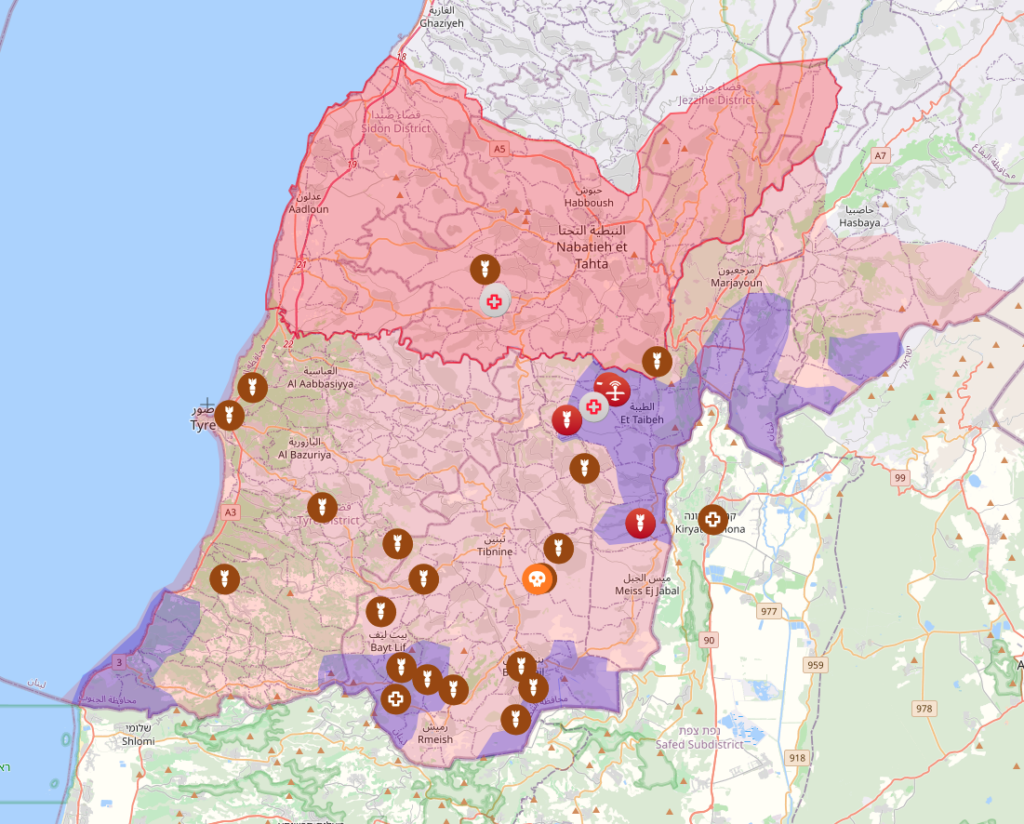
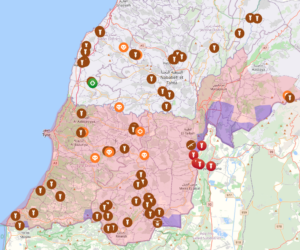
It’s always hard to tell what the state of the war in Lebanon is, but to my casual observation, it looks like the intensity of strike has lessened on both sides, but Hezbollah attacks seem to have fallen sharply. On the other hand, today’s status map show that Israeli forces are already at the Litani River in the eastern part of Lebanon:
“US military has been working on Iran ground raid plans for years.” One would hope.
Retired Gen. Frank McKenzie, the former commander of U.S. Central Command (Centcom), said Sunday that the U.S. military has been working on plans for a ground raid in Iran for years, as President Trump is reportedly considering sending troops into the war.
“Margaret, for many years we’ve considered options along the southern coast of Iran, seizing islands, seizing small bases. Typically raids. And a raid is an operation with a planned withdrawal. You’re not going to stay. But some of those islands you could seize and hold. That would have a couple effects,” McKenzie told CBS News’s Margaret Brennan on “Face the Nation.”
“First of all, it would be profoundly humiliating for Iran and would give us great weight in negotiations. The second, the example of Kharg Island, which everyone talks about, if you seize Kharg Island, you really can shut down the Iranian oil economy completely. And the beauty of seizing it is, you’re not destroying it,” he said.
Is China pushing Iran for a ceasefire?
“The risks to global trade through the Strait of Hormuz have surged and the dynamics of Iran’s relationships with Russia and China are constantly in the spotlight. Recently, both countries have pressured Iran, urging diplomatic solutions to the crisis. On March 24th, China’s foreign ministry reported that Foreign Minister Wang Yi held a phone call with Iran, calling for seizing the opportunity for peace and negotiating as soon as possible.” So did Russian Foreign Minister Sergei Lavrov.
“Analysts believe Russia has explicitly urged Iran to back down, signaling that Moscow views Iran as unable to continue fighting. Shortly afterward, China followed suit, aligning with Russia in terms of diplomatic timing. This indicates coordination between the two countries. Their shared goal is to maintain the stability of the Iranian regime, ensuring it continues to act as a strategic counterbalance to the United States.”
“From Beijing’s perspective, Iran is not only a major energy supplier, but also a key node in the Belt and Road Initiative. Chinese investments in the country amount to at least hundreds of billions of dollars, covering oil and gas field development, port construction, and transportation networks. If the Iranian regime were completely overthrown, it would directly threaten China’s energy and geopolitical interests. Therefore, Beijing must intervene diplomatically and urge Iran to turn to negotiations.” A lot of observers believe that Belt and Road is already moribund.
“A source close to China’s Foreign Minister, Wang Yi, revealed to the Epoch Times that Iran has refused any purely diplomatic arrangements and instead pressured Beijing with selective security, linking substantial aid to the safe passage of Chinese commercial ships through the Strait of Hormuz. This is soft extortion. Without military assistance, China cannot ensure the smooth passage of its trade routes. Beijing’s multiple secret negotiations have ended in failure and its efforts to profit from the geopolitical game are now facing the dual impact of diplomatic imbalance and economic stagnation.”
China also thought it could be a negotiating mediator between Washington and Tehran. Yeah, fat chance.
“This crisis is essentially the inevitable backlash of China’s ‘wolf warrior diplomacy” and camp confrontation mentality.”
“China’s leaders have fallen into a self-entangling dilemma. The forces they’ve supported are now cutting off their own economic lifelines. The disruption in the Straight of Hormuz is not only a rupture in global logistics, but also a microcosm of the complete collapse of China’s geopolitical strategy.”
“You’re starting to see the Iranian regime looking for an exit ramp.”
“USAF A-10s are arriving in the UK tonight as the U.S. surges more Warthogs to the Middle East.”
As usual, this is just the Iran news I felt significant enough to include in the roundup. If you think I’ve missed anything, feel free to share in the comments below.
More proof of widespread Biden Administration abuse and fraud uncovered, more news from the Iran war, the Trump Administration fights welfare fraud, LA displays both welfare and voting fraud, more lefty sorts stealing funds to feather their own nests, Muslim EPIC City development runs into more roadblocks, and some weird video game news.
It’s the Friday LinkSwarm!
Thanks for everyone who contributed to the Pay For Buddy’s Vet Bill Fund. He’s already doing so much better that you can’t tell he was hurt, though some of that is probably the pain pills.
Newly released records in the Senate investigation into the weaponization of government raise questions about whether the FBI went on a fishing expedition targeting Trump advisors who were never charged with crimes and whether Special Counsel Jack Smith’s prior testimony to Congress was truthful.
The documents were made public by Chairman Chuck Grassley, R-Iowa, before a Senate Judiciary Committee subcommittee hearing into alleged abuses by the Biden-era FBI and Justice Department in their investigations into then ex-president Donald Trump before and during the 2024 presidential election during its probe code-named “Arctic Frost.” Just the News previously reported that Biden’s FBI paid anti-Trump ‘Sedition Hunters’ as informants in the Arctic Frost probes.
“If Watergate taught us anything, it is that even a single abuse of power carried out by a handful of individuals can shake the foundations of our Republic,” said Sen. Ted Cruz, R-Tex., Chairman of the Judiciary Committee’s Subcommittee on Federal Courts, Oversight, Agency Action, and Federal Rights.
“What we confront today, the Biden administration’s Arctic Frost scheme, is not a single act,” he continued in his opening remarks. “It is a modern Watergate trading a break-in at one office for a digital sweep into approximately 100,000 private communications, more than a dozen senators and 1000s of individuals lives.”
Cruz said that ultimately, “just like Watergate,” the judges, FBI and Justice Department officials involved should be “investigated, tried, impeached, and brought to justice.”
The scope of Smith’s probe, which centered on Trump’s challenge to the 2020 election results and the events of January 6, 2021, was truly expansive. Grassley previously released records showing that Smith’s office issued nearly 200 subpoenas in his sweeping Arctic Frost-linked case, secretly seeking records on more than 400 Republican personalities and groups. This included more than 160 Republicans–many closely connected to Trump.
The Arctic Frost was one of four separate probes that targeted Trump and his allies stretching from summer 2016 to January 2025. The other probes were code-named Crossfire Hurricane, Round River, and Plasmic Echo, Just the News reported earlier this month.
As FBI Director, Patel has personally led the effort to review those probes, uncovering evidence of a far-reaching dragnet that in some cases may have been predicated on false, misleading or uncorroborated justifications, officials previously told Just the News.
The newly-disclosed records show that the FBI ordered two sweeping subpoenas of FBI Director Kash Patel’s phone records, while he was a private citizen in Trump’s orbit. Each subpoena covered an approximately two-year time frame.
The FBI’s requests for information included demands for highly personal data of Patel’s, including Patel’s addresses (“mailing addresses, residential addresses, business addresses, and e-mail addresses”), a “call detail record” which lists inbound and outbound calls, text messages and voicemail messages, as well as sources of payment for the phone service, including credit card and bank account numbers. The FBI also demanded expansive internet session data including exact IP addresses, the document shows.
The FBI also sought–and was granted–non-disclosure orders (NDOs) from federal judges, shielding the existence of the subpoenas from Patel and his lawyers on the grounds that revealing them could result in his “flight from prosecution, destruction of or tampering with evidence, intimidation of potential witnesses and serious jeopardy to the investigation.”
Susie Wiles, Donald Trump’s then campaign manager and future chief of staff, was also targeted in the probe. The Biden-era FBI reportedly even went so far as to record a private phone call between Wiles and her lawyer in 2023 while she was actively managing the campaign of President Joe Biden’s chief political rival, according to Reuters.
U.S. intelligence intercepted Ukrainian government communications discussing a plot to route hundreds of millions of American tax dollars earmarked for clean energy in the war-torn country and move them to the United States to enrich then-President Joe Biden’s 2024 re-election campaign and the Democratic National Committee, according to a declassified intelligence report summarizing the intercepts that was obtained by Just the News….
‘The Ukrainian Government and unspecified U.S. Government personnel, through USAID in Kyiv, reportedly developed a plan that would provide hundreds of millions of US taxpayer dollars to fund an infrastructure project for Ukraine that would be used as a cover to send approximately 90% of funds allocated to the DNC to fund Joe Biden’s reelection campaign,’ the declassified summary of the intercepts stated.
Every American involved in the scheme should be prosecuted. Still doesn’t justify taking Russia’s side in their illegal war of territorial aggression.
Long overdue: “Trump Administration Launches Whole-of-Government Effort to Fight Welfare Fraud.”
Vice President JD Vance and Federal Trade Chairman Andrew Ferguson convened members of the administration’s newly created anti-fraud task force on Friday to lay out the administration’s hopes for rooting out fraud in public programs across the country.
Established by President Trump via executive order earlier this month, the task force includes newly confirmed fraud-focused Assistant Attorney General Colin McDonald and spans multiple government agencies tasked with implementing new fraud detection and reporting protocols, investigating Biden-era policies regarding fraud prevention, proposing new legislative and regulatory tools to combat fraud, and prosecuting illegal behavior when necessary to recover as much in improperly obtained funds as possible.
According to a task force memo authored by Vance and Ferguson and shared with National Review, the White House will focus primarily on high-spend, low-verification programs that “pay out large sums of money with low confidence or limited information about the ultimate recipients and uses of those funds.” Key programs that fall into this category include benefits administered through Medicare, Medicaid, the Supplemental Nutrition Assistance Program, and Small Business Administration loans.
The task force divides fraud into four main categories, according to the memo. The first category is so-called “ghost” billing where there is no real beneficiary and no real service provided, a prime example being a fake business that applied for Paycheck Protection Program relief during the Covid-19 pandemic. The second category are low-quality services provided to real beneficiaries, such as substandard medical care provided to elderly patients at nursing homes or memory-care facilities.
The third category is “upcoding” or “overbilling,” where fraudsters hand patients manipulated bills. “When hospitals commit fraud, for example, there are often real patients receiving necessary hospitalizations but with exaggerated diagnoses purporting to justify more expensive services than the patient actually needed or received,” the memo reads.
And the final category outlined by the task force is “necessity” fraud, where a real service is provided to an unqualified beneficiary. “Medicare fraud, for example, often involves real doctors giving real people treatments they don’t need, such as a person who can walk getting a wheelchair or a patient getting a lab test they don’t need,” the memo adds.
During a brief news conference on Friday, the vice president spotlighted egregious practices by autism daycare programs in Minnesota, where earlier this month one defendant, a Somali man named Abdinajib Yussuf, pleaded guilty to one count of wire fraud in a $6 million Medicaid reimbursement scheme.
“The first tragedy is that you have people who pay into the federal government, who pay into the IRS, who pay their taxes, expecting that those taxes will go to help their fellow citizens, and it’s not going to. It’s going to help fraudsters,” Vance said in remarks to the press before leading a closed-door strategy meeting with cabinet members and other senior administration officials working on the effort.
And the more important tragedy is that you have families who need these services who are unable to get them because people are getting rich off of fraud schemes, instead of making sure that autistic children and their families get access to these resources,” he added.
The task force has already cracked down on blue states and cities like Los Angeles, where the Centers for Medicare & Medicaid recently suspended 70 home-health providers and hospice centers identified as high-risk fraudulent medical programs.
Another target is also Minnesota, where federally funded nutrition-assistance fraud and state-agency-related mismanagement ran rampant during Democratic Governor Tim Walz’s tenure while somehow failing to disqualify him from Vice President Kamala Harris’s running-mate shortlist. The White House paused $259 million in federal Medicaid payments to Minnesota earlier this month as part of the administration’s response to the state’s baffling degree of fraud.
Over the coming months, task force members are also looking to highlight lax verification protocols at the state level that amplify this problem, particularly in states run by Democrats.
“I think that most citizens probably assume that there’s some verification process that takes place for the receipt of most federal benefits,” said White House Deputy Chief of Staff for Policy Stephen Miller. “The reality is that there is not. This is particularly true in blue states — willfully true in blue states in which all of these programs are operating entirely on the honor system, no verification takes place before individuals are enrolled in or receive these benefits.”
“Vance’s Anti-Fraud Task Force Suspends 70 Hospices in Los Angeles. The Senate also confirmed federal prosecutor Colin McDonald to lead the DOJ’s anti-fraud division.”
Yesterday the Telegraph told us about a “sinister new power” pulling the strings in Iran: “Ahmad Vahidi is the key cog in the regime’s chain of command.”
Unlike [Mohammad Bagher] Ghalibaf, Vahidi has remained in the shadows since the war. This is not without reason: our analysis suggests he is likely to be operating as the key cog in the regime’s chain of command and his survival is essential to its continuity. Long before the war, Ali Khamenei had entrusted Vahidi to draw up plans to further militarise the regime. If he outlasts this conflict and the regime survives, he will finally be able to implement this vision – a design that will produce a far more radical and extremist Islamic Republic.
Vahidi has unmatched experience and influence across the regime’s military, intelligence, and bureaucracy. His career began in the 1980s in the IRGC’s Intelligence Bureau, made up of the regime’s most ideologically loyal operatives. As the IRGC’s deputy for intelligence, he was hand-picked to join a secretive cohort to accompany Khamenei to visit North Korea – a trip designed to acquire missile and nuclear technology.
During the Iran-Iraq War (1980-1988), Vahidi was also one of the original members of the Ramadan Headquarters, a unit within the IRGC created to form Islamist terrorist groups globally and overseen by Khamenei.
Upon assuming the supreme leadership in 1989, Khamenei created the notorious Quds Force – the IRGC’s extraterritorial terror branch – and appointed Vahidi as its first commander. It was a testament to his loyalty. Vahidi demonstrated in that role that his vision to export terrorism was far more global than his notorious successor Qasem Soleimani.
Under Vahidi’s command, the IRGC orchestrated the bombing of a Jewish cultural centre in Argentina in 1994, the 1996 Khobar Towers attack in Saudi Arabia, and secretly dispatched operatives to Europe to train Islamist Mujahideen – including members of al-Qaeda – during the Bosnian war. This résumé would earn him a spot on Interpol’s wanted list in 2007.
Today:
🚨🇮🇷BREAKING: General Ahmad Vahidi who was appointed as commander-in-chief of the Islamic Revolutionary Guard Corps (IRGC) on March 1, 2026, reporadaly has been ELIMINATED in U. S. & Israel strikes. pic.twitter.com/7wuxWVRV6X
US signals to allies no ground invasion coming, with thousands of troops still en route: Iran denies requesting Donald Trump’s 10-day halt; Israel attacks steel & industrial sites. Also, Khondab Heavy Water Research Reactor, part of the Arak Nuclear Complex, targeted. Yellow Cake factory in Yazd province hit.
Escalation on all fronts: IRGC HQ targeted by US-Israsel; Iran signals expansion by naming UAE targets, hitting Kuwait ports and sending drones on Riyadh. Iran newly warning it will hit Gulf industry.
Rubio tells G7 foreign ministers war will continue for another 2-4 weeks.
Israel doubles down amid reports of manpower strain: IDF chief warns of manpower pressure even as Defense Minister Katz vows to “intensify and expand” strikes.
Risk rises that Iran is holding back more advanced missiles for a prolonged war: WSJ writes “The US and Israel are pounding Iran’s missile-launching sites… But Tehran’s missiles keep flying.”
The last seems tinged with ZeroHedge’s usual Iran war pessimism. Ever fewer missiles have been flying as time goes on, and the places they’re manufactured have been hammered.
“Iranian Atomic Energy Organization: US and Israeli airstrikes target uranium processing plant.” Good. Bomb every nuclear-related facility twice-over, then make the rubble bounce.
A special House Ethics Committee found Representative Sheila Cherfilus-McCormick guilty of 25 total ethics violations, after a three-year investigation into allegations that the Florida Democrat stole millions in federal relief funds.
Following a seven-hour televised trial, members deliberated through the night before voting, finding Cherfilus-McCormick guilty of almost all the charges against her — 25 of the 27.
“I’m as pure as the driven snow!” denials snipped.
In November, a federal grand jury indicted Cherfilus-McCormick, alleging she stole $5 million from the Federal Emergency Management Agency. Cherfilus-McCormick’s family operates a health care company, Trinity Healthcare Services, and received FEMA funds for a Covid vaccination contract.
According to the DOJ, the $5 million payment was an overpayment, and the congresswoman and her brother never paid back the funds to the government. Rather, the pair funneled the funds through various accounts and used the money to back Cherfilus-McCormick’s 2022 special election campaign, which she ultimately won.
Snip.
Cherfilus-McCormick and her siblings “funneled more than $500,000 originating from Trinity into various outside organizations that made expenditures on behalf of the campaign,” Sydney Bellwoar, the committee’s lawyer, said.
Further, Bellwoar said “the most egregious example” was when Cherfilus-McCormick received $2 million directly from Trinity Health into her campaign in July 2021, to forge the appearance of a robust campaign infrastructure.
Seize everything she owns to pay back and sentence her to extended prison time.
Sen Rand Paul offers up a simple, elegant solution that Democrats will fight tooth and claw against:
DataRepublican says that John Thune is trying to pull a sneaky maneuver to kill the SAVE Act.
Hello Senator Thune,
Let’s expose what you’re really doing with “reconciliation.”
You announced it yesterday, eleven months after the House passed the SAVE America Act. You’re not trying to pass this bill. You’re trying to kill it in a way you can blame on process.
Here’s how we know:
Reconciliation requires the Senate parliamentarian to rule that provisions are “budgetary.” Citizenship verification is not budgetary. Photo ID mandates are not budgetary. The parliamentarian will gut the bill. Then you’ll shrug and say “we tried.” We see through you.
Meanwhile, you WON’T use the tools that actually work:
Rule XIX limits each senator to two speeches per legislative day. Keep the Senate in continuous session, file cloture daily, and the filibuster exhausts in ~12-20 days. You dismissed it as “complicated.” Because if you tried and succeeded, you’d have to actually pass the bill.
Harry Reid nuked the filibuster in 2013 when he wanted results.
Mitch McConnell changed Senate rules THREE times and canceled the August recess.
Chuck Schumer used reconciliation within months on a 50-50 Senate.
You have 53 seats. You’ve changed nothing, canceled nothing, and waited eleven months.
Now let’s talk donors:
• Goldman Sachs: $150K to you – top H-1B user
• Google: $75K – lobbies against E-Verify
• Meta: $72.5K – Zuckerberg’s FWD[.]us pushes mass immigration
• Wells Fargo: $90K – banks undocumented immigrants
Same corporations sponsor Punchbowl News, where you sit for “Fly Out Days” which nobody watches except Congress staffers and K Street lobbyists who pays premium bucks for legislative intelligence. Their reporter then telegraphs to the audience the SAVE Act “will ultimately fail.”
Corporate money flows to you AND to the outlet that frames your inaction as inevitable.
We see the loop.
You called grassroots anger a “paid influencer ecosystem.” YOU are the paid influencer. You take the wrong side of a 80% issue because you are indistinguishable from a K Street mouthpiece, and an ineffective one to boot who won’t bend the rules to get anything passed.
What we want:
1. Force a real talking filibuster.
2. Stop hiding behind process.
3. Pass the SAVE America Act.
YOU will become the reason that we will have our butts kicked in midterms. Not Candace Owens, not Nick Fuentes, not anyone else. You and you alone, and all because you want to make the 200 or so viewers of Punchbowl Fly Out Days happy. You’re living in a K Street information bubble, addicted to the comforts and praises of lobbyists masquerading as journalists. You mistake the steak and martini dinners you get invited to as your own constituents.
You are not “moderate.” The SAVE America Act has 98% support among Republicans. Name one other thing that has 98% support. You are an extreme minority who prides himself on being a calm leader, when in reality you are well in the running for the most ineffective Majority leader of all time.
Prove me wrong. Do the bare modicum of effort. Not symbolic. Actual effort. Cancel the recess. Get SAVE America Act passed.
Paid activists in Los Angeles, California, have been caught on hidden camera paying homeless people on skid row to forge signatures of registered voters on ballot initiatives.
O’Keefe Media Group (OMG) released part Two of its undercover investigation into the Democrats’ blatant election fraud operation in L.A. on Tuesday.
California’s Republican gubernatorial frontrunner Steve Hilton commented on X: “They paid homeless people cash and drugs on Skid Row to forge your signature. Your name. Your vote. Stolen by a crackhead with a clipboard — while Gavin Newsom looked the other way.”
Hilton added: “This isn’t a conspiracy theory. It’s on tape. And not one Democrat is outraged. That’s because THEY DID IT ON PURPOSE.”
Part One showed petitioners offering cash to homeless people and drug addicts for their signatures. The shocking new video shows the activists, armed with printed lists of voter names and addresses, taking the scheme to another level.
“Fraudulent petitioners on Skid Row are now paying the homeless people to forge names, forge addresses and forge signatures of registered voters,” O’Keefe says at the beginning of Part Two.
Rather than registering the Skid Row denizens to vote, activists gave them $2–$3 in cash to commit forgery and election fraud in what OMG called “a coordinated system.”
O’Keefe stated that the operation was observed on nearly every street corner in downtown Los Angeles.
“The scheme appeared to be present in whatever direction we walked,” he noted.
The goal of the operation, according to OMG, is to “ensure the information matches official records so he signature passes verification.”
The workers handed out post-it notes with the names of a single voter written on them to each of the homeless dupes.
Lots of “activists” need to go to prison.
“‘Not a done deal‘: Democrats start to sweat over Virginia’s redistricting referendum. The unique nature of the April special election and the state’s recent redistricting history have presented challenges for Democrats, even as they hold a financial edge in the race.” “Some supporters of the Virginia referendum acknowledge the challenge of convincing voters to back a gerrymandered map when Democrats, who several years ago backed the formation of the state’s bipartisan redistricting commission, have criticized Republicans for similar moves.” Ya think? (Hat tip: Sarah Hoyt at Instapundit.)
Democrats have been hyping their wins in very specialized races. And the Left has been declaring that it’s going to finish devouring and digesting the Democrats.
On paper, it should be looking good. The public is dissatisfied. The Left’s program of socialism disguised as economic populism and antisemitism disguised as anti-Zionism should be selling. Except the Illinois wipeout suggests it’s not.
Again, on paper Obamaville, where the dead vote and the unions run everything, should have been a good choice. Plenty of leftists have been elected here. And the Democrat primaries in many urban areas are virtually owned by the Left.
But 6 potential Squaddies, including two Muslim candidates, lost Democrat congressional primary races.
The media and the Left (but I repeat myself) are blaming AIPAC and the newly combative pro-Israel lobby, which sees itself being NRA’d out of the Democrats, is happy to take credit, but its results were mostly mixed.
So what does explain the Left taking a beating in primaries it should have been able to dominate?
Despite all the anti-ICE hysteria, radicalism fatigue may be setting in. Enough Democrat primary voters showed no interest in voting for the ‘podcast class’, the Bernie Brats, Hamas fan girls and the rest of the radicals.
The Left was hoping that Mamdani’s victory was a bellwether, but just like Obama’s win what it really showed was that a smooth radical isn’t supposed to sound like one. Democrats didn’t want. The Bernie people, the Justice Dems and that ilk lost badly in Illinois because maybe radicalism isn’t what the Democrat voter wants right now.
They also hit the Ust-Luga oil terminal in the same general area, and it was still burning 24 hours later. They also hit two oil tankers in the same strike.
But that’s not all! They hit the same Ust-Luga oil terminal again less than a day later. “Russia has lost 40% of its oil export capacity.”
One of Russia’s newest warships, a Project 23550 icebreaker, is now damaged and listing heavily after drone strike.
“U. North Texas Cutting up to 70 Programs in Effort to Trim Deficit” including “women’s and gender studies, LGBTQ studies, Mexican American studies, Africana studies, Asian studies as well as dance, geology and special education.” Most of those sound like they should be killed, and the rest are unnecessary luxuries if no one is taking them.
Attorney General Ken Paxton has obtained a court order halting actions by an EPIC City-linked municipal utility district.
The case centers on allegations that the Double R Municipal Utility District No. 2A has been used to advance a controversial development project organized by the East Plano Islamic Center by skirting state oversight and standard MUD-creation procedures. The project, originally known as EPIC City, has been rebranded as the Meadow.
Judge Christine Nowak’s order blocks the district and its board from taking further steps to support the development while the litigation continues.
The state’s lawsuit focuses on a 2025 special meeting where the Double R MUD board allegedly resigned en masse, installed new directors at a remote roadside location identified only by GPS coordinates, and then quickly voted to annex more than 400 acres tied to the EPIC project.
State lawyers say that maneuver effectively transformed the MUD into a vehicle for EPIC City’s backers, allowing them to expand taxing authority and infrastructure support without going through the process of forming a new district.
After the annexation, regulators requested documents to confirm that the new board members met legal requirements to hold public office and levy taxes on residents inside the district.
According to the suit, records submitted by Double R MUD showed the individuals did not meet statutory qualifications—a finding the attorney general’s office said casts doubt on every action the board took, including the EPIC City annexation.
The state is asking the court to remove the disputed board members, unwind the 402.5-acre annexation tied to EPIC City, and restore what Paxton describes as lawful governance of the utility district.
More: “Hunt County Rejects Plans for Controversial EPIC City. Commissioners disapproved the Islamic development based on deficiencies in the plat application.”
“Monica Cannon-Grant, a Black Lives Matter activist who was named ‘Bostonian of the Year’ by the Boston Globe, was ordered to pay back every dime she stole from her nonprofit, unemployment benefits, and other fraudulent practices, amounting to almost $225,000. U.S. District Court Judge Angel Kelley sentenced Cannon-Grant to four years’ probation, six months of home detention, and 100 hours of community service. Federal prosecutors, however, recommended 18 months in prison. Although Cannon-Grant dodged time behind bars, she must return all of the money she managed to bilk from her nonprofit.” Kelley was appointed by Biden, and I bet if Cannon-Grant hadn’t been a leftwing political activist, she would have received prison time.
Important tip: “Ultra-pure copper” bought from China shouldn’t stick to a magnet. Plus, make sure the Chinese companies you’re buying materials from actually exists…
Just hours after Irish rappers Kneecap blasted the amps and turned a Havana concert into a rave for Code Pink activists chanting anti-blockade slogans, reports claim local hospital went dark and ventilator patients died.
Meanwhile, members of the communist flotilla stayed in 5-star hotels with the lights blazing and AC running.
No one cashes in on capitalism faster than the clowns preaching communism.
The U.S. Attorney’s Office for the Southern District of New York has charged associates of an unidentified U.S. server maker with illegally diverting billions of dollars in Nvidia-powered servers to China.
The U.S. government has been trying to figure out how high-powered chips have reached China without authorization, as American artificial intelligence companies such as Anthropic and OpenAI face challenges from DeepSeek and other Chinese rivals.
In an indictment unsealed Thursday, the U.S. government alleged that Yih-Shyan “Wally” Liaw, Ruei-Tsan “Steven” Chang and Ting-Wei “Willy” Sun worked together to violate the Export Control Reform Act.
The server company’s products containing Nvidia chips “are subject to strict U.S. export controls barring their sale to China without a license,” the plaintiff said in the indictment. “Those controls are in place to protect U.S. national security and foreign policy interests, among other things.”
Artificial intelligence may well be the most important technological development of the coming decade-and that is exactly why the current capital surge around it warrants skepticism. History is littered with transformative innovations that were nonetheless disastrously overbuilt and mispriced in their early phases. Austrian Business Cycle Theory was never a children’s story in which every boom ends with clowns, ashes, and worthless machinery; its real claim is subtler and nastier. When the price of time is falsified-when interest rates are pushed below their natural rate-often proxied, however imperfectly, by modern estimates of the neutral rate-entrepreneurs are encouraged to undertake projects that are more roundabout, more capital-intensive, and more time-sensitive than underlying saving and final demand can actually support. The neutral rate is a policy construct; the natural rate is an economic reality. Some of those projects may still embody genuine innovation.
The problem is not that AI must be fake; it is that a very real technological advance can be financed, priced, and physically built in ways that are wildly uneconomic.
That distinction matters because AI is about as roundabout as modern capitalism gets. This is not a boom in apps and slogans alone; it is a boom in data centers, power, cooling, transformers, specialized semiconductors, fiber, land, and the commodities and construction needed to house and feed all of it. Reuters reports that Alphabet, Amazon, Meta, and Microsoft are expected to spend more than $630 billion combined on AI-related infrastructure in 2026, up sharply from 2025, while separate Reuters reporting says Amazon alone projects roughly $200 billion of 2026 capex. Analysts also expect the hyperscalers’ debt issuance to keep climbing, with BofA lifting its 2026 forecast to $175 billion after Amazon’s jumbo deal and Reuters noting that these firms issued $121 billion in bonds in 2025 versus a 2020–2024 annual average of just $28 billion. In Austrian terms, this is not consumption drunkenness; it is higher-order production marching deep into the structure of capital with a flamethrower and an Excel model.
Snip.
The most charitable case is that AI is a genuine general-purpose technology whose economics are merely messy in the early innings. OpenAI says ChatGPT had more than 900 million weekly users as of late February, and Bloomberg reports OpenAI’s annualized revenue topped $20 billion in 2025 while Anthropic is tracking near that level as well. There are also signs of real productivity gains in narrow use cases, especially coding and selected support tasks. But the bill is arriving much faster than the profits: Bain estimated the industry would need roughly $2 trillion in annual revenue by 2030 to support projected compute demand, yet expected a gap of about $800 billion. That is not a business model; that is a promissory note written in GPU ink.
The more worrying Austrian angle is not simply overvaluation in public equities, but miscoordination in the capital structure. If chips depreciate economically faster than accountants admit, if grid interconnections lag by years, if open models compress pricing power, and if customers love AI demos more than they love paying enterprise invoices, then the industry has a classic ABCT problem: complementary capital arrives in the wrong proportions and at the wrong times. And though not easily captured in formal models, technological history is clear: infrastructure-heavy systems rarely stay that way for long, and early capital often pays the price. The New York Fed warns that r-star is an estimate, not an oracle, but the larger point survives that caveat: if market rates were held too low relative to the economy’s true intertemporal balance, then the resulting investment pattern will look profitable only until bottlenecks, replacement cycles, and cost of capital reassert themselves. Bloomberg reports OpenAI has discussed infrastructure commitments above $1.4 trillion, while Anthropic has announced a $50 billion U.S. data-center push; meanwhile, the IEA has warned of grid-connection queues, transformer shortages, and permitting delays for the power build-out data centers require. A boom can survive many indignities, but not all of them at once.
So: does AI constitute malinvestment? The best answer is that AI almost certainly contains both real innovation and a large malinvestment component.
Barksdale Air Force Base (BAFB), a major U.S. strategic bomber installation in northwest Louisiana, has just experienced an unusually serious series of unauthorized drone incursions over its most sensitive areas.
More than a dozen unsanctioned drones repeatedly swarmed a US Air Force base that is home to a nuclear bomber fleet — and were able to resist efforts to bring them down via jamming technology, according to military officials.
The restricted airspace of Barksdale Air Force Base in Bossier City, Louisiana, was infiltrated by “multiple unauthorized drones” between March 9 and March 15, a base spokesperson told The Post.
The 22-acre installation located east of Shreveport, hosts a fleet of B-52 bombers which can carry out nuclear strikes with “worldwide precision,” according to the Air Force.
As an Air Force Global Strike Command base, Barksdale also plays a crucial role in the Air Force’s nuclear defense capabilities…
Military officials report that more than 12 to 15 unauthorized drones swarmed the base, which hosts the U.S. nuclear B-52 bomber fleet.
The drones resisted jamming efforts, with multiple waves detected.
Snip.
The briefing includes a determination that the drones were different than what the typical consumer could purchase off the shelf. They appeared to be custom built and required “advanced knowledge” of signal operations.
The analysts said “with high confidence” they expected unauthorized drones to continue to operate in and around Barksdale Air Force Base in the immediate future.
“The drone incursions at BAFB pose a significant threat to public safety and national security since they require the flight line to be shut down while also putting manned aircrafts already inflight in the area at risk,” the document said.
Maybe his hatred for the police will finally be his undoing. “Resignation Demands Mount for Travis County DA Garza over Prosecutorial Misconduct Allegations.”
Travis County District Attorney Jose Garza is facing calls for his resignation over accusations that he withheld evidence in prosecuting a police officer for actions taken during a 2020 Black Lives Matter protest in Austin.
“Jose Garza’s habitual misconduct and his lack of prosecutorial experience puts our entire community at risk,” said Austin Police Retired Officers Association (APROA) President Dennis Farris in a statement.
“Felony cases, when properly handled, present opportunities for the innocent to be absolved of serious allegations, for the guilty to be held accountable and for the residents of Travis County to have confidence in the judicial system. In order for these principles to be upheld, Travis County needs a new district attorney.”
Farris was responding to recent revelations about Garza’s prosecution of Austin police officer Chance Bretches.
In 2022, Garza charged Bretches with Aggravated Assault, two years after an anti-police demonstration spurred by the death of George Floyd. During the protest, Bretches fired a “less lethal” bean bag round, resulting in severe injury to a woman who said she was a volunteer providing medical assistance to protestors.
In 2024, Garza brought additional charges against Bretches for Aggravated Assault by a Public Servant, Deadly Conduct, and Assault.
Although prosecutors are required to provide the defense with exculpatory evidence in accordance with a U.S. Supreme Court ruling in Brady v. Maryland and Texas’ Michael Morton Act, Garza did not disclose alleged “secret” meetings in 2023 with city officials to discuss the possibility of charging the City of Austin.
Last week, attorney Doug O’Connell asked Travis County District Court Judge Karen Sage to dismiss the case on the grounds that Garza violated Bretches’ constitutional due process rights and violated the law by not disclosing the meetings or related communications. O’Connell also argued that Garza’s actions are part of a pattern of misconduct.
“This goes to the issue of why dismissing the case is the only solution, because how will the judge ever know whether they turned over all the evidence,” O’Connell told The Texan.
Courts previously sanctioned Garza for withholding evidence in the manslaughter prosecution of two Williamson County Sheriff’s deputies, and an investigator also accused the DA of hiding evidence in the trial of Daniel Perry.
Perry was convicted in 2023 of murdering Air Force veteran and Black Lives Matter protester Garrett Foster. Gov. Greg Abbott pardoned Perry in 2024.
In addition to APROA, the Combined Law Enforcement Associations of Texas (CLEAT) has also called for Garza’s resignation, and the incoming president of the nonprofit Central Texas Public Safety Commission, Jennifer Stevens, told CBS Austin that Garza’s prosecution of police officers instead of criminal defendants is contributing to division between the Travis County District Attorney’s Office (TCDAO) and law enforcement.
“There can be no worse violation of the oath taken by a district attorney than to intentionally deny a defendant a fair trial. It is a direct violation of their constitutional rights,” said CLEAT Executive Director Robert Leonard in a statement.
In December, a Texas appeals court overturned the conviction of Austin police officer Christopher Taylor, who had been prosecuted by Garza over the 2019 shooting death of Mauris DeSilva.
Abbott responded to the new allegations against Garza in a social media post.
“All of this will be taken into consideration when I have the final say on the fate of the police officer. This DA’s failure to prosecute murderers & repeatedly letting dangerous criminals go free, while prioritizing prosecuting police, will have consequences,” wrote Abbott.
The sooner Garza is gone, the sooner citizens can stop dying because he let criminal scumbags back on the street.
“Dallas and Williamson County GOPs to Return to Countywide Voting After Primary Election Day Confusion. At least 13,000 Dallas residents reportedly showed up to the wrong polling place on March 3.”
America’s most prolific serial killers now burns in hell. Kermit Gosnell dies in prison at 85.
A Philadelphia grand jury, in its investigation of Gosnell’s Women’s Medical Society abortion center, labeled it a ‘house of horrors’ and initially sought charges for hundreds of murders of babies born alive and then killed.
Charges were ultimately limited to seven murder counts ‘after pressure from senior political and law enforcement officials,’ according to accounts from those covering the case.
The facility functioned as a ‘pill mill by day and an ‘abortion mill’ by night,’ federal authorities noted….
Witnesses described shocking details: Baby A was large enough that employees took photos after the killing, with Gosnell joking the baby was ‘big enough to walk around with me or walk me to the bus stop.’
Other infants showed signs of life, including breathing and movement, before being killed.
Gosnell was also convicted of involuntary manslaughter in the 2009 death of 41-year-old patient Karnamaya Mongar, a Bhutanese refugee who died from an overdose of anesthesia during a botched abortion.
He faced more than 200 additional counts and was found guilty on most, including 21 felony counts of performing illegal abortions beyond Pennsylvania’s 24-week limit and violations of the state’s 24-hour informed-consent law.
Finally. “International Olympic Committee Bans Male Athletes from Women’s Sports.” Pretty soon the only place radical transsexism will still hold sway is among 2028 Democratic Presidential candidates…
The House Select Committee on Governmental Oversight will have over a dozen members, with state Rep. Cody Vasut (R-Angleton) serving as the chair and state Rep. Armando Walle (D-Houston) as co-chair.
The other representatives on it will be state Reps. Richard Hayes (R-Denton), Brooks Landgraf (R-Odessa), Mitch Little (R-Lewisville), AJ Louderback (R-Victoria), Christian Manuel (D-Beaumont), Eddie Morales (D-Eagle Pass), Richard Raymond (D-Laredo), Shelby Slawson (R-Stephenville), Carl Tepper (R-Lubbock), Ellen Troxclair (R-Lakeway, and Erin Zwiener (D-Driftwood).
“Meta to Pay $375 Million Penalty After Jury Finds Company Endangered Children in Landmark Case.”
A jury in New Mexico determined on Tuesday that Meta misled consumers about the safety of its platforms and put children in harm’s way by failing to protect them from sexual predators.
The jury ordered meta to pay a $375 million penalty, significantly lower than the $2.2 billion that New Mexico sought, based on the total number of violations and a $5,000 fine per violation. Meta was found to have violated New Mexico’s unfair-practices act
Adam Savage reorganizes his storage drawers. I’m not saying everyone should watch all 40 minutes of this, but if you have a workshop full of tiny components you have trouble organizing, you might find his method useful.
Tom Scott returns to YouTube after a two year absence. I’m not necessarily super excited for the particular shows he’s returning with (a tour through all of England’s counties, with something interesting in each), but I’ll probably dip into it because I liked his previous work, where he traveled around the world and explained interesting things.
The Iran war continues, with attacks on energy grids and refineries across the Persian Gulf, (maybe) another bunker buster strike, serious regime confusion, countries reporting impending shortages, and part of the 82nd Airborne moving into the theater.
ZeroHedge has piece up that starts with a nice state-of-play summary.
WSJ, Fox reporting 3,000 elite Army [82nd] Airborne soldiers to be ordered to Middle East. Axios says US awaits Iran response to proposed Thursday peace talks.
Backchannel diplomacy vs skepticism: Abbas Araghchi reportedly signaled openness to negotiations with the US via envoy Steve Witkoff, but Israel has appeared cool on deal prospects or offramp.
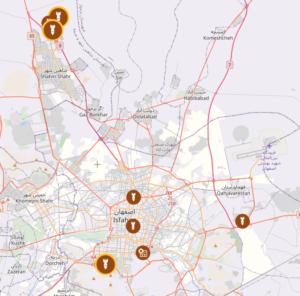
Heavy exchange of fire and testing red lines: Iran continues missile and drone waves targeting Israel and US bases, amid reports of overnight airstrikes on military and gas infrastructure near Isfahan.
Iran reshuffles its security leadership, appointing Mohammad Bagher Zolghadr: he’s a former IRGC commander and replaces the assassinated Ali Larijani.
Iran halts natural gas exports to Turkey: follows last week’s Israeli strike on the massive South Pars gas field; QatarEnergy declares force majeure on some LNG contracts due war.
“The Israeli Air Force recently struck an Iranian nuclear research and development site in Tehran, the military announces. According to the Israeli army, the “strategic” site at the Malek Ashtar University was used by Iran’s military industries to develop components for nuclear weapons. Malek Ashtar University, subordinate to Iran’s defense ministry, is under Western sanctions over its activities relating to Iran’s nuclear and ballistic missile programs.”
This falls into the “Big if true” category: “Three heavy bombers of the U.S. Air Force are currently conducting heavy strikes on the underground missile base of the IRGC Aerospace Force in Yazd, central Iran (Al-Qadir missile base). A total of six bunker-buster bombs have been dropped on the site by either B-1B heavy bombers flown from RAF Fairford in the United Kingdom or B-2A Spirit stealth bombers flown directly from Whiteman AFB in the United States.” I haven’t seen enough of Babak Taghvaee’s work to gauge the accuracy of this. (The few bits of his I’ve read have seemed accurate.) It seems like the sort target we would hit, but not knowing which bomber hit these targets suggests a source lacking firsthand knowledge. If anyone has a better bead on Taghvaee’s accuracy, feel free to share it in the comments below.
Not just over the Strait: The Warthog is also engaging Iranian back militias in Iraq.
USAF A-10 Warthogs spent most of the day strafing Iranian-backed militia positions around Mosul, Iraq. pic.twitter.com/5GLcm1XVnN
Victor Davis Hanson has spent fifty years studying how wars end. When he says the tide is turning, it’s worth listening to why.
His argument isn’t based on what the Pentagon is saying. It’s based on how everyone else is behaving.
𝗧𝗵𝗲 𝗘𝘂𝗿𝗼𝗽𝗲𝗮𝗻𝘀. VDH’s rule: Europeans never agree to go anywhere near a conflict unless they think the winning side has already been determined. They didn’t help in the early days. Now they’re starting to move. That movement is not idealism. It’s a calculation. They’ve looked at the battlefield and decided which way this ends.
𝗧𝗵𝗲 𝗚𝘂𝗹𝗳 𝗽𝗲𝘁𝗿𝗼-𝗻𝗮𝘁𝗶𝗼𝗻𝘀. The Saudis, the Emiratis, the Qataris — these governments have survived for generations by reading the regional climate with precision. When they expel Iranian military attachés, when they intercept Iranian missiles over their own capitals and say nothing about American strikes, when the UAE reaffirms its $1.4 trillion investment commitment to the United States mid-war — they are not making ideological statements. They are placing bets. And they are betting on the United States.
𝗔𝗹 𝗝𝗮𝘇𝗲𝗲𝗿𝗮. This is the one that should stop you cold. Al Jazeera — the Qatari state media network, historically critical of American military action, the network Tucker Carlson and the anti-war right love to cite against Israel — is now calling the U.S. bombing campaign brilliant and effective, and saying it has been underestimated. When the media outlet of a nation that hosts both the largest American air base in the Middle East and a Hamas political office starts praising American military effectiveness, the message is unmistakable: 𝘵𝘩𝘦𝘺 𝘵𝘩𝘪𝘯𝘬 𝘸𝘦’𝘳𝘦 𝘨𝘰𝘪𝘯𝘨 𝘵𝘰 𝘸𝘪𝘯.
𝗧𝗵𝗲 𝗺𝗶𝗹𝗶𝘁𝗮𝗿𝘆 𝘀𝗶𝗴𝗻𝗮𝗹. A-10 Warthogs and Apache helicopter gunships are now flying strike missions in Iranian airspace at will. VDH’s point: you only deploy those aircraft when there is effectively no air defense left to threaten them. They are slow, low-flying, close-support platforms. Their presence confirms what the Pentagon has been claiming — Iran has no meaningful air defense remaining.
Iran’s strategy now is rope-a-dope. Run out the clock. Wait for American public opinion to shift. Hope the midterms create political pressure on Trump to stop. It is the only play they have left.
VDH’s conclusion: if Trump sees it through — and he believes he will — the regime falls. Not in years. 𝗣𝗿𝗲𝘁𝘁𝘆 𝘀𝗼𝗼𝗻.
Since President Trump revealed contacts with the Islamic Republic, we’re seeing something very telling inside Iran: chaos at the top.
Regime officials are either turning on each other, pointing fingers, accusing one another of negotiating with the United States or in their own media and social platforms, they’re warning against character assassination of figures like Ghalibaf or Rouhani, because suspicion is spreading inside the regime itself.
Some are even calling for arrests or worse. Others are publicly shaming officials, accusing them of secret talks.
This is the atmosphere on the Islamic Republic’s side of social media. Total panic.
Jim Geraghty wonders “Why Are We Lifting Sanctions on Iranian Oil During a War with the Mullahs?” It’s a good question, though Trump seems to have a more intuitive grasp of alternating between carrots and sticks in negotiations than anyone I’ve ever seen. Also: “We have seen oil tankers carrying Russian oil divert from China to India in the aftermath of the Treasury Department’s lifting of sanctions on their cargo: ‘At least seven tankers carrying Russian oil have switched their destinations mid-voyage from China to India, according to Vortexa Ltd., with all of India’s major refiners now in the market for the country’s crude.'”
“Three explosions in Bushehr following attacks on the airbase and airport in Iran.” Bushehr is reasonably close to Kharg Island.
“Iran launches 10 million rial note.” Hyperinflation is rarely a sign of military strength. Also: The 5 million rial note was introduced “just weeks earlier.”
The Guardian (usual caveats apply) is saying that “Hundreds of petrol stations across Australia run out of fuel,” but Australian Energy Minister Chris Bowen states “Australia’s fuel supply remains strong and there are no immediate plans to ration fuel,” though the article admits “localized shortages.”
In Japan, gasoline prices have evidently hit record highs and the government is tapping national reserves, but tankers from UAE and Saudi Arabia bypassing the Strait of Hormuz are on the way.”
“Taiwan has about 11 days of liquefied natural gas reserves—a limited buffer that has become critical after Iran disrupted shipping through the Strait of Hormuz, cutting off key supplies from Qatar. Because Taiwan relies heavily on LNG to power its grid and semiconductor industry, any prolonged disruption could force energy rationing and threaten chip production.”
“Philippine president declares ‘national energy emergency‘, citing risks to fuel supply created by Middle East war.”
Some Iran War updates, Russo-Ukrainian War updates, Democrats, Trannies, and Tranny Democrat child sex offenders, a Democrat judge bonds out a would-be jihad mass murderer, Bible discussion turns a bus rider stabby, and gamers come out against AI “assistance.” Plus: Marlene Dietrich, show us your guns!
It’s the Friday LinkSwarm!
Still having the occasional 429 error, but if I wait an hour, they seem to clear.
President Trump weighs boots on the ground options in Iran. In addition to the Marines, the storied 82nd Airborne Division is an option.
IRGC “Brigadier General Ali Mohammad Naeini killed in overnight strike.” “Naeini had been the public face of Iran’s military communications throughout the conflict.” Not anymore…
When co-host David Friedberg asked Fetterman point-blank, “Who do you think leads the Democratic Party today?” the Pennsylvania senator didn’t flinch. “Oh, we don’t have one,” he said. “I think the TDS, that’s the leader right now. You know, right now our party is governed by the TDS.”
Fetterman then described what that governance actually looks like in practice – a kind of loyalty test that runs in reverse. Opposition to Trump has become the organizing principle, the ideological north star. Agree with anything the other side does and you face consequences. “It’s made it virtually impossible, without being punished, as a Democrat, to agree something’s good, or ‘I agree with the other side,'” he said.
He then cited Operation Epic Fury – the U.S. military campaign against Iran – as the latest illustration of the problem. Fetterman said he is “literally the only Democrat […] in Congress, that I’ve come across that’s saying, ‘I think it’s a great thing to break and destroy the Iranian regime.’ I think it’s entirely appropriate to hold them accountable.”
Fetterman correctly pointed out that this is not a fringe or even partisan position, historically. Every Democrat who ran for president in recent memory vowed Iran would never get a nuclear weapon. Now that it’s actually happening, the party’s response has been mostly blind criticism of President Trump for finally taking action.
Fetterman previously accused Democrats of refusing to put “country over party” over the Iran strikes.
“The last two professional candidates for the Democratic Party all agreed that we can never allow Iran to acquire nuclear bombs, and that’s made that possible now. I think we can say, ‘Hey, that’s a great thing. That makes the world more safe, more secure and holds Iran accountable,’” he told Fox News’s Sean Hannity earlier this month, after 53 House Democrats voted against a resolution declaring that Iran is a state sponsor of terrorism — something which isn’t remotely in doubt. “That’s almost 25% of Democrats in the House that can’t just call Iran the world’s biggest terrorism underwriter,” Fetterman added.
“Virtually every Democrat that I’m aware of says we can never allow Iran to acquire a nuclear bomb, and they were a significant risk to America,” Fetterman continued. “I know why they [Democrats] don’t say that now because I’m aware that it is very damaging as a Democrat to just happen to agree with the president on anything. But, for me, that’s easy — country over party.”
Deep State functionaries seem unclear on tricky concepts like “chain of command” and “democracy.” “”US intel hid Chinese 2020 election meddling from Trump because they opposed his policies.” “Dr. Barry A. Zulauf, a member of the Senior National Intelligence Service reported that others in the intelligence community said ‘I don’t want my intelligence going to the White House where it will be used by that vulgarian in the Oval Office to support policies against China with which I personally disagree.'”
Analysts inside the U.S. intelligence community sought to conceal evidence of Chinese influence efforts from President Donald Trump during the 2020 election, with analysts saying they didn’t want their intel used by “that vulgarian in the Oval Office” to pursue policies toward China they personally disagreed with.
The revelation is found within a January 2021 report written by — and never before reported upon comments by — analytic ombudsman Barry Zulauf, who conducted a review of the spy community’s handling of Russian versus Chinese meddling efforts during the 2020 election. Among his conclusions was that intelligence analysts downplayed China’s actions because they had disdain for the “vulgarian” Trump and did not want to support the policies and priorities of the Trump administration toward China with which they “personally disagree.”
Just the News reported this week that the U.S. intelligence community has known since early 2020 that Beijing also gained access to American voter registration data and used that information to conduct opinion analysis related to the presidential election between Trump and then-former Vice President Joe Biden.
This is not the only piece of evidence pointing to Chinese government election influence efforts in the 2020 election. Although much about China’s activities in 2020 remains classified, Just the News conducted a thorough review of publicly-available intelligence assessments, federal indictments, foreign government warnings, and cybersecurity firm analyses.
There is credible evidence that Chinese government-linked cyber hackers and Chinese social media troll farms took aim at the U.S. presidential election in 2020 and sought to undercut Trump during his run against now-former President Biden. There are also indicators that Chinese intelligence and law enforcement agencies — China’s Ministry of State Security (MSS) and its Ministry of Public Security (MPS) — also played a role in 2020.
Republicans love America. Democrats’ love for America is contingent on a Democrat in the White House.
A man who was shot and killed by police in Dallas was part of Texas Democratic Rep. Jasmine Crockett’s security detail, multiple sources reported on Friday.
According to CBS News, the individual in question was “known publicly as Mike King,” although he’d been using various aliases to gain employment.
He was also running a business that placed law enforcement officers in off-duty jobs — and was a figure present near Crockett at numerous campaign stops during her failed bid to gain the party’s Senate nomination, as photographic evidence showed.
King was fatally shot Wednesday after a standoff with a SWAT team in Dallas outside of Children’s Medical Center.
According to DFW Scanner, a site that chronicles crime reports from police scanners in and around the Dallas-Fort Worth metroplex, the suspect “barricaded himself in a vehicle at 1934 Medical District Drive.”
“Officers used tear gas in an effort to get the suspect out of the vehicle. He exited the vehicle armed with a gun, and pointed it at officers,” the report noted. “Officers opened fire and killed the suspect.”
Early reports indicated that he was a fugitive who was known to police and was under investigation for impersonation of a law enforcement officer.
Play stupid games, win stupid prizes. Democrats just have a gift for hiring they best, don’t they?
“Reddit’s biggest trans moderator was just unmasked as convicted child sex abuser.” Branden “Brynn” Dunleavy. “The whistleblower, who waved the red flag, said he thinks this Branden and his crimes were deliberately shielded” by other Reddit moderators. (Hat tip: Stephen Green at Instapundit.)
Monsterous: “Transgender ‘youth advocate’ was just charged with raping a BABY GIRL.” William Kelso Flournoy IV even filmed himself doing it. Hell’s too good for him.
The accusations come from two of the alleged victims themselves, one who was 12 when she said the sexual abuse started. The other alleged victim quoted in the piece was 13 when she says Chavez sexually abused her:
Ana Murguia remembers the day the man she had regarded as a hero called her house and summoned her to see him. She walked along a dirt trail, entered the rundown building, passed his secretary and stepped into his office.
He locked the door, as he always did when he called her, and told her how lonely he had been. He brought her onto the yoga mat that he often used in his office for meditation, kissed her and pulled her pants down. “Don’t tell anyone,” he told her afterward. “They’d get jealous.”
The man, Cesar Chavez, one of the most revered figures in the Latino civil rights movement, was 45. She was 13. Ms. Murguia said she was summoned for sexual encounters with him dozens of times over the next four years.
[…]
Ms. Murguia and Ms. [Debra] Rojas, both of whom are now 66, were the daughters of longtime organizers who had marched in rallies alongside Mr. Chavez. He used the privacy of his California office to frequently molest Ms. Murguia, she said. He had known her since she was 8 years old. She became so traumatized that she attempted to end her life multiple times by the age of 15.
How is it so many Democrat “community organizers” and “activists” turn out to be sexual predators? Those movements seem to draw them like flies to an open sewer…
Fallout: “Abbott Blocks Annual Cesar Chavez Observation in Texas.”
Samuel James Hall, a green card holder from Great Britain, appeared in federal court on a misdemeanor charge of voting by an alien. According to his defense attorney, James Alston, Hall has lived in the Houston area for several years but is not a U.S. citizen. Federal prosecutors allege he cast a ballot in Harris County during the 2024 General Election, voting in races for president, vice president, U.S. Senate, and the House of Representatives. The charge carries a maximum penalty of one year in federal prison. Hall posted bond and is free while his case moves through court.
“Former MD Anderson Researcher Pleads Guilty To Stealing Cancer Research for China.” “Harris County court records show that Yunhai Li pleaded guilty on March 6 to a state jail felony charge of attempted theft of trade secrets. He was recently sentenced to 364 days in the Harris County jail and received credit for 196 days already served, indicating a remaining time in jail of 168 days. Court records indicate Li, 35, is expected to be deported upon release.” (Previously.)
After paying Bari Weiss $150 million for The Free Press and hiring her to run their newsroom, CBS News announced a fresh round of layoffs on Friday which will affect over 60 jobs, or 6% of the news division, according to the NY Times.
“Certain parts of this newsroom need to get smaller in order for us to make room for the things that we need to build to remain competitive in the future,” said Weiss, who entered the scene last October, during a Friday newsroom-wide conference call.
The move follows roughly 100 layoffs last year, while ratings have continued to plummet under Weiss.
Today’s round includes the entirety of CBS News Radio – a century-old division that “served as the foundation for everything we have built since 1927,” said network president Tom Cibrowski in a memo.
I’m going to go out on a limb and guess the average CBS Radio news listener age is around 85…
After decades of relying on Vietnam-era designs, the Army has approved the first offensive hand grenade to enter the service since 1968.
The new M111 Offensive Hand Grenade was approved for full material release this year, the Army announced Tuesday in a statement. The new grenade relies primarily on blast overpressure rather than fragmented inner pieces to incapacitate, making it better suited for close-quarters combat inside of buildings, bunkers and tunnels.
Full material release allows the Army to field the weapon across the force after testing has confirmed that it meets safety and performance requirements. The approval lets the Army move the grenade from development into production.
The Army’s standard M67 fragmentation grenade explodes shrapnel in all directions, making it risky for soldiers to use in tight spaces. Blast overpressure refers to the intense pressure wave created by an explosion.
“One of the key lessons learned from the door-to-door urban fighting in Iraq was the M67 grenade wasn’t always the right tool for the job. The risk of fratricide on the other side of the wall was too high,” said Col. Vince Morris, the Army’s project manager for Close Combat Systems, in the statement. But a weapon utilizing blast overpressure instead of fragmentation, he said, “can clear a room of enemy combatants quickly leaving nowhere to hide while ensuring the safety of friendly forces.”
The M111 is intended to replace the body and fuze of the Mk3A2 grenade series, which has an asbestos body that has restricted its use. Unlike the Mk3A2, the new weapon has a plastic casing that is consumed during detonation.
It also uses the same fuze system as the M67 grenade, allowing the service to streamline manufacturing.
With 310 meters in length and roughly 90 meters at the beam, the 80,000-tonne France Libre will dwarf its predecessor, the 42,000-tonne Charles de Gaulle, which has served as the Marine Nationale‘s sole carrier strike platform since 2001. Power will come from a pair of TechnicAtome K-22 pressurized water reactors, granting the vessel virtually unlimited range and endurance at speeds of up to 27 knots via three shaft lines. Crew complement (including air wing) is set to be about 2,000 sailors.
They’re targeting it to be ready for service in 2038.
Insane story out of Houston: “Armed Man Wearing Tactical Gear Arrested for Attempted Entry to Klein Elementary School.”
A 39-year-old man in tactical gear, armed with a handgun and taser, attempted entry to Zwink Elementary in Klein Independent School District (ISD) on March 10.
Kyle Chris lives four minutes away from the school and was arrested on the evening of March 11, more than 24 hours after the incident. He has a felony charge of unlawfully carrying a weapon in a prohibited place.
District officials say Chris was able to enter an initial set of front doors during a 15-second period after a parent entered and before the doors shut completely. Zwink Elementary’s double-door system kept Chris in the entrance and stopped him from entering the area of the school with access to students.
But the story gets even more insane: “Kyle Chris” turns out to be “Muhi Mohanad Najm” and Democrat Judge Lori Chambers Gray bonded him out for $75K.
Talking about the Bible on a bus in Austin? That’s a stabbing. Boy, Steve Adler’s decision to lure drug addicted transients to Austin, and Jose Garza’s determination to keep violent lunatics on the streets, just keep paying dividends.
Among the numerous things he predicted incorrectly:
In the 1970s and 1980s hundreds of millions of people will starve to death [from mass famine].
This was, of course, entirely false. It did not happen. It is hard to overstate how wrong this was. Indeed, after the communist-run Great Leap Forward famine in 1950s-1960s China, major famines have become a vanishing rarity on the global stage
Snip.
Elsewhere, in a comical essay that presented itself as being written from the future, Ehrlich claimed the U.S. population in 1999 would be around 22 million, the result of a famine-induced “Great Die-Off.”
There is a personality type that every institution eventually learns to fear. Not the whistleblower. Not the activist. Not the dissident. Those are legible threats. They want something. They have an agenda. They can be categorized, managed, countered, discredited.
The personality the institution cannot process is the person who corrects errors because they are errors.
Not because the correction serves their interests. Not because they are aligned against the people who made the error. Not because they are building a case or advancing a cause or positioning themselves for advantage. Because the error exists. Because it is wrong. Because someone published a number that is not the right number, and the wrong number is sitting there, propagating, being cited, being absorbed, being built upon, and nobody is fixing it.
This person will spend three hours writing a detailed correction of a statistical claim in a policy document that has nothing to do with their field, their career, their politics, or their life. They will do this for free. They will do it knowing that the correction will make them no friends and several enemies. They will do it on a Saturday. They will do it again the following Tuesday when they find another error in a different document.
If you ask them why, the answer is: because it’s wrong.
That answer is incomprehensible to most institutional actors. And the incomprehension is the beginning of the immune response.
It’s not our job to make sure nVidia’s fucking shit lands. It’s my job to identify when their shit has not landed and has, in fact, remained suspended in mid-air. It’s not a great metaphor. And I guess I say it’s not our job, but that’s not really true; they’re the entire economy. We all work for them, in a literal way. The rational play here is to suck as many dicks as possible, and to suck them on an industrial scale. We might suck a dick here, a dick there, but we need to be thinking about these firm rods like a Henry Ford or a Ray Croc. You better clap to keep this fucking fairy alive or your gramma is gonna have to live in a hedge like a witch.
I saw impressive environmental lighting for sure, but that’s not what punched people in the gut. All people did was respond viscerally to Grace Ashcroft. That’s not who she is. We had an uncanny valley, and now we have… I dunno. An “Eerie Mesa.” We don’t like that either. And when I say we don’t like it, I mean our bones don’t like it. There’s a Eurogamer article on nVidia’s response, which is to say that we don’t know everything and are thinking about it wrong, which is a great pitch. I talked to Gabe a couple years ago about how eventually nVidia would just… do it. Do it all, do the whole shebang. Expound mathemagically on base assets and shim the whole thing. I wish I’d said so at the time! I could link back to it, and simply deploy the Lemmy Face. In the meantime, it’s not clear to me that the developers I’m interested in are gonna feel like jacking this thing off until their game doesn’t look scary.
Speaking of people rejecting scary faces, Meta is closing down it’s virtual realty project after pouring $80 billion on it. Or saying they lost $80 billion so they can rake off the money somewhere else…
Mark Felton has a fun video up covering Marlene Dietrich’s guns she brought back after entertaining U.S. troops in Europe during World War II, including gifts from Omar Bradley and George S. Patton!
Dune Part 3 trailer drops. The difficulty here is that Parts 1 and 2 were made from Dune, which is a great novel, where this is made from Dune Messiah, which isn’t. Indeed, Dune Messiah takes place after Muad’Dib’s jihad has swept the galaxy, and it looks like there will be a lot more jihad in the movie than the book. I’m guessing this is the rare case where the movie may be better than the book.
Another Iran update: More Jihadis dirtnaped, Iran’s neighbors want the Islamic regime finished off, Mossad gives regime members person-to-person call warnings, Uncle Sam fast-tracks a lot of weapon sales to the Middle East, and the BRRRRRRRTTTTTTTT of Freedom rings out over the Strait of Hormuz.
Israel Defense Forces killed top Iranian intelligence official Esmaeil Khatib and Hamas commander Yahya Abu Labda in separate airstrikes in the Middle East overnight.
The IDF confirmed Khatib, Iran’s intelligence minister, was killed in the strike in Tehran on Wednesday morning.
“Khatib played a significant role during the recent protests throughout Iran, including the arrest & killing of protestors and led terrorist activities against Israelis & Americans around the world,” the IDF wrote in a post announcing Khatib’s death. “Similarly, he operated against Iranian citizens during the Mahsa Amini protests.”
The Hamas commander was reportedly killed during an IDF airstrike in the Gaza Strip on Tuesday, according to the Times of Israel.
The strikes come a day after Israel killed Ali Larijani, secretary of Iran’s National Security Council, in an airstrike.
Abu Labda was a prominent figure in the development of Hamas’s precision missile project, according to the Times of Israel.
The Israeli Air Force (IAF) for the first time hit Iranian naval targets in the Caspian Sea on Wednesday, striking infrastructure and ships at the port of Bandar Anzali in northern Iran, at a distance of some 1,300 kilometers (over 800 miles) from Israel.
In addition, the IAF continued striking targets belonging to the Iranian regime’s Islamic Revolutionary Guard Corps (IRGC), the Basij militia, and the Air Force, among others.
The Israeli military confirmed on Thursday that the strikes in Bandar Anzali hit several ships, a repair facility, as well as a headquarters controlling naval operations in the Caspian Sea.
The US has deployed A-10 Warthogs attack jets, Ah-64 Apache helicopters, and 5,000-pound ground penetrator bombs to take out Iranian drones, boats, and mines to help secure the Strait of Hormuz, America’s top general said Thursday.
Gen. Dan Caine, chairman of the Joint Chiefs of Staff, vowed at a Pentagon news conference that the US would “hunt and kill” all of Tehran’s weapons facilities and assets being used against the strait, a critical trade route through which 20% of the world’s oil supply is transported.
“We continue to hunt and kill afloat assets, including more than 120 vessels and 44 minelayers,” Caine told reporters alongside War Secretary Pete Hegseth.
Simon Whistler has a meaty update on the war, including how all the Persian Gulf nations now agree that the Islamic Republic of Iran must go.
“Iran’s response to this war has managed to achieve something truly remarkable. [Ali Larijani]’s own neighbors, who had previously gone to bat for them, are now done dodging missiles and are reportedly pushing Washington to eliminate the Iranian threat for good, destroying the tools of repression.”
Skipping over the deaths of Ali Larijani and Gholam Reza Soleimani, previously reported here.
“Since the war began, American and Israeli forces have been running what amounts to a parallel campaign alongside the more headline grabbing strikes on nuclear sites and missile infrastructure. This campaign has been aimed squarely at the regime’s domestic repression capabilities and infrastructure, and it’s been accelerating massively in recent days. These targets should tell you something about what this part of the campaign is actually designed to do. Destroying missile launchers and stockpiles might degrade Iran’s ability to hit back, but destroying a law enforcement station and the men who run it degrades Iran’s ability to keep the lid on a country that it only barely had a grasp on before all of this kicked off.”
Skipping lightly over news of Iranians celebrating the traditional Chaharshanbe Suri fire festival, and the regime cracking down on same (no Zoroastrian fire festivals allowed in Islamic Iran), because it’s hard to get a sense of scale there.
“Noras, or Persian New Year falls on March 20th this year. This holiday is historically one of the largest public gatherings in Iranian life and has often been a flash point for protests against the regime. Last year, they arrested dozens of people across multiple provinces during Nar and that was before any of this broke out. this year. Suffice it to say, the situation has uh changed a bit. We don’t want to rest too much on Naras as a make or break moment, though. But it nevertheless represents a significant test of the coalition’s core theory for ousting or at least seriously pressuring the regime. Degrade their tools of oppression enough and the population will be able to do the rest.”
“The Guards have never been a domestic military force, but instead an ideologically driven group of hardliners explicitly set up to defend the Islamic Republic’s continued existence, no matter what the cost. Whatever comes next on the streets of Tehran, it does not appear likely that these men will simply lay down their weapons and go quietly into that good night.”
“The IRGC’s hardliner stance did not just reveal the power dynamics going on in Tehran, though. It helped to reshape the entire region’s posture in ways that would have been difficult to imagine just a few weeks ago. Before the war started, the Gulf States were the closest thing that Iran has to a coalition against American military action. Despite hosting US bases, most of them had adamantly pushed the White House not to strike Iran and were actively working to try and find common ground between Washington and Iran so they can avoid conflict.”
“While this was partially out of self-preservation interests, they knew the conflict in the region is never good for their bottom line, at least in the short term. They were still some of the best friends that Tehran had left. The Emirates had spent years rebuilding its relationship with Iran, and Aman’s foreign minister was in Washington discussing the matter with Vice President JD. Vance the day before the strikes took place. None of them doubted that Iran posed a threat. They hosted US bases for a reason, after all. But they calculated that living with the Iranian threat would be preferable instead of being largely defenseless in a war.”
“Iran’s response to Operation Epic Fury settled that debate in about 72 hours. Since February the 28th, Iran has launched over 1,800 projectiles split between ballistic missiles and drones at the UAE alone.”
“Bahrain took it even further, branding Iran treacherous. Bahrain even took the lead in sponsoring a UN Security Council resolution condemning Iran for its targets in this conflict which passed with unusually lopsided support. While not everyone throughout the Gulf was quite as forceful as that, they’ve all been moving in the same direction.”
“Behind the public statements urging peace, the private messaging to Washington has been far more direct: ‘Finish the job.'”
“Gulf officials have been pushing the Trump administration for what amounts to a permanent end to Iran’s ability to threaten their infrastructure.”
“In the space of three weeks, Iran has managed to turn every Gulf state that was lobbying Washington on its behalf into a partner actively backing the campaign to destroy its military capabilities. It is by almost any measure one of the most self-defeating foreign policy decisions a country has made in the modern Middle East.”
“A recent Goldman Sachs stress test published on March 15th showed that if the strait remained effectively closed through April, Qatar and Kuwait could see their full-year GDP contract by 14%, the worst since the 1990 Gulf War. The UAE and Saudi Arabia wouldn’t be quite as hard hit, but they’d both take a 5 and 3-point hit, respectively.”
Whistler also offers up a nice roundup of the current state of Israel’s incursion into Lebanon: “By March 16th, at least three separate IDF divisions were operating simultaneously inside of southern Lebanon, pushing through Kiam, Bins Jabel, and Marion in the most significant ground operations since their 2006 intervention. Evacuation orders are now covering everything south of the Latani, which when combines with the evacuated areas in the Bekaa Valley and southern Beirut totals to roughly 14% of the entirety of Lebanon’s territory.”
“Israeli Defense Minister [Israel] Katz has said at least parts of the operation are modeled explicitly on Gaza, offered no timeline for withdrawal, and some ministers are already floating the idea of a semi-permanent security zone. For now, there are no signs of a push toward Beirut or anything beyond the Litani.”
“In the last 48 hours alone, [Lebanese President Joseph Aoun] publicly called Hezbollah’s decision to enter the war a trap and an almost overt ambush serving Iranian interests, warned that the country is on the path to become a second Gaza, and floated a four-point plan calling for an immediate ceasefire, international backing for the Lebanese armed forces to oversee disarmament, direct negotiations with Israel, and long-term border security agreements.”
“While all of this is unprecedented for a Lebanese president, Beirut is currently falling short of Israeli expectations for two reasons. First, Lebanon has a long history of promising to finally get tough on Hezbollah that, well, hasn’t exactly materialized. Second, and more pertinently, the LAF [Lebanese Armed Forces] are already struggling to implement the ban on Hezbollah’s military operations that we reported on just a week ago. Hezbollah’s attack was earth-shattering for Beirut, which appeared to have finally found a moment of cross sectarian agreement that Hezbollah simply had to go. And while there were initially promising signs that the LAF was taking this seriously, the army has largely stalled. LAF commander [Rodolphe Haykal] has essentially refused to enforce the government’s ban on Hezbollah military activities, and the United States has even suspended some coordination with the LAF over it. The country’s prime minister has considered firing him for the whole debacle.”
“Now look, in fairness to Haykal, this isn’t just some random act of indifference where he’d rather sit around and watch Warfronts than go out and disarm the group. Though we couldn’t blame him if that was the case, could we? Rather, his calculation is that 20 to 30% of the LA Shia and would possibly refuse to mobilize against Hezbollah entirely, risking a total fracture of the military. Keep in mind that in Lebanon, sectarian identity is front and center just about everything that happens, especially in politics, and the LAF is broadly considered to be the last cross-sector institution in the country.”
“All that said, the inaction here is seriously jeopardizing the country’s sovereignty. The lesson that Israel took away from the October 7th attacks, rightly or wrongly, was that they couldn’t afford to allow a hostile force to exist along its borders anymore. In the aftermath of the 2024 ceasefire with Lebanon, Israel made it clear that disarmament of the group was an absolute bare minimum condition. And the tragic thing is that the LAF largely delivered on this. Earlier this year, they completed phase one of the operation. And while it was slowgoing, potentially so slow that Hezbollah was actually rearming faster elsewhere in the country than it was being disarmed, the LAF nevertheless demonstrated that it could deliver.”
“And all of this isn’t helped by the fact that even today, right now, Hezbollah continues to launch on Israel. While their stockpile has been severely reduced and seems likely to be further reduced in their ongoing clashes with the IDF, they don’t appear to be anywhere close to surrender.”
One of the reasons Iran was caught off guard at the opening of this war is that its leadership did not take Yahya Sinwar or Hassan Nasrallah’s approach. The Iranian regime—a state built on terror—was acting like a state and forgot what happens to those who spread terror. What Hezbollah and Hamas understood, and what Iran forgot, is that when you attack Israel, you become prey.
After the regime’s decapitation on the first day, Larijani grasped that reality. As Iran’s most senior surviving security official, he never stayed in the same place twice, and maintained exceptionally high security awareness.
In the end, it took a combination of precise intelligence, special ground capabilities, and rapid decision-making at both the political level and the by chief of staff to complete the operation. The time between the intelligence alert and the order for the strike was less than an hour; that’s an incredibly tight kill chain. This wasn’t a Hamas or Hezbollah target; exploiting this opportunity meant scrambling aircraft all the way to Iran.
Snip.
According to The Wall Street Journal, Israel is chasing internal repression forces from their headquarters to secret muster points at sports stadiums, even to neighborhood police stations. All in an effort to demonstrate to the Iranians that the regime’s fangs have been removed.
Meanwhile, Israel is calling mid- and low-level commanders, threatening them and their families if they don’t stand aside in the event of an uprising.
One conversation is worth recounting.
“Can you hear me?” a Mossad agent can be heard, speaking in Farsi. “We know everything about you. You are on our blacklist, and we have all the information about you.”
“OK,” the commander said in the recording.
“I called to warn you in advance that you should stand with your people’s side,” the Mossad agent said. “And if you will not do that, your destiny will be as your leader. Do you hear me?”
“Brother, I swear on the Quran, I’m not your enemy,” the commander said. “I’m a dead man already. Just please come help us.”
Last night, a very senior Israeli source outlined to me Israel’s five objectives in this war:
To act jointly with the United States to reopen the Strait of Hormuz.
To permanently deny any future Iranian regime the ability to again close the strait — including through the development of alternative pipelines.
To dismantle Iran’s weapons industry, with an emphasis on ballistic missile capabilities — this time targeting not just equipment but the factories that produce it.
To complete the destruction of Iran’s nuclear program.
Israeli Defense Minister Israel Katz has authorized the country’s military to kill Iranian and Hezbollah officials without explicit approval from higher-ups.
Katz announced the blanket order as he alerted Israeli residents that the military had taken out top Iranian intelligence official Esmaeil Khatib. Katz said he and Prime Minister Benjamin Netanyahu authorized the directive overnight.
The purpose of the authorization is to thwart the possibility of delays in Israel’s Operation Roaring Lion against Iran, according to Israeli network Channel 12. Katz vowed that there were more “significant surprises” to come as part of the development.
In the past several days, targeted Israeli strikes have assassinated several top Tehran officials, dealing a devastating blow to the Iranian regime’s power structure as the war moves well into its third week.
Snip.
The assassinations come as Israel has ramped up its attacks targeting Basij checkpoints and infrastructure. The Guard’s Basij unit has notably been targeted in the war, as the paramilitary force has long been seen as the leading military unit behind the deadly crackdown on Iranian protesters over the winter and behind repression in general against regime dissidents.
The Israeli military is targeting Basij personnel and facilities as the country seeks to weaken the Islamic regime enough to encourage Iranian citizens to topple the power structure.
“We’re undermining this regime in the hope of giving the Iranian people a chance to oust it,” Netanyahu said in a statement on Tuesday.
Next regime figure to get droned announced. “Hossein Dehghan, who was sanctioned in 2019 for his alleged role in an attack that killed 241 American troops, has been named to replace the assassinated Ali Larijani. According to a report by Iran International, Iran appointed former Defense Minister Hossein Dehghan on Thursday as the new secretary of the Supreme National Security Council,”
The Trump administration announced plans to sell more than $16.5 billion worth of radar systems, air defense equipment, and fighter aircraft weaponry to the United Arab Emirates, Kuwait and Jordan Thursday, as Iranian missiles and drones continued to hit sensitive infrastructure across the Gulf region.
US Secretary of State Marco Rubio issued an emergency waiver to bypass the mandatory congressional review period for the sales, the Pentagon said in its press release.
For the UAE, the State Department approved $2.1 billion worth of 10 FS-LIDS counter-drone interception systems, along with 240 Coyote backpack-carried drone interceptor systems, along with related sensors and munitions.
Another planned sale to the UAE includes a THAAD long-range discrimination radar, as well as Sentinel A-4 uplinkers and THAAD tactical operations and launch and control systems. A third sale set for Abu Dhabi includes $644 million worth of F-16 munitions and upgrades, including GBU-39/B small diameter bombs and Joint Direct Attack Munitions guidance systems (JDAMs), along with 400 AIM-120C AMRAAM air-to-air missiles and eight guidance sections, the Pentagon said.
Kuwait is set to receive $8 billion in Lower-Tier Air and Missile Defense Sensor (LTAMDS) radars, the administration further announced Thursday, along with a slew of accompanying electronic equipment. Jordan, meanwhile, is slated to receive $70.5 million worth of maintenance, logistics, and munitions support for its F-16s, C-130s and F-5 aircraft.
The planned sales come as Iran has targeted sensitive early warning and missile defense radar sensors in several US-aligned countries in the Gulf. Iran has also repeatedly struck civilian centers and, increasingly over the last 48 hours, oil and gas infrastructure with drones and missiles.
US Defense Secretary Pete Hegseth on Thursday praised Gulf states for their support for Washington’s war effort, saying Iran’s “reckless” pattern of counterattacks has brought some of those countries “squarely into our orbit.” He specifically named the UAE, Qatar, Bahrain, Kuwait and Saudi Arabia.
Speaking alongside Hegseth at the Pentagon, the US’ top-ranking general, Chairman of the Joint Chiefs of Staff Gen. Dan Caine, said the US military will continue to work with Gulf states “to help them to improve any defensive capabilities that they need.”
Missile plant hit: “Karaj Surface-to-Surface Missile Plant” destroyed by U.S. strikes. This was March 1, but CENTCOM only released the images today.
Iran evidently managed to damage an F-35:
“Likely hit by a Qaem-118 short range SAM.” The pilot returned to base safely and made an emergency landing.
Once again, this was just what I was able to gather from various sources. If you think I’ve missed something, feel free to share it in the comments below.
More regime honchos dead, America and Irseal are (try to contain your shock) winning, a bad weekend for the KC-135, a Dem uber-lawyer backs Trump on Iran, and Israel is hunting Basij in the streets of Tehran. It’s your Iraq war update, incorporating news from late Friday until now.
Also, I keep getting the occasional 429 errors that require Bluehost support to snip long-running processes that they won’t give me access fix without handing them more money (which isn’t happening). An optimization scan brought up suggestions for improving performance, some highly impractical (no, I’m going to hand-optimize WordPress generated JavaScript), but one of the things spinning up long threads is Twitter embeds, so I’m going to try to do less of that and just link and summarize rather than embed. I’ve also updated and turned the caching plugin back on (turned off in a previous Bluehost troubleshooting session), so I’m hoping that will speed things up as well.
Israeli forces killed the Iranian regime’s security chief and de facto leader, Ali Larijani, in a Tuesday morning airstrike that has the potential to foment greater chaos within the Islamic Republic’s remaining leadership.
The IDF announced that Larijani was killed through “a precise strike” on his location near Tehran.
“His elimination adds to the elimination of dozens of senior commanders and leaders of the Iranian terror regime, who were eliminated by the IDF during Operation Roaring Lion, and constitutes a further blow to the Iranian regime’s abilities to manage and coordinate hostile activity against the State of Israel,” the IDF wrote in its statement.
After Ali Khamenei’s death, Larijani emerged as the country’s de facto leader, consolidating his power and overseeing combat operations against Israel and other Arab nations in the region. Along with his brother, Sadeq, Larijani waged outsized influence in the Iranian leadership and positioned himself as a successor after Khamenei’s death. He also served as secretary of the Iranian Supreme National Security Council, the body that orchestrated attacks on Israel and led efforts to violently suppress the Iranian people.
“During the most recent wave of protests against the Iranian terror regime, Larijani advanced violent enforcement measures and repression operations, and personally oversaw the massacre that was carried out against Iranian protestors,” the IDF said. “Larijani led the regime’s national-security coordination and directed its international activity, including engagement with members of the axis.”
Hilarious if true: “Missile hit Sepah Bank digital security center in Tehran.”
A missile strike hit the digital security center of Sepah Bank in Tehran early on Wednesday, according to information received by Iran International.
The building, located on Haghani Street, was destroyed in the attack while the bank was processing salary payments for military personnel.
The services at Sepah Bank and Melli Bank Iran remained widely disrupted for a second day, with online banking unavailable and only card-based services operating.
FACT 1: Iran’s missile capability has been functionally destroyed.
As of Day 6, Adm. Brad Cooper (CENTCOM) confirmed Iranian missile attacks declined roughly 90 percent since strikes began [ISW, March 5, 2026]. Per joint intelligence assessment (IDF/CENTCOM briefing), approximately 75% of all launchers destroyed; 100–200 remain. The IRGC Aerospace Force — Iran’s primary instrument of long-range conventional power projection — has been catastrophically degraded in nine days. “Hundreds” of warheads destroyed (conventional missile warheads — Iran has no deployed nuclear warheads). Defense industrial base under systematic attack. This is not a setback. This is the functional end of Iran’s power projection capability.
Fact 2 has been edited back from Iran’s nuclear program being 8-15 years to reconstitute, to being substantially destroyed for the the immediate future.
FACT 3: The Strait of Hormuz is closed — not by mines, but by insurance actuaries.
Seven of twelve International Group P&I Clubs cancelled war risk coverage on March 1–2, 2026. These seven clubs insure approximately 90% of the world’s ocean-going commercial tonnage. War risk premiums surged over 1,000%. The result: tanker traffic through Hormuz collapsed from a pre-conflict baseline of approximately 138–153+ vessels per day (figures vary by data provider: Lloyd’s List/Kpler cite ~138; CSIS/Starboard cite 153+) to as few as 3 commercial transits recorded by Windward.ai AIS tracking on March 7; a near-total shutdown. Iran achieved a de facto blockade by making the risk-reward calculation of commercial transit economically irrational, without firing a single mine.
FACT 4: The US is the primary economic beneficiary of this crisis.
Brent crude has risen from $72/barrel (pre-conflict) to $106.81/barrel on March 8, 2026 (Day 9), with an intraday spike to $110 when Asian markets opened Sunday evening — the first time Brent has exceeded $100 in nearly four years, and up 50%+ from the $60/barrel that started 2026. WTI (US crude futures) hit $106.57 (+17.2% on the day). A new cascade has begun: Gulf producers are being forced to cut output as storage fills — Iraq’s production has collapsed 60%, UAE and Kuwait have begun cuts. Goldman Sachs warned Friday night that the Hormuz shock is now “17 times larger” than the peak Russia disruption of April 2022 and projects Brent could reach $150/barrel by end of March if Hormuz flows remain depressed. The US is a net petroleum exporter. Every $10/barrel increase in oil costs China and Japan hundreds of millions per day while benefiting US shale producers and LNG exporters (Cheniere, Shell, ExxonMobil). Qatar suspended LNG production. CSIS senior fellow Clayton Seigle: “A deficit of 20 million barrels per day is hitting global oil market balances with no sign of relief.” The Washington Post confirmed explicitly: “The conflict has hit Europe and Asia harder than the United States.”
FACT 5: Ali Khamenei is dead. His son is not a legitimate successor.
Supreme Leader Ali Khamenei was assassinated February 28, 2026, in a joint US-Israeli airstrike on his Tehran compound — Israeli jets dropped 30 bombs in daylight with zero effective Iranian air defense response. Mojtaba Khamenei, his son, was named Supreme Leader by the Assembly of Experts on March 8. Mojtaba is a Hojjatoleslam (mid-ranking cleric), not an Ayatollah — his theological credentials are below what the constitution’s spirit requires. He has never held a formal government position. The regime has chosen dynastic succession in a self-described revolutionary republic. This legitimacy deficit is the long-term vulnerability. [CONFIRMED — NYT, Reuters, P1B]
DataRepublican assume there will be no land war. But she’s working from the assumption that such a land war will require occupying all of Iran, rather than, say, Tehran and various oil exporting ports.
FACT 7: China is losing 1.7 million barrels per day of discounted Iranian oil and faces secondary sanctions.
China bought approximately 90% of Iran’s oil exports at sanction-discount prices. That supply is gone. Higher global oil prices hit China’s economy directly. The February 2026 Executive Order imposes tariffs on any country purchasing Iranian oil — aimed directly at Chinese “teapot” refineries in Shandong Province. The US simultaneously disrupted both of China’s discounted petro-state suppliers (Iran and Venezuela). China is watching US military capabilities through its satellites and reading the Taiwan signal.
FACT 8: The Mosaic Defense kept Iran fighting but cannot project offensive power.
Iran’s 31 autonomous provincial IRGC commands, each with pre-delegated launch authority, are firing pre-authorized strike packages without central coordination. This means the regime cannot be decapitated; missiles keep flying. But the same decentralization that enables survival prevents the complex multi-axis offensive operations that would actually threaten US interests at scale. The 90% launch decline is the empirical proof: what remains is dispersed residue, not a coherent military campaign. [ASSESSED — CEPA, P1B, P2A mosaic paradox]
FACT 9: The Iranian economy was already at collapse threshold before the war began.
Pre-war data: rial at 1.45 million per US dollar (December 2025 peak); 49% inflation; negative GDP growth; government budget deficit at 6%+ of GDP. The January 2026 protests — the largest in Iranian history, with 3,000–30,000 killed by the regime — were triggered directly by rial collapse. The war adds destroyed infrastructure, disrupted trade, severed oil revenue, and accelerating secondary sanctions. The economic collapse is not a future risk; it is an ongoing reality that predates Operation Epic Fury.
FACT 10: The Axis of Resistance has been substantially degraded.
Syria land bridge severed (Assad fell December 8, 2024). Hezbollah “dramatically weakened” by 2024 Israeli offensive; Nasrallah killed September 2024; Iran-Hezbollah land corridor gone. Hamas catastrophically degraded after 18+ months of Israeli ground operations; IRGC’s Hamas portfolio manager Saeed Izadi killed June 2025. Houthis’ stockpiles reduced by Operation Rough Rider (2025); Houthis “staying out of the Iran-US fight for now” (Al Jazeera, March 7, 2026). Iraqi PMF taking active US strikes. Iran’s 40-year investment in regional proxy power has been substantially degraded — not dismantled. Hezbollah retains organizational structure, partial rocket inventory, and political control of southern Lebanon. Hamas retains organizational elements outside Gaza.
I feel that most of this is probably correct. And that’s just the topline analysis; there’s a lot more in-depth data and analysis at the link. (Hat tip: Borepatch.)
You know who likes the chances of America and Israel winning the war? Al Jazeera.
When you look at what has actually happened to Iran’s principal instruments of power – its ballistic missile arsenal, its nuclear infrastructure, its air defences, its navy and its proxy command architecture – the picture is not one of US failure. It is one of systematic, phased degradation of a threat that previous administrations allowed to grow for four decades….
The campaign has moved through two distinct phases. The first suppressed Iran’s air defences, decapitated its command and control, and degraded its missile and drone launch infrastructure. By March 2, US Central Command announced local air superiority over western Iran and Tehran, achieved without the confirmed loss of a single American or Israeli combat aircraft.
The second phase, now under way, targets Iran’s defence industrial base: missile production facilities, dual-use research centres and the underground complexes where remaining stockpiles are stored. This is not aimless bombing. It is a methodical campaign to ensure that what has been destroyed cannot be rebuilt.
Iran now faces a strategic dilemma that tightens every day. If it fires its remaining missiles, it exposes launchers that are promptly destroyed. If it conserves them, it forfeits the ability to impose costs of the war. Missile and drone launch data suggest Iran is rationing its remaining capacity for politically timed salvoes rather than sustaining operational tempo.
This is a force managing decline, not projecting strength.
The closure of the Strait of Hormuz is dominating the critical commentary. US Senator Chris Murphy has called it evidence that President Donald Trump misjudged Iran’s capacity to retaliate. CNN has described it as proof that the administration has lost control of the war’s escalation.
The economic pain is real: Oil prices have surged, a record 400 million barrels of oil will be released from global reserves, and Gulf states are facing drone and missile strikes on their energy infrastructure.
But this framing inverts the strategic logic. Closing the strait was always Iran’s most visible retaliatory card, and always a wasting asset. About 90 percent of Iran’s own oil exports pass through Kharg Island and then the strait.
China, Tehran’s largest remaining economic partner, cannot receive Iranian crude while the strait is shut. Every day the blockade continues, Iran severs its own economic lifeline and alienates the one major power that has consistently shielded it at the United Nations. The closure does not just hurt the global economy; it accelerates Iran’s isolation.
Meanwhile, the naval assets Iran needs to sustain the blockade – fast-attack boats, drones, mines, shore-based antiship missiles – are being degraded daily. Its naval bases at Bandar Abbas and Chahbahar have been severely damaged.
The question is not whether the strait reopens but when and whether Iran retains any naval capacity to contest it. Critics compare the challenge of escorting a hundred tankers daily to an impossible logistical burden. But you do not need to escort tankers through a strait if the adversary no longer has the means to threaten them. That is the operational trajectory.
Strait of Hormuz update: “War risk insurance peaks at 5% of hull value. Insurance costs reach highest level since Iran-Iraq Tanker War (1980s). Oil tanker valued at $100M now costs $5M to insure for single transit. Strait effectively closed despite technical navigation possibility.”
“Reports indicate clashes between security forces and citizens around Chaharbagh Square in Tehran. The sound of gunfire can be heard.” Not the only area where such clashes are reported.
Five KC-135 tankers damaged in an Iranian missile strike at Prince Sultan Air Base in Saudi Arabia:
Suchomimus notes that there’s simply not a lot of space to park at that base, so there’s going to be risk parking so many tankers (or other large aircraft) there. None of the planes were destroyed, and all are being repaired.
Iranian hovercraft base at Bandar Abbas hit:
I don’t get to use the “Hovercraft” tag nearly enough…
Famous Democrat lawyer David Boies thinks Trump is doing the right thing in Iran and “Democrats should get behind the President, and make sure that he finishes the job.”
Boies, a Democrat, argues passionately in favor of the war, and scolds people—mainly other Democrats—for, in his mind, letting their dislike of President Trump affect their opinion of attacking Iran. As he writes, “If we believe that Iran presents a serious threat, we need to support the president on this issue. There’s plenty to disagree with him about, and we don’t need to like or admire him. But on Iran we should be on common ground.”
Another successful Iranian strike (or possibly Iranian-linked militia) in Iraq:
BIG: A drone strike hit the U.S. Embassy compound in Baghdad’s Green Zone, damaging or disabling the embassy’s C-RAM air defense system (C-RAM's radar) and striking a helipad.
There are multiple rumors floating around about Schrodinger’s Ayatollah, who still hasn’t been seen in public since the initial strikes. The first is that he shuffled off his mortal aba in the airstrike that killed his father Ayatollah Senior and most of Iran’s ruling council.
“We know the new so-called not-so-supreme leader is wounded and likely disfigured,” Hegseth said in a press briefing on Friday, March 13. “He put out a statement yesterday. A weak one, actually, but there was no voice and there was no video. It was a written statement.”
“Iran has plenty of cameras and plenty of voice recorders,” Hegseth added. “Why a written statement? I think you know why. … He’s scared, he’s injured, he’s on the run and he lacks legitimacy.”
Here’s the obligatory Simon Whistler video to sort through the possibilities.
“According to Iranian leaders, he’s alive and well. According to US defense leaders, he’s quote wounded and likefully disfigured. And as regional experts and conflict observers have recently pointed out, he might already be in a coma or even dead.”
“One week after he was elevated to rule Iran, the younger Khamenei hasn’t been seen and he hasn’t been heard, raising the distinct possibility that the world and even the people of Iran don’t actually know who’s in charge of Iran’s war effort.”
“A longtime adviser and money man who had assisted his father for decades, Motjaba was already rumored not to be on his father’s short list for succession even before the current war with the US and Israel began. Instead, Motjaba was an avatar of some of Iran’s most hardline fighting factions. The internal repression forces known as the Basij, which Motjaba essentially controlled himself, and the Islamic Revolutionary Guard Corps, where he’d been close with the deceased General Qasem Soleimani and his successor Hossein Taeb.”
“Motjaba was widely understood to be much more extreme than his father, even in his open support of Iranian nuclear weapons, which his father had always publicly denied pursuing. Motjaba had spent years in Iran building a loyal support network, angling to take over despite his father’s wishes, and along with his father, Motjaba’s wife, his mother, and one of his sons were all reported killed in the early waves of US and Israeli bombing.”
“Claims from Israeli intelligence as well as anonymous Iranian officials speaking to the global press confirmed that Motjaba is in significantly worse shape than the Iranian regime will acknowledge.”
Trump: “I hear he’s not alive.”
Back to Whistler: “We can observe a convergence of analysis from the US, Israel, purported Iranian insiders, Iranian opposition sources, and others on the out-abouts. What’s probably true here? While it’s more likely than not that Motjaba Khamenei is alive in some form, most accounts on his whereabouts and status have converged on the idea that he’s in bad shape, isolated, and even if he is alert, he probably isn’t the person calling the shots in Iran on a daily basis.”
“If Motjaba isn’t calling the shots, then who is?”
“The answer may be a facet of the groups that helped elevate him to the leadership. The Revolutionary Guard, the Basij Paramilitaries, and Iran’s hardline factions.”
“It’s not clear that those leaders can exert direct control over the Iranian military. Iran has already shifted into a wartime strategy called mosaic defense. An approach that’s meant to make the country more resilient to decapitation strikes and command and control destruction than it otherwise would be.”
“In a mosaic defense, Iran essentially fractures into decentralized individually controlled military units, each given control of certain regions, certain paramilitary allies, and certain warfighting assets. Those units have their broad instructions from the top. But after that, they’re essentially on their own.” A mosaic defense can be effective in running a decentralized insurgency, but is a lot less useful when you’re trying to defend your country against two of the world’s most powerful and technologically sophisticated militaries.
“On the one hand, that’s helpful in ensuring that Iran’s military can still function when people like the Supreme Leader are killed. But on the other hand, it’s very difficult to reign those mosaic forces back in once they’ve been given the order to decentralize.”
“Already, Iranian leaders have suggested that some of Iran’s actions, like the pervasive strikes on Gulf Energy infrastructure, may have been due to mosaic forces making their own decisions about how to handle the war. With a hardline supreme leader legitimizing the commands and the power of Iran’s revolutionary guard and Basij, there’s a real risk that those forces will only become less responsive to more moderate civil leaders.” Yeah, “moderate civil leaders” isn’t exactly what anyone thinks of when it comes to the Islamic Republic of Iran.
Kharg Islands/Marines/Hormuz stuff snipped.
I think the Babylon Bee nicely captures the consensus about Mojtaba: “‘It’s Just A Flesh Wound!‘ Says Legless Torso Of Iranian Ayatollah.”
But beyond dead, coma, and crippled, another possibility about MiniMe Khamenei has recently surfaced, namely that he might be a prancing Nancy Boy.
President Trump was stunned to learn last week that US intelligence indicates new Iranian Supreme Leader Mojtaba Khamenei may be gay — and that his father, the late Ayatollah Ali Khamenei, feared his suitability to rule the Islamic Republic for that reason, The Post can reveal.
Trump couldn’t contain his surprise and laughed aloud when he was briefed on the intel, according to sources.
Others in the room also found it “hilarious” and joined the president’s reaction, while one senior intelligence official “has not stopped laughing about it for days,” said one person familiar with the briefing.
The shocking claim was described to The Post by two intelligence community officials and a third person close to the White House.
Of course, all this could merely be scurrilous rumor or psychological warfare aimed at the regime. The idea that Mojtaba enjoys having burly men pound his poop-chute would obviously radically reduce his support among the notoriously anti-gay power circles of the Islamic Republic of Iran. The Supreme Leader doing the same things that get others hung from cranes might make regime figures less likely to follow his orders, especially if they start suspecting they’re being issued from inside a strapless lavender evening gown.
There is another possibility: Like Liberace and Oscar Wilde, Mojtaba Khamenei could be both gay and dead…
U.S. forces pass the 5,500 targets mark, the regime starts emptying the bank accounts of citizens to stay afloat, China’s weapons are (still) garbage, more Iranian planes cratered on runways, a tanker burns off Iraq, Weekend at Mojtaba’s, and the idea that our troops in harm’s way might be eating well enrages the Democrat Media Complex.
CENTCOM operations briefing:
“Every day, we’re striking hard at Iranian ballistic missile and drones. To date, we have struck more than 5,500 targets inside Iran including more than 60 ships using a variety of precision weapon systems.”
“Since the first 24 hours of this campaign, Iranian ballistic missile and drone attacks have dropped drastically but it’s worth pointing out that Iranian forces continue to deliberately target innocent civilians in Gulf countries while hiding behind their own people as they launch attacks from highly populated cities in Iran.”
“Our warfighters are leveraging a variety of advanced AI tools. These systems help us sift through vast amounts of data in seconds, so our leaders can cut through the noise and make smarter decisions faster than the enemy can react. Humans will always make final decisions on what to shoot and what not to shoot and when to shoot, but advanced AI tools can turn processes that used to take hours and sometimes even days into seconds.
Note that YouTube’s auto-translate function renders Operation Epic Fury as “Operation Epicure,” so if you see that somewhere in any Iran reports, you know someone was asleep at the switch…
Iran’s attacks targeting radars and other missile defense equipment in the Gulf have not achieved the regime’s objective of degrading air defenses enough to reliably penetrate them. Interception rates of ballistic missiles have not changed significantly.
Iran likely seeks to preserve the option to threaten, disrupt, and selectively control traffic through the Strait of Hormuz without fully halting Iranian crude exports that still rely on the waterway by mining it heavily.
The combined force continues to target several key internal security sites in Tehran City and Kurdish-populated areas in northwestern Iran. An open-source intelligence (OSINT) analyst reported that the combined force struck several internal security sites in Marivan City, Kurdistan Province, which is about 10 miles east of the Iran-Iraq border in northwestern Iran. Marivan City and other mountainous cities in Kurdistan Province are hotspots for anti-regime protests and clashes between Iranian security forces and Kurdish anti-regime groups.
Russia is reportedly sharing advanced drone tactics with Iran to support Iranian attacks against US forces and assets in the Middle East, which highlights deepening cooperation between key US adversaries. The CNN report comes after three unspecified officials told the Washington Post on March 6 that Russia has provided Iran with the locations of US military assets, including warships and aircraft, since the war started on February 28.
China continues to supply Iran with precursors for solid fuel to support Iran’s ballistic missile program. An OSINT analyst reported on March 11 that the Iranian cargo vessel Barzin departed Gaolan Port in China, likely carrying a shipment of missile fuel precursors, and is now en route to Iran.
Some elements of Hezbollah’s political support appear to be fracturing due to Hezbollah’s participation in the war. Hezbollah ally, the Amal Movement, recently voted in favor of the Lebanese cabinet’s decision to ban Hezbollah’s military activity. The Amal Movement has been Hezbollah’s key political and strategic ally since 2005.
Not a lot new there if you’ve been following along here.
Has the regime run out of money and just started stealing?
The Iranian Mullah Regime cannot meet the payroll of the Regime Security Forces…
…so, it is stealing the next payroll from everyone else.
Food security issues started the last Iranian mass insurrection. The Mullah Regime just lit the short fuze for the next one. https://t.co/xIIQaxfTWe
Coalition air power continues to pound the greater Tehran area:
Iran got $5 billion in Chinese MilTech that proved absolutely worthless:
And it changes EVERYTHING about who's really fighting this war.
🚨 CHINA SECRETLY ARMED IRAN WITH $5 BILLION IN WEAPONS →EVERY SINGLE ONE FAILED 🚨
A secret oil-for-weapons deal between China and Iran has been exposed by Reuters. Beijing raided its own People's Liberation Army… pic.twitter.com/nesaOtWeKt
CHINA SECRETLY ARMED IRAN WITH $5 BILLION IN WEAPONS →EVERY SINGLE ONE FAILED 🚨
A secret oil-for-weapons deal between China and Iran has been exposed by Reuters. Beijing raided its own People’s Liberation Army inventory to fast-track delivery before the war started.
$5 BILLION. Pulled from China’s own military stockpile.
WHAT HAPPENED:
→ US-Israeli strikes destroyed the ENTIRE stockpile on DAY ONE
→ CM-302 missiles launched at US Navy – ZERO hits
→ Some malfunctioned mid-flight. Others intercepted by SM-3 and SM-6
→ 100% failure rate. Not a single US warship scratched.
💀 China’s “world’s best anti-ship missile” = couldn’t hit a destroyer
💀 CM-302 has NO data link, NO satellite guidance, NO active terminal tracking
💀 Once launched it flies BLIND — and the US Navy knew it
💀 $5 BILLION in Chinese weapons = DESTROYED in hours
⚠️ China denied the deal publicly. Reuters confirmed it.
⚠️ This violates the UN weapons embargo reimposed last September
⚠️ China pulled weapons from its OWN military – meaning its Pacific fleet is now WEAKER
They’re showing you Iran’s missile launches and calling it a threat.
They’re NOT showing you that China armed Iran with its best weapons → and they ALL failed against American destroyers.
You don’t secretly arm a country with $5 billion in weapons from your own military unless you’re betting on them winning. China bet everything on Iran. And lost.
Oil terminals at Iraqi ports on Thursday said they have suspended operations following attacks on tankers near its waters, according to Iraqi authorities cited by state media.
Farhan al-Fartousi, director general of the state-owned General Company for Ports of Iraq (GCPI), said was quoted by the Iraqi News Agency (INA) as saying, “The operation of oil ports has been suspended, commercial ports continue operations.”
Ships remain in the waiting area, and loading and unloading are ongoing at the North and South Um Qasr ports, the INA reported.
This decision, the news outlet reported, was taken after a tanker loaded with petroleum products – supplied by the Iraqi State Organization for Marketing of Oil (SOMO) to the Iraqi Oil Tankers Company, “was involved in an incident”.
Al-Fartousi said that the vessel was carrying a fuel supply tank in the Ship-to-Ship (STS) transfer area and was in the process of loading when it was hit by an explosion. He added that “one of the smaller tankers involved flies the Maltese flag.”
SOMO is Iraq’s national company responsible for marketing and exporting the country’s crude oil and fuel oil. Headquartered in Baghdad, it manages sales to international buyers.
As per the Iraqi News Agency, rescue teams from the company, in coordination with naval units in the SDS area, recovered 38 people, including one confirmed dead. Specialized firefighting tugs from Basra Oil Port were deployed to extinguish fires on both vessels, while search-and-rescue teams continue to look for missing crew members.
There’s video:
The US loses a KC-135 refueling tanker over Iraq, evidently due to an aerial collision with another friendly aircraft (which landed safely). Rescue efforts “ongoing.”
“An SAS base in Iraq was hit by a barrage of drones last night as top UK generals confirmed that Russia was ‘definitely’ helping Iran.”
I have to give leftists and Democrats some credit because they put in no effort to conceal their true feelings, objectives, or that their hatred for President Donald Trump blinds them.
They lost their minds when data showed that Secretary of War Pete Hegseth spent a lot of money to improve the lives of the military.
They latched onto the $20 million spent on steaks, lobster tails, and crab legs.
How Pete Hegseth spent taxpayer funds:
$225 million for furniture
$15.1 million for ribeye steak
$6.9 million on lobster tail
$5.3 million for new Apple devices
$2 million for Alaskan king crab
$139,224 on donuts
$124,000 for ice cream machines
$98,329 for a grand piano
— Melanie D’Arrigo (@DarrigoMelanie) March 10, 2026
Snip.
Also, who is “they?”
Didn’t Congress allocate the money for the Defense Department?
What does the allocated money have to do with healthcare costs, SNAP, and other services that do not fall under the defense budget?
Am I missing something here? Doesn’t Congress have to approve the budgets? How did the “they” cut those costs?
If Congress doesn’t want the military to eat well, have treats, and have a better life while serving, then maybe don’t hand the department billions.
More on that subject via Stephen Green at Instapundit:
I've heard Democrats complain more loudly about our soldiers being well fed than about fraud in California or Minnesota. They sure do have their priorities. They seem to only be upset about the military spending because they'd prefer the lobster and steak to go to illegal aliens.
As usually, this is just what I was able to collect from various sources. If you think I’ve missed anything important, feel free to share it in comments below.
Another day of airstrikes against the Islamic Republic of Iran, another roundup of news.
Note that earlier in the day the blog went down with a 429 (too many requests) error. I rattled Bluehost’s cage and they fixed it. Hopefully it doesn’t happen again…
Secretary of War Pete Hegseth and Joint Chiefs of Staff Gen. Dan Caine held a press conference this morning with a few updates on Operation Epic Fury.
“On day ten of Operation Epic Fury, we are winning with an overwhelming and unrelenting focus on our objectives, which are the same as the day I gave my first briefing here on Operation Epic Fury,” said Hegseth. “They’re straightforward, and we are executing them with ruthless precision.”
Hegseth also reiterated the objectives: “One, destroy their missile stockpiles, their missile launchers, and their defense industrial base missiles and their ability to make them. Two, destroy their Navy, and three, permanently deny Iran nuclear weapons forever.”
Tuesday will be another bad day for Iran:
It’s a laser-focused, maximum authority mission, delivered with overwhelming and unrelenting precision. No hesitation, no half measures. As President Trump declared yesterday, we’re crushing the enemy in an overwhelming display of technical skill and military force. We will not relent until the enemy is totally and decisively defeated. But we do so — we do so on our timeline and at our choosing. For example, today will be yet again our most intense day of strikes inside Iran.
The most fighters, the most bombers, the most strikes, intelligence more refined and better than ever, so that’s on one hand. On the other hand, the last 24 hours have seen Iran fire the lowest number of missiles they’ve been capable of firing. Yet just the bifurcation, just the trend lines that we talked about on our first briefing. You see, this is not 2003. This is not endless nation-building under those types of quagmires we saw under Bush or Obama. It’s not even close. Our generation of soldier[ [sic] will not let that happen again. And nor will this President, who very clearly ran against those kinds of never-ending, nebulously-scoped missions. Those days are dead. Instead, we’re winning decisively with brutal efficiency, total air dominance, and an unbreakable will to accomplish the President’s objectives on our timeline. We stay locked on the target because here at the Department of War, that’s our job.
Stephen Green: “Iran’s Richest Oil Region Demands Freedom, Democracy.”
Khuzestan is Iran’s most oil-rich and ethnically diverse province — and the Arabs there have finally had it up to here with the theocrats who run things in Tehran. Whoever they are today, that is.
In a daring new statement, the Khuzestan Arab Tribes Assembly this week calling for “a free, democratic, and federal Iran,” and that they “firmly believe that the Islamic Republic’s system has violated the rights of the people of Iran.”
While Khuzestan borders Iraq and is roughly one-third Arab, the assembly called the province the “beating heart of Iran” and emphasized “the protection of Iran’s territorial integrity and reject any separatist or divisive project that harms the homeland of Iran.”
“We see ourselves in the transitional phase from the current repressive regime toward a free, democratic, and federal Iran. We can play a constructive role alongside other compatriots in building a prosperous and united Iran.”
“We, along with all Iranians—Persians, Kurds, Baluchis, Azeris, Lors, Turks, and others—stand hand in hand for freedom, prosperity, and the bright future of Iran.”
You don’t put out a statement like that one unless you enjoy at least some confidence that “security” troops won’t soon make a visit to explain to you the error of you ways. You know, in a dark cell somewhere from which you will only ever emerge feet-first. So whatever the real-world political efficacy of the assembly may or may not prove to be, the people behind it seem to believe that the IRGC’s reach no longer extends there.
And — this is kind of a big deal — Khuzestan holds about 80% of Iran’s onshore oil reserves, and also accounts for about the same percentage of Iran’s onshore production. That’s nearly 60% of all of Iran’s oil production.
But he also owes his position to the IRGC, unofficially making the ayatollah subordinate to the military for the first time in the Islamic state’s 47-year history.
And yet… Mojtaba’s figurehead status might be even less than it appears because there’s also the question of whether Mojtaba remains upright and breathing. Also on Monday, Iran state television confirmed that Mojtaba was wounded, presumably during an airstrike. AP reported: “The anchors read reports describing him as ‘janbaz’ or wounded by the enemy,” even as they parade him around — virtually only! — as the new boss.
Mojtaba has yet to be seen in public since his promotion. Strange way to reassure the public about the succession, yes?
In addition to Ali Khamenei, also believed dead in the compound airstrike is the elder Khamenei’s wife, a daughter, a grandchild, a son-in-law, and Mojtaba’s wife.
Maybe it’s a bit of a stretch to believe that coalition airpower took out so much of the Khamenei family, except for the one guy the IRGC needed as a well-known figurehead to consolidate its power during a chaotic time when one military and theocratic leader after another gets chalked up as KIA.
I also note that the IRGC will need to maintain the fiction of him alive if they want to access those untold billions the Khamenei clan withdrew from government funds to stash in international bank accounts…
IRGC Qods Force Colonel Majid Kashefi killed in Israeli drone strike:
BREAKING: This beast from the IRGC Qods Force, Colonel Majid Kashefi, who had the blood of many Iranians on his hands, was eliminated in an Israeli drone strike in Iran. State media of the regime has published his image and video.#OperationEpicFury#OperationLionsRoarpic.twitter.com/aNdkFc22xK
— Babak Taghvaee – The Crisis Watch (@BabakTaghvaee1) March 10, 2026
US intelligence has begun detecting indications that Iran may be preparing to deploy naval mines in the Strait of Hormuz, one of the world’s most critical energy chokepoints. Officials cited by CBS News say Tehran is believed to be using small boats capable of carrying two to three naval mines each. Estimates suggest Iran could possess between 2,000 and 6,000 naval mines, including Iranian-made systems as well as variants designed in China and Russia.
More recent intelligence reporting indicates that Iran has already begun laying a limited number of mines, with a few dozen reportedly placed in the waterway in recent days. However, the deployment remains limited for now. Officials say Iran still retains around 80% to 90% of its small boats and mine-laying vessels, meaning it could potentially place hundreds more mines if tensions escalate.
US intelligence has begun detecting indications that Iran may be preparing to deploy naval mines in the Strait of Hormuz, one of the world’s most critical energy chokepoints. Officials cited by CBS News say Tehran is believed to be using small boats capable of carrying two to three naval mines each. Estimates suggest Iran could possess between 2,000 and 6,000 naval mines, including Iranian-made systems as well as variants designed in China and Russia.
More recent intelligence reporting indicates that Iran has already begun laying a limited number of mines, with a few dozen reportedly placed in the waterway in recent days. However, the deployment remains limited for now. Officials say Iran still retains around 80% to 90% of its small boats and mine-laying vessels, meaning it could potentially place hundreds more mines if tensions escalate.
Given the indiscriminate nature of naval mines, I can’t imagine that China would be pleased if one of their cargo or tanker ships were hit.
Kyiv has dispatched three teams of military experts to the Middle East, President Volodymyr Zelensky said on March 10 amid Iran’s ongoing drone strikes in the region.
“This week, all three (teams) will be in three different countries… Qatar, the United Arab Emirates (UAE), and Saudi Arabia,” Zelensky said in a briefing with journalists.
Countries across the Middle East have come under fire from Iranian Shahed drones and missiles in the wake of Israeli-U.S. strikes against Iran on Feb. 28.
Ukraine has signalled readiness to share its extensive experience with countering the low-cost kamikaze drones, which Russia launches in daily attacks against Ukrainian cities and infrastructure.
MSM reporting on Iran sucks.
Iran Coverage
The headlines abound:
Iran Regime doing well, in control
Trump under pressure to end war
Khomeini son just as tough as Father
US responsible for missile on school
One headline after another essentially featuring Iranian propaganda as the news.
I suspect anyone reading this roundup already knew that…
Saudi Aramco is using their East-West pipeline to reroute oil exports away from the Strait of Hormuz to terminals on the Red Sea.
Iranian “numbers” station under attack. Numbers stations are mysterious radio stations that feature numbers spoken over the air, presumably to send coded messages to spies and other agents. But Iran seems to be jamming the station, suggesting someone other than the regime put it up.
Once again, if there are any bits of news you think I missed, feel free to share them in the comments below.
Day 10 of the Iran War: Oil spikes then falls, Iran gets a new theoretical Supreme Leader, China’s low cost GPS substitute is just as crappy as their other MilTech, the gulf states are investing in Ukrainian MilTech, and Habitual Linecrosser tries to cut through the fog of war.
He told CBS News “I think the war is very complete, pretty much”, and said the US was “very far ahead of schedule”
Speaking to NBC, he left open the prospect of acquiring Iranian oil, saying “certainly people have talked about it”
In an interview with the New York Post, he said the administration was “nowhere near” making a decision on whether to order US troops into Iran
Speaking to Republican lawmakers, Trump said the US was drawn into a “short-term” military operation in Iran to “get rid of some very evil people”
He went on to say: “We’ve already won in many ways, but we haven’t won enough”
Trump told the New York Post he is “not happy” with Iran’s new supreme leader, Mojtaba Khamenei, but at his press briefing later did not make clear who he wants to take his place – or how that will be achieved
At his press briefing, Trump reiterated that the operation in Iran has been a “tremendous success”, but also added that he wants to ensure Iran cannot develop nuclear weaponry “for a very long time” – a much bigger task
The US still has targets in Iran, Trump tells reporters, but they could be taken out “in one day”
Theoretically, Mojtaba Khamenei survived the leadership airstrike and is now the Iran’s new supreme leader. Maybe, but I wouldn’t put it past the people currently not running the country to announce him as leader even though he’s room temperature so they can continue to keep not running the country without U.S. and Israeli planes sending them to Allah.
“Third Iranian Shahid Soleimani-class Corvette Hit By America: At Bandar Abbas Port.”
The war between the U.S., Israel and Iran has entered a decisive phase that may determine the political future of the Middle East for decades to come.
President Trump declared that there will be no deal with the Iranian regime — nothing short of unconditional surrender. Tehran responded with predictable defiance, announcing that it would never surrender. Yet behind the regime’s rhetoric, reality appears very different.
Much of the leadership now reportedly communicates from undisclosed locations, hiding from sustained strikes while the propaganda machine attempts to project strength and resilience.
The scale of the military campaign has been extraordinary. In the first week alone, the U.S. reportedly struck approximately 3,000 Iranian targets across the country and the region. Israel has launched repeated waves of air strikes — more than twenty separate operations — systematically dismantling the regime’s military infrastructure. Missile launchers, air defense systems, command centers and naval facilities have been destroyed. Advanced weapons systems and new technologies, including next-generation laser defense platforms, are shaping the battlefield.
Israel has reportedly targeted and dismantled hardened command structures associated with the regime’s leadership, including the underground bunker networks linked to Supreme Leader Ali Khamenei. Several key figures may have been killed in these operations, though the regime has yet to publicly acknowledge casualties buried under the rubble of destroyed facilities.
Meanwhile, the Islamic Republic’s military capacity has been devastated. What once appeared to be a formidable regional force increasingly looks like what many analysts suspected all along: a paper tiger built on intimidation, propaganda and bluff.
For decades, the regime invested enormous resources in projecting power across the Middle East, building proxy networks and threatening neighboring states. Now it faces an unprecedented strategic crisis. Today, it is focused primarily on surviving.
The central question confronting policymakers in Washington and Jerusalem is not whether the regime’s military capabilities can be degraded — that process is already underway — but whether the campaign will stop short of dismantling the Islamic Republic itself. Anything short of regime-change risks allowing the system to recover, reorganize and once again threaten regional stability.
The military balance of power favors the U.S. and Israel. Iran’s conventional warfighting capabilities have been severely degraded. Air superiority allows continued targeting of strategic assets, meaning the regime’s ability to project military power beyond its borders will keep declining as long as the campaign persists. In the short run, this places the regime in a defensive posture.
But the weakening of Iran’s military does not automatically translate to the collapse of the regime. The Islamic Republic has historically relied less on conventional military strength and more on asymmetric tools — intelligence networks, ideological mobilization, proxy militias and global terrorism. Even if its missile forces, navy and air defenses are heavily damaged, the regime’s internal security structures — the Islamic Revolutionary Guard Corps, the domestic Basij security force, intelligence services and propaganda apparatus — can still function. Note that these institutions exist primarily to protect the regime rather than to defend the country.
LUCAS drones (“even cheaper than the Shahed, around $15,000”).
Ship-based anti-drone lasers (cost per kill: 50¢).
Tomahawk
Precision Strike Missile
Evidently American forces have found a way to jam China’s BeiDou system, their version of GPS:
Also, BeiDou seems to include its own text message system, which comes with a lot of drawbacks in an active combat environment…
A document circulating lays out the possibility of a limited campaign for U.S. ground forces to taking over Bandar Abbas and surrounding areas.
It is important to note that the United States does not currently maintain the ground force numbers in the region required for a full-scale invasion of Iran, nor has it established the logistical infrastructure that such a campaign would demand. Furthermore, there is no visible mobilization that would indicate preparation for a large occupation force. However, the US does have a large number of forward-deployed naval assets, rapid deployment units available back home, and special operations forces that could deploy within 18 to 48 hours to conduct a limited landing designed to seize specific objectives only.
The current goal of the ongoing air campaign appears to be to undermine the Iranian military and political leadership, to ignite internal dissent and local opposition movements, and whereafter, support these through air support and supply drops. Nevertheless, if current aerial efforts fail to create such a scenario, the US may consider scaling up its efforts.
One viable strategy could entail securing a foothold inside Iran to host a provisional government and facilitate overland supply routes instead. The most likely target for such a landing is Bandar Abbas, Iran’s primary southern port and a central node in its oil export system. In addition to establishing a bridgehead, capturing the city would allow US forces to obtain Iran’s main naval base. The accompanying port infrastructure, including cargo terminals and former fleet facilities, could then be repurposed to rapidly unload supplies and serve as a staging ground to support friendly forces inland.
Most importantly, Bandars Abbass’ is strategically located on the Strait of Hormuz. Following the attack, Iran is attempting to blockade the Strait, causing disruptions that are already affecting global shipping lanes. Securing Bandar Abbas would give the US a position from which to guarantee maritime passage to the major oil flows and deny Iran the ability to leverage the strait as a pressure tool.
In preparation for a landing, the US would shift focus to an air campaign aimed at degrading Iranian coastal defenses, displacing Iranian army units from the shoreline, and disrupting their ability to maneuver along the main logistics corridors leading into Bandar Abbas. With defenses disrupted, a numerically smaller landing force could then move into secure administrative buildings, port facilities, and the surrounding districts, in order to secure a perimeter and consolidate control. Infiltration routes through the mountains would be used to send small special forces groups to link up with local resistance networks as well as provide supplies and weaponry overland. Any landing would also force Iranian army units hiding in the surrounding mountains into the open terrain, if they want to contest the US bridgehead. However, any attempt to mass forces for a real counterattack would expose them to US and Israeli airstrikes almost immediately; with over 150 US combat aircraft, several cruisers, and guided-missile destroyers, ready to provide fire support to any landing party.
The alternative for the Iranian army would be a shift toward a guerrilla‑style resistance inside the city and surrounding area. But the operational impact of such a campaign would remain limited if the United States avoids expanding the offensive inland, and positions itself as a supporting force for a new government, instead of an occupying one. High local pro‑Western sentiment, visible in the large protests in the cities and towns here earlier this year, could additionally constrain the Iranian army’s ability to operate covertly.
Highly speculative, but it does contain a certain logic. Plus, with physical control of the oil export terminal, the U.S. could start selling oil in exchange for direct payment, promising to turn over any proceeds after a non-Jihadist government takes power…
Add the Royal Jordanian Air Force to the list of countries flying defensive missions over the Persian Gulf, specifically protecting Bahrain and UAE.
Azerbaijan has reportedly reopened the border with Iran, but the source is TASS, so several grains of salt are probably in order.
Jordan Peterson and Douglas Murray talk about what a scumbag death cult Hamas is.
UAE is investing in Ukrainian MilTech companies and buying Flamingo missiles to counter Iran.
“The United Arab Emirates-based Edge Group is set to purchase a 30 percent ownership stake in Fire Point, Ukraine’s combat-proven missile and drone manufacturer. The proposed deal of around 760 million US dollars will raise the total valuation of the Ukrainian defense firm to roughly 2.5 billion US dollars. Fire Point, which produces the FP-1 and FP-2 unmanned aerial systems as well as the Flamingo cruise missile, has risen to become Ukraine’s leading defense technology manufacturer within just two years, with production of drones currently reaching 6,000 per month.”
“The most interesting product in Fire Point’s arsenal is the Flamingo cruise missile, of which the company produces 1 to 2 units per day. With 30% share in the company and certain agreements, the UAE can receive around 10 to 20 such missiles and 1800 drones per month, significantly enhancing its ability not only to protect itself against enemies like Iran, but to carry out preventive strikes. Combat-proven with an estimated range of 3,000 kilometers and already successfully used to target critical Russian infrastructure within the 2,000 kilometer range, the missile is capable of reaching and destroying any target across Iran. Air bases, command centers, and missile storage facilities can be targeted with ease by its 1,150 kilogram warhead, forcing the Iranian command to change planning due to another deadly threat in the region.”
And what’s happening in the “southern front” of the war? In Lebanon, Israel seems to settling Hezbollah’s hash in both Beirut…
…and southern Lebanon.
Today’s Habitual Linecrosser:
As usual, if you think I missed any significant stories on the war, feel free to share them in the comments below.